Feeds:
Posts
Comments

picture-2

California utility PG&E has signed a deal for the world’s first space-based solar power plant, to be built by a secretive Southern California startup staffed by veterans of the U.S. Air Force, Boeing and Lockheed Martin.

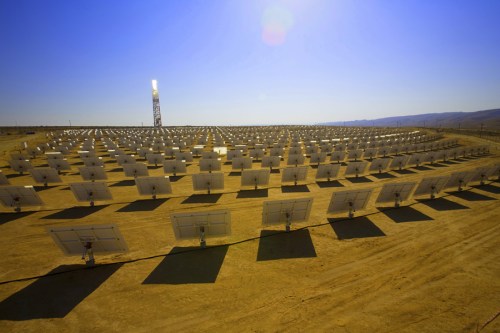
In papers filed Friday with the California Public Utilities Commission, San Francisco-based PG&E asked for approval of a 15-year, 200-megawatt contract with Solaren, a Manhattan Beach, Calif.-based company that plans to put satellites in geosynchronous orbit by 2016 to collect solar energy. The sunlight would then be transmitted to a ground station in Fresno, Calif., in the form of radio frequency waves and converted into electricity to be distributed into the power grid. Since the sun shines 24/7 in space, a Solaren solar farm could theoretically supply “baseload” green electricity to coal-dependent regions without access to abundant sources of renewable energy.

While PG&E won’t spend any money until Solaren beams down electricity, it’s uncertain whether regulators will be willing to count a contract for such unproven, bleeding-edge technology toward the utility’s state-mandated obligation to obtain 20% of its power from renewable sources by 2010 and 33% by 2020. After all, the utilities commission last year rejected PG&E’s contract with a wave energy firm on the grounds that the technology was too early stage. PG&E’s discussion of the Solaren project’s viability was filed under a request for confidentiality.

“Solaren is using an innovative space-based solar technology, which, if successful, would represent a break-through in the renewable power industry,” Brian Cherry, PG&E’s vice present of regulatory relations, wrote in the utility’s 24-page application. “While emerging technologies like space solar face considerable hurdles under a traditional viability analysis, PG&E believes that potential, significant benefits to its customers from a successful space solar installation outweigh the challenges associated with a new and unproven technology.”

Space-based solar has long been a dream and numerous studies have been conducted on its potential viability. In the documents filed with the utilities commission, PG&E (PCG) asserted that the biggest technological obstacle is building satellites that can collect megawatts’ worth of sunlight rather than transmitting the energy miles to a ground station.

“The engineering challenge of building a Space Solar Power Plant is not the energy conversion process itself, but the need to engineer and build MW-class SSP satellites, which are much larger than current kW-class communications satellites,” Cherry wrote. “Solaren’s patented SSP Plant design employs the SSP concept described above to deliver renewable electricity to PG&E.”

Solaren’s website offers a single page that contains no information on the company other than the slogan, “Energy for Tomorrow with Technology of Today.”

In its filing, PG&E said that, “Solaren was founded in 2001 to develop, engineer, test, construct, and operate space solar generating stations. Solaren has informed PG&E that its team is comprised of experienced satellite engineers and space scientists with 20 to 45 years of experience in the leading edge space industry and come from various aerospace organizations that include the U.S. Air Force, Hughes Aircraft Company, Boeing (BA), and Lockheed Martin (LMT).

Not all the hurdles to space-based solar are likely to be technological. While there are no desert tortoises in space or other protected wildlife that live on earth-bound sites for big solar power plants, any orbiting solar farm will have to pass muster with a long list of state, federal and international government agencies. Among them, the U.S. Department of Defense, NASA and the United Nations, according to PG&E.

three_in_row_hi_mediumWave farm developers must overcome more hurdles to get their projects approved under an agreement signed Thursday ending a feud between two federal agencies that warred over the regulation of offshore wind and wave farms.

A jurisdictional dispute between the U.S. Department of the Interior and the Federal Energy Regulatory Commission had left in limbo a number of wave energy projects planned for the outer continental shelf, particularly applications from Grays Harbor Ocean Energy of Seattle to build half a dozen combined wave-and-wind farms from New Jersey to Hawaii. The Interior Department’s Minerals Management Service had challenged FERC’s right to approve approve projects on the outer continental shelf. Last month the agencies agreed to end the water fight but offered few specifics on how offshore wind and wave farms would be regulated.

On Thursday, Interior Secretary Ken Salazar and FERC chairman Jon Wellinghoff signed an accord detailing how their agencies will deal with such projects. FERC will license the construction and operation of wave farms on the outer continental shelf but the Minerals Management Service will issue leases and rights-of-way for those projects. The Minerals Management Service also will be the sole agency to license wind and solar projects on the outer continental shelf.

Previously, a wave energy developer applied to FERC for a preliminary permit to explore the feasibility of a project in a particular stretch of ocean. As such permits award developers first rights to build a project in a given locale, there’s been something of an offshore land rush over the past couple of years to stake claims on the best sites. (The city of San Francisco and Grays Harbor Ocean Energy, for instance, are feuding over competing claims.)

Under Thursday’s agreement, FERC will no longer issue such preliminary permits for wave farms on the outer continental shelf and will not license any projects until developers first secure a lease or right-of-way from the Interior Department.

That should slow the land rush as developers will now be dealing with two federal agencies when it comes to floating their projects.

solara

photo: BrightSource Energy

As the Nevada legislature debates extending tax breaks for large-scale solar power plants, a new report finds that ramping up solar development in the Silver State could produce thousands of good-paying green jobs while generating nearly $11 billion in economic benefits.

The study from San Francisco-based non-profit Vote Solar concludes that 2,000 megawatts’ worth of big solar thermal and photovoltaic farms — needed to meet Nevada’s electricity demand — would result in 5,900 construction jobs a year during the plants’ building phase, 1,200 permanent jobs and half a billion dollars in tax revenues.

“It is likely that such an investment in solar generating facilities could bring solar and related manufacturing to Nevada,” the reports authors wrote. “The economic impact of such manufacturing development is not included in this analysis, but would add significant additional benefits.”

Vote Solar’s job projections are based on an economic model developed by the National Renewable Energy Laboratory to project the impact of solar trough power plants, the most common, if dated, type of Big Solar technology.

The different solar technologies set to come online in the next couple of years could change that equation. No doubt thousands of jobs will be generated by Big Solar but just how many will depend on the mix of solar thermal and photovoltaic power plants that ultimately come online. New technologies like BrightSource Energy’s “power tower,” Ausra’s compact linear fresnel reflector and Stirling Energy Systems’s solar dish may generate similar numbers of jobs. But then there’s eSolar’s power tower solar farms – which uses fields of mirrors called heliostats to focus the sun on a water-filled boiler, creating steam that drives an electricity-generating turbine.  eSolar’s small and prefabricated heliostat arrays cut out much of the skilled labor typically needed on such projects as they can be installed by two workers using a wrench.

Photovoltaic farms essentially take rooftop solar panels and put them on the ground and thus don’t require highly skilled laborers to build turbine power blocks, miles of piping and other infrastructure needed in solar thermal facilities. (They also can be built much more quickly than a solar thermal plant, which is why utilities have been striking deals with companies like First Solar (FSLR) and SunPower (SPWRA) for PV farms.)

A second report released this week — from the Large-Scale Solar Association, an industry group — found that Nevada could gain an edge over Arizona and California in luring solar power plant builders if it extended and sweetened tax incentives.  The three states form something of a golden triangle of solar, offering the nation’s most intense sunshine and vast tracts of government-owned desert land that are being opened up for solar development.

The timing of the reports was no accident. The Nevada Legislature held hearings earlier this week on extending tax breaks for Big Solar that expire in June, and Vote Solar’s utility-scale solar policy director, Jim Baak, went to Carson City to lobby legislators, hoping to head off one proposal to tax renewable energy production.

The Large-Scale Solar report, prepared by a Las Vegas economic consulting firm, found that if legislators let the tax breaks sunset, as it were, the developer of a 100-megawatt solar power plant would pay $55.1 million in taxes in Nevada during the first 15 years of the facility’s operation compared to $26.1 million in Arizona and between $36.1 and $37.9 million in California. If the current incentives are kept, tax payments drop to $25.1 million. A bigger tax break would reduce the tax burden to $14.3 million.

think-city-8_imagelarge

photo: Think

Not too many car factories are getting built in the United States these days, especially in the midst of a global economic meltdown. So the prospect of landing Norwegian electric carmaker Think’s North American plant will have Oregon Governor Ted Kulongoski and Senator Ron Wyden turning out Tuesday to take a test drive of the Think City in Portland with company CEO Richard Canny.

Oregon is one of eight states Think is considering for the assembly plant. The company has been coy about identifying those states and has only said that Michigan and Oregon are in the running. About Tuesday’s media event, Think said in a statement that “the future of electric car manufacturing in Oregon will be the topic of a news conference.”

When it comes to electric car factories, there’s a certain Lucy yanking the football away from Charlie Brown risk for prospective hosts. Silicon Valley electric car company Tesla Motors, for instance, so far has signed and then canceled agreements to build a factory for its new Model S sports sedan in New Mexico and San Jose. Los Angeles, the latest factory site, hopes the third time’s a charm.

Nothing nefarious at work here, just the tenuous economics of startup electric car companies. Think, for example, is on the hunt for additional capital so it can restart its assembly plant in Norway. It idled the factory and laid off workers late last year when the credit crunch dried up funding. The company has some heavyweight backers, including General Electric (GE), and marquee venture capital firms Kleiner Perkins Caufield & Byers and Rockport Capital have invested in its North American operation.

Think says it will  apply for a low-interest loan from the U.S. Department of Energy under its Advanced Technology Vehicle Manufacturing program to help pay for its U.S. factory. Undoubtedly part of the bake-off with the eight states under consideration is to see which can offer the best tax breaks and incentives.

After the first-year startup phase, the U.S. factory will initially employ 300 workers and is projected to produce 16,000 cars annually, according to Think. Capacity would eventually be expanded to 60,000 cars and a workforce of 900. A research and development center will employ about 70 people.

Green Wombat is betting that Think will try to locate the assembly plant on the West Coast. So far Think has targeted densely populated, environmentally friendly cities — London, Amsterdam — to roll out the Think City, a two-seater urban runabout that goes about 112 miles on a charge.  Former CEO Jan-Olaf Willums told Green Wombat last year that the San Francisco Bay Area was a likely gateway market in the U.S. In November, the mayors of San Francisco, San Jose and Oakland inked a deal with Better Place to build a $1 billion electric car charging network in the Bay Area.

Präsentation der Studie „Auswirkung von Elektrofahrzeugen auf die Stromwirtschaft“

photo: Think

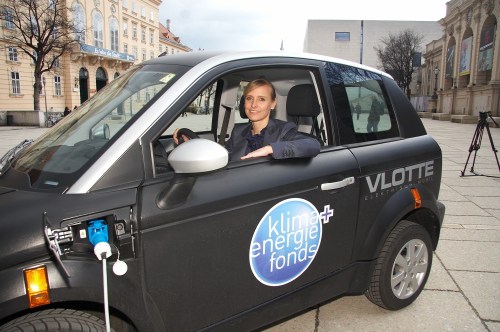
Norwegian electric car maker Think has started shipping its City urban runabout to an Austria utility as part of a government project to test the impact of EVs on the power grid.

The €4.7 million ($6.3 million) Vlotte initiative is placing 100 electric vehicles with companies, municipal governments and individuals in Austria’s Bregenz region. The project is being managed by utility Vorarlberger Kraftwerke and will evaluate how well the cars perform in an area where most people drive an average 50 kilometers (31 miles) a day. The Think City has a range of about 180 kilometers (112 miles).

Solar arrays will be used to charge the plastic-bodied cars to ensure they remain carbon neutral, according to the utility. In 2010, Vlotte will offer electric cars for lease if there is sufficent demand from local residents.

Think CEO Richard Canny said Think is expected to supply most of the cars for the project.

It’s the latest deal for Think, which continues to seed the City across Europe despite financial problems that have stalled its Norwegian assembly plant. Earlier this month, Think signed an agreement to supply 500 cars to a Dutch auto leasing company and announced plans to open a factory in the United States in 2010.

siting1

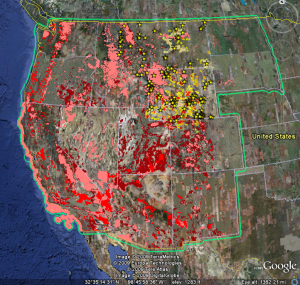
Can Google help defuse a simmering green civil war between renewable energy advocates and wildlife conservationists in the American West?

That’s the idea behind a new Google Earth mapping project launched Wednesday by the Natural Resources Defense Council and the National Audubon Society. Path to Green Energy will identify areas in 13 western states potentially suitable for massive megawatt solar power plants, wind farms, transmission lines and other green energy projects. The app will also pinpoint critical habitat for protected wildlife such as the desert tortoise in California and Wyoming’s sage grouse as well as other environmentally sensitive lands.

“This was information that was unavailable or very scattered,” said Google.org program director David Bercovich at a press conference. “The potential cost savings from this will be enormous. If we can get people to the right areas and streamline the process that will have enormous benefits in getting clean energy online faster.”

NRDC senior attorney Johanna Wald said her group already is using Path to Green Energy in New Mexico to help plan a new transmission project. “Careful siting is the key to renewable energy development,” she said, noting that NRDC has mapped 860 million acres. “We’re not greenlighting development on places that are on our map but we’re providing a framework for discussion.”

siting2The unveiling of Path to Green Energy comes two weeks after California Senator Dianne Feinstein announced she would introduce legislation to put as many as 600,000 acres of the Mojave Desert off limits to renewable energy development to protect endangered wildlife and their habitats.  Solar developers have filed lease claims on a million acres of federal land in the California Mojave and there are state and federal efforts already under way to identify green energy zones across the West.

Path to Green Energy is designed to give regulators and developers a tool to choose the best potential sites for solar and wind farms so they don’t get bogged down in years-long and multimillion-dollar fights over wildlife.  Ausra, BrightSource Energy and other developers of the first half-dozen solar power plant projects moving through the licensing process in California have spent big sums on hiring wildlife consultants who spend thousands of hours surveying sites for desert tortoises, blunt-nosed leopard lizards and other protected species.

The Google Earth app won’t do away with the need to do such detailed environmental review but puts in one package a variety of information that developers must now cobble together themselves — if they can find it. Path to Green Energy could also prove valuable to utilities like PG&E (PCG) and Southern California Edison (EIX) as more and more projects are proposed and regulators scrutinize the cumulative impact of Big Solar power plants across regions.

For instance, in California’s San Luis Obispo County, three large-scale solar farms are being planned within a few miles of each other by Ausra, SunPower (SPWRA) and First Solar (FSLR). That has resulted in delays as wildlife officials initiate studies looking at how all those projects affect the movement of wildlife throughout the area. Going forward, Path to Green Energy will give developers a snapshot of where the wild things are, as well as wildlife corridors to help them avoid siting one plant too close to another in a way that may impede animals’ migration. That could save millions of dollars in mitigation costs – money builders must spend to acquire land to replace wildlife habitat taken for a power plant project as well as avoid fights with environmental groups that have become increasingly uneasy about Big Solar projects.

If the desert tortoise is the critter to avoid when building solar power plants in the Mojave, the sage grouse poses problems for Wyoming wind farms. Brian Rutledge, executive director of Audubon Wyoming, said Path to Green Energy shows the densities of sage grouse across the state, allowing developers to stay clear of those areas.

“We get a solid indication of where energy development shouldn’t go,” he said. “Just as important, we get a better sense of the places that should be evaluated for wind turbine farms and transmission lines. The maps make clear that there is plenty of room for green energy.”

The payback from using Web 2.0 software could indeed be tremendous, given that Google (GOOG) spent a scant $50,000 in donations to NRDC and Audubon to create the maps.

Along with the rest of the economy, venture capital investment in green technology has fallen off the proverbial cliff, according to a survey released Wednesday by market research firm the Cleantech Group.

Global investment in renewable energy, electric cars and other green tech dropped 48% to $1 billion in the first quarter of 2009 from the previous year and fell 41% from the previous quarter. (Global here being defined as North America, Europe, China and India.)

The survey, conducted with Deloitte, found that the size of the average round of funding also crashed, from $20 million in the fourth quarter of 2008 to $12.3 million in the first quarter.

Solar captured the biggest chunk of VC cash at $346 million, with the money going to companies like concentrated photovoltaic startup SolFocus and Norwegian polysilicon maker Norsun.

“Venture funds continue to invest significant sums, albeit at a slower pace and smaller scale than in the past two years,” Brian Fan, the Cleantech Group’s senior director of research, said in a statement.

North America remains the epicenter of green tech investing, with nearly two-third of all of investments in the first quarter.

img_1296_2

photo: Todd Woody

IBM on Tuesday said it has signed  a deal to help build a smart grid for utility EnergyAustralia. Some 12,000 sensors will be installed on the Australian utility’s transmission network around Sydney to monitor electricity distribution and detect outages and other problems. It’s IBM’s largest smart grid project of its type to date.

Big Blue will build the software systems to integrate the sensor data into the operations of EnergyAustralia, which runs the country’s biggest electricity distribution network. In dollar terms, the deal is small – just A$3.2 million (U.S. $2.2 million) – but significant in showing the viability of transforming analog electricity distribution systems into an intelligent network, according to Michael Valocchi, an executive with IBM’s (IBM) global energy and utilities unit.

“The electricity distribution operator will have a real-time view of the network and will be able to pinpoint outages quickly and reduce their length,” Valocchi told Green Wombat. “What I really like about this deal is that it starts to show and harden the message that smart grid is much more than automated metering. As you see more distributed energy and renewable energy out there, this type of sensor and this type of intelligence on the grid will help manage that.”

The sensors will be placed mainly at EnergyAustralia’s substations and around transformers, Valocchi says.

IBM had previously rolled out a smaller version of the smart grid system in Denmark. And in February the tech giant announced a deal to build a smart utility and water system for the Mediterranean island nation of Malta.  While overseas utilities have been quicker to smarten up their analog power grids, Valocchi says the United States should not be far beyond, especially as federal stimulus money for smart grids begins to flow.

desert-tortoise1

photo: Wild Rose Images

California Senator Dianne Feinstein’s move to put a large swath of the Mojave Desert off-limits to renewable energy development is splitting the environmental movement and could derail some two dozen solar and wind power projects the state needs to comply with its ambitious climate change laws.

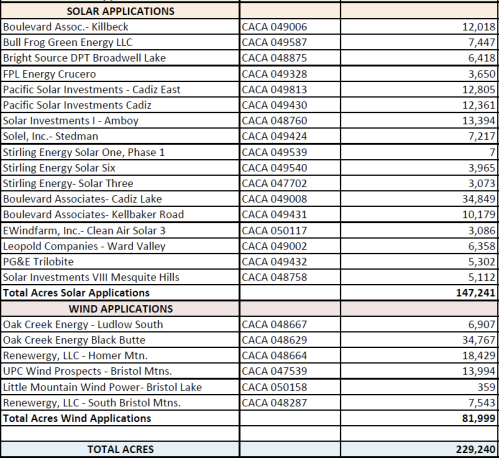
On the firing line are 17 massive solar power plants and six wind farms planned for federal land — land that would be designated a national monument under legislation Feinstein intends to introduce. The solar projects in question would be built by a range of companies, from startups BrightSource Energy and Stirling Energy Systems to corporate heavyweights Goldman Sachs (GS) and FPL (FPL), according to federal documents. (For the complete list, see below.)

The companies are among scores that have filed lease claims on a million acres of acres of desert dirt controlled by the U.S. Bureau of Land Management. California utilities PG&E (PCG) and Southern California Edison (EIX) have signed long-term power purchase agreements for some of the projects now in jeopardy and are counting on the electricity they would produce to meet state-mandated renewable energy targets. PG&E itself has filed a solar power plant land claim in the proposed national monument.

The area of the desert in dispute is some 600,000 acres formerly owned by Catellus, the real estate arm of the Union Pacific Railroad, and donated to the federal government a decade ago by the Wildlands Conservancy, a Southern California environmental group. About 210,000 of those acres are managed by the U.S. Bureau of Land Management, which opened part of the land to renewable energy projects.

“Many of the sites now being considered for leases are completely inappropriate and will lead to the wholesale destruction of some of the most pristine areas in the desert,” Feinstein wrote in a letter to Interior Secretary Ken Salazar released last week, notifying him that she will introduce legislation to designate the former Catellus lands a national monument. “Beyond protecting national parks and wilderness from development, the conservation of these lands has helped to ensure the sustainability of the entire desert ecosystem by preserving the vital wildlife corridors.”

The Catellus land controlled by the BLM forms something of a golden triangle between the Joshua Tree National Park and the Mojave National Preserve in Southern California and are particularly coveted for renewable energy development because of its proximity to transmission lines.

Alan Stein, a deputy district manager for the BLM in California, told Green Wombat that the solar and wind lease claims are in areas that are not designated as wilderness or critical habitat for protected species like the desert tortoise. “This is public domain land, ” he says.

Tortoises, however, are found across the Mojave, and battles over Big Solar’s impact on endangered wildlife are quietly brewing in several solar power plant licensing cases now being reviewed by the California Energy Commission.  Environmentalists find themselves walking a thin green line, trying to balance their interest in promoting carbon-free energy with protecting fragile desert landscapes and a host of threatened animals and plants.

Take BrightSource Energy’s Ivanpah 400-megawatt solar power plant complex on the California-Nevada border. The three solar power plants to be built by the Oakland-based company will supply electricity to PG&E and Southern California Edison. But the project will also destroy some 4,000 acres of desert tortoise habitat and at least 25 tortoises will have to be relocated – a somewhat risky proposition as previous efforts in other cases have resulted in the deaths of the animals.

On Wednesday, the California Energy Commission granted two national environmental groups – the Defenders of Wildlife and the Sierra Club – the right to intervene in the Ivanpah case. “Defenders strongly supports … the development of renewable energy in California,” Kim Delfino, California program director for Defenders of Wildlife, wrote to the energy commission in a Jan. 23 letter.  “Defenders has several serious concerns about the potential impacts of this project on a number of rare, declining and listed species and on their associated desert habitat and waters.”

Natural Resources Defense Council attorney Johanna Wald wrote a letter with the Wilderness Society expressing concern over the impact of Ivanpah project on the desert tortoise but also made a strong statement of support for renewable energy development. “Our public lands harbor substantial wind, solar, and geothermal resources,” wrote Wald, who serves on a state task force to identify appropriate areas for renewable energy development. “Developing some of these resources will be important to creating a sustainable energy economy and combating climate change.”

The big national enviro groups are working with the government and power plant developers to create zones in the Mojave where renewable energy projects would be permitted while setting aside other areas that are prime habitat and wildlife corridors. A similar effort is underway on the federal level to analyze the desert-wide impact of renewable energy development.

Local environmental organizations, however, have split with the Big Green groups over developing the desert and other rural areas. In San Luis Obispo County,  Ausra, SunPower (SPWRA) and First Solar’s (FSLR) plans to build three huge solar farms within miles of each other has prompted some local residents worried about the impact on wildlife to organize in opposition to the projects.

And some small Mojave Desert green groups pledge to go to court to stop big solar projects. “We don’t want to see the Endangered Species Act gutted for the sake of mega solar projects,” veteran grass roots activist Phil Klasky told Green Wombat last year for a story on the solar land rush in the Mojave. “I can say the smaller environmental organizations I’m involved with are planning to challenge these projects.”

It would be unwise to underestimate Klasky. In the 1990s, he helped lead a long-running  and successful campaign to scuttle the construction of a low-level radioactive waste dump in tortoise territory in the Mojave’s Ward Valley – now a prime solar spot.

Still, while California’s senior senator’s move in the Mojave may exacerbate rifts in the environmental movement over renewable energy, it also could galvanize efforts to resolve critter conflicts in a comprehensive way. Otherwise, environmentalists of varying hues may find themselves fighting each other rather than global warming.

Update: I just had a conversation with BrightSource spokesman Keely Wachs, who takes issue with my characterization that the Ivanpah project will “destroy” desert tortoise habitat. He points out that the company is taking care to minimize the impact of the power plant on the surrounding desert and that wildlife may still occupy the site. It would be more accurate to say that the project will remove desert tortoise habitat from active use during Ivanpah’s construction and operation.

(Below is a list of solar and wind projects that fall within the proposed Mojave national monument. Note: Solar Investments is a subsidiary of Goldman Sachs and Boulevard Associates is a subsidiary of FPL.)

source:  BLM

blm-nm2

cstste_eldorado_13850021

photo: First Solar

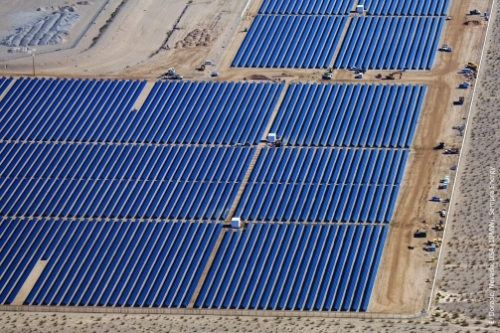
The arid Southwest has no shortage of sun but has been rather slow to embrace Big Solar power plants, at least compared to California, where more than a half-dozen massive megawatt solar farms are being licensed.

That appears to be changing. On Tuesday, First Solar said it will give New Mexico its first big solar power plant, a 30 megawatt photovoltaic farm that will generate electricity from the company’s thin-film panels. Once the plant is built in Colfax County in northeastern New Mexico, First Solar will sell the electricity it generates to the Tri-State Generation and Transmission Association under a 25-year power purchase agreement. Tri-State is an electric cooperative.

The deal continues First Solar’s (FSLR) move into the power plant business. Earlier this month, the Tempe, Ariz.-based company acquired OptiSolar’s 1.85 gigawatt project portfolio – including a 550-megawatt photovolatic power plant for California utility PG&E (PCG) – in a $400 million stock transaction.

First Solar has also signed contracts for smaller-scale solar farms with Southern California Edison (EIX) and Sempre (SRE).

Design a site like this with WordPress.com
Get started