Feeds:
Posts
Comments

Archive for the ‘Uncategorized’ Category

With billions of dollars of solar and wind power projects and thousands of green-collar jobs hanging in the balance, the U.S. Senate on Wednesday again failed to extend a key investment tax credit for renewable energy.

Republicans blocked the legislation from coming to the floor, marking the eighth attempt to extend the 30 percent tax credit beyond it’s Jan. 1, 2009, expiration date. The extension is backed by all the state governors save Georgia, a coalition of Fortune 500 companies, Wall Street banks, renewable energy startups, and tech giants like Google (GOOG), Hewlett-Packard (HPQ) and Applied Materials (AMAT).

Utilities like PG&E (PCG) and Edison International (EIX) as well as financiers such as Morgan Stanley (MS) and GE Energy Financial Services (GE), are pushing for an eight-year extension of the investment tax credit to give Big Solar projects enough time to get off the ground and start to achieve economies of scale.

Senate Republicans opposed the legislation, contending it would raise taxes. A list of senators and their votes on the legislation can be found here.

Without the 30 percent tax credit, the viability of several large solar power plant projects remains in doubt. Spanish solar company Abengoa Solar has said it probably will pull out of plans to build a 280-megawatt power plant in Arizona if Congress doesn’t renew the tax credit. Green Wombat happened to have breakfast this morning with a PG&E executive who said that the large solar projects that California utilities are counting on to meet renewable energy mandates would have a hard time securing financing absent the investment tax credit.

First Solar (FSLR) CEO Michael Ahearn said on an earnings call Wednesday afternoon that if the investment tax credit is not extended the thin-film solar module maker would focus its efforts on the European market. “We don’t have massive volumes of solar planned for the U.S. in the short term,” said Ahearn.

Said Rhone Resch, president of the trade group Solar Energy Industries Association, in a statement: “Already companies are putting projects on hold and preparing to send thousands of jobs overseas – real jobs that would otherwise be filled by American workers.”

While Senators Barack Obama and John McCain have have expressed support for increasing the U.S.’s investment in green energy, neither presidential candidate showed up to vote Wednesday on the extension of the tax credit.

Read Full Post »

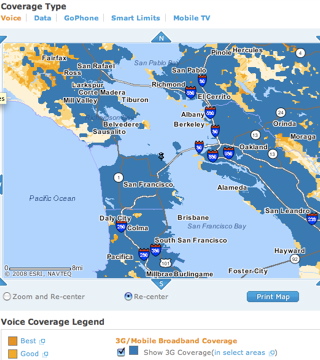
MOUNT TAMALPAIS, Calif. – The folks at AT&T kindly sent Fortune’s San Francisco bureau an iPhone 3G on Friday to try out. Now, Green Wombat is a Mac kind of marsupial but no Apple (AAPL) fan boy. So over the weekend I was most interested in how the new phone performed in the Bay Area’s topographically diverse terrain, where mountains, valleys and exceedingly tall redwoods can play havoc with cell signals.

More to the point, how fast and useful is the GPS-enabled Jesus phone on the mountain bike trails that surround San Francisco? After all, this is a place where you can be sitting on the 19th floor one minute and a half hour later be bombing down a fire road on a stretch of state park that seems as remote as the Sierra. But we still want to be connected; witness the techies texting on the trails or the matchy-match Mill Valley cyclists pedaling their $6,000 rigs, BlackBerrys aloft,  to the next peak in search of a signal.

So what better place to put the iPhone 3G through its paces than Mount Tamalpais in Marin County, mountain biking’s birthplace? AT&T (T) claims 3G blankets most of the Bay Area, but that can depend on your altitude. As I throw the bike on the car rack at my home near the top of the Berkeley Hills, it’s clear I live on the EDGE – the iPhone is only picking up AT&T’s slower network. Rolling down the hill, the 3G kicks in. (This will happen occasionally elsewhere, such as in Fairfax, a Marin town sitting in the shadow of Mount Tam, or in my office tower in downtown San Francisco.)

On Mount Tam, I pick a trail I haven’t ridden before – one with a hard-to-find entrance – to test out the iPhone’s GPS. Although the mountain is an EDGE zone, the GPS-Google satellite maps mashup pinpoints my location with a luminecent blue dot, allowing me to zoom in and see that I’ve just passed the trailhead and that if I backtrack I’ll even find a small gravel parking lot hidden by a stand of trees. Sweet.

After riding a few miles through groves of bay laurel and redwood, I check my coordinates. Zooming out shows me just how long of a steep climb I’ve got ahead of me – maybe too much information. Still, this is pretty bloody cool and I snap a photo of myself that the iPhone geotags. I’m a happy rider. I compare the iPhone’s signal with my BlackBerry and they’re pulling the same number of bars, though I’ve noticed the iPhone can be much slower to grab a signal when rolling out of a dead zone.

At the crest of the hill there’s a turnoff to another trail I haven’t ridden. It’s hot and my legs are getting tired, but it looks like a fun run. Problem is, just how long and steep will this side trip be? Without the iPhone I might have given it a pass. But I move into a clearing, catch a signal and GPS myself and then take a virtual ride on the trail to see where it goes and check out the terrain. (It’s also a great way to cut down on the environmental impact of driving in the city by optimizing routes.)  Looks good. It turns out to be a great spur, taking me to the Bolinas-Fairfax Ridge overlooking the Pacific Ocean. While enjoying the view, I contemplate writing this blog post on the phone (WordPress has been iPhone-optimized for that) but ditch the idea, given iPhone’s lack of a cut-and-paste function and inability to import photos to the post.

There’s another problem: I’m about to enter the red zone on the battery meter. The phone has been on for just some four hours and the battery is already 80 percent depleted, though I haven’t been surfing the web much – mainly using the GPS and maps and listening to music on the drive to Mount Tam. (Unfortunately, while the iPhone will play music over the older iPod cable in my car and on my Soundock at home, it won’t charge while plugged in. I end up charging the phone twice a day over the weekend.)

While the prospect of not having enough juice to listen to tunes on the way home is no fun, the iPhone is a great biking companion. (An iPhone app I want to see: one that collects distance and altitude data from the bike’s wireless computer.) In fact, why go home? I finger-flick through the iPhone weather report for the beaches at Point Reyes. Sunny and 82.

Read Full Post »

The souring economy hasn’t dissuaded green tech investors from making big bets on renewable energy. On Wednesday, solar power plant builder BrightSource Energy announced it had raised $115 million from a group of investors that include Google.org, the search giant’s philanthropic arm, and oil giants Chevron and BP.

The investment in the Oakland, Calif.-based startup is Google’s (GOOG) second big solar energy play in the past two months. In April, Google.org joined a $130 million round for eSolar, a Pasadena solar power plant company whose chairman is Idealab founder Bill Gross.

BrightSource Energy, started by American-Israeli solar pioneer Arnold Goldman, has contracts to supply California utility PG&E (PCG) with up to 900 megawatts of solar electricity from power plants to be built in the Mojave Desert on the California-Nevada border. BrightSource has developed a new solar technology, dubbed distributed power tower, that focuses fields of sun-tracking mirrors called heliostats on a tower containing a water-filled boiler. The sun’s rays superheat the water and the resulting steam drives an electricity-generating turbine. (Artist rendering of BrightSource’s planned Ivanpah plant above.)

Given that a 500-megawatt solar power plant can cost more than $1 billion to build, $115 million is but a drop in the bucket. But it will allow BrightSource, which previously raised $45 million, to proceed with the development of its technology as it seeks project financing for construction of its first power plants.

And it can’t hurt to have such high-profile backers when you negotiate power purchase agreements with utilities. Besides Google, BP Alternative Energy (BP) and Chevron Technology Ventures (CVX), previous investors participating in the new round include Morgan Stanley (MS), VantagePoint Venture Partners, Draper Fisher Jurvetson and DBL Investors.

Another new BrightSource investor is Norweigan oil and gas behemoth StatoilHydro (STO). Apparently, even Big Oil has seen the light when it comes to hedging its bets with green energy.

Read Full Post »

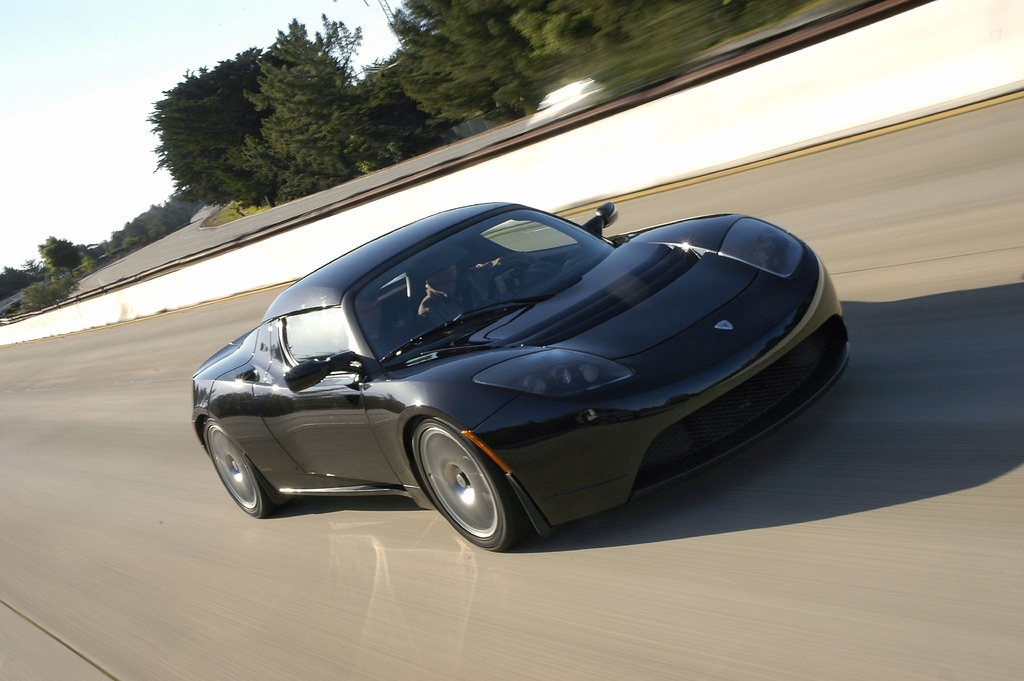
Monday night, Green Wombat swung by SF Green, one of a growing number of green tech networking events sprouting up around San Francisco and Silicon Valley. The draw – beyond drinks with a standing-room-only crowd of bright-eyed twenty-and-thirtysomethings in a San Francisco art gallery – was the appearance of leading venture capitalist Ray Lane of Kleiner Perkins Caufield & Byers and Darryl Siry of Tesla Motors, maker of the Roadster electric supercar.

Despite the fact that Tesla has sued a Kleiner company, Fisker Automotive – which is producing an electric hybrid sports sedan – for alleged intellectual property theft, no sparks flew. (Though at Fortune’s recent Brainstorm Green conference, Lane couldn’t resist taking a jab at allegations that Fisker founder Henrik Fisker appropriated Tesla technology when he did design work for the Silicon Valley startup: “It’s ridiculous,” Lane said. “Henry Fisker wouldn’t know a drive train from a glass of water. He’s a designer.)

Siry, Tesla’s vp of sales, marketing & service, said five of the $100,000 Roadsters have rolled off the assembly line so far with one car tooling around Los Angeles, and others in the Bay Area and London. By year’s end, Tesla, which has been wrestling with drive train problems, should have more than 100 cars on Bay Area roads, home to many the company’s tech titan customers.

Tesla has raised $145 million, Siry noted, and will do another round before an IPO. The Roadster will always be a limited production marquee car but to mass produce its next vehicle, a five-seat sports sedan code-named White Star, Tesla will need that IPO or project financing. Siry also sketched a future where Tesla might supply electric drive trains to automakers in exchange for project financing.

“Tesla is a tech company wrapped in an automotive brand,” he said at the event co-sponsored by VentureBeat.

Lane and Kleiner Perkins have gone beyond investing in electric car companies to running one. Lane is chairman of Think North America, the U.S. arm of Norwegian electric carmaker Think Global. Kleiner and Rockport Capital took a 50 percent stake in the North American operation, which launched last month.

The Think and Fisker investments are emblematic of a new direction for VCs who have jumped into the green tech game. Unlike the first dot-com era or even the current Web 2.0 age, there’s no quick exit on the horizon for investments in green tech companies that may be years away from producing a product and require hundreds of millions, if not billions, in project financing to build car factories or solar energy power plants.

Lane compared investing in green tech to the long-term horizon needed for investing in biotech startups, where the key is to hit milestones that allow investors to calculate valuations.

Still, it’s a big gamble, given rising commodity prices and global economic upheaval.

Kleiner is also an investor in solar power plant startup Ausra. “Steel prices are killing us,” Lane said. Ausra’s power plants consist of hundred of acres of mirrors mounted on steel frames. “With Ausra, we [calculate] we could deliver solar thermal electricity at 12 cents a kilowatt-hour. But with steel prices, who knows?”

A shortage of qualified green tech workers has become an issue, according to Lane. The nascent solar power plant business relies on recruiting engineers and project developers from the carbon-based industry. “Talented people in project development at companies like Bechtel are maxed out for years on building projects,” he said.

Read Full Post »

Stealth Bay Area solar startup OptiSolar has quietly revealed plans to build the world’s largest photovoltaic solar farm on the central California coast — a $1 billion, 550-megawatt monster that would be nearly 40 times as large as the biggest such power plant operating today.

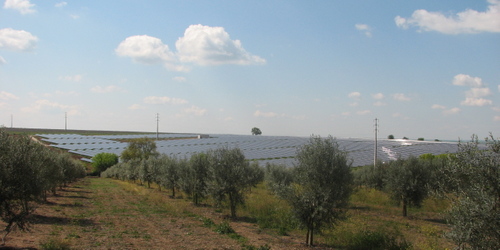
PV solar power plants essentially take solar panels similar to those found on suburban rooftops and put them on the ground. Unlike solar thermal power plants that use mirrors to heat a liquid to produce steam that drives an electricity-generating turbine, photovoltaic power stations generate power directly when the sun strikes the panel’s semiconducting cells. That means there’s virtually no moving parts or need for industrial infrastructure like power blocks, turbines and piping. (A photo of a PV solar farm in Serpa, Portugal, is above.)

But because photovoltaic solar is less efficient at converting sunlight into electricity than solar thermal and requires big swaths of land, it has not been considered economical to build large-scale PV power plants in the United States. (Unlike in Portugal, Spain and other European countries where utilities pay a premium rate for green energy.)

Furthermore, OptiSolar makes thin-film solar cells, which are even less efficient than traditional solar panels. The hoped for advantage of thin-film solar is that the cells can be printed on rolls of metal much more cheaply than bulky conventional solar cells. They also use far less polysilicon –an expensive semiconducting material — than standard solar cells.

Still, hardly any thin-film solar companies in the U.S. have begun mass production, let alone tried to build a huge power plant. OptiSolar intends to both produce solar panels and build and operate solar power plants. It currently has deals to build more than 20 solar farms representing more than 200 megawatts in Canada, which pays higher rates for electricity generated from renewable sources.

“We have propriety technology and a business approach that we’re convinced will let us deploy PV at large scale and be competitive with other forms of renewable energy,” OptiSolar executive vice president Phil Rettger told Green Wombat recently in an interview about the Hayward, Calif.-based company’s plans.

Says Reese Tisdale, a solar energy analyst with Emerging Energy Research: “At this point I see it as an announcement with plenty to prove.” He says the benefits of a large-scale photovoltaic plants are low operation and maintenance costs and the fact that thin-film prices are falling. But he notes that thin-film solar’s low efficiency and inability to store the electricity generated — solar thermal plants can store heat in water or molten salt to create steam when the sun sets — puts such power plants at a disadvantage.

And the large tracts of land needed for such solar farm could create conflicts, particularly when threatened or endangered animals and plants are present. “Environmental groups will go crazy,” Tisdale says.

OptiSolar has kept a low profile and has said little about its technology or how efficent it is, other than that it uses just 1% of the silicon needed in conventional solar cells. Many thin-film solar cells have efficiencies of five to six percent though Global Solar Energy CEO Mike Gering recently told Green Wombat that his company has achieved 10 percent efficiency in production runs.

Founded by veterans of the carbon-intensive Canadian oil sands industry, OptiSolar has a factory in Hayward and just signed a deal to build another manufacturing facility in Sacramento.

The company’s Topaz solar farm would be constructed on nine-and-a-half square miles of ranch land in San Luis Obispo County near the site of the 177-megawatt Carizzo Plains solar thermal power plant planned by Silicon Valley startup Ausra. Optisolar spokesman Jeff Lettes told Green Wombat that the company has taken options to buy the 6,080 acres of land from farming families if the county approves the project.

Who would buy Topaz’s electricity remains to be seen. The plant would be in PG&E’s (PCG) territory and Rettger acknowledged that the company has been in talks with big California utilities such as Southern California Edison (EIX) and San Diego Gas & Electric (SRE). Lettes says the company is currently negotiating a power purchase agreement for Topaz but could not comment further.

OptiSolar says its solar farm would generate electricity for about 190,000 homes. Unlike other PV power plants, OptiSolar will not place its panels on trackers that follow the sun throughout the day. That will lower the cost of the plant but also reduce its efficiency. If approved by the county, construction would begin in 2010. Unlike solar thermal plants, photovoltaic power stations do not need to be licensed by the California Energy Commission, a process that can take a year or two to complete.

Still, OptiSolar will face challenges. Some residents have objected to the size and environmental impact of Ausra’s project and the prospect of another large-scale solar facility in their backyard will raise new concerns. The OptiSolar site is also habitat for the protected California kit fox.

Read Full Post »
PASADENA, Calif. — Green tech guru Vinod Khosla probably didn’t win many friends among the chardonnay-and-carbon-offsets crowd Tuesday during an appearance at Fortune’s Brainstorm Green conference, where he castigated well-heeled enviros for thinking that driving a Toyota (TM) Prius and other “feel-good solutions” will save the planet

“The Prius is more greenwash than green,” the venture capitalist said on stage during a conversation with Fortune senior writer Adam Lashinsky. “Priuses sell a lot but so do Gucci bags. The hybridization of cars is the most expensive way to reduce carbon.”

“We do a lot of feel-good things like put solar panels up in foggy San Francisco so a few middle-class and upper-middle-class people feel good about themselves,” he added.

Ouch.

If Khosla was typically on the offensive, he’s been on the defensive a bit of late over early investments in corn-based biofuels. Alarm has escalated over the past year about the impact of taking food crops out of production to grow a gasoline substitute.

After Lashinsky read a recent quote from the Indian finance minister – “food-based biofuels are a crime against humanity,” Khosla agreed that “food-based biofuels are the wrong way to go. We have much better alternatives.” He has long championed cellulosic biofuels that can be produced from non-food plants like switchgrass or from wood waste and characterized his ethanol investments as a way to get the lay of the biofuels landscape.

Never shy about stirring the pot, he declared that, “People’s views on green are obsolete.” The way to fight climate, according to Khosla, is not to focus on putting solar panels on roofs or building electric cars but increasing the efficiency of things like engines and the operations of mainstream businesses.

Worried about the high price of oil? Don’t. “My forecast for 2030 is that price of oil will be below $25 a barrel,” Khosla said. No matter, he added, because by then biofuels will be cheaper.

So stick that in your Prius.

Read Full Post »

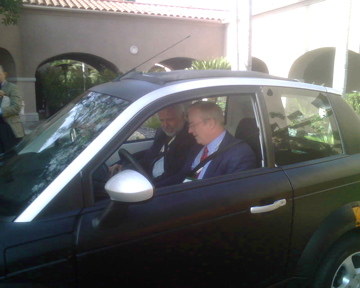
PASADENA, Calif. — If you wanted a snapshot of the emerging alliance between utilities and automakers, the car park of the Langham hotel here was the place to be Tuesday morning. There was the CEO of one of the largest utilities in the United States putting the pedal to the metal of the battery-powered Think City with Think Global CEO Jan-Olaf Willums riding shotgun.

“I liked it a lot,” PG&E (PCG) Chairman and CEO Peter Darbee told Green Wombat after a few spins around the hotel in the electric coupe. “The acceleration was fast, it handled well and it has a European feel.”

We had just finished a Fortune Brainstorm Green session on electric cars (along General Motors’ (GM) executive Beth Lowery), where Darbee declared, “We want to replace the oil industry” as the fuel supplier to the automakers. Fuel in this case is electricity, though unlike Big Oil, regulated utilities such as PG&E and Southern California Edison (EIX) will not make windfall profits no matter how many electrons they push into Chevy Volts.

The topic at hand was the potential for vehicle-to-grid, or V2G, if electric cars go mass market. The big idea: electric cars are essentially mobile generators and rolling energy storage devices. When hundreds of thousands of them are plugged in, they can not only download electricity but return power to the grid from their batteries, allowing utilities to meet peak demand without firing up expensive fossil fuel power plants that often sit idle until everyone cranks up their air conditioners.

PG&E is working with Google (GOOG) to develop technology to allow a smart power grid to detect where an electric car is plugged in so the owner can be charged or credited with consuming electricity or returning it to the grid. The smart grid would also be able to detect power demand spikes and then tap the appropriate number of car batteries to smooth out the electricity supply.

Utilities like PG&E are eager to forge alliances with electric carmakers for other reasons. In California, electric cars could be charged at night when greenhouse gas-free power sources like wind farms tend to produce the most electricity but when demand otherwise falls off. Utilities are also interested in buying used electric car batteries (which retain 80 percent of their capacity even after they’re no longer good for transportation) to store renewable energy that can be released when electricity demand spikes.

Lowery, GM’s vice president for environment, energy and safety policy, said such interest from utilities is prompting the automaker to think how electric cars could spawn new markets. “We’re definitely looking at different business models for batteries,” she said.

On Monday, Think Global and venture capital powerhouses Kleiner Perkins Caufield & Byers and Rockport Capital Partners announced the formation of Think North America as a joint venture between the Norwegian company and the VCs that will bring the Think City to California next year.

Rockport managing general partner and acting Think North America president Wilber James was at the panel and suggested Think supply some cars to PG&E. As the session ended, Darbee, James and Willums headed to the parking lot where Willums showed off the car’s Internet-enabled interactive features, including a video screen with a button already labeled “vehicle-to-grid.”

Read Full Post »

PASADENA, Calif. — Solar power plant builder eSolar has raised $130 million from Google’s philanthropic arm, Google.org, and other investors.

That was the headline news that eSolar chairman and Idealab founder Bill Gross slipped to Green Wombat during dinner Sunday night as Fortune’s Brainstorm Green conference kicked off in Pasadena. The other investors include Idealab and Oak Investment Partners. Big numbers grab attention but the far more interesting angle is the technology that eSolar is developing. If it lives up to its claims, eSolar could help break the logjam that has put Big Solar on the slow track in California.

“We just completed tests at our test site this week and we will be able to produce electricity that is competitive with coal,” said an animated Gross Sunday evening.

That is the Holy Grail of renewable energy and the charge set out by Google (GOOG) founders Sergey Brin and Larry Page when they launched their green power initiative, RE<C (Renewable Energy less than Coal), in November. Google.org subsequently invested $10 million in Pasadena-based eSolar. (eSolar did not say how much of the $130 million Google.org ponied up in the latest round.)

eSolar has been operating in stealth mode but Gross shared details of the company’s technology and how it intends to produce greenhouse gas-free electricity so cheaply — a claim sure to be met with some skepticism by competitors like Ausra, BrightSource Energy and Solel.

At first glance, there doesn’t seem much radically different about an eSolar solar thermal power plant — it’ll use fields of mirrors to focus the sun’s rays on a tower containing a water-filled boiler. The resulting heat will create steam that will drive an electricity-generating turbine.

The tipping-point innovation, according to Gross, is the mirrors and the software that controls them as well as the modular design of the power plants.

While Oakland, Calif.-based BrightSource is developing a similar system, Gross says eSolar is able to use smaller mirrors — called heliostats — that can be cheaply mass produced from off-the-shelf glass like that used in bathroom mirrors. Proprietary software developed by eSolar controls each sun-tracking mirror, increasing their efficiency to produce more electricity. “It’s all about the software,” Gross said.

Smaller more powerful solar fields means that eSolar can build power plants on far less land than competitors for less money, according to Gross. For instance, a 500-megawatt solar power plant can cost more than $1 billion to build and requires thousands of acres of land — which is why most will built in remote deserts. But eSolar plans to build modular, 33-megawatt power plants that can be constructed on a couple hundred acres and plugged into existing transmission lines near urban areas.

“We’ve already bought up rights to enough land to produce more than a gigawatt of electricity,” said Gross, showing Green Wombat a map of California polk-a-dotted with the locations of potential eSolar power plants. A gigawatt can power about 750,000 homes.

The small size of each power plant has another benefit — solar thermal power stations under 50 megawatts do not have to be licensed by the California Energy Commission. That means eSolar can cut at least a year or two off the process of getting a solar power plant online.

That will certainly be attractive to the Golden State’s big utilities — PG&E (PCG), Southern California Edison (EIX) and San Diego Gas & Electric (SRE) — which face a mandate to obtain 20 percent of their electricity from renewable sources by 2010 and 33 percent by 2020.

Although all those utilities have signed massive megawatt deals with solar energy companies, no plant has been yet built.

Gross says that while eSolar has been talking to the utilities it’s not going to wait to have a power purchase agreement in hand before building its first plant.

“Sergey said to go for it and we are.”

Read Full Post »

Heliovolt
Thin is in. HelioVolt, an Austin, Texas-based thin-film solar startup, has raised a $77 million round, indicating that investors are still betting on the yet-to-be-realized promise of a technology that could integrate solar cells into everything from windows to building facades. Although the efficiency of thin-film solar is less than conventional photovoltaics, the cells can be printed on rolls of flexible material at lower costs. The payoff, HelioVolt executive John Langdon told Green Wombat last year, is a relatively inexpensive solar film that could be incorporated into the roofs and walls of homes and office towers and, eventually, even windows so that a skyscraper, for instance, might generate half of the electricity it needs. The $77 million that HelioVolt raised from a group of international investors puts it within shouting distance of better-known competitors like Silicon Valley’s Nanosolar, which has raised around $100 million. HelioVolt will tap the $77 million to build its first factory to produce so-called building-integrated photovoltaic systems. Leading HelioVolt’s latest round are Washington, D.C.’s Paladin Capital Group and Masdar Clean Tech Fund – funded by the government of Abu Dhabi, Credit Suisse (CS) and Siemens (SI). Other investors include Silicon Valley’s New Enterprise Associates, Spain’s Solúcar Energias, Morgan Stanley (MS) and Sunton United Energy.

Read Full Post »

Wester_states_climate_initiativeThe governors of Arizona, California, New Mexico, Oregon and Washington today signed a climate initiative designed to create a western regional carbon trading market to reduce greenhouse gases. "This … sets the stage for a regional cap and trade program, which will provide a powerful framework for developing a national cap and trade program,” said California Governor Arnold Schwarzenegger in a statement.  “This agreement shows the power of states to lead our nation addressing climate change.” The five-state accord, known as the Western Regional Climate Action Initiative, calls for the participants to develop over the next 18 months a regional target for cutting greenhouse gases and to create a regional emissions inventory. The accord in effect extends California’s landmark global warming law to neighboring states, establishing a western counterpart to nine northeastern states’ Regional Greenhouse Gas Initiative. The creation of two large carbon trading blocs will undoubtedly put further pressure on Congress to pass a national cap-and-trade legislation.

But drafting a western regional emissions cap won’t be easy, given the states’ varying dependence on coal-fired power. Arizona and New Mexico generate coal-fired electricity while the three coastal states rely largely on natural gas and hydro for their power.  California in January banned its investor-owned utilities – PG&E (PCG), Southern California Edison (EIX) and San Diego Gas & Electric (SRE) – from signing long-term contracts to buy electricity from out-of-state coal-fired plants. The regional accord will also put new pressure on coal plants in two border states not part of the deal – Nevada and Utah. The announcement of the accord comes as Texas utility TXU (TXU) agreed to a $45 billion takeover by private equity firms that will result in the abandonment of 8 of 11 planned coal-fired power plants for the Lone Star State. TXU also will forego plans for coal-fired plants in other states.

In a speech at the National Governors Association meeting in Washington, D.C., Schwarzenegger urged other states to adopt California’s low carbon fuel standard, which requires that transportation fuel sold in the Golden State must be 10 percent less carbon intensive by 2020.

Read Full Post »

« Newer Posts - Older Posts »

Design a site like this with WordPress.com
Get started