Feeds:
Posts
Comments

Archive for the ‘green financing’ Category

The souring economy hasn’t dissuaded green tech investors from making big bets on renewable energy. On Wednesday, solar power plant builder BrightSource Energy announced it had raised $115 million from a group of investors that include Google.org, the search giant’s philanthropic arm, and oil giants Chevron and BP.

The investment in the Oakland, Calif.-based startup is Google’s (GOOG) second big solar energy play in the past two months. In April, Google.org joined a $130 million round for eSolar, a Pasadena solar power plant company whose chairman is Idealab founder Bill Gross.

BrightSource Energy, started by American-Israeli solar pioneer Arnold Goldman, has contracts to supply California utility PG&E (PCG) with up to 900 megawatts of solar electricity from power plants to be built in the Mojave Desert on the California-Nevada border. BrightSource has developed a new solar technology, dubbed distributed power tower, that focuses fields of sun-tracking mirrors called heliostats on a tower containing a water-filled boiler. The sun’s rays superheat the water and the resulting steam drives an electricity-generating turbine. (Artist rendering of BrightSource’s planned Ivanpah plant above.)

Given that a 500-megawatt solar power plant can cost more than $1 billion to build, $115 million is but a drop in the bucket. But it will allow BrightSource, which previously raised $45 million, to proceed with the development of its technology as it seeks project financing for construction of its first power plants.

And it can’t hurt to have such high-profile backers when you negotiate power purchase agreements with utilities. Besides Google, BP Alternative Energy (BP) and Chevron Technology Ventures (CVX), previous investors participating in the new round include Morgan Stanley (MS), VantagePoint Venture Partners, Draper Fisher Jurvetson and DBL Investors.

Another new BrightSource investor is Norweigan oil and gas behemoth StatoilHydro (STO). Apparently, even Big Oil has seen the light when it comes to hedging its bets with green energy.

Read Full Post »

img_2914.jpg

Israeli solar power plant developer Solel announced Monday it has scored $105 million in funding from London-based investment firm Ecofin — yet another sign that the market for large-scale solar energy projects is reaching critical mass.

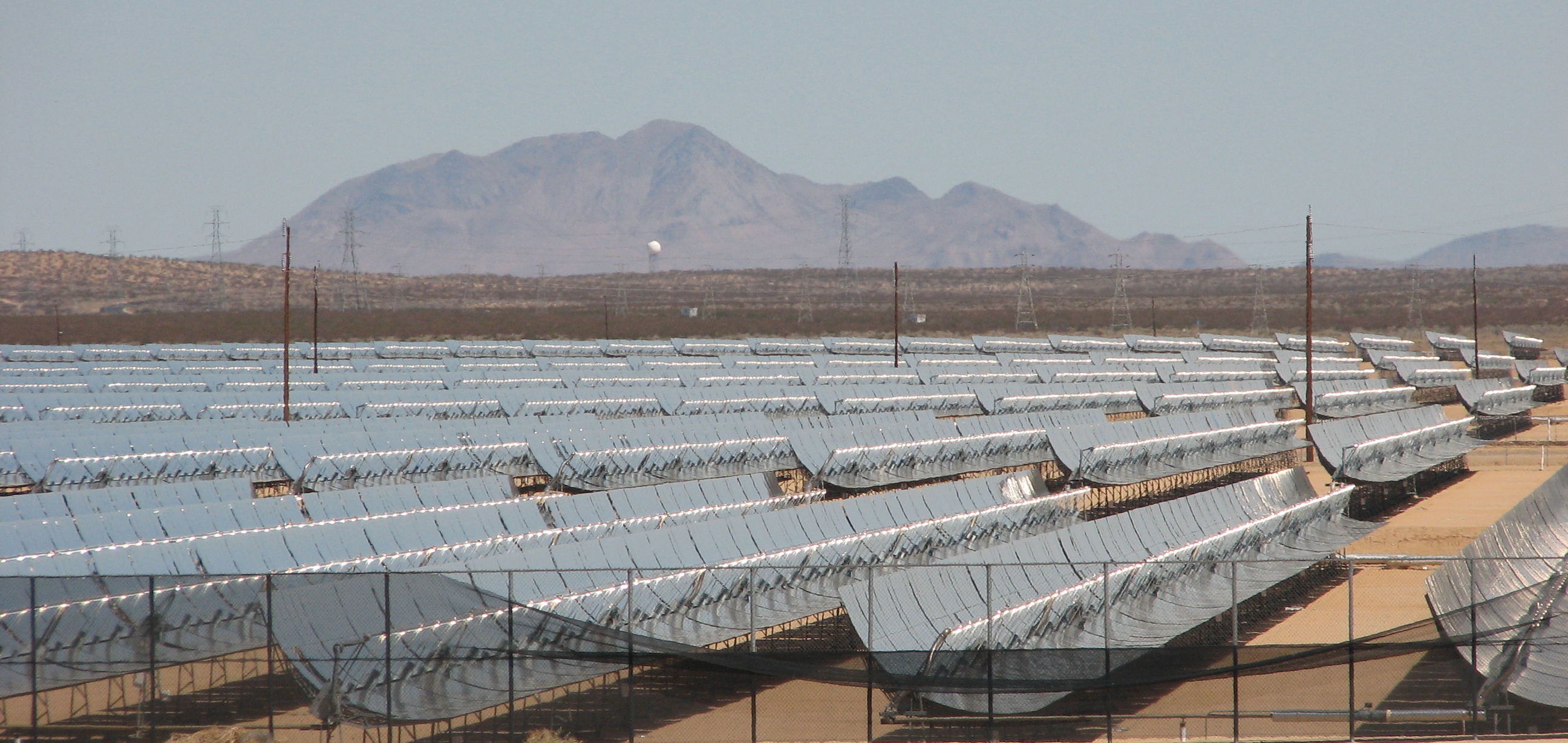
Solel last July signed the world’s largest solar power deal when it agreed to supply California utility PG&E (PCG) with 553 megawatts of green electricity to be produced by a massive solar thermal power plant to be built in the Mojave Desert. The company’s solar trough technology is also used in nine solar power plants (photo above) that were built in the Southern California desert in the 1980s. (In a solar trough power plant, long rows of parabolic mirrors focus the sun’s rays on tubes of liquid suspended over the arrays to create steam that drives an electricity-generating turbine.)

Raising $105 million is impressive and it’s certainly a big number. But given that a 500-megawatt solar power plant can easily cost $1 billion or more to build, it’s a relative drop in the bucket. However, it will allow Solel to move forward with the project and line up project financing for the PG&E plant while it negotiates more deals with other utilities — it won’t say which, but likely candidates are Southern California Edison (EIX) and San Diego Gas & Electric (SRE).

Competitors BrightSource Energy and Ausra have solar power plant applications before the California Energy Commission and have signed or are negotiating power purchase agreements with PG&E.

“Everyone is realizing that the market is there for thousands of megawatts of peaking power,” Solel CEO Avi Brenmiller recently told Green Wombat. “As time goes by we see energy prices rising and utilities are focusing their efforts to get solar thermal power because this is the right solution in the southwest United States.”

The Ecofin investment in Solel is notable also given the uncertainty surrounding solar power at the moment due to Congress’ failure to extend the solar investment tax credit in the recently enacted energy bill. The 30 percent credit is considered crucial to help solar energy companies secure financing for power plants and achieve economies of scale. The tax credit expires at the end of 2008 but solar energy proponents and their allies on Wall Street say they’re confident that Congress will take up legislation this session to extend it for as long as eight years.

Read Full Post »

brightsource-ivanpah.png

When President Bush signed the energy bill into law last month, much was made of the legislation’s mandate that automakers dramatically boost the fuel efficiency of their fleets. Less noticed was that the bill dropped a provision that would have extended the solar investment tax credit — a measure viewed as essential to transforming solar energy from a niche business into a multi billion-dollar industry that can generate gigawatts of greenhouse gas-free electricity.

The timing couldn’t be worse. With the current solar credit set to sunset, as it were, at the end of 2008, Big Solar is at at a tipping point: Utilities and renewable energy companies are in the midst of negotiating massive megawatt power purchase deals whose financing depends on the 30 percent investment tax credit, or ITC.

“I think there is a major concern that this will stall all the beneficiaries of the ITC,” said Joshua Bar-Lev, vice president for regulatory affairs for solar power plant developer BrightSource Energy. The Oakland, Calif.-based startup is negotiating a 500-megawatt agreement with California utility PG&E and is proceeding with plans to build a 400-megawatt solar thermal power station on the Nevada border (artist rendering above).

Solar energy companies, utilities like PG&E (PCG) and Edison International (EIX) as well as financiers such as Morgan Stanley (MS) and GE Energy Financial Services (GE), had pushed for an eight-year extension of the investment tax credit to give Big Solar projects enough time to get off the ground and start to achieve economies of scale. The provision also would have allowed utilities to claim the credit for solar projects they build. The measure drew support from both sides of the aisle in Congress but died — by one vote in the Senate — when Bush threatened to veto the energy bill because the solar tax credit would be financed by repealing previous tax breaks given to Big Oil.

“The Congressional leadership is very strong in their support of the ITC; they will put this on the table In 2008,” said Chris O’Brien, a Sharp Solar executive and chairman of the Solar Energy Industries Association, in an e-mail. “The solar industry will continue to contact legislators in key states.”

House Speaker Nancy Pelosi and the Democratic leadership in the Senate have pledged to re-introduce renewable energy tax credit legislation this session. “Speaker Pelosi has said repeatedly that she hopes to address that this year,” Drew Hammill, a spokesman for Pelosi, told Green Wombat. “We’re just getting started but there’s bipartisan support for the tax credit.”

Publicly, at least, no one in the solar industry will say that the uncertainty over the tax credit is affecting planned projects. “Our expectation is that there will be another tax bill that will address this issue,” said Kevin Walsh, managing director of the renewable energy group at GE Energy Financial Services. “We’re working on a number of [solar thermal] deals but it’s too early to disclose them.”

In recent months, PG&E has signed deals for more than a gigawatt of electricity — enough to light more than 750,000 homes — with solar power plant developers. Such power purchase agreements can take more than a year to hammer out and the permitting and construction of a solar power station can take another three to five years.

“We’re continuing to move forward with negotiations and with contracts that have already been signed, but certainly the absence of the ITC could potentially impact future projects,” said PG&E spokesman Keely Wachs. “Without the credit, it does increase the cost of that energy and of course it also sends a very clear market signal as to our country’s energy priorities.”

Silicon Valley solar startup Ausra is building a 177-megawatt solar power plant on the Central California coast to supply electricity to PG&E and is pursuing deals with Florida’s FPL (FPL) and other utilities.

“Just like any business, the solar industry prefers a predictable system for the future,” wrote Holly Gordon, Ausra’s director of regulatory and legislative affairs, in an e-mail. “It will be more difficult to plan for our projects while the situation remains uncertain. While we are currently seeing excellent demand for solar energy at market prices, we need a long term extension of the renewable energy tax credits to ensure market stability and investor confidence as the market continues to grow.”

Read Full Post »

hp-enviro-1.pngOvershadowed by Google’s jump into the renewable energy business on Tuesday was Hewlett-Packard’s more modest move to go green by installing a 1-megawatt solar array at its San Diego facility, buying wind power for its Ireland operations and subsidizing employees’ home solar systems.

In Silicon Valley these days putting a whopping solar array up on your roof is akin to having the coolest corporate jet or your CEO back-ordered for a Tesla Roadster. Google (GOOG), of course, has the biggest, a 1.6-megawatt monster that covers buildings and carports at the Googleplex in Mountain View. Not to be outdone, Applied Materials (AMAT) is planning an even larger solar system for its headquarters in neighboring Santa Clara.

But there’s more at stake here than green bragging rights. Companies like HP (HPQ) are realizing that tapping renewable energy can also be good for the bottom line. Take HP’s solar array in San Diego, for instance. The 5,000-panel system carries no capital costs for HP as the array will be financed and operated by a third-party affiliated with solar cell maker SunPower (SPWR). The Silicon Valley company will install the array and perform maintenance for 15 years while HP purchases the electricity produced by the solar system at a guaranteed below-market rate. That gives the company a hedge against rising energy costs. (HP thinks it’ll save $750,000 over 15 years.) HP also retains ownership of any potentially marketable renewable energy credits associated with the array while the financier can take advantage of California’s solar subsidies.

SunPower wasn’t disclosing the identity of that financier when Green Wombat inquired on Tuesday, but this morning the company announced a $200 million deal with Morgan Stanley (MS) to provide financing for solar installations and power purchase agreements like the one HP signed. SunPower and Morgan Stanley have formed a jointly owned holding company to finance SunPower’s solar systems for customers, with the Wall Street firm kicking in up to $190 million and SunPower putting up as much as $10 million.

In Ireland, HP will buy a year’s worth of clean electricity generated by Airtricity’s European wind farms, saving the company an estimated $40,000 in 2008. Electricity generated by Airtricity’s wind farms is fed into Ireland’s national power grid rather than directly to HP facilities. But the additional power generated by the wind farms, as well as the solar electricity eventually produced by the San Diego array, will eliminate tons of greenhouse gas emissions from the atmosphere.

Last, SunPower will give HP employees a $2,000 rebate if they install the company’s residential solar systems, with HP providing another $2,000. That’s on top of state rebates under the California Solar Initiative program.

Read Full Post »

berkeley-city-council-solar-vote.png

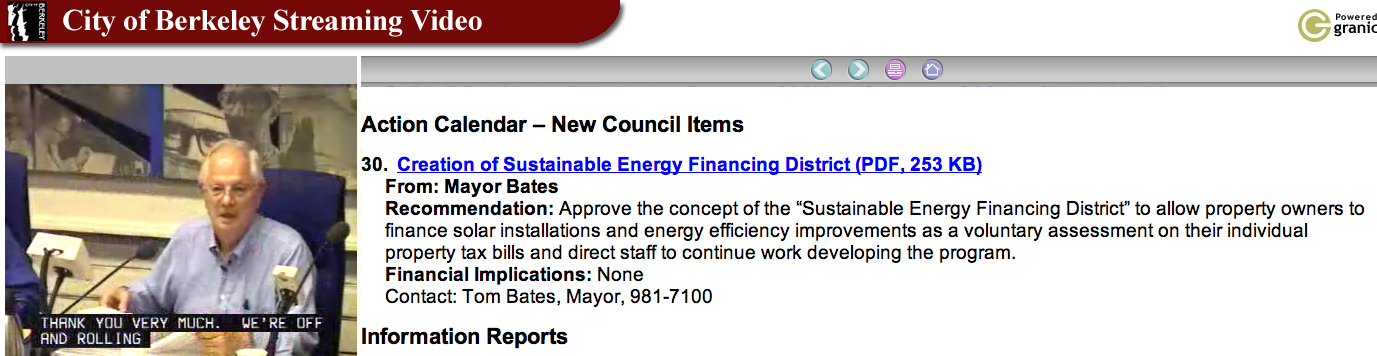
The Berkeley, California, city council Tuesday night greenlighted a proposal to pay for the installation of solar panels and solar hot water systems for any homeowner or commercial building owner in a move to dramatically boost local use of renewable energy. Property owners would retain ownership of the solar systems, paying back the cost over 20 years through an assessment on their annual property tax bill.

“We’re off and rolling,” said Berkeley Mayor Tom Bates after the city council unanimously gave initial approval for the Sustainable Energy Financing District.

Cisco DeVries, Bates’ chief of staff who devised the municipal solar financing proposal, said the city hopes to start signing up homeowners by June 2008. But first it must hammer out the legal and financial details. The city will likely float a bond to obtain millions in bank financing to pay for homeowners’ solar arrays.

“The banks and others have been very interested in this,” said Bates. “The banks that Cisco and I have had conversations with have been very encouraging.”

City manager Phil Kamlarz said Berkeley should be able to obtain a lower interest rate than commercial home equity loans as the property tax assessment will act as a lien, putting banks first in line to collect in the event a property owner defaults.

“We’re looking at what’s the benchmark to make this thing work and right now its less than 7.5% so we’re going to try to make this less than 7.5%,” he told council members.

A property owner would choose a solar installer from a city-approved list. It appears to be a win-win situation solution to the high cost of going solar. The homeowner immediately begins saving money on electricity bills without incurring the $15,000 to $30,000 upfront cost of installing a solar system. They also usually get a boost in their property value from the solar array and the property tax that pays for the system is deductible on their federal income tax return. When the house is sold the solar array and the tax assessment remain with the property, passing to the new owner and thus further diluting the cost of the system.

Bates said other cities have approached him about replicating the Berkeley initiative. The city has won the backing of utility PG&E (PCG) and the solar industry has, not surprisingly, been enthusiastic about a program that promises to expand the market for solar panels made by companies like SunPower (SPWR) and Sharp as well give installers more work.

“This is going to create green collar jobs,” said Bates.

Berkeley’s left-wing politics often puts it on the fringe of the U.S. mainstream but when it comes to environmental policies, the Bay Area city has led the way. Berkeley, after all, was the first city to adopt curbside recycling decades ago, now common even in some of the reddest of red states.

“The power of this is really expanding it beyond Berkeley,” noted one council member.

Read Full Post »

Cvn_logocleantechnetwork
Venture capitalists poured $1.74 billion into North American and European green technology startups in the third quarter, according to a survey by the Cleantech Network, a coalition of investors and companies. That brings total investment to $3.64 billion so far this year, a 13 percent rise over the same period in 2006. Most of the action was in North America, where green tech investment in the third quarter rose to $1.3 billion, a 36 percent jump over 2006. VCs are placing their biggest bets on green energy, which soaked up about 92 percent of the cash. North American investments in solar rose 16 percent to $410 million in the third quarter from the previous quarter while biofuels attracted $215 million.

Read Full Post »

Bofa_logo

Bofa_live_green

Tap your home equity and help save the planet? Well, kinda. Bank of America (BAC)  said Wednesday that when customers take out a home equity line of credit and spend at least $2,500 by year’s end, it will donate $100 to green group Conservation International to preserve tropical rainforests. The program is a small part of the bank’s groundbreaking $20 billion green lending initiative announced last month. The nation’s second largest bank will use that cash to fight global warming over the next decade by financing companies creating low-emissions technology, lending money for green building projects and creating the ability for customers to trade carbon credits. While the green home equity line deal seems like another way for Mr. and Ms. America to greenwash their guilty conscience for remodeling their McMansion, BofA claims donating a Benjamin to the Amazon will "offset the impact from energy use in the average household for one year." (Though not, of course, the greenhouse gas emissions and resources consumed in the construction of the increasingly bloated U.S. home.) Bank executives say they hope homeowners will be inspired to use their home equity line of credit to green up their abodes. "Our research has indicated that many customers are using home equity loans and lines of credit to make home improvements that increase energy efficiency," BofA exec David Rupp said in a statement. "This program will enable customers to not only boost energy conservation at home but also drive environmentally sustainable efforts around the globe."

Read Full Post »

« Newer Posts

Design a site like this with WordPress.com
Get started