Feeds:
Posts
Comments

Archive for the ‘alternative energy’ Category

In my new Green State column on Grist, I write about the latest political machinations in Australia that derailed carbon cap-and-trade legislation at the 11th hour and sets the stage for a national election fought largely over climate change:

As I boarded my flight back to California in Brisbane, Australia, last Wednesday, I received an email alert that the Australian Senate had just defeated the Labor government’s climate change legislation. Only days earlier victory seemed all but assured, allowing Australia to go to Copenhagen with an iron-clad, albeit weak, agreement in hand to reduce the nation’s greenhouse gas emissions, which per capita are among the highest in the world.

Then in the course of 24 hours the conservative opposition Liberal Party sacked its leader—who had pledged to pass the government’s cap-and-trade legislation—and replaced him with a one-time global warming denier and quickly voted down the government’s Carbon Pollution Reduction Scheme.

The defeat gives Prime Minister Rudd the trigger for an early election that would largely be fought over climate change. (If Parliament twice rejects a government bill, the prime minister can ask that the legislature be dissolved and a snap election called.)

In August, after the Senate first rejected the center-left government’s cap-and-trade legislation, I wrote in Grist that the defeat reflected the peculiarities of the Australian political system rather than the viability of a cap-and-trade system.

I’m not so sure any more after watching the latest reversal unfold during a visit to the Lucky Country.

Just as Australia is the proverbial canary in the coal mine for the environmental affects of climate change, a national election waged over cap-and-trade will offer a preview of voters’ willingness to pull the lever for action on climate change.

You can read the rest of the column here.
image: courtesy cinephobia via Flickr

Read Full Post »

In Monday’s Los Angeles Times, I write about the migration of renewable energy firms from California and the Southwest to the nation’s industrial heartland to tap the down-and-out region’s manufacturing might:

At a recent solar energy conference in Anaheim, economic development officials from Ohio talked up a state that seemed far removed from the solar panels and high-tech devices that dominated the convention floor.

Ohio, long known for its smokestack auto plants and metal-bending factories, would be an ideal place for green technology companies to set up shop, they said.

“People don’t traditionally think of Ohio when they think of solar,” said Lisa Patt-McDaniel, director of Ohio’s economic development agency. But in fact, the Rust Belt goes well with the Green Belt, she said.

In years past, Sunbelt governors recruited Midwestern businesses to set up shop in their states, dangling tax breaks and the lure of a union-free workforce.

Now the tables have turned as solar start-ups, wind turbine companies and electric carmakers from California and the Southwest migrate to the nation’s industrial heartland. They’re looking to tap its manufacturing might and legions of skilled workers, hit hard by the near-collapse of the United States auto industry and eager for work.

For all of green tech’s futuristic sheen, solar power plants and wind farms are made of much of the same stuff as automobiles: machine-stamped steel, glass and gearboxes.

That has renewable energy companies hitting the highway for Detroit and Northeastern industrial states, driven in part by the federal stimulus package’s incentives and buy-American mandates.

You can read the rest of the story here.

Read Full Post »

photo: Solyndra

In my Green State column in Grist this week, I talk to Ryan Pletka, a renewable energy expert at engineering and consulting firm Black & Veatch, who has been conducting economic analysis for California’s Renewable Energy Transmission Initiative.  The rapid evolution of the solar market has prompted Pletka to rethink the the need for massive new transmission projects in California:

California’s ambitious goal of obtaining a third of its electricity from renewable sources by 2020 has spawned a green energy boom with thousands of megawatts of solar, wind, and biomass power plants planned for … the middle of nowhere.

And therein lies the elephant in the green room: transmission. Connecting solar farms and geothermal plants in the Mojave Desert and wind farms in the Tehachapis to coastal metropolises means building a massive new transmission system. The cost for 13 major new power lines would top $15.7 billion, according to a report released in August by the state’s Renewable Energy Transmission Initiative.

The initiative, called RETI, is an attempt to build a statewide green grid in an environmentally sensitive way that will avoid the years-long legal battles that have short-circuited past transmission projects.

But the rapidly evolving solar photovoltaic market may moot the need for some of those expensive and contentious transmission lines, requiring transmission planners to rethink their long-term plans, according to Black & Veatch, the giant consulting and engineering firm that does economic analysis for RETI.

In short, solar panel prices have plummeted so much as to make viable the prospect of generating gigawatts of electricity from rooftops and photovoltaic farms built near cities.

“This has pretty significant implications in terms of transmission planning,” Ryan Pletka, Black & Veatch’s renewable energy project manager, told me last week. “What we thought would happen in a five-year time frame has happened in one year.”

You can read the rest of the column here.

Read Full Post »

Solarthermische Parabolrinnenkraftwerke Andasol 1 und 2

Photo: Solar Millennium

Water is emerging as a make-or-break issue for solar developers hoping to build massive megawatt solar power plants in the desert Southwest. On Monday, Solar Millennium announced it would rather switch to dry-cooling its proposed 500-megawatt solar farm in the Nevada desert rather than fight to use more than a billion gallons of water a year to cool the power plant. As I write in The New York Times:

A solar developer caught in the crossfire of the West’s water wars is waving the white flag.

Solar Millennium, a German developer, had proposed using as much as 1.3 billon gallons of water a year to cool a massive solar power plant complex it wants to build in a desert valley 80 miles northwest of Las Vegas.

That divided the residents of Amargosa Valley, some of whom feared the solar farm would suck dry their aquifer. Others worried about the impact of the $3 billion project on the endangered pupfish, a tiny blue-gray fish that survives only in a few aquamarine desert pools fed by the valley’s aquifer.

Now Solar Millennium says it will instead dry-cool the twin solar farms, which will result in a 90 percent drop in water consumption.

“We trust that this decision to employ dry-cooling will accelerate the approval process and enable us to begin construction and stimulate the local economy by December 2010,” Josef Eichhammer, president of Solar Millennium’s American operations, said in a statement on Monday.

Water has emerged as contentious issue as dozens of large-scale solar power plants are proposed for the desert Southwest. Solar Millennium’s move is likely to put pressure on other solar developers to follow suit.

You can read the rest of the story here.

Read Full Post »

ausra-16

photo: Ausra

Silicon Valley solar company Ausra has sold its sole remaining solar power plant project in the United States, all but completing its exit from solar farming. As I write Thursday in The New York Times:

Ausra is continuing its exit from the business of building solar power plants, announcing on Wednesday that it has sold a planned California solar farm to First Solar.

The Carrizo Energy Solar Farm was one of the three large solar power plants planned within a few miles of each other in San Luis Obispo County on California’s central coast.

Together they would supply nearly 1,000 megawatts of electricity to the utility Pacific Gas and Electric.

First Solar will not build the Carrizo project, and the deal has resulted in the cancellation of Ausra’s contract to provide 177 megawatts to P.G.&E. — a setback in the utility’s efforts to meet state-mandated renewable energy targets.

But it could speed up approval of the two other solar projects, which have been bogged down in disputes over their impact on wildlife, and face resistance from residents concerned about the concentration of so many big solar farms in a rural region.

First Solar is only buying an option on the farmland where the Ausra project was to be built, according to Alan Bernheimer, a First Solar spokesman. Terms of the sale were not disclosed.

The deal will let First Solar revamp its own solar farm, a nearby 550-megawatt project called Topaz that will feature thousands of photovoltaic panels arrayed on miles of ranchland.

“This will allow us to reconfigure Topaz in a way that lessens its impact and creates wildlife corridors,” said Mr. Bernheimer.

You can read the rest of the story here.

Read Full Post »

artist_picture_of_project

Image: SolarReserve

Ok, I’m exaggerating a bit in the headline above but we’re getting closer to solar farms that will provide baseload power, operating at night and under cloudy conditions. As I write on Tuesday in The New York Times:

The holy grail of renewable energy is a solar power plant that continues producing electricity after the sun goes down.

A Santa Monica, Calif., company called SolarReserve has taken a step toward making that a reality, filing an application with California regulators to build a 150-megawatt solar farm that will store seven hours’ worth of the sun’s energy in the form of molten salt.

Heat from the salt can be released when it’s cloudy or at night to create steam that drives an electricity-generating turbine.

The Rice Solar Energy Project, to be built in the Sonoran Desert east of Palm Springs, will “generate steady and uninterrupted power during hours of peak electricity demand,” according to SolarReserve’s license application.

So-called dispatchable solar farms would in theory allow utilities to avoid spending billions of dollars building fossil fuel power plants that are fired up only a few times a year when electricity demand spikes, like on a hot day.

SolarReserve is literally run by rocket scientists, many of whom formerly worked at Rocketdyne, a subsidiary of the technology giant United Technologies. Rocketdyne developed the solar salt technology, which was proven viable at the 10-megawatt Solar Two demonstration project near Barstow, Calif., in the 1990s.

You can read the rest of the story here.

Read Full Post »

RFK Jr

Image: Solar Power International

I had the chance to interview Robert F. Kennedy Jr., this week after he gave an impassioned speech at the Solar Power International conference in Anaheim, Calif. As I wrote in The New York Times:

In a barn-burning speech Wednesday at the Solar Power International conference in Anaheim, Calif., Robert F. Kennedy Jr., sounded a bit like a green Gordon Gekko.

“We are in process of overthrowing the incumbents in a $1.3 trillion industry,” said Mr. Kennedy, a veteran environmental activist, in a full-throated attack on one of his longtime foes, the coal industry. “We are going to democratize the energy industry and take it away from the incumbents.”

This year, Mr. Kennedy joined VantagePoint Venture Partners, a Silicon Valley firm that specializes in green technology investments — including several with solar start-ups.

After his speech, Mr. Kennedy retired to a Starbucks to huddle with the chief executive of BrightSource Energy, a VantagePoint-backed solar power plant builder, and then sat down for an interview with Green Inc.

“There’s been a coalescence of interests between the environmental and business communities,” said Mr. Kennedy. “For me, fighting the bad guys has been a David and Goliath battle for many years, because they have all the money on their side. This changes the odds for us,” he said. “Now we have industry on our side. We have our own industry.”

You can read the rest of the story here.

Read Full Post »

2765584331_7811d890d9_o
photo: Curt Carnemark /World Bank

At the Solar Power International conference this week, one of the more interesting panels was one that looked at bringing solar to the developing world. As I wrote in The New York Times:

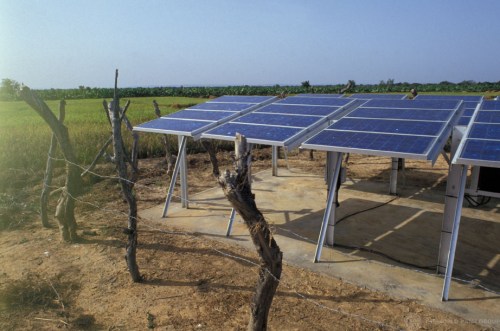
By 2020, the world’s biggest potential solar markets will be found in the developing world, areas largely ignored by solar industry today, according to executives working to bring renewable energy to rural regions.

Just 1 percent of the world’s solar panel production has been installed in developing countries, said Michael Eckhart, the president of the American Council on Renewable Energy, during a panel discussion Tuesday at the Solar Power International conference in Anaheim, Calif.

“This is a scandal for our industry and we must find solutions,” said Mr. Eckhart, who has worked on solar projects in Africa and India.

The market in Africa, Asia and Latin America is potentially vast given that nearly 44 percent of the population of the developing world lacks access to electricity, according to Simon Rolland, a policy and development officer for the Alliance for Rural Electrification, based in Brussels.

Therein lies a conundrum: Bringing solar energy to those communities means building and financing off-the-grid solar arrays in remote locations that use batteries to store the electricity generated by the photovoltaic panels.

You can read the rest of the story here.

Read Full Post »

4055519813_53462058cc_b

photo: Solar Power International

I spent the week at the Solar Power International conference in Anaheim, Calif., where some 22,000 people gathered for the industry’s biggest get-together in the United States. As I wrote in The New York Times, solar industry leaders are taking an aggressive new approach to pushing their agenda:

A solar industry leader smacked down the oil and coal industries on Tuesday, calling for renewable energy proponents to open their wallets to level the playing field in Washington.

“The full promise of solar power is being restrained by the tyranny of policies that protect our competitors, subsidize wealthy polluters and disadvantage green entrepreneurs,” said Rhone Resch, chief executive of the Solar Energy Industries Association, according to prepared remarks for a speech he is to give at the opening of the Solar Power International conference.

The event, being held in Anaheim, Calif., is the solar industry’s biggest annual get-together in the United States, and is usually a celebration of the industry’s breakneck growth of recent years.

But Mr. Resch said that with the fossil fuel industry devoting tens of millions of dollars to defeat climate change legislation now before Congress, the solar industry needs to start throwing its weight around Washington.

You can read the rest of the story here.

Read Full Post »

img_2914

photo: Todd Woody

California utility PG&E on Monday announced two new Big Solar deals that will likely to ramp up the debate over solar thermal power plants’ thirst for water in the desert Southwest. As I write in The New York Times:

The West’s water wars are likely to intensify with Pacific Gas and Electric’s announcement on Monday that it would buy 500 megawatts of electricity from two solar power plant projects to be built in the California desert.

The Genesis Solar Energy Project would consume an estimated 536 million gallons of water a year, while the Mojave Solar Project would pump 705 million gallons annually for power-plant cooling, according to applications filed with the California Energy Commission.

With 35 big solar farm projects undergoing licensing or planned for arid regions of California alone, water is emerging as a contentious issue.

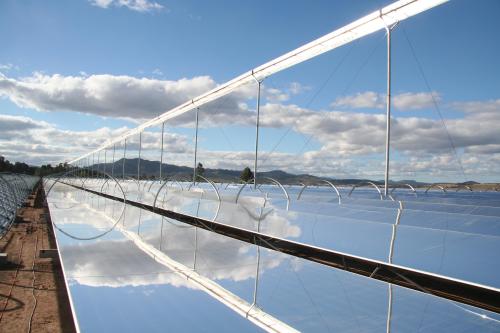
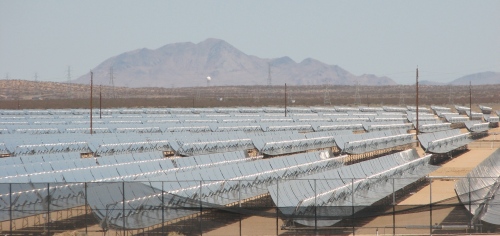
The Genesis and Mojave projects will use solar trough technology that deploys long rows of parabolic mirrors to heat a fluid to create steam that drives an electricity-generating turbine. The steam must be condensed back into water and cooled for re-use.

Solar trough developers prefer to use so-called wet cooling in which water must be constantly be replenished to make up for evaporation. Regulators, meanwhile, are pushing developers to use dry cooling, which takes about 90 percent less water but is more expensive and reduces the efficiency –- and profitability – of a power plant.

NextEra Energy Resources, a subsidiary of the utility giant FPL Group, is developing the Genesis project in the Chuckwalla Valley in the Sonoran Desert. The twin solar farms would tap about 5 percent of the valley’s available water.

You can read the rest of the story here.

Read Full Post »

« Newer Posts - Older Posts »

Design a site like this with WordPress.com
Get started