Feeds:
Posts
Comments

CODA Front_hires

photo: Coda Automotive

A new electric car company, Coda Automotive, emerged from stealth mode this week and unveiled a $45,000 sedan that it says will hit the streets in 2010.

The Santa Monica, Calif., startup is an offshoot of Miles Electric Vehicles, a maker of low-speed neighborhood runabouts. The CEO is Kevin Czinger, a veteran of Goldman Sachs (GS), Fortress Investment Group and dot-com era online grocer WebVan. Goldman Sachs’ Mac Heller serves as co-chairman and the board includes John Bryson, past chairman and chief executive of Edison International (EIX). Coda has raised $40 million from the Angeleno Group and other investors.

Green Wombat took a spin in the car, called the Coda, earlier this week in Southern California. As I wrote in my Green State column on Grist:

Open one of those minimalist black boxes that contain a shiny new iPod and you’re greeted by five words—“Designed by Apple in California.” In much smaller print would be the phrase “Made in China.”

That, in a nutshell, describes the strategy of the latest entrant in the electric car sweepstakes: Santa Monica-based Coda Automotive. At a defunct Wilshire Boulevard Jaguar dealership on Wednesday, the startup emerged from stealth mode and CEO Kevin Czinger literally pulled the cover off the Coda, a $45,000 battery-powered sedan set to go on sale next year in California. Coda is an offshoot of Miles Electric Vehicles, a maker of low-speed “neighborhood electric” runabouts.

The Coda sedan, which resembles a previous-generation Honda Civic, is a highway-ready, 80 mph five-seater that will travel 90 to 120 miles on a charge, according to the company.

And it is likely to be the first Chinese-made car to hit American roads. The car’s 333-volt lithium ion battery pack comes from the Tianjin Lishen Battery Joint-Stock Co., a huge state-owned corporation that supplies batteries to Apple and other consumer electronics companies.  Coda has established a joint venture with Tianjin Lishen to design and sell batteries for transportation and utility storage. The sedan’s design, brand and intellectual property will be owned by Coda, but it will be manufactured and assembled in China by Hafei, a state-owned automobile and aircraft manufacturer.

Read the rest of the column here.

NRDC water report

Water isn’t as sexy as solar, doesn’t carry the smart grid’s geek cred or inspire green technolust like the Fisker Karma or Tesla Roadster electric sports cars. But as a new Natural Resources Defense Council report drives home, it could be one of the biggest climate-change related business opportunities of the new century.

The NRDC study focuses on California, where drought, a growing population and the specter of global warming-triggered water shortages demand innovative water efficiency policies and technological solutions. Just like California has kept its per capita energy consumption flat over the past 30 years as its population doubled through energy efficiency standards, the reports’ authors say that the Golden State must take the same approach with water.

“Such measures can help stretch limited water supplies, save businesses, money, reduce energy consumption, improve water quality, and protect local, regional, and statewide ecosystems,” wrote authors Ronnie Cohen, Kristina Ortez and Crossley Pinkstaff.

They focus on the so-called commercial, industrial and institutional sector, or CII — i.e. Big Business and Big Government — and the takeaway headline is that if those water consumers cut their consumption by implementing existing conservation technology they would save enough H2O to supply the coastal metropolises of Los Angeles, San Diego and San Francisco.

As has been oft pointed out, a great deal of energy is expended to transport and manage water — 20% of California’s electricity production is water-related, according to the state’s energy commission — and cutting water use will also slash companies’ electricity bill and, not incidentally, greenhouse gas emissions.

The report says that CII accounts for one-third of California’s urban water use. Taking such prosaic measures as installing aerators on faucets, low-flow shower heads and energy efficient commercial dishwashers and washers can save millions of gallons of water. Take toilets, for example. Urinals alone — pay attention guys — consume 15% of the water used in commercial restrooms. Switching to waterless urinals would save 45,000 gallons a year per urinal, according to the report.

More high tech measures involve deploying smart irrigation systems that use sensor networks to determine when to turn on the sprinklers at all those golf courses built in the California desert and in suburban communities throughout the state.  Needless to say, much of the opportunity in Big Water be for consultants and policymakers.

The whale in the room, of course, is Big Agriculture. Ag was beyond the scope of the NRDC report but it is the biggest consumer of water in California and has often been the most resistance to change or paying the true cost of such things as growing rice and alfalfa in the desert.

But as far as the commercial and government sectors go, the report concludes with these policy recommendations:

  • “Establish efficiency standards for water-using products.
  • Set performance-based water savings targets that provide water agencies with flexibility.
  • Prioritize water conservation above increasing supply.
  • Adopt a Public Goods Charge on water sales to provide a dedicated funding source for water efficiency programs, including expanded technical and financial assistance.
  • Encourage partnerships with—and financial support from—energy utilities and wastewater agencies.
  • Streamline the process for recycled water use.
  • Encourage volumetric pricing for sewer services.
  • Decouple water agencies’ sales from revenue.
  • Improve water use data collection and management.”

Top 10 solar utilities

A solar industry trade group on Thursday released its list of the Top 10 solar integrated utilities of 2008 and it will come as no surprise that California’s Big Three utilities took the top three spots.

What is news, and a sign that solar’s reach is extending beyond the Golden State, is that six of the Top 10 solar utilities on the Solar Electric Power Association’s list hail from places like New York and New Jersey.

Still, San Francisco-based PG&E (PCG), which claimed the No. 1 slot, alone connected 84.9 megawatts of photovoltaic solar to the grid in 2008, accounting for 44% of all new solar capacity last year. Southern California Edison (EIX) came in second with 32.4 megawatts and San Diego Gas & Electric (SRE) took third place with 16 megawatts.

Xcel Energy (XEL) in Colorado was close behind with 14.2 megawatts. After that the numbers take a dive to the single megawatts. Still, utilities from not-so-sunny places like Portland, Ore.  made the list.

Southern California Edison is No. 1 when it comes to total installed solar to date — 441.4 megawatts — due largely to the 354 megawatts of electricity generated by nine solar thermal power plants built in the 1980s that continue to operate in the Mojave Desert. PG&E came in second with 229.5 megawatts connected to the grid so far.

Those numbers should skyrocket in the coming years as the California utilities have signed contracts for more than 3 gigawatts of electricity to be produced by large solar farms. Utilities like Arizona Public Service (PNW) — No. 5 on the list for 2008 — are also beginning to contract for solar electricity to be produced by massive megawatt solar power plants.

solara

photo: BrightSource Energy

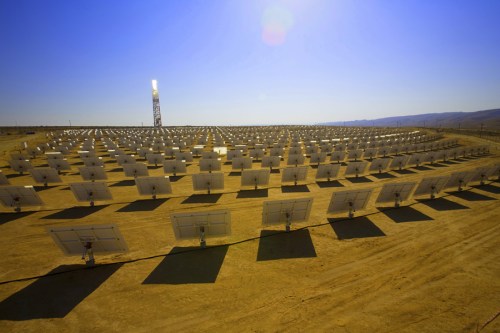
California utility PG&E on Wednesday expanded an agreement with BrightSource Energy to buy 1,310 megawatts of carbon-free electricity to be generated by seven giant solar power plant projects – the world’s biggest solar deal to date. Coming on top of a 1,300 megawatt agreement with Southern California Edison in February, the Google-backed, Oakland, Calif.-based  startup says it now holds more than 40% of the Big Solar contracts in the United States.

PG&E had previously signed a power purchase agreement with BrightSource in April 2008 for 500 megawatts with an option to buy another 400 megawatts. The new 1,310-megawatt deal will supply enough electricity to power about 530,000 homes in California.

Those are impressive numbers, but not an electron of electricity has been produced yet. BrightSource now faces the challenge of licensing, financing billions of dollars in construction costs and then building nearly a dozen large-scale solar power plants to meet a 2016 deadline for the Southern California Edison (EIX) contract and a 2017 completion date for PG&E (PCG).  (The big wild card is whether transmission lines will be available to connect the power plants to the grid.) The first PG&E project is set to go online in 2012 with the first SoCal Edison solar farm to begin generating electricity the next year. Those first two power plants are part of a 400-megawatt complex BrightSource is planning for the Ivanpah Valley on the California-Nevada border.

“The biggest part of our strategy is to ramp up slowly and methodically,” BrightSource CEO John Woolard told Green Wombat. “We’re very, very careful about how we sequence the projects.”

To give you an idea of how arduous the licensing process is in California, consider that BrightSource filed its application to build Ivanpah with the California Energy Commission on Aug. 31, 2007 — the state’s first large-scale solar power plant application in two decades. But the energy commission currently estimates that it won’t sign off on the license until around 2010, more than six months’ behind schedule as a multitude of state and federal agencies and green groups weigh in on the project’s environmental impact. The clock is ticking as BrightSource needs to start shoveling dirt on the construction site by the end of 2010 to qualify for federal loan guarantees that are part of the Obama stimulus package.

BrightSource may also build solar power plants in Nevada and Arizona, where licensing is easier, to supply electricity to PG&E and Southern California Edison. Woolard says the company controls enough land for nine gigawatts’ worth of solar farms.

While BrightSource’s technology is untested on a large scale, the company has built a six-megawatt demonstration plant in Israel, where its technology development arm is headquartered. BrightSource deploys arrays of mirrors called heliostats that concentrate sunlight on a water-filled boiler that sits atop a tower. The intense heat vaporizes the water to create high-pressure steam that drives a standard electricity-generating turbine.

Woolard says an independent engineering firm, R.W. Beck, has validated the technology at the Negev Desert demo plant. That no doubt helped persuade PG&E, which has sent executives to Israel to inspect the project, to supersize its contract. (And while BrightSource represents the biggest solar deal PG&E has signed, it’s probably far more likely to be fulfilled than the utility’s agreement in April to buy electricity from a space-based solar farm to be built by Southern California startup Solaren.)

“What it came down to is that they saw us delivering,” Woolard says. “Our plant in Israel performed above expectations. The fact that we have a solar plant producing the highest quality, highest temperature, highest pressure steam anywhere in the world is the most important thing.”

The company’s pedigree also provides a certain amount of corporate comfort. BrightSource was founded by American-Israeli solar pioneer Arnold Goldman, whose Luz International built nine large-scale solar trough power plants in the Mojave Desert in the 1980s that continue to generate electricity for Southern California Edison. BrightSource has also raised more than $160 million from a blue-chip group of investors that includes Google (GOOG), Morgan Stanley (MS) and VantagePoint Venture Partners as well as a clutch of oil giants – Chevron (CVX), BP (BP) and Norway’s StatoilHydro.

schottsolar09

photos: Schott

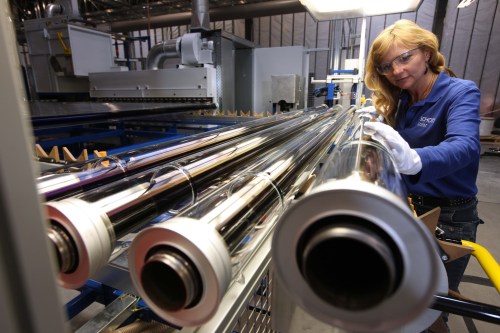
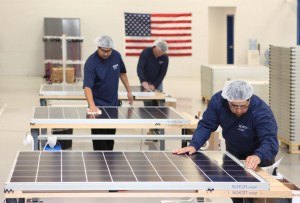
German solar company Schott on Monday cut the ribbon on a $100 million factory in Albuquerque, N.M., that will produce solar panels as well as receivers for solar trough power plants. Meanwhile, Chinese solar giant Suntech said Monday that it will build a solar cell manufacturing plant in the United States.

The move to North America comes as the European market softens as government subsidies ebb and solar panel prices fall. Despite the severe U.S. recession, Schott and Suntech are betting that the solar market will boom when the economy recovers and they’ll gain a competitive edge by manufacturing near customers.

“We think North America in general is the next big market for solar power,” Gerald Fine, CEO of Schott Solar’s North American operations, told Green Wombat. “Especially in the case of concentrated solar receivers you want to be close to your customers and provide great customer service and low shipping costs.”

schottsolar05And it doesn’t hurt to be generating green jobs as well. The 200,000-square-foot New Mexico factory employs 350 people. The plant was built too late to take advantage of the Obama stimulus package’s 30% tax credit for renewable energy manufacturing. But Fine said the tax credit will encourage Schott’s plans to eventually expand the facility to 800,000 square feet with a workforce of 1,500.

The receivers the factory makes are long glass-covered steel tubes that sit above parabolic troughs in large solar farms. The troughs concentrate sunlight on the receivers to heat a synthetic oil inside that is used to create steam that drives an electricity-generating turbine.

Fine declined to discuss specific customers for the receivers but there are numerous solar trough power plants being planned for the Southwest, including Abengoa Solar’s Solana project in Arizona and utility FPL’s (FPL) Beacon 250-megawatt solar in California.

“We feel pretty comfortable with our order books in both product lines for the foreseeable future,” said Fine. “If you look at the publicly announced plans and try to put a reasonable probability of them being completed, there’s in excess of two gigawatts of power plants out there.”

Schott will have the North American receiver market to itself but will face some stiff competition when it comes to making photovoltaic modules. Thin-film solar cell maker First Solar (FSLR) is headquartered in neighboring Arizona and claims the lowest cost of manufacturing. Last year, German solar cell maker SolarWorld opened a factory outside Portland, Ore., while Silicon Valley’s SunPower (SPWRA) makes some of the most efficient solar cells — albeit overseas.

And now China’s Suntech (STP) is moving into the U.S. manufacturing market. The company on Monday said it is looking at several states as potential sites for a factory and will make a decision on where to locate the facility within six months

“We believe in the outstanding long-term prospects of the solar energy market in the United States, and we will continue to invest in our ability to meet a substantial portion of that potential growth through in-market manufacturing,” Suntech CEO Zhengrong Shi said in a statement.

spanish-decal-car

photo: Think

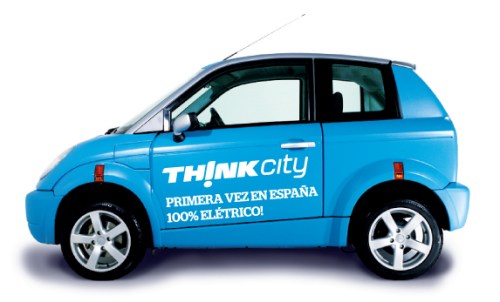
Norwegian electric automaker Think on Wednesday announced a deal to send 550 of its City urban runabouts to Spain, continuing to seed the European market as governments offer incentives for carbon-free cars.

The deal with Spanish electric car distributor Going Green calls for Think to start delivering the City later this year through early 2010. Spain’s government has launched a €10 million ($13.3 million) program to subsidize electric cars and an electric car charging network. Going Green will sell the Think City to private customers as well as to companies and municipalities.

“Spain is an important and large market for us, and the Spanish government’s decisive action to move to electric vehicles will enable Think to continue to take advantage of our first-mover position in the European EV market,” Think CEO Richard Canny said in a statement.

Think has done similar-sized deals in the Netherlands and Austria while it conducts a bake-off in the U.S. among eight states that want to host the company’s North American assembly plant. While Think continues to do deals, its factory outside Oslo remains idle as it attempts to secure funding to restart operations after the credit crunch forced layoffs late last year.

Ironically, one country not providing incentives to Think is Norway. The Norwegian government has rejected Think’s plea for a loan guarantee to help it raise capital. That had Think investor Wilber James, a venture capitalist with Rockport Capital Partners, fuming when Green Wombat ran into him at Fortune Magazine’s Brainstorm Green conference two weeks ago.

“The Norwegian government has made trillions from North Sea oil, and they can’t give Think $10 million!” said James, whose firm invested in Think last year and formed Think North America with Silicon Valley VC Kleiner Perkins Caufield & Byers. He noted that three U.S. states, meanwhile, are offering tax breaks and cash in a bid to become the site of Think North America’s first U.S. factory. Oregon was one of the states, James said; he would not say what the other two were.

The wind industry has been getting a lot of love of late from the Obama administration.

The president spent Earth Day at an Iowa factory that makes wind turbine towers and announced new regulations for offshore wind farms. Meanwhile, Interior Secretary Ken Salazar has been talking up the potential of offshore wind to generate as much as 20% of the eastern seaboard’s electricity that is now provided by coal-fired power plants.

But such scenarios won’t come to pass unless the administration seriously tackles the transmission grid problems that are keeping wind from becoming a nationwide source of green energy, according to panel of wind industry executives who spoke at Fortune Magazine’s Brainstorm Green panel this week.

“The real challenge is to connect wind farms in the Great Plains with the population centers of the Midwest,” said Bob Gates, senior vice president of commercial operations for Clipper Windpower. California-based Clipper is one of two U.S.-owned wind turbine makers (the other being General Electric (GE) ).

For instance, Clipper and BP (BP) have signed an agreement to build a 5,000-megawatt wind farm – the nation’s largest – in South Dakota. But the deal is more a dream at this stage because there are no power lines to transmit such massive amounts of electricity to Chicago and other Midwestern cities. (Gates said there is enough transmission available to begin construction this summer of a small 25-megawatt portion of the wind farm.)

The Obama administration has devoted billions of dollars in stimulus package funding to transmission projects and the Federal Energy Regulatory Commission last week approved incentives for a company planning to build a $12 billion “Green Power Express” transmission project to bring wind to Midwest metropolises.

Gates and the other panelists — Andris Cukurs, CEO of Indian turbine maker Suzlon’s North American operations; Don Furman, a transmission executive with Spanish wind developer Iberdrola Renewables, and James Walker, vice chairman of French-owned wind developer enXco – said the development of wind offshore from East Coast cities would ease transmission bottlenecks.

“Connecting offshore wind to cities is relatively cheap and easy compared to bringing wind power from the Dakotas to New York City,” Gates said. Another way to work around transmission gridlock would be to develop highly efficient small turbines that could be placed near cities and existing power lines, said Gates.

Despite Obama’s embrace of wind, the executives said they don’t see the industry resuming its record growth in 2008 – when U.S. wind capacity more than doubled – until 2010 or later. The credit crunch delayed or scuttled numerous wind farms and turbine orders have fallen dramatically.

One bright spot: Growing interest from well-capitalized utilities in directly investing in wind farms.

“Utility ownership is about 15% of the U.S. turbine fleet,” said Furman of Iberdrola Renewables. “I see more utility ownership in the coming years,, perhaps up to a third of the fleet.”

LAGUNA NIGUEL, Calif. — Chinese electric carmaker BYD will put an electric car on the road this year that goes 250 miles on a charge and intends to bring the vehicle to the United States, a key investor in the company said Tuesday.

“We want to introduce the car in the U.S., ” said Li Lu, founder of LL Investment Partners at Fortune Magazine’s Brainstorm Green conference in Southern California.

His Pasadena, Calif.-based firm owns 2.5% of BYD and was instrumental in getting Warren Buffett to invest in the electric car company, according to Fortune contributing editor Mark Gunther. (Read Gunther’s recent Fortune cover story on BYD here.)

During a panel discussion on electric car batteries, Lu said BYD could produce a battery that went 300 to 400 miles on a charge. “We can do a 300-mile battery today,” he said. “But it’s really heavy stuff, cuts into the space of the car. It’s a matter of what the consumer really needs.”

If BYD does move into the U.S., it will also build auto factories, Lu noted. “When we come to this country, we will do our manufacturing here.”

DANA POINT, Calif. — Have you driven a gas-guzzling planet-warming SUV lately? If so, it’s probably because gasoline prices have plunged in recent months and you’re more likely to trade up to a truck, Ford Motor Executive Chairman Bill Ford said Monday.

And he’s not happy about that.

“When gasoline went to $3.50 a gallon we saw a sea change in customer behavior,” Ford told Fortune Magazine managing editor Andy Serwer at Fortune’s Brainstorm Green conference in Orange County, Calif. “Now people are turning away from more fuel-efficient vehicles and taking the bigger vehicles.”

“I’ve been talking for five years now about the need for a gas tax,” he added. “We have to have some predictability on fuel pricing and that price signal has to be strong enough so customers” will continue buying smaller, fuel-efficient cars.” (Read more on Ford’s talk at Brainstorm Green.)

In other words, Ford Motor (F), General Motors (GM) and Chrysler won’t be able to kick their addiction to the profit margins that come from selling monster cars until consumers go cold turkey on cheap fuel.

Ford, who said he had been considered “something of a Bolshevik” in the auto industry for his early embrace of electric cars, said Detroit needs a floor under gasoline prices so it can make investments in alternative fuel vehicles.

“The worst thing for us is instability,” he said. “We need a much more stable planning horizon. That’s not just true for gasoline but for any fuel we use.”

Ford noted that when he joined the Ford board two decades ago he was told to stop “consorting” with suspected environmentalists. Times have changed in the car business.

“We haven’t had a lot of revolutions but boy are we now. I love it.”

Follow the Brainstorm: Green conference on Twitter at twitter.com/greenwombat and twitter.com/marcgunther.

First Solar Electric, 701 El Dorado Valley Dr., Boulder City, NV

photo: First Solar

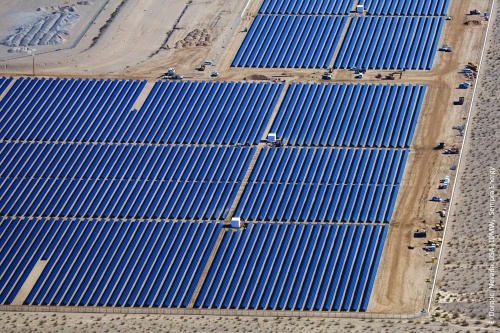
Sempra Generation on Wednesday said it has signed a deal for the United States’ largest photovoltaic power plant, a 48-megawatt solar farm to be built by First Solar in Nevada.

The thin-film solar power station will add on to a 10-megawatt solar farm built by First Solar (FSLR) last year adjacent to a Sempra  natural-gas fired power plant in Boulder City, Nev., outside of Las Vegas. Sempra Generation CEO Michael Allman told Green Wombat that Wednesday’s deal is part of a strategy to bring 500 megawatts of solar electricity online.

“The initial focus is on projects that are next to natural gas fired plants in the desert Southwest,” said Allman, whose company is a division of San Diego-based power giant Sempra Energy (SRE).

By building solar farms on the site of existing fossil fuel plants, Sempra can plug them in to the existing power grid, cutting costs for land, permits and electricity transmission. The 10-megawatt solar plant in Boulder City went online six months after ground was broken. Allman said Sempra also owns land next to its Mesquite natural gas power plant outside of Phoenix suitable for solar development.

“Those two power plants provide us with a substantial competitive advantage in both timing and cost,” said Allman. “These two initial projects will be the lowest cost energy delivered out of a solar project anywhere in the world.”

He declined to say what that cost is but an executive with PG&E (PCG), which is buying the electricity from the 10-megawatt Boulder City solar farm, previously told Green Wombat that the California utility was “very happy” with the rate it negotiated.

Allman said Sempra owns more than 4,000 acres in Arizona that could generate 300 megawatts of solar electricity. The company has also filed lease claims on 11,000 acres of desert land owned by the U.S. Bureau of Land Management in California’s Imperial Valley. But Allman said Sempra’s preference is to acquire private land to avoid the years-long BLM permitting process. The company will consider a range of solar technologies, including solar thermal, for future solar projects.

The 48-megawatt deal announced Wednesday is contingent upon Sempra signing a power purchase agreement with a utility.

Design a site like this with WordPress.com
Get started