November 19, 2009 by Todd Woody
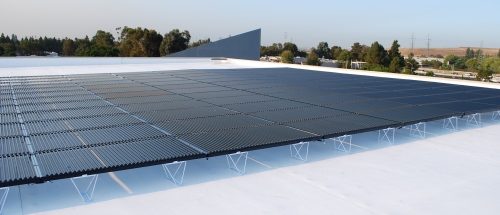
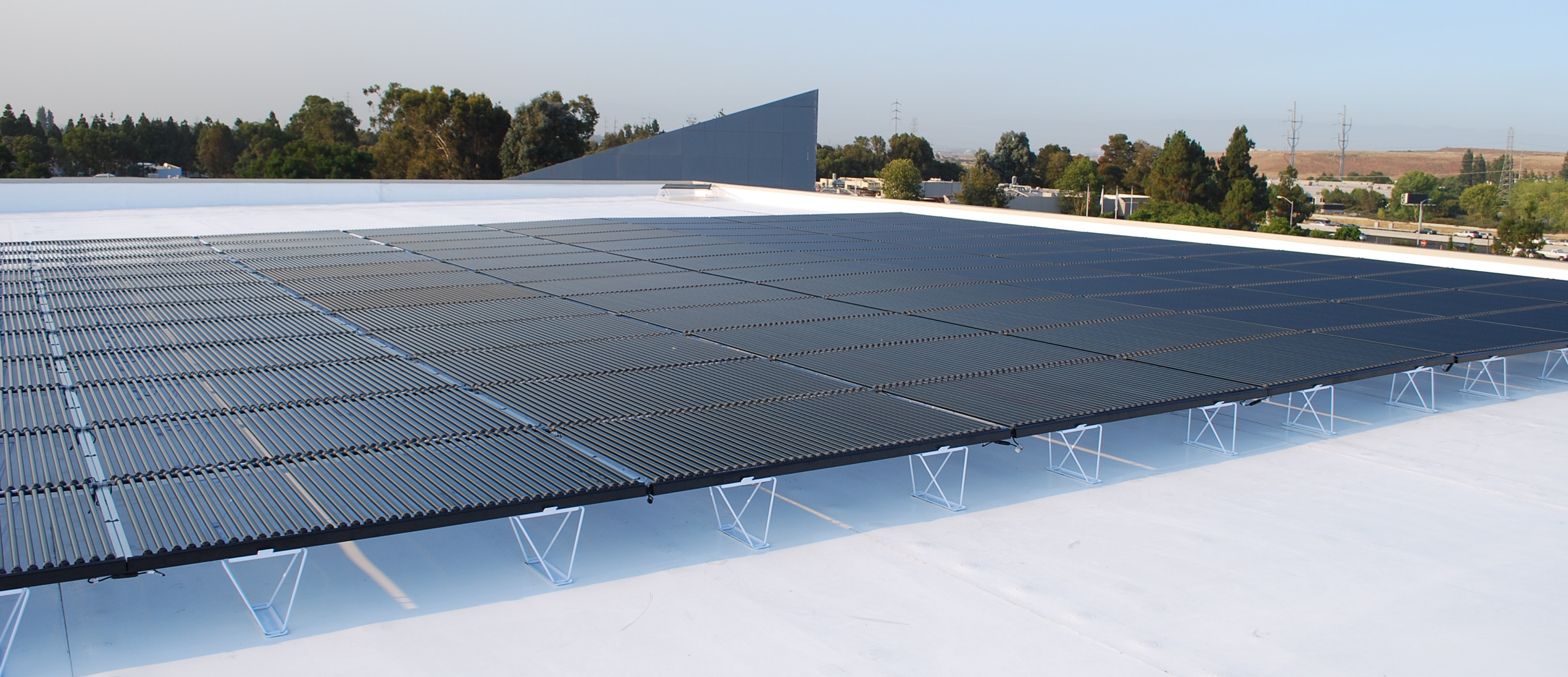
photo: Solyndra
In my Green State column in Grist this week, I talk to Ryan Pletka, a renewable energy expert at engineering and consulting firm Black & Veatch, who has been conducting economic analysis for California’s Renewable Energy Transmission Initiative. The rapid evolution of the solar market has prompted Pletka to rethink the the need for massive new transmission projects in California:
California’s ambitious goal of obtaining a third of its electricity from renewable sources by 2020 has spawned a green energy boom with thousands of megawatts of solar, wind, and biomass power plants planned for … the middle of nowhere.
And therein lies the elephant in the green room: transmission. Connecting solar farms and geothermal plants in the Mojave Desert and wind farms in the Tehachapis to coastal metropolises means building a massive new transmission system. The cost for 13 major new power lines would top $15.7 billion, according to a report released in August by the state’s Renewable Energy Transmission Initiative.
The initiative, called RETI, is an attempt to build a statewide green grid in an environmentally sensitive way that will avoid the years-long legal battles that have short-circuited past transmission projects.
But the rapidly evolving solar photovoltaic market may moot the need for some of those expensive and contentious transmission lines, requiring transmission planners to rethink their long-term plans, according to Black & Veatch, the giant consulting and engineering firm that does economic analysis for RETI.
In short, solar panel prices have plummeted so much as to make viable the prospect of generating gigawatts of electricity from rooftops and photovoltaic farms built near cities.
“This has pretty significant implications in terms of transmission planning,” Ryan Pletka, Black & Veatch’s renewable energy project manager, told me last week. “What we thought would happen in a five-year time frame has happened in one year.”
You can read the rest of the column here.
Posted in alternative energy, energy, environment, green policy, smart grid, solar energy, solar power plants | Tagged Black & Veatch, Renewable Energy Transmission Initiative, rooftop solar, solar energy | 1 Comment »
November 17, 2009 by Todd Woody

Photo: Ausra
Ausra has become the latest credit-crunched solar startup to seek a buyer/investor to bankroll its expansion. As I write Tuesday in The New York Times:
Disrupting trillion-dollar energy markets is expensive, as solar companies like OptiSolar and Solel have found. Both sold out to larger, deep-pocketed companies this year.
Now Ausra, a high-profile solar company bankrolled by some of Silicon Valley’s top venture capital firms, has become the latest renewable energy startup to put itself on the block.
Ausra, which makes solar thermal equipment to generate electricity, is in negotiations with three large international companies interested in taking a majority ownership stake in the venture, according to a person familiar with the situation.
The negotiations were first reported by Reuters.
All three potential acquirers are companies that make equipment for conventional power generation. Ausra declined to comment. Founded in Australia to build solar power plants, Ausra relocated to Silicon Valley and secured funding in 2007 from marquee venture capital firms Khosla Ventures, Kleiner Perkins Caufield & Byers and other investors.
Ausra soon filed plans to build one of the first new solar farms in California in 20 years. The company also built a factory in Las Vegas to manufacture long mirror arrays that focus the sun on water-filled tubes to create steam to drive electricity-generating turbines.
But as the credit crunch made building billion-dollar solar power plants an increasingly dicey proposition, Ausra switched gears earlier this year to focus on supplying solar thermal equipment to other developers.
You can read the rest of the story here.
Posted in Ausra, Australia, energy, enviro startups, environment, renewable energy, solar energy, solar power plants, SolarReserve | Tagged Ausra, OptiSolar, solar energy, solar power plants, Solel | Leave a Comment »
November 16, 2009 by Todd Woody

Photo: Solar Millennium
Water is emerging as a make-or-break issue for solar developers hoping to build massive megawatt solar power plants in the desert Southwest. On Monday, Solar Millennium announced it would rather switch to dry-cooling its proposed 500-megawatt solar farm in the Nevada desert rather than fight to use more than a billion gallons of water a year to cool the power plant. As I write in The New York Times:
A solar developer caught in the crossfire of the West’s water wars is waving the white flag.
Solar Millennium, a German developer, had proposed using as much as 1.3 billon gallons of water a year to cool a massive solar power plant complex it wants to build in a desert valley 80 miles northwest of Las Vegas.
That divided the residents of Amargosa Valley, some of whom feared the solar farm would suck dry their aquifer. Others worried about the impact of the $3 billion project on the endangered pupfish, a tiny blue-gray fish that survives only in a few aquamarine desert pools fed by the valley’s aquifer.
Now Solar Millennium says it will instead dry-cool the twin solar farms, which will result in a 90 percent drop in water consumption.
“We trust that this decision to employ dry-cooling will accelerate the approval process and enable us to begin construction and stimulate the local economy by December 2010,” Josef Eichhammer, president of Solar Millennium’s American operations, said in a statement on Monday.
Water has emerged as contentious issue as dozens of large-scale solar power plants are proposed for the desert Southwest. Solar Millennium’s move is likely to put pressure on other solar developers to follow suit.
You can read the rest of the story here.
Posted in alternative energy, environment, renewable energy, solar energy, Solar Millennium, solar power plants, water | Tagged Amargosa Valley, Nevada, solar energy, Solar Millennium, solar power plants, water | 1 Comment »
November 5, 2009 by Todd Woody
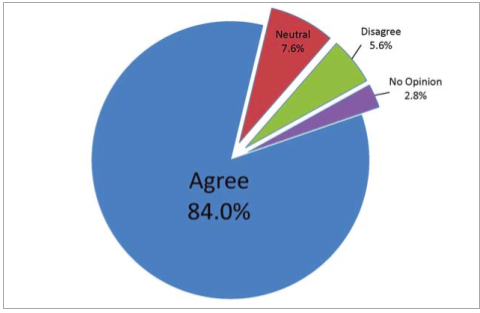
A survey of top economists has found them remarkably like-minded on the economic threat posed by climate change. As I wrote Wednesday in The New York Times:
A New York University School of Law survey found near unanimity among 144 top economists that global warming threatens the United States economy and that a cap-and-trade system of carbon regulation will spur energy efficiency and innovation.
“Outside academia the level of consensus among economists is unfortunately not common knowledge,” Richard Revesz, dean of the law school, said during a press conference on Wednesday. “The results are conclusive – there is broad agreement that reducing emissions is likely to have significant economic benefits.”
The law school’s Institute for Policy Integrity sent surveys to 289 economists who had published at least one article on climate change in a top-rated economics journal in the past 15 years. Half of those economists responded anonymously to a dozen questions that solicited their opinions on a range of issues, from the impact of climate change on particular industries to how the benefits of reduced greenhouse-gas emissions should be calculated.
The survey found that 84 percent of the economists agreed that climate change “presents a clear danger” to the United States and global economies – hitting agriculture the hardest – even though the severity of global warming remains unknown.
You can read the rest of the story here.
Posted in Uncategorized | 6 Comments »
November 5, 2009 by Todd Woody
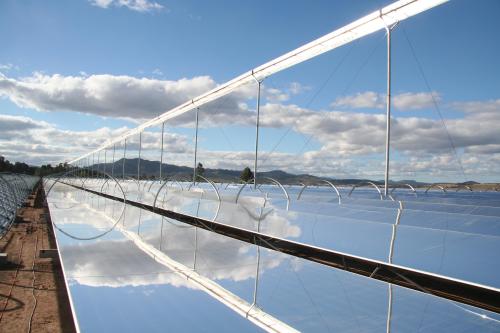
photo: Ausra
Silicon Valley solar company Ausra has sold its sole remaining solar power plant project in the United States, all but completing its exit from solar farming. As I write Thursday in The New York Times:
Ausra is continuing its exit from the business of building solar power plants, announcing on Wednesday that it has sold a planned California solar farm to First Solar.
The Carrizo Energy Solar Farm was one of the three large solar power plants planned within a few miles of each other in San Luis Obispo County on California’s central coast.
Together they would supply nearly 1,000 megawatts of electricity to the utility Pacific Gas and Electric.
First Solar will not build the Carrizo project, and the deal has resulted in the cancellation of Ausra’s contract to provide 177 megawatts to P.G.&E. — a setback in the utility’s efforts to meet state-mandated renewable energy targets.
But it could speed up approval of the two other solar projects, which have been bogged down in disputes over their impact on wildlife, and face resistance from residents concerned about the concentration of so many big solar farms in a rural region.
First Solar is only buying an option on the farmland where the Ausra project was to be built, according to Alan Bernheimer, a First Solar spokesman. Terms of the sale were not disclosed.
The deal will let First Solar revamp its own solar farm, a nearby 550-megawatt project called Topaz that will feature thousands of photovoltaic panels arrayed on miles of ranchland.
“This will allow us to reconfigure Topaz in a way that lessens its impact and creates wildlife corridors,” said Mr. Bernheimer.
You can read the rest of the story here.
Posted in alternative energy, Ausra, environment, First Solar, OptiSolar, PG&E, renewable energy, Solar Millennium, solar power plants | Tagged Ausra, First Solar, PG&E, solar energy, solar power plants | Leave a Comment »
November 3, 2009 by Todd Woody
A Silicon Valley startup called EcoFactor aims to cut consumers’ electricity bills and help utilities manage peak demand by controlling homes’ heating and air conditioning systems over the Internet. As I write on Tuesday in The New York Times:
As utilities install more smart meters in homes, more companies are offering services that tap the devices’ ability to give consumers information about their electricity use.
But EcoFactor, a startup in the Silicon Valley suburb of Redwood City, aims to take things even further by gathering data about the weather, as well as consumers’ individual climate-control habits, to adjust a home’s air-conditioning and heating systems.
Call it a smart thermostat.
Besides learning when homeowners tend to turn on their heat or air-conditioning, EcoFactor also monitors weather down to the zip code level. Every 60 seconds, its algorithms take that data and calculate how much electricity use can be reduced while keeping the occupants comfortable.
“After three days of energy data collection, we’re able to create a thermodynamic model for a home and use that for running energy efficiency programs,” said Scott Hublou, a co-founder of EcoFactor and its senior vice president for products. “We understand how much outside weather impacts temperatures inside and how a home’s systems have to overcome that outside temperature.”
On Tuesday, EcoFactor announced a three-year agreement to run a program for the Texas utility Oncor to reduce peak electricity demand by three megawatts. That’s a relatively small amount, and the program will initially involve only a handful of households.
You can read the rest of the story here.
Posted in energy efficiency, environment, green grid, green startups | Tagged EcoFactor, home energy management, Oncor, smart meters, smart thermostats | Leave a Comment »
November 3, 2009 by Todd Woody

Image: SolarReserve
Ok, I’m exaggerating a bit in the headline above but we’re getting closer to solar farms that will provide baseload power, operating at night and under cloudy conditions. As I write on Tuesday in The New York Times:
The holy grail of renewable energy is a solar power plant that continues producing electricity after the sun goes down.
A Santa Monica, Calif., company called SolarReserve has taken a step toward making that a reality, filing an application with California regulators to build a 150-megawatt solar farm that will store seven hours’ worth of the sun’s energy in the form of molten salt.
Heat from the salt can be released when it’s cloudy or at night to create steam that drives an electricity-generating turbine.
The Rice Solar Energy Project, to be built in the Sonoran Desert east of Palm Springs, will “generate steady and uninterrupted power during hours of peak electricity demand,” according to SolarReserve’s license application.
So-called dispatchable solar farms would in theory allow utilities to avoid spending billions of dollars building fossil fuel power plants that are fired up only a few times a year when electricity demand spikes, like on a hot day.
SolarReserve is literally run by rocket scientists, many of whom formerly worked at Rocketdyne, a subsidiary of the technology giant United Technologies. Rocketdyne developed the solar salt technology, which was proven viable at the 10-megawatt Solar Two demonstration project near Barstow, Calif., in the 1990s.
You can read the rest of the story here.
Posted in Abengoa Solar, alternative energy, energy, enviro startups, solar energy, solar power plants, SolarReserve | Tagged energy storage, molten salt, solar energy, solar power plants, SolarReserve | 1 Comment »
October 30, 2009 by Todd Woody

Image: Solar Power International
I had the chance to interview Robert F. Kennedy Jr., this week after he gave an impassioned speech at the Solar Power International conference in Anaheim, Calif. As I wrote in The New York Times:
In a barn-burning speech Wednesday at the Solar Power International conference in Anaheim, Calif., Robert F. Kennedy Jr., sounded a bit like a green Gordon Gekko.
“We are in process of overthrowing the incumbents in a $1.3 trillion industry,” said Mr. Kennedy, a veteran environmental activist, in a full-throated attack on one of his longtime foes, the coal industry. “We are going to democratize the energy industry and take it away from the incumbents.”
This year, Mr. Kennedy joined VantagePoint Venture Partners, a Silicon Valley firm that specializes in green technology investments — including several with solar start-ups.
After his speech, Mr. Kennedy retired to a Starbucks to huddle with the chief executive of BrightSource Energy, a VantagePoint-backed solar power plant builder, and then sat down for an interview with Green Inc.
“There’s been a coalescence of interests between the environmental and business communities,” said Mr. Kennedy. “For me, fighting the bad guys has been a David and Goliath battle for many years, because they have all the money on their side. This changes the odds for us,” he said. “Now we have industry on our side. We have our own industry.”
You can read the rest of the story here.
Posted in alternative energy, green policy, solar energy | Tagged Jr., Robert F. Kennedy, Solar Power International | 1 Comment »
October 30, 2009 by Todd Woody
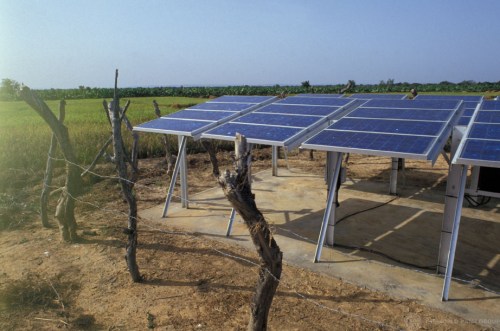
photo: Curt Carnemark /World Bank
At the Solar Power International conference this week, one of the more interesting panels was one that looked at bringing solar to the developing world. As I wrote in The New York Times:
By 2020, the world’s biggest potential solar markets will be found in the developing world, areas largely ignored by solar industry today, according to executives working to bring renewable energy to rural regions.
Just 1 percent of the world’s solar panel production has been installed in developing countries, said Michael Eckhart, the president of the American Council on Renewable Energy, during a panel discussion Tuesday at the Solar Power International conference in Anaheim, Calif.
“This is a scandal for our industry and we must find solutions,” said Mr. Eckhart, who has worked on solar projects in Africa and India.
The market in Africa, Asia and Latin America is potentially vast given that nearly 44 percent of the population of the developing world lacks access to electricity, according to Simon Rolland, a policy and development officer for the Alliance for Rural Electrification, based in Brussels.
Therein lies a conundrum: Bringing solar energy to those communities means building and financing off-the-grid solar arrays in remote locations that use batteries to store the electricity generated by the photovoltaic panels.
You can read the rest of the story here.
Posted in alternative energy, green policy, solar energy, SolarWorld | Tagged Alliance for Rural Electrification, American Council on Renewable Energy, developing world, off-grid solar, solar power, SolarWorld | Leave a Comment »
October 30, 2009 by Todd Woody

photo: Solar Power International
I spent the week at the Solar Power International conference in Anaheim, Calif., where some 22,000 people gathered for the industry’s biggest get-together in the United States. As I wrote in The New York Times, solar industry leaders are taking an aggressive new approach to pushing their agenda:
A solar industry leader smacked down the oil and coal industries on Tuesday, calling for renewable energy proponents to open their wallets to level the playing field in Washington.
“The full promise of solar power is being restrained by the tyranny of policies that protect our competitors, subsidize wealthy polluters and disadvantage green entrepreneurs,” said Rhone Resch, chief executive of the Solar Energy Industries Association, according to prepared remarks for a speech he is to give at the opening of the Solar Power International conference.
The event, being held in Anaheim, Calif., is the solar industry’s biggest annual get-together in the United States, and is usually a celebration of the industry’s breakneck growth of recent years.
But Mr. Resch said that with the fossil fuel industry devoting tens of millions of dollars to defeat climate change legislation now before Congress, the solar industry needs to start throwing its weight around Washington.
You can read the rest of the story here.
Posted in alternative energy, green policy, solar energy | Tagged coal industry, oil industry, Rhone Resch, solar industry, Solar Power International | Leave a Comment »
« Newer Posts - Older Posts »

 Green Wombat