Feeds:
Posts
Comments

photo: SolarCity

In The New York Times on Monday, I write about a $100 million tax equity fund created by PG&E Corporation to finance residential solar installations:

P.G.&E. Corporation, the California utility holding company, has created a $100 million tax-equity fund to finance residential solar installations by SunRun, a San Francisco start-up that leases photovoltaic arrays to homeowners.

The fund, managed by a P.G.&E. subsidiary, Pacific Energy Capital II, is the largest single solar leasing pool to date, according to the company, and marks the growing interest of utilities in the renewable energy financing business.

“We’re in somewhat of a unique position in that roughly half of the nation’s rooftop solar installations are in our service territory,” Brian Steel, P.G.&E.’s senior director of corporate strategy, said in an interview. “We’re at the proverbial ground zero of these new technologies and so perhaps more than any utility holding company in the country we have a strategic imperative to get ahead of the curve through having a propriety seat at the table with a partner like SunRun.”

The financing, announced Monday, follows P.G.&E.’s creation of a $60 million tax-equity vehicle in January for SolarCity, a Silicon Valley company that also leases solar arrays to homeowners.

The $100 million in financing is expected to fund solar installations for 3,500 homes in Arizona, California, Colorado, Massachusetts and New Jersey.

“That a major energy company like P.G.&E. is coming to the table illustrates that distributed solar is becoming part of the mainstream energy business,” said Edward Fenster, SunRun’s chief executive.

You can read the rest of the story here.

photo: eSolar

This post first appeared on Grist.

Amid all the hope and hype about the nascent solar boom under way in California, there’s long been an elephant in the room – transmission. Billions and billions of dollars must be spent to build and upgrade transmission lines to connect dozens of proposed solar power plants to the grid.

Now that elephant has rolled over and squashed one project’s use of innovative solar technology. Last year, California utility PG&E signed a deal with NRG Energy, a New Jersey-based electricity provider, to buy power from a 92-megawatt solar farm called the Alpine SunTower to be built near the desert town of Lancaster, northeast of Los Angeles.

The power plant would deploy solar thermal technology developed by eSolar, a Pasadena startup founded by serial technology entrepreneur Bill Gross. NRG and eSolar earlier had inked a partnership to build 500 megawatts’ worth of solar farms. In January, eSolar reached an agreement with a Chinese company to supply technology for solar farms that would generate a massive 2,000 megawatts of electricity.

PG&E, however, submitted a letter recently to the California Public Utilities Commission  asking approval for a re-negotiated deal with NRG that has resulted in a downsizing of the Alpine SunTower project to 66 megawatts. And instead of deploying eSolar’s fields of mirrors that focus the sun on a water-filled boiler that sits atop a tower to create steam to drive a turbine, the power plant will generate electricity from photovoltaic panels like those found on residential rooftops.

The utility gave no reason for the technology switch. “NRG has not finalized the exact type of panels or the manufacturer of the panels,” a PG&E executive wrote in the letter. “Solar PV panels have been used in installations throughout the world, in both small and utility scale applications.”

However, when I contacted eSolar about the change, I received a joint statement from the company and NRG:

“NRG is returning the project to its originally proposed size to match the transmission capacity available to the project at this time,” it said. “Maintaining the project as previously announced would require waiting for additional interconnection studies and potential transmission upgrades that would delay the project delivery date.”

While solar panels are not as efficient as eSolar’s solar thermal technology in generating electricity, they are modular – meaning you can just keeping adding them to produce a desired amount of power or to match the transmission capacity in an area. ESolar’s power plants, on the other hand, are designed to be built in 46-megawatt units so there’s far less flexibility in scaling them up or down.

It’s too early to say whether this portends other switches from solar thermal to photovoltaic technology, especially as solar cell prices fall and California utilities scramble to meet a mandate requiring they obtain 20 percent of their electricity from renewable sources by the end of this year and 33 percent by 2020.

But the elephant is getting restless.

photo: Todd Woody

In The New York Times on Thursday, I write about the solar industry’s dismay over the rent and other fees the United States government will charge developers to build big solar power plants on federal land in the desert Southwest:

The nation’s biggest landlord, the United States government, has set the rent it will charge developers who build solar power plants on federal land, and some prospective tenants are not happy.

Solar developers will actually pay two fees – the lease for the land along with what the Bureau of Land Management calls a “megawatt capacity fee” based on how much electricity a project generates.

“Since we don’t have authority to collect royalties for wind and solar projects, we had to come up with a methodology to convert that electrical generation into an upfront rent payment,” Ray Brady, manager of the bureau’s renewable energy team, said in an interview.

But potential developers see a disparity. “The proposed B.L.M. rental fees are in many cases two times higher than market rates for private land,” Monique Hanis, a spokeswoman for the Solar Energy Industries Association, said in an e-mail message. “The B.L.M. must collect ‘fair market value’ from developers, but this seems to go beyond that threshold.”

That methodology is a work in progress as the agency tries to adapt decades-old formulas designed for oil and gas leasing and mineral extraction to renewable energy production.

Some 23 million acres of federal property are suitable for large-scale solar development, according to the bureau, and the agency has received more than 200 lease applications from developers who covet hot and sunny desert real estate in the Southwest.

Solar farms typically require vast swaths of land, meaning the lease fees can be considerable depending on a project’s location and local property values. The Bureau of Land Management’s solar rents range from $15.70 an acre in Hidalgo County, N.M., to $313.88 an acre in Riverside County, Calif.

For instance, BrightSource Energy will pay the government about $427,000 a year in rent for its 3,400-acre Ivanpah Solar Electric Generating System in San Bernardino, Calif., now undergoing licensing. The company, based in Oakland, Calif., will also pay an annual megawatt capacity fee of $2.6 million for the 392-megawatt solar thermal power plant. Fees over the 25-year life of the contracts that BrightSource has signed with California utilities would total about $76 million.

In neighboring Riverside County, First Solar, a solar module maker and developer based in Tempe, Ariz., plans to build a 550-megawatt photovoltaic farm on 4,410 acres of federal land. Lease and capacity fees for the Desert Sunlight project will total about $4.3 million a year.

The agency is charging different capacity fees for different solar technologies. Photovoltaic power plants, which deploy solar panels like those found on residential rooftops, are assessed $5,256 a megawatt.

Developers of more efficient solar thermal power plant, which uses mirrors to heat liquids to generate steam that drives a turbine, pay $6,570 a megawatt. The same rate is charged for concentrating photovoltaic farms that use mirrors to focus the sun on a highly efficient solar cell.

If either technology uses energy storage systems to produce electricity when the sun doesn’t shine, the fee jumps to $7,884 a megawatt. The fees will be phased in over the first five years of a power plant’s operation.

Some developers and environmentalists argue that such a fee structure penalizes technologies that are more efficient and thus use less land.

“This is an unfortunate way of emphasizing one technology over another,” said Bobby McEnaney, a land program expert at the Natural Resources Defense Council.

You can read the rest of the story here.

photo: Think

This post first appeared on Grist.

“Honey, could you run down to the store and pick up some milk, tofu and one of those new Think City electric cars?”

That could be a conversation you’ll be hearing soon in Switzerland (in French, German Italian and Romansh, of course) now that Norwegian electric automaker Think has struck a deal with Swiss retailer Migros to market the City.

Sort of a cooperatively owned Costco, Migros is Switzerland’s largest supermarket chain and operates more than 600 stores across the country. In a deal announced Wednesday, Migros will sell the battery-powered Think urban runabout through a new division called M-Way.

“We have the key central retail locations all over Switzerland and beyond, now we want to use these bases to spread the news and sales of electric vehicles such as the Think City,” Herbert Bolliger, President of the Federation of Migros Cooperatives, said in a statement.

The announcement caught my attention because it’s a reminder that, one, not all green tech innovation is destined to happen here in California, and two, business model innovation will be just as important as technology itself in transforming electric cars from a niche to a knockout.

From its reincarnation a few years ago under the leadership of then-chief executive Jan Olaf-Willums, Think sought not to sell so much a car as mobility. Internet-enabled and connected to your mobile phone and the power grid, the plastic-bodied City was designed to plug into the transportation and electric power networks rather than be just another isolated hunk of metal rolling down the road.

You might buy the City but lease it’s battery or drive one when needed through a car-sharing service like Zipcar. Or from your neighborhood grocery store.

James Andrews, a Think spokesman, told me that sales of the City will begin this summer at Migros supermarkets. M-Way will initially set up retail outlets at Migros stores in urban areas.

It’s a smart strategy to expose consumers to electric cars. After all, how often do you casually stroll through car dealerships, which, in the United States at least, tend to be isolated in “auto rows” off the beaten path.

Now how often do you pop down to Whole Foods or Safeway for a gallon of milk? You’re probably likely to check out the City or another electric car if you pass it on the way to the wine aisle. Maybe you’ll even take one for a test drive around the block.

Migros’ M-Way already has sold a fleet of 60 Citys to Alpmobil, an eco-tourism company that will provide them for the use of its guests at a resort in the Swiss Alps.

Back in the 1990s, Think leased a previous version of the City to San Francisco Bay Area residents as part of a pilot project that let them plug the cars in to charge at train stations. Among the Think early adopters was a guy named Sergey Brin.

San Francisco is likely to be among the first U.S. cities to receive shipments of the latest City when Think begins selling the car in America later this year. Who knows, you might even be able to buy one at the farmer’s market one day.

This post first appeared in Grist.

As we know, one of the few beneficial side effects of the Great Recession of 2009 was the decline in global greenhouse gas emissions as our consumer-centric economy sputtered. But that also sent the voluntary carbon markets into a tailspin, according to a new report released Tuesday by Bloomberg New Energy Finance and Ecosystem Marketplace.

Voluntary carbon markets, such as the Chicago Climate Exchange, allow companies to trade carbon credits, usually as part of corporate sustainability programs where they pledge to neutralize greenhouse gas emissions by buying offsets tied to forestry programs, the capture of methane gas from landfills, and other efforts. (Such markets should not be confused with mandatory, regulated markets such as the European Trading Scheme.)

The value of greenhouse gas emissions credits traded on the voluntary markets plunged 47 percent in 2009 to $387.4 million, while the volume of greenhouse gas emissions traded fell 26 percent to 93.7 millions of tons of carbon dioxide equivalent (MtCO2e).

“The economic recession had a marked impact on the number of companies offsetting greenhouse gas (GHG) emissions,” wrote the report’s authors, who compiled data provided by more than 200 carbon credit suppliers and the carbon exchanges. “In response to the global financial crisis, companies cut back on discretionary funding for corporate social responsibility initiatives, including offsetting emissions. At the same time, the prospects for new compliance demand remained uncertain.”

Still, even in a recession the volume of greenhouse gas emissions traded in 2009 was 39 percent higher than in 2007.

Interestingly, the regulated carbon markets powered through the downturn, growing 7 percent with 8,625 MtCO2e traded at a value of $144 billion, according to the report.

The United States became the world’s biggest supplier of voluntary carbon credits for the first time last year, followed by Latin America and Asia.

Methane-related projects accounted for 41 percent of offset credits while forestry programs were tied to 24 percent of credits and renewable energy to 17 percent.

“Survey respondents were highly positive about the prospects for the global voluntary markets and collectively believe transactions will increase to approximately 400 MtCO2e in 2012, 800 MtCO2e in 2015, and 1,200 MtCO2e in 2020,” the report concluded. “Whether this growth will actually be achieved remains to be seen; it does demonstrate a strong sense of optimism for future activity in the voluntary marketplace.”

photo: Skyline Solar

This post first appeared on Grist.

Grist’s David Roberts sent out a Tweet to his Tweeps today asking which city has installed the most solar. I’ve got an answer for you, David: Nipton, California.

The desert micropolis – population 38 – announced Thursday that it had installed a solar array that will provide 85 percent of its electricity. (The population of the outpost on the edge of Mojave National Preserve spikes to 250 or so during tourist season.)

The solar system is ground-mounted rather than on rooftops and only generates 82 kilowatts. But what is notable is the technology developed by Skyline Solar, a Silicon Valley startup I first wrote about for Grist last year.

The company’s power plants resemble solar thermal parabolic trough installation that deploy long rows of mirrors to heat tubes of liquid suspended over the arrays to create steam that drives an electricity-generating turbine.

Skyline’s system is purely solid state, however. Each 120-foot-long trough concentrates the sun on photovoltaic modules attached to the edges of the arrays. That boosts the solar cell’s electricity production as does a tracking mechanism that allows the arrays to follow the sun throughout the day.

Such concentrating photovoltaic systems – which Skyline calls “high gain solar “ – have been a niche market due to their relatively high costs. But as solar cell prices decline and solar thermal projects get bogged down in environmental disputes, they have become increasingly attractive as they can be built near utility substations and plugged directly into the grid without the need to build expensive new transmission systems.

Skyline has pushed to lower costs by using common materials – glass, steel – and designing the arrays so their components can be mass-produced by automotive manufacturers. The company last year struck a deal with the Michigan subsidiary of Canadian auto manufacturing giant Magna International to make components for its HGS 1000 solar system.

In other news on the solar frontier Thursday, Silicon Valley startup MiaSolé said the National Renewable Energy Laboratory had confirmed that the company’s copper indium gallium selenide solar cells have 13.8 percent efficiency in production. Such thin-film cells typically have a lower efficiency than standard polysilicon solar cells but are cheaper to manufacture. But with an efficiency approaching 14 percent, MiaSolé could give some standard module makes a run for their money.

photo: Duke University

In The New York Times on Thursday, I write about how scientists are using machines designed to measure greenhouse gas emissions to fingerprint the Gulf oil spill to calculate its size and movements:

Scientists from Texas A&M and the University of California, Santa Barbara, will try to measure the size of the gulf oil spill more precisely by taking continuous measurements of methane with machines that can also fingerprint deep-water oil plumes to track their dispersal.

“What’s coming out of the spill currently is 40 percent methane by weight,” Dr. John Kessler, an assistant professor of oceanography at Texas A&M, said in an interview. “We’ll be measuring methane in the water and the atmosphere every 10 seconds, which will gives us an unprecedented amount of data.”

After sailing to Gulfport, Miss., on their research vessel, the Cape Hatteras, Dr. Kessler’s team and a group of researchers from the University of California, Santa Barbara, are scheduled to set out on Saturday to conduct measurements. The voyage is being financed by a $160,000 grant from the National Science Foundation.

Other expeditions, including one led by Samantha Joye of the University of Georgia, have been measuring the extent of the oil spill and taking methane measurements. The difference in Texas A&M’s approach is in technology and technique, Dr. Kessler said.

As the Cape Hatteras travels around the gulf, water will be pumped into a device called a seawater equilibrator in which gases in the water are equalized with air. An analyzer made by Picarro, a Silicon Valley company, will then continuously measure the methane concentrations.

The $50,000 Picarro machines are about the size of a desktop computer and take precise, real-time measurements of greenhouse gases like carbon dioxide and methane. The company has sold its analyzers to the National Oceanic and Atmospheric Administration, governments in China and California, and to academic scientists.

A conventional gas chromatograph allows measurements to be taken only every 5 to 10 minutes, Dr. Kessler said.

You can read the rest of the story here.

This post first appeared on Grist.

Legislation pending in New York that would require the state to install 5,000 megawatts of solar power by 2025 could generate 22,198 jobs and boost the economy by $20 billion, according to a report released by Vote Solar on Wednesday.

The cost to consumers would be just a 39-cent-a-month hike on their utility bills, the report found.

Vote Solar, a San Francisco non-profit that is backing the bills in the New York legislature along with the Natural Resources Defense Council and other environmental groups, commissioned the study conducted by Crossborder Energy. Described as an independent consultant, Crossborder relied on economic models developed by the National Renewable Energy Laboratory to make its projections.

“We note that in an effort to be conservative in our assumptions, these benefits are calculated without taking into account any potential new manufacturing,” the report stated. “Precedent shows that states that make a clear commitment to clean energy see reciprocal investment on behalf of manufacturing companies. For example, in both Arizona and California, the states’ strong and transparent policies were fundamental to the decisions of two major global solar manufacturers…to locate their first domestic manufacturing operations in those states.”

New York currently has less than 25 megawatts of solar installed. The New York Solar Jobs and Development Act would require the state’s utilities to install enough solar to account for at least 2.5 percent of their electricity sales by 2025. Those targets could be reached through residential and commercial rooftop solar installations or by building solar power plants. Utilities could own and operate their own solar power facilities to meet 25 percent of their mandate.

But the legislation does not specify incentives or other policies to encourage solar installations, which would inevitably affect the cost of the program for developers and consumers.

This post first appeared on Grist.

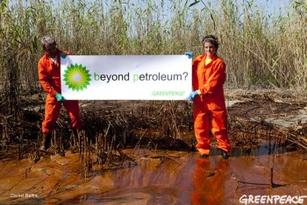
I generally don’t write much about big business, but in light of the implosion of BP’s  “green” oil company image — it’s looking more Exxon than eco — I went to a dinner Monday night in San Francisco attended by dozens of Fortune 500 executives committed to corporate sustainability. (There were reportedly a few BP execs in the audience but not surprisingly they seemed to keep a low profile.)

The occasion was the Corporate Eco Forum, an organization that brings together multinationals ranging from AT&T to Yahoo to hash out strategies for sustainable business.  The occasion for the gathering at the Asian Art Museum was to give an award to Walmart Brazil’s chief executive for the company’s efforts to stop the illegal logging of the Amazon rainforest to grow soybeans and raise cattle.

More on that later. Usually at these events, there can be expected to be a fair amount of feel-good cheerleading among the corporate tribe. But most of the speakers Monday were more gently chastising than congratulatory.

“Being British here, I speak sensitively at the moment as I only have turn on an American channel to see a British brand struggling with public resonance,” said Lord Michael Hastings, global head of citizenship and diversity for KPMG International, the giant consulting firm. “The reality is that such exceptional deepwater drilling only comes about, in the words of President Obama in a speech last week in Phoenix, where he said because of America’s desperation to continue the fight for fossil fuels.”

“And we have to face the fact that we play heavy risks with the natural environment, with the sustainability of our planet and the reality actually of water ecosystems, which are now so signficantly threatened by the oil spill because we have lifestyles that necessitate extreme exploration.”

“We have to actually face the responsiblity of the lifestyles we’ve chosen and be ready to change them,” he added.

Hastings said the oil spill underscores how water shortages as much as peak oil will be a defining challenge of the 21st century.

He talked about attending a recent event at a hotel in China where bottled water from France was on offer. “Come on, let’s just stop this,” he said to an audience that included executives from Coca-Cola.  “There are thousands of children and adults that simply have no access to clean water. And if we think this pressure on oil is giving us hassle and stress, it’s nothing like the issues on water that will drive us to fight one another, to argue with one another and to war with one another as we’ve never done before.”

Mindy Lubber, president of Ceres, an organization that works on corporate sustainability issues, told the executives that on a scale of 1 to 100, even the most enlightened big companies rate only a 7 or 8 in their efforts to green up their operations.

She did note that Walmart Brazil was pushing ahead. The company last year pledged not to sell products sourced from illegal logging of the Amazon and obtained agreements from companies in its supply chain to take action to protect the rainforest.

When Walmart Brazil’s chief executive, Héctor Núñez, took the stage to receive his award he sounded more Greenpeace than Wall Street.

“The environmental situation of Brazil, the planet, is not sustainable,” he said. “As you know, there’s a real chance that the planet’s temperature will increase 2 to 3 degrees by 2050. Think of the direct financial impact on global warming on the environment and human health….Consumers will demand social and environmental action.”

The conundrum, of course, for all these companies and their customers is how to create a sustainable business model and a sustainable planet in a global economy dependent on ever-increasing consumption to fuel prosperity.

In my new Green State column on Grist, I write about GreenRoad, a Silicon Valley startup that uses technology to change drivers’ behavior to cut fuel use — and greenhouse gas emissions — as well as accidents:

I recently took the Chevrolet Volt for a spin near San Francisco’s ballpark, checking another item off my electric-car life list. (Getting to drive pre-production EVs is one fringe benefit of covering green tech.)

Then the other week, I took a drive in another car that promised to help cut greenhouse gas emissions. The car itself was unremarkable — a Lexus RX hybrid that anyone with a spare $42,000 can buy. What was potentially revolutionary was the little black box sitting on the dashboard to the left of the steering wheel.

The box had three lights and when the car’s driver makes a fuel-wasting or dangerous move, such as slamming on the brakes, making fast, sharp turns or weaving through traffic — the LEDs go from green to yellow to red.

See, the problem, dear reader, isn’t just your carbon-spewing car, it’s you.

“There are habits that people fall into that they get away with all the time and by making slight changes in those habits you crash a lot less often and you burn less fuel,” says Dan Steere, chief executive of GreenRoad, a Silicon Valley startup that installs that little black box and other technology in commercial vehicle fleets. GreenRoad is backed by Richard Branson’s Virgin Green Fund and Al Gore’s Generation investment firm.

The road to a sustainable future, in other words, will be paved not just with shiny new gadgets that help cut fossil-fuel consumption, but also by new technology designed to change people’s planet-unfriendly behavior.

“Most of the focus around safety and fuel consumption has been about making a vehicle less lethal when it crashes or inventing entirely new systems like the Volt to try and make the vehicles better,” says Steere. “Ninety percent of crashes are caused by a bad decision the driver made, and the EPA has said that 33 percent of fuel consumption is due to driver behavior.”

GreenRoad attempts to change drivers’ fuel-wasting ways by giving them constant feedback — the little black box — and by sending them weekly emails that analyze their driving and offer tips for improvements.

The payoff for GreenRoad’s corporate customers, according to Steere, is fewer accidents and a lower bill at the pump, all without having to make capital investments in new vehicles.

You can read the rest of the column here.

Design a site like this with WordPress.com
Get started