Feeds:
Posts
Comments

photo: EcoVeggies

In The New York Times on Monday, I write about how Newark is becoming a hotbed of sustainable agriculture, or Ag 2.0:

On the rooftop garden at St. Philip’s Academy, a private school in Newark, students tend plots of everything from broccoli and beets to sweet corn and spaghetti squash.

But since August they’ve also been helping to farm arugula, chervil, fun jen, and komatsuna in a machine installed in a fourth-floor science classroom that grows crops without soil or sunshine.

Made by an Ithaca, N.Y., company called AeroFarms, the aeroponic growing system is owned by EcoVeggies, a startup formed by former three Wall Street technology workers who aim to transform Newark’s abandoned and vacant buildings into so-called vertical farms.

“The produce will sold and used in the areas immediately surrounding Newark to start with and then we expect to be able to service the immediate tri-state area,” Richard Charles, one of EcoVeggies founders, wrote in an e-mail message.

At St. Philip’s Academy, leafy greens are planted in a cloth bed and irrigated with a nutrient-infused mist. Light is provided by LED lamps, which are more energy-efficient than conventional lighting and can be placed closer to the beds. The LED lamps also provide pest control, according to AeroFarms’ chief executive, Ed Harwood, because they can be set to emit certain wavelengths that disrupt insects’ breeding.

AeroFarms is leasing the machine, which stands 7 feet tall by 10 feet long, to EcoVeggies for use in the pilot project at St. Philip’s. It can produce about 20 pounds of produce per harvest, Mr. Charles said.

EcoVeggies and AeroFarms are part of the sustainable agriculture movement, sometimes called Agriculture 2.0, which seeks to combine technology and organic farming to grow crops in urban areas that often lack access to fresh food.

You can read the rest of the story here:

photo: California Energy Commission

In Friday’s New York Times, I wrote about California regulators’ licensing of a 1,000-megawatt solar thermal power plant, which would be the world’s largest solar energy complex:

California regulators have licensed what is for the moment the world’s largest solar thermal power plant, a 1,000-megawatt complex called the Blythe Solar Power Project to be built in the Mojave Desert.

By contrast, a total of 481 megawatts of new solar capacity was installed in the United States last year, mostly from thousands of rooftop solar arrays, according to the Solar Energy Industries Association, a trade group.

“Given the challenge of climate change at this time, it is very important to reduce fossil fuel use by moving forward with the largest solar project in California,” Robert Weisenmiller, a member of the California Energy Commission, said at a hearing Wednesday in Sacramento after a unanimous vote to approve the Blythe project.

“We’re taking a major step toward reducing the threat of future climate change impacts on the state, and at the same time the other real challenge for the state is the economy,” he added, referring to 604 construction jobs and 221 permanent jobs that the Blythe project would create in an area of California where the unemployment rate was 15 percent this summer.

After years of environmental reviews, the California Energy Commission has in the past three weeks licensed solar thermal farms that would generate 1,500 megawatts of electricity when completed.

A commission spokeswoman said the commissioners anticipated making licensing decisions by the end of 2010 on additional solar projects that would produce another 2,829 megawatts. At peak output, those solar farms would generate the equivalent electricity produced by several large nuclear power plants.

Developers are racing to start construction before federal tax incentives for big renewable energy projects expire at year’s end.

If all the projects are built, they would create 8,000 construction jobs and 1,000 permanent jobs, according to the energy commission.

At peak operation, the Blythe solar complex would supply enough electricity for 800,000 homes. The multibillion-dollar project will be built in four 250-megawatt phases.

It is notable for being the first big solar project to be licensed that would be built on federal land. The United States Bureau of Land Management is expected to decide by the end of October whether to approve the Blythe complex.

The project will be constructed by Solar Millennium, a German developer, and will cover 9.3 square miles in Riverside County in Southern California with long rows of parabolic troughs. The solar reflectors focus the sun on liquid-filled tubes suspended over the mirrors to create steam that drives an electricity-generating turbine housed in a central power block.

You can read the rest of the story here.

I wrote this story for Grist, where it first appeared.

The campaign against Proposition 23, the California ballot initiative that would suspend the state’s global warming law, took in more than a half million dollars in contributions this week. Meanwhile, fundraising by the oil companies backing the measure was so lackluster it prompted a plea for help from the petrochemical industry.

“A defeat for Proposition 23 in California could energize environmental fanatics around the country and in Washington to match California’s destructive policies with their own versions of AB32,” wrote Charles T. Drevna, president of the National Petrochemical & Refiners Association, in an email first reported by The New York Times. “We’ve raised about $6 million so far, but unfortunately in California’s expensive media market this is not enough to win the fight against environmental zealots led by Gov. Arnold Schwarzenegger, who seems hell-bent on becoming the real-life Terminator of our industry.”

“I am pleading with each you,” Drevna continued, “for our nation’s best interest and for your company’s own self-interest, please contact me and tell me how much you can contribute to this critical effort as soon as possible. Nov. 2 is drawing near.”

The Texas oil companies backing the initiative made news recently when they secured a $1 million donation from the billionaire Koch brothers, who bankroll various right-wing causes. But the only sizeable donation to the Yes on 23 campaign this week came from Tower Energy Group, a Southern California-based petroleum wholesaler, which contributed $100,000 on Monday. Meanwhile, according to campaign finance records, the anti-Prop 23 forces have been having a pretty good few weeks.

On Monday, Susan Packard Orr, yet another daughter of David Packard, the late co-founder of Hewlett-Packard, contributed $250,000 to the No campaign. She joins her two sisters who have given a total of $201,895 to the effort to defeat Prop 23.

On Wednesday, William Patterson of SPO Partners, a Marin County, Calif., private investment firm, also gave $250,000. The California chapter of the Audubon Society stepped up with a $100,000 donation last week. Earlier in the month, Environment California, a non-profit, made a $100,000 contribution.

Another non-profit, the San Francisco-based Tides Foundation, put in $40,000 while a high-profile San Francisco real estate magnate, Douglas Shorenstein, contributed $25,000.

The big Silicon Valley venture capitalists, who vociferously oppose a ballot initiative that could derail the billions of dollars they’ve invested in green technology startups, have largely remained no-shows on the No on 23 donor roll. Though Tom Baruch, founder of CMEA Capital, did give $25,000 on Wednesday, and John Doerr, a leading green tech investor with Kleiner Perkins Caufield & Byers, is a notable exception with his $500,000 investment to defeat Prop 23.

If Silicon Valley’s venture capitalists decide to open their checkbooks, game on.

Photo: WorldWater & Solar Technologies

I wrote this story for Grist, where it first appeared.

Carbon neutral jumbo jets may be a long way off but some airports are making strides in cutting their greenhouse gas emissions.

Denver International, for instance, announced Tuesday that it will install a 4.4-megawatt solar array, more than doubling the 2 megawatts’ worth of photovoltaic panels the airport built in 2008. Earlier this year, Denver signed a deal for a third array, which will generate an additional 1.6 megawatts of electricity.

Yingli Green Energy is providing the 19,000 panels for the 4.4-megawatt project. A Yingli spokesperson told me that altogether, the photovoltaic arrays will supply on average about 6 percent of the airport’s electricity demand. But on days when the sunshine is intense, the solar farm would generate enough electricity to meet nearly a third of Denver International’s electricity needs.

When completed in 2011, the 4.4-megawatt installation will be Colorado’s largest commercial solar project. But what’s really notable is the photovoltaic module maker supplying the solar panels, Yingli.

The Chinese company only entered the United States in 2009 and by that year’s end had captured nearly a third of the California solar market, the bright star of the U.S. solar system. Low-cost Chinese solar companies now supply almost half the California market, according to Bloomberg New Energy Finance, a consulting and research firm.

The Denver deal is another sign that Yingli and other Chinese solar panel makers are shaking up the U.S. market as they move beyond their California base.

In other news, another relatively little-known Chinese firm, Solarfun, said Monday it struck a deal to supply 9.5 megawatts’ worth of solar modules to Martifer Solar, the U.S. subsidiary of a Portuguese renewable energy company, which will install them at projects in California and Colorado.

“Solarfun is focused on the U.S. market as one of our primary growth drivers going forward and we expect Martifer to be a key partner as we continue to build market presence and share,” Bruce Ludemann, the vice president and general manager of Solarfun’s North American operations, said in a statement.

Such success may cause consternation in the executive suites of rivals from Bonn to Silicon Valley, where low-cost Chinese manufacturing is forcing competitors to become even more efficient and maintain their technological edge.

But in the end, the China’s ability to secure such large deals shows that the solar market truly is taking off.

In Wednesday’s New York Times, I wrote about two experimental projects in California to store solar energy produced by photovoltaic rooftop arrays:

In the garage of Peter Rive’s San Francisco home is a battery pack. It is not connected to Mr. Rive’s electric Tesla Roadster sports car, but to the power grid.

The California Public Utilities Commission has awarded $1.8 million to Mr. Rive’s company, SolarCity, a residential photovoltaic panel installer, to research the feasibility of storing electricity generated by rooftop solar arrays in batteries.

As rooftop solar systems provide a growing percentage of electricity to California’s grid, regulators and utilities are increasingly concerned about how to balance the intermittent nature of that power with demand.

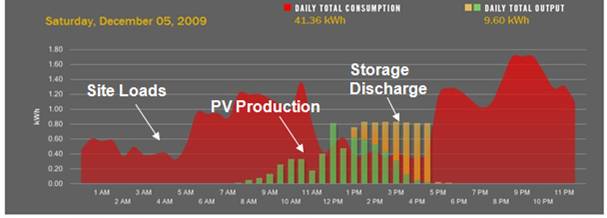
One possible solution is to store energy generated by solar arrays in batteries and other systems and then feed that electricity to the grid when, say, a cloudy day results in a drop in power production. And when demand peaks, electricity generated from renewable sources could be dispatched from batteries rather than fossil-fuel burning power plants.

“As soon as distributed solar starts providing 5 to 10 percent of demand, its intermittent nature will need to be addressed,” said Mr. Rive, who is SolarCity’s co-founder and chief operating officer.

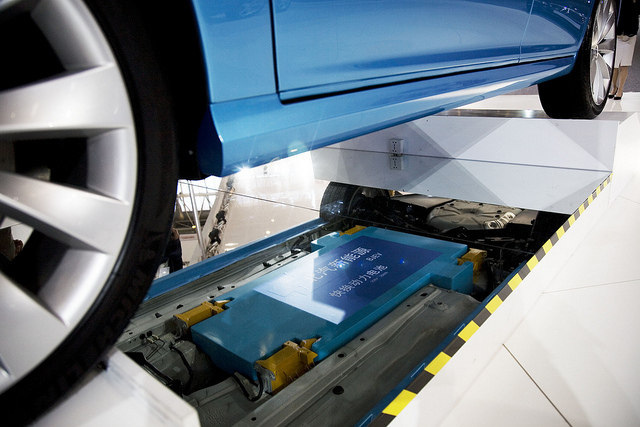
SolarCity is teaming with Tesla Motors, the Silicon Valley electric car company run by Mr. Rive’s cousin, Elon Musk, and the University of California, Berkeley, to study how to integrate solar arrays and off-the-shelf Tesla lithium-ion battery backs into the grid. SolarCity plans to put such systems in six homes.

“We think in the years ahead this will be the default way that solar is installed,” Mr. Rive said. “Getting the costs down, though, is not going to be an easy task.”

Homeowners could potentially benefit by tapping batteries at hours when electricity rates are high or using them to provide backup power if the grid goes down.

The research has just begun, and at the moment SolarCity is testing the impact of charging and discharging electricity from the Tesla battery pack in Mr. Rive’s garage. His roof sports a three-kilowatt solar array.

“We’re at the point now where we can direct the battery to charge and discharge at specific times by sending a signal over the Internet,” Mr. Rive said.

Included in the $14.6 million awarded for solar energy storage research by the utilities commission was $1.9 million to SunPower for a project that will store in ice and batteries electricity generated by solar arrays at Target stores.

SunPower, a Silicon Valley solar panel manufacturer and power plant developer, will work with Ice Energy, a Colorado company that makes systems that use electricity when rates are low to form ice. When rates are high, air conditioning refrigerant is cooled by the melting ice rather than by an electricity-hogging compressor.

The Ice Bear system and a solar array will be installed at one Target store while battery packs will be used at two other stores in California.

You can read the rest of the story here.

I wrote this story for Grist, where it first appeared.

The federal energy efficiency cops are on the beat – finally.

For the first time in 35 years, the United States Department of Energy is moving to enforce decades-old energy efficiency and water conservation standards for products like refrigerators, light bulbs and shower heads.

On Monday, the Energy Department said it had filed enforcement actions against 27 companies for failing to certify their products comply with energy efficiency and water conservation regulations.

“As a part of its mission to help consumers purchase energy efficient products that will save them money, the Department sets energy efficiency standards for a vast array of consumer and commercial products,” wrote Scott Blake Harris, the Energy Department’s general counsel in a blog post Monday. “But when I arrived at DOE, I was stunned to discover that the Department had never systematically enforced DOE’s 35-year-old energy efficiency standards.”

“The problem, of course, is that lax enforcement of energy efficiency standards undermines the goal of increased energy efficiency,” he added. “When efficiency standards are not regularly enforced, bad actors soon learn that they can gain an unfair economic advantage over law-abiding competitors by falsely or improperly certifying the efficiency of their products. This not only distorts competition in the short-term, but it undermines the kind of long-term competition that drives innovation.”

The Energy Department filed complaints against companies ranging from ASKO, the Swedish maker of upscale appliances, to Duralamp.

But the enforcement actions announced Monday will hardly make chief financial officers tremble.

General Electric, for instance, faces a maximum fine of $252,140 for not certifying that some dehumidifier models comply with energy efficiency standards. But the Energy Department proposed a civil penalty of $36,500 and informed GE —  and other companies targeted for enforcement — that it would drop the case for $5,000 if the global conglomerate agreed to settle within 30 days and come into compliance.

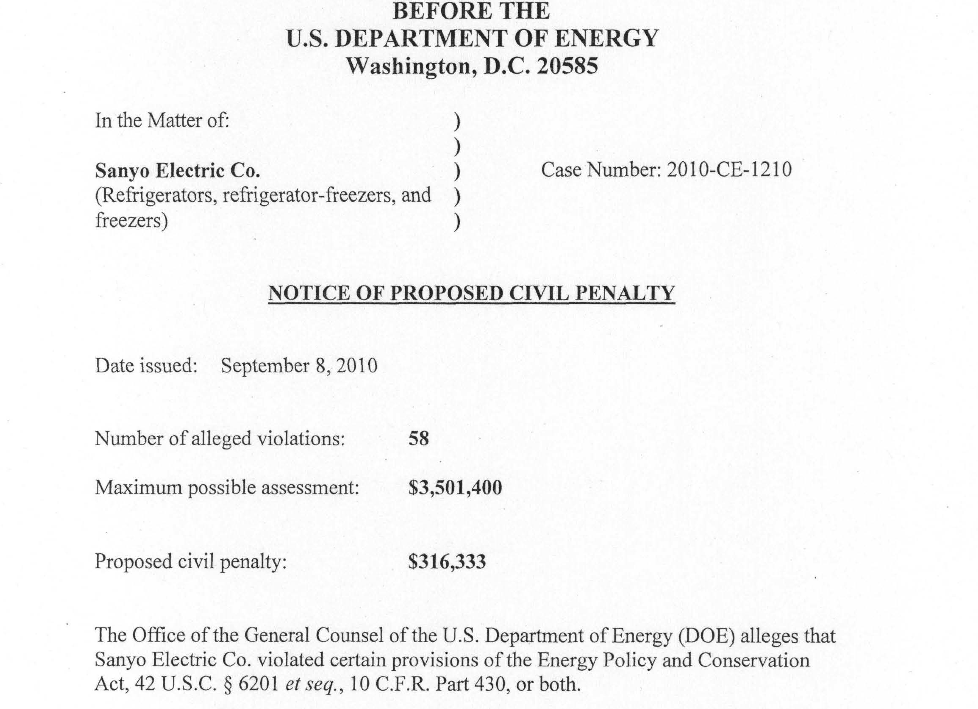
Likewise,  Sanyo faces a maximum fine of $3.5 million for 58 violations involving its refrigerators and freezers. The proposed penalty is $316,333 but the Energy Department will settle for $10,000.

The Energy Department says that as a result of its enforcement program it has removed from the market 66 products that violated energy efficiency standards and filed a total of 75 enforcement actions to date.

“Before our effort, the number of products that had been removed from the market was zero,” noted the department’s general counsel.

I wrote this story for Grist, where it first appeared.

The same day this week that The New York Times published an extensive report by correspondent Keith Bradsher on China’s massive subsidies for renewable energy companies, Ernst & Young released a study showing that, not surprisingly, China has overtaken the United States as the most attractive place for green tech investment.

“China’s steady rise to pole position has been underpinned by strong and consistent government support for renewable energy,” Ben Warren, Ernst & Young’s environment and energy infrastructure advisory leader, said in a statement. “This, together with substantial commitment from industry and the sheer scale of its natural resources, means that its position as top spot for renewable energy investment is well merited.”

Some of that government support may violate World Trade Organization rules. On Thursday, an American union, the United Steelworkers, filed an unfair trade complaint against China with the Office of the United States Trade Representative.

But the Ernst & Young report points to failures on the part of the U.S. government to take action that would attract green investors.

For one thing, Congress has so far failed to establish a national Renewable Energy Standard that would require the country’s utilities to obtain a certain percentage of electricity from non-carbon-emitting sources.

Also, a federal tax subsidy program that is spurring construction of big solar power plants expires at the end of the year and legislation to extend the incentives is languishing in Congress.

“Although the United States remains a highly attractive location for investors in renewable energy, it is clear that recent events have eased momentum,” said Warren. “The U.S. market continues to have significant potential but requires consistent legislative support to provide investors with the long-term confidence they need.”

China, in contrast, “aims to reach an installed capacity of 300GW [gigawatts] of hydro, 70GW of nuclear, 100GW of wind, and 20GW of solar capacity by 2020,” according to the Ernst & Young study.

Reports by the U.S. Energy Information Agency provide a glimpse of the green imbalance of trade between the two countries. The figures from 2008 — apparently the latest available from the government — show that fewer than 1 percent of U.S.-made solar modules were shipped to China while nearly 23 percent of Chinese-made photovoltaic modules were exported to the U.S.

Since then, Chinese imports have risen dramatically. At the end of 2009, for instance, Chinese firms supplied about half the California solar market alone, according to Bloomberg New Energy Finance, a consulting firm.

What China is not exporting, of course, is green jobs.

I wrote this story for Grist, where it first appeared.

Talk about sporting greens: On Wednesday, all of the United States’ professional sports leagues said they would distribute a guide on how to switch to renewable energy and urge their teams to solarize their stadiums.

The guide was prepared by the Natural Resources Defense Council (NRDC) and the Bonneville Environmental Foundation and marks a new alliance between environmentalists and the nation’s baseball, football, hockey, and soccer teams.

“It’s not a league mandate, it’s not a requirement for stadiums and arenas to install solar panels, but it indicates an important cultural shift recognized by professional sports that all arenas and stadiums in the country should at least consider and evaluate the opportunity that solar power might provide,” Allen Hershkowitz, a senior scientist with the NRDC, said during a conference call Wednesday.

“Frankly, sports matter. Sports matter a lot,” he added. “Sports is one of the most iconic and influential sectors of our society and frankly we need to have a cultural shift as well as a technical and economic shift if we’re going to advance and move to sustainability.”

In other words, if Jill Six-Pack sees that the Yankees have gone solar she might consider doing the same.

“We really have the ability to shift the dial,” said Darryl Benge, the assistant general manager of Qwest Field in Seattle, home to the Seahawks and Sounders. “We basically bring together small cities on game day.”

Representatives from the National Basketball Association, the National Hockey League, and other stadiums said that economics as well as the environment were pushing them to go green.

Benge noted that Qwest Field’s electricity rates had jumped 18 percent this year, which played a part in the stadium’s decision to solicit bids to install a 600-kilowatt solar array.

In Los Angeles, the Staples Center flipped the switch on a 345.6-kilowatt photovoltaic system that has so far saved $100,000 in electricity costs, according to Lee Zeidman, executive vice president for operations for the facility.

The Staples Center has gone beyond solar to install waterless urinals that save seven million gallons of water annually, and switched to non-toxic cleaning products.

Other teams have tackled the waste issue. Scott Jenkins, the vice president of ballpark operations for the Seattle Mariners, said the team has saved $1 million over three years by recycling 80 percent of the waste generated at games.

Gary Betteman, commissioner of the National Hockey League, said 30,000 shopping bags were replaced with reusable totes during the Stanley Cup, and he noted that several NHL venues have installed solar panels.

Stadium managers acknowledged that sports’ biggest carbon footprint comes from fans driving to and from games. The challenge, they said, will be to get more fans to take public transportation as well as to build arenas in urban areas with accessible mass transit.

For his part, Hershkowitz said he was astounded that it has taken the environmental movement 40 years to forge a strong alliance with professional sports.

“If you want to change the world you don’t emphasize how different you are from everybody else,” he said. “You focus on your similarities.”

I wrote this story for Grist, where it first appeared.

Want to help solve the global water crisis? Step away from your laptop and let it join millions of other computers being used by scientists who will tap idle processing power to develop water filtering technology, clean up polluted waterways, and find treatments for water-related diseases.

Those were among the projects announced Tuesday by IBM, which sponsors a global network of linked personal computers called the Worldwide Community Grid.

The idea of aggregating thousands of individual computers to create a virtual supercomputer is nothing new — searchers of extraterrestrial life and scientists seeking medical cures have been doing that for years. But this is apparently the first time the approach has been used to tackle one of the planet’s bigger environmental problems.

In China, Tsinghua University researchers, with the help of Australian and Swiss scientists, will use 1.5 million computers on the Worldwide Community Grid to develop nanotechnology to create drinkable water from polluted sources, as well as from saltwater.

To do that, the scientists need to run millions of computer simulations as part of their “Computing for Clean Water” project.

“They believe they can collapse tens or even hundreds of years of trial and error into mere months,” Ari Fishkind, an IBM spokesperson, told me.

Big Blue is providing computer hardware, software, and technical help to the Worldwide Community Grid. But Fishkind says the company doesn’t anticipate the effort will have a commercial payoff for its own water filtering membrane efforts.

“We will be watching Tsinghua University’s progress closely, but the two projects are not directly related,” he said in an email message. “While IBM’s research focuses on a broad application of filtering technology/technique, including industrial applications, Tsignhua’s focus is drinking water.”

Brazilian scientists, meanwhile, will plug into the grid to screen 13 million chemical compounds in their search for a cure for schistosomiasis, a water-borne tropical disease that kills between 11,000 and 200,000 people annually.

In the United States, the Worldwide Community Grid will be used to run complex simulations that assess how actions by farmers, power plant operators, real estate developers, and others affect the health of Chesapeake Bay, the nation’s largest estuary.

“Responsible and effective stewardship of complex watersheds is a huge undertaking that must balance the needs of each unique environment with the needs of the communities that depend on them for survival,” said Philippe Cousteau, co-founder of Azure Worldwide, a firm that is participating in the project.

To join the Worldwide Community Grid, you just need to download a piece of software from the group’s site.

Oh, and stay off Facebook and Twitter for a bit.

photo: Better Place

In The New York Times on Monday, I wrote about the challenges of developing electric car batteries that will match the range of gasoline-powered vehicles:

Silicon Valley may be an epicenter of the nascent electric car industry, but don’t expect the battery revolution to mimic the computer revolution, one of I.B.M.’s top energy storage scientists advises.

“Forget Moore’s Law — it’s nothing like that,” said Winfried Wilcke, senior manager for I.B.M.’s Battery 500 project, referring to the maxim put forward by Gordon Moore, an Intel founder, that computer processing power doubles roughly every two years.

“Lithium ion, which clearly is the best battery technology today, is flat, completely flat since 2003,” Mr. Wilcke said last week at a gathering in San Francisco attended by executives from I.B.M. and Better Place, a Silicon Valley electric car infrastructure company.

Mr. Wilcke’s team at the Almaden Research Center of I.B.M. in San Jose, Calif., is trying to develop a new battery technology called lithium air that could allow a car to go 500 miles on a single charge. Most electric cars coming onto the market this year have a range of around 100 miles.

Such batteries theoretically could pack 10 times the energy density of the lithium ion batteries now used in electric cars because they use air drawn in from outside the battery as a reactant. That means lithium-air storage devices weigh less than lithium-ion batteries, a factor that also improves the performance of electric cars.

“I always compare it to climbing Mount Everest,” Mr. Wilcke said. “In the last two months, we just left base camp — meaning that we actually made some pretty significant breakthroughs.”

He declined to give details but said that his team had shown that lithium-air batteries could be recharged, something that had not been done before.

“It will take many years, if ever, before it can be useful,” he said. “It’s a high-high-risk project.”

He illustrated the challenge of building a battery with the energy density of gasoline by recounting that it took 47 seconds to put 13.6 gallons of gas in his car when he stopped to fill up on the way to San Francisco. That’s the equivalent of 36,000 kilowatts of electricity. An electric car would need to pump 6,000 kilowatts to charge its battery.

“The dream that we have today to have exactly the same car charge up in minutes and drive off hundreds of miles cannot happen,” Mr. Wilcke said. “Or at least not for 50 years.”

Mr. Wilcke and Lawrence Seeff, head of global alliances for Better Place, dismissed the idea that the fast-charging stations being tested in California and elsewhere were a solution to the battery conundrum.

Depending on the battery, high-voltage stations can recharge a battery to 80 percent capacity in 20 to 30 minutes rather than in the 8 to 10 hours it takes with a more conventional charging station.

Allan Schurr, I.B.M.’s vice president for strategy, energy and utilities, noted that the cost to drivers of plugging in to a rapid charging station might be prohibitive, given the demands that the devices place on the electric grid.

“It’s physically possible to have a fast-charge mechanism and a fast-charge outlet, but can the grid support it?” Mr. Seeff said. “And what do we define by fast-charging? Is it 20 minutes, 10 minutes, 30 minutes? Because if you have two people waiting to fast-charge, you could be waiting an hour.”

You can read the rest of the story here.

Design a site like this with WordPress.com
Get started