Feeds:
Posts
Comments

Archive for the ‘solar energy’ Category

photo: Todd Woody

I made my debut on Reuters on Thursday with a scoop on one of China’s biggest solar companies forming a joint venture with California’s SolarReserve to build photovoltaic power plants in the United States:

A subsidiary of China’s GCL-Poly Energy Holdings Ltd has formed a joint venture with SolarReserve, a California developer, to build photovoltaic power plants in the United States.

The deal, to be announced Thursday, marks a major bid by a Chinese solar company to enter a market dominated by European and U.S. firms. Last week, GCL obtained a commitment from Wells Fargo to provide $100 million in financing for its solar projects.

GCL is China’s largest manufacturer of polysilicon and wafers used to make photovoltaic modules. The company also builds conventional power plants in China along with wind and solar projects. The state-owned China Investment Corporation owns a 20 percent stake in GCL.

“We value the U.S. market as one of the most important markets for us and we wanted to get into the development side of the game,” Yumin Liu, president of GCL Solar Energy Inc, the company’s San Francisco-based subsidiary, said in an interview.

“To support the continued growth of the company we have to have a portfolio for years to come. The only way to do it economically is to secure a pipeline of projects.”

GCL will acquire a 50 percent share of SolarReserve’s 1,100-megawatt project pipeline in photovoltaics for an undisclosed price.

SolarReserve, based in Santa Monica, California, has focused on developing large solar thermal power plants using molten-salt technology licensed from United Technologies Corporation. This type of plant is not part of the joint venture.

Kevin Smith, SolarReserve’s chief executive, said the startup last year began to acquire control of 40 sites throughout the desert Southwest that would be suitable for smaller-scale photovoltaic-power projects. The company hired Macquarie Capital to search for a partner to share development costs.

“The U.S. market is a hugely competitive market on pricing, given the current policy structures and limited federal government support for renewable energy,” Smith said. “Partnering with a low-cost Chinese company gives us insight on how to maintain competitiveness in these markets and we will learn a trick or two.”

He said that SolarReserve will handle land acquisition, permitting and negotiating power purchase agreements with utilities while GCL will oversee procurement of solar panels and construction. Work on 400 megawatts’ worth of projects should begin in 2011.

You can read the rest of the story here.

Read Full Post »

photo: Todd Woody

In The New York Times on Wednesday, I follow up my story on community solar power plants:

In an article in the special Energy section of The New York Times on Wednesday, I write about a developer who wants to sell “garden plots” in a 15-megawatt photovoltaic farm in Davis, Calif., so that residents can go solar without having to cut down trees in the city’s urban forest to install rooftop arrays.

While solar power plants seem like a 21st-century phenomenon, the Davis project dates from 1987, when the utility Pacific Gas and Electric built P.V.U.S.A. — Photovoltaics for Utility Scale Applications –- to test various nascent technologies.

Matt Cheney, a veteran renewable financier in San Francisco and founder of CleanPath Ventures, eventually acquired P.V.U.S.A. and received the city’s blessing to expand the power plant from around one megawatt to 15 megawatts.

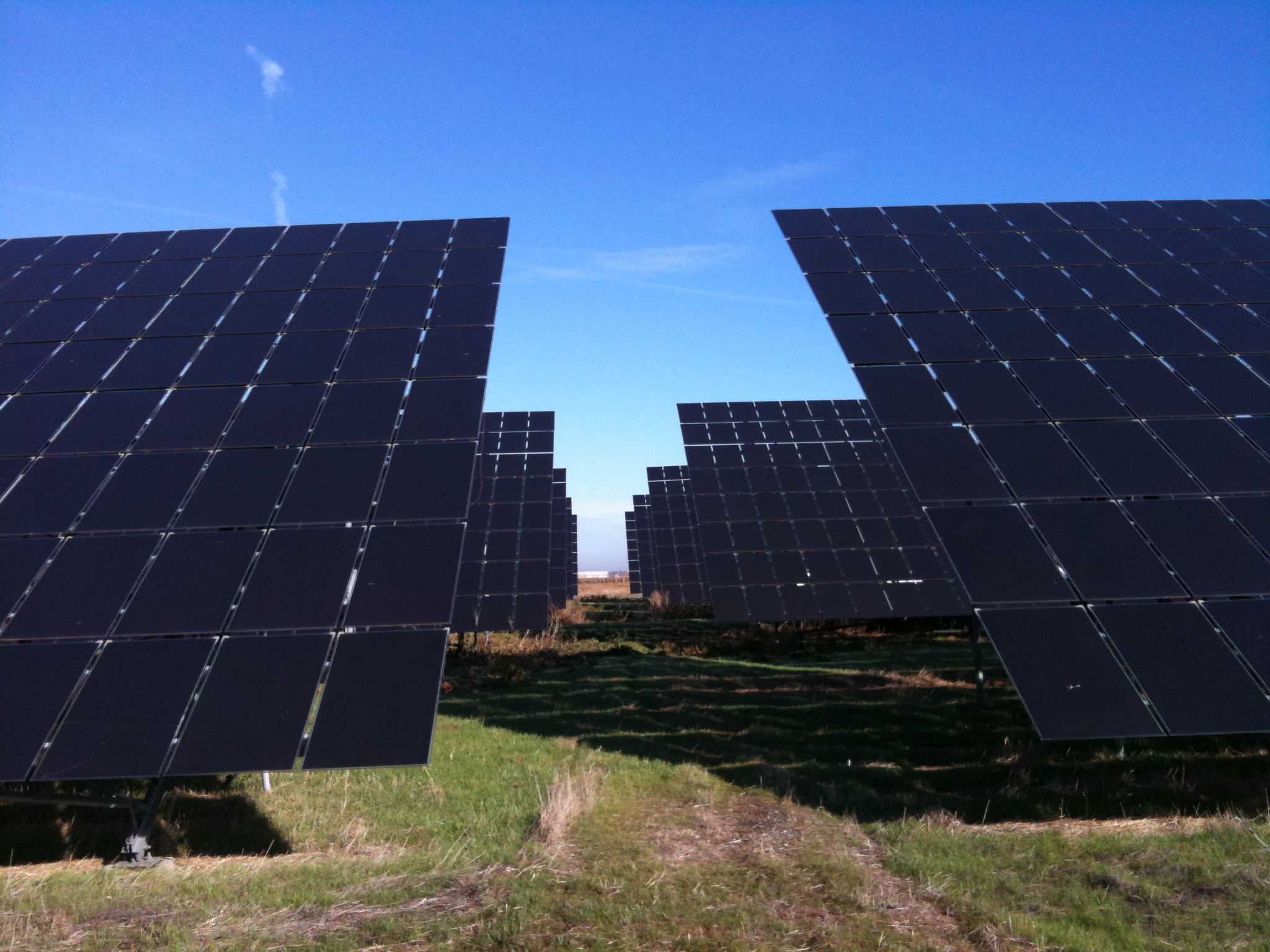
Last week, I took a took a tour of the solar farm, a veritable outdoor Smithsonian of solar power displaying a dozen photovoltaic technologies. Some have become common sights on rooftops and at power plants while others barely left the laboratory before failing and bear the name of start-ups long gone.

Built on an abandoned wastewater treatment plant and surrounded by farmland on Davis’s outskirts, P.V.U.S.A. features two-story-high thin-film solar panel arrays that were on the technological cutting edge in their day but only became commercially viable in recent years.

Strips of early solar tiles designed to serve as power-generating roofing material are laid out on a wooden platform.

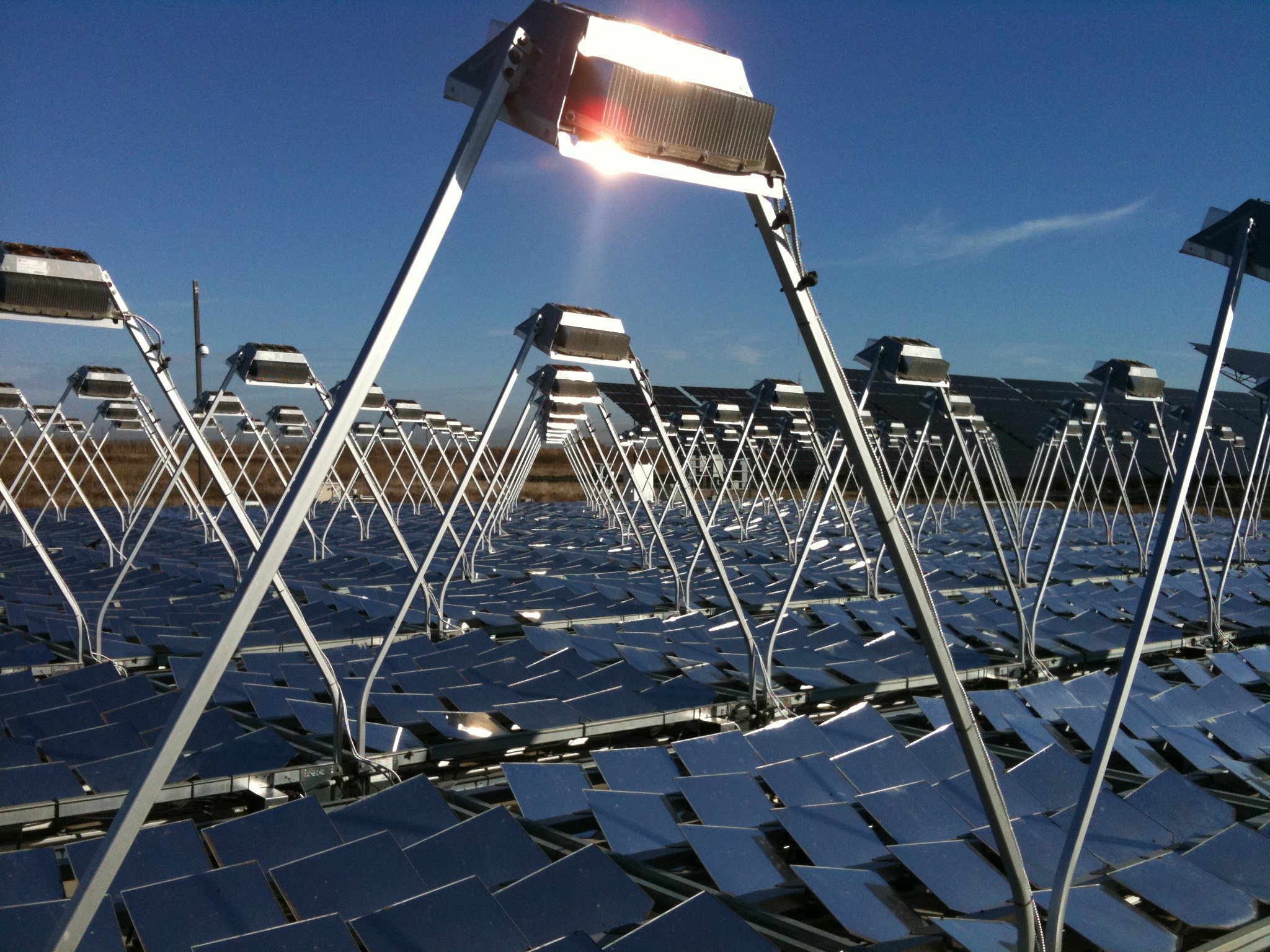
And behind rows of more conventional solar panels lies a field of what looks like photovoltaic sunflowers. Pods of 25 small mirrors designed to concentrate the sun on a high-efficiency photovoltaic cell suspended on a stamenlike strut.

“They installed them back in 2004 and 2005, and two months into the installation, it stopped working and the company didn’t want to deal with them anymore,” said Dang H. Dang, P.V.U.S.A.’s on-site manager, as jackrabbits darted among the arrays.

You can read the rest of the story here.

Read Full Post »

photo: Todd Woody

In the New York Times on Wednesday, I follow up my story on solar power plants and desert tortoises:

In an article in The New York Times on Wednesday, I write about how the fortunes of big solar power plants in the desert Southwest can hinge on the way developers handle imperiled wildlife in the path of their projects.

The protected desert tortoise has become the totemic animal for environmentalists fighting to ensure that the huge solar farms don’t eliminate essential habitat for the long-lived reptile and other wildlife, like the bighorn sheep and flat-tailed horned lizard.

The tortoise has been in decline for decades, and the rampant changing of the desert — including the development of casinos, strip malls and subdivisions, and designation of off-road recreational vehicle areas — took its toll long before construction began late last month on the Ivanpah solar power plant, the first large-scale solar thermal project to be break ground in the United States in 20 years.

Still, the solar farms will industrialize the desert on an unparalleled scale. The seven projects already licensed in California will cover 42 square miles with immense mirror arrays.

But as much as some biologists fear that the need to generate electricity without carbon dioxide emissions will harm the desert tortoise, the projects offer an opportunity for intensive research on the critter. That’s because regulations require solar developers to monitor tortoises for three years after they are relocated.

“Certainly the monitoring of the translocated desert tortoises will yield useful research information on the ability of desert tortoises to adapt to new surroundings,” Larry LaPré, a wildlife biologist with the United States Bureau of Land Management, said in an e-mail.

Such data is critical. While environmental regulations and efforts by developers like BrightSource Energy, the builder of the Ivanpah project in Southern California, are tailored to remove the tortoise from harm’s way during construction, the survival of the animals depends on how well they adjust to their new homes.

The track record on tortoise relocations is not encouraging. In 2008, more than 700 tortoises were moved from the Fort Irwin military installation in Southern California so the base could expand. Nearly half the relocated tortoises died within two years from, among other things, predation by coyotes and ravens, according to state records.

Biologists I met recently at the Ivanpah power plant site were far more optimistic about the relocation of 23 tortoises found in the project’s first phase.

“The tortoises at Fort Irwin were moved a lot further than these, and there also was a big problem with predators there,” Peter Woodman, a biologist who worked on the military project, explained as he stood by a holding pen where the Ivanpah tortoises will live until they are moved next spring.

You can read the rest of the story here.

Read Full Post »

photo: Todd Woody

In The New York Times special Energy report, I write about how the success of large-scale solar power plants being built in the desert Southwest depends on how developers deal with the imperiled desert tortoise and other wildlife:

NIPTON, Calif. — On the construction site of the $2 billion Ivanpah solar power plant here, burly laborers slowly walk around their trucks, dropping to their knees to peer underneath before turning the ignition. Hanging on each rearview mirror is a placard warning workers to “Look under your car for desert tortoise before you drive away!”

Road graders and backhoes crawl along at 10 miles per hour, led by biologists wearing green hard hats who scan for tortoises in a landscape studded with creosote bushes. “Nobody is allowed on the site without a biologist to escort them,” said Mercy Vaughn, the lead biologist for BrightSource Energy, the Oakland, Calif., company that is building the 370-megawatt power plant, the first large-scale solar thermal project to break ground in the United States in two decades.

The imperiled desert tortoise sets the pace here in the desert Southwest, and how developers deal with a host of protected plants and animals has become crucial to getting vast renewable energy projects built. That means hiring scores of biologists, managing the relocation of species and acquiring thousands of acres of replacement habitat.

With seven large solar power plants already approved that would cover 42 square miles of the California desert with huge mirror arrays, solar dishes and towers, environmentalists and regulators have increasingly become concerned about the impact that industrialization of the desert will have on fragile landscapes.

“If wildlife issues are not at the top of a developer’s list, they should be,” said Karen Douglas, the chairwoman of the California Energy Commission, which licenses large solar thermal power plants. “The footprint of these solar projects is unprecedented, and obviously they can impact a range of species.”

Developers underestimate the importance of desert animals at their peril.

The California Energy Commission in October, for instance, approved Tessera Solar’s huge Calico project in Southern California only after the company agreed to slash the project nearly in half to avoid having to relocate most of the 104 tortoises found on the site this year. And the commission’s staff has indicated that it is unlikely to recommend the licensing of Solar Millennium’s 250-megawatt Ridgecrest power plant because of its impact on the desert tortoise and the Mohave ground squirrel.

Late last month, the Quechan Indian Tribe sued the federal government over its approval of a second Tessera power plant, contending that the 709-megawatt Imperial Valley Solar Project would harm the flat-tailed horned lizard, an animal proposed for endangered species protection. It is part of the tribe’s creation story.

As the first big solar thermal power project to undergo licensing in 20 years and the first to begin construction, Ivanpah is being watched closely by environmentalists, regulators and competitors over how it handles wildlife challenges.

BrightSource, which is backed by Google, Morgan Stanley and several oil companies, has signed contracts to deliver 2,610 megawatts of electricity to utilities in the state. It took three years for the project to be licensed by the California Energy Commission as BrightSource and environmental groups tussled over the power plant’s impact on the desert tortoise, bighorn sheep and other species that roam the 3,582-acre site in the Mojave Desert.

BrightSource shrank Ivanpah by 12 percent, reducing the number of desert tortoises that would have to be relocated and avoiding an area of rare plants. The portion of the project that would most affect wildlife was cut by 23 percent.

The energy commission in September licensed Ivanpah over the objections of the Sierra Club, the Center for Biological Diversity and other groups that argued it would eliminate high-quality habitat for the tortoise.

“If you put a project in the wrong place and even do some things to reduce its impact, it’s still bad,” said Lisa Belenky, a senior lawyer with the Center for Biological Diversity in San Francisco. “We’re really trying to get companies and regulators focused on lands that have already been disturbed.”

The Ivanpah site is just over the Nevada border, about 40 miles southwest of Las Vegas. The neon glow of two hulking casinos looms in the distance. An incongruous patch of luminescent green marks an 18-hole golf course adjacent to the site.

“Everyone wants to do the right thing, but everyone is concerned because there are so many precedents that are being set since we’re the first ones through the hoop,” Todd Stewart, the Ivanpah project manager, said recently as he stood amid the desert scrub as biologists tracked a tortoise that had been outfitted with a radio transmitter. The orange and brown tortoise, which the biologists said was probably 30 to 40 years old, was about the size of a soccer ball.

By 2014, nearly six square miles of government-owned desert surrounding Mr. Stewart will be covered with 347,000 mirrors, each the dimension of a billboard. The mirrors will focus the sun on a three 459-foot towers topped by water-filled boilers to create steam that will drive turbines to generate electricity.

BrightSource executives take pains to point out that they designed Ivanpah to minimize its disturbance of the desert. Vegetation, for example, will be trimmed rather than plowed as equipment is installed.

Following conditions of its license, the company fielded an army of more than 50 biologists to capture and radio-tag tortoises in the 900-acre first phase of the project and ensure none were harmed as construction began.

You can read the rest of the story here.

Read Full Post »

photo: Todd Woody

In The New York Times special Energy report, I write about how community solar power plants offer residents a chance to own photovoltaic arrays without putting panels on their roofs — or cutting down trees:

DAVIS, Calif. — In this environmentally conscious college town, thousands of bicyclists commute each day through a carefully cultivated urban forest whose canopy shields riders and their homes from the harsh sun of this state’s Central Valley.

The intensity of that sunshine also makes Davis an attractive place to generate clean green energy from rooftop solar panels. And therein lies a conundrum. Tapping the power of the sun can also mean cutting down some of those trees.

“Davis has spent many, many decades getting trees planted and improving energy efficiency by virtue of shade trees that cool houses,” said Mitch Sears, the city’s sustainability program manager. “But if you want solar energy, it’s not rocket science that you need the sun.”

Now a San Francisco company, CleanPath Ventures, is promoting a solution to allow homeowners to keep their trees and go solar at the same time. CleanPath plans to expand its existing solar farm on the city’s outskirts and then sell “garden plots” to homeowners who would own the electricity generated by their patch of photovoltaic panels. Apartment dwellers and other residents whose homes are not suitable for rooftop solar arrays would also be able to own a piece of the power plant.

“If you moved down the block, you’d take the electricity production with you just like if you make an investment in a community garden, wherever you live you’ll benefit from what’s grown in the garden,” said Matt Cheney, a longtime financier of renewable energy and the founder of CleanPath Ventures.

Community solar power plants are seen as a way to expand the availability of renewable energy while taking advantage of the economies of scale that result from installing thousands of solar panels in a central location rather than scattered on thousands of individual homes.

“To get the energy benefits of solar there’s no reason to drill holes in a roof,” said Jim Burke, manager of the SolarShares program for the Sacramento Municipal Utility District, which serves the region surrounding the state capital.

The utility, known as SMUD, started SolarShares, one of the nation’s first community solar-power-plant programs, in July 2008 when it offered customers the opportunity to buy electricity from a 1.2-megawatt photovoltaic power plant built on a turkey farm southeast of Sacramento.

“People love solar, but we required you to own a roof” and that it face a certain way, said Mr. Burke. “Multifamily buildings were usually excluded and renters were excluded.”

Then there was the tree issue.

“SMUD has planted hundreds of thousands of trees to shade rooftops and then with solar we’re saying cut them down,” he noted.

The SolarShares program gives customers the option of buying power from a half-kilowatt or a one-kilowatt portion of the solar farm. For instance, for a household that uses 2,158 kilowatt-hours a year, a one-kilowatt solar system would cover about 81 percent of their electricity consumption and cost $21.50 a month. However, the household would receive a monthly credit for the solar electricity produced that would average $13.96.

The pilot SolarShares program sold out within six months and there’s now a waiting list, according to Mr. Burke.

He said SMUD was planning a one-megawatt community solar-power plant that would be built next year and was exploring the placement of up to four megawatts of solar farms on highway rights-of-way owned by the state transportation agency.

Like a community solar farm in St. George, Utah, and a proposed solar garden in Falmouth, Mass., the CleanPath project in Davis would offer residents the chance to buy a physical part of a solar farm.

You can read the rest of the story here.

Read Full Post »

photo: Todd Woody

I wrote this story for Grist, where it first appeared.

When experts try to describe the smart grid, their favorite analogy is the internet.

Just as the internet enabled interactive, two-way communication, the smart grid, we’re told, will deploy sensors and software to digitize a century-old analog electricity distribution system, transforming it into one capable of integrating renewable energy and decentralizing power production.

But while the benefits of the internet are manifest — YouTube, Facebook, Grist! — what will the smart grid do for you and me?

For most people, the most familiar part of the smart grid is the smart meter, those wireless digital devices being installed in homes by the millions so that residents can monitor electricity use in real time rather than through a monthly utility bill that arrives long after the power has been consumed.

Smart meters have been controversial in Northern California, where a number of communities have moved to ban the devices over fears about the potential health effects from their emission of electromagnetic frequencies. (Mobile phones, televisions, and other electronic devices also emit electromagnetic frequencies, and so far there has been no scientific evidence to support the health claims about smart meters.)

A sunnier view of the smart meter as a gateway to a new energy future emerges in Los Angeles, where utility Southern California Edison has built a model home with smart grid technology embedded in everything from the dishwasher to the thermostat.

“It’s much easier to show than tell,” says Mindy McDonald, a Southern California Edison project manager. She is standing outside the “Smart Energy Experience” home that’s been constructed inside the utility’s Customer Technology Application Center, just off the 210 freeway in the inland suburb of Irwindale. “Grappling with the smart grid, it’s much easier to just walk people through,” says McDonald.

The idea is to show people how smart grid technology can cut their electricity bills, reduce the need to build additional fossil fuel plants, and therefore cut greenhouse gas emissions.

A Coda electric car is parked in the stylish suburban ranch’s garage. Solar panels, a solar hot water system, and a wind turbine sit on the roof. LEDs provide the home’s lighting, and every appliance contains communication chips, allowing them to “talk” to each other and to the utility through the smart meter attached to the front of the house.

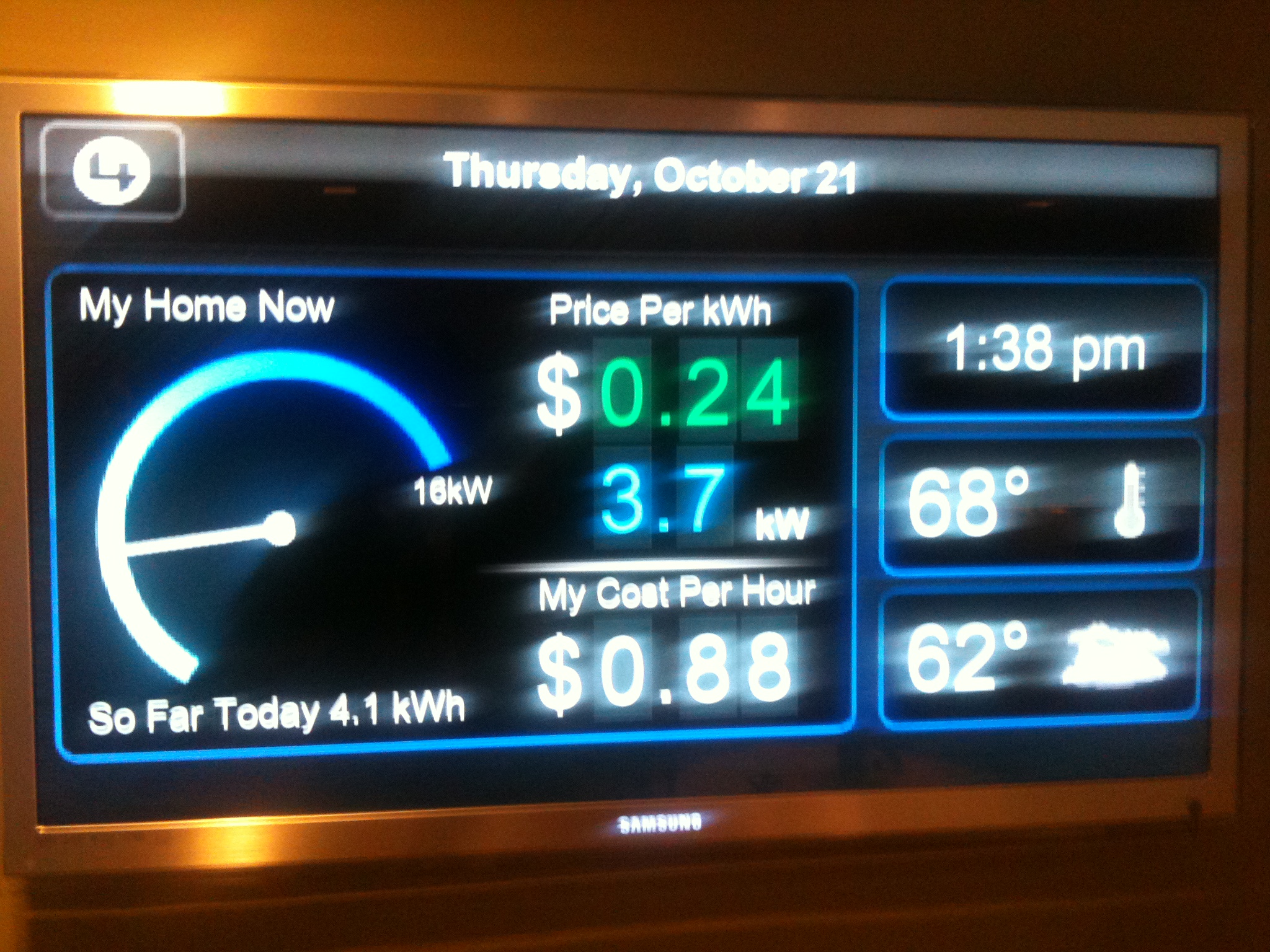
A video screen in the living room displays the home’s energy management system, and a large flat screen in the kitchen tracks the amount of electricity being consumed and its cost.

When McDonald turns on the washing machine and the air conditioner and then plugs in the car, an “energy speedometer” on the screen shows the cost of electricity rapidly accelerating from 11 cents an hour to $2.81. The display also tells the homeowner how much electricity has been consumed so far in the day and the price per kilowatt-hour.

“It’s really has an impact when you can see how much it’s costing and they realize that maybe they should turn something off,” McDonald says. “Most people don’t pay any attention to what electricity costs until they get their bill and it’s too late to do anything about it.”

The utility so far has installed smart meters in about a fifth of the 4.9 million households and businesses it serves. Beginning in January, those customers can set a monthly electricity budget and receive a text alert, email, or phone call when they’re on track to exceed their limit, according to McDonald.

Another upcoming program, called Save Power Days, will let customers sign up to have their electricity consumption automatically curtailed when demand — and prices — spike, say on a hot summer afternoon. In return, they could save up to $200 a year on their bills.

“Your meter would receive a notification and send it to your programmable communicating thermostat, and it would automatically raise or lower the home’s temperature,” says McDonald. “If you have energy management system, you could set it up any way you want.”

She touches the iPad that controls the house to show how a smart house would react. When the meter signals the energy management system, it adjusts the thermostats, turns off the air conditioner, and switches on ceiling fans. Window blinds lower to block sunlight and keep the house cooler while the lights are dimmed.

“It’s all automatic,” notes McDonald. “If you are home and you don’t want to participate, you can opt out by turning up thermostat temperature, or just push ‘opt out’ on the screen.”

Theodore F. Craver, Jr., chief executive of Edison International, the utility’s parent company, said in an interview that these technologies will change people’s relationship with the energy system.

“Most people think it’s out of sight, out of mind — as long as the light switch goes on and an appliance can be plugged in, that’s it,” he says. “Now the customer will interact with the grid instead of just being passive.”

The question is just how successful utilities will be at persuading people to become active participants in managing their energy consumption.

“Too many of them are saying just giving people more and better information about electricity use, for example, is automatically a huge environmental plus,” Ralph Cavanagh, the co-director of energy programs for the Natural Resources Defense Council, said at the E2 Environmental Entrepreneurs recent conference.

“I’m all for better information but the average electric bill in the average U.S. household is $3 a day,” he continued. “If all you’re talking about is giving people more and better information about their $3 a day, at some point many of them are going to conclude that they have more important things to do with their time.”

Said Jesse Berst, president of the Center for Smart Energy, a research and consulting firm in Redmond, Wash.: “I think it’s a lot easier to teach devices to be smart about energy than to teach people to be smart about energy. I don’t see people clustered around the warmth of the home energy management console.”

They might well start paying more attention when utilities begin introducing what is called “time of day” pricing. Since the smart grid lets utilities monitor electricity consumption in real time, they can start charging consumers higher prices when demand spikes and thus the cost of power rises.

In other words, if you set your air conditioner at arctic temperatures when all your neighbors are cranking up their units on a sweltering day, you’ll pay the price. The flip side is that your smart meter could tell your smart washing machine and dishwasher to delay switching on until power prices drop in the evening.

The smart grid offers Joe and Josephine Ratepayer other benefits as well. For instance, if a storm knocks out a power line, all the 1,500 homes on a typical Southern California Edison circuit served by that line will lose electricity. The utility usually doesn’t find out about such outages until customers call to complain. It can be hours before a repair crew can be dispatched and the problem located and fixed.

As part of its smart grid program, Southern California Edison will be installing sensors on the top of power poles to monitor the circuit. If a line goes down, sensors will reroute power to minimize the number of homes affected by a blackout. The sensors will also notify the utility of the problem and its location and the system will automatically dispatch a repair crew.

That means fewer people sitting in the dark.

Edison International’s Craver says that a grid with this kind of smarts could make a huge difference. “There’s such a high potential for change, and a perhaps pretty radical difference that will start to be created where the grid has a two-way communications capability, and some level of intelligence actually built into the system.”

Read Full Post »

photo: Todd Woody

I wrote this story for Grist, where it first appeared.

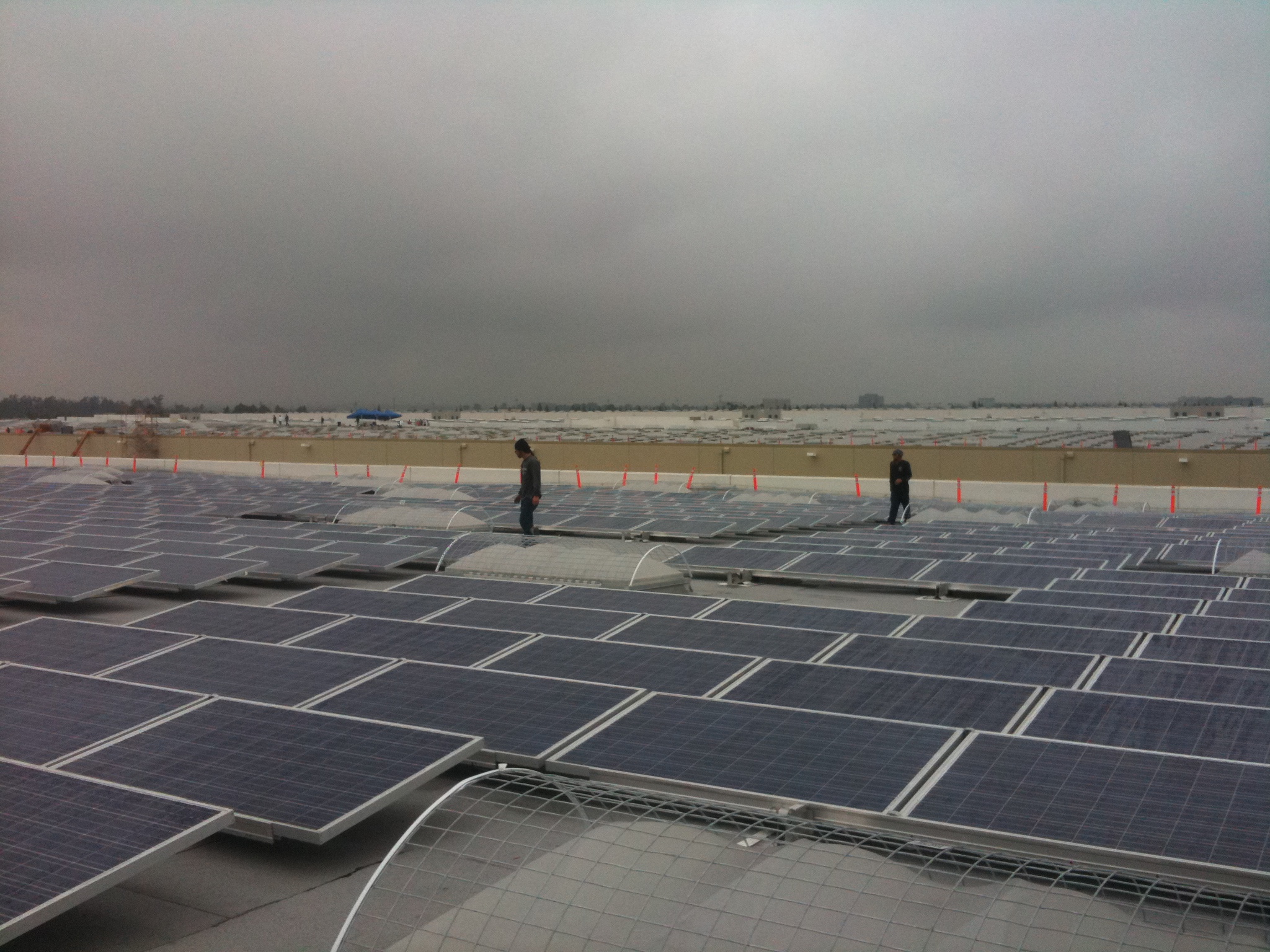
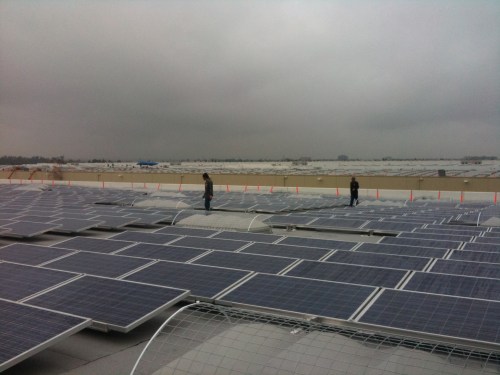
If you want a birds-eye view of the future of power, scramble up to the roof of a 562,089-square-foot warehouse in Ontario, a city that sits in the smoggy heart of Southern California’s Inland Empire east of Los Angeles.

On a roof the size of several football fields, workers are busy installing 11,591 solar panels that will generate 2.55 megawatts of electricity. Across the street is another massive warehouse blanketed in photovoltaic panels. Beyond that lie two more warehouses with solar arrays under construction.

Warehouses themselves use relatively little electricity, so owners lease their roofs to utility Southern California Edison, which own the solar arrays and feeds the power they produce into the grid. Over the next five years, the utility will install 250 megawatts worth of photovoltaic panels on big commercial rooftops and buy an additional 250 megawatts from solar developers that will build and operate warehouse arrays. At peak output, those solar arrays will generate as much electricity as a mid-sized fossil-fuel power plant.

“In the Inland Empire you’ve got big buildings and good sun,” Rudy Perez, manager of the utility’s solar rooftop program, said as we stood on the top of the warehouse where solar panels covered the roof as far as the eye could see.

He noted that the number of applications from solar developers to connect rooftop photovoltaic projects to the grid has tripled in the past six months alone.

“It’s one thing when you have one building in an area with a big solar array, another when you have five,” said Perez. “As you get into the higher and higher numbers, that’s where you really need smart grid technology.”

That’s because the rise of renewable energy and electric cars will vastly complicate how the power grid operates.

“We could literally have more change in the system in the next 10 years than we’ve had in the last 100 years,” Theodore F. Craver, Jr., chief executive of the utility’s parent company, Edison International, said in an interview after meeting with executives from French utility giant EDF. The French had come to Los Angeles to learn about Southern California Edison’s smart grid efforts.

In the current, mostly analog grid, the distribution of electricity is fairly straightforward. A utility or another company builds a fossil-fuel-powered plant and flips the switch. For the next 30 years or more, electricity flows into high-voltage transmission lines hour after hour, day after day.

The transmission lines carry the electricity to a distribution system where transformers “step down” the power to a lower voltage and then send it to homes and businesses. And though technological improvements have been made over the decades to the grid, it remains essentially a one-way system. And while storms and accidents can bring down power lines and blackouts can occur when demand soars on a hot day and electricity generation can’t keep up, power flows 24/7 from a natural gas or coal-fired plant.

Now consider the challenges posed by intermittent sources of electricity like solar and wind, not to mention the prospect of thousands of cars plugging into the grid at once to recharge their batteries.

“A rolling cloud can cut electrical output by 80 percent in a just few seconds,” says Perez. “That’s one reason why we have to be smart about where we put [solar].”

And why it’s necessary to build a digitalized grid that deploys software, sensors, and other hardware to monitor and manage electricity distribution and troubleshoot problems.

Instead of relying on dozens of big power plants, the smart grid of the future will increasingly tap thousands or millions of individual rooftop power plants and wind turbines. It will need to collect information about their electricity output and balance the flow of electricity throughout the grid — to ensure that a neighborhood doesn’t go dark because a large cloud is hovering over the solar array atop the local Costco.

“As we start to replace more of the generation with different technologies, we are altering the physics of the system,” said Pedro Pizarro, Southern California Edison’s executive vice president of power operations.

This drizzly October morning is a case in point. A ceiling of gray clouds hangs over the four Ontario warehouses that altogether would be generating some 7.59 megawatts if the sun were shining at peak intensity. So the smart grid also needs to be able to forecast the weather and know, say, that for the next few days electricity production is going to fall in one area while it might rise another, sun-splashed one.

“There’s new technologies that allow for much precise control of the grid,” Perez said. “One of the concerns would be that the intermittency of one of these buildings causes problem for our customers.”

Down the coast at the University of California, San Diego (UCSD), researchers have built what looks like a mirrored hemispherical bowl that scans the skies and snaps two photos a minute to predict when clouds will form over the campus’ one-megawatt worth of solar panels that are installed at seven locations.

“We do a 3-D characterization of all clouds on the horizon every 30 seconds,” Byron Washom, director of strategic energy initiatives at UCSD, said at a solar conference in October. “And then in the next second we note its vector, its speed, its height, its opacity and we characterize it.”

“So we actually begin to forecast what type of cloud is going to intersect where the sun is,” added Washom. “We know where it is at all times in the sky [in relation to] each individual panel on campus.”

He said the scientists’ goal is to be able to use the machines, which cost $12,000 apiece and have a range of one kilometer (0.62 miles), to do hourly forecasts with 90 percent accuracy.

“So a capital investment of less than $1 million could bring this to the Southern California rooftop market if we crack the science,” said Washom, referring to the concentration of warehouses in places such as Ontario.

Another smart grid strategy is to store energy generated by solar arrays in batteries and feed power to the grid when renewable energy production falls or demand spikes.

Washom showed a picture of a device that looks like the back end of a DVD player. The Sanyo lithium ion battery can store 1.5-kilowatt hours of electricity. UCSD plans to stack them like servers in a data center so it can store 1.5 megawatts of electricity produced by campus solar arrays.

In the San Francisco Bay Area, SolarCity, a solar panel installer, and electric carmaker Tesla Motors have received a $1.8 million state grant for a pilot project that will put lithium ion car batteries in half a dozen homes with rooftop solar arrays.

The Sacramento Municipal Utility District (SMUD), meanwhile, plans to install lithium ion batteries in 15 residences as part of its smart solar homes program. The utility will also put two 500-kilowatt batteries near substations to test energy storage on a larger scale.

Such systems are expensive but if the price eventually falls, utilities would be able to use them to release power to the grid when, say, a one of Washom’s cloud-forecasting devices predicts electricity production will fall off. (SMUD also will deploy 70 solar stations to help it forecast weather conditions that could affect electricity production, according to Mark Rawson, the utility’s project manager for advanced, renewable and distributed generation.)

So will the smart grid and increasing production of rooftop solar and other renewable energy spell the end of big centralized power stations and the multibillion-dollar transmission infrastructure? Will the future bring some sort of Ecotopian nirvana where power is put in the hands of the people (or at least on their rooftops)?

Not anytime soon, according to Pizarro of Southern California Edison, barring technological breakthroughs that dramatically reduce the cost of photovoltaic power.

“Right now solar is increasing but it’s not overwhelming the system,” says Pizarro, noting that rooftop photovoltaics remain a tiny percentage of the overall power supply even in places like California, where utilities must obtain a third of their electricity from renewable sources by 2020.

Still, renewable energy “has the potential to reduce the generation from central stations,” Pizarro said. “It’s a question of how much and how soon.”

The other wild card is the price of oil and natural gas, notes Craver, Edison’s chief executive. When the cost of natural gas — the dominant energy source in California — rises, renewable energy becomes more attractive. When natural gas prices plunge, as they have over the past couple of years, installing solar becomes far more expensive in relative terms.

At last month’s solar conference, SMUD’s Rawson said his utility currently relies on photovoltaics, or PV, for less than one percent of its electricity generation. But that will likely change dramatically in the years ahead, he says, as the smart grid evolves to handle the widespread distribution of solar power.

“We’re trying to change PV from something that is tolerated by the utility to something that is controlled by the utility,” he said.

Read Full Post »
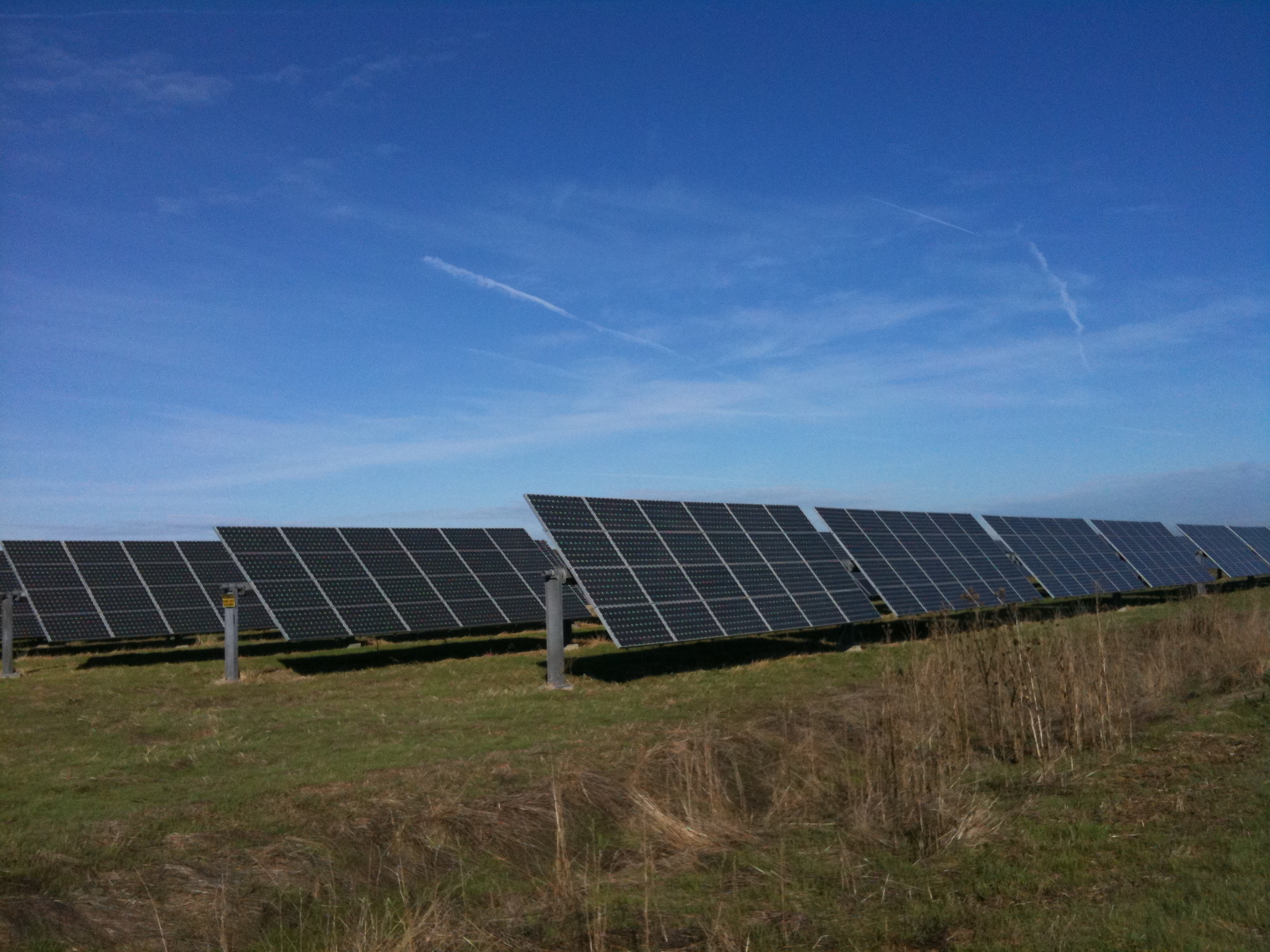
photo: White House

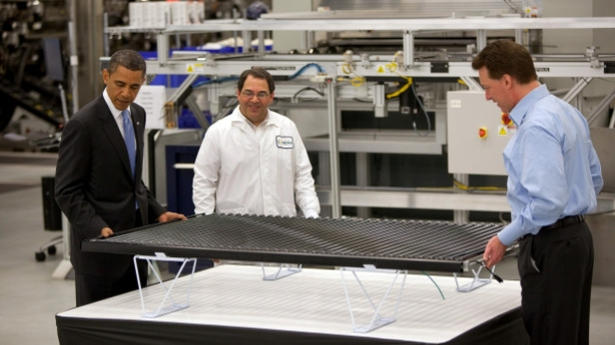
In Wednesday’s New York Times, I have an exlusive about Silicon Valley solar startup Solyndra’s move to shutter a factory and lay off workers just weeks after it opened a state-of the art plant built with a half-billion-dollar federal loan guarantee:

SAN FRANCISCO — Solyndra, a Silicon Valley solar-panel maker that won half a billion dollars in federal aid to build a state-of-the-art robotic factory, plans to announce on Wednesday that it will shut down an older plant and lay off workers.

The cost-cutting move, which will reduce the company’s previously announced production capacity, is a sign of the notable shift in the prospects for cutting-edge American solar companies, which now face intense price competition from Chinese manufacturers that use more established photovoltaic technologies.

Just seven weeks ago, Solyndra opened Fab 2, a $733 million factory in Fremont, Calif., to make its high-tech solar panels. The new plant was supposed to be the first phase of a rapid expansion of the company.

Instead, Solyndra has decided to shutter the old plant and postpone plans to expand Fab 2, which was built with a $535 million federal loan guarantee.

“Fab 2 is much more efficient and cost-effective than our existing facility,” Brian Harrison, Solyndra’s chief executive, said in an interview. “We’re adjusting our plans to be more in line with where the market is and where our business is at the moment.”

When Solyndra filed for an initial public stock offering in December, it estimated it would have a total production capacity of 610 megawatts by 2013 if its two plants were fully built out. The company now expects it have capacity of 285 to 300 megawatts by 2013.

Solyndra abandoned plans for the stock offering in June, citing market conditions.

The company is the most prominent of a wave of Silicon Valley solar start-ups that hoped to transform the economics of the industry. Gov. Arnold Schwarzenegger of California and Energy Secretary Steven Chu helped break ground on Fab 2 last year, and President Obama made an appearance at the unfinished factory in May to extol Solyndra’s innovative technology.

Mr. Harrison noted that the market had undergone a significant shift since Solyndra filed for the stock offering, with solar module prices plummeting as low-cost Chinese manufacturers like Suntech and Yingli ramped up production.

You can read the rest of the story here.

Read Full Post »

photo: Todd Woody

In a follow up to my story in Friday’s New York Times on the beginning of a solar building boom in the desert Southwest, I take a look at California regulators’ approval of the seventh Big Solar farm in two months, the 663.5-megawatt Calico project:

In an article in Friday’s paper, I write about the solar thermal power plant building boom now under way in California’s Mojave Desert. The looming expiration of crucial federal financial support for the multibillion-dollar projects, though, could turn the boom to bust.

But that hasn’t deterred California regulators, who on Thursday approved the seventh large-scale solar thermal farm since late August.

After years of painstaking environmental review, the California Energy Commission has been green-lighting the massive solar power plants at warp speed so developers can break ground before year’s end and qualify for a government cash grant that covers 30 percent of the cost of construction.

The latest approval goes to Tessera Solar’s Calico project, to be built in the San Bernardino County desert in Southern California. Originally proposed to generate 850 megawatts -– at peak output, that’s close to the production of a nuclear power plant -– the project was whittled down to 663.5 megawatts to lessen the impact on wildlife like the desert tortoise and the bighorn sheep.

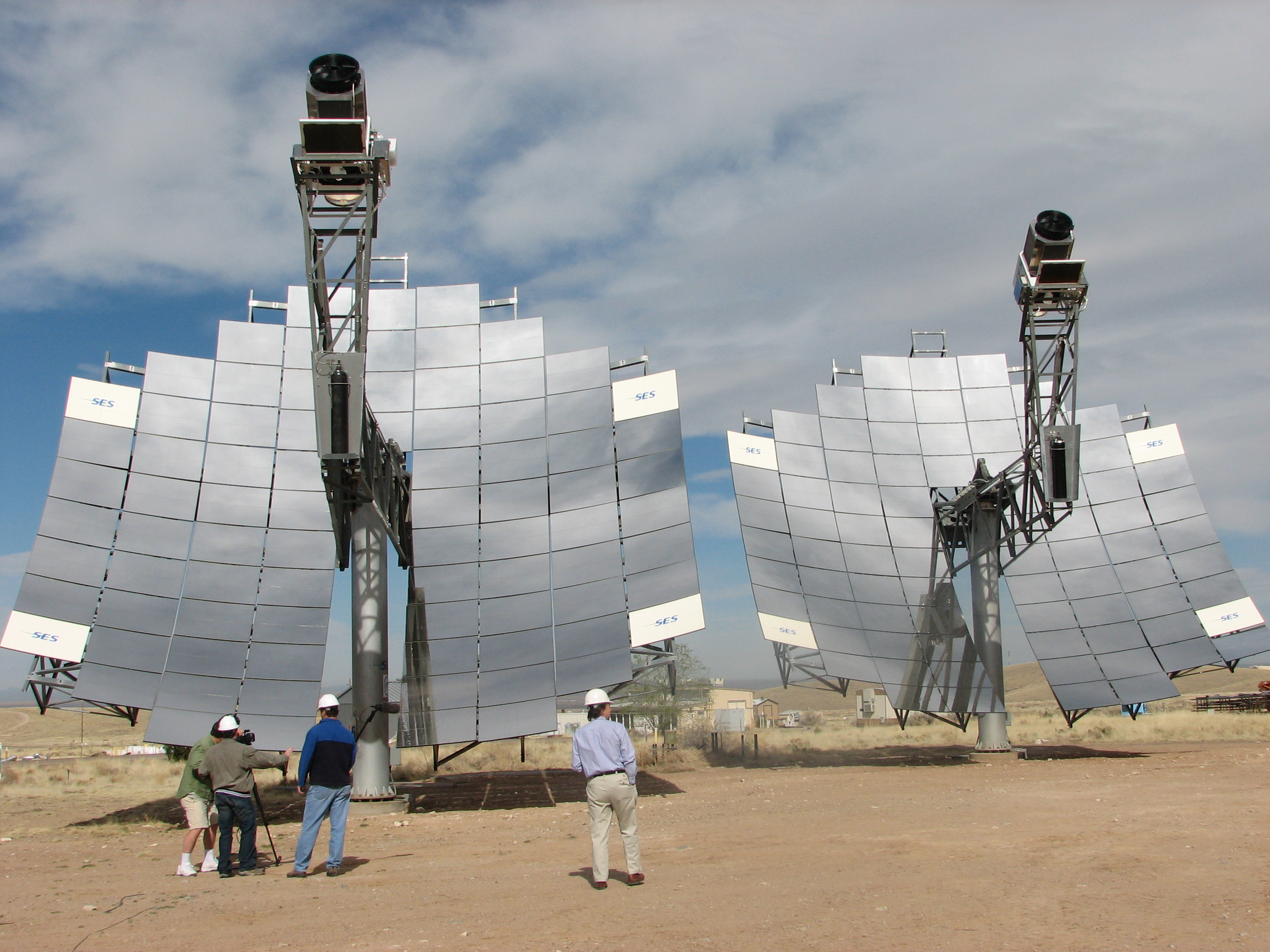
It’s difficult to appreciate the sheer scale of even the smaller version of the Calico project until you’ve seen Tessera’s Suncatcher solar dishes on the ground. A few years ago I had the opportunity to visit a prototype six-dish Suncatcher solar farm at the Sandia National Laboratories in New Mexico.

Resembling a giant mirrored satellite receiver, each Suncatcher stands 40 feet tall and 38 feet wide with a Stirling engine suspended on an arm over the center of the dish. As the dish tracks the sun, its mirrors concentrate sunlight on the hydrogen gas-filled heat engine. As the superheated gas expands, it drives pistons, which generates 25 kilowatts of electricity.

Now imagine planting 26,540 Suncatchers on 4,613 acres of federal land for the Calico project. Tessera, based in Houston, has also received approval for a 709-megawatt solar power plant to be built in California near the Mexico border. That will require the installation of 28,360 Suncatchers.

“These desert solar projects will provide clean power for our schools, homes, and businesses while reducing fossil fuel consumption, creating local jobs, and reducing the greenhouse gas emissions that threaten California’s economy and environment,” Anthony Eggert, a member of the California Energy Commission, said in a statement on Thursday.

The cost to build the two projects will exceed $4.6 billion, according to Tessera, and it’s highly unlikely that they’ll go online unless the company receives federal loan guarantees that allow developers to borrow up to 80 percent of construction costs on favorable terms. That program expires next September, and Tessera needs to start putting steel into the ground by the end of the year to qualify for the cash grant program.

You can read the rest of the story here.

Read Full Post »


photo: Todd Woody

In Friday’s New York Times, I write about the beginning of the long-awaited solar boom in the Mojave Desert and how it may well be short-lived if crucial federal incentives for renewable energy are allowed to expire in the coming months:

NIPTON, Calif. — The long-promised solar building boom in the desert Southwest is finally under way. Here in the Mojave Desert, a dice throw away from the Nevada border, giant road graders and a small army of laborers began turning the dirt for BrightSource Energy’s $2 billion Ivanpah project, the first large-scale solar thermal power plant to be built in the United States in two decades.

The Ivanpah plant is the first of nine multibillion-dollar solar farms in California and Arizona that are expected to begin construction before the end of the year as developers race to qualify for tens of billions of dollars in federal grants and loan guarantees that are about to expire. The new plants will generate nearly 4,000 megawatts of electricity if built — enough to power three million homes.

But this first wave may very well be the last for a long time, according to industry executives. Without continued government incentives that vastly reduce the risks to investors, solar companies planning another dozen or so plants say they may not be able to raise enough capital to proceed.

“I think we’re going to see a burst of projects over the next two months and then you’re going to hear the sounds of silence for quite a while,” said David Crane, chief executive of NRG Energy, on Wednesday after he announced that his company would invest $300 million in the Ivanpah plant.

Solar developers depend on two federal programs to make their projects financially viable. The most crucial is a loan guarantee program, expiring next September, that allows them to borrow money on favorable terms to finance up to 80 percent of construction costs.

The other is the option to take a 30 percent tax credit in the form of a cash payment once a project is built. Although the tax credit does not expire until the end of 2016, the option to take it as a cash payment disappears this year, making it far less valuable to a start-up company that is just beginning to generate revenue.

With both Democrats and Republicans promising to rein in the federal budget, it is unclear whether lawmakers will extend the programs in any form. “That could stall a number of projects and even lead to the failure of some,” said Ted Sullivan, an analyst with Lux Research, a consulting firm in New York.

Yet no one in the desert here wants to think too much about those looming clouds.

“Ivanpah represents a transformational moment in our energy equation,” said John Woolard, BrightSource’s chief executive, who was joined Wednesday by Gov. Arnold Schwarzenegger of California and Interior Secretary Ken Salazar at Ivanpah’s groundbreaking ceremony. “It demonstrates that the U.S. can lead in the drive for renewable energy at scale by building the largest solar plant in the world with new technology.”

The eight California projects that are expected to break ground this year will turn 46 square miles of the desert into a futuristic landscape of mirrors, towers and solar dishes. State officials estimate the plants will create 8,000 jobs in a state with a 12.4 percent unemployment rate.

During its three years of construction, Ivanpah will employ as many as 1,000 laborers in a recession-scarred region.

“In the last year, I haven’t worked,” said Basilio Yniguez, a 36-year-old pipefitter and father of seven, as he helped build a holding pen last week for threatened desert tortoises on the Ivanpah site. “Thanks to the green thing going up, I’m working.”

The state is supporting the industry in part by mandating that California utilities get a third of their electricity from renewable sources by 2020.

“When you look at the raw number of kilowatt-hours we need, I don’t see how you get there without large central station solar projects,” said Pedro Pizarro, a top executive with Southern California Edison, one of the state’s largest utilities.

Unlike the photovoltaic panel systems found on rooftops, most of the new solar plants will use thousands of large mirrors to heat liquids to generate steam that drives conventional electricity-generating turbines.

“Without the Department of Energy coming in to assume a lot of the risk, you might not find lenders willing to lend, particularly if you’re a start-up with untried technology,” said Nathaniel Bullard, a solar analyst at Bloomberg New Energy Finance.

Other hurdles also stand in the way of the solar expansion. For some plants, multibillion-dollar transmission lines must be built to carry electricity from the desert to cities. Some environmentalists continue to oppose the projects’ impact on imperiled wildlife, such as the desert tortoise, and may sue to stop construction.

The competitiveness of large-scale solar thermal plants in California also depends on the cost of natural gas, the state’s dominant source of electricity. According to Mr. Bullard, gas-fueled plants can produce electricity for about 10 cents a kilowatt-hour. After including the government subsidies, solar thermal plants are expected to generate power at 13 to 17 cents a kilowatt-hour, which the industry says is close enough in price to be competitive.

So far, Ivanpah is the only California solar thermal project to win a government loan guarantee, although other projects have applied and are awaiting decisions from the Energy Department.

“We are sensitive to the deadlines and are doing everything we can so that these projects can move forward,” said Jonathan Silver, the executive director of the department’s loan program. “There’s a significant demand for these funds.”

The uncertainty has left even some of the licensed solar projects in limbo.

You can read the rest of the story here.

Read Full Post »

« Newer Posts - Older Posts »

Design a site like this with WordPress.com
Get started