Feeds:
Posts
Comments

Archive for the ‘green tech’ Category

In my new Green State column on Grist, I write about how an environmental justice group in Texas is using a greenhouse gas analyzer from Silicon Valley’s Picarro to detect pollution from natural gas fracking operations in two communities near Dallas:

If you had been driving through North Texas this week you might have seen a white Dodge Sprinter van circling some of the natural gas wells and compression stations that have sprung up around the Barnett Shale belt like boom-time subdivisions.

Drillers tap natural gas by splitting shale through a process called hydraulic fracturing, or fracking, that injects fluids laced with chemicals into the rock formations. The proliferation of shale gas drilling northeast of Dallas has ignited an uproar among residents, some of whom fear that fracking could be poisoning ground water and polluting the air with carcinogens. But the industry won’t disclose all the chemicals it uses and Texas environmental authorities won’t compel them to do so.

Which brings us back to our mystery van. Inside was a desktop computer-sized analyzer connected to a translucent tube that snaked out the roof of the van. The analyzer is made by a Silicon Valley company called Picarro and it provides real-time measurements of methane and other greenhouse gas emissions. By correlating the data with wind patterns, Picarro scientists can pinpoint the source of emissions. Oil and gas operations emit methane, which can also indicate the presence of benzene and other carcinogens, according to Picarro scientists.

This is an image created by a mashup of the methane concentrations recorded by the Picarro analyzer in Flower Mound, Texas, overlaid on a Google map.
A Picarro employee had driven the van to Texas from California at the request of Wilma Subra, a Louisiana scientist, environmental justice activist and MacArthur genius grant recipient. Picarro’s director of research and development, Chris Rella, flew to Texas and joined Subra and activists from Earthworks’ Texas Oil & Gas Accountability Project on the hunt for fugitive emissions in the towns of DISH and Flower Mound.

DISH — the name is capitalized because in 2005 the town changed its name in exchange for free satellite television from the DISH Network — is home to about 200 people and a dozen compression stations that push natural gas from wells into pipelines. As the Picarro van drove around DISH, concentrations of methane spiked from background concentrations of 1.8 parts per million to 20 parts per million near the compression stations. As the analyzer recorded the spikes they were automatically plotted on a Google map.

Twenty miles to the southeast in the Dallas exurb of Flower Mound, methane concentrations near natural gas wells literally went off the analyzer’s chart, topping 40 parts per million, says Subra and Picarro executives.

“I see this as very, very beneficial to the environmental justice movement,” says Subra. “It gives you real-time data and you can potentially identify the source as opposed to having to collect air samples and then have them analyzed. You can see the plume on the map and how close houses are to the compressor stations.”

You can read the rest of the column here.
Read Full Post »

photo: Todd Woody

In an interview I did with green tech entrepreneur Bill Gross for Yale Environment 360, Gross talks about the future of solar energy, his relationship with Google, and how to avoid battles over building large solar farms in the deserts of the Southwest:

Bill Gross is not your typical solar energy entrepreneur. In a business dominated by Silicon Valley technologists and veterans of the fossil fuel industry, Gross is a Southern Californian who made his name in software. His Idealab startup incubator led to the creation of companies such as eToys, CitySearch, and GoTo.com. The latter pioneered search advertising — think Google — and was acquired by Yahoo for $1.6 billion in 2003.

That payday has allowed Gross to pursue his green dreams. (As a teenager, he started a company to sell plans for a parabolic solar dish he had designed.) Over the past decade, Gross has launched a slew of green tech startups, including solar power plant builder eSolar, electric car company Aptera, and Energy Innovations, which is developing advanced photovoltaic technology.

But it has been eSolar, backed by Google and other investors, that has been Idealab’s brightest light. In January, the company signed one of the world’s largest green-energy deals when it agreed to provide the technology to build solar farms in China that would generate 2,000 megawatts of electricity — at peak output the equivalent of two large nuclear power plants. And last week, eSolar licensed its technology to German industrial giant Ferrostaal to build solar power plants in Europe, the Middle East, and South Africa. Those deals followed eSolar partnerships in India and the U.S.

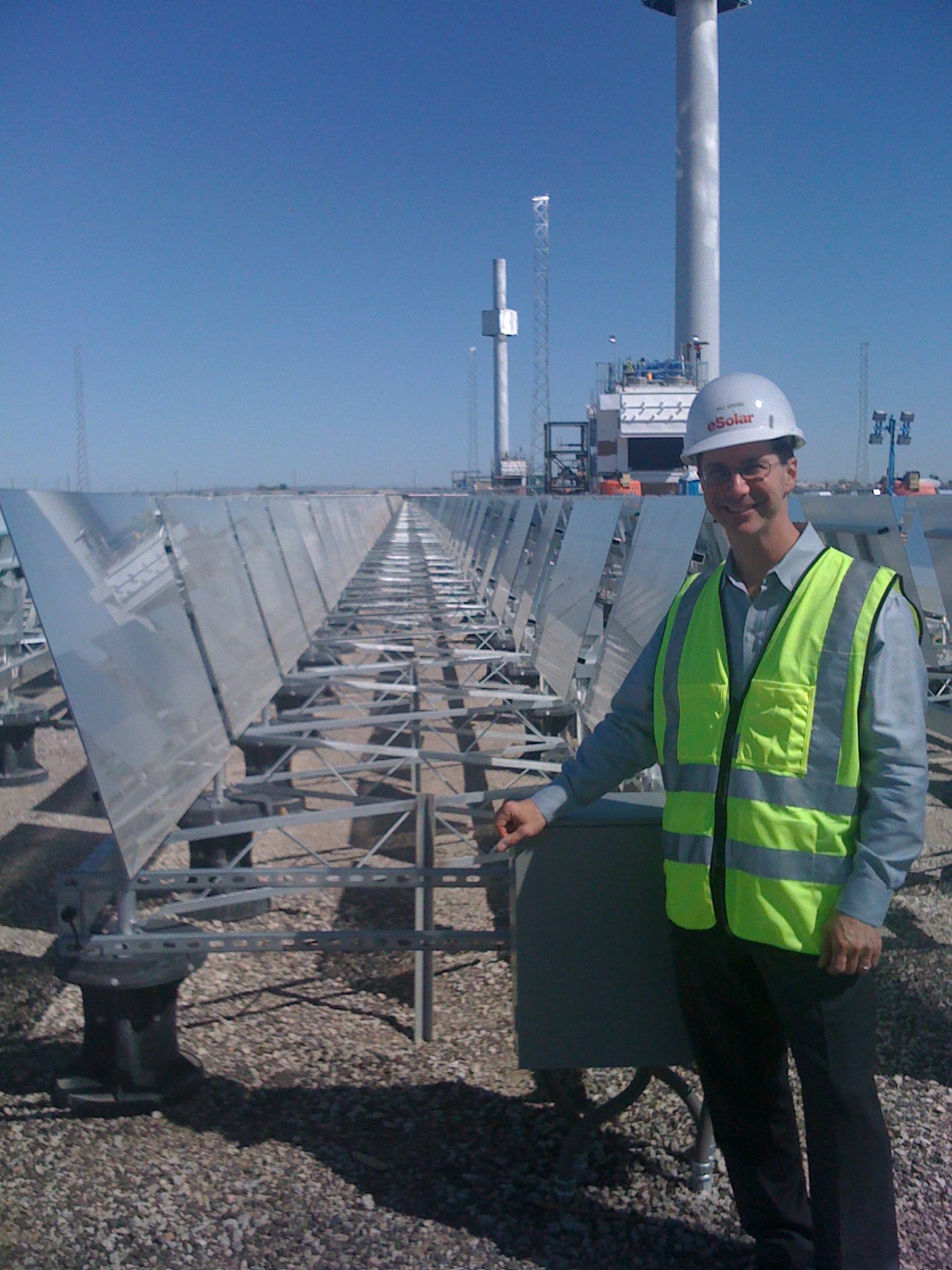
ESolar’s power plants deploy thousands of mirrors called heliostats to focus the sun’s rays on a water-filled boiler that sits atop a slender tower. The heat creates steam that drives an electricity-generating turbine. Last year, eSolar built its first project, a five-megawatt demonstration power plant, called Sierra, in the desert near Los Angeles.

This “power tower” technology is not new, but what sets the company apart is Gross’ use of sophisticated software and imaging technology to control the 176,000 mirrors that form a standard, 46-megawatt eSolar power plant. That computing firepower precisely positions the mirrors to create a virtual parabola that focuses the sun on the tower. That allows the company to place small, inexpensive mirrors close together, which dramatically reduces the land needed for the power plant and cuts manufacturing and installation costs.

“We use Moore’s law rather than more steel,” Gross likes to quip, referring to Intel co-founder Gordon Moore’s maxim that computing power doubles every two years.

You can read the interview here.

Read Full Post »

Photo: Flickr via Pink Sherbet Photography

In my latest Green State column in Grist, I write about the need to roll out a smart water grid as drought and water shortages take their toll:

The other day I came home to find a colorful flyer on my front door proclaiming, “Your meter just got smarter.”

While I was out and about in Berkeley, a worker from my utility, PG&E, slipped in the side gate and gave my old gas and electric meter a digital upgrade. So-called smart meters allow the two-way transmission of electricity data and will eventually let me monitor and alter my energy consumption in near real-time. I’ll be able to fire up an app on my iPhone and see, for instance, a spike in watts because my son has left the lights on in his room and a laptop plugged in.

Now I only learn of my electricity use when I get my monthly utility bill, long after all that carbon has escaped into the atmosphere. The situation is even worse when it comes to water consumption; my bill and details of my water use arrive every other month.

“When you tell people what total bucket of water they used in the past 60 days, the barn door is open and the animals are long gone,” says Richard Harris, water conservation manager for the East Bay Municipal Utility District, my local water agency.

EBMUD is currently testing smart water meters in 30 households and plans to expand the pilot program to 4,000 homes and businesses later this year.

“It’ll give us better knowledge of where our water is going,” says Harris. “We also thought if we’re going to ask people to use water more efficiently, especially when we’re coming out of a drought and have imposed water restrictions, customers need to have an idea of what their current use is.”

EBMUD’s smart meters take readings every hour and participants in the pilot program will be able to go online to check their consumption and set up an email alert if their water use rises above a certain level. The agency also plans to offer a social networking feature to allow people to compare their water consumption with other households in the area. Nothing like a little peer pressure to get you to turn off the tap.

Given that many states expect to face water shortages in the coming years, one would think we’d be seeing a roll out of smart water meters akin to the national effort being made to smarten up the power grid.

The payoff could be enormous. Water agencies and consumers would be able to detect leaking pipes and toilets in real-time and fix the problem before the water literally goes down the drain.

You can read the rest of the column here.

Read Full Post »

image: Tessera Solar

In a follow-up to my New York Times story Tuesday on Senator Dianne Feinstein’s bill to ban renewable energy production in parts of California’s Mojave Desert, I take a look at some of the incentives in the legislation that could speed green energy projects:

In Tuesday’s Times, I write about Senator Dianne Feinstein’s bill to create two Mojave Desert monuments in California that would ban renewable energy projects on lands that are both coveted for solar farms and valued for their sweeping vistas and populations of rare wildlife.

The mere prospect of the legislation has derailed several massive solar power plants planned by Goldman Sachs and other developers. But Mrs. Feinstein, a California Democrat, has included provisions in the bill that could, if enacted, accelerate renewable energy development and ease tensions over endangered species that are slowing other solar projects outside the monument area.

In a big concession to renewable-energy advocates, Mrs. Feinstein would allow transmission lines to be built through existing utility rights-of-way in the monument to transmit renewable energy from other desert areas to coastal metropolises. That will not likely sit well with some of the senator’s environmental allies. (Nor will a provision that permanently designates areas of the desert for off-road vehicle use.)

The legislation also features a pilot program to assemble huge tracts of land -– at least 200,000 acres — to be used as endangered species habitat to make up for areas lost to renewable energy production.

You can read the rest of the story here.

Read Full Post »

photo: Solyndra

In The New York Times on Friday, I write that Solyndra, a Silicon Valley photovoltaic module maker, has become the first solar startup in years to brave the public markets:

Solyndra, a well-financed solar module maker, filed a registration statement for an initial public offering on Friday to raise $300 million to expand its manufacturing capacity.

It would be the biggest solar-related offering in years and follows the stock-market debut of the electric car battery-maker A123 Systems in September.

Based in Fremont, Calif., Solyndra emerged from stealth mode in October 2008 having secured $600 million in venture financing and $1.2 billion in orders. The company, founded in 2005 by veterans of the chip equipment maker Applied Materials, has since raised nearly $200 million more in venture funds.

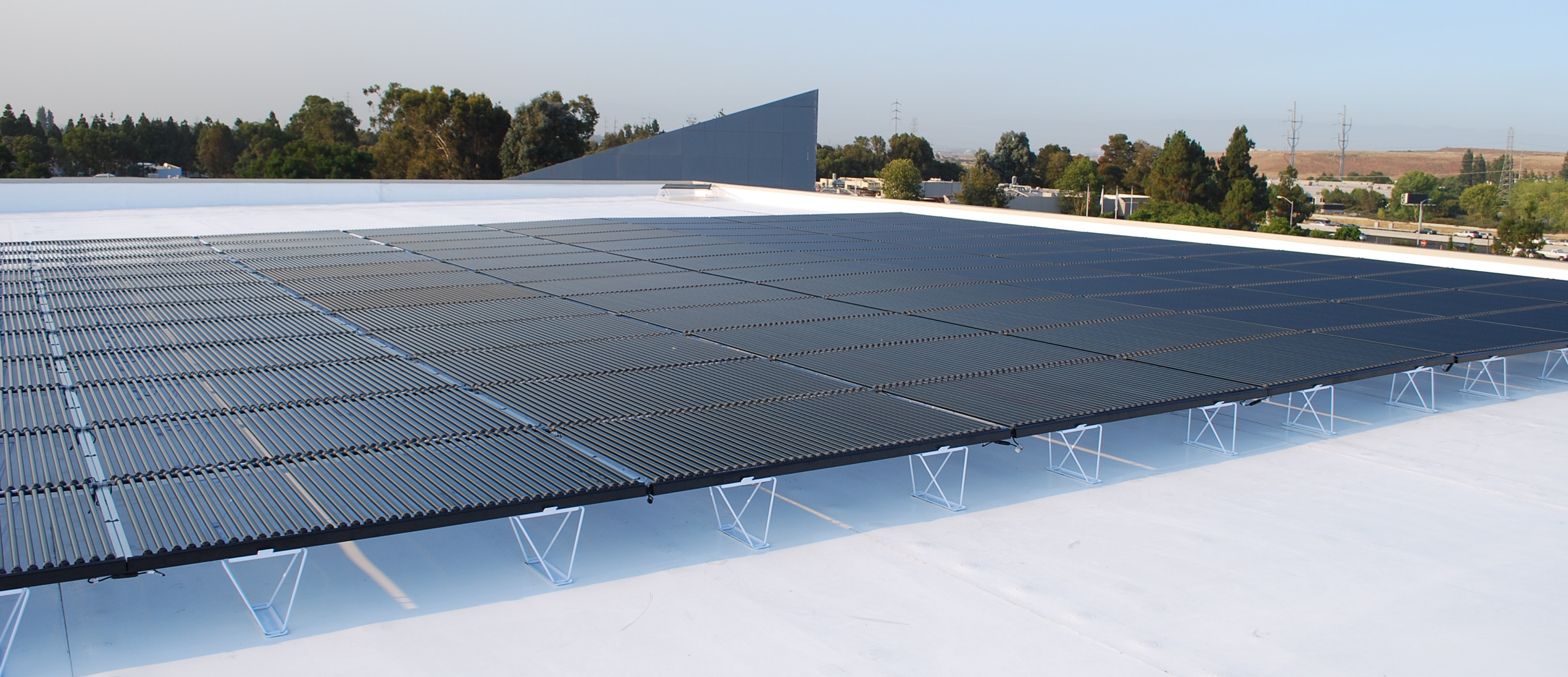
The company makes cylindrical thin-film solar modules designed for commercial rooftops. The round modules collect sunlight from all angles, allowing the solar panels to be placed horizontally and packed close together, increasing efficiency and lowering installation costs, according to Solyndra.

Solyndra secured a $535 million loan guarantee from the United States Department of Energy in March to help finance the construction of a second factory near its headquarters. In September, the company applied for an additional government loan guarantee to help pay for the second phase of the $1.38 billion factory, according to the registration statement.

You can read the rest of the story here.

Read Full Post »

photo: Todd Woody

In Thursday’s New York Times, I write about the latest trend to come out of Southern California — sustainable surfing:

SAN CLEMENTE, Calif.

A few blocks from the beach, the pungent smell of polyester resin wafts from the surfboard factories that crowd an alley known as the surf ghetto in this Southern California town. Inside warrens of rooms painted ocean blue, young men wearing face masks shape slabs of snow-white polyurethane foam into surfboards, the cast-off chemical dust covering floors and filling trash barrels.

Despite its nature-boy image, the American surfing industry often relies on toxic manufacturing processes and generates tons of waste to make surfboards and other products. While surfers have long fought polluters that befoul beaches and oceans, the surfing industry — which has annual revenue of $7.2 billion, according to the Surf Industry Manufacturing Association, a trade group — is also focusing on cleaning up its own backyard.

“The dirtiest thing about surfing is under our feet — a conventional surfboard is 100 percent toxic,” said Frank Scura, a surfer and executive director of the Action Sports Environmental Coalition, an organization that promotes green retailing.

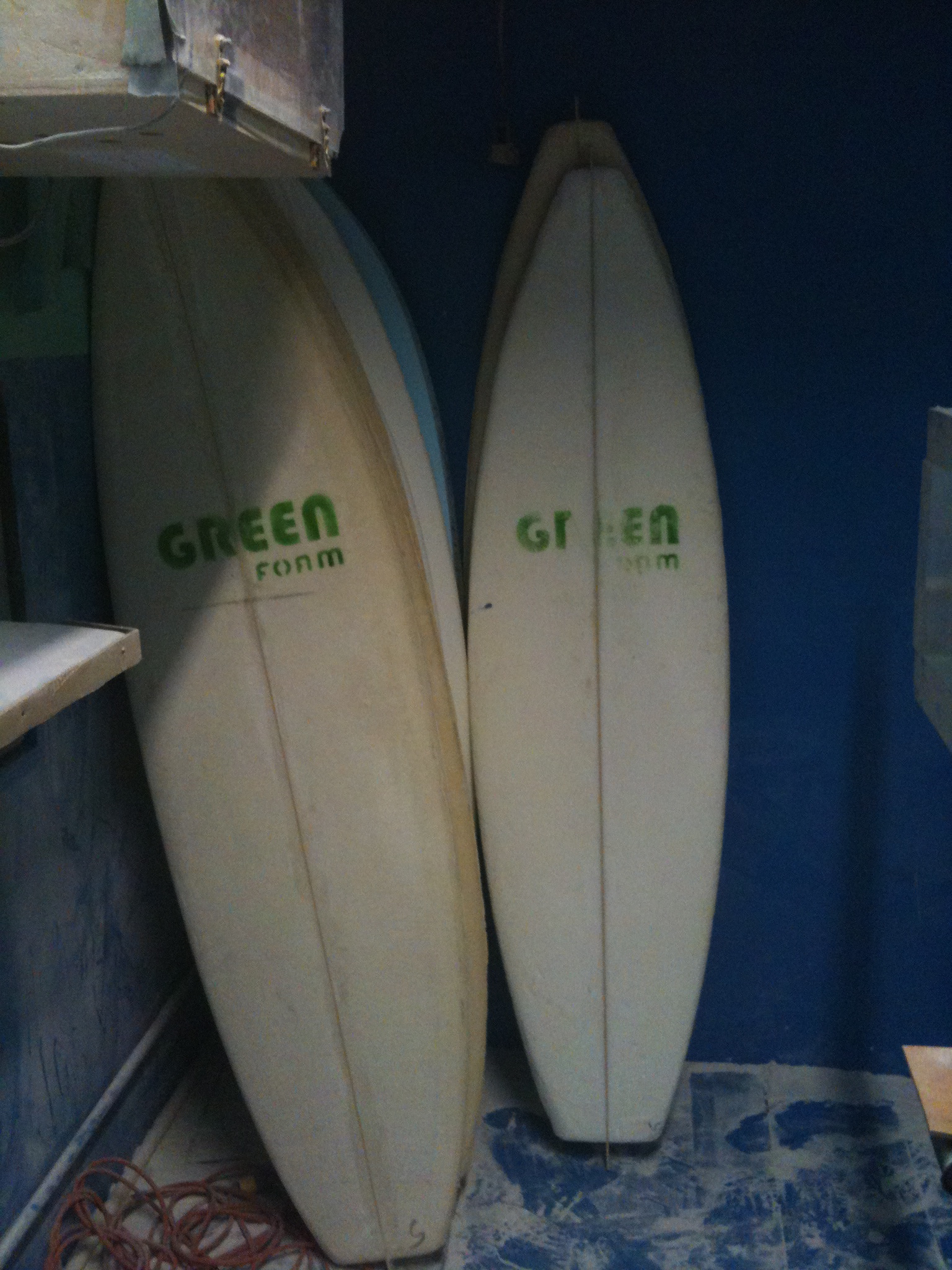
In San Clemente, a start-up company called Green Foam Blanks is out to change a half-century of surfboard-making tradition. Its founders, Joey Santley and Steve Cox, have created what is thought to be the world’s first recycled polyurethane blank — the foam core of a surfboard.

They collect polyurethane cuttings from surfboard factories and, using a proprietary process, mix the trimmings with virgin foam to create a blank that is 60 to 65 percent recycled waste. The goal is to reduce production of new foam, which is typically made with a carcinogenic compound called toluene diisocyanate, or TDI.

“Every day in Southern California, about 800 boards are being shaped and as much as 40 percent of each blank, which contains toxic materials, ends up being put into landfills,” said Mr. Santley, who is 44 and a veteran of the surfing industry.

You can read the rest of the story here.

Read Full Post »

Rack Welding

photo: Skyline Solar

Silicon Valley startup Skyline Solar has joined other green energy companies beating a path to Detroit to take advantage of the down-and-out auto industry’s manufacturing might. As I write in the Los Angeles Times on Thursday:

Skyline Solar, a Silicon Valley start-up, has become the latest green energy company to tap the struggling auto industry’s manufacturing muscle.

The company announced today that components for its solar power plants were being made in a Troy, Mich., car factory operated by Cosma International, a division of auto manufacturing giant Magna International.

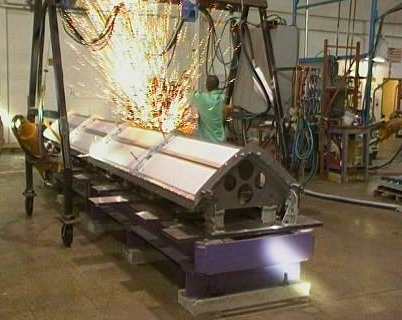
The same machines that stamp out doors, hoods and other car body parts are now making long metal arrays that hold Skyline’s photovoltaic panels.

“It’s literally just carving out a piece of an existing facility and putting through a product that for all intents and purposes could be a new make and model of the next family sedan,” said Bob MacDonald, Skyline’s chief executive.  “Every time there’s a new model year for a Ford Mustang, they have a tool and die set they put into this press. So you just have a different tool and die in there that forms a new shape for Skyline.”

The bottom line, said MacDonald, is that Skyline has slashed its capital costs by taking advantage of Cosma’s existing manufacturing capability. He said Skyline of Mountain View, Calif., has contracts in place for small-scale solar farms. He said he could not divulge the details of those contracts but noted that Skyline has begun to receive shipments of arrays from Michigan.

It’s also a good deal for Cosma, whose parent company has agreed to acquire Opel from General Motors.

“Renewable energy trends and forecast data suggest significant growth potential for this market — we expect to participate in this growth potential,” Tracy Fuerst, a Magna spokeswoman, said in an e-mail.

You can read the rest of the story here.

Read Full Post »

image002There are a growing number of “green” software applications for the iPhone. One of the newest is an app that turns the gadget into an anemometer to clock wind speeds for those considering installing a backyard turbine. As I write in The New York Times on Thursday:

Thinking of putting a wind turbine in your backyard? Mariah Power is introducing a program that will let you measure the wind speed around your house by pointing your iPhone toward the sky.

The application uses the phone’s microphone to capture wind noise. It filters out ambient sound and an algorithm converts the result into a decibel rating that corresponds to wind speed, according to Bill Westerman, a principal at Create with Context, a Silicon Valley digital design company that developed the app for Mariah.

“If you go out in your backyard and do a few measurements it gives you a pretty good idea of the wind speed and tells you what kinds of things you could power with a wind turbine,” said Mr. Westerman.

Mariah, based in Reno, Nev., makes the Windspire, 1.2-kilowatt residential turbine with horizontal blades that looks more like a piece of modern art than a conventional windmill.

You can read the rest of the story here.

Read Full Post »

IMG_1214

photo: Todd Woody

Can a state that gets 95 percent of its electricity from coal-fired power plants go green? The Natural Resources Defense Council thinks so. In a report released this week, the environmental group lays out how Indiana can become the California of the Midwest when it comes to renewable energy. As I write in The New York Times on Friday:

Coal-dependent Indiana could become one of the nation’s greenest states by tapping rural resources to generate renewable energy, according to a new report issued by the Natural Resources Defense Council.

The Hoosier State now obtains 95 percent of its electricity from plants running on coal — largely imported from Wyoming and elsewhere — but it could profit as an exporter of wind energy and machinery, the report said.

“Indiana has some of the best wind potential in the eastern U.S. and has a competitive advantage as a wind producer over most other states because of its location,” said the report’s author, Martin R. Cohen, said during a conference call on Wednesday.

Mr. Cohen noted that while the wind blows stronger in states like North Dakota and Nebraska, Indiana already has the transmission system in place to bring wind-generated electricity to eastern cities.

If Indiana increased wind energy production to 4,500 megawatts from its current 530 megawatts, it would create thousands of jobs and attract turbine manufacturers, according to the report. An owner of a 500-acre farm could earn $30,000 a year from leasing land for wind turbines, Mr. Cohen estimated.

Farmers also could profit, the report said, if Indiana starts harvesting corn stalks, wheat stalks and soybean residue and uses the biomass either for power production or to make ethanol.

You can read the rest of the story here.

Read Full Post »

ausra-kimberlina

photo: Ausra

In Wednesday’s Los Angeles Times, I write about green tech guru Vinod Khosla’s new $1.1 billion venture funds — the biggest first-time fund since the halcyon days of the dot-com era a decade ago and and a strong signal that investors see a bright future in clean and green technologies. CalPERS, the United States’ biggest pension fund, is the major backer of the new Khosla Ventures’ funds:

In a sign that green technology investing is bouncing back, Silicon Valley venture capital firm Khosla Ventures said Tuesday that it had raised $1.1 billion to spur development of renewable energy and other clean technologies.

It is the biggest first-time fund in a decade and comes as venture capital investment in green technology is just beginning to recover from a precipitous fall prompted by the global economic collapse last fall.

In the first half of the year, investments in green tech plunged to $513 million from $2 billion in the first six months of 2008, according to a survey by PricewaterhouseCoopers.

But Vinod Khosla, founder of Khosla Ventures in Menlo Park, Calif., and a leading green tech guru, has managed to raise an $800-million fund to invest in early and mid-stage clean energy and information technology companies as well as a $275-million fund to finance what he called high-risk “science experiments” that may exist only in a university laboratory.

You can read the rest of the story here.

Read Full Post »

« Newer Posts - Older Posts »

Design a site like this with WordPress.com
Get started