Feeds:
Posts
Comments

Archive for the ‘green startups’ Category

ausra-kimberlina

photo: Ausra

In Wednesday’s Los Angeles Times, I write about green tech guru Vinod Khosla’s new $1.1 billion venture funds — the biggest first-time fund since the halcyon days of the dot-com era a decade ago and and a strong signal that investors see a bright future in clean and green technologies. CalPERS, the United States’ biggest pension fund, is the major backer of the new Khosla Ventures’ funds:

In a sign that green technology investing is bouncing back, Silicon Valley venture capital firm Khosla Ventures said Tuesday that it had raised $1.1 billion to spur development of renewable energy and other clean technologies.

It is the biggest first-time fund in a decade and comes as venture capital investment in green technology is just beginning to recover from a precipitous fall prompted by the global economic collapse last fall.

In the first half of the year, investments in green tech plunged to $513 million from $2 billion in the first six months of 2008, according to a survey by PricewaterhouseCoopers.

But Vinod Khosla, founder of Khosla Ventures in Menlo Park, Calif., and a leading green tech guru, has managed to raise an $800-million fund to invest in early and mid-stage clean energy and information technology companies as well as a $275-million fund to finance what he called high-risk “science experiments” that may exist only in a university laboratory.

You can read the rest of the story here.

Read Full Post »

moss

Photo: Creative Water Solutions

In today’s New York Times’ Green Inc. blog, I write about a literally green pool cleaner that could upend a $3 billion industry:

As its license plates proclaim, Minnesota is the Land of 10,000 Lakes.

Now a Minneapolis-area company says it has figured out the secret to the state’s famously crystalline watering holes: moss.

Specifically, species of sphagnum moss that the startup, Creative Water Solutions, envisions will keep tens of thousands of swimming pools clean while drastically reducing the use of chlorine and other harsh chemicals.

The patented treatment system, which the company has sold for backyard swimming pools since 2007, underwent its first large-scale commercial test this summer at a public aquatic complex in St. Paul.

“I think this is going to have a dramatic effect and change the whole aquatic industry,” said Thomas Schaffer, a 35-year pool industry veteran hired by the City of St. Paul to monitor the moss treatment of an Olympic-size pool and a smaller children’s pool. “We saw a one-third decline in chlorine demand for the water immediately. We’re now using two-thirds less chlorine.”

You can read the rest of the story here.

Read Full Post »

Sierra Club Green Home

At Fortune’s recent Brainstorm Green conference, Green Wombat had a chance to get a guided tour of Sierra Club Green Home — the new for-profit online venture of the venerable Sierra Club — from Jennifer Schwab, the startup’s  sustainability director.

As interesting as the site is the business model being pursued by the 117-year-old non-profit. As I wrote in my Green State column on Grist:

It’s not unusual these days for big green groups to get in bed with business, but one of the oldest and most-respected environmental organizations—the Sierra Club—is going them one better by getting into business itself.

The San Francisco-based Sierra Club has launched a for-profit online venture called Sierra Club Green Home as a one-stop shop for information and services to green up your lifestyle and decarbonize your abode.

Sierra Club Green Home is a joint venture between the 117-year-old institution and a group of individual investors—or “donors” as they like to call themselves. “It’s the social entrepreneurship model,” says Gordon Wangers, the company’s marketing chief and one of the donor/investors. “A non-profit finds some enterprising business types who are committed to a cause but bring business savvy to a venture and have the skills and wherewithal to run it.”

Wangers thinks it’s a model for other green groups as the economic collapse zaps the fortunes of their well-heeled donors.

You can read the rest of the column here.

Read Full Post »

CODA Front_hires

photo: Coda Automotive

A new electric car company, Coda Automotive, emerged from stealth mode this week and unveiled a $45,000 sedan that it says will hit the streets in 2010.

The Santa Monica, Calif., startup is an offshoot of Miles Electric Vehicles, a maker of low-speed neighborhood runabouts. The CEO is Kevin Czinger, a veteran of Goldman Sachs (GS), Fortress Investment Group and dot-com era online grocer WebVan. Goldman Sachs’ Mac Heller serves as co-chairman and the board includes John Bryson, past chairman and chief executive of Edison International (EIX). Coda has raised $40 million from the Angeleno Group and other investors.

Green Wombat took a spin in the car, called the Coda, earlier this week in Southern California. As I wrote in my Green State column on Grist:

Open one of those minimalist black boxes that contain a shiny new iPod and you’re greeted by five words—“Designed by Apple in California.” In much smaller print would be the phrase “Made in China.”

That, in a nutshell, describes the strategy of the latest entrant in the electric car sweepstakes: Santa Monica-based Coda Automotive. At a defunct Wilshire Boulevard Jaguar dealership on Wednesday, the startup emerged from stealth mode and CEO Kevin Czinger literally pulled the cover off the Coda, a $45,000 battery-powered sedan set to go on sale next year in California. Coda is an offshoot of Miles Electric Vehicles, a maker of low-speed “neighborhood electric” runabouts.

The Coda sedan, which resembles a previous-generation Honda Civic, is a highway-ready, 80 mph five-seater that will travel 90 to 120 miles on a charge, according to the company.

And it is likely to be the first Chinese-made car to hit American roads. The car’s 333-volt lithium ion battery pack comes from the Tianjin Lishen Battery Joint-Stock Co., a huge state-owned corporation that supplies batteries to Apple and other consumer electronics companies.  Coda has established a joint venture with Tianjin Lishen to design and sell batteries for transportation and utility storage. The sedan’s design, brand and intellectual property will be owned by Coda, but it will be manufactured and assembled in China by Hafei, a state-owned automobile and aircraft manufacturer.

Read the rest of the column here.

Read Full Post »

solara

photo: BrightSource Energy

California utility PG&E on Wednesday expanded an agreement with BrightSource Energy to buy 1,310 megawatts of carbon-free electricity to be generated by seven giant solar power plant projects – the world’s biggest solar deal to date. Coming on top of a 1,300 megawatt agreement with Southern California Edison in February, the Google-backed, Oakland, Calif.-based  startup says it now holds more than 40% of the Big Solar contracts in the United States.

PG&E had previously signed a power purchase agreement with BrightSource in April 2008 for 500 megawatts with an option to buy another 400 megawatts. The new 1,310-megawatt deal will supply enough electricity to power about 530,000 homes in California.

Those are impressive numbers, but not an electron of electricity has been produced yet. BrightSource now faces the challenge of licensing, financing billions of dollars in construction costs and then building nearly a dozen large-scale solar power plants to meet a 2016 deadline for the Southern California Edison (EIX) contract and a 2017 completion date for PG&E (PCG).  (The big wild card is whether transmission lines will be available to connect the power plants to the grid.) The first PG&E project is set to go online in 2012 with the first SoCal Edison solar farm to begin generating electricity the next year. Those first two power plants are part of a 400-megawatt complex BrightSource is planning for the Ivanpah Valley on the California-Nevada border.

“The biggest part of our strategy is to ramp up slowly and methodically,” BrightSource CEO John Woolard told Green Wombat. “We’re very, very careful about how we sequence the projects.”

To give you an idea of how arduous the licensing process is in California, consider that BrightSource filed its application to build Ivanpah with the California Energy Commission on Aug. 31, 2007 — the state’s first large-scale solar power plant application in two decades. But the energy commission currently estimates that it won’t sign off on the license until around 2010, more than six months’ behind schedule as a multitude of state and federal agencies and green groups weigh in on the project’s environmental impact. The clock is ticking as BrightSource needs to start shoveling dirt on the construction site by the end of 2010 to qualify for federal loan guarantees that are part of the Obama stimulus package.

BrightSource may also build solar power plants in Nevada and Arizona, where licensing is easier, to supply electricity to PG&E and Southern California Edison. Woolard says the company controls enough land for nine gigawatts’ worth of solar farms.

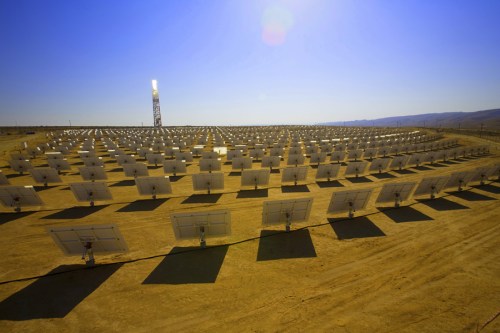
While BrightSource’s technology is untested on a large scale, the company has built a six-megawatt demonstration plant in Israel, where its technology development arm is headquartered. BrightSource deploys arrays of mirrors called heliostats that concentrate sunlight on a water-filled boiler that sits atop a tower. The intense heat vaporizes the water to create high-pressure steam that drives a standard electricity-generating turbine.

Woolard says an independent engineering firm, R.W. Beck, has validated the technology at the Negev Desert demo plant. That no doubt helped persuade PG&E, which has sent executives to Israel to inspect the project, to supersize its contract. (And while BrightSource represents the biggest solar deal PG&E has signed, it’s probably far more likely to be fulfilled than the utility’s agreement in April to buy electricity from a space-based solar farm to be built by Southern California startup Solaren.)

“What it came down to is that they saw us delivering,” Woolard says. “Our plant in Israel performed above expectations. The fact that we have a solar plant producing the highest quality, highest temperature, highest pressure steam anywhere in the world is the most important thing.”

The company’s pedigree also provides a certain amount of corporate comfort. BrightSource was founded by American-Israeli solar pioneer Arnold Goldman, whose Luz International built nine large-scale solar trough power plants in the Mojave Desert in the 1980s that continue to generate electricity for Southern California Edison. BrightSource has also raised more than $160 million from a blue-chip group of investors that includes Google (GOOG), Morgan Stanley (MS) and VantagePoint Venture Partners as well as a clutch of oil giants – Chevron (CVX), BP (BP) and Norway’s StatoilHydro.

Read Full Post »

solara

photo: BrightSource Energy

As the Nevada legislature debates extending tax breaks for large-scale solar power plants, a new report finds that ramping up solar development in the Silver State could produce thousands of good-paying green jobs while generating nearly $11 billion in economic benefits.

The study from San Francisco-based non-profit Vote Solar concludes that 2,000 megawatts’ worth of big solar thermal and photovoltaic farms — needed to meet Nevada’s electricity demand — would result in 5,900 construction jobs a year during the plants’ building phase, 1,200 permanent jobs and half a billion dollars in tax revenues.

“It is likely that such an investment in solar generating facilities could bring solar and related manufacturing to Nevada,” the reports authors wrote. “The economic impact of such manufacturing development is not included in this analysis, but would add significant additional benefits.”

Vote Solar’s job projections are based on an economic model developed by the National Renewable Energy Laboratory to project the impact of solar trough power plants, the most common, if dated, type of Big Solar technology.

The different solar technologies set to come online in the next couple of years could change that equation. No doubt thousands of jobs will be generated by Big Solar but just how many will depend on the mix of solar thermal and photovoltaic power plants that ultimately come online. New technologies like BrightSource Energy’s “power tower,” Ausra’s compact linear fresnel reflector and Stirling Energy Systems’s solar dish may generate similar numbers of jobs. But then there’s eSolar’s power tower solar farms – which uses fields of mirrors called heliostats to focus the sun on a water-filled boiler, creating steam that drives an electricity-generating turbine.  eSolar’s small and prefabricated heliostat arrays cut out much of the skilled labor typically needed on such projects as they can be installed by two workers using a wrench.

Photovoltaic farms essentially take rooftop solar panels and put them on the ground and thus don’t require highly skilled laborers to build turbine power blocks, miles of piping and other infrastructure needed in solar thermal facilities. (They also can be built much more quickly than a solar thermal plant, which is why utilities have been striking deals with companies like First Solar (FSLR) and SunPower (SPWRA) for PV farms.)

A second report released this week — from the Large-Scale Solar Association, an industry group — found that Nevada could gain an edge over Arizona and California in luring solar power plant builders if it extended and sweetened tax incentives.  The three states form something of a golden triangle of solar, offering the nation’s most intense sunshine and vast tracts of government-owned desert land that are being opened up for solar development.

The timing of the reports was no accident. The Nevada Legislature held hearings earlier this week on extending tax breaks for Big Solar that expire in June, and Vote Solar’s utility-scale solar policy director, Jim Baak, went to Carson City to lobby legislators, hoping to head off one proposal to tax renewable energy production.

The Large-Scale Solar report, prepared by a Las Vegas economic consulting firm, found that if legislators let the tax breaks sunset, as it were, the developer of a 100-megawatt solar power plant would pay $55.1 million in taxes in Nevada during the first 15 years of the facility’s operation compared to $26.1 million in Arizona and between $36.1 and $37.9 million in California. If the current incentives are kept, tax payments drop to $25.1 million. A bigger tax break would reduce the tax burden to $14.3 million.

Read Full Post »

siting1

Can Google help defuse a simmering green civil war between renewable energy advocates and wildlife conservationists in the American West?

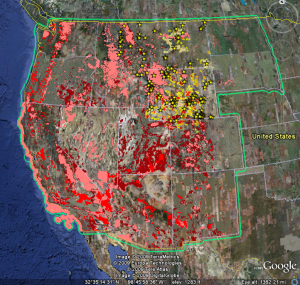
That’s the idea behind a new Google Earth mapping project launched Wednesday by the Natural Resources Defense Council and the National Audubon Society. Path to Green Energy will identify areas in 13 western states potentially suitable for massive megawatt solar power plants, wind farms, transmission lines and other green energy projects. The app will also pinpoint critical habitat for protected wildlife such as the desert tortoise in California and Wyoming’s sage grouse as well as other environmentally sensitive lands.

“This was information that was unavailable or very scattered,” said Google.org program director David Bercovich at a press conference. “The potential cost savings from this will be enormous. If we can get people to the right areas and streamline the process that will have enormous benefits in getting clean energy online faster.”

NRDC senior attorney Johanna Wald said her group already is using Path to Green Energy in New Mexico to help plan a new transmission project. “Careful siting is the key to renewable energy development,” she said, noting that NRDC has mapped 860 million acres. “We’re not greenlighting development on places that are on our map but we’re providing a framework for discussion.”

siting2The unveiling of Path to Green Energy comes two weeks after California Senator Dianne Feinstein announced she would introduce legislation to put as many as 600,000 acres of the Mojave Desert off limits to renewable energy development to protect endangered wildlife and their habitats.  Solar developers have filed lease claims on a million acres of federal land in the California Mojave and there are state and federal efforts already under way to identify green energy zones across the West.

Path to Green Energy is designed to give regulators and developers a tool to choose the best potential sites for solar and wind farms so they don’t get bogged down in years-long and multimillion-dollar fights over wildlife.  Ausra, BrightSource Energy and other developers of the first half-dozen solar power plant projects moving through the licensing process in California have spent big sums on hiring wildlife consultants who spend thousands of hours surveying sites for desert tortoises, blunt-nosed leopard lizards and other protected species.

The Google Earth app won’t do away with the need to do such detailed environmental review but puts in one package a variety of information that developers must now cobble together themselves — if they can find it. Path to Green Energy could also prove valuable to utilities like PG&E (PCG) and Southern California Edison (EIX) as more and more projects are proposed and regulators scrutinize the cumulative impact of Big Solar power plants across regions.

For instance, in California’s San Luis Obispo County, three large-scale solar farms are being planned within a few miles of each other by Ausra, SunPower (SPWRA) and First Solar (FSLR). That has resulted in delays as wildlife officials initiate studies looking at how all those projects affect the movement of wildlife throughout the area. Going forward, Path to Green Energy will give developers a snapshot of where the wild things are, as well as wildlife corridors to help them avoid siting one plant too close to another in a way that may impede animals’ migration. That could save millions of dollars in mitigation costs – money builders must spend to acquire land to replace wildlife habitat taken for a power plant project as well as avoid fights with environmental groups that have become increasingly uneasy about Big Solar projects.

If the desert tortoise is the critter to avoid when building solar power plants in the Mojave, the sage grouse poses problems for Wyoming wind farms. Brian Rutledge, executive director of Audubon Wyoming, said Path to Green Energy shows the densities of sage grouse across the state, allowing developers to stay clear of those areas.

“We get a solid indication of where energy development shouldn’t go,” he said. “Just as important, we get a better sense of the places that should be evaluated for wind turbine farms and transmission lines. The maps make clear that there is plenty of room for green energy.”

The payback from using Web 2.0 software could indeed be tremendous, given that Google (GOOG) spent a scant $50,000 in donations to NRDC and Audubon to create the maps.

Read Full Post »

Along with the rest of the economy, venture capital investment in green technology has fallen off the proverbial cliff, according to a survey released Wednesday by market research firm the Cleantech Group.

Global investment in renewable energy, electric cars and other green tech dropped 48% to $1 billion in the first quarter of 2009 from the previous year and fell 41% from the previous quarter. (Global here being defined as North America, Europe, China and India.)

The survey, conducted with Deloitte, found that the size of the average round of funding also crashed, from $20 million in the fourth quarter of 2008 to $12.3 million in the first quarter.

Solar captured the biggest chunk of VC cash at $346 million, with the money going to companies like concentrated photovoltaic startup SolFocus and Norwegian polysilicon maker Norsun.

“Venture funds continue to invest significant sums, albeit at a slower pace and smaller scale than in the past two years,” Brian Fan, the Cleantech Group’s senior director of research, said in a statement.

North America remains the epicenter of green tech investing, with nearly two-third of all of investments in the first quarter.

Read Full Post »

desert-tortoise1

photo: Wild Rose Images

California Senator Dianne Feinstein’s move to put a large swath of the Mojave Desert off-limits to renewable energy development is splitting the environmental movement and could derail some two dozen solar and wind power projects the state needs to comply with its ambitious climate change laws.

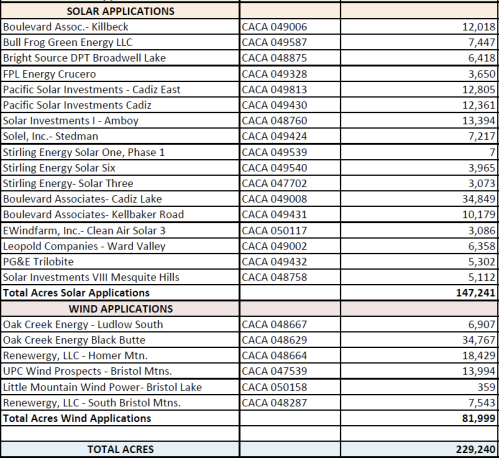
On the firing line are 17 massive solar power plants and six wind farms planned for federal land — land that would be designated a national monument under legislation Feinstein intends to introduce. The solar projects in question would be built by a range of companies, from startups BrightSource Energy and Stirling Energy Systems to corporate heavyweights Goldman Sachs (GS) and FPL (FPL), according to federal documents. (For the complete list, see below.)

The companies are among scores that have filed lease claims on a million acres of acres of desert dirt controlled by the U.S. Bureau of Land Management. California utilities PG&E (PCG) and Southern California Edison (EIX) have signed long-term power purchase agreements for some of the projects now in jeopardy and are counting on the electricity they would produce to meet state-mandated renewable energy targets. PG&E itself has filed a solar power plant land claim in the proposed national monument.

The area of the desert in dispute is some 600,000 acres formerly owned by Catellus, the real estate arm of the Union Pacific Railroad, and donated to the federal government a decade ago by the Wildlands Conservancy, a Southern California environmental group. About 210,000 of those acres are managed by the U.S. Bureau of Land Management, which opened part of the land to renewable energy projects.

“Many of the sites now being considered for leases are completely inappropriate and will lead to the wholesale destruction of some of the most pristine areas in the desert,” Feinstein wrote in a letter to Interior Secretary Ken Salazar released last week, notifying him that she will introduce legislation to designate the former Catellus lands a national monument. “Beyond protecting national parks and wilderness from development, the conservation of these lands has helped to ensure the sustainability of the entire desert ecosystem by preserving the vital wildlife corridors.”

The Catellus land controlled by the BLM forms something of a golden triangle between the Joshua Tree National Park and the Mojave National Preserve in Southern California and are particularly coveted for renewable energy development because of its proximity to transmission lines.

Alan Stein, a deputy district manager for the BLM in California, told Green Wombat that the solar and wind lease claims are in areas that are not designated as wilderness or critical habitat for protected species like the desert tortoise. “This is public domain land, ” he says.

Tortoises, however, are found across the Mojave, and battles over Big Solar’s impact on endangered wildlife are quietly brewing in several solar power plant licensing cases now being reviewed by the California Energy Commission.  Environmentalists find themselves walking a thin green line, trying to balance their interest in promoting carbon-free energy with protecting fragile desert landscapes and a host of threatened animals and plants.

Take BrightSource Energy’s Ivanpah 400-megawatt solar power plant complex on the California-Nevada border. The three solar power plants to be built by the Oakland-based company will supply electricity to PG&E and Southern California Edison. But the project will also destroy some 4,000 acres of desert tortoise habitat and at least 25 tortoises will have to be relocated – a somewhat risky proposition as previous efforts in other cases have resulted in the deaths of the animals.

On Wednesday, the California Energy Commission granted two national environmental groups – the Defenders of Wildlife and the Sierra Club – the right to intervene in the Ivanpah case. “Defenders strongly supports … the development of renewable energy in California,” Kim Delfino, California program director for Defenders of Wildlife, wrote to the energy commission in a Jan. 23 letter.  “Defenders has several serious concerns about the potential impacts of this project on a number of rare, declining and listed species and on their associated desert habitat and waters.”

Natural Resources Defense Council attorney Johanna Wald wrote a letter with the Wilderness Society expressing concern over the impact of Ivanpah project on the desert tortoise but also made a strong statement of support for renewable energy development. “Our public lands harbor substantial wind, solar, and geothermal resources,” wrote Wald, who serves on a state task force to identify appropriate areas for renewable energy development. “Developing some of these resources will be important to creating a sustainable energy economy and combating climate change.”

The big national enviro groups are working with the government and power plant developers to create zones in the Mojave where renewable energy projects would be permitted while setting aside other areas that are prime habitat and wildlife corridors. A similar effort is underway on the federal level to analyze the desert-wide impact of renewable energy development.

Local environmental organizations, however, have split with the Big Green groups over developing the desert and other rural areas. In San Luis Obispo County,  Ausra, SunPower (SPWRA) and First Solar’s (FSLR) plans to build three huge solar farms within miles of each other has prompted some local residents worried about the impact on wildlife to organize in opposition to the projects.

And some small Mojave Desert green groups pledge to go to court to stop big solar projects. “We don’t want to see the Endangered Species Act gutted for the sake of mega solar projects,” veteran grass roots activist Phil Klasky told Green Wombat last year for a story on the solar land rush in the Mojave. “I can say the smaller environmental organizations I’m involved with are planning to challenge these projects.”

It would be unwise to underestimate Klasky. In the 1990s, he helped lead a long-running  and successful campaign to scuttle the construction of a low-level radioactive waste dump in tortoise territory in the Mojave’s Ward Valley – now a prime solar spot.

Still, while California’s senior senator’s move in the Mojave may exacerbate rifts in the environmental movement over renewable energy, it also could galvanize efforts to resolve critter conflicts in a comprehensive way. Otherwise, environmentalists of varying hues may find themselves fighting each other rather than global warming.

Update: I just had a conversation with BrightSource spokesman Keely Wachs, who takes issue with my characterization that the Ivanpah project will “destroy” desert tortoise habitat. He points out that the company is taking care to minimize the impact of the power plant on the surrounding desert and that wildlife may still occupy the site. It would be more accurate to say that the project will remove desert tortoise habitat from active use during Ivanpah’s construction and operation.

(Below is a list of solar and wind projects that fall within the proposed Mojave national monument. Note: Solar Investments is a subsidiary of Goldman Sachs and Boulevard Associates is a subsidiary of FPL.)

source:  BLM
blm-nm2

Read Full Post »

solyndra-rooftop-2

photo: Solyndra

It’s been a good news, bad news Friday for the solar industry. Silicon Valley startup Solyndra received a half billion-dollar loan guarantee from the U.S. Department of Energy to build a solar module factory while further up Interstate 880 OptiSolar moved to shut down its manufacturing operations.

OptiSolar too had asked for a federal loan guarantee to complete work on its Sacramento thin-film solar cell plant but a decision on the $300 million application couldn’t come soon enough to save the startup. “We continued to be unable to find a buyer for the technology and manufacuring business, and the board of directors decided that we needed to limit ongoing operational expense,” wrote OptiSolar spokesman Alan Bernheimer in an e-mail.

First reported by the San Francisco Chronicle’s David Baker, OptiSolar will shut down factories in Sacramento and Hayward, Calif., and lay off 200 workers.  Earlier this month, OptiSolar sold its pipeline of solar power plants – including a 550-megawatt solar farm that will supply electricity to PG&E (PCG) – to rival First Solar  in a $400 million stock deal. At the time, OptiSolar said it intended to focus on manufacturing solar modules.

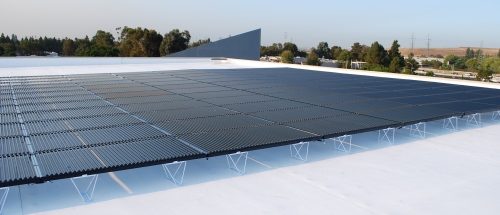
The news was definitely brighter Friday for Solyndra, which emerged from stealth mode last September with $600 million in funding and $1.2 billion in orders for its solar panels composed of cylindrical tubes imprinted with solar cells. Conventional rooftop solar panels must be tilted to absorb direct sunlight as they aren’t efficient at producing electricity from diffuse light. But the round Solyndra module collects sunlight from all angles, including rays reflected from rooftops. That allows the modules, 40 to a panel,  to sit flat and packed tightly together on commercial rooftops, maximizing the amount of space for power production.

The $535 million federal loan guarantee will allow the Fremont, Calif.-based company to build a second factory, which is expected to create 3,000 construction jobs and more than 1,000 other jobs once the plant is in operation. The factory will be able to produce 500 megawatts’ worth of solar panels a year.

“The DOE Loan Guarantee Program funding will enable Solyndra to achieve the economies of scale needed to deliver solar electricity at prices that are competitive with utility rates,” Solyndra CEO Chris Gronet said in a statement. “This expansion is really about creating new jobs while meaningfully impacting global warming.”

Friday’s grant makes good on Secretary of Energy Steven Chu’s pledge to speed up processing of renewable energy loan guarantee applications. The department had come under fire during the previous administration for taking years to dole out grants and loan guarantees for electric car and green energy projects.

Meanwhile, First Solar (FSLR) announced on Friday that it had manufactured 1 gigawatt of thin-film solar cells since beginning commercial production in 2002. It took the Tempe, Ariz., company six years to hit 500 megawatts and only eight months to produce the second 500 megawatts. First Solar’s annual production capacity will reach 1 gigawatt by year’s end, according to the company.

Read Full Post »

« Newer Posts - Older Posts »

Design a site like this with WordPress.com
Get started