Feeds:
Posts
Comments

Archive for the ‘green policy’ Category

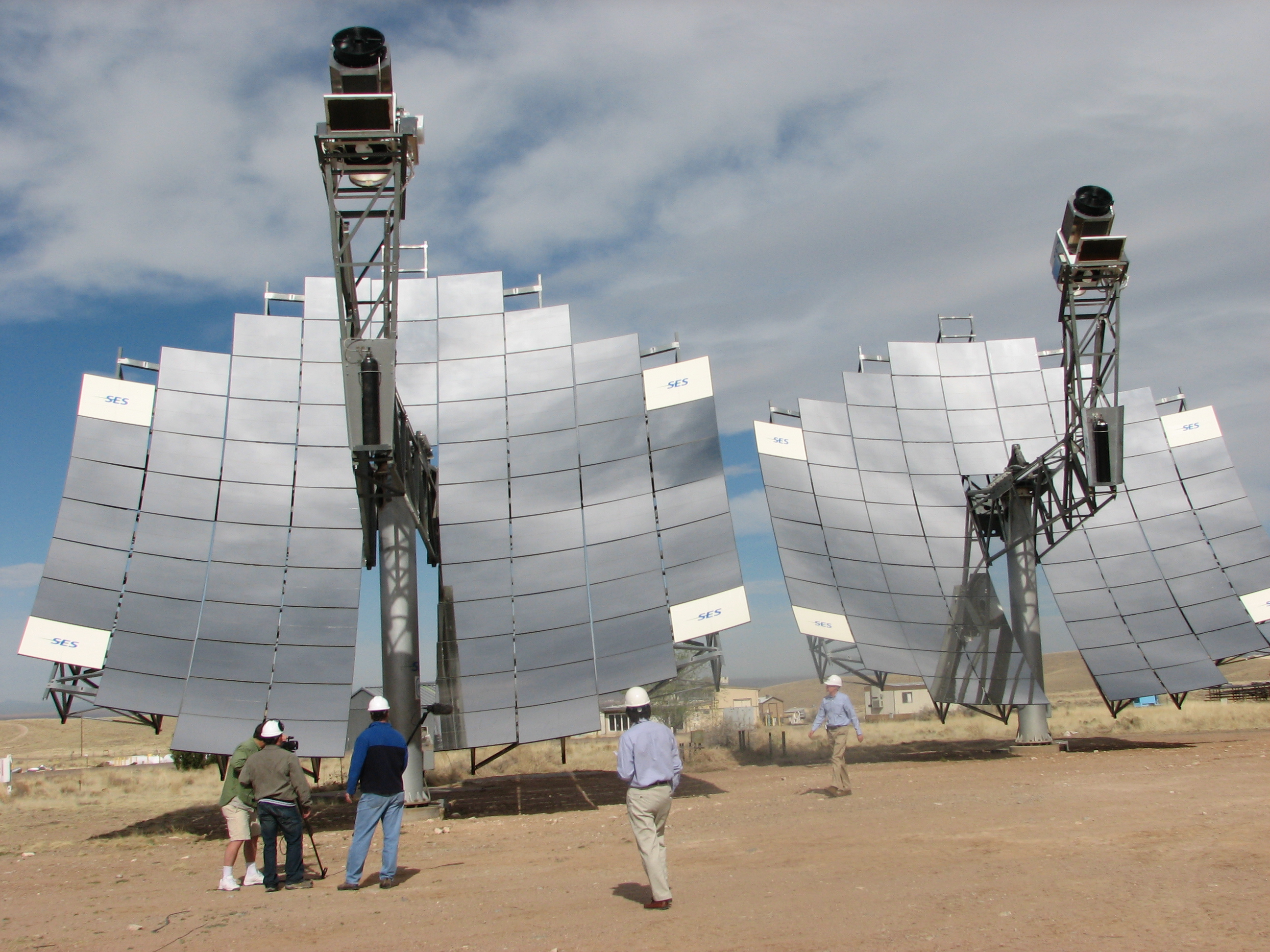
photo: Todd Woody

I wrote this story for Grist, where it first appeared.

While efforts to pass federal climate change legislation have stalled and a fight rages in California to overturn its global warming law at the ballot box, Golden State regulators have been licensing massive desert solar power plant projects at a breakneck pace in recent weeks.

On Wednesday, for instance, the California Energy Commissioned approved two solar projects that would generate nearly 1,000 megawatts of electricity, the 250-megawatt Genesis Solar Energy Project and the 709-megawatt Imperial Valley Solar Project.

Since Aug. 25, the energy commission has licensed six solar thermal power plants that would cover some 39 square miles of desert land and generate 2,829 megawatts. That’s nearly six times as much solar capacity that was installed in the United States last year, mostly from rooftop solar panels.

“Consider how important it is that California move aggressively toward renewables and how important these pioneering projects are,” said Jeffrey Byron, a member of the California Energy Commission, said at a hearing Wednesday.

Regulators and developers are racing to put shovels to ground before the end of the year when federal incentives for large renewable energy projects expire, which could threaten the financial viability of some of the solar projects.

The Genesis project, to be built by Florida-based energy giant NextEra Energy Resources (formerly called FPL), will build long rows of parabolic troughs in the Riverside County desert that will focus sun on liquid-filled tubes suspended over the mirrors to create steam that will drive an electricity-generating turbine. It’s an older solar technology that was first deployed in the 1980s in California.

Tessera Solar’s  Imperial Valley project, on the other hand, will be the first big test of Stirling dish technology. Resembling a giant mirrored satellite receiver, the 38-foot-high, 40-foot-wide, solar dish focuses the sun’s rays on a Stirling engine, heating hydrogen gas to drive pistons that generate 25-kilowatts of electricity. Some 29,000 of Tessera’s Suncatchers will be installed on more 6,400 acres of desert land near the Mexican border about 100 miles east of San Diego.

Meanwhile, California Gov. Arnold Schwarzenegger this week signed into law what is thought to be the nation’s first energy storage legislation. The bill, AB 2514 could result in regulations requiring the state’s utilities to store a certain percentage of electricity generated in energy storage systems such as batteries, compressed air or flywheels.

Energy storage is considered crucial for the mass deployment of solar power plants, wind farms and other sources of intermittent renewable energy, as well to build out the smart grid.

Read Full Post »

In The New York Times on Thursday, I write about an unusual alliance between California financiers and environmental justice activists to reach minority voters who they believe will be key in defeating Proposition 23, the ballot measure that would suspend the state’s global warming law:

The fight over Proposition 23, the California ballot initiative that would suspend the state’s landmark global warming law, has spawned some unusual political alliances. Mainstream environmentalists, venture capitalists, labor unions, tech chieftains and even some Republicans have all made common cause to oppose the measure, which is backed by two Texas oil companies.

Now activists who work on behalf of poor communities afflicted by pollution and some of California’s top financiers have come together in an effort to bring minority voters to the polls on Nov. 2.

At a recent fund raiser at the waterfront offices of Sungevity, an Oakland, Calif., solar company, hedge-fund managers and other well-heeled investors sipped cocktails and mingled with inner-city activists in the hope of raising $1.9 million for a turn-out-the-vote campaign that will target nine counties with large populations of African-American, Asian and Latino voters.

“There is something kind of strange but great that there are environmental justice activists mixing with entrepreneurs and financiers who are all committed equally to building this clean economy that can lift all boats,” Danny Kennedy, Sungevity’s co-founder and a former Greenpeace activist, told the crowd.

California’s Global Warming Solutions Act of 2006, known as A.B. 32, mandates that the state’s greenhouse gas emissions be cut to 1990 levels by 2020. Proposition 23 would suspend the law until the state unemployment rate falls to 5.5 percent for four consecutive quarters, a rare occurrence in recent decades.

“How voters of color vote on Prop 23 will be the margin of victory or defeat on this,” Roger Kim, executive director of the Asian Pacific Environmental Network, an Oakland-based group, said at the event. “As little as three percent of the vote may make the difference.” (Mr. Kennedy’s wife, Miya Yoshitani, serves as associate director of the Asian Pacific Environmental Network.)

A Field Poll released on Sunday showed Proposition 23 opposed by 45 percent and favored by 34 percent of respondents, with 21 percent still undecided. Latino voters supported the ballot measure 41 percent to 38 percent while African-American and Asian voters opposed it 41 percent to 34 percent. A Los Angeles Times/University of Southern California poll published on Friday found the initiative supported by a slight margin, 40 percent to 38 percent.

“Let’s talk about why people of color especially matter in this campaign,” Thomas F. Steyer, founder of Farallon Capital Management, a $20 billion San Francisco hedge fund, and co-chairman of the “No on 23” campaign, said in a speech at the fund raiser. “And it is true that the swing vote if you look at it may well be people of color. And that’s definitely important and we need to definitely to win this so I don’t want to downplay that.”

You can read the rest of the story here.

Read Full Post »

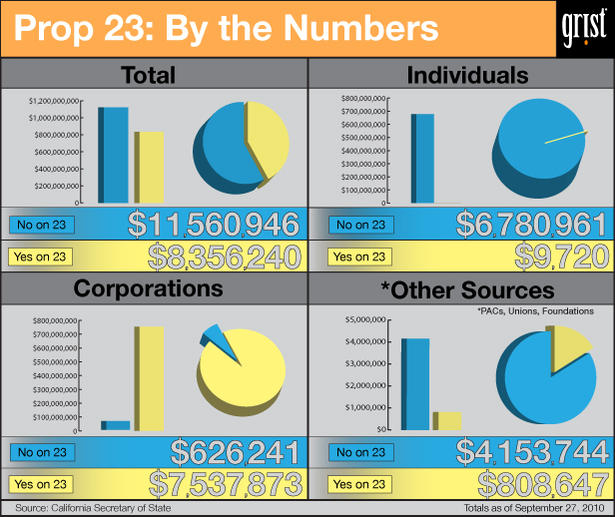
graphic: Grist

I wrote this story for Grist, where it first appeared.

As predicted, the big money has started to pour into the battle over Proposition 23, the California ballot measure that would suspend the state’s global warming law.

But not from where you’d expect. The six-figure donations filling campaign coffers is not coming from the Texas oil companies and petrochemical giants backing Prop 23 but from a coalition of environmentalists, venture capitalists, green tech companies, and environmental justice activists who are working to defeat the measure.

Over the past two weeks, the No on 23 forces have collected more than $1.8 million in contributions while the Yes campaign has taken in only $6,500, according to California Secretary of State records.

The windfall for opponents comes as a Field Poll released Sunday shows Prop 23 losing 45 percent to 34 percent with a large number of voters — 21 percent — still undecided. Meanwhile, a poll from the Los Angeles Times/University of Southern California has Prop 23 winning by a slight margin, 40 percent to 38 percent.

I’ll take a closer look at those poll numbers later but first let’s see who’s putting up the green to keep California green.

Environmental justice groups have jumped into the fight in a significant way this month. SCOPE (Strategic Concepts in Organizing and Policy Education), a Los Angeles-based group that formed in the wake of the 1992 Rodney King riots, has contributed $300,000 in recent weeks. SCOPE is funded by various foundations, including the Ford Foundation and James Irvine Foundation. The organization promotes green jobs and other economic development programs for disadvantaged areas of Los Angeles.

Another Los Angeles organization, listed in financial disclosure filings only as A.L.L.E.R.T., donated $150,000 to another No on Prop 23 group called the California Alliance Action Fund: A Committee Sponsored by Social Justice Organizations.

Then there’s Californians for Clean Energy and Jobs, a Sacramento-based organization that says its “sponsored by environmental organizations and business.” It gave $100,000 to a No on Prop 23 campaign committee that’s backed by the Ella Baker Center for Human Rights, the Oakland, Calif., organization founded by Van Jones.

Meanwhile, individuals continue to write checks. San Francisco investor Robert Fisher, former chair of The Gap clothing empire, contributed another half million dollars on Thursday, bringing his total donations to $1 million.

Steve Westly, the former eBay executive and California state controller who now runs an investment group, donated $10,000; Southern California businessperson, Claire Perry, made her second $250,000 contribution.

A couple of well-heeled New Yorkers also got into the act: Daniel Tishman of Tishman Construction and Garrett Moran of private equity giant The Blackstone group, each donated $25,000 on Friday.

The solar industry, whose prosperity in the United States has been driven in large part by California mandates and incentives for renewable energy, has begun to step up to the plate.

Recurrent Energy, which last week agreed to be acquired by the Japanese conglomerate Sharp, donated $50,000, as did First Solar, the Tempe, Ariz., thin-film solar giant whose early investors include the Walton family. Thomas Werner, chief executive of Silicon Valley’s SunPower, one of the largest American solar panel makers and developers, gave $25,000 on Sept. 18. Another Silicon Valley solar startup, Solaria, put in $5,000.

The Field Poll released this weekend indicates that the broad-based alliance against Prop 23 appears to be keeping proponents of the ballot measure from gaining ground. The only demographic groups that favor Prop 23 are Republicans (47 percent to 33 percent), Latino voters (41 percent to 38 percent), and less educated voters (37 percent to 34 percent for those with a high school education or less; 39 percent to 37 percent for those with some college education).

Geographically, all areas of California, including the conservative Central Valley, oppose Prop 23 by varying margins, according to the poll.

Over the past few weeks, the editorial boards of California’s major newspapers have come out against Prop 23. And Meg Whitman, the Republican candidate for governor, has said she’ll voted against the measure, though she supports suspending the global warming law for one year.

But with just six weeks to go until Election Day, Prop 23 opponents still expect to see a gusher of oil money flowing into the Yes campaign from fossil fuel interests.

Read Full Post »

photo: California Energy Commission

In Friday’s New York Times, I wrote about California regulators’ licensing of a 1,000-megawatt solar thermal power plant, which would be the world’s largest solar energy complex:

California regulators have licensed what is for the moment the world’s largest solar thermal power plant, a 1,000-megawatt complex called the Blythe Solar Power Project to be built in the Mojave Desert.

By contrast, a total of 481 megawatts of new solar capacity was installed in the United States last year, mostly from thousands of rooftop solar arrays, according to the Solar Energy Industries Association, a trade group.

“Given the challenge of climate change at this time, it is very important to reduce fossil fuel use by moving forward with the largest solar project in California,” Robert Weisenmiller, a member of the California Energy Commission, said at a hearing Wednesday in Sacramento after a unanimous vote to approve the Blythe project.

“We’re taking a major step toward reducing the threat of future climate change impacts on the state, and at the same time the other real challenge for the state is the economy,” he added, referring to 604 construction jobs and 221 permanent jobs that the Blythe project would create in an area of California where the unemployment rate was 15 percent this summer.

After years of environmental reviews, the California Energy Commission has in the past three weeks licensed solar thermal farms that would generate 1,500 megawatts of electricity when completed.

A commission spokeswoman said the commissioners anticipated making licensing decisions by the end of 2010 on additional solar projects that would produce another 2,829 megawatts. At peak output, those solar farms would generate the equivalent electricity produced by several large nuclear power plants.

Developers are racing to start construction before federal tax incentives for big renewable energy projects expire at year’s end.

If all the projects are built, they would create 8,000 construction jobs and 1,000 permanent jobs, according to the energy commission.

At peak operation, the Blythe solar complex would supply enough electricity for 800,000 homes. The multibillion-dollar project will be built in four 250-megawatt phases.

It is notable for being the first big solar project to be licensed that would be built on federal land. The United States Bureau of Land Management is expected to decide by the end of October whether to approve the Blythe complex.

The project will be constructed by Solar Millennium, a German developer, and will cover 9.3 square miles in Riverside County in Southern California with long rows of parabolic troughs. The solar reflectors focus the sun on liquid-filled tubes suspended over the mirrors to create steam that drives an electricity-generating turbine housed in a central power block.

You can read the rest of the story here.

Read Full Post »

I wrote this story for Grist, where it first appeared.

The campaign against Proposition 23, the California ballot initiative that would suspend the state’s global warming law, took in more than a half million dollars in contributions this week. Meanwhile, fundraising by the oil companies backing the measure was so lackluster it prompted a plea for help from the petrochemical industry.

“A defeat for Proposition 23 in California could energize environmental fanatics around the country and in Washington to match California’s destructive policies with their own versions of AB32,” wrote Charles T. Drevna, president of the National Petrochemical & Refiners Association, in an email first reported by The New York Times. “We’ve raised about $6 million so far, but unfortunately in California’s expensive media market this is not enough to win the fight against environmental zealots led by Gov. Arnold Schwarzenegger, who seems hell-bent on becoming the real-life Terminator of our industry.”

“I am pleading with each you,” Drevna continued, “for our nation’s best interest and for your company’s own self-interest, please contact me and tell me how much you can contribute to this critical effort as soon as possible. Nov. 2 is drawing near.”

The Texas oil companies backing the initiative made news recently when they secured a $1 million donation from the billionaire Koch brothers, who bankroll various right-wing causes. But the only sizeable donation to the Yes on 23 campaign this week came from Tower Energy Group, a Southern California-based petroleum wholesaler, which contributed $100,000 on Monday. Meanwhile, according to campaign finance records, the anti-Prop 23 forces have been having a pretty good few weeks.

On Monday, Susan Packard Orr, yet another daughter of David Packard, the late co-founder of Hewlett-Packard, contributed $250,000 to the No campaign. She joins her two sisters who have given a total of $201,895 to the effort to defeat Prop 23.

On Wednesday, William Patterson of SPO Partners, a Marin County, Calif., private investment firm, also gave $250,000. The California chapter of the Audubon Society stepped up with a $100,000 donation last week. Earlier in the month, Environment California, a non-profit, made a $100,000 contribution.

Another non-profit, the San Francisco-based Tides Foundation, put in $40,000 while a high-profile San Francisco real estate magnate, Douglas Shorenstein, contributed $25,000.

The big Silicon Valley venture capitalists, who vociferously oppose a ballot initiative that could derail the billions of dollars they’ve invested in green technology startups, have largely remained no-shows on the No on 23 donor roll. Though Tom Baruch, founder of CMEA Capital, did give $25,000 on Wednesday, and John Doerr, a leading green tech investor with Kleiner Perkins Caufield & Byers, is a notable exception with his $500,000 investment to defeat Prop 23.

If Silicon Valley’s venture capitalists decide to open their checkbooks, game on.

Read Full Post »

In Wednesday’s New York Times, I wrote about two experimental projects in California to store solar energy produced by photovoltaic rooftop arrays:

In the garage of Peter Rive’s San Francisco home is a battery pack. It is not connected to Mr. Rive’s electric Tesla Roadster sports car, but to the power grid.

The California Public Utilities Commission has awarded $1.8 million to Mr. Rive’s company, SolarCity, a residential photovoltaic panel installer, to research the feasibility of storing electricity generated by rooftop solar arrays in batteries.

As rooftop solar systems provide a growing percentage of electricity to California’s grid, regulators and utilities are increasingly concerned about how to balance the intermittent nature of that power with demand.

One possible solution is to store energy generated by solar arrays in batteries and other systems and then feed that electricity to the grid when, say, a cloudy day results in a drop in power production. And when demand peaks, electricity generated from renewable sources could be dispatched from batteries rather than fossil-fuel burning power plants.

“As soon as distributed solar starts providing 5 to 10 percent of demand, its intermittent nature will need to be addressed,” said Mr. Rive, who is SolarCity’s co-founder and chief operating officer.

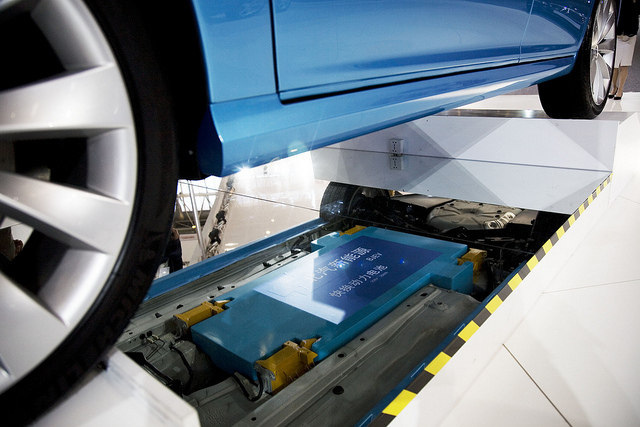
SolarCity is teaming with Tesla Motors, the Silicon Valley electric car company run by Mr. Rive’s cousin, Elon Musk, and the University of California, Berkeley, to study how to integrate solar arrays and off-the-shelf Tesla lithium-ion battery backs into the grid. SolarCity plans to put such systems in six homes.

“We think in the years ahead this will be the default way that solar is installed,” Mr. Rive said. “Getting the costs down, though, is not going to be an easy task.”

Homeowners could potentially benefit by tapping batteries at hours when electricity rates are high or using them to provide backup power if the grid goes down.

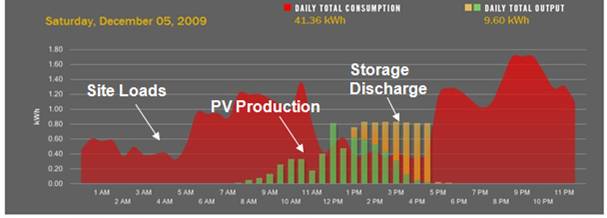
The research has just begun, and at the moment SolarCity is testing the impact of charging and discharging electricity from the Tesla battery pack in Mr. Rive’s garage. His roof sports a three-kilowatt solar array.

“We’re at the point now where we can direct the battery to charge and discharge at specific times by sending a signal over the Internet,” Mr. Rive said.

Included in the $14.6 million awarded for solar energy storage research by the utilities commission was $1.9 million to SunPower for a project that will store in ice and batteries electricity generated by solar arrays at Target stores.

SunPower, a Silicon Valley solar panel manufacturer and power plant developer, will work with Ice Energy, a Colorado company that makes systems that use electricity when rates are low to form ice. When rates are high, air conditioning refrigerant is cooled by the melting ice rather than by an electricity-hogging compressor.

The Ice Bear system and a solar array will be installed at one Target store while battery packs will be used at two other stores in California.

You can read the rest of the story here.

Read Full Post »

I wrote this story for Grist, where it first appeared.

The federal energy efficiency cops are on the beat – finally.

For the first time in 35 years, the United States Department of Energy is moving to enforce decades-old energy efficiency and water conservation standards for products like refrigerators, light bulbs and shower heads.

On Monday, the Energy Department said it had filed enforcement actions against 27 companies for failing to certify their products comply with energy efficiency and water conservation regulations.

“As a part of its mission to help consumers purchase energy efficient products that will save them money, the Department sets energy efficiency standards for a vast array of consumer and commercial products,” wrote Scott Blake Harris, the Energy Department’s general counsel in a blog post Monday. “But when I arrived at DOE, I was stunned to discover that the Department had never systematically enforced DOE’s 35-year-old energy efficiency standards.”

“The problem, of course, is that lax enforcement of energy efficiency standards undermines the goal of increased energy efficiency,” he added. “When efficiency standards are not regularly enforced, bad actors soon learn that they can gain an unfair economic advantage over law-abiding competitors by falsely or improperly certifying the efficiency of their products. This not only distorts competition in the short-term, but it undermines the kind of long-term competition that drives innovation.”

The Energy Department filed complaints against companies ranging from ASKO, the Swedish maker of upscale appliances, to Duralamp.

But the enforcement actions announced Monday will hardly make chief financial officers tremble.

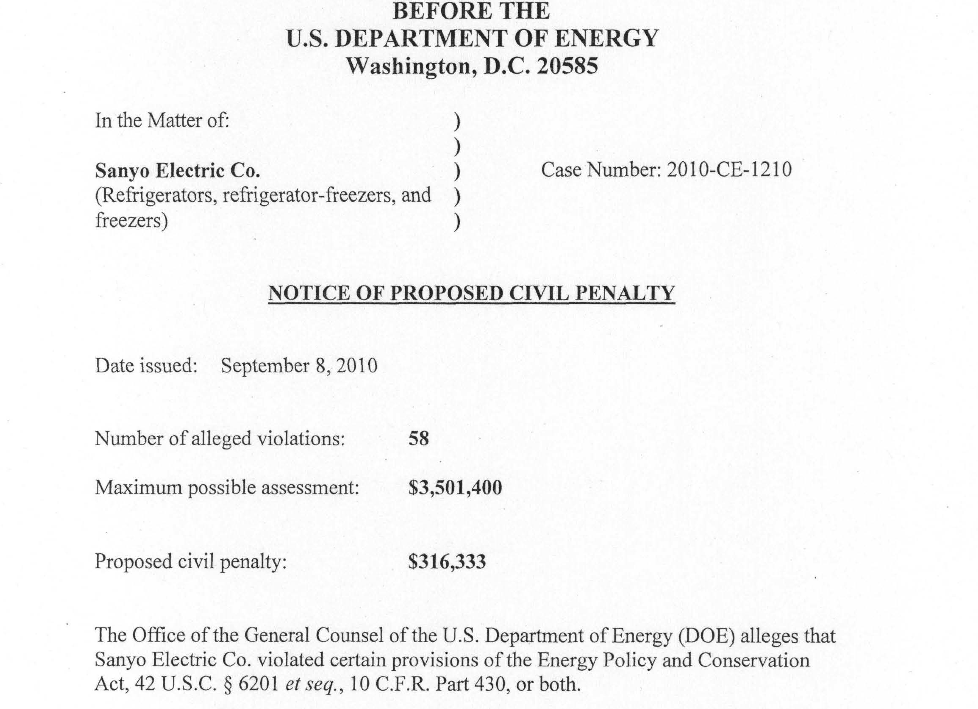
General Electric, for instance, faces a maximum fine of $252,140 for not certifying that some dehumidifier models comply with energy efficiency standards. But the Energy Department proposed a civil penalty of $36,500 and informed GE —  and other companies targeted for enforcement — that it would drop the case for $5,000 if the global conglomerate agreed to settle within 30 days and come into compliance.

Likewise,  Sanyo faces a maximum fine of $3.5 million for 58 violations involving its refrigerators and freezers. The proposed penalty is $316,333 but the Energy Department will settle for $10,000.

The Energy Department says that as a result of its enforcement program it has removed from the market 66 products that violated energy efficiency standards and filed a total of 75 enforcement actions to date.

“Before our effort, the number of products that had been removed from the market was zero,” noted the department’s general counsel.

Read Full Post »

I wrote this story for Grist, where it first appeared.

The same day this week that The New York Times published an extensive report by correspondent Keith Bradsher on China’s massive subsidies for renewable energy companies, Ernst & Young released a study showing that, not surprisingly, China has overtaken the United States as the most attractive place for green tech investment.

“China’s steady rise to pole position has been underpinned by strong and consistent government support for renewable energy,” Ben Warren, Ernst & Young’s environment and energy infrastructure advisory leader, said in a statement. “This, together with substantial commitment from industry and the sheer scale of its natural resources, means that its position as top spot for renewable energy investment is well merited.”

Some of that government support may violate World Trade Organization rules. On Thursday, an American union, the United Steelworkers, filed an unfair trade complaint against China with the Office of the United States Trade Representative.

But the Ernst & Young report points to failures on the part of the U.S. government to take action that would attract green investors.

For one thing, Congress has so far failed to establish a national Renewable Energy Standard that would require the country’s utilities to obtain a certain percentage of electricity from non-carbon-emitting sources.

Also, a federal tax subsidy program that is spurring construction of big solar power plants expires at the end of the year and legislation to extend the incentives is languishing in Congress.

“Although the United States remains a highly attractive location for investors in renewable energy, it is clear that recent events have eased momentum,” said Warren. “The U.S. market continues to have significant potential but requires consistent legislative support to provide investors with the long-term confidence they need.”

China, in contrast, “aims to reach an installed capacity of 300GW [gigawatts] of hydro, 70GW of nuclear, 100GW of wind, and 20GW of solar capacity by 2020,” according to the Ernst & Young study.

Reports by the U.S. Energy Information Agency provide a glimpse of the green imbalance of trade between the two countries. The figures from 2008 — apparently the latest available from the government — show that fewer than 1 percent of U.S.-made solar modules were shipped to China while nearly 23 percent of Chinese-made photovoltaic modules were exported to the U.S.

Since then, Chinese imports have risen dramatically. At the end of 2009, for instance, Chinese firms supplied about half the California solar market alone, according to Bloomberg New Energy Finance, a consulting firm.

What China is not exporting, of course, is green jobs.

Read Full Post »

photo: Better Place

In The New York Times on Monday, I wrote about the challenges of developing electric car batteries that will match the range of gasoline-powered vehicles:

Silicon Valley may be an epicenter of the nascent electric car industry, but don’t expect the battery revolution to mimic the computer revolution, one of I.B.M.’s top energy storage scientists advises.

“Forget Moore’s Law — it’s nothing like that,” said Winfried Wilcke, senior manager for I.B.M.’s Battery 500 project, referring to the maxim put forward by Gordon Moore, an Intel founder, that computer processing power doubles roughly every two years.

“Lithium ion, which clearly is the best battery technology today, is flat, completely flat since 2003,” Mr. Wilcke said last week at a gathering in San Francisco attended by executives from I.B.M. and Better Place, a Silicon Valley electric car infrastructure company.

Mr. Wilcke’s team at the Almaden Research Center of I.B.M. in San Jose, Calif., is trying to develop a new battery technology called lithium air that could allow a car to go 500 miles on a single charge. Most electric cars coming onto the market this year have a range of around 100 miles.

Such batteries theoretically could pack 10 times the energy density of the lithium ion batteries now used in electric cars because they use air drawn in from outside the battery as a reactant. That means lithium-air storage devices weigh less than lithium-ion batteries, a factor that also improves the performance of electric cars.

“I always compare it to climbing Mount Everest,” Mr. Wilcke said. “In the last two months, we just left base camp — meaning that we actually made some pretty significant breakthroughs.”

He declined to give details but said that his team had shown that lithium-air batteries could be recharged, something that had not been done before.

“It will take many years, if ever, before it can be useful,” he said. “It’s a high-high-risk project.”

He illustrated the challenge of building a battery with the energy density of gasoline by recounting that it took 47 seconds to put 13.6 gallons of gas in his car when he stopped to fill up on the way to San Francisco. That’s the equivalent of 36,000 kilowatts of electricity. An electric car would need to pump 6,000 kilowatts to charge its battery.

“The dream that we have today to have exactly the same car charge up in minutes and drive off hundreds of miles cannot happen,” Mr. Wilcke said. “Or at least not for 50 years.”

Mr. Wilcke and Lawrence Seeff, head of global alliances for Better Place, dismissed the idea that the fast-charging stations being tested in California and elsewhere were a solution to the battery conundrum.

Depending on the battery, high-voltage stations can recharge a battery to 80 percent capacity in 20 to 30 minutes rather than in the 8 to 10 hours it takes with a more conventional charging station.

Allan Schurr, I.B.M.’s vice president for strategy, energy and utilities, noted that the cost to drivers of plugging in to a rapid charging station might be prohibitive, given the demands that the devices place on the electric grid.

“It’s physically possible to have a fast-charge mechanism and a fast-charge outlet, but can the grid support it?” Mr. Seeff said. “And what do we define by fast-charging? Is it 20 minutes, 10 minutes, 30 minutes? Because if you have two people waiting to fast-charge, you could be waiting an hour.”

You can read the rest of the story here.

Read Full Post »

photo: Southern California Edison

I wrote this story for Grist, where it first appeared.

The California Legislature started out the week in the green by passing the nation’s first energy storage bill. But legislators quickly ran into the red Wednesday when they failed to approve legislation to impose a statewide ban on plastic bags, or codify Governor Arnold Schwarzenegger’s executive order that utilities obtain a third of their electricity from renewable sources by 2020.

But don’t go crying in your organic beer yet. On Thursday, the California Public Utilities Commission signed off on 650 megawatts of new solar energy contracts and programs.

Whch all goes to show that in the Golden State, environmental politics are not green and brown. And despite the fate of Proposition 23, the oil company-bankrolled ballot initiative to suspend California’s global warming law, the state’s panoply of green laws allows progress to be made on various fronts.

The utilities commission, for instance, approved contracts for two giant photovoltaic solar farms to be built in the Mojave Desert by First Solar. Together they will supply 550 megawatts of electricity to the utility Southern California Edison.

Commissioner Timothy Simon noted at Thursday’s energy commission meeting in San Francisco that the price for that electricity is lower than previous solar contracts, another sign that photovoltaic power is edging ever closer to edging out fossil fuels. The price also speaks to the ability of First Solar, the Tempe, Ariz.-based thin-film solar company, to win and begin to execute big projects.

The commission also greenlighted San Diego Gas & Electric’s proposal for 100-megawatt’s worth of small-scale photovoltaic projects.

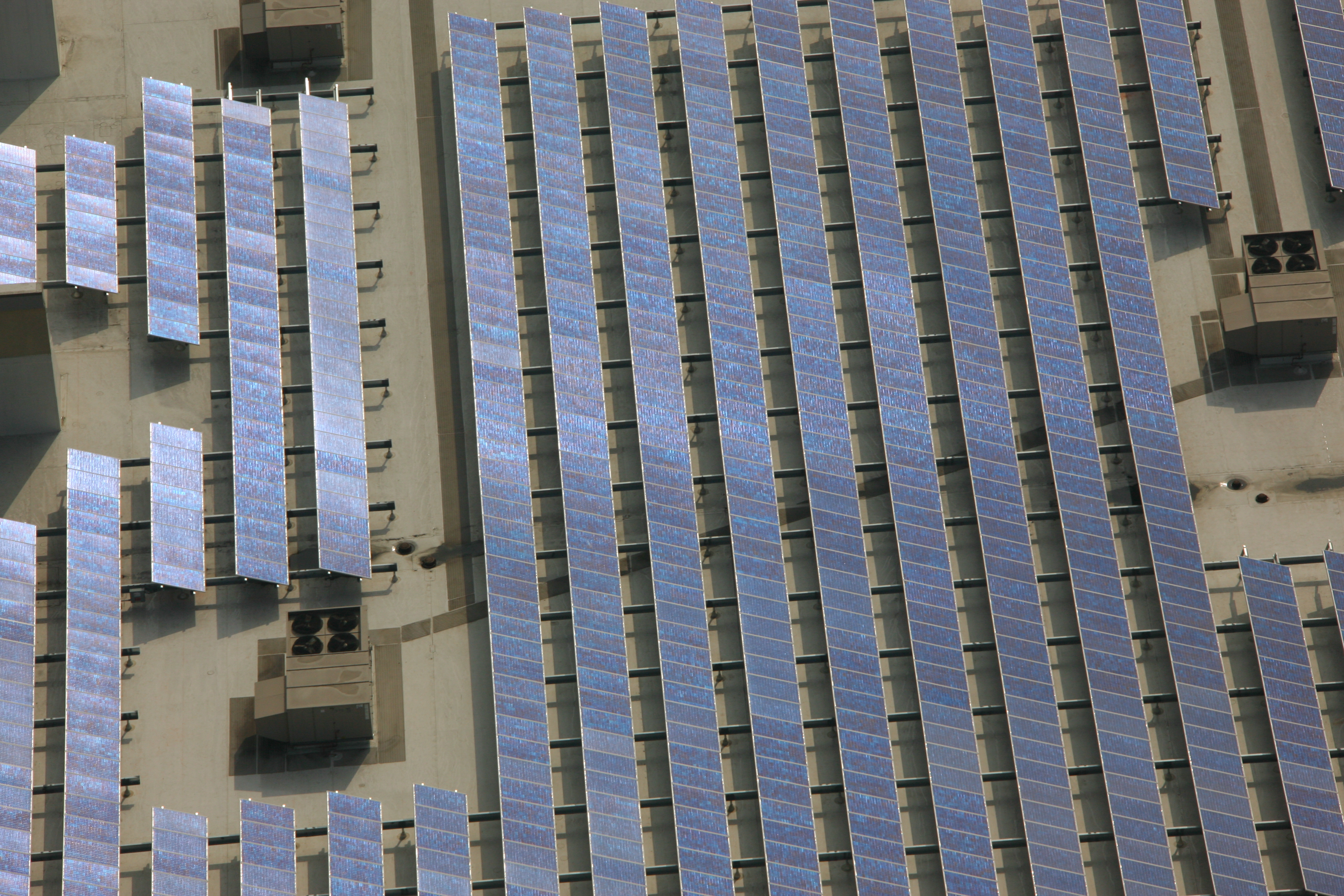
Most installations will be 1 or 2 megawatts and built in parking lots or other open spaces where they can be plugged into the grid without expensive transmission upgrades. The move comes on top of 1,000 megawatts of distributed solar generation that the utilities commission previously approved for California’s two other big utilities.

Michael R. Peevey, the president of the utilities commission, said despite the failure of the state legislature to institutionalize the 33 percent renewable portfolio standard — currently subject to reversal by the next governor — California was on a solar streak.

“With approval of this project we’ll have added 1,100 megawatts of photovoltaic electricity by the three utilities,” said Peevey, noting that separately the California Solar Initiative will add another 3,000 megawatts and that by year’s end regulators are poised to approve big solar farms that will generate 4,700 megawatts of electricity.

“These are big, big numbers,” Peevey added. “Independent of the legislature, we’re moving to a RPS economy.”

Read Full Post »

« Newer Posts - Older Posts »

Design a site like this with WordPress.com
Get started