Feeds:
Posts
Comments

Archive for the ‘green policy’ Category

desert-tortoise1

photo: Wild Rose Images

California Senator Dianne Feinstein’s move to put a large swath of the Mojave Desert off-limits to renewable energy development is splitting the environmental movement and could derail some two dozen solar and wind power projects the state needs to comply with its ambitious climate change laws.

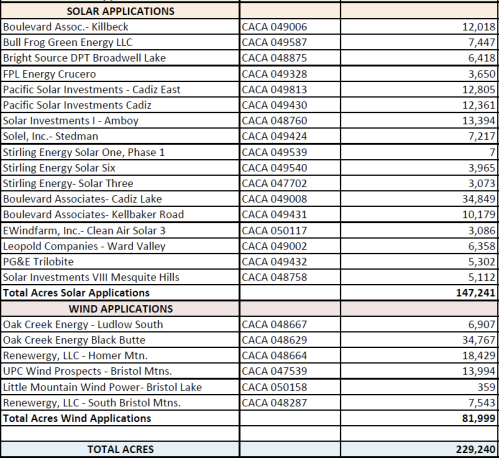
On the firing line are 17 massive solar power plants and six wind farms planned for federal land — land that would be designated a national monument under legislation Feinstein intends to introduce. The solar projects in question would be built by a range of companies, from startups BrightSource Energy and Stirling Energy Systems to corporate heavyweights Goldman Sachs (GS) and FPL (FPL), according to federal documents. (For the complete list, see below.)

The companies are among scores that have filed lease claims on a million acres of acres of desert dirt controlled by the U.S. Bureau of Land Management. California utilities PG&E (PCG) and Southern California Edison (EIX) have signed long-term power purchase agreements for some of the projects now in jeopardy and are counting on the electricity they would produce to meet state-mandated renewable energy targets. PG&E itself has filed a solar power plant land claim in the proposed national monument.

The area of the desert in dispute is some 600,000 acres formerly owned by Catellus, the real estate arm of the Union Pacific Railroad, and donated to the federal government a decade ago by the Wildlands Conservancy, a Southern California environmental group. About 210,000 of those acres are managed by the U.S. Bureau of Land Management, which opened part of the land to renewable energy projects.

“Many of the sites now being considered for leases are completely inappropriate and will lead to the wholesale destruction of some of the most pristine areas in the desert,” Feinstein wrote in a letter to Interior Secretary Ken Salazar released last week, notifying him that she will introduce legislation to designate the former Catellus lands a national monument. “Beyond protecting national parks and wilderness from development, the conservation of these lands has helped to ensure the sustainability of the entire desert ecosystem by preserving the vital wildlife corridors.”

The Catellus land controlled by the BLM forms something of a golden triangle between the Joshua Tree National Park and the Mojave National Preserve in Southern California and are particularly coveted for renewable energy development because of its proximity to transmission lines.

Alan Stein, a deputy district manager for the BLM in California, told Green Wombat that the solar and wind lease claims are in areas that are not designated as wilderness or critical habitat for protected species like the desert tortoise. “This is public domain land, ” he says.

Tortoises, however, are found across the Mojave, and battles over Big Solar’s impact on endangered wildlife are quietly brewing in several solar power plant licensing cases now being reviewed by the California Energy Commission.  Environmentalists find themselves walking a thin green line, trying to balance their interest in promoting carbon-free energy with protecting fragile desert landscapes and a host of threatened animals and plants.

Take BrightSource Energy’s Ivanpah 400-megawatt solar power plant complex on the California-Nevada border. The three solar power plants to be built by the Oakland-based company will supply electricity to PG&E and Southern California Edison. But the project will also destroy some 4,000 acres of desert tortoise habitat and at least 25 tortoises will have to be relocated – a somewhat risky proposition as previous efforts in other cases have resulted in the deaths of the animals.

On Wednesday, the California Energy Commission granted two national environmental groups – the Defenders of Wildlife and the Sierra Club – the right to intervene in the Ivanpah case. “Defenders strongly supports … the development of renewable energy in California,” Kim Delfino, California program director for Defenders of Wildlife, wrote to the energy commission in a Jan. 23 letter.  “Defenders has several serious concerns about the potential impacts of this project on a number of rare, declining and listed species and on their associated desert habitat and waters.”

Natural Resources Defense Council attorney Johanna Wald wrote a letter with the Wilderness Society expressing concern over the impact of Ivanpah project on the desert tortoise but also made a strong statement of support for renewable energy development. “Our public lands harbor substantial wind, solar, and geothermal resources,” wrote Wald, who serves on a state task force to identify appropriate areas for renewable energy development. “Developing some of these resources will be important to creating a sustainable energy economy and combating climate change.”

The big national enviro groups are working with the government and power plant developers to create zones in the Mojave where renewable energy projects would be permitted while setting aside other areas that are prime habitat and wildlife corridors. A similar effort is underway on the federal level to analyze the desert-wide impact of renewable energy development.

Local environmental organizations, however, have split with the Big Green groups over developing the desert and other rural areas. In San Luis Obispo County,  Ausra, SunPower (SPWRA) and First Solar’s (FSLR) plans to build three huge solar farms within miles of each other has prompted some local residents worried about the impact on wildlife to organize in opposition to the projects.

And some small Mojave Desert green groups pledge to go to court to stop big solar projects. “We don’t want to see the Endangered Species Act gutted for the sake of mega solar projects,” veteran grass roots activist Phil Klasky told Green Wombat last year for a story on the solar land rush in the Mojave. “I can say the smaller environmental organizations I’m involved with are planning to challenge these projects.”

It would be unwise to underestimate Klasky. In the 1990s, he helped lead a long-running  and successful campaign to scuttle the construction of a low-level radioactive waste dump in tortoise territory in the Mojave’s Ward Valley – now a prime solar spot.

Still, while California’s senior senator’s move in the Mojave may exacerbate rifts in the environmental movement over renewable energy, it also could galvanize efforts to resolve critter conflicts in a comprehensive way. Otherwise, environmentalists of varying hues may find themselves fighting each other rather than global warming.

Update: I just had a conversation with BrightSource spokesman Keely Wachs, who takes issue with my characterization that the Ivanpah project will “destroy” desert tortoise habitat. He points out that the company is taking care to minimize the impact of the power plant on the surrounding desert and that wildlife may still occupy the site. It would be more accurate to say that the project will remove desert tortoise habitat from active use during Ivanpah’s construction and operation.

(Below is a list of solar and wind projects that fall within the proposed Mojave national monument. Note: Solar Investments is a subsidiary of Goldman Sachs and Boulevard Associates is a subsidiary of FPL.)

source:  BLM
blm-nm2

Read Full Post »

solyndra-rooftop-2

photo: Solyndra

It’s been a good news, bad news Friday for the solar industry. Silicon Valley startup Solyndra received a half billion-dollar loan guarantee from the U.S. Department of Energy to build a solar module factory while further up Interstate 880 OptiSolar moved to shut down its manufacturing operations.

OptiSolar too had asked for a federal loan guarantee to complete work on its Sacramento thin-film solar cell plant but a decision on the $300 million application couldn’t come soon enough to save the startup. “We continued to be unable to find a buyer for the technology and manufacuring business, and the board of directors decided that we needed to limit ongoing operational expense,” wrote OptiSolar spokesman Alan Bernheimer in an e-mail.

First reported by the San Francisco Chronicle’s David Baker, OptiSolar will shut down factories in Sacramento and Hayward, Calif., and lay off 200 workers.  Earlier this month, OptiSolar sold its pipeline of solar power plants – including a 550-megawatt solar farm that will supply electricity to PG&E (PCG) – to rival First Solar  in a $400 million stock deal. At the time, OptiSolar said it intended to focus on manufacturing solar modules.

The news was definitely brighter Friday for Solyndra, which emerged from stealth mode last September with $600 million in funding and $1.2 billion in orders for its solar panels composed of cylindrical tubes imprinted with solar cells. Conventional rooftop solar panels must be tilted to absorb direct sunlight as they aren’t efficient at producing electricity from diffuse light. But the round Solyndra module collects sunlight from all angles, including rays reflected from rooftops. That allows the modules, 40 to a panel,  to sit flat and packed tightly together on commercial rooftops, maximizing the amount of space for power production.

The $535 million federal loan guarantee will allow the Fremont, Calif.-based company to build a second factory, which is expected to create 3,000 construction jobs and more than 1,000 other jobs once the plant is in operation. The factory will be able to produce 500 megawatts’ worth of solar panels a year.

“The DOE Loan Guarantee Program funding will enable Solyndra to achieve the economies of scale needed to deliver solar electricity at prices that are competitive with utility rates,” Solyndra CEO Chris Gronet said in a statement. “This expansion is really about creating new jobs while meaningfully impacting global warming.”

Friday’s grant makes good on Secretary of Energy Steven Chu’s pledge to speed up processing of renewable energy loan guarantee applications. The department had come under fire during the previous administration for taking years to dole out grants and loan guarantees for electric car and green energy projects.

Meanwhile, First Solar (FSLR) announced on Friday that it had manufactured 1 gigawatt of thin-film solar cells since beginning commercial production in 2002. It took the Tempe, Ariz., company six years to hit 500 megawatts and only eight months to produce the second 500 megawatts. First Solar’s annual production capacity will reach 1 gigawatt by year’s end, according to the company.

Read Full Post »

Infighting among U.S. federal agencies over regulation of wind and wave energy development on the outer continental shelf ended Tuesday with an accord that gives the Department of the Interior oversight of offshore wind farms while the Federal Energy Regulatory Commission gets jurisdiction over wave and tidal projects.

While the deal brokered by Interior Secretary Ken Salazar and acting FERC chairman Jon Wellinghoff will allow wind and wave projects to proceed, it’s still unclear what the impact will be on proposals to build combined offshore wind-and-wave farms.

As Green Wombat wrote earlier this month, a Seattle company called Grays Harbor Ocean Energy has filed applications with FERC to build such combo plants off several states. Among them, California, where the city of San Francisco is attempting to scuttle Grays’ proposed 100 megawatt project that would be located in a marine sanctuary in favor of its own 30 megawatt wave farm that would be built closer to shore.

Environmentalists, surfers and sailors also have objected to the Grays Harbor wave farm and the Department of the Interior’s Minerals Management Service had challenged FERC’s right to approve combined wind-wave projects.

Read Full Post »

thnk-city-michigan-usa_imagelarge

photo: Think

Norwegian electric car company Think announced Thursday that it will open a factory in the United States in 2010 to produce its City urban runabout.

Think CEO Richard Canny, a former Ford executive, is in Ann Arbor, Mich., this week meeting with officials from eight states vying for the factory. But don’t put in your order just yet – only 2,500 cars will roll off the assembly line the first year and they will be reserved for demonstration projects and fleet sales.

“The U.S. is quickly overtaking Europe as an attractive market for EVs and is an ideal location to engineer and build EVs,” Canny said in a statement. “We see ourselves playing a small but potentially growing role in re-inventing the U.S. auto industry by bringing back new manufacturing jobs to the U.S.”  Think has not yet responded to Green Wombat’s inquiry about which states, other than Michigan, is in talks with the company for the factory.

How Think will finance its North American expansion remains an open question. Just three months ago the company was teetering on the edge of bankruptcy as the global financial crisis cut off capital and forced Think to idle its Norwegian factory and lay off workers. The company obtained $5.7 million interim financing in January and recalled some workers. A report on Treehugger Thursday cited sources that said Think was contemplating relocating to Sweden or the U.K.

Think spokeswoman Katinka Von Der Lippe told Green Wombat on Thursday that the interim financing has been extended but that the company is still seeking a new infusion of capital to resume full production of the City, a two-seater that goes 112 miles on a charge with a top speed of about 62 miles per hour.  Update: Think’s U.S. spokesman, Brendan Prebo, tells Green Wombat that Think will raise most of the new capital from its existing European and U.S. investors, which include General Electric (GE), so it can resume full production of the City in Norway.

The company said that it will apply for a low-interest loan from the U.S. Department of Energy under its Advanced Technology Vehicle Manufacturing program to help pay for the factory. Prebo declined to reveal the size of the DOE loan the company will seek but noted it “will be a substantial investment for Think” but small compared to what some of the big automakers want.

After the first-year startup phase, the U.S. factory will initially employ 300 workers and produce 16,000 cars annually, according to Think. Capacity would eventually be expanded to 60,000 cars and a workforce of 900. A research and development center will employ about 70 people.

But calling a Think facility a factory is somewhat misleading. It’s really an assembly plant and the one Green Wombat visited in 2007 in Aurskog, Norway, was more Ikea than Henry Ford, with plastic-bodied Think City models quietly gliding through clean well-lighted spaces.

The question for Think, Tesla Motors other EV startups is whether they can gain a foothold in the market before the major players big-foot them with their own electric and plug-in electric cars. Ford (F), General Motors (GM), Honda (HMC), Toyota (TM), Renault-Nissan and other global automakers all are accelerating plans to introduce electric vehicles.

Thursday’s announcement follows the formation of Think North America, unveiled in April 2008 at Fortune’s Brainstorm Green conference.  A bicoastal group of venture capital firms – Silicon Valley’s Kleiner Perkins Caufield & Byers and Boston’s Rockport Capital Partners – signed on as lead investors.

Read Full Post »

clintonbill1Another reason Green Wombat will be spending Earth Day in Southern California this year: Former President Bill Clinton will deliver the keynote speech at Fortune Magazine’s Brainstorm Green conference on April 22.
Clinton will be joining a gathering of business and environmental leaders, including Ford (F) executive chairman Bill Ford, PG&E (PCG) chief executive Peter Darbee, SunPower (SPWRA) CEO Tom Werner and executives from Fortune 500 companies like IBM (IBM),  Wal-Mart (WMT) and General Electric (GE). On the green side of the aisle, execs from the Natural Resources Defense Council, Environmental Defense Fund and Greenpeace will be attending the confab in Laguna Niguel.  Former California State Treasurer Phil Angelides, now chairman of the Apollo Alliance, and green jobs guru Van Jones will also be present.

We now end the shameless self-promotion and return to our regular Green Wombat programming.

Read Full Post »

solar_and_your_home_header
photo: Sungevity

Berkeley on Friday hands over checks to the first two homeowners who tapped the California city’s pioneering solar financing program to install solar arrays.

The city fronts the cash for rooftop solar panels for any Berkeley business or homeowner, who pays back the cost through a 20-year surcharge on their property tax bill. If a home is sold, the surcharge rolls over to the new owner. The city council created a Sustainable Energy Financing District and launched a $1.5 million pilot program for the Berkeley FIRST Financing Initiative for Renewable and Solar Technology) in November to finance 40 rooftop systems. It took all of nine minutes for those 40 slots to be filled when the online application went live.

Berkeley issued a bond for the programs that was bought by Oakland-based Renewable Funding, which financed the solar arrays and whose president, Francisco DeVries, devised the Berkeley program when he served as Mayor Tom Bates’ chief of staff. Renewable Funding now is taking the program nationwide as cities from Portland to Tuscon consider adopting similar solar financing schemes. Under legislation enacted last year, any California city can implement a Berkeley-style program.

Municipal financing of solar arrays has become even more attractive since October when Congress lifted a $2,000 cap on federal tax credits for residential systems. Homeowners now can claim a tax credit for 30% of the cost of a solar system. When a state rebate is added, the cost of going solar in California has fallen by half.

Municipal financing programs are good news for solar panel makers and installers like SunPower (SPWRA), SunTech (STP), Akeena (AKNS) and First Solar (FSLR), the thin-film solar company that recently jumped into the residential market.

On Friday, Berkeley homeowner Jeanne Pimentel will receive a check from the mayor to hand over Borrego Solar, which installed her solar panels while homeowner Aaron Mann will sign his check over to Sungevity.

Read Full Post »

topaz-solar-farm-app

In the green stimulus sweepstakes, big potential winners are companies like Silicon Valley startup OptiSolar.

The solar-cell maker came out of nowhere last year to score a deal with utility PG&E to build the world’s largest photovolaic power plant, a 550-megawatt monster that would cover some 9 1/2 square miles on California’s central coast. OptiSolar subsequently began construction of a factory in Sacramento to produce the thousands of thin-film solar panels needed for the project. Then the economy tanked and as financing dried up, OptiSolar laid off half its workforce – some 300 employees – and halted construction of the Sacramento facility.

With a Colorado solar company executive joining President Barack Obama as he signed the $787 billion stimulus legislation into law Tuesday at a solar-powered museum in Denver, OptiSolar and other renewable energy companies stalled by the financial crisis may see their fortunes revive. The package allows builders of big renewable energy projects to apply for a government cash grant to cover 30% of construction costs in lieu of claiming a 30% investment tax credit. A dearth of investors who finance solar power plants and wind farms in exchange for the tax credits has put in jeopardy green energy projects planned for the desert Southwest and the Great Plains. The cash grant would shave about $300 million off the projected $1 billion price tag for OptiSolar’s Topaz Solar Farm.

The stimulus package also includes $2.3 billion to fund a 30% manufacturing tax credit for equipment used to make components for green energy projects, a provision OptiSolar can tap to help finance its solar cell factories. And the company may be able to take advantage of the legislation’s government loan guarantees for large renewable energy projects.

“It will lower the cost of the factory we’re building in Sacramento and make it easier to attract financing,” OptiSolar spokesman Alan Bernheimer told Green Wombat, noting the company’s priority is to complete the facility and begin production of solar panels. “The factory is more than shovel ready – our shovels are hanging on the wall where we put them when we had stop work in November.” (OptiSolar currently manufactures solar modules at its Hayward, Calif., plant.)

Fred Morse, senior adviser to Spanish solar energy giant Abengoa, says the stimulus package puts back on track a $1 billion, 280-megawatt solar thermal power plant the company will build outside Phoenix to produce electricity for utility Arizona Public Service. “With the stimulus bill we’re very confident we’ll be able to finance the project,” says Morse. He says Abengoa expects to use the government loan guarantees to obtain debt financing to fund construction of the project and then apply for the 30% cash refund. “I think the entire industry is very optimistic that these two aspects of the stimulus package, the grants and the temporary loan guarantees, should allow a lot of projects to be built.”

Mark McLanahan, senior vice president of corporate development for MMA Renewable Ventures, agrees. “I expect the government grants to attract new investors,” says McLanahan, whose San Francisco firm finances and owns commercial and utility-scale solar projects.

There are some strings attached, though.

To qualify for the cash grants, developers need to start shoveling dirt by Dec. 31, 2010. That means only a handful of big solar thermal power plants planned for California, for instance, are likely to make it through a complicated two-year licensing process in time to break ground by the deadline. One of those could be the first phase of BrightSource Energy’s 400-megawatt Ivanpah power plant on the California-Nevada border. But BrightSource’s biggest projects, part of a 1,300 megawatt deal signed with Southern California Edison (EIX) last week, won’t start coming online until 2013 at the earliest.

Another Big Solar project, Stirling Energy Systems’ 750-megawatt solar dish farm for San Diego Gas & Electric (SRE), will be racing to meet the 2010 deadline. The project is in the middle of a long environmental review by the California Energy Commission and the U.S. Bureau of Land Management which currently is scheduled to stretch into 2010.

SolarReserve CEO Terry Murphy says his Santa Monica-based startup has a couple of solar power plant projects in the works that should be able to take advantage of the stimulus provisions. “The likelihood of us being able to close on a financial deal has increased,” Murphy says.

Solar analyst Nathan Bullard of research firm New Energy Finance expects the stimulus package to prompt a push for large photovoltaic power projects. That’s because in California such solar farms – which essentially take rooftop solar panels and mount them in huge arrays on the ground – do not need approval from the California Energy Commission and can be built relatively quickly.

That’s good news for companies like thin-film solar cell maker First Solar (FSLR), which builds smaller scale photovoltaic power plants, and SunPower (SPWRA), which has a long-term contract with PG&E (PCG) for the electricity generated from a planned 250-megawatt PV solar farm to be built near OptiSolar’s project.

“It’s great for PV because you can definitely can get construction done by the end of 2010,” says Bullard. “It’s also good news for smaller and mid-sized developers who couldn’t access tax-equity financing.”

The catch, however, is that renewable energy companies still must raise money from investors in a credit-crunched market to cover construction costs, as the government doesn’t pay out the cash until 60 days after a solar power plant or wind farm goes online. And as McLanahan points out, the cost of raising capital from private equity investors is typically higher and will add to the cost of renewable energy projects. Those costs will only rise if the government is late in paying out refunds.

MMA Renewable finances large commercial arrays and solar power plants and then sells the electricity under long-term contracts to customers who host the solar systems. The loan guarantee provision of the stimulus legislation will help secure financing from investors skittish that some of MMA Renewable’s customers may default on their agreements, according to McLanahan.

Says Murphy: “The fact that we’re getting iron into the ground and getting things moving helps us.”

The wind industry also stands to gain from the stimulus package through a three-year extension of the production tax credit for generating renewable electricity as well as the government cash grants and manufacturing tax credit. Despite a record year for wind farm construction in 2008, projects have come to a standstill in recent months as the financial crisis froze development and forced the European-dominated industry to lay off workers.

“I think it’s good down payment on what needs to happen,” says Doug Pertz, CEO of Clipper Windpower, one of two U.S. wind turbine makers. “A lot more needs to be done but I think this will start to bring a lot of people back into the marketplace.”

Read Full Post »

sunrise_powerlink_031506

Over the weekend The New York Times’ Matthew L. Wald had a sobering story on the not-inconsiderable challenges facing efforts to expand and upgrade the United States’ power grid to tap renewable energy from wind farms and solar power plants. Among them: Opposition to new high-voltage power lines from landowners and environmentalists, a Byzantine permitting process and fights over who pays the costs of transmission projects that span state lines.

Here in California, the ongoing controversy over the Sunrise Powerlink project is a case study in just how difficult it will be to build the infrastructure to transmit electricity from dozens of solar power plants planned for the Mojave Desert. Among the big companies looking to cash in on the solar land rush: Goldman Sachs (GS), Chevron (CVX) and FPL (FPL)

Utility San Diego Gas & Electric first proposed the $1.3 billion, 150-mile Sunrise Powerlink in 2005 to connect the coastal metropolis with remote solar power stations and wind farms in eastern San Diego County and the Imperial Valley. For instance, SDG&E’s contract to buy up to 900 megawatts of solar electricity from massive solar farms to be built by Stirling Energy Systems is dependent on the construction of the Sunrise Powerlink. Like California’s other big investor-owned utilities – PG&E (PCG) and Southern California Edison (EIX) – SDG&E, a unit of energy giant Sempra (SRE), is racing the clock to meet a state mandate to obtain 20% of its electricity from renewable sources by 2010 and 33% by 2020.

But Sunrise sparked opposition from the get-go as the utility proposed routing part of the transmission project through a pristine wilderness area of the Anza-Borrego Desert State Park.  The prospect of 150-foot-tall transmission towers marching through critical habitat for desert tortoises and other protected wildlife galvanized environmentalists well-versed in the arcane arts of regulatory warfare.

Opponents also painted the project as a Trojan horse to bring in cheap coal-fired power from Mexico. (Wald makes a similar point in his Times‘ piece – the same high-voltage lines designed to transmit green electricity from wind farms can also be used to send cheap carbon-intensive coal-fired electricity across the country.) That argument subsequently lost currency when regulators, citing California’s landmark global warming law, barred utilities from signing long-term contracts for out-of-state coal power.

After more than three years of hearings and procedural skirmishes culminating in an 11,000-page environmental impact report, a PUC administrative law judge last October issued a 265-page decision all but killing the project on environmental grounds. Whether SDG&E thought that green energy and climate change concerns would trump worries over wildlife and wilderness, it was clear that trying to build an industrial project through a state park was a costly mistake.

Then in December, after California Governor Arnold Schwarzenegger signed an executive order to streamline and prioritize the licensing of renewable energy projects, the utilities commission’s board revived Sunrise Powerlink, approving a different route for the transmission lines that avoids Anza-Borrego.

But the fight is far from over. With the cost of the project now approaching $2 billion, late last month the Center for Biological Diversity, a Tucson, Ariz.-based environmental group, filed a suit in the California Supreme Court challenging the utilties commission’s approval of Sunrise Powerlink.

Safe to say, the battle will drag on for some time to come, giving new meaning to the term “stranded assets” for some would-be Big Solar developers.

Read Full Post »

malta-smart-grid

Photo: Visit Malta

The Mediterranean island nation of Malta on Wednesday unveiled a deal with IBM to build a “smart utility” system that will digitize the country’s electricity grid and water system.

Granted, Malta is a microstate with a population of 403,500 (smaller than Sacramento; bigger than Iceland). But the world — and utility infrastructure giants like General Electric (GE) — will be watching closely. Not only is Malta the first country to green its national grid but it will also serve as a test case for whether integrating so-called smart technologies into both electricity and water systems can help mitigate the increasing deleterious effects of global warming on the island.

As with other island states, power and water are intricately linked on Malta. All of the archipelago’s electricity is generated from imported fuel oil while the country depends on energy-intensive desalinization plants for half its water supply. Meanwhile, rising sea levels threaten its underground freshwater supplies.

“About 55% of the cost of water on Malta is related to electricity – it’s a pretty staggering amount,” Guido Bartels, general manager of IBM’s Global Energy & Utilities Industry division, told Green Wombat from Malta on Tuesday.

So how can digitizing the grid help? IBM (IBM) and its partners will replace Malta’s 250,000 utility meters with interactive versions that will allow Malta’s electric utility, Enemalta, to monitor electricity use in real-time and set variable rates that reward customers that cut their power consumption.  As part of the $91 million (€70 million) project, a sensor network will be deployed on the grid  –  along transmission lines, substations and other infrastructure – to provide information that will let the utility more efficiently manage electricity distribution and detect potential problems. IBM will provide the software that will aggregate and analyze all that data so Enemalta can identify opportunities to reduce costs – and emissions from Malta’s carbon-intensive power plants. (For an excellent primer on smart grids, see Earth2Tech editor Katie Fehrenbacher’s recent story.)

A sensor network will also be installed on the water system for Malta’s Water Services Corporation. “They’ll indicate where there is water leakage and provide better information about the water network,” says Robert Aguilera, IBM’s lead executive for the Malta project, which is set to be completed in 2012. “The information that will be collected by the system will allow the government to make decisions on how to save money on water and electricity consumption.”

Cutting the volume of water that must be desalinated would, of course, reduce electricity use in the 122-square-mile (316-square-kilometer) nation.

With the U.S. Congress debating an economic stimulus package that includes tens of billions of dollars for greening the power grid, IBM sees smart grid-related technologies as a $126 billion market opportunity in 2009. That’s because what’s happening in Malta today will likely be the future elsewhere – no country is an island when it comes to climate change. Rising electricity prices and water shortages are afflicting regions stretching from Australia to Africa to California.

IBM spokeswoman Emily Horn says Big Blue has not yet publicly identified which companies will be providing the smart meters, software and other services for the Malta grid project.

Malta’s greenhouse gas emissions are expected to rise 62% above 1990 levels by 2012, according to the European Environment Agency, and as a member of the European Union the country will be under pressure to cut its carbon. A smart energy grid will help but Malta, like Hawaii and other island states, will have to start replacing carbon-intensive fuel oil with renewable energy.

The island could present opportunities for other types of smart networks. According to the Maltese government, Malta has the second-highest concentration of cars in the world, with 660 vehicles per square kilometer. That also contributes to the country’s dependence on imported oil and its greenhouse gas emissions.

Given that Silicon Valley company Better Place has described islands as the ideal location to install its electric car charging infrastructure, perhaps CEO Shai Agassi should be looking at adding Malta to the list of countries that have signed deals with the startup.

Read Full Post »

csi-report

The other day I ran into Danny Kennedy, president of solar installation company Sungevity, on the playground as we were picking up our kids at Malcolm X Elementary (we live in Berkeley). I had spent the week chronicling layoffs at various solar and wind companies so it was with a bit of trepidation that Green Wombat asked Danny how business was going at at Sungevity.  “Great,” he replied as I quizzed him about the impact of the recession. “We’re as busy as ever.”

Apparently so. A report released Wednesday by the California Public Utilities Commission shows that residential and commercial rooftop solar installations in the Golden State more than doubled in 2008 from the previous year to 158 megawatts. What’s more, a record-breaking number of applications to participate in California’s $3 billion solar rebate program were filed in December as the drumbeat of bad economic news grew deafening and the state’s unemployment rate hit 9%.

Are Californians being crazily contrarian? While one would think that a $30,000 solar array would be one of those luxuries most people would put on the back burner in bad times, there are some solid economic reasons for the surge. First, rebates for solar systems under the California Solar Initiative get less lucrative in 2009 as incentives fall as the amount of installed solar rises.  Then in October Congress lifted the $2,000 cap on the federal tax credit on solar arrays, allowing homeowners and businesses to take a 30% tax credit on systems installed after Dec. 31.  Add in the state rebate and the cost of a solar system in California suddenly fell by half.

“The surge in applications occurring in the fourth quarter of 2008 is particularly noteworthy given the slowdown in the economy that occurred during the same time period,” the report’s authors noted. “In addition to environmental benefits such as cutting greenhouse gas emissions and other pollutants, it appears that solar energy is benefiting California by serving as an economic bright spot in the economy.”

And therein lies some lessons as the U.S. Congress debates how to promote green jobs. Two years into the California Solar Initiative, the taxpayers’ investment of $775 million in solar rebates has yielded $5 billion in private investment in solar projects and rapidly expanded the state’s renewable energy industry, according to the report. That’s helped create strong solar companies like solar cell maker SunPower (SPWRA) and markets for thin-film solar companies such as First Solar (FSLR). The decade-long program is on track to achieve its target of 3,000 megawatts of rooftop solar and in the first two years of the program more solar has been installed in California than in the previous 25 years.

While California regulators expect the pace to continue in 2009, the big unknown is how many homeowners and business owners will drop out of the program and cancel their applications if the economy continues to deteriorate rapidly this year. The current dropout rate is 15%, according to the report.

“We are hopeful that many of those pending projects will move forward,” Molly Tirpak Sterkel, who oversees the California Solar Initiative for the utilities commission, told Green Wombat. “We’re also cognizant of the economy and economic forces that may pose a threat to those installations.”

Demand for solar is far stronger in Northern California than in sunny SoCal. Northern California utility PG&E’s (PCG) customers have installed more than twice the megawatts of solar than Southern California Edison (EIX) customers. And the report notes that while applications for commercial arrays in PG&E’s territory rose 71% between April and December 2008, they fell 23% in Southern California Edison’s area. San Diego Gas & Electric (SRE), which covers a much smaller service area, saw applications triple for residential solar arrays.

Sterkel says it is unclear why Northern Californians are going solar at a much faster rate than their southern counterpart, but it may be due to differences in electricity pricing and more mature solar markets in regions like the San Francisco Bay Area. “There’s just that many more solar companies with experience, installations and sales channels, ” she says.

Solar panels seem to be sprouting from Bay Area rooftops like California poppies after a late winter rain. In Berkeley, the city has launched a program that pays for residential and business solar arrays upfront and let owners pay the cost back over 20 years through an annual assessment on their property taxes.

Which also may explain why I seem to be seeing more of those Sungevity signs around town.

Read Full Post »

« Newer Posts - Older Posts »

Design a site like this with WordPress.com
Get started