
Feeds:
Posts
Comments

Archive for the ‘environment’ Category

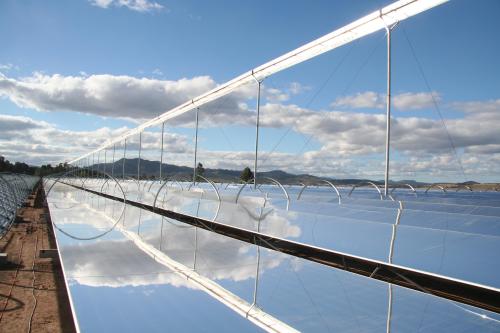
image: Tessera Solar

In a follow-up to my New York Times story Tuesday on Senator Dianne Feinstein’s bill to ban renewable energy production in parts of California’s Mojave Desert, I take a look at some of the incentives in the legislation that could speed green energy projects:

In Tuesday’s Times, I write about Senator Dianne Feinstein’s bill to create two Mojave Desert monuments in California that would ban renewable energy projects on lands that are both coveted for solar farms and valued for their sweeping vistas and populations of rare wildlife.

The mere prospect of the legislation has derailed several massive solar power plants planned by Goldman Sachs and other developers. But Mrs. Feinstein, a California Democrat, has included provisions in the bill that could, if enacted, accelerate renewable energy development and ease tensions over endangered species that are slowing other solar projects outside the monument area.

In a big concession to renewable-energy advocates, Mrs. Feinstein would allow transmission lines to be built through existing utility rights-of-way in the monument to transmit renewable energy from other desert areas to coastal metropolises. That will not likely sit well with some of the senator’s environmental allies. (Nor will a provision that permanently designates areas of the desert for off-road vehicle use.)

The legislation also features a pilot program to assemble huge tracts of land -– at least 200,000 acres — to be used as endangered species habitat to make up for areas lost to renewable energy production.

You can read the rest of the story here.

Read Full Post »

In Tuesday’s New York Times, I write about California Senator Dianne Feinstein’s move to ban renewable energy production in two proposed national monuments in the Mojave Desert:

AMBOY, Calif. — Senator Dianne Feinstein introduced legislation in Congress on Monday to protect a million acres of the Mojave Desert in California by scuttling some 13 big solar plants and wind farms planned for the region.

But before the bill to create two new Mojave national monuments has even had its first hearing, the California Democrat has largely achieved her aim. Regardless of the legislation’s fate, her opposition means that few if any power plants are likely to be built in the monument area, a complication in California’s effort to achieve its aggressive goals for renewable energy.

Developers of the projects have already postponed several proposals or abandoned them entirely. The California agency charged with planning a renewable energy transmission grid has rerouted proposed power lines to avoid the monument.

“The very existence of the monument proposal has certainly chilled development within its boundaries,” said Karen Douglas, chairwoman of the California Energy Commission.

For Mrs. Feinstein, creation of the Mojave national monuments would make good on a promise by the government a decade ago to protect desert land donated by an environmental group that had acquired the property from the Catellus Development Corporation.

“The Catellus lands were purchased with nearly $45 million in private funds and $18 million in federal funds and donated to the federal government for the purpose of conservation, and that commitment must be upheld. Period,” Mrs. Feinstein said in a statement.

The federal government made a competing commitment in 2005, though, when President George W. Bush ordered that renewable energy production be accelerated on public lands, including the Catellus holdings. The Obama administration is trying to balance conservation demands with its goal of radically increasing solar and wind generation by identifying areas suitable for large-scale projects across the West.

Mrs. Feinstein heads the Senate subcommittee that oversees the budget of the Interior Department, giving her substantial clout over that agency, which manages the government’s landholdings. Her intervention in the Mojave means it will be more difficult for California utilities to achieve a goal, set by the state, of obtaining a third of their electricity from renewable sources by 2020; projects in the monument area could have supplied a substantial portion of that power.

“This is arguably the best solar land in the world, and Senator Feinstein shouldn’t be allowed to take this land off the table without a proper and scientific environmental review,” said Robert F. Kennedy Jr., the environmentalist and a partner with a venture capital firm that invested in a solar developer called BrightSource Energy. In September, BrightSource canceled a large project in the monument area.

You can read the rest of the story here.

Read Full Post »

photo: Solyndra

In The New York Times on Friday, I write that Solyndra, a Silicon Valley photovoltaic module maker, has become the first solar startup in years to brave the public markets:

Solyndra, a well-financed solar module maker, filed a registration statement for an initial public offering on Friday to raise $300 million to expand its manufacturing capacity.

It would be the biggest solar-related offering in years and follows the stock-market debut of the electric car battery-maker A123 Systems in September.

Based in Fremont, Calif., Solyndra emerged from stealth mode in October 2008 having secured $600 million in venture financing and $1.2 billion in orders. The company, founded in 2005 by veterans of the chip equipment maker Applied Materials, has since raised nearly $200 million more in venture funds.

The company makes cylindrical thin-film solar modules designed for commercial rooftops. The round modules collect sunlight from all angles, allowing the solar panels to be placed horizontally and packed close together, increasing efficiency and lowering installation costs, according to Solyndra.

Solyndra secured a $535 million loan guarantee from the United States Department of Energy in March to help finance the construction of a second factory near its headquarters. In September, the company applied for an additional government loan guarantee to help pay for the second phase of the $1.38 billion factory, according to the registration statement.

You can read the rest of the story here.

Read Full Post »

In my latest Green State column for Grist, I take a look at AlertMe, a British startup that’s making a play to become a consumer brand for managing home energy use:

I’m sitting in a conference room at a PR agency on the San Francisco waterfront when the chief executive of AlertMe, a British energy management startup, pulls out his iPhone to check on a colleague’s kilowatt consumption back in the U.K.

The executive, who has the Vonnegutian name of Pilgrim Beart, taps the “history” icon on the screen. “I can see that his wife has arrived home,” he says before touching the energy button.

“They’re watching TV right now,” Beart notes, staring at the iPhone screen. “I could turn the TV off if I wanted to wind them up. I won’t do that. But I will turn off the microwave as no one is using it right now.”

He touches the screen and, voila, 5,300 miles away, the microwave blinks off, saving its owners a few pence and reducing the load on the grid by a watt.

All very cool. And a bit creepy.

Beart has a window into his colleague’s home life because the house is outfitted with AlertMe smart plugs that monitor appliances’ electricity use. Other gadgets track the home’s temperature. Key fobs carried by the homeowners keep tabs on their comings and goings so AlertMe’s software can adjust heating and cooling and turn appliances on and off to maximize energy efficiency.

Of course, Beart’s use of the iPhone as Big Brother was purely for demo purposes. In real life, AlertMe customers’ data remains anonymous. However, homeowners can monitor and control their electricity use on their smartphones.

AlertMe is one of a growing number of startups competing to help consumers cut their electricity use by providing real-time data and services to manage energy consumption. The company is backed by Silicon Valley and European venture capital firms, including VantagePoint Venture Partners, Good Energies, and Index Ventures.

What caught my attention is AlertMe’s strategy. Beart is attempting to build a consumer brand and he’s doing it without relying on digital smart meters, which utilities are slowly rolling out to provide real-time data on electricity use.

You can read the rest of the column here.

Read Full Post »

In my new Green State column on Grist, I write about the latest political machinations in Australia that derailed carbon cap-and-trade legislation at the 11th hour and sets the stage for a national election fought largely over climate change:

As I boarded my flight back to California in Brisbane, Australia, last Wednesday, I received an email alert that the Australian Senate had just defeated the Labor government’s climate change legislation. Only days earlier victory seemed all but assured, allowing Australia to go to Copenhagen with an iron-clad, albeit weak, agreement in hand to reduce the nation’s greenhouse gas emissions, which per capita are among the highest in the world.

Then in the course of 24 hours the conservative opposition Liberal Party sacked its leader—who had pledged to pass the government’s cap-and-trade legislation—and replaced him with a one-time global warming denier and quickly voted down the government’s Carbon Pollution Reduction Scheme.

The defeat gives Prime Minister Rudd the trigger for an early election that would largely be fought over climate change. (If Parliament twice rejects a government bill, the prime minister can ask that the legislature be dissolved and a snap election called.)

In August, after the Senate first rejected the center-left government’s cap-and-trade legislation, I wrote in Grist that the defeat reflected the peculiarities of the Australian political system rather than the viability of a cap-and-trade system.

I’m not so sure any more after watching the latest reversal unfold during a visit to the Lucky Country.

Just as Australia is the proverbial canary in the coal mine for the environmental affects of climate change, a national election waged over cap-and-trade will offer a preview of voters’ willingness to pull the lever for action on climate change.

You can read the rest of the column here.

image: courtesy cinephobia via Flickr

Read Full Post »

photo: Solyndra

In my Green State column in Grist this week, I talk to Ryan Pletka, a renewable energy expert at engineering and consulting firm Black & Veatch, who has been conducting economic analysis for California’s Renewable Energy Transmission Initiative.  The rapid evolution of the solar market has prompted Pletka to rethink the the need for massive new transmission projects in California:

California’s ambitious goal of obtaining a third of its electricity from renewable sources by 2020 has spawned a green energy boom with thousands of megawatts of solar, wind, and biomass power plants planned for … the middle of nowhere.

And therein lies the elephant in the green room: transmission. Connecting solar farms and geothermal plants in the Mojave Desert and wind farms in the Tehachapis to coastal metropolises means building a massive new transmission system. The cost for 13 major new power lines would top $15.7 billion, according to a report released in August by the state’s Renewable Energy Transmission Initiative.

The initiative, called RETI, is an attempt to build a statewide green grid in an environmentally sensitive way that will avoid the years-long legal battles that have short-circuited past transmission projects.

But the rapidly evolving solar photovoltaic market may moot the need for some of those expensive and contentious transmission lines, requiring transmission planners to rethink their long-term plans, according to Black & Veatch, the giant consulting and engineering firm that does economic analysis for RETI.

In short, solar panel prices have plummeted so much as to make viable the prospect of generating gigawatts of electricity from rooftops and photovoltaic farms built near cities.

“This has pretty significant implications in terms of transmission planning,” Ryan Pletka, Black & Veatch’s renewable energy project manager, told me last week. “What we thought would happen in a five-year time frame has happened in one year.”

You can read the rest of the column here.

Read Full Post »

Photo: Ausra

Ausra has become the latest credit-crunched solar startup to seek a buyer/investor to bankroll its expansion. As I write Tuesday in The New York Times:

Disrupting trillion-dollar energy markets is expensive, as solar companies like OptiSolar and Solel have found. Both sold out to larger, deep-pocketed companies this year.

Now Ausra, a high-profile solar company bankrolled by some of Silicon Valley’s top venture capital firms, has become the latest renewable energy startup to put itself on the block.

Ausra, which makes solar thermal equipment to generate electricity, is in negotiations with three large international companies interested in taking a majority ownership stake in the venture, according to a person familiar with the situation.

The negotiations were first reported by Reuters.

All three potential acquirers are companies that make equipment for conventional power generation. Ausra declined to comment. Founded in Australia to build solar power plants, Ausra relocated to Silicon Valley and secured funding in 2007 from marquee venture capital firms Khosla Ventures, Kleiner Perkins Caufield & Byers and other investors.

Ausra soon filed plans to build one of the first new solar farms in California in 20 years. The company also built a factory in Las Vegas to manufacture long mirror arrays that focus the sun on water-filled tubes to create steam to drive electricity-generating turbines.

But as the credit crunch made building billion-dollar solar power plants an increasingly dicey proposition, Ausra switched gears earlier this year to focus on supplying solar thermal equipment to other developers.

You can read the rest of the story here.

Read Full Post »

Solarthermische Parabolrinnenkraftwerke Andasol 1 und 2

Photo: Solar Millennium

Water is emerging as a make-or-break issue for solar developers hoping to build massive megawatt solar power plants in the desert Southwest. On Monday, Solar Millennium announced it would rather switch to dry-cooling its proposed 500-megawatt solar farm in the Nevada desert rather than fight to use more than a billion gallons of water a year to cool the power plant. As I write in The New York Times:

A solar developer caught in the crossfire of the West’s water wars is waving the white flag.

Solar Millennium, a German developer, had proposed using as much as 1.3 billon gallons of water a year to cool a massive solar power plant complex it wants to build in a desert valley 80 miles northwest of Las Vegas.

That divided the residents of Amargosa Valley, some of whom feared the solar farm would suck dry their aquifer. Others worried about the impact of the $3 billion project on the endangered pupfish, a tiny blue-gray fish that survives only in a few aquamarine desert pools fed by the valley’s aquifer.

Now Solar Millennium says it will instead dry-cool the twin solar farms, which will result in a 90 percent drop in water consumption.

“We trust that this decision to employ dry-cooling will accelerate the approval process and enable us to begin construction and stimulate the local economy by December 2010,” Josef Eichhammer, president of Solar Millennium’s American operations, said in a statement on Monday.

Water has emerged as contentious issue as dozens of large-scale solar power plants are proposed for the desert Southwest. Solar Millennium’s move is likely to put pressure on other solar developers to follow suit.

You can read the rest of the story here.

Read Full Post »

ausra-16

photo: Ausra

Silicon Valley solar company Ausra has sold its sole remaining solar power plant project in the United States, all but completing its exit from solar farming. As I write Thursday in The New York Times:

Ausra is continuing its exit from the business of building solar power plants, announcing on Wednesday that it has sold a planned California solar farm to First Solar.

The Carrizo Energy Solar Farm was one of the three large solar power plants planned within a few miles of each other in San Luis Obispo County on California’s central coast.

Together they would supply nearly 1,000 megawatts of electricity to the utility Pacific Gas and Electric.

First Solar will not build the Carrizo project, and the deal has resulted in the cancellation of Ausra’s contract to provide 177 megawatts to P.G.&E. — a setback in the utility’s efforts to meet state-mandated renewable energy targets.

But it could speed up approval of the two other solar projects, which have been bogged down in disputes over their impact on wildlife, and face resistance from residents concerned about the concentration of so many big solar farms in a rural region.

First Solar is only buying an option on the farmland where the Ausra project was to be built, according to Alan Bernheimer, a First Solar spokesman. Terms of the sale were not disclosed.

The deal will let First Solar revamp its own solar farm, a nearby 550-megawatt project called Topaz that will feature thousands of photovoltaic panels arrayed on miles of ranchland.

“This will allow us to reconfigure Topaz in a way that lessens its impact and creates wildlife corridors,” said Mr. Bernheimer.

You can read the rest of the story here.

Read Full Post »

A Silicon Valley  startup called EcoFactor aims to cut consumers’ electricity bills and help utilities manage peak demand by controlling homes’ heating and air conditioning systems over the Internet. As I write on Tuesday in The New York Times:

As utilities install more smart meters in homes, more companies are offering services that tap the devices’ ability to give consumers information about their electricity use.

But EcoFactor, a startup in the Silicon Valley suburb of Redwood City, aims to take things even further by gathering data about the weather, as well as consumers’ individual climate-control habits, to adjust a home’s air-conditioning and heating systems.

Call it a smart thermostat.

Besides learning when homeowners tend to turn on their heat or air-conditioning, EcoFactor also monitors weather down to the zip code level. Every 60 seconds, its algorithms take that data and calculate how much electricity use can be reduced while keeping the occupants comfortable.

“After three days of energy data collection, we’re able to create a thermodynamic model for a home and use that for running energy efficiency programs,” said Scott Hublou, a co-founder of EcoFactor and its senior vice president for products. “We understand how much outside weather impacts temperatures inside and how a home’s systems have to overcome that outside temperature.”
On Tuesday, EcoFactor announced a three-year agreement to run a program for the Texas utility Oncor to reduce peak electricity demand by three megawatts. That’s a relatively small amount, and the program will initially involve only a handful of households.

You can read the rest of the story here.
Read Full Post »

« Newer Posts - Older Posts »

Design a site like this with WordPress.com
Get started