Feeds:
Posts
Comments

Archive for the ‘enviro startups’ Category

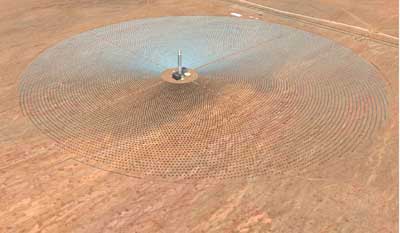
artist_picture_of_project

Image: SolarReserve

Ok, I’m exaggerating a bit in the headline above but we’re getting closer to solar farms that will provide baseload power, operating at night and under cloudy conditions. As I write on Tuesday in The New York Times:

The holy grail of renewable energy is a solar power plant that continues producing electricity after the sun goes down.

A Santa Monica, Calif., company called SolarReserve has taken a step toward making that a reality, filing an application with California regulators to build a 150-megawatt solar farm that will store seven hours’ worth of the sun’s energy in the form of molten salt.

Heat from the salt can be released when it’s cloudy or at night to create steam that drives an electricity-generating turbine.

The Rice Solar Energy Project, to be built in the Sonoran Desert east of Palm Springs, will “generate steady and uninterrupted power during hours of peak electricity demand,” according to SolarReserve’s license application.

So-called dispatchable solar farms would in theory allow utilities to avoid spending billions of dollars building fossil fuel power plants that are fired up only a few times a year when electricity demand spikes, like on a hot day.

SolarReserve is literally run by rocket scientists, many of whom formerly worked at Rocketdyne, a subsidiary of the technology giant United Technologies. Rocketdyne developed the solar salt technology, which was proven viable at the 10-megawatt Solar Two demonstration project near Barstow, Calif., in the 1990s.

You can read the rest of the story here.
Read Full Post »

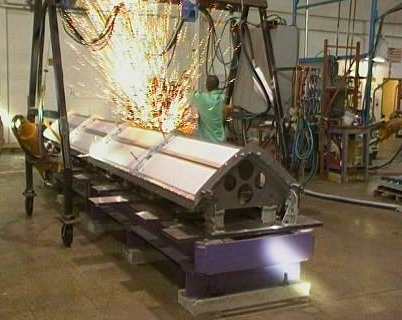
Rack Welding

photo: Skyline Solar

Silicon Valley startup Skyline Solar has joined other green energy companies beating a path to Detroit to take advantage of the down-and-out auto industry’s manufacturing might. As I write in the Los Angeles Times on Thursday:

Skyline Solar, a Silicon Valley start-up, has become the latest green energy company to tap the struggling auto industry’s manufacturing muscle.

The company announced today that components for its solar power plants were being made in a Troy, Mich., car factory operated by Cosma International, a division of auto manufacturing giant Magna International.

The same machines that stamp out doors, hoods and other car body parts are now making long metal arrays that hold Skyline’s photovoltaic panels.

“It’s literally just carving out a piece of an existing facility and putting through a product that for all intents and purposes could be a new make and model of the next family sedan,” said Bob MacDonald, Skyline’s chief executive.  “Every time there’s a new model year for a Ford Mustang, they have a tool and die set they put into this press. So you just have a different tool and die in there that forms a new shape for Skyline.”

The bottom line, said MacDonald, is that Skyline has slashed its capital costs by taking advantage of Cosma’s existing manufacturing capability. He said Skyline of Mountain View, Calif., has contracts in place for small-scale solar farms. He said he could not divulge the details of those contracts but noted that Skyline has begun to receive shipments of arrays from Michigan.

It’s also a good deal for Cosma, whose parent company has agreed to acquire Opel from General Motors.

“Renewable energy trends and forecast data suggest significant growth potential for this market — we expect to participate in this growth potential,” Tracy Fuerst, a Magna spokeswoman, said in an e-mail.

You can read the rest of the story here.

Read Full Post »

2009 Solar Decathlon

photo: Stefano Paltera/DOE

In my new Green State column on Grist (I’m stealing the above headline from Grist executive editor Russ Walker), I take a look at the state of green tech venture investing gleaned from a recent seminar at the University of California, Berkeley:

Silicon Valley is by nature an optimistic place. After all, inventing the carbon-free future and making boatloads of money along the way is fun. And even though California is slouching toward apocalyptic collapse these days, there’s always another innovation wave to ride.

So it’s always interesting to get a more-or-less unvarnished assessment of the state of green tech, as happened last week when a group of regulators, venture capitalists and entrepreneurs gathered at the University of California, Berkeley’s business school. They were there for the Cleantech Institute, one of those pricey, closed-door seminars for executives and government officials. (I was present to “facilitate.”)

The good news: Speakers reported that investors are starting to turn on the taps again when it comes to funding green tech startups.

But don’t expect a return to the halcyon days of 2008 when $4 billion poured into all manner of green technology companies. In the wake of the “Great Recession,” VCs are reassessing their investment strategies as it becomes clear that the success of their portfolios will be influenced to a large degree by government policy and incentives.

You can read the rest of the column here.

Read Full Post »

Stirling Energy Systems Solar One project

image: Tessera Solar

In a feature published in today’s New York Times, I look at a water war breaking out in the desert Southwest over plans to build dozens of large-scale solar power projects on hundreds of thousands of acres of land:

AMARGOSA VALLEY, Nev. — In a rural corner of Nevada reeling from the recession, a bit of salvation seemed to arrive last year. A German developer, Solar Millennium, announced plans to build two large solar farms here that would harness the sun to generate electricity, creating hundreds of jobs.

But then things got messy. The company revealed that its preferred method of cooling the power plants would consume 1.3 billion gallons of water a year, about 20 percent of this desert valley’s available water.

Now Solar Millennium finds itself in the midst of a new-age version of a Western water war. The public is divided, pitting some people who hope to make money selling water rights to the company against others concerned about the project’s impact on the community and the environment.

“I’m worried about my well and the wells of my neighbors,” George Tucker, a retired chemical engineer, said on a blazing afternoon.

Here is an inconvenient truth about renewable energy: It can sometimes demand a huge amount of water. Many of the proposed solutions to the nation’s energy problems, from certain types of solar farms to biofuel refineries to cleaner coal plants, could consume billions of gallons of water every year.

“When push comes to shove, water could become the real throttle on renewable energy,” said Michael E. Webber, an assistant professor at the University of Texas in Austin who studies the relationship between energy and water.

Conflicts over water could shape the future of many energy technologies. The most water-efficient renewable technologies are not necessarily the most economical, but water shortages could give them a competitive edge.

In California, solar developers have already been forced to switch to less water-intensive technologies when local officials have refused to turn on the tap. Other big solar projects are mired in disputes with state regulators over water consumption.

To date, the flashpoint for such conflicts has been the Southwest, where dozens of multibillion-dollar solar power plants are planned for thousands of acres of desert. While most forms of energy production consume water, its availability is especially limited in the sunny areas that are otherwise well suited for solar farms.

You can read the rest of the story here.

Read Full Post »

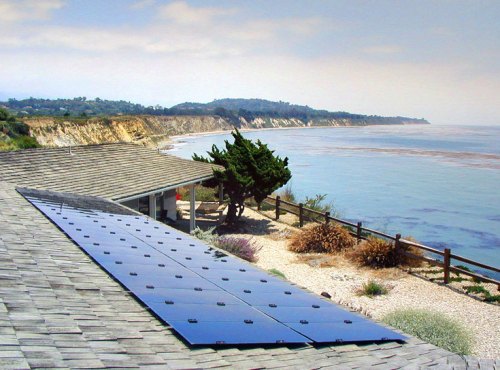
SolarCity_FirstSolarArray-_Coast

photo: SolarCity

When Wall Street collapsed last year so did  tax equity funds, the primary vehicle to finance renewable energy development.  But as I write in The New York Times today, investors are beginning to jump back into the game.

U.S. Bancorp has agreed to finance $100 million of solar installations in 2009 for California startup SolarCity. Investors are being lured in part by a federal stimulus package provision that lets them take a 30 percent investment tax credit for renewable energy projects as a cash grant:

The credit crunch has walloped the residential solar industry, making it hard for installers like SolarCity to tap investor funds to finance rooftop arrays for their customers.

But in a sign that the recessionary clouds are parting a bit, SolarCity on Tuesday said that U.S. Bancorp has agreed to finance $100 million worth of solar installations in 2009.

That’s double the money the bank committed to provide SolarCity in June when the original deal – but not the financial details – was announced.

SolarCity, based in the Silicon Valley suburb of Foster City, offers customers the option of leasing their rooftop panels and thus avoiding the five-figure cost of buying a solar system.

The company retains ownership of the solar array and thus qualifies for a 30 percent federal tax credit against its cost. Since most startups have no use for such tax credits, they give them to investors in exchange for financing installations.

Still, most such tax equity partnerships have collapsed along with the Wall Street banks that often funded them. In fact, U.S. Bancorp stepped in after Morgan Stanley pulled the plug on a financing arrangement with SolarCity earlier this year.

“For all of this year, tax equity has been the number one constraint in financing for the entire solar industry,” said Lyndon Rive, SolarCity’s chief executive. “In the third quarter of last year there were about 20 active banks and insurance companies making tax equity investments. They all fell off a cliff and now there’s three or four.”

You can read the rest of the story here.
Read Full Post »

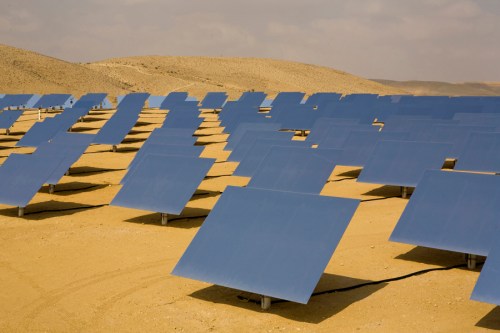
solarh

Photo: BrightSource Energy

In today’s New York Times, I write about how Harvey Whittemore — one of Nevada’s biggest power brokers and a confident of Senate majority leader Harry Reid — has responded to the housing crash by leasing desert land at his mega-home development to BrightSource Energy for a 960-megawatt solar farm complex.

What to do when building a 159,000-home city in the Nevada desert and the housing market collapses?

Go solar.

The Coyote Springs Land Company this week expanded a deal with BrightSource Energy, a solar power developer based in Oakland, Calif., to carve out 12 square miles of it its 43,000-acre mega-development for solar power plants that would generate up to 960 megawatts of electricity.

Harvey Whittemore, Coyote Springs’s chairman, said his plan always was to include some renewable energy in the massive golfing community under development 50 miles northeast of Las Vegas. But, Mr. Whittemore said, he decided to go bigger as the housing market crashed and solar developers like BrightSource began to sign deals with utilities.

“We’ve always said we’ll adjust the land use plan to the market,” said Mr. Whittemore in an interview. “At the end of the day we have approvals for 159,000 units and we looked at what we could do to reduce the number of units while at same time coming up with a functional business plan that takes advantage of private land.”

Private land is in short supply in Nevada, where the federal government owns about 87 percent of the state. That has forced solar developers like BrightSource – which is under the gun to supply 2,610 megawatts to California utilities — to seek leases on desert property managed by the United States Bureau of Land Management, a years-long process involving extensive environmental review.

By dealing with Mr. Whittemore, BrightSource is sidestepping all of that and acquiring an ally who knows how to get things done in the Silver State.

You can read the rest of the story here.
Read Full Post »

ausra-kimberlina

photo: Ausra

In my new Green State column on Grist, I sit down with legendary Silicon Valley venture capitalist Vinod Khosla to talk about his approach to green tech. Khosla — who raised a record $1.1 billion for green tech investing earlier this month — believes that unless a technology can scale and be adopted in markets like China and India, it will not have a meaningful impact on climate change.

Getting an audience with Silicon Valley’s guru of green investing isn’t always easy.

If Vinod Khosla is not speaking at one of the innumerable, and apparently recession-proof, green business conferences that seem to happen every other week, he’s giving lectures at Google headquarters, writing white papers, or, of course, inking checks to green tech startups with the potential to disrupt multi trillion-dollar global industries like energy, automobiles and building materials.

He’s something of a Valley legend:  Co-founder of Sun Microsystems, then a longtime tech investor with marquee venture capital firm Kleiner Perkins Caufield & Byers and now head of Khosla Ventures, which he started in 2004 to invest in green tech startups.

Khosla and his partners had been investing their own money, but earlier this month the firm announced it had raised $1.1 billion for two funds—one of which is the largest first-time fund in a decade. It was a rather staggering amount, given that clean-tech investing has plummeted from $4 billion in 2008 to $513 million so far this year, according to PricewaterhouseCoopers, as the “Great Recession” continues to take its toll.  Putting money into the two Khosla funds was the nation’s largest pension fund, the California Public Employees’ Retirement System.

It’s not the size of Khosla’s fund but what he intends to do with it that should command your attention. In short, he wants to take the green out of green investing and globalize the bottom line.

You can read the rest of the column here.

Read Full Post »

esolar_8
photo: eSolar

In Sunday’s Los Angeles Times, I write about how the rise of green technology is changing the way Silicon Valley venture capitalists do business:

Silicon Valley venture capitalists have always been about inventing the future — taking a wild idea, nurturing it with cash and creativity and giving birth to new products, companies and industries we once couldn’t imagine and now can’t conceive of living without: the Web, Google, the iPhone, Twitter.

But as green technology becomes the latest tech wave to break from the nation’s entrepreneurial epicenter, it’s now all about companies reinventing the past. Solar power companies, electric car start-ups and algae biofuel ventures aim to remake century-old trillion-dollar industries on a global scale.

Venture capitalists poured $4 billion into green-tech start-ups in 2008 — nearly 40% of all tech investments in the U.S., according to a survey by PricewaterhouseCoopers. Green-tech investment plunged in the first half of 2009 to $513 million as the recession dragged on, but there are signs of a rebound: Silicon Valley’s Khosla Ventures announced this month that it had raised $1.1 billion — the biggest first-time fund in a decade — that would be largely devoted to investing in green-tech start-ups, many in Southern California.

But green-tech companies face unique challenges, including global markets, tough technological hurdles and a future shaped by government incentives and regulatory policy. Those challenges are changing the game on Sand Hill Road.

“If you’re starting a Web 2.0 company, your basic needs are personnel and servers — there is no physical product, no manufacturing capacity, no inventory, no steel in the ground,” VantagePoint’s Salzman said, referring to software-based companies that provide services over the Internet.

Green-tech start-ups, he said, often need big money and investors steeped in big science and big government.

You can read the rest of the story here.

Read Full Post »

0060-20090901-DSC_4084

photo: Mission Motors

Would you pay $68,995 for an electric motorcycle that goes 150 mph and 150 miles on a charge? Mission Motors, a San Francisco startup, is betting well-heeled techies and gearheads will pony up for the thrill of instantaneous acceleration offered by an electric superbike. The company’s prototype, the Mission One, earlier this month set a world speed record for electric motorcycles. As I write in The New York  Times today:

Mission Motors, an electric motorcycle startup based in San Francisco, said Tuesday that its prototype vehicle had set a world speed record for battery-powered bikes of 150.059 miles per hour at the Bonneville Speedway in Utah.

That was the average speed achieved during two, mile-long trials but the motorcycle, called the Mission One, hit 161 m.p.h. on the Bonneville Salt Flats during one run on Sept 1.

Speed matters for what amounts to the Tesla Roadster of electric motorcycles.

“Our focus is on the market that is most motivated by performance,” said Forrest North, the co-founder and chief executive of Mission Motors and a former battery engineer at the high-end electric car maker, Tesla. Mr. North is bringing a bit of that company’s strategy to Mission Motors: Build a stylish high-tech, high-priced electric vehicle for enthusiasts, and then move down the market with less expensive models.

You can read the rest of the story here.

Read Full Post »

ausra-kimberlina

photo: Ausra

In Wednesday’s Los Angeles Times, I write about green tech guru Vinod Khosla’s new $1.1 billion venture funds — the biggest first-time fund since the halcyon days of the dot-com era a decade ago and and a strong signal that investors see a bright future in clean and green technologies. CalPERS, the United States’ biggest pension fund, is the major backer of the new Khosla Ventures’ funds:

In a sign that green technology investing is bouncing back, Silicon Valley venture capital firm Khosla Ventures said Tuesday that it had raised $1.1 billion to spur development of renewable energy and other clean technologies.

It is the biggest first-time fund in a decade and comes as venture capital investment in green technology is just beginning to recover from a precipitous fall prompted by the global economic collapse last fall.

In the first half of the year, investments in green tech plunged to $513 million from $2 billion in the first six months of 2008, according to a survey by PricewaterhouseCoopers.

But Vinod Khosla, founder of Khosla Ventures in Menlo Park, Calif., and a leading green tech guru, has managed to raise an $800-million fund to invest in early and mid-stage clean energy and information technology companies as well as a $275-million fund to finance what he called high-risk “science experiments” that may exist only in a university laboratory.

You can read the rest of the story here.

Read Full Post »

« Newer Posts - Older Posts »

Design a site like this with WordPress.com
Get started