Feeds:
Posts
Comments

Archive for the ‘electric cars’ Category

SalinasRabobankTeslaChargingSM

photo: SolarCity

In my new Green State column on Grist, I write about how SolarCity, a Silicon Valley rooftop solar installer, is getting into the electric-car charging station business:

You can’t get more California greenin’ than this.

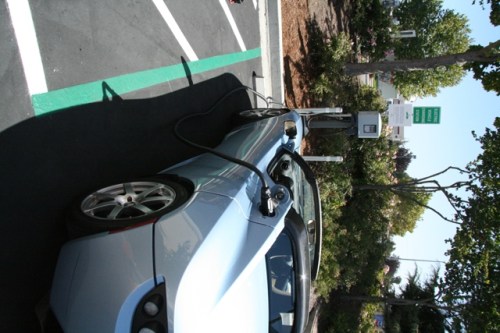
Peter Rive can charge up his Tesla Roadster electric sports car in his San Francisco garage with carbon-free electricity supplied by a solar array on his roof. Then, if he’s in the mood for a road trip, he can drive to Los Angeles, stopping at a solar-powered charging station along the way to top off the battery.

The free charging stations on the “solar highway”—aka the 101—were recently installed by SolarCity, the Silicon Valley rooftop solar company Rive founded with his brother Lyndon. (The electric-blue Roadster sitting in his garage was made by his cousin Elon Musk‘s startup, Tesla Motors.)

So what’s a solar company doing installing highway charging stations for six-figure sports cars driven by people with seven-figure salaries?

In part, it’s a result of SolarCity’s connection to Tesla and grants the electric carmaker received from the state of California to demo charging stations. It makes for great PR, of course, but the bigger picture here is how the emerging electric vehicle industry will drive (sorry) the adoption of residential and commercial photovoltaic systems.

You can read the rest of the column here.

Read Full Post »

thnk-goes-amsterdam77
photo: Think

In The New York Times today, I write about how Stockholm’s congestion pricing system, which charges drivers to enter the city center, has helped triple the number of alternative fuel cars in the Swedish capital:

When Sweden began charging motorists to drive into downtown Stockholm during rush hour, the goal was to reduce traffic congestion, cut greenhouse gas emissions and boost ridership on public transportation.

That has happened, and now a new study has found another benefit from so-called congestion pricing: In the 24-square kilometer congestion zone in Sweden’s capital, the number of registered alternative fuel vehicles, which are exempt from congestion tolls, jumped from five percent of the total vehicle fleet in 2006 to 14 percent in 2008.

“The changes in the make-up of the vehicle fleet are not exclusively due to the congestion tax, but surveys show that exemption from the congestion tax is the single most significant incentive for those buying alternative fuel vehicles in Stockholm,” concluded the report, which was released this month by the Stockholm Traffic Administration.

You can read the rest of the story here.

Read Full Post »

0060-20090901-DSC_4084

photo: Mission Motors

Would you pay $68,995 for an electric motorcycle that goes 150 mph and 150 miles on a charge? Mission Motors, a San Francisco startup, is betting well-heeled techies and gearheads will pony up for the thrill of instantaneous acceleration offered by an electric superbike. The company’s prototype, the Mission One, earlier this month set a world speed record for electric motorcycles. As I write in The New York  Times today:

Mission Motors, an electric motorcycle startup based in San Francisco, said Tuesday that its prototype vehicle had set a world speed record for battery-powered bikes of 150.059 miles per hour at the Bonneville Speedway in Utah.

That was the average speed achieved during two, mile-long trials but the motorcycle, called the Mission One, hit 161 m.p.h. on the Bonneville Salt Flats during one run on Sept 1.

Speed matters for what amounts to the Tesla Roadster of electric motorcycles.

“Our focus is on the market that is most motivated by performance,” said Forrest North, the co-founder and chief executive of Mission Motors and a former battery engineer at the high-end electric car maker, Tesla. Mr. North is bringing a bit of that company’s strategy to Mission Motors: Build a stylish high-tech, high-priced electric vehicle for enthusiasts, and then move down the market with less expensive models.

You can read the rest of the story here.

Read Full Post »

switch station location

photo: Better Place

In today’s New York Times, I write about Better Place’s unveiling of its software platform for managing tens of thousands of electric cars on the road and the grid. Software as much as hardware will be key to making electric cars a mass market phenomenon:

Electric cars may be all about hardware – batteries, drivetrains, charging stations — but companies like Better Place are depending on software to give a niche product mass-market appeal.

At the Frankfurt Motor Show on Tuesday, Better Place, which builds electric vehicle charging networks, is expected to take the wraps off a software platform that tells drivers when and where to charge their batteries, while giving utilities the ability to manage the impact of tens of thousands of vehicles tapping into the power grid.

The company, based in Palo Alto, Calif., has signed deals to roll out networks of charging spots and battery switching stations in Australia, Denmark, California, Canada and Hawaii and Israel.

Better Place will own the car batteries and drivers will buy “miles” (or kilometers) on a subscription plan much like they purchase mobile phone minutes. That means Better Place must track the location and capacity of thousands of batteries at any given moment to properly bill customers and ensure that fresh batteries and charging posts are available when needed.

You can read the rest of the story here.

Read Full Post »

IMG_1598

Photo: Todd Woody

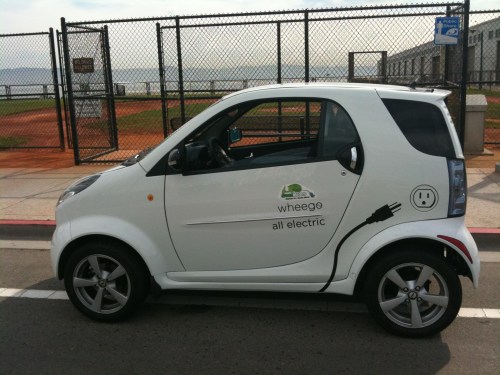
In my Green State column for Grist on Thursday, I write about Wheego, an Atlanta startup that will soon begin selling an electric microcar called the Whip.

I took the Whip for a spin around San Francisco with Wheego chief executive Mike McQuary riding shotgun but what really grabbed my attention was the fact that the chassis and body are made in China. While U.S. automakers take halting steps toward weaning themselves from the internal combustion engine, the Chinese are positioning themselves to make the great leap forward into the electric age. As I write on Grist:

A traffic jam is developing on the electric highway.

A decade after General Motors killed the electric car, big automakers and startups are revving up to put battery-powered vehicles on the road over the next couple of years. One of the latest entrants is Wheego, an Atlanta company that is about to launch the Whip—a tiny low-speed “neighborhood electric vehicle” that will be upgraded in 2010 to a full-speed, highway-ready car.

Wheego chief executive Mike McQuary brought a Whip to San Francisco last week, and I took the car for a spin around the city. (More on that in a bit.)

You see quite a few neighborhood electrics across the Bay in Berkeley where I live. Their top speed is around 25 miles per hour and many look like glorified golf carts or cast-offs from an East Bloc auto factory, circa 1984. And at the risk of stereotyping, most seem to be driven by the proverbial little old leftist lady in tennis shoes who glides down the hill for the weekly nuclear disarmament rally outside the Cal campus (circa 1984).

The Wheego Whip, on the other hand, looks like a “real” car (PDF brochure). Somewhat similar in appearance to the Smart fortwo or Think City EV, it’s a two-seater microcar sporting all the mod cons—power windows, Bluetooth stereo, iPod/iPhone jack, air conditioning.

Like Coda Automotive’s forthcoming electric sedan, the Whip’s body and chassis are Chinese made—another sign that China is emerging as a player in the nascent electric car industry—while the battery comes from Canada and the motor from Wisconsin (U-S-A! U-S-A!). The Whip will be assembled in California in the Los Angeles exurb of Ontario. Other electric startups are following a similar business plan, making the old Detroit automotive model increasingly look as viable as a Hummer.

You can read the rest of the column here.

Read Full Post »

think-city-8_imagelarge

photo: Think

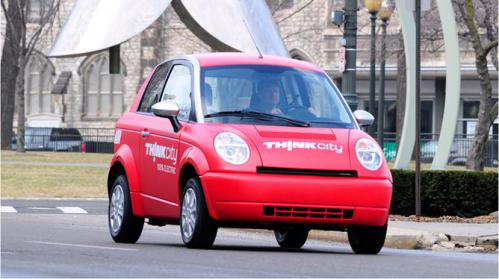
Norwegian electric car maker Think has exited bankruptcy protection and brought on board new investors. As I write in the New York Times Green Inc. blog today:

Norwegian electric car maker Th!nk is back on the road.

The company on Thursday said it has exited bankruptcy protection and secured $47 million in new funding to restart production of the Think City, a highway-capable urban runabout with a range of about 112 miles.

Think had shut down its assembly line outside of Oslo late last year when the global financial crisis cut off access to new capital.

But is Think still a Norwegian automaker? The company did get some local street cred Thursday: Among its new shareholders is Investinor, an investment fund backed by the Norwegian government.

Still, in another sign of the globalization of the nascent electric car industry, the Think City will now be made in Finland at the plant of one of its new investors, Valmet Automotive. (Valmet assembles the Porsche Boxster and Cayman and will begin producing the Fisker Karma plug-in hybrid electric sports sedan.)

You can read the rest of the story here.

Read Full Post »

TH!NK-city-Michigan-USA_imagelarge

photo: Think

Norwegian electric carmaker Think is going into the drive-train businesses with battery maker EnerDel and their first big customer is the Japanese postal service.

Think makes the City, a two-seater urban runabout currently sold in Europe. EnerDel supplies (ENER1) lithium-ion batteries for the car and will be the provider of batteries for Think’s new electric drive-train business.

“We have seen increased interest in Think’s proprietary EV drive system from a variety of third parties, which represents a significant and exciting new business line and revenue opportunity for the company,” said Think CEO Richard Canny in a statement.

The company is selling the drive trains to Zero Sports, a Japanese company that converts cars to battery power and which is working with the Japanese postal service to electrify its 22,000-vehicle fleet.

Think, previously owned by Ford (F), was forced to halt production of the City late last year as the global financial crisis cut off access to capital. The company subsequently obtained new funding and has announced plans to build a factory in the United States.

Read Full Post »

Global investment in green technology rose 12% to $1.2 billion in the second quarter after two quarters of sharp declines, according to a report released Wednesday by the Cleantech Group and Deloitte.

Electric cars attracted the most investment at $236 million while solar fell to a low of $114 million. Biofuels scored $206 million and advanced batteries received $165 million from investors.

“It looks like things have leveled out and have stabilized,” said Brian Fan, senior director of research for the Cleantech Group, a San Francisco-based research and consulting firm.

Still, the second quarter numbers are down 44% from a year ago.

North America grabbed 66% of green tech investment while Europe and Israel captured 21% percent, India 11% and China 1%.

Fan said that while investors were hot on smart grid companies at the end of 2008 their ardor has cooled so far this year.

In a sign that the green tech industry has been consolidating as the recession drags on, mergers and acquisitions jumped 291% in the second quarter to $12.2 billion.

Read Full Post »

ibm-smarter-planet

While the U.S. Department of Energy on Tuesday issued nearly $8 billion in loans to Ford (F), Nissan and Tesla Motors to manufacture electric cars and batteries, IBM unveiled an initiative to develop a next-generation battery technology that would allow those vehicles to travel 400 miles or more on a charge.

Big Blue will investigate the potential of lithium air technology to replace current state-of-the-art lithium ion batteries. Lithium air potentially could pack 10 times the energy density of lithium ion storage devices by drawing oxygen into the batteries to use as a reactant. As a result lithium air batteries would weigh less than lithium ion batteries, C. Spike Narayan, manager of science and technology at IBM’s Almaden Research Center, told Green Wombat.

So besides powering cars, lithium air batteries could store electricity generated from solar power plants and wind farms, turning them into 24/7 energy sources.

But don’t expect to see the super-charged batteries anytime soon.”This is a five-to-10-year project,” says Narayan. “The first phase is to go after the big science problems. Then we’re ready to engage with automotive companies and battery manufacturers.”

The technological hurdles are high and even IBM (IBM), with its expertise in nanotechnology, green chemistry and supercomputing, won’t try to go it alone. It’s seeking partners at research universities and government laboratories to crack the tech challenges, which include developing a membrane that will strip water out of the air before it enters the battery and the development of nano materials to prevent layers of lithium oxide from interfering with chemical reactions.

IBM intends to limit its role in the battery business to R&D. “We have no desire to make batteries,” says Rich Lechner, IBM’s vice president for energy and the environment. “We will license the IP.”

In another sign that climate change and the imminent imposition of carbon caps are creating opportunities for Big Business and rearranging the competitive landscape, IBM also announced “Green Sigma,” an alliance of erstwhile competitors that will offer solutions to companies seeking to shrink their carbon footprint.

Green Sigma includes business software giant SAP (SAP), Cisco (CSCO), Johnson Controls (JCI) and Honeywell (HON). Dave Lebowe, an IBM executive with the Green Sigma program, acknowledged the potential for conflicts of interests among these frenemies but said such problems were outweighed by the upside of bringing together a broad range of expertise to help customers cut their CO2 emissions and save money.

Read Full Post »

CODA Front_hires

photo: Coda Automotive

A new electric car company, Coda Automotive, emerged from stealth mode this week and unveiled a $45,000 sedan that it says will hit the streets in 2010.

The Santa Monica, Calif., startup is an offshoot of Miles Electric Vehicles, a maker of low-speed neighborhood runabouts. The CEO is Kevin Czinger, a veteran of Goldman Sachs (GS), Fortress Investment Group and dot-com era online grocer WebVan. Goldman Sachs’ Mac Heller serves as co-chairman and the board includes John Bryson, past chairman and chief executive of Edison International (EIX). Coda has raised $40 million from the Angeleno Group and other investors.

Green Wombat took a spin in the car, called the Coda, earlier this week in Southern California. As I wrote in my Green State column on Grist:

Open one of those minimalist black boxes that contain a shiny new iPod and you’re greeted by five words—“Designed by Apple in California.” In much smaller print would be the phrase “Made in China.”

That, in a nutshell, describes the strategy of the latest entrant in the electric car sweepstakes: Santa Monica-based Coda Automotive. At a defunct Wilshire Boulevard Jaguar dealership on Wednesday, the startup emerged from stealth mode and CEO Kevin Czinger literally pulled the cover off the Coda, a $45,000 battery-powered sedan set to go on sale next year in California. Coda is an offshoot of Miles Electric Vehicles, a maker of low-speed “neighborhood electric” runabouts.

The Coda sedan, which resembles a previous-generation Honda Civic, is a highway-ready, 80 mph five-seater that will travel 90 to 120 miles on a charge, according to the company.

And it is likely to be the first Chinese-made car to hit American roads. The car’s 333-volt lithium ion battery pack comes from the Tianjin Lishen Battery Joint-Stock Co., a huge state-owned corporation that supplies batteries to Apple and other consumer electronics companies.  Coda has established a joint venture with Tianjin Lishen to design and sell batteries for transportation and utility storage. The sedan’s design, brand and intellectual property will be owned by Coda, but it will be manufactured and assembled in China by Hafei, a state-owned automobile and aircraft manufacturer.

Read the rest of the column here.

Read Full Post »

« Newer Posts - Older Posts »

Design a site like this with WordPress.com
Get started