Feeds:
Posts
Comments

Archive for the ‘alternative energy’ Category

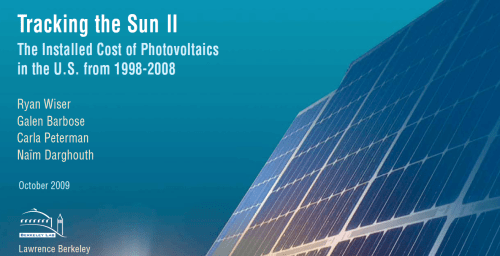
Lawrence Berkeley solar study

The Lawrence Berkeley National Laboratory this week released a comprehensive study on the cost of going solar in the United States. No surprise that the cost of installing a photovoltaic solar system has fallen 30 percent over the past decade, but there are some interesting developments. For instance, California may be the biggest solar state but it’s not the cheapest. As I write in The New York Times on Friday:

The cost of going solar fell last year, resuming a decade-long decline after several years of flat prices, according to a new study from Lawrence Berkeley National Laboratory.

The report found that the installed cost of residential and commercial photovoltaic systems in the United States dropped 30 percent overall between 1998 and 2008. But prices had become relatively stagnant between 2005 and 2007, as demand spiked and solar module makers ramped up production.

The global economic meltdown, however, along with a resulting oversupply of modules, led the cost of installing a solar system last year to fall from $7.80 in a watt to $7.50 a watt — though the actual cost to homeowners actually increased slightly as state incentives for installing solar arrays fell faster than module prices.

In states like California, the per-watt rebate declines as more solar systems are installed.

Among other findings: the researchers, who reviewed data from the installations of 52,356 solar systems, discovered that it is 10 percent less expensive to install a solar array on a new home than to retrofit an existing home.

And although California is by far the largest solar market in the United States with 81 percent of all installed photovoltaic systems, it isn’t the cheapest place to install small-scale solar.

That distinction goes to Arizona, where the installed cost of solar systems smaller than 10 kilowatts was $7.30 per watt compared to $8.20 per watt in California.

You can read the rest of the story here.
Read Full Post »

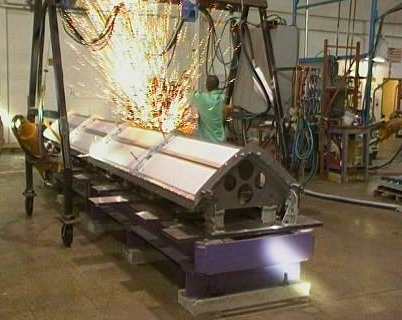
Rack Welding

photo: Skyline Solar

Silicon Valley startup Skyline Solar has joined other green energy companies beating a path to Detroit to take advantage of the down-and-out auto industry’s manufacturing might. As I write in the Los Angeles Times on Thursday:

Skyline Solar, a Silicon Valley start-up, has become the latest green energy company to tap the struggling auto industry’s manufacturing muscle.

The company announced today that components for its solar power plants were being made in a Troy, Mich., car factory operated by Cosma International, a division of auto manufacturing giant Magna International.

The same machines that stamp out doors, hoods and other car body parts are now making long metal arrays that hold Skyline’s photovoltaic panels.

“It’s literally just carving out a piece of an existing facility and putting through a product that for all intents and purposes could be a new make and model of the next family sedan,” said Bob MacDonald, Skyline’s chief executive.  “Every time there’s a new model year for a Ford Mustang, they have a tool and die set they put into this press. So you just have a different tool and die in there that forms a new shape for Skyline.”

The bottom line, said MacDonald, is that Skyline has slashed its capital costs by taking advantage of Cosma’s existing manufacturing capability. He said Skyline of Mountain View, Calif., has contracts in place for small-scale solar farms. He said he could not divulge the details of those contracts but noted that Skyline has begun to receive shipments of arrays from Michigan.

It’s also a good deal for Cosma, whose parent company has agreed to acquire Opel from General Motors.

“Renewable energy trends and forecast data suggest significant growth potential for this market — we expect to participate in this growth potential,” Tracy Fuerst, a Magna spokeswoman, said in an e-mail.

You can read the rest of the story here.

Read Full Post »

image002There are a growing number of “green” software applications for the iPhone. One of the newest is an app that turns the gadget into an anemometer to clock wind speeds for those considering installing a backyard turbine. As I write in The New York Times on Thursday:

Thinking of putting a wind turbine in your backyard? Mariah Power is introducing a program that will let you measure the wind speed around your house by pointing your iPhone toward the sky.

The application uses the phone’s microphone to capture wind noise. It filters out ambient sound and an algorithm converts the result into a decibel rating that corresponds to wind speed, according to Bill Westerman, a principal at Create with Context, a Silicon Valley digital design company that developed the app for Mariah.

“If you go out in your backyard and do a few measurements it gives you a pretty good idea of the wind speed and tells you what kinds of things you could power with a wind turbine,” said Mr. Westerman.

Mariah, based in Reno, Nev., makes the Windspire, 1.2-kilowatt residential turbine with horizontal blades that looks more like a piece of modern art than a conventional windmill.

You can read the rest of the story here.

Read Full Post »

nextlight renewable power agua caliente

That was quick: Just days after California Gov. Arnold Schwarzenegger vetoed legislation that would have limited utilities’ ability to buy out-of-state renewable energy, utility PG&E on Thursday asked regulators to approve a deal with an Arizona solar farm to supply 290 megawatts of electricity. As I write in The New York Times on Friday:

Pacific Gas & Electric, the big California utility, asked regulators on Thursday to approve the purchase of electricity from an Arizona solar power plant, only days after Gov. Arnold Schwarzenegger vetoed legislation that would have limited utilities’ ability to tap out-of-state projects to meet renewable energy mandates.

NextLight Renewable Power will construct the 290-megawatt Aqua Caliente photovoltaic farm on private land in Yuma County, Ariz. The company, based in San Francisco, signed a deal with P.G.&E. in June to supply 230 megawatts from a solar power plant to be built outside of Los Angeles.

The legislation vetoed by Mr. Schwarzenegger on Sunday would have required California utilities to obtain 33 percent of their electricity from renewable sources by 2020, mostly from in-state projects.

Environmental groups and unions supported that provision as a way to limit the need to build new transmission lines and to keep construction jobs in California. But the governor said it would hamstring utilities from complying with the 33 percent target, which he supports.

According to the filing the utility made Thursday, Arizona regulators have already approved the project and NextLight expects to obtain county building permits within a few months. In contrast, the licensing of a solar power plant in California can take years. The Agua Caliente project is also located near existing transmission lines that connect to California’s power grid.

You can read the rest of the story here.

Read Full Post »

2009 Solar Decathlon

photo: Stefano Paltera/DOE

In my new Green State column on Grist (I’m stealing the above headline from Grist executive editor Russ Walker), I take a look at the state of green tech venture investing gleaned from a recent seminar at the University of California, Berkeley:

Silicon Valley is by nature an optimistic place. After all, inventing the carbon-free future and making boatloads of money along the way is fun. And even though California is slouching toward apocalyptic collapse these days, there’s always another innovation wave to ride.

So it’s always interesting to get a more-or-less unvarnished assessment of the state of green tech, as happened last week when a group of regulators, venture capitalists and entrepreneurs gathered at the University of California, Berkeley’s business school. They were there for the Cleantech Institute, one of those pricey, closed-door seminars for executives and government officials. (I was present to “facilitate.”)

The good news: Speakers reported that investors are starting to turn on the taps again when it comes to funding green tech startups.

But don’t expect a return to the halcyon days of 2008 when $4 billion poured into all manner of green technology companies. In the wake of the “Great Recession,” VCs are reassessing their investment strategies as it becomes clear that the success of their portfolios will be influenced to a large degree by government policy and incentives.

You can read the rest of the column here.

Read Full Post »

IMG_1214

photo: Todd Woody

Can a state that gets 95 percent of its electricity from coal-fired power plants go green? The Natural Resources Defense Council thinks so. In a report released this week, the environmental group lays out how Indiana can become the California of the Midwest when it comes to renewable energy. As I write in The New York Times on Friday:

Coal-dependent Indiana could become one of the nation’s greenest states by tapping rural resources to generate renewable energy, according to a new report issued by the Natural Resources Defense Council.

The Hoosier State now obtains 95 percent of its electricity from plants running on coal — largely imported from Wyoming and elsewhere — but it could profit as an exporter of wind energy and machinery, the report said.

“Indiana has some of the best wind potential in the eastern U.S. and has a competitive advantage as a wind producer over most other states because of its location,” said the report’s author, Martin R. Cohen, said during a conference call on Wednesday.

Mr. Cohen noted that while the wind blows stronger in states like North Dakota and Nebraska, Indiana already has the transmission system in place to bring wind-generated electricity to eastern cities.

If Indiana increased wind energy production to 4,500 megawatts from its current 530 megawatts, it would create thousands of jobs and attract turbine manufacturers, according to the report. An owner of a 500-acre farm could earn $30,000 a year from leasing land for wind turbines, Mr. Cohen estimated.

Farmers also could profit, the report said, if Indiana starts harvesting corn stalks, wheat stalks and soybean residue and uses the biomass either for power production or to make ethanol.

You can read the rest of the story here.

Read Full Post »

POWERHOUSE1

photo: Dow Chemical

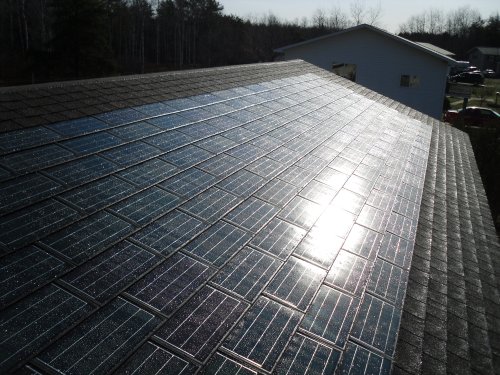
Industrial giant Dow Chemical is getting into the residential solar business with a potentially game-changing product: A “solar shingle” that can be integrated into any asphalt-tiled roof and installed by any roofer. As I wrote in The New York Times on Wednesday:

Dow Chemical has unveiled a residential roof shingle in the form of a solar panel designed to be integrated into asphalt-tiled roofs.

Jane Palmieri, managing director of Dow’s Solar Solutions unit, said the Powerhouse thin-film shingle slashes installation costs because it can be installed by a roofer who is already building or retrofitting a roof.

“As a roofer is nailing asphalt shingle on roof, wherever the array needs to be installed he just switches to solar shingle,” said Ms. Palmieri, who said the solar singles are similarly attached to the roof with nails.

“You don’t have to have a solar installation crew do the work or have an electrician on site,” she added. “The solar shingle can be handled like any other shingle – it can be palletized, dropped from a roof, walked on.”

An electrician is still needed to connect the completed array to an inverter and to a home’s electrical system, but unlike conventional solar panels that must be wired together, the solar shingles plug into each other to form the array.

Dow plans to begin test-marketing the solar shingle in mid-2010, initially targeting new-home construction. Ms. Palmieri said the market could be worth $5 billion by 2015 and noted that 90 percent of homes in the United States use asphalt shingles.

You can read the rest of the story here.
Read Full Post »

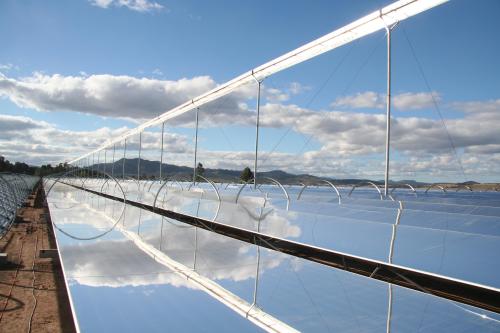
ausra-16

photo: Ausra

Silicon Valley solar startup Ausra in January decided to get out of the solar power plant business and focus on supply solar steam systems to developers. As I write in The New York Times today, the company has announced deals in Australia, Jordan and, soon, the United States:

Ausra, a Silicon Valley solar start-up, burst on to the green-tech scene in 2007, bankrolled by marquee venture capitalists and armed with ambitions to build gigawatts of solar farms.

Earlier this year, though, the company abruptly changed course, abandoning its solar power plant business to focus on supplying solar thermal technology to other developers.

Now the deals are starting to roll in.

On Wednesday, Ausra said it has signed a contract to provide a solar steam system to a German developer, MENA Cleantech. MENA plans to build a 100-megawatt hybrid solar farm in Jordan that will rely on an oil-fired boiler to generate electricity when the sun does not shine.

Robert Fishman, Ausra’s chief executive, said his company also has agreed to build a 23-megawatt solar steam plant adjacent to a 750-megawatt coal-fired power station in Queensland, Australia. The company’s mirror arrays and boilers will produce supplemental steam to boost the coal plant’s electricity production.

You can read the rest of the story here.
Read Full Post »

Stirling Energy Systems Solar One project

image: Tessera Solar

In a feature published in today’s New York Times, I look at a water war breaking out in the desert Southwest over plans to build dozens of large-scale solar power projects on hundreds of thousands of acres of land:

AMARGOSA VALLEY, Nev. — In a rural corner of Nevada reeling from the recession, a bit of salvation seemed to arrive last year. A German developer, Solar Millennium, announced plans to build two large solar farms here that would harness the sun to generate electricity, creating hundreds of jobs.

But then things got messy. The company revealed that its preferred method of cooling the power plants would consume 1.3 billion gallons of water a year, about 20 percent of this desert valley’s available water.

Now Solar Millennium finds itself in the midst of a new-age version of a Western water war. The public is divided, pitting some people who hope to make money selling water rights to the company against others concerned about the project’s impact on the community and the environment.

“I’m worried about my well and the wells of my neighbors,” George Tucker, a retired chemical engineer, said on a blazing afternoon.

Here is an inconvenient truth about renewable energy: It can sometimes demand a huge amount of water. Many of the proposed solutions to the nation’s energy problems, from certain types of solar farms to biofuel refineries to cleaner coal plants, could consume billions of gallons of water every year.

“When push comes to shove, water could become the real throttle on renewable energy,” said Michael E. Webber, an assistant professor at the University of Texas in Austin who studies the relationship between energy and water.

Conflicts over water could shape the future of many energy technologies. The most water-efficient renewable technologies are not necessarily the most economical, but water shortages could give them a competitive edge.

In California, solar developers have already been forced to switch to less water-intensive technologies when local officials have refused to turn on the tap. Other big solar projects are mired in disputes with state regulators over water consumption.

To date, the flashpoint for such conflicts has been the Southwest, where dozens of multibillion-dollar solar power plants are planned for thousands of acres of desert. While most forms of energy production consume water, its availability is especially limited in the sunny areas that are otherwise well suited for solar farms.

You can read the rest of the story here.

Read Full Post »

SolarCity_FirstSolarArray-_Coast

photo: SolarCity

When Wall Street collapsed last year so did  tax equity funds, the primary vehicle to finance renewable energy development.  But as I write in The New York Times today, investors are beginning to jump back into the game.

U.S. Bancorp has agreed to finance $100 million of solar installations in 2009 for California startup SolarCity. Investors are being lured in part by a federal stimulus package provision that lets them take a 30 percent investment tax credit for renewable energy projects as a cash grant:

The credit crunch has walloped the residential solar industry, making it hard for installers like SolarCity to tap investor funds to finance rooftop arrays for their customers.

But in a sign that the recessionary clouds are parting a bit, SolarCity on Tuesday said that U.S. Bancorp has agreed to finance $100 million worth of solar installations in 2009.

That’s double the money the bank committed to provide SolarCity in June when the original deal – but not the financial details – was announced.

SolarCity, based in the Silicon Valley suburb of Foster City, offers customers the option of leasing their rooftop panels and thus avoiding the five-figure cost of buying a solar system.

The company retains ownership of the solar array and thus qualifies for a 30 percent federal tax credit against its cost. Since most startups have no use for such tax credits, they give them to investors in exchange for financing installations.

Still, most such tax equity partnerships have collapsed along with the Wall Street banks that often funded them. In fact, U.S. Bancorp stepped in after Morgan Stanley pulled the plug on a financing arrangement with SolarCity earlier this year.

“For all of this year, tax equity has been the number one constraint in financing for the entire solar industry,” said Lyndon Rive, SolarCity’s chief executive. “In the third quarter of last year there were about 20 active banks and insurance companies making tax equity investments. They all fell off a cliff and now there’s three or four.”

You can read the rest of the story here.
Read Full Post »

« Newer Posts - Older Posts »

Design a site like this with WordPress.com
Get started