Feeds:
Posts
Comments

Posts Tagged ‘solar power plants’

sunrise_powerlink_031506

Over the weekend The New York Times’ Matthew L. Wald had a sobering story on the not-inconsiderable challenges facing efforts to expand and upgrade the United States’ power grid to tap renewable energy from wind farms and solar power plants. Among them: Opposition to new high-voltage power lines from landowners and environmentalists, a Byzantine permitting process and fights over who pays the costs of transmission projects that span state lines.

Here in California, the ongoing controversy over the Sunrise Powerlink project is a case study in just how difficult it will be to build the infrastructure to transmit electricity from dozens of solar power plants planned for the Mojave Desert. Among the big companies looking to cash in on the solar land rush: Goldman Sachs (GS), Chevron (CVX) and FPL (FPL)

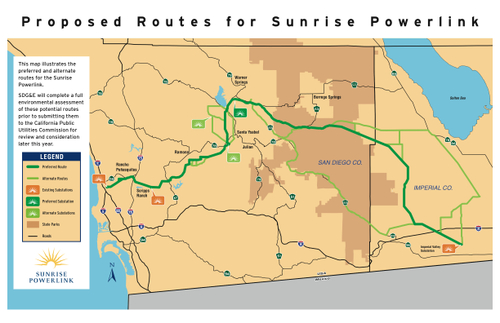
Utility San Diego Gas & Electric first proposed the $1.3 billion, 150-mile Sunrise Powerlink in 2005 to connect the coastal metropolis with remote solar power stations and wind farms in eastern San Diego County and the Imperial Valley. For instance, SDG&E’s contract to buy up to 900 megawatts of solar electricity from massive solar farms to be built by Stirling Energy Systems is dependent on the construction of the Sunrise Powerlink. Like California’s other big investor-owned utilities – PG&E (PCG) and Southern California Edison (EIX) – SDG&E, a unit of energy giant Sempra (SRE), is racing the clock to meet a state mandate to obtain 20% of its electricity from renewable sources by 2010 and 33% by 2020.

But Sunrise sparked opposition from the get-go as the utility proposed routing part of the transmission project through a pristine wilderness area of the Anza-Borrego Desert State Park.  The prospect of 150-foot-tall transmission towers marching through critical habitat for desert tortoises and other protected wildlife galvanized environmentalists well-versed in the arcane arts of regulatory warfare.

Opponents also painted the project as a Trojan horse to bring in cheap coal-fired power from Mexico. (Wald makes a similar point in his Times‘ piece – the same high-voltage lines designed to transmit green electricity from wind farms can also be used to send cheap carbon-intensive coal-fired electricity across the country.) That argument subsequently lost currency when regulators, citing California’s landmark global warming law, barred utilities from signing long-term contracts for out-of-state coal power.

After more than three years of hearings and procedural skirmishes culminating in an 11,000-page environmental impact report, a PUC administrative law judge last October issued a 265-page decision all but killing the project on environmental grounds. Whether SDG&E thought that green energy and climate change concerns would trump worries over wildlife and wilderness, it was clear that trying to build an industrial project through a state park was a costly mistake.

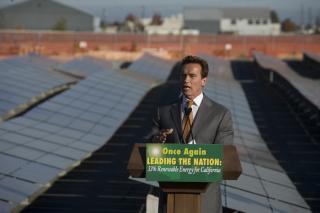
Then in December, after California Governor Arnold Schwarzenegger signed an executive order to streamline and prioritize the licensing of renewable energy projects, the utilities commission’s board revived Sunrise Powerlink, approving a different route for the transmission lines that avoids Anza-Borrego.

But the fight is far from over. With the cost of the project now approaching $2 billion, late last month the Center for Biological Diversity, a Tucson, Ariz.-based environmental group, filed a suit in the California Supreme Court challenging the utilties commission’s approval of Sunrise Powerlink.

Safe to say, the battle will drag on for some time to come, giving new meaning to the term “stranded assets” for some would-be Big Solar developers.
Read Full Post »

kimberlina0089l1

photo: Ausra

When Green Wombat sat down for a chat with Ausra founder David Mills back in September 2007, he allowed that it was not unreasonable to expect the Silicon Valley solar startup to soon be building several massive megawatt solar power plants a year. The optimism was not unwarranted. After all, in the space of 12 months Ausra had relocated from Sydney to Palo Alto, raised $40 million from A-list venture capitalists and was about to ink a deal with utility PG&E for a 177-megawatt  solar power project.

That was then. This month Ausra laid off 10% of its 108 employees amid a move to stop building Big Solar projects – for now – to focus on providing its solar thermal technology to other power plant developers and to industries that use steam. (Ausra’s compact linear fresnel reflector technology deploys flat mirrors that sit low to the ground and concentrate sunlight on water-filled pipes that hang over the mirrors. The superheated water creates steam which drives an electricity-generating turbine.)

“I think our competitors will figure this out sooner or later but nobody’s going from a five-megawatt project to a 500-megawatt project. No one’s going to finance that,” Ausra CEO Bob Fishman told Green Wombat. “If you look at the amount of money it takes to be involved in the project development business, that’s not something a startup can do.”

At least any time soon. Ausra last year opened a robotic factory in Las Vegas to make mirror arrays and other components for the many power plant projects it had on the drawing boards. Just three months ago the company flipped the switch on its five-megawatt Kimberlina demonstration power plant outside Bakersfield. But as the credit crunch hit, financing for billion-dollar solar power projects evaporated. Then in October, Congress passed legislation allowing utilities like PG&E (PCG), Southern California Edison (EIX) and San Diego Gas & Electric (SRE) to claim a 30% investment tax credit for solar projects. As the only well-capitalized institutions left standing in the energy game, utilities are stepping forward as investors.

PG&E CEO Peter Darbee says he’s prepared to make direct investments in solar power plants – projects the utility needs to comply with a California mandate to obtain 20% of its electricity from renewable sources by 2010 and 33% by 2020. Under pressure to meet those targets, California utilities have signed more than four gigawatts worth of power purchase agreements with solar power plant startups like BrightSource Energy, Solel, Stirling Energy Systems and eSolar. Utilities also have begun signing deals for electricity produced by smaller scale photovoltaic power plants built by companies like First Solar (FSLR) and SunPower (SPWRA).

Fishman said Ausra will complete the 177-megawatt Carrizo Energy Solar Farm in San Luis Obispo County on California’s central coast to supply electricity to PG&E. “If Peter Darbee wants to own Carrizo rather than buy the electricity, we’re willing to do it. It makes sense,” he says.

Ausra will also will complete a second big solar power plant planned for Arizona. But the company has quietly let drop a Florida project for utility FPL (FPL) and is negotiating to offload lease claims it filed on federal land in Arizona and Nevada for solar power plants during the solar land rush.

“Other projects in the pipeline we’ll be selling to utilities or developers for a modest amount of cash with a commitment that those developers must use our technology,” says Fishman.

Fishman notes that the cost of licensing a solar power plant can be $5 million to $10 million a year – and in California it’s a multi-year process – so Ausra will realize some immediate savings by morphing into a technology provider.

Customers for Ausra’s technology include oil companies that could inject solar-generated steam in oil wells to enhance recovery of thick petroleum as well as food processing plants and other heavy users of steam. Fishman just returned from a trip to the Middle East where he says he held talks in Kuwait, Qatar and Dubai about using Ausra’s technology for oil recovery and desalinization.

Going forward, he says Ausra’s focus will be on medium-sized power plants. “Maybe next year we’ll do four projects of 50 megawatts a year. It’s a walk before you run situation,” says Fishman. “The financial customers and financial community are going to insist we do medium scale before we do large scale. We’ll still want to do very large projects but given the project finance market, it’ll be a few years from now.”

Read Full Post »

schwarzenegger-optisolarjpeg
photo: California Governor’s Office

California Governor Arnold Schwarzenegger on Monday terminated talk that the recession will crimp California’s fight against global warming when he ordered every utility in the state to obtain a third of its electricity from renewable sources by 2020. And in a move that will shake up the land rush to build solar power plants in the desert, Schwarzenegger signed an executive order to streamline and prioritize the licensing of such projects.

“One of the great things about California, of course, is that we always push the envelope,” said Schwarzenegger at startup OptiSolar’s solar cell factory in Sacramento, surrounded by a triptych of solar panels, utility executives and environmentalists. “That is why today I’m proposing that we set our sights even higher. This will be the most aggressive target in the nation.”

California currently requires the state’s Big Three investor-owned utilities – PG&E (PCG), Southern California Edison (EIX) and San Diego Gas & Electric (SRE) – to secure 20% of their electricity from green energy sources like wind, solar and geothermal by 2010. Monday’s move turns what had been a 33% renewables goal into a mandate and extends responsibility for meeting it to every electricity retailer in California.

Utilities, however, have struggled to reach even the 20% target as renewable energy projects become bogged down in California’s extensive environmental review and licensing process that involves a host of state and federal agencies.

Many proposed massive megawatt solar power plants will be built on environmentally sensitive land in the Mojave and Colorado deserts in California, threatening to trigger years-long battles over endangered species and water.

Take, for instance, the Ivanpah Solar Electric Generating System, 400-megawatt solar thermal power plant  to be built by Bay Area startup BrightSource Energy on U.S. Bureau of Land Management property. BrightSource, which has a 20-year contract to sell the power plant’s electricity to PG&E, is dealing with the California Energy Commission, the California Department of Fish and Game, the BLM and the U.S. Fish and Wildlife Service as well as the agencies that control access to the transmission grid.

Then there’s environmental fights over extending power lines to connect such projects to coastal metropolises. Late last month, state regulators rejected San Diego Gas & Electric’s plan to build $1.3 billion transmission line called the Sunrise Powerlink due to the environmental impact of routing it through sensitive desert lands.  A final decision on the project to bring green energy from the Imperial Valley to coastal metropolises will be made next month.

Schwarzenegger’s executive order requires various state agencies to collaborate to create a one-stop shopping permit process to cut in half the time it takes to license a renewable energy project – which now can be a two-year slog. The U.S. Fish and Wildlife Service and BLM also agreed to participate in a Renewable Energy Action Team to expedite the licensing of solar power plants and other green energy projects.

“We will streamline the permitting process and the siting of new plants and transmission lines,” Schwarzenegger said. “We will complete the environmental work up front, dramatically reducing the time and the uncertainty normally associated with any of those projects.”

By March 1, the action team will identify and prioritize those areas of the desert that should be developed first for renewable energy projects based on environmental impacts and access to transmission. The group will also work with another task force that is identifying where power lines should be extended into the desert.

That will affect the fortunes of dozens of solar startups, financiers and speculators — everyone from Goldman Sachs (GS) to Chevron (CVX) — that have filed lease claims on nearly a million areas of desert land that the BLM is opening up for solar power plants. Those with land claims in areas at the top of the list for renewable energy development will find it easier to obtain financing – currently in short supply – to build billion-dollar projects. Those at the bottom of the list may rue the six-figure application fees they paid to stake claims on thousands of acres of desert land.

Behind the optimistic talk and smiles at Monday’s press conference, utility execs and environmentalists who praised the governor’s latest green initiative also signaled that political fights over how to achieve the state’ ambitious renewable energy goals are not over.

“Transmission is absolutely critical to get those renewables from the Imperial Valley,” San Diego Gas & Electric CEO Deborah Reed told the audience. “Assuming a positive decision on Sunrise Powerlink next month, we’ll get to 33% by 2020.”

But when the Nature Conservancy’s Rebecca Shaw took the microphone, she offered a cautionary note. “In our urgency to create a more sustainable future, we must be careful not to destroy the very environment that we are trying to protect,” said Shaw, associate state director for the environmental group.

California’s aggressive renewable energy policies already have had one desired consequence: spurring the creation of green collar jobs. OptiSolar, which earlier this year signed a long-term contract to supply PG&E with 550 megawatts of electricity from a massive photovoltaic solar farm, employs 500 people at its Bay Area headquarters and factory. CEO Randy Goldstein said his company will hire another 1,000 for its new Sacramento factory.

Read Full Post »

cool-earth-solar-balloon1

Image: Cool Earth

LIVERMORE, Calif. – It sounds like something out of one of those do-it-your-self magazines: Stitch together two buck’s worth of thin-film plastic – the stuff potato chip bags are made of – stick in a photovoltaic cell, inflate with air and, voilà, you’ve got yourself a “solar balloon” that will generate a kilowatt of electricity. String together 10,000 balloons and you’ve got a solar power plant that can power a town.

California startup Cool Earth Solar believes this high-low tech approach is what will make its solar power plants competitive with fossil fuels. Green Wombat visited Cool Earth’s Livermore headquarters recently for a Fortune Magazine story and got a look at the technology.  “We wanted to do solar in a very different way,” says Cool Earth CEO Rob Lamkin.

Different it is. We’re standing in Cool Earth’s back shop in front of an eight-foot-high solar balloon. Two pounds of plastic are pumped with a third of a pound of air per square inch to make the balloon taut. The curved top two-thirds of the balloon is transparent and the bottom is made of the silvery reflective plastic you’d find lining a bag of junk food. A steel strut inside will hold a tiny but highly efficient solar cell, which is the most high-tech component of the balloon.

Here’s the ingenious part of the technology, developed by scientists at Caltech: Instead of using expensive optics to concentrate sunlight on the solar cell, Cool Earth manipulates the air pressure inside the balloon to change the shape of the mirrored surface so that it focuses the maximum amount of sunlight on the solar cell, boosting electricity generation 300 to 400 times.

By replacing expensive materials like steel with cheap-as-chips plastic and air, Cool Earth aims to dramatically lower the price of solar electricity. “We strongly believe it’s all about cost,” says Lamkin, “not how clever the technology is or if it is 1% more efficient.”  For instance, the amount of aluminum in a can of Coke would provide enough reflective material for 750 balloons, he notes.

The company, founded in 2007, has raised $21 million so far. It plans to build solar power stations in the 10-megawatt to 30-megawatt range. Two to six balloons will be suspended on wood poles and anchored with cables about 10 feet off the ground. That means the earth won’t have to be graded, reducing the environmental impact of Cool Earth’s power plants – a growing issue given that most solar thermal power stations will be built in the desert, home to a plethora of protected wildlife. The relatively compact size of Cool Earth’s power stations also means they can be located close to existing transmission lines.

A prototype power plant is being built in a field across the street from Cool Earth’s offices and Lamkin says a 1.5 megawatt plant will be constructed early next year in the Central Valley town of Tracy. The electricity probably will be sold to utility PG&E (PCG) under a state renewable energy program.

Unlike big solar thermal plants, photovoltaic power stations do not need to obtain a license from the California Energy Commission, which can be an expensive two-year ordeal. Lamkin estimates that a Cool Earth power plant can be up and running in six months, which should appeal to utilities like PG&E, Southern California Edison (EIX) and San Diego Gas & Electric (SRE), which are under the gun to meet state mandates to obtain 20% of their electricity from renewable sources by 2010.

Now Cool Earth just needs to make the technology work in the field. It has yet to produce electricity from its balloons, as the solar cells are still being produced. Also unknown is how the balloons will operate in real-world conditions. Lamkin says they can withstand 125-mile-an-hour winds. They have a lifespan of just five years, but Cool Earth expects to replace the balloons every year, given their low cost.

“Our major structural element is air, which so far is free,” Lamkin says. “And the sun isn’t taxed either.”

Yet.

Read Full Post »

The risky nature of Big Solar projects has been driven home with California regulators’ move to kill a controversial $1.3 billion transmission line that would have connected massive solar power stations in the desert to coastal cities.

“These projects are unlikely to proceed,” wrote Jean Vieth, an administrative law judge with the California Public Utilities Commission, in a ruling rejecting San Diego Gas & Electric’s Sunrise Powerlink transmission line.

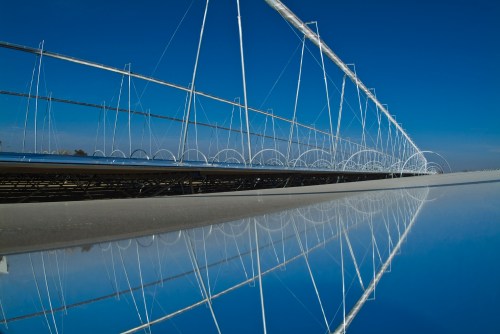
Phoenix-based Stirling Energy Systems in 2005 scored a contract to provide SDG&E (SRE) with up to 900 megawatts of electricity to be generated by as many as 36,000 solar dishes. A few months later, the utility filed an application to build the Sunrise Powerlink, a new transmission line to connect the Stirling power plants and other renewable energy projects to the coast.

But the utility’s proposal to build 150-foot-high transmission towers right through wilderness areas of Anza-Borrego State Park, home to a host of protected species, triggered a long-running fight with green groups that generated an 11,000-page environmental impact report. On Halloween, Vieth issued a ruling that found that despite state mandates to cut greenhouse gas emissions, the environmental impact of the transmission project was frightening.

“The potentially high economic costs to ratepayers and the potential implications for our [greenhouse gas] policy objectives do not justify the severe environmental damage that any of the transmission proposals would cause,” concluded Vieth in a 265-page decision.

The battle isn’t over — the public utilities commission will vote in December whether to accept the judge’s ruling. They will also consider an alternative decision issued by a commissioner assigned to review the case. That decision would let SDG&E build a transmission line along a different route under certain conditions.

But the case highlights the conflicting environmental values that will dog solar power projects. In other words, just what trade-offs are we willing to make to secure a planet-friendly source of energy? In this case, the judge ruled that to avoid the environmental damage of a massive new transmission line, the preferred alternative is to build more fossil-fuel plants close to San Diego along with a smaller-scale solar power station and a huge increase in rooftop solar arrays. The judge acknowledged that such an alternative “would cause substantially more GHG emissions than the proposed project and other transmission proposals.”

The judge’s second preferred alternative was to build only renewable-energy projects near San Diego that would not require big new transmission lines. Some Sunrise Powerlink opponents argue that San Diego has enough roof space to generative massive amounts of electricity from photovoltaic solar panels. (The cost of such an undertaking was left unsaid.)

Public Utilities Commissioner Dian Grueneich’s alternative decision would allow San Diego Gas & Electric to build Sunrise Powerlink along a more environmentally-benign route if the utility could prove that most of the transmission line would carry renewable energy so as to offset the 100,000 tons of greenhouse gases emitted during its construction. “Reliance on a single 900-megawatt contract (the Stirling Energy Systems contract) is too risky,” she wrote.

So where does this leave Stirling? COO Bruce Osborn didn’t immediately respond to a request for comment. But earlier this year, he told Green Wombat that even if Sunrise Powerlink was killed, there’s enough existing transmission capacity to carry electricity from the power plant’s first 300-megawatt phase. Stirling also has a 20-year contract to supply up to 850 megawatts of electricity to utility Southern California Edison (EIX), a deal not contingent on Sunrise Powerlink.

Read Full Post »

photo: Ausra

The promise and peril of large-scale renewable energy was on display Thursday as California’s first solar power plant of the 21st century went online near Bakersfield. Under blue skies, Governor Arnold Schwarzenegger and other politicians heralded the five-megawatt Ausra solar station as the vanguard of a new era of alternative energy that would combat the effects of climate change while building a green economy.

Then the CEO of one of the nation’s largest utilities stepped up to the podium and delivered a reality check. “As we all know the capital markets are in disarray,” said PG&E chief Peter Darbee, whose utility has a contract to buy 177 megawatts of electricity from Ausra. “They’re down 40%. The capital markets are going to distinguish between high-risk projects and low-risk projects and the high-risk projects are not going to get financed in the future.”

But he added, “PG&E stands ready to take on the challenge of financing renewables.”

The utility may just have to.

At the solar industry’s big annual conference in San Diego last week, renewable energy executives were euphoric over Congress’ 11th-hour passage this month of an eight-year investment tax credit that would allow big solar power plants to get up and running, eventually allowing for economies of scale crucial to driving down the price of green electricity. Then a dark clouded drifted over the sun-splashed proceedings in the form of three somber-suited men bearing ominous PowerPoint presentations.

The message from Wall Street: The credit crunch will wallop big solar plant projects that need billions of dollars in financing to get built.

Here’s why. It gets a bit arcane but bear with the wombat. The renewable energy legislation passed as part of the financial bailout package allows solar companies to take a 30% tax credit on the cost of building a power plant. Now most of these companies are startups and have no way to monetize, as they say on the Street and in Silicon Valley, those tax credits as they’re not profitable. Instead, a solar company must essentially trade the tax credits to a firm that can use them in exchange for cash to finance construction.

So investors form something called a tax equity partnership, in which they agree to finance, say, a solar power plant in exchange for the tax credits generated by the project. The problem, according Tim Howell, managing director of renewable energy for GE (GE) Energy Financial Services, is that investors’ appetite for tax equity partnerships has taken a nose dive just as the market will be flooded with solar tax credits from a growing number of projects currently being licensed. For instance, he said, 1,000 megawatts of solar projects would generate $1.5 billion in tax credits.

That means there has to be enough investment dollars – or “capacity” in Wall Street lingo – available to buy those tax credits from the solar power companies.  “Competition for tax capacity, which is a scarce resource in tough financial times, is a problem we have to solve,” Howell told a packed ballroom in San Diego.

John Eber, managing director of JPMorgan Capital (JPM), flashed a PowerPoint that showed the total value of the tax equity market at $15 billion last year with 40% going to renewable energy projects, mainly wind. Now that investment banks-which put together the partnerships and sometimes invested their own capital-are all but an extinct species on Wall Street, only an estimated $875 million will be available for all solar projects in 2008. In contrast, he noted, just the solar power plant projects already announced  would need between $6 billion and $8.5 billion in tax equity funding.

“Tax equity is becoming increasingly hard to raise for renewable energy projects,” said Keith Martin, a project finance attorney at the Washington firm Chadbourne & Parke. “Several large institutional investors who put money into renewable energy deals in the last three years have dropped out of the market.”

That, they said, means untried technologies from startups will face higher hurdles to attract investors.

In conversations Green Wombat has had with solar power plant executives over the past couple of weeks, they acknowledge that financing will be much harder to come by but they’re hardly ready to throw in the towel.

“There’s probably a gigawatt of press releases and 200 megawatt of plants that acutally will go live in 2010,” says John Woolard, CEO of Oakland-based BrightSource Energy, which has a contract with PG&E to deliver up to 900 megawatts of electricity.

His point: Despite gigawatts of signed utility deals, only a few power plants will actually be built in the next couple of years when financing is expected to be the toughest to obtain. “In 2011, it’s reasonable that 500 to 600 megawatts could happen,” he says. “Those aren’t big numbers for the tax equity market, but if you believe everything that’s been announced is going to be built, then it is a big market.”

California utilities, however, are counting on that big market to meet a state mandate to obtain 20% of their electricity from renewable sources by 2010 with a 33% target for 2020. PG&E (PCG), for instance, has signed 20-year power purchase agreements for more than 2.5 gigawatts of solar electricity.

When Congress extended the solar investment tax credit it also lifted a ban on utilities claiming the tax subsidy. Hence PG&E chief Peter Darbee’s statement Thursday that his utility would be willing to make sure its projects get funded by using the company’s considerable capital clout.

“We certainly could look at potentially funding or investing in renewable projects,” PG&E senior vice president Greg Pruett told Green Wombat Thursday. While he said PG&E has no specific projects in mind, it might consider financing construction of solar power plants through a tax equity partnership or a direct investment.

“Say we have a solar thermal company and they have a proven technology and they have done a demonstration plant, but because of the markets they can’t get financing,” says Pruett. “We might consider investing so they can build the plant and get it online.”

He says it’s less likely that PG&E would get into the solar construction business itself.

While it’s anyone’s guess how the markets will shake out by the time solar companies start making the rounds in New York, it’s clear that a shakeup in the nascent solar power plant business is in the offing.

Read Full Post »

In another sign that the financial crisis is not slowing the solar industry, Suntech, the giant Chinese solar module maker, made a big move into the United States market on Thursday. The company announced a joint venure with green energy financier MMA Renewable Ventures to build solar power plants and said it would acquire California-based solar installer EI Solutions.

Founded in 2001, Suntech (STP) recently overtook its Japanese and German rivals to become the world’s largest solar cell producer. The company has focused on the lucrative European market and only opened a U.S. outpost, in San Francisco, last year.  The joint venture with MMA Renewable Ventures (MMA) – called Gemini Solar – will build photovoltaic power plants bigger than 10 megawatts.

Most solar panels are produced for commercial and residential rooftops, but in recent months utilities have been signing deals for massive megawatt photovoltaic power plants. Silicon Valley’s SunPower (SPWRA) is building a 250-megawatt PV power station for PG&E (PCG) while Bay Area startup OptiSolar inked a contract with the San Francisco-based utility for a 550-megawatt thin-film solar power plant. First Solar (FSLR), a Tempe, Ariz.-based thin-film company, has contracts with Southern California Edision (EIX) and Sempre to build smaller-scale solar power plants.

Suntech’s purchase of EI Solutions gives it entree into the growing market for commercial rooftop solar systems. EI has installed large solar arrays for Google, Disney, Sony and other corporations.

“Suntech views the long-term prospects for the U.S. solar market as excellent and growing,” said Suntech CEO  Zhengrong Shi in a statement.

Other overseas investors seem to share that sentiment, credit crunch or not.  On Wednesday, Canadian, Australian and British investors lead a $60.6 million round of funding for Silicon Valley solar power plant builder Ausra. “So far the equity market for renewable energy has not been affected by the financial crisis,” Ausra CEO Bob Fishman told Green Wombat.

The solar industry got more good news Wednesday night when the U.S. Senate passed a bailout bill that included extensions of crucial renewable energy investment and production tax credits that were set to expire at the end of the year.

Read Full Post »

After a year of stalemate that threatened to strangle the nascent United States solar industry, the U.S. Senate on Tuesday passed energy legislation that extends a key investment tax credit until 2016.

The 30% solar tax credit was part of a package of green energy incentives that includes a one-year extension of the production tax credit crucial to the wind industry and a $2,500-$7,500 tax credit for people who buy plug-in electric vehicles. (That should make General Motors (GM) happy as it prepares to roll out its ever-increasingly expensive Volt plug-in electric hybrid.)

Homeowners also won an extension of a tax credit for installing solar panels and the $2,000 cap on such systems was lifted. Put in a small wind turbine or a geothermal heat pump and you can claim up to a $4,000 and $2,000 tax credit, respectively.

The big winner was the solar industry. Congress’ failure to extend the investment tax credit threatened to scuttle scores of multibillion-dollar solar power plants in the pipeline and undermine mandates that utilities like PG&E (PCG) and Southern California Edison (EIX) obtain a growing percentage of their electricity from renewable sources.

The legislation now returns to the House of Representatives, which earlier passed a similar version of the Senate bill.

Read Full Post »

photo: Todd Woody

Green Wombat’s story in the new issue of Fortune magazine on the solar power plant-fueled boom in demand for wildlife biologists is now online here. The photo above of the blunt-nosed leopard lizard was taken at a state reserve in San Luis Obispo County.

Or you can read the story below.

The hottest tech job in America

Giant solar plants are being built where dozens of protected species live. That’s good news for wildlife biologists.

By Todd Woody, senior editor

(Fortune Magazine) — It looks like a scene from an old episode of The X-Files: As a red-tailed hawk circles overhead and a wild pronghorn sheep grazes in the distance, a dozen people in dark sunglasses move methodically through a vast field of golden barley, eyes fixed to the ground, GPS devices in hand. They’re searching for bodies.

In this case, however, the bodies belong to the endangered blunt-nosed leopard lizard, and the crew moving through the knee-high grain are wildlife biologists hired by Ausra, a Silicon Valley startup that’s building a solar power plant for utility PG&E on this square mile of central California ranchland.

With scores of solar power stations planned for sites in the Southwest, demand for wildlife biologists is hot. They’re needed to look for lizards and other threatened fauna and flora, to draw up habitat-protection plans, and to comply with endangered-species laws to ensure that a desert tortoise or a kit fox won’t be inadvertently squashed by a solar array.

That has engineering giants like URS (URS, Fortune 500) in San Francisco and CH2MHill of Englewood, Colo., scrambling to hire biologists to serve their burgeoning roster of solar clients. “It’s a good time to be a biologist – it’s never been busier in my 15 years in the business,” says Angela Leiba, a senior project manager for URS, which is staffing the $550 million Ausra project. URS has brought onboard 40 biologists since 2007 to keep up with the solar boom. Salaries in the industry, which typically start around $30,000 and run up to about $120,000, have spiked 15% to 20% over the past year.

The work is labor-intensive. “It can take a 30- to 50-person team several weeks to complete just one wildlife survey,” says CH2MHill VP David Stein.

The economics of Big Solar ensure that wildlife biology will be a growth field for years to come. For one thing, there’s the mind-boggling scale of solar power plants. Adjacent to the Ausra project in San Luis Obispo County, for instance, OptiSolar of Hayward, Calif., is building a solar farm for PG&E that will cover 9 1/2 square miles with solar panels. Nearby, SunPower of San Jose will do the same on 3.4 square miles. Every acre must be scoured for signs of “species of special concern” during each phase of each project.

That adds up to a lot of bodies on the ground. URS, for instance, has dispatched 75 biologists to Southern California where Stirling Energy Systems of Phoenix is planting 12,000 solar dishes in the desert. “The biologists are critical to move these projects forward,” notes Stirling COO Bruce Osborn. For one project Stirling had to pay for two years’ worth of wildlife surveys before satisfying regulators.

Just about every solar site is classified as potential habitat for a host of protected species whose homes could be destroyed by a gargantuan power station. (Developers of California solar power plants, for example, have been ordered to capture and move desert tortoises out of harm’s way.) The only way to determine if a site is crawling with critters is to conduct surveys.

While that means a lot of jobs for wildlife biologists, it’s not all red-tailed hawks and pronghorn sheep for these nature boys and girls. The work can get a bit Groundhog Dayish, say, after spending 1,400 hours plodding through the same barley field in 90-degree heat in search of the same blunt-nosed leopard lizard. No wonder then when URS crew boss Theresa Miller asks for volunteers to reconnoiter a decrepit farmhouse for some protected bats on the Ausra site, hands shoot up like schoolchildren offered the chance to take the attendance to the principal’s office.

PG&E (PCG, Fortune 500) renewable-energy executive Hal La Flash worries that universities aren’t cranking out enough workers of all stripes for the green economy. “It could really slow down some of these big solar projects,” he says. Osborn can vouch for that: Biological work on the Stirling project has ground to a halt at times while the company waits for its consultants to finish up surveys on competitors’ sites.

For the young graduate, veteran biologist Thomas Egan wants to say just three words to you: Mohave ground squirrel. The rare desert dweller is so elusive that the only way to detect it on a solar site is to set traps and bag it. “There’s a limited number of people authorized to do trapping for Mohave ground squirrels,” says Egan, a senior ecologist with AMEC Earth & Environmental. “If you can work with the Mohave ground squirrel, demand is intense.”

Read Full Post »

The looming expiration of a crucial renewable energy investment tax credit doesn’t seem to have spooked investors. Silicon Valley thin-film solar startup Nanosolar said Wednesday that it has secured another $300 million in funding and is jumping into the Big Solar game as well.

Writing on the Nanosolar blog,  CEO Martin Roscheisen said that the latest financing round – the company’s funding now totals half a billion dollars –  comes from oldline utility AES (AES), French utility giant EDF and the Carlyle Group, among other investors. Nanosolar, which prints solar cells on flexible materials, will supply solar panels to the newly formed AES Solar, which will build medium-scale – up to 50 megawatts – photovoltaic power plants.

The Nanosolar news is just the latest of a spate of deals to take solar panels off rooftops and plant them on the ground to generate massive megawattage. Two weeks ago, thin-film solar startup Optisolar won a contract from utility PG&E (PCG) for a 550-megawatt PV solar power plant while SunPower (SPWR) will build a 250-megawatt photovoltaic solar farm for the utility. Leading  thin-film company First Solar (FSLR), meanwhile, has inked deals over the past few months to build smaller-scale PV power plants for Southern California Edison (EIX) and Sempre (SRE). And thin-film solar company Energy Conversion Devices is assembling a 12-megawatt array for a General Motors plant in Spain.

Read Full Post »

« Newer Posts - Older Posts »

Design a site like this with WordPress.com
Get started