Feeds:
Posts
Comments

Posts Tagged ‘solar power plants’

img_2914

photo: Todd Woody

California utility PG&E on Monday announced two new Big Solar deals that will likely to ramp up the debate over solar thermal power plants’ thirst for water in the desert Southwest. As I write in The New York Times:

The West’s water wars are likely to intensify with Pacific Gas and Electric’s announcement on Monday that it would buy 500 megawatts of electricity from two solar power plant projects to be built in the California desert.

The Genesis Solar Energy Project would consume an estimated 536 million gallons of water a year, while the Mojave Solar Project would pump 705 million gallons annually for power-plant cooling, according to applications filed with the California Energy Commission.

With 35 big solar farm projects undergoing licensing or planned for arid regions of California alone, water is emerging as a contentious issue.

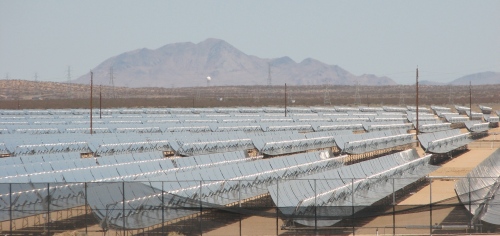
The Genesis and Mojave projects will use solar trough technology that deploys long rows of parabolic mirrors to heat a fluid to create steam that drives an electricity-generating turbine. The steam must be condensed back into water and cooled for re-use.

Solar trough developers prefer to use so-called wet cooling in which water must be constantly be replenished to make up for evaporation. Regulators, meanwhile, are pushing developers to use dry cooling, which takes about 90 percent less water but is more expensive and reduces the efficiency –- and profitability – of a power plant.

NextEra Energy Resources, a subsidiary of the utility giant FPL Group, is developing the Genesis project in the Chuckwalla Valley in the Sonoran Desert. The twin solar farms would tap about 5 percent of the valley’s available water.

You can read the rest of the story here.

Read Full Post »

Stirling Energy Systems Solar One project

image: Tessera Solar

In a feature published in today’s New York Times, I look at a water war breaking out in the desert Southwest over plans to build dozens of large-scale solar power projects on hundreds of thousands of acres of land:

AMARGOSA VALLEY, Nev. — In a rural corner of Nevada reeling from the recession, a bit of salvation seemed to arrive last year. A German developer, Solar Millennium, announced plans to build two large solar farms here that would harness the sun to generate electricity, creating hundreds of jobs.

But then things got messy. The company revealed that its preferred method of cooling the power plants would consume 1.3 billion gallons of water a year, about 20 percent of this desert valley’s available water.

Now Solar Millennium finds itself in the midst of a new-age version of a Western water war. The public is divided, pitting some people who hope to make money selling water rights to the company against others concerned about the project’s impact on the community and the environment.

“I’m worried about my well and the wells of my neighbors,” George Tucker, a retired chemical engineer, said on a blazing afternoon.

Here is an inconvenient truth about renewable energy: It can sometimes demand a huge amount of water. Many of the proposed solutions to the nation’s energy problems, from certain types of solar farms to biofuel refineries to cleaner coal plants, could consume billions of gallons of water every year.

“When push comes to shove, water could become the real throttle on renewable energy,” said Michael E. Webber, an assistant professor at the University of Texas in Austin who studies the relationship between energy and water.

Conflicts over water could shape the future of many energy technologies. The most water-efficient renewable technologies are not necessarily the most economical, but water shortages could give them a competitive edge.

In California, solar developers have already been forced to switch to less water-intensive technologies when local officials have refused to turn on the tap. Other big solar projects are mired in disputes with state regulators over water consumption.

To date, the flashpoint for such conflicts has been the Southwest, where dozens of multibillion-dollar solar power plants are planned for thousands of acres of desert. While most forms of energy production consume water, its availability is especially limited in the sunny areas that are otherwise well suited for solar farms.

You can read the rest of the story here.

Read Full Post »

solarh

Photo: BrightSource Energy

In today’s New York Times, I write about how Harvey Whittemore — one of Nevada’s biggest power brokers and a confident of Senate majority leader Harry Reid — has responded to the housing crash by leasing desert land at his mega-home development to BrightSource Energy for a 960-megawatt solar farm complex.

What to do when building a 159,000-home city in the Nevada desert and the housing market collapses?

Go solar.

The Coyote Springs Land Company this week expanded a deal with BrightSource Energy, a solar power developer based in Oakland, Calif., to carve out 12 square miles of it its 43,000-acre mega-development for solar power plants that would generate up to 960 megawatts of electricity.

Harvey Whittemore, Coyote Springs’s chairman, said his plan always was to include some renewable energy in the massive golfing community under development 50 miles northeast of Las Vegas. But, Mr. Whittemore said, he decided to go bigger as the housing market crashed and solar developers like BrightSource began to sign deals with utilities.

“We’ve always said we’ll adjust the land use plan to the market,” said Mr. Whittemore in an interview. “At the end of the day we have approvals for 159,000 units and we looked at what we could do to reduce the number of units while at same time coming up with a functional business plan that takes advantage of private land.”

Private land is in short supply in Nevada, where the federal government owns about 87 percent of the state. That has forced solar developers like BrightSource – which is under the gun to supply 2,610 megawatts to California utilities — to seek leases on desert property managed by the United States Bureau of Land Management, a years-long process involving extensive environmental review.

By dealing with Mr. Whittemore, BrightSource is sidestepping all of that and acquiring an ally who knows how to get things done in the Silver State.

You can read the rest of the story here.

Read Full Post »

solarh
Photo: BrightSource Energy

In another sign that old-line corporate giants see solar power as big business, engineering and construction giant Bechtel has signed a deal with BrightSource Energy to build the solar developer’s first solar power plant, a 440-megawatt project in Southern California on the Nevada border. As I write in Wednesday’s New York Times:

Bechtel, the global engineering and construction giant, has jumped into the solar power plant business in a deal with a developer to build a 440-megawatt energy complex in California.

The agreement, being announced Wednesday, calls for Bechtel’s development and finance arm, Bechtel Enterprises, to take an equity stake in the solar project known as the Ivanpah Solar Electricity Generating System. The collection of three solar power stations will deliver electricity to Pacific Gas & Electric and Southern California Edison.

Bechtel is teaming up with BrightSource Energy, a start-up company based in Oakland, Calif.

Ivanpah is the first large-scale solar power plant to undergo regulatory review in the United States in nearly two decades, and the selection of Bechtel as BrightSource’s engineering, procurement and construction contractor is considered a significant step in obtaining financing needed to build the project.

You can read the rest of the story here.

Read Full Post »

first solar

Photo: First Solar

First Solar became the first U.S. solar company to break into the Chinese market on Tuesday and it did do in a big way when it signed an agreement to build a two-gigawatt thin-film solar power plant in Inner Mongolia. As I write in The New York Times:

Chinese government officials signed an agreement on Tuesday with First Solar, an American solar developer, for a 2,000-megawatt photovoltaic farm to be built in the Mongolian desert.

Set for completion in 2019, the First Solar project represents the world’s biggest photovoltaic power plant project to date, and is part of an 11,950-megawatt renewable-energy park planned for Ordos City in Inner Mongolia.

The memorandum of understanding between Chinese officials and First Solar, the world’s largest photovoltaic cell manufacturer, would open a potentially vast solar market in China and follows the Chinese government’s recent moves to accelerate development of renewable energy.

You can read the rest of the story here.

Read Full Post »

solarF

In Monday’s New York Times’ Green Inc. blog, I take a look at two recently approved solar energy contracts in California that offer a rare look at the economics of large-scale solar power plants:

California regulators have approved contracts for more than 8,600 megawatts of renewable energy, to be generated mostly by big solar power plants for the state’s largest utilities. But the details of those deals and the emerging economics of green energy often remain shrouded in secrecy, subject to confidentiality agreements.

That black box cracked open a bit on Thursday, when the California Public Utilities Commission gave the green light to two 25-year power purchase agreements between Pacific Gas & Electric and BrightSource Energy, a solar power plant builder based in Oakland, Calif.

When approving contracts for 310 megawatts of solar electricity, the utilities commission also signed off on an apparently first-of-its-kind technology royalty agreement between BrightSource and PG&E.

You can read the rest of the story here.

Read Full Post »

esolar_8

photo: eSolar

eSolar on Wednesday fired up its five-megawatt Sierra “power tower” solar farm outside Los Angeles during an opening ceremony that featured such green tech luminaries as Google.org climate change director Dan Reicher and Dan Kammen of the University of California at Berkeley.

But the speaker that caught my eye was environmentalist David Myers, executive director of the Wildlands Conservancy, a Southern California non-profit that is working with California Senator Dianne Feinstein to put hundreds of thousands of acres of the Mojave Desert off limits to industrial-scale solar power plants.

“By siting their project on disturbed lands, eSolar has avoided degrading treasured public lands and core areas of biodiversity,” said Myers. “This is an important distinction from the solar firms that propose to industrialize 600,000 acres of pristine California desert lands belonging to the American people.”

I’ve written extensively on Green Wombat and Grist about eSolar’s technology and CEO Bill Gross’ vision of a software-driven solar revolution that taps computing power to drive down renewable energy costs. (Google-backed (GOOG) eSolar has a partnership with energy producer NRG (NRG) to build power plants for Southern California Edison (EIX), PG&E (PCG) and other utilities.)

But eSolar’s strategy of building relatively small-scale modular solar farms on privately owned agricultural land is also allowing it to avoid — so far — fights over endangered species that have slowed big solar power plants planned for federally owned land in the Mojave Desert.

While Myers was praising eSolar at the Sierra ceremony, his environmental group, as I wrote in Wednesday’s New York Times, has been raising issues about the impact of Tessera Solar’s planned 8,230-acre, 850-megawatt power plant on such Mojave species as the desert tortoise, Mojave fringe-toed lizard and Nelson’s bighorn sheep.

Meanwhile, Defenders of Wildlife, a local chapter of the Sierra Club and other national and grassroots environmental groups are worried about the impact of BrightSource Energy’s 400-megawatt Ivanpah solar farm on the imperiled desert tortoise. The Sierra Club chapter recently proposed that BrightSource move the solar power plant to avoid disturbing habitat currently occupied by desert tortoises.

eSolar has spent $30 million acquiring previously disturbed ag land — mostly in California. While that should speed development of its solar farms as it won’t need federal approval to build, there’s no guarantee, of course, that the Pasadena, Calif.-based startup won’t also run into critter problems.

Just ask Ausra, the Silicon Valley solar company that’s building a 177-megawatt power plant on ag land in San Luis Obispo County on California’s central coast. That project has been bogged down in disputes over the solar farm’s consequences for a plethora of species and the cumulative impact of two other solar power plants planned for the same area that First Solar (FSLR) and SunPower (SPWR) want to build.

Still, eSolar’s focus on location, location, location could pay off. While the five-megawatt Sierra demonstration plant is a small project, the fact that company was able to get it built in a year is no doubt a competitive advantage.

“This plant delivers the lowest-cost solar electricity in history,” said Gross, the founder of tech incubator Idealab, at the ceremony in the L.A. ex-urb of Lancaster.  “We currently compete with natural gas and as we continue to drive down the cost, we will even compete with coal.”

And if eSolar continues to carefully select sites for its solar farms it won’t have to worry about environmentalists like David Myers of the Wildlands Conservancy.

“You can see why the entire environmental community is so excited about a firm that’s model is to use disturbed lands,” said Myers after slamming an unnamed eSolar competitor for trying to build a solar farm in what he described as a fragile desert ecoystem. “We can’t say enough great things about eSolar.”

With that, Gross walked over to a computer, pressed a button and 24,000 mirrors began to focus sunlight on two water-filled boilers sitting atop two towers. As the intense heat vaporized the water, steam flowed to a power block to drive an electricity generating turbine.

Read Full Post »
eSolar Sierra

photo: eSolar

The U.S. Department of Energy on Friday began accepting applications for at least $3 billion in direct funding of renewable energy power plant projects.

The funding, part of the federal stimulus package, is in lieu of a 30 percent investment tax credit that green energy developers can take on their projects. Given that most solar and wind developers carry no tax liabilities, they have relied on investment banks and other investors to front the hundreds of millions and billions of dollars in financing needed for their projects in exchange for the tax credits. But as the economy tanked along with investment banks, demand for so-called tax equity partnerships evaporated.  Big Solar projects stalled and wind developers delayed turbine orders.

Curiously, the Department of Energy said on Friday that the $3 billion would fund some 5,000 projects. That works out to about $600,000 per power plant. But a single 250-megawatt solar power plant alone can cost more than a $1 billion and would thus soak up $300 million or 10% of the funding pool.

The question is, will DOE end up funding a few large-scale green energy projects that could start to give, say, the solar thermal industry economies of scale, or will it spend the money on hundreds of smaller renewable energy facilities?

That’s a crucial issue for solar developers like Tessera Solar/Stirling Energy Systems, eSolar and BrightSource Energy, which is backed Google (GOOG), Morgan Stanley (MS) and VantagePoint Venture Partners as well as a clutch of oil giants – Chevron (CVX), BP (BP) and Norway’s StatoilHydro.

Also left unsaid in the DOE’s announcement was the fact that renewable energy projects need to break ground by the end of 2010 to qualify for the direct funding. Which is why BrightSource, Nextera Energy (a subsidiary of utility giant FPL Group (FPL) ) and Tessera Solar are eager to expedite the lengthy California licensing process and get their projects approved before New Year’s Eve 2010 so they can put shovel to dirt and start shoveling cash into their coffers.

Read Full Post »

Stirling Energy Systems Solar One project

image: URS

Green Wombat spent several months looking into allegations that California labor unions are using environmental laws to pressure  solar developers to hire union workers to build large-scale solar power plants. The story was published last Friday in The New York Times:

SACRAMENTO — When a company called Ausra filed plans for a big solar power plant in California, it was deluged with demands from a union group that it study the effect on creatures like the short-nosed kangaroo rat and the ferruginous hawk.

By contrast, when a competitor, BrightSource Energy, filed plans for an even bigger solar plant that would affect the imperiled desert tortoise, the same union group, California Unions for Reliable Energy, raised no complaint. Instead, it urged regulators to approve the project as quickly as possible.

One big difference between the projects? Ausra had rejected demands that it use only union workers to build its solar farm, while BrightSource pledged to hire labor-friendly contractors.

As California moves to license dozens of huge solar power plants to meet the state’s renewable energy goals, some developers contend they are being pressured to sign agreements pledging to use union labor. If they refuse, they say, they can count on the union group to demand costly environmental studies and deliver hostile testimony at public hearings.

If they commit at the outset to use union labor, they say, the environmental objections never materialize.

You can read the rest of the story here.

Read Full Post »

AV Solar Ranch

California utility PG&E on Friday announced a contract to buy 230 megawatts of electricity from a photovoltaic solar farm to be built by San Francisco-based NextLight Renewable Power.

NextLight — backed by private equity firm Energy Capital Partners — will build the AV Solar Ranch on agricultural land in Los Angeles County’s Antelope Valley.  PG&E (PCG) says the solar power plant will begin producing electricity in 2011. When fully built out by 2013, it will generate enough power for 90,000 homes, according to the utility.

Since the project will deploy solar panels rather than solar thermal technology that uses mirrors to heat liquids to drive a turbine, it does not need to go through the laborious California Energy Commission permitting process.

NextLight apparently also plans to build solar thermal farms — the company has filed lease claims on some 20,000 acres of Mojave Desert land owned by the U.S. Bureau of Land Management for two 500-megawatt solar trough power plants.

Friday’s agreement follows PG&E’s deal in May with BrightSource Energy to buy 1,300 megawatts of solar electricity to be produced by seven solar power plants.

Read Full Post »

« Newer Posts - Older Posts »

Design a site like this with WordPress.com
Get started