Feeds:
Posts
Comments

Posts Tagged ‘solar energy’

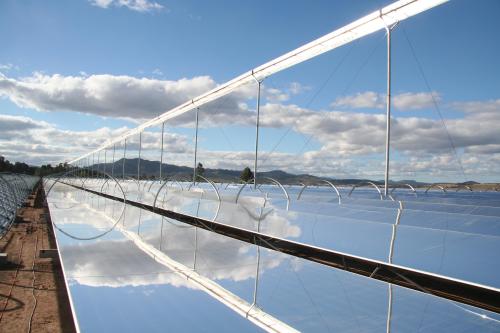
Solarthermische Parabolrinnenkraftwerke Andasol 1 und 2

Photo: Solar Millennium

Water is emerging as a make-or-break issue for solar developers hoping to build massive megawatt solar power plants in the desert Southwest. On Monday, Solar Millennium announced it would rather switch to dry-cooling its proposed 500-megawatt solar farm in the Nevada desert rather than fight to use more than a billion gallons of water a year to cool the power plant. As I write in The New York Times:

A solar developer caught in the crossfire of the West’s water wars is waving the white flag.

Solar Millennium, a German developer, had proposed using as much as 1.3 billon gallons of water a year to cool a massive solar power plant complex it wants to build in a desert valley 80 miles northwest of Las Vegas.

That divided the residents of Amargosa Valley, some of whom feared the solar farm would suck dry their aquifer. Others worried about the impact of the $3 billion project on the endangered pupfish, a tiny blue-gray fish that survives only in a few aquamarine desert pools fed by the valley’s aquifer.

Now Solar Millennium says it will instead dry-cool the twin solar farms, which will result in a 90 percent drop in water consumption.

“We trust that this decision to employ dry-cooling will accelerate the approval process and enable us to begin construction and stimulate the local economy by December 2010,” Josef Eichhammer, president of Solar Millennium’s American operations, said in a statement on Monday.

Water has emerged as contentious issue as dozens of large-scale solar power plants are proposed for the desert Southwest. Solar Millennium’s move is likely to put pressure on other solar developers to follow suit.

You can read the rest of the story here.
Read Full Post »

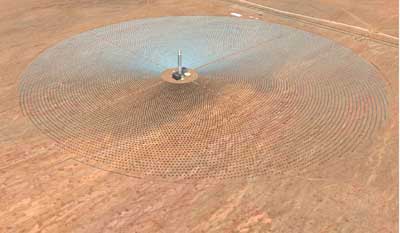
ausra-16

photo: Ausra

Silicon Valley solar company Ausra has sold its sole remaining solar power plant project in the United States, all but completing its exit from solar farming. As I write Thursday in The New York Times:

Ausra is continuing its exit from the business of building solar power plants, announcing on Wednesday that it has sold a planned California solar farm to First Solar.

The Carrizo Energy Solar Farm was one of the three large solar power plants planned within a few miles of each other in San Luis Obispo County on California’s central coast.

Together they would supply nearly 1,000 megawatts of electricity to the utility Pacific Gas and Electric.

First Solar will not build the Carrizo project, and the deal has resulted in the cancellation of Ausra’s contract to provide 177 megawatts to P.G.&E. — a setback in the utility’s efforts to meet state-mandated renewable energy targets.

But it could speed up approval of the two other solar projects, which have been bogged down in disputes over their impact on wildlife, and face resistance from residents concerned about the concentration of so many big solar farms in a rural region.

First Solar is only buying an option on the farmland where the Ausra project was to be built, according to Alan Bernheimer, a First Solar spokesman. Terms of the sale were not disclosed.

The deal will let First Solar revamp its own solar farm, a nearby 550-megawatt project called Topaz that will feature thousands of photovoltaic panels arrayed on miles of ranchland.

“This will allow us to reconfigure Topaz in a way that lessens its impact and creates wildlife corridors,” said Mr. Bernheimer.

You can read the rest of the story here.
Read Full Post »

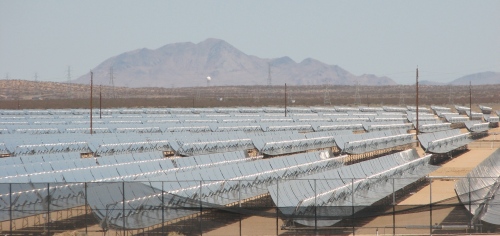
artist_picture_of_project

Image: SolarReserve

Ok, I’m exaggerating a bit in the headline above but we’re getting closer to solar farms that will provide baseload power, operating at night and under cloudy conditions. As I write on Tuesday in The New York Times:

The holy grail of renewable energy is a solar power plant that continues producing electricity after the sun goes down.

A Santa Monica, Calif., company called SolarReserve has taken a step toward making that a reality, filing an application with California regulators to build a 150-megawatt solar farm that will store seven hours’ worth of the sun’s energy in the form of molten salt.

Heat from the salt can be released when it’s cloudy or at night to create steam that drives an electricity-generating turbine.

The Rice Solar Energy Project, to be built in the Sonoran Desert east of Palm Springs, will “generate steady and uninterrupted power during hours of peak electricity demand,” according to SolarReserve’s license application.

So-called dispatchable solar farms would in theory allow utilities to avoid spending billions of dollars building fossil fuel power plants that are fired up only a few times a year when electricity demand spikes, like on a hot day.

SolarReserve is literally run by rocket scientists, many of whom formerly worked at Rocketdyne, a subsidiary of the technology giant United Technologies. Rocketdyne developed the solar salt technology, which was proven viable at the 10-megawatt Solar Two demonstration project near Barstow, Calif., in the 1990s.

You can read the rest of the story here.
Read Full Post »

img_2914

photo: Todd Woody

California utility PG&E on Monday announced two new Big Solar deals that will likely to ramp up the debate over solar thermal power plants’ thirst for water in the desert Southwest. As I write in The New York Times:

The West’s water wars are likely to intensify with Pacific Gas and Electric’s announcement on Monday that it would buy 500 megawatts of electricity from two solar power plant projects to be built in the California desert.

The Genesis Solar Energy Project would consume an estimated 536 million gallons of water a year, while the Mojave Solar Project would pump 705 million gallons annually for power-plant cooling, according to applications filed with the California Energy Commission.

With 35 big solar farm projects undergoing licensing or planned for arid regions of California alone, water is emerging as a contentious issue.

The Genesis and Mojave projects will use solar trough technology that deploys long rows of parabolic mirrors to heat a fluid to create steam that drives an electricity-generating turbine. The steam must be condensed back into water and cooled for re-use.

Solar trough developers prefer to use so-called wet cooling in which water must be constantly be replenished to make up for evaporation. Regulators, meanwhile, are pushing developers to use dry cooling, which takes about 90 percent less water but is more expensive and reduces the efficiency –- and profitability – of a power plant.

NextEra Energy Resources, a subsidiary of the utility giant FPL Group, is developing the Genesis project in the Chuckwalla Valley in the Sonoran Desert. The twin solar farms would tap about 5 percent of the valley’s available water.

You can read the rest of the story here.
Read Full Post »

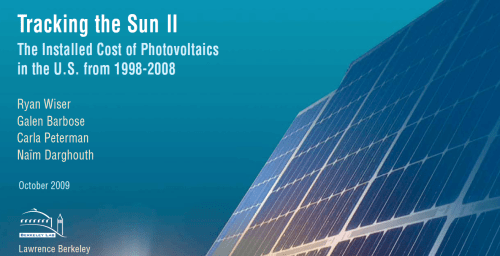
Lawrence Berkeley solar study

The Lawrence Berkeley National Laboratory this week released a comprehensive study on the cost of going solar in the United States. No surprise that the cost of installing a photovoltaic solar system has fallen 30 percent over the past decade, but there are some interesting developments. For instance, California may be the biggest solar state but it’s not the cheapest. As I write in The New York Times on Friday:

The cost of going solar fell last year, resuming a decade-long decline after several years of flat prices, according to a new study from Lawrence Berkeley National Laboratory.

The report found that the installed cost of residential and commercial photovoltaic systems in the United States dropped 30 percent overall between 1998 and 2008. But prices had become relatively stagnant between 2005 and 2007, as demand spiked and solar module makers ramped up production.

The global economic meltdown, however, along with a resulting oversupply of modules, led the cost of installing a solar system last year to fall from $7.80 in a watt to $7.50 a watt — though the actual cost to homeowners actually increased slightly as state incentives for installing solar arrays fell faster than module prices.

In states like California, the per-watt rebate declines as more solar systems are installed.

Among other findings: the researchers, who reviewed data from the installations of 52,356 solar systems, discovered that it is 10 percent less expensive to install a solar array on a new home than to retrofit an existing home.

And although California is by far the largest solar market in the United States with 81 percent of all installed photovoltaic systems, it isn’t the cheapest place to install small-scale solar.

That distinction goes to Arizona, where the installed cost of solar systems smaller than 10 kilowatts was $7.30 per watt compared to $8.20 per watt in California.

You can read the rest of the story here.
Read Full Post »

POWERHOUSE1

photo: Dow Chemical

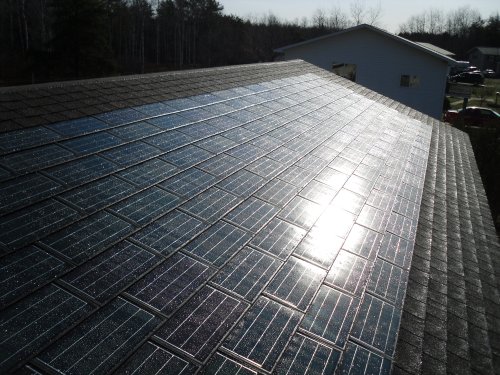
Industrial giant Dow Chemical is getting into the residential solar business with a potentially game-changing product: A “solar shingle” that can be integrated into any asphalt-tiled roof and installed by any roofer. As I wrote in The New York Times on Wednesday:

Dow Chemical has unveiled a residential roof shingle in the form of a solar panel designed to be integrated into asphalt-tiled roofs.

Jane Palmieri, managing director of Dow’s Solar Solutions unit, said the Powerhouse thin-film shingle slashes installation costs because it can be installed by a roofer who is already building or retrofitting a roof.

“As a roofer is nailing asphalt shingle on roof, wherever the array needs to be installed he just switches to solar shingle,” said Ms. Palmieri, who said the solar singles are similarly attached to the roof with nails.

“You don’t have to have a solar installation crew do the work or have an electrician on site,” she added. “The solar shingle can be handled like any other shingle – it can be palletized, dropped from a roof, walked on.”

An electrician is still needed to connect the completed array to an inverter and to a home’s electrical system, but unlike conventional solar panels that must be wired together, the solar shingles plug into each other to form the array.

Dow plans to begin test-marketing the solar shingle in mid-2010, initially targeting new-home construction. Ms. Palmieri said the market could be worth $5 billion by 2015 and noted that 90 percent of homes in the United States use asphalt shingles.

You can read the rest of the story here.
Read Full Post »

solarh

Photo: BrightSource Energy

In today’s New York Times, I write about how Harvey Whittemore — one of Nevada’s biggest power brokers and a confident of Senate majority leader Harry Reid — has responded to the housing crash by leasing desert land at his mega-home development to BrightSource Energy for a 960-megawatt solar farm complex.

What to do when building a 159,000-home city in the Nevada desert and the housing market collapses?

Go solar.

The Coyote Springs Land Company this week expanded a deal with BrightSource Energy, a solar power developer based in Oakland, Calif., to carve out 12 square miles of it its 43,000-acre mega-development for solar power plants that would generate up to 960 megawatts of electricity.

Harvey Whittemore, Coyote Springs’s chairman, said his plan always was to include some renewable energy in the massive golfing community under development 50 miles northeast of Las Vegas. But, Mr. Whittemore said, he decided to go bigger as the housing market crashed and solar developers like BrightSource began to sign deals with utilities.

“We’ve always said we’ll adjust the land use plan to the market,” said Mr. Whittemore in an interview. “At the end of the day we have approvals for 159,000 units and we looked at what we could do to reduce the number of units while at same time coming up with a functional business plan that takes advantage of private land.”

Private land is in short supply in Nevada, where the federal government owns about 87 percent of the state. That has forced solar developers like BrightSource – which is under the gun to supply 2,610 megawatts to California utilities — to seek leases on desert property managed by the United States Bureau of Land Management, a years-long process involving extensive environmental review.

By dealing with Mr. Whittemore, BrightSource is sidestepping all of that and acquiring an ally who knows how to get things done in the Silver State.

You can read the rest of the story here.
Read Full Post »

solarh
Photo: BrightSource Energy

In another sign that old-line corporate giants see solar power as big business, engineering and construction giant Bechtel has signed a deal with BrightSource Energy to build the solar developer’s first solar power plant, a 440-megawatt project in Southern California on the Nevada border. As I write in Wednesday’s New York Times:

Bechtel, the global engineering and construction giant, has jumped into the solar power plant business in a deal with a developer to build a 440-megawatt energy complex in California.

The agreement, being announced Wednesday, calls for Bechtel’s development and finance arm, Bechtel Enterprises, to take an equity stake in the solar project known as the Ivanpah Solar Electricity Generating System. The collection of three solar power stations will deliver electricity to Pacific Gas & Electric and Southern California Edison.

Bechtel is teaming up with BrightSource Energy, a start-up company based in Oakland, Calif.

Ivanpah is the first large-scale solar power plant to undergo regulatory review in the United States in nearly two decades, and the selection of Bechtel as BrightSource’s engineering, procurement and construction contractor is considered a significant step in obtaining financing needed to build the project.

You can read the rest of the story here.
Read Full Post »

solarcells

photo: Southern California Edison

It hasn’t received much media attention, but the California Public Utilities Commission has just proposed instituting a first-of-its-kind reverse auction market to spur renewable energy development — mainly solar photovoltaic.  As I write today in The New York Times:

California regulators are taking an eBay approach to ramping-up renewable energy in the Golden State.

In what might be a world first, the California Public Utilities Commission on Thursday proposed letting developers bid on contracts to install green energy projects. A solar company that offers to sell electricity to one of California’s three big utilities at a rate lower than its competitors would win a particular power purchase agreement.

This “reverse auction market” feed-in tariff is designed to avoid the pitfalls the have plagued efforts in Europe to encourage development of renewable energy by paying artificially high rates for electricity produced by solar power plants or rooftop photovoltaic projects.

You can read the rest of the story here:

Read Full Post »

solarF

In Monday’s New York Times’ Green Inc. blog, I take a look at two recently approved solar energy contracts in California that offer a rare look at the economics of large-scale solar power plants:

California regulators have approved contracts for more than 8,600 megawatts of renewable energy, to be generated mostly by big solar power plants for the state’s largest utilities. But the details of those deals and the emerging economics of green energy often remain shrouded in secrecy, subject to confidentiality agreements.

That black box cracked open a bit on Thursday, when the California Public Utilities Commission gave the green light to two 25-year power purchase agreements between Pacific Gas & Electric and BrightSource Energy, a solar power plant builder based in Oakland, Calif.

When approving contracts for 310 megawatts of solar electricity, the utilities commission also signed off on an apparently first-of-its-kind technology royalty agreement between BrightSource and PG&E.

You can read the rest of the story here.

Read Full Post »

« Newer Posts - Older Posts »

Design a site like this with WordPress.com
Get started