Feeds:
Posts
Comments

Posts Tagged ‘PG&E’

picture-2

California utility PG&E has signed a deal for the world’s first space-based solar power plant, to be built by a secretive Southern California startup staffed by veterans of the U.S. Air Force, Boeing and Lockheed Martin.

In papers filed Friday with the California Public Utilities Commission, San Francisco-based PG&E asked for approval of a 15-year, 200-megawatt contract with Solaren, a Manhattan Beach, Calif.-based company that plans to put satellites in geosynchronous orbit by 2016 to collect solar energy. The sunlight would then be transmitted to a ground station in Fresno, Calif., in the form of radio frequency waves and converted into electricity to be distributed into the power grid. Since the sun shines 24/7 in space, a Solaren solar farm could theoretically supply “baseload” green electricity to coal-dependent regions without access to abundant sources of renewable energy.

While PG&E won’t spend any money until Solaren beams down electricity, it’s uncertain whether regulators will be willing to count a contract for such unproven, bleeding-edge technology toward the utility’s state-mandated obligation to obtain 20% of its power from renewable sources by 2010 and 33% by 2020. After all, the utilities commission last year rejected PG&E’s contract with a wave energy firm on the grounds that the technology was too early stage. PG&E’s discussion of the Solaren project’s viability was filed under a request for confidentiality.

“Solaren is using an innovative space-based solar technology, which, if successful, would represent a break-through in the renewable power industry,” Brian Cherry, PG&E’s vice present of regulatory relations, wrote in the utility’s 24-page application. “While emerging technologies like space solar face considerable hurdles under a traditional viability analysis, PG&E believes that potential, significant benefits to its customers from a successful space solar installation outweigh the challenges associated with a new and unproven technology.”

Space-based solar has long been a dream and numerous studies have been conducted on its potential viability. In the documents filed with the utilities commission, PG&E (PCG) asserted that the biggest technological obstacle is building satellites that can collect megawatts’ worth of sunlight rather than transmitting the energy miles to a ground station.

“The engineering challenge of building a Space Solar Power Plant is not the energy conversion process itself, but the need to engineer and build MW-class SSP satellites, which are much larger than current kW-class communications satellites,” Cherry wrote. “Solaren’s patented SSP Plant design employs the SSP concept described above to deliver renewable electricity to PG&E.”

Solaren’s website offers a single page that contains no information on the company other than the slogan, “Energy for Tomorrow with Technology of Today.”

In its filing, PG&E said that, “Solaren was founded in 2001 to develop, engineer, test, construct, and operate space solar generating stations. Solaren has informed PG&E that its team is comprised of experienced satellite engineers and space scientists with 20 to 45 years of experience in the leading edge space industry and come from various aerospace organizations that include the U.S. Air Force, Hughes Aircraft Company, Boeing (BA), and Lockheed Martin (LMT).

Not all the hurdles to space-based solar are likely to be technological. While there are no desert tortoises in space or other protected wildlife that live on earth-bound sites for big solar power plants, any orbiting solar farm will have to pass muster with a long list of state, federal and international government agencies. Among them, the U.S. Department of Defense, NASA and the United Nations, according to PG&E.

Read Full Post »

desert-tortoise1

photo: Wild Rose Images

California Senator Dianne Feinstein’s move to put a large swath of the Mojave Desert off-limits to renewable energy development is splitting the environmental movement and could derail some two dozen solar and wind power projects the state needs to comply with its ambitious climate change laws.

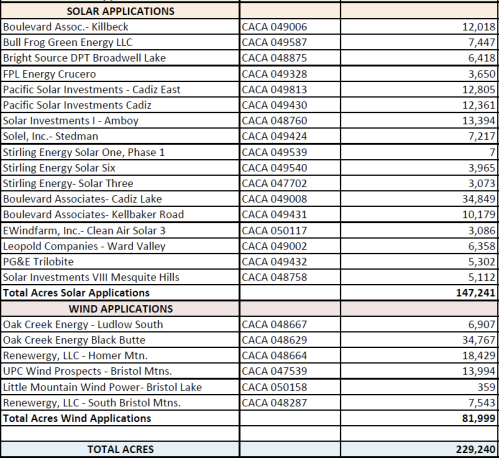
On the firing line are 17 massive solar power plants and six wind farms planned for federal land — land that would be designated a national monument under legislation Feinstein intends to introduce. The solar projects in question would be built by a range of companies, from startups BrightSource Energy and Stirling Energy Systems to corporate heavyweights Goldman Sachs (GS) and FPL (FPL), according to federal documents. (For the complete list, see below.)

The companies are among scores that have filed lease claims on a million acres of acres of desert dirt controlled by the U.S. Bureau of Land Management. California utilities PG&E (PCG) and Southern California Edison (EIX) have signed long-term power purchase agreements for some of the projects now in jeopardy and are counting on the electricity they would produce to meet state-mandated renewable energy targets. PG&E itself has filed a solar power plant land claim in the proposed national monument.

The area of the desert in dispute is some 600,000 acres formerly owned by Catellus, the real estate arm of the Union Pacific Railroad, and donated to the federal government a decade ago by the Wildlands Conservancy, a Southern California environmental group. About 210,000 of those acres are managed by the U.S. Bureau of Land Management, which opened part of the land to renewable energy projects.

“Many of the sites now being considered for leases are completely inappropriate and will lead to the wholesale destruction of some of the most pristine areas in the desert,” Feinstein wrote in a letter to Interior Secretary Ken Salazar released last week, notifying him that she will introduce legislation to designate the former Catellus lands a national monument. “Beyond protecting national parks and wilderness from development, the conservation of these lands has helped to ensure the sustainability of the entire desert ecosystem by preserving the vital wildlife corridors.”

The Catellus land controlled by the BLM forms something of a golden triangle between the Joshua Tree National Park and the Mojave National Preserve in Southern California and are particularly coveted for renewable energy development because of its proximity to transmission lines.

Alan Stein, a deputy district manager for the BLM in California, told Green Wombat that the solar and wind lease claims are in areas that are not designated as wilderness or critical habitat for protected species like the desert tortoise. “This is public domain land, ” he says.

Tortoises, however, are found across the Mojave, and battles over Big Solar’s impact on endangered wildlife are quietly brewing in several solar power plant licensing cases now being reviewed by the California Energy Commission.  Environmentalists find themselves walking a thin green line, trying to balance their interest in promoting carbon-free energy with protecting fragile desert landscapes and a host of threatened animals and plants.

Take BrightSource Energy’s Ivanpah 400-megawatt solar power plant complex on the California-Nevada border. The three solar power plants to be built by the Oakland-based company will supply electricity to PG&E and Southern California Edison. But the project will also destroy some 4,000 acres of desert tortoise habitat and at least 25 tortoises will have to be relocated – a somewhat risky proposition as previous efforts in other cases have resulted in the deaths of the animals.

On Wednesday, the California Energy Commission granted two national environmental groups – the Defenders of Wildlife and the Sierra Club – the right to intervene in the Ivanpah case. “Defenders strongly supports … the development of renewable energy in California,” Kim Delfino, California program director for Defenders of Wildlife, wrote to the energy commission in a Jan. 23 letter.  “Defenders has several serious concerns about the potential impacts of this project on a number of rare, declining and listed species and on their associated desert habitat and waters.”

Natural Resources Defense Council attorney Johanna Wald wrote a letter with the Wilderness Society expressing concern over the impact of Ivanpah project on the desert tortoise but also made a strong statement of support for renewable energy development. “Our public lands harbor substantial wind, solar, and geothermal resources,” wrote Wald, who serves on a state task force to identify appropriate areas for renewable energy development. “Developing some of these resources will be important to creating a sustainable energy economy and combating climate change.”

The big national enviro groups are working with the government and power plant developers to create zones in the Mojave where renewable energy projects would be permitted while setting aside other areas that are prime habitat and wildlife corridors. A similar effort is underway on the federal level to analyze the desert-wide impact of renewable energy development.

Local environmental organizations, however, have split with the Big Green groups over developing the desert and other rural areas. In San Luis Obispo County,  Ausra, SunPower (SPWRA) and First Solar’s (FSLR) plans to build three huge solar farms within miles of each other has prompted some local residents worried about the impact on wildlife to organize in opposition to the projects.

And some small Mojave Desert green groups pledge to go to court to stop big solar projects. “We don’t want to see the Endangered Species Act gutted for the sake of mega solar projects,” veteran grass roots activist Phil Klasky told Green Wombat last year for a story on the solar land rush in the Mojave. “I can say the smaller environmental organizations I’m involved with are planning to challenge these projects.”

It would be unwise to underestimate Klasky. In the 1990s, he helped lead a long-running  and successful campaign to scuttle the construction of a low-level radioactive waste dump in tortoise territory in the Mojave’s Ward Valley – now a prime solar spot.

Still, while California’s senior senator’s move in the Mojave may exacerbate rifts in the environmental movement over renewable energy, it also could galvanize efforts to resolve critter conflicts in a comprehensive way. Otherwise, environmentalists of varying hues may find themselves fighting each other rather than global warming.

Update: I just had a conversation with BrightSource spokesman Keely Wachs, who takes issue with my characterization that the Ivanpah project will “destroy” desert tortoise habitat. He points out that the company is taking care to minimize the impact of the power plant on the surrounding desert and that wildlife may still occupy the site. It would be more accurate to say that the project will remove desert tortoise habitat from active use during Ivanpah’s construction and operation.

(Below is a list of solar and wind projects that fall within the proposed Mojave national monument. Note: Solar Investments is a subsidiary of Goldman Sachs and Boulevard Associates is a subsidiary of FPL.)

source:  BLM

blm-nm2

Read Full Post »

solfocus-puertollano-200kw-low

photo: SolFocus

Silicon Valley solar power company SolFocus on Monday said it has signed a deal to install 10 megawatts of concentrating photovoltaic panels in Greece and expects to build its first project in the United States later this year.

SolFocus’ solar panels use small curved mirrors to focus sunlight on a high-efficiency solar cell to maximize production of electricity while reducing the use of expensive silicon. SolFocus claims its panels are up to twice as efficient as conventional photovoltaics. But given the relatively high costs of such systems, the company decamped for Europe where governments in Spain and Greece pay a premium rate for solar energy through “feed-in tariffs.”

But the recently enacted federal economic stimulus package, which includes billions of dollars dedicated to renewable energy projects, is luring SolFocus home.

“Now with the new stimulus package we believe the big year for us in the U.S. will be 2010,” Nancy Hartsoch, SolFocus’ vice president of corporate marketing, told Green Wombat.

Meanwhile, utilities are ramping up installations of photovoltaic solar projects. California utility PG&E (PCG) two weeks ago, for instance, unveiled a program to install 500 megawatts of ground-mounted solar panels over the next five years. The projects would essentially be small-scale solar farms generating between one and 20 megawatts of electricity and built on utility-owned land near substations.

“That‘s the perfect spot for our technology,” says Hartsoch.

Not so perfect is PG&E’s Northern California territory. SolFocus’ power plants need direct sunlight to most efficiently produce electricity. But Hartsoch says the southern reaches of PG&E’s service area offer sufficient sunlight and as production costs fall it’ll become cost effective by 2012 to build concentrating photovoltaic power plants in Silicon Valley and elsewhere in Northern California.

She says SolFocus’ first solar farms will likely be built for municipal-owned utilities and the company currently is in discussions with cities in the Southwest.

The deal announced Monday with Greece’s Samaras Group expands a 1.6 megawatt agreement the companies signed last year.

Read Full Post »

First Solar Electric, 701 El Dorado Valley Dr., Boulder City, NV
photo: First Solar

In the second big solar deal of the day, First Solar on Monday announced it was acquiring rival thin-film photovoltaic startup OptiSolar’s solar power plant projects in an all-stock transaction worth $400 million.

The acquisition vaults First Solar into the ranks of big solar power plant developers, giving it control of a 550-megawatt photovoltaic solar farm — the world’s largest — OptiSolar is building for utility PG&E (PCG) as well as 1,300 megawatts’ worth of projects in the pipeline. The deal also includes federal land claims OptiSolar filed on 136,000 acres in the Southwest desert that could support power plants generating 19,000 megawatts of solar electricity.

First Solar CEO Mike Ahearn said 6,500 megawatts of those projects are in the front of the line in the “transmission queue” to connect to the power grid, allowing solar farms to be rapidly deployed over the next couple of years.

“This package in total would be very hard to replicate, if at all,” Ahearn said Monday afternoon during a conference call. “That positions us ideally to be the player in the U.S. utility market.”

OptiSolar spokesman Alan Bernheimer told Green Wombat that OptiSolar will now focus on its solar cell manufacturing operations. “We needed to find a way to realize value for our shareholders,” he said. “This is a wonderful fit. We developed what we think is the largest power plant pipeline while First Solar developed the lowest cost thin-film technology.”

Silicon Valley-based OptiSolar quickly became a leader in the nascent solar power plant market but stalled as the financial crisis hit, forcing the company to halt work on a solar cell factory and lay off half its workers last November. Bernheimer said OptiSolar has applied for a $300 million federal loan guarantee to restart and expand its manufacturing operations.

He said OptiSolar CEO Randy Goldstein will join First Solar, along with about 30 other employees, when the deal closes.

First Solar (FSLR), backed by Wal-Mart’s (WMT) Walton family, has become become known as the Google (GOOG) of solar for its stratospheric stock price. The Tempe, Ariz.-based company jumped into the solar power plant market last year with deals to build small-scale solar power plants for Sempre Energy (SRE) and Southern California Edison (EIX).

The OptiSolar deal follows by hours the sale of solar financier MMA Renewable Ventures’ solar portfolio to Spanish solar developer Fotowatio.  “There’s a shakeout in the marketplace and there’s opportunities for consolidation,” MMA Renewable Ventures CEO Matt Cheney presciently told Green Wombat Monday morning

Read Full Post »

three_in_row_hi_medium

San Francisco on Friday made a bid to rule the waves, filing an application to build a 30-megawatt wave energy farm off its coast in a move to sink a Seattle company’s claim on a nearby patch of ocean.

The company, Grays Harbor Ocean Energy, has filed applications with the Federal Energy Regulatory Commission, or FERC, for wave projects to be built from New Jersey to Hawaii. Wave energy technology remains in its infancy but there’s been something of a land – or sea – rush to secure rights to the most promising ocean sites to produce clean green electricity.

Last October, Grays Harbor filed for a preliminary permit to test technology for a 100-megawatt wave park to be floated 20 to 25 miles off the San Francisco coast.  Grays’ San Francisco Ocean Energy Project “may also generate power from wind turbines” placed on the wave-energy converters, according to the company’s application.

So far the project has generated heated opposition from a coalition of environmental groups, surfers and commercial fishing organizations that have intervened in the case.  They argue that the wave farm’s location in federally protected marine sanctuaries near the Farallon Islands could harm endangered whales, turtles and seabirds as well as interfere with surfers, sailors and pose a navigation hazard for oil tankers and other ships.

“Wave energy projects raise many potential environmental concerns, including elevated hydrocarbon concentrations, electromagnetic field effects, interruption of migratory patterns, toxic releases from leaks or spills, impacts to sensitive spawning areas,” wrote the coalition, which includes the Natural Resources Defense Council, in a Jan. 26 letter to FERC.

The next day, the city of San Francisco moved to intervene in the Grays case, saying it would file a competing application. On Friday, the city did so, asking federal regulators to give priority to its Oceanside Wave Energy Project, arguing there’s only room for one wave farm off the San Francisco coast.

The city’s project would be located eight miles offshore, outside the marine sanctuaries. As San Francisco Mayor Gavin Newsom – a Democratic gubernatorial candidate for 2010 – blogged about the municipal wave farm on Friday, the city filed an affidavit from its consultant stating that the Grays project would “impact the nature, quality and direction of the waves” to be used by the Oceanside wave energy plant.

It’s not the first time that San Francisco has tried to scuttle other wave projects. In June 2007, the city unsuccessfully petitioned FERC to deny utility PG&E’s (PCG) application for wave farms hundreds of miles up the coast from San Francisco, contending companies were trying to lock up choice sites.

Despite the rush to file claims, there’s no guarantee that any wave farm will be built. The preliminary permit that San Francisco has applied for would give it the ability to conduct a feasibility study and test wave energy technology with first rights to secure a license build a full-scale wave energy plant.

Although a range of wave technologies are being developed, they generally involve devices that float or are anchored to the seabed that that transform the motion of waves into mechanical energy which drives an electricty generating turbine. The electricity is transmitted through undersea cables to an onshore substation.

In its application, San Francisco said it was considering a number of technologies but anticipates floating between ten and 30 1-megawatt wave energy converters.  The city estimates it would spend between $1 million and $3 million on the feasibility study over the next three years.

San Francisco’s green scheme isn’t the only headache for Grays. Like the company’s other proposed wave energy projects, the San Francisco wave farm would sit on the outer continental shelf. The U.S. Department of the Interior’s Minerals Management Service claims jurisdiction over projects on the outer continental shelf and a fight has broken out between the agency and FERC over who gets to issue permits for OCS wave projects. On Jan. 26, the agency filed a challenge to FERC’s right to license eight of Grays wave farms that would also feature wind turbines.

Wrote Interior Department attorneys: “Some believe the preliminary permit application is part of an attempt to stake a claim to certain areas through the FERC process with the objective of siting wind energy projects, over which FERC does not claim jurisdiction, or then, according to press accounts, selling those rights.”

image: Pelamis Wave Power

Read Full Post »

optisolar-panels
photo: Optisolar

SAN FRANCISCO — With the financial crisis dimming solar’s prospects to become a significant source of renewable energy, utility giant PG&E on Tuesday said it will spend $1.4 billion over five years to install 250 megawatts’ worth of photovoltaic panels in California while contracting with private developers for another 250 megawatts. PG&E chief executive Peter Darbee said the utility is also prepared to be a “green knight,” rescuing distressed big centralized solar power plant projects by providing financing so they can get built.

“We have contracted for 24% of our energy to be renewable and we’re concerned whether our [developers] will have access to capital,” Darbee said at PG&E’s San Francisco headquarters during a press conference. “We think financing for these projects may be in jeopardy. PG&E is well-positioned with its $35 billion balance sheet to step up and help.”

PG&E’s (PCG) move to take a direct role in obtaining the renewable energy it needs to comply with California’s global warming laws could be big business for solar module panel makers and installers like SunPower (SPWRA), Suntech (STP) and First Solar (FSLR). The action was prompted in part by a change in the tax laws that lets utilities claim a 30% investment tax credit for solar projects.

Fong Wan, PG&E’s vice president for energy procurement, said most of the 500 megawatts of solar panels will be installed on the ground in arrays of between one and 20 megawatts at utility substations or on other PG&E-owned property. (The utility is one of California’s largest landowners.) A small portion may be installed on rooftops, he said.

PG&E said the solar initiative will generate enough electricity to power 150,000 homes and will provide 1.3% of the utility’s electricity supply.

“There’s no or little need for new transmission and these projects can plug directly into the grid,” said Darbee. “Given our size and our credit ratings and our strength, we can move forward where smaller developers may not be able to do so.”

The California Public Utilities Commission must approve PG&E’s solar initiative, which Wan estimated would add about 32 cents to the average monthly utility bill.  An $875 million program unveiled by Southern California Edison (EIX) last year to install 250 megawatts of utility-owned rooftop solar panels has run into opposition from solar companies that argue it is  anti-competitive and from consumer advocates who contend the price is too high. The state’s third big utility, San Diego Gas & Electric (SRE), has also proposed a rooftop solar program.

Wan acknowledged that objections to Edison led PG&E to design its program so that private developers would have a 50% stake in the initiative. PG&E will sign 20-year power purchase agreements for privately owned solar installations.

PG&E will also need regulators’ approval to inject equity financing into companies developing big solar power plants. The utility has signed power purchase agreements for up to 2,400 megawatts of electricity to be produced by solar thermal  and photovoltaic power plants to be built by companies like Ausra, BrightSource Energy, OptiSolar and SunPower.

“We are looking at the least risky and most developed opportunities to see where we can be the most helpful,” Darbee said.

Read Full Post »

cpuc-rps-report

California quadrupled the amount of renewable energy it installed in 2008 over the previous year, according to a report released Wednesday by the state’s Public Utilities Commission.

The 500 megawatts of green electricity brought online last year represents 60% of all renewable energy generation built since 2002, when California mandated that the state’s investor-owned utilities obtain 20% of their power from renewable sources by 2010. In November, Governor Arnold Schwarzenegger signed an executive order raising the Renewable Portfolio Standard, or RPS, to 33% by 2020.

“Clearly, 2008 was a turning point for the RPS program and contracted projects are beginning to deliver in large numbers,” the California Public Utilities Commission report stated.

The CPUC in 2008 approved projects that would generate 2,812 megawatts of renewable energy for California’s Big Three utilities – PG&E (PCG), Southern California Edison (EIX) and San Diego Gas & Electric (SRE). Impressive numbers but the utilities have acknowledged they are unlikely to meet their renewable energy targets by the 2010 deadline because it takes years to get solar and wind projects online and some will inevitably fail. For instance, the financial crisis has raised questions about just how many of the Big Solar power plants the utilities are relying on will actually get built, though the $787 billion stimulus packaged signed into law Tuesday by President Barack Obama has brightened the solar industry’s prospects.

California increasingly is depending on solar energy to meet its commitments to reduce greenhouse gas emissions under the state’s landmark 2006 global warming law. According to regulators, utilities received 30% more bids for solar power projects in 2008 than in the previous year while wind farm proposals dropped by half and “very few” geothermal tenders were filed.

The fact that utilities received 24,000 megawatts’ worth of renewable energy bids last year (more than enough, if built, to meet the 33% renewable energy target) speaks to the frothy state of the market. But before solar power plants and other green energy projects can go online they face years-long and often contentious environmental reviews, while a lack of transmission lines to bring all this electricity from the desert to coastal cities remains the green elephant in the room.

Meanwhile, regulators are reviewing a policy change that would seem to undercut the state’s goal of encouraging utilities to generate more renewable energy. On March 12 Feb. 20,the California Public Utilities Commission will consider whether to allow utilities to buy so-called tradable renewable energy credits, or TRECs, from other entities  to meet their green electricity mandates. Such credits are associated with the electricity generated by wind farms, solar power plants and other projects and can be bought and sold. In other words, if a utility finds itself falling short of its renewable energy goals – or just doesn’t want to spend the money procuring green power – it could buy TRECs on the open market.

Green Wombat is awaiting a reply from the utilities commission on whether California utilities could purchase TRECs generated by out-of-state projects – which, of course, would do nothing to reduce the state’s own greenhouse gas emissions.  UPDATE: CPUC spokeswoman Terrie Prosper says that utilities will be able to buy out-of-state TRECs as long as they meet California’s eligibility requirements.

Read Full Post »

topaz-solar-farm-app

In the green stimulus sweepstakes, big potential winners are companies like Silicon Valley startup OptiSolar.

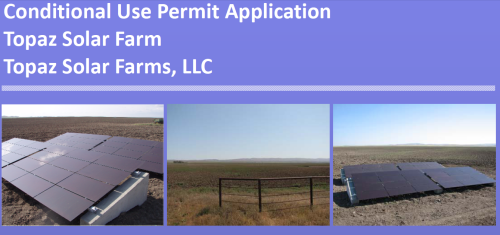
The solar-cell maker came out of nowhere last year to score a deal with utility PG&E to build the world’s largest photovolaic power plant, a 550-megawatt monster that would cover some 9 1/2 square miles on California’s central coast. OptiSolar subsequently began construction of a factory in Sacramento to produce the thousands of thin-film solar panels needed for the project. Then the economy tanked and as financing dried up, OptiSolar laid off half its workforce – some 300 employees – and halted construction of the Sacramento facility.

With a Colorado solar company executive joining President Barack Obama as he signed the $787 billion stimulus legislation into law Tuesday at a solar-powered museum in Denver, OptiSolar and other renewable energy companies stalled by the financial crisis may see their fortunes revive. The package allows builders of big renewable energy projects to apply for a government cash grant to cover 30% of construction costs in lieu of claiming a 30% investment tax credit. A dearth of investors who finance solar power plants and wind farms in exchange for the tax credits has put in jeopardy green energy projects planned for the desert Southwest and the Great Plains. The cash grant would shave about $300 million off the projected $1 billion price tag for OptiSolar’s Topaz Solar Farm.

The stimulus package also includes $2.3 billion to fund a 30% manufacturing tax credit for equipment used to make components for green energy projects, a provision OptiSolar can tap to help finance its solar cell factories. And the company may be able to take advantage of the legislation’s government loan guarantees for large renewable energy projects.

“It will lower the cost of the factory we’re building in Sacramento and make it easier to attract financing,” OptiSolar spokesman Alan Bernheimer told Green Wombat, noting the company’s priority is to complete the facility and begin production of solar panels. “The factory is more than shovel ready – our shovels are hanging on the wall where we put them when we had stop work in November.” (OptiSolar currently manufactures solar modules at its Hayward, Calif., plant.)

Fred Morse, senior adviser to Spanish solar energy giant Abengoa, says the stimulus package puts back on track a $1 billion, 280-megawatt solar thermal power plant the company will build outside Phoenix to produce electricity for utility Arizona Public Service. “With the stimulus bill we’re very confident we’ll be able to finance the project,” says Morse. He says Abengoa expects to use the government loan guarantees to obtain debt financing to fund construction of the project and then apply for the 30% cash refund. “I think the entire industry is very optimistic that these two aspects of the stimulus package, the grants and the temporary loan guarantees, should allow a lot of projects to be built.”

Mark McLanahan, senior vice president of corporate development for MMA Renewable Ventures, agrees. “I expect the government grants to attract new investors,” says McLanahan, whose San Francisco firm finances and owns commercial and utility-scale solar projects.

There are some strings attached, though.

To qualify for the cash grants, developers need to start shoveling dirt by Dec. 31, 2010. That means only a handful of big solar thermal power plants planned for California, for instance, are likely to make it through a complicated two-year licensing process in time to break ground by the deadline. One of those could be the first phase of BrightSource Energy’s 400-megawatt Ivanpah power plant on the California-Nevada border. But BrightSource’s biggest projects, part of a 1,300 megawatt deal signed with Southern California Edison (EIX) last week, won’t start coming online until 2013 at the earliest.

Another Big Solar project, Stirling Energy Systems’ 750-megawatt solar dish farm for San Diego Gas & Electric (SRE), will be racing to meet the 2010 deadline. The project is in the middle of a long environmental review by the California Energy Commission and the U.S. Bureau of Land Management which currently is scheduled to stretch into 2010.

SolarReserve CEO Terry Murphy says his Santa Monica-based startup has a couple of solar power plant projects in the works that should be able to take advantage of the stimulus provisions. “The likelihood of us being able to close on a financial deal has increased,” Murphy says.

Solar analyst Nathan Bullard of research firm New Energy Finance expects the stimulus package to prompt a push for large photovoltaic power projects. That’s because in California such solar farms – which essentially take rooftop solar panels and mount them in huge arrays on the ground – do not need approval from the California Energy Commission and can be built relatively quickly.

That’s good news for companies like thin-film solar cell maker First Solar (FSLR), which builds smaller scale photovoltaic power plants, and SunPower (SPWRA), which has a long-term contract with PG&E (PCG) for the electricity generated from a planned 250-megawatt PV solar farm to be built near OptiSolar’s project.

“It’s great for PV because you can definitely can get construction done by the end of 2010,” says Bullard. “It’s also good news for smaller and mid-sized developers who couldn’t access tax-equity financing.”

The catch, however, is that renewable energy companies still must raise money from investors in a credit-crunched market to cover construction costs, as the government doesn’t pay out the cash until 60 days after a solar power plant or wind farm goes online. And as McLanahan points out, the cost of raising capital from private equity investors is typically higher and will add to the cost of renewable energy projects. Those costs will only rise if the government is late in paying out refunds.

MMA Renewable finances large commercial arrays and solar power plants and then sells the electricity under long-term contracts to customers who host the solar systems. The loan guarantee provision of the stimulus legislation will help secure financing from investors skittish that some of MMA Renewable’s customers may default on their agreements, according to McLanahan.

Says Murphy: “The fact that we’re getting iron into the ground and getting things moving helps us.”

The wind industry also stands to gain from the stimulus package through a three-year extension of the production tax credit for generating renewable electricity as well as the government cash grants and manufacturing tax credit. Despite a record year for wind farm construction in 2008, projects have come to a standstill in recent months as the financial crisis froze development and forced the European-dominated industry to lay off workers.

“I think it’s good down payment on what needs to happen,” says Doug Pertz, CEO of Clipper Windpower, one of two U.S. wind turbine makers. “A lot more needs to be done but I think this will start to bring a lot of people back into the marketplace.”

Read Full Post »

csi-report

The other day I ran into Danny Kennedy, president of solar installation company Sungevity, on the playground as we were picking up our kids at Malcolm X Elementary (we live in Berkeley). I had spent the week chronicling layoffs at various solar and wind companies so it was with a bit of trepidation that Green Wombat asked Danny how business was going at at Sungevity.  “Great,” he replied as I quizzed him about the impact of the recession. “We’re as busy as ever.”

Apparently so. A report released Wednesday by the California Public Utilities Commission shows that residential and commercial rooftop solar installations in the Golden State more than doubled in 2008 from the previous year to 158 megawatts. What’s more, a record-breaking number of applications to participate in California’s $3 billion solar rebate program were filed in December as the drumbeat of bad economic news grew deafening and the state’s unemployment rate hit 9%.

Are Californians being crazily contrarian? While one would think that a $30,000 solar array would be one of those luxuries most people would put on the back burner in bad times, there are some solid economic reasons for the surge. First, rebates for solar systems under the California Solar Initiative get less lucrative in 2009 as incentives fall as the amount of installed solar rises.  Then in October Congress lifted the $2,000 cap on the federal tax credit on solar arrays, allowing homeowners and businesses to take a 30% tax credit on systems installed after Dec. 31.  Add in the state rebate and the cost of a solar system in California suddenly fell by half.

“The surge in applications occurring in the fourth quarter of 2008 is particularly noteworthy given the slowdown in the economy that occurred during the same time period,” the report’s authors noted. “In addition to environmental benefits such as cutting greenhouse gas emissions and other pollutants, it appears that solar energy is benefiting California by serving as an economic bright spot in the economy.”

And therein lies some lessons as the U.S. Congress debates how to promote green jobs. Two years into the California Solar Initiative, the taxpayers’ investment of $775 million in solar rebates has yielded $5 billion in private investment in solar projects and rapidly expanded the state’s renewable energy industry, according to the report. That’s helped create strong solar companies like solar cell maker SunPower (SPWRA) and markets for thin-film solar companies such as First Solar (FSLR). The decade-long program is on track to achieve its target of 3,000 megawatts of rooftop solar and in the first two years of the program more solar has been installed in California than in the previous 25 years.

While California regulators expect the pace to continue in 2009, the big unknown is how many homeowners and business owners will drop out of the program and cancel their applications if the economy continues to deteriorate rapidly this year. The current dropout rate is 15%, according to the report.

“We are hopeful that many of those pending projects will move forward,” Molly Tirpak Sterkel, who oversees the California Solar Initiative for the utilities commission, told Green Wombat. “We’re also cognizant of the economy and economic forces that may pose a threat to those installations.”

Demand for solar is far stronger in Northern California than in sunny SoCal. Northern California utility PG&E’s (PCG) customers have installed more than twice the megawatts of solar than Southern California Edison (EIX) customers. And the report notes that while applications for commercial arrays in PG&E’s territory rose 71% between April and December 2008, they fell 23% in Southern California Edison’s area. San Diego Gas & Electric (SRE), which covers a much smaller service area, saw applications triple for residential solar arrays.

Sterkel says it is unclear why Northern Californians are going solar at a much faster rate than their southern counterpart, but it may be due to differences in electricity pricing and more mature solar markets in regions like the San Francisco Bay Area. “There’s just that many more solar companies with experience, installations and sales channels, ” she says.

Solar panels seem to be sprouting from Bay Area rooftops like California poppies after a late winter rain. In Berkeley, the city has launched a program that pays for residential and business solar arrays upfront and let owners pay the cost back over 20 years through an annual assessment on their property taxes.

Which also may explain why I seem to be seeing more of those Sungevity signs around town.

Read Full Post »

first-solar-11

With Big Solar thermal power plants bogged down in bureaucracy and facing environmental and financial hurdles, utilities are turning to smaller-scale thin-film solar stations that can be built in a matter of months.

In late December, PG&E (PCG), for instance, signed a 20-year contract for electricity generated  from a 10-megawatt thin-film solar power plant in Nevada owned by energy giant Sempra (SRE) that was officially dedicated on Thursday. The solar farm was built by First Solar (FSLR) in a scant six months. Meanwhile, the utility’s nearly two gigawatts worth of deals with solar thermal power companies won’t start producing power for another two years at the earliest. (Southern California Edison (EIX) and San Diego Gas & Electric signed agreements with solar dish developer Stirling Energy Systems for 1.75 gigawatts in 2005 and those projects are just now beginning to move through the regulatory approval process.) And the financial crisis has made it more difficult for solar thermal developers to obtain the billions of dollars needed to finance the construction of a massive megawatt power plant.

Solar thermal power plants typically use miles of mirrors to heat a fluid to create steam which drives an electricity-generating turbine. Photovoltaic (or PV) solar farms essentially take solar panels similar to those found on residential rooftops and mount them on the ground in huge arrays. (Thin-film solar panels are made by depositing layers of photovoltaic materials on glass or flexible materials.)

“In terms of construction, photovoltaic tends to have a much faster development and construction track,” Roy Kuga, PG&E’s vice president for energy supply, told Green Wombat. “There is a segment of mid-sized projects – in the two to 20 megawatt size – where PV shows a distinct advantage in that market. There’s a huge potential for the PV market to expand.”

That’s good news for companies like First Solar – the Tempe, Ariz.-based company backed by the Walton family that is often called the Google of solar for its stock price and market prowess – and SunPower (SPWRA), the Silicon Valley solar cell maker that’s moved into the power plant-building business.

The speed at which the Sempra-First Solar project went online owes much to the fact that it was built on the site of an existing fossil fuel power plant. “It was already permitted for power generation, transmission existed and it did not have to go through the laborious California permitting process,” says Reese Tisdale, a solar analyst with Emerging Energy Research. “As such, First Solar was able to essentially plug and play.”

Nathaniel Bullard, a solar analyst with New Energy Finance, says he expects utilities increasingly to bet on smaller-scale photovoltaic farms to help meet state mandates to obtain a growing percentage of their electricity from renewable sources. Just this week, PG&E CEO Peter Darbee said his utility plans to invest in solar power plant projects rather than just buy the power they produce.

“I think a utility could easily integrate, technically and financially, 100 megawatts of PV,” Bullard says.  If something is falling behind on your big solar thermal projects, you can plug in PV. I think you’ll see more of this with California utilities and I expect to see it more in Florida and North Carolina. It’s a great runaround to issues of siting and transmission.”

That’s because in California photovoltaic power plants do not need approval from the California Energy Commission. And smaller-scale plants take up far less land and can be built close to existing transmission lines. Most large solar thermal power plants typically are planned for the Mojave Desert and require the construction of expensive power lines to connect them to the grid.

The modular nature of PV solar farms means they can begin generating electricity as each segment is completed while a solar thermal plant only goes online once the entire project is finished.

“Certainly there is a sweet spot in which the project is large enough to gain advantages of scale,” says Tisdale. “Also, these small-to-mid-size systems can be spread about a transmission network, instead of at one site.”

Read Full Post »

« Newer Posts - Older Posts »

Design a site like this with WordPress.com
Get started