Feeds:
Posts
Comments

Posts Tagged ‘BrightSource Energy’

solara

photo: BrightSource Energy

Chevron and solar developer BrightSource Energy have revealed a deal for a solar steam plant that is being built in an oil field in California. As I wrote in The New York Times this week:

BrightSource Energy has broken ground on a 29-megawatt solar steam plant at a Chevron oil field in Coalinga, Calif.

The 100-acre project’s 7,000 mirrors will focus sunlight on a water-filled boiler that sits atop a 323-foot tower to produce hot, high-pressure steam.

In a conventional solar power plant, the steam drives a turbine to generate electricity. In this case, the steam will be injected into oil wells to enhance production by heating thick petroleum so it flows more freely. Oil companies typically rely on steam generated by natural gas or other fossil fuels to maximize oil recovery in places like the oil patch in California’s Fresno and Kern counties, where the petroleum is heavy and gooey.

You can read the rest of the story here:

Read Full Post »

solarF

In Monday’s New York Times’ Green Inc. blog, I take a look at two recently approved solar energy contracts in California that offer a rare look at the economics of large-scale solar power plants:

California regulators have approved contracts for more than 8,600 megawatts of renewable energy, to be generated mostly by big solar power plants for the state’s largest utilities. But the details of those deals and the emerging economics of green energy often remain shrouded in secrecy, subject to confidentiality agreements.

That black box cracked open a bit on Thursday, when the California Public Utilities Commission gave the green light to two 25-year power purchase agreements between Pacific Gas & Electric and BrightSource Energy, a solar power plant builder based in Oakland, Calif.

When approving contracts for 310 megawatts of solar electricity, the utilities commission also signed off on an apparently first-of-its-kind technology royalty agreement between BrightSource and PG&E.

You can read the rest of the story here.

Read Full Post »

eSolar Sierra

photo: eSolar

The U.S. Department of Energy on Friday began accepting applications for at least $3 billion in direct funding of renewable energy power plant projects.

The funding, part of the federal stimulus package, is in lieu of a 30 percent investment tax credit that green energy developers can take on their projects. Given that most solar and wind developers carry no tax liabilities, they have relied on investment banks and other investors to front the hundreds of millions and billions of dollars in financing needed for their projects in exchange for the tax credits. But as the economy tanked along with investment banks, demand for so-called tax equity partnerships evaporated.  Big Solar projects stalled and wind developers delayed turbine orders.

Curiously, the Department of Energy said on Friday that the $3 billion would fund some 5,000 projects. That works out to about $600,000 per power plant. But a single 250-megawatt solar power plant alone can cost more than a $1 billion and would thus soak up $300 million or 10% of the funding pool.

The question is, will DOE end up funding a few large-scale green energy projects that could start to give, say, the solar thermal industry economies of scale, or will it spend the money on hundreds of smaller renewable energy facilities?

That’s a crucial issue for solar developers like Tessera Solar/Stirling Energy Systems, eSolar and BrightSource Energy, which is backed Google (GOOG), Morgan Stanley (MS) and VantagePoint Venture Partners as well as a clutch of oil giants – Chevron (CVX), BP (BP) and Norway’s StatoilHydro.

Also left unsaid in the DOE’s announcement was the fact that renewable energy projects need to break ground by the end of 2010 to qualify for the direct funding. Which is why BrightSource, Nextera Energy (a subsidiary of utility giant FPL Group (FPL) ) and Tessera Solar are eager to expedite the lengthy California licensing process and get their projects approved before New Year’s Eve 2010 so they can put shovel to dirt and start shoveling cash into their coffers.

Read Full Post »

Stirling SunCatcher

photo: Tessera Solar

When it comes to renewable energy, Texas has been all about Big Wind. But this week the Lone Star State took on its first Big Solar project when San Antonio utility CPS Energy signed a 27-megawatt deal with Tessera Solar.

Houston-based Tessera is the solar farm developer for Stirling Energy Systems, which makes a Stirling solar dish. Resembling a giant mirrored satellite receiver, the 25-kilowatt solar dish focuses the sun’s rays on a Stirling engine, heating hydrogen gas to drive pistons that generate electricity. (Last year Irish green energy firm NTR pumped $100 million into Scottsdale, Ariz.-based Stirling Energy Systems and created Tessera to develop solar power plants using the Stirling dish, called the SunCatcher.

Stirling Energy Systems previously signed deals with Southern California Edison (EIX) and San Diego Gas & Electric (SRE) to supply up to 1,750 megawatts of electricity from some 70,000 solar dishes to be planted in the Mojave and Sonoran deserts.

Other solar developers privately have cast doubt on Stirling’s ability to make good on those contracts, arguing the SunCatcher is just too expensive and complex to compete against solar thermal technologies that rely on mirrors to heat liquids to create steam that drives electricity-generating turbines.

But earlier this week, Stirling unveiled the latest generation of the SunCatcher at Sandia National Laboratories in Albuquerque, N.M. The new SunCatcher has shed 5,000 pounds and its Stirling hydrogen engine contains 60% fewer parts than the previous version, according to the company.

The SunCatcher also uses a fraction of the water consumed by competing solar thermal technologies being developed by startups like BrightSource Energy and Ausra — no small deal in the desert. Tessera solar farms also can be built in modules, meaning that when a 1.5 megawatt pod of 60 SunCatchers is installed it can immediately begin generating electricity — and cash.

California utility PG&E also went modular Thursday when it signed a 92-megawatt deal with New Jersey’s NRG (NRG) for electricity to be generated by a Southern California solar power plant using eSolar’s technology. Google-backed (GOOG) eSolar’s builds its solar power tower plants in 46-megawatt modules. The power plants take up much less land than competing solar thermal technologies, thanks to eSolar’s use of sophisticated software to control small mirrors that are packed close together.

NRG earlier this month signed a deal to build a 92-megawatt eSolar-powered solar farm in New Mexico near the Texas border.

eSolar CEO Bill Gross says his solar farms will generate electricity cheaper than natural gas-fired power plants, a claim PG&E (PCG) appears to confirm in its submission of the deal to the regulators. (Thanks to Vote Solar for pointing to the document.)

Read Full Post »

Stirling Energy Systems Solar One project

image: URS

Green Wombat spent several months looking into allegations that California labor unions are using environmental laws to pressure  solar developers to hire union workers to build large-scale solar power plants. The story was published last Friday in The New York Times:

SACRAMENTO — When a company called Ausra filed plans for a big solar power plant in California, it was deluged with demands from a union group that it study the effect on creatures like the short-nosed kangaroo rat and the ferruginous hawk.

By contrast, when a competitor, BrightSource Energy, filed plans for an even bigger solar plant that would affect the imperiled desert tortoise, the same union group, California Unions for Reliable Energy, raised no complaint. Instead, it urged regulators to approve the project as quickly as possible.

One big difference between the projects? Ausra had rejected demands that it use only union workers to build its solar farm, while BrightSource pledged to hire labor-friendly contractors.

As California moves to license dozens of huge solar power plants to meet the state’s renewable energy goals, some developers contend they are being pressured to sign agreements pledging to use union labor. If they refuse, they say, they can count on the union group to demand costly environmental studies and deliver hostile testimony at public hearings.

If they commit at the outset to use union labor, they say, the environmental objections never materialize.

You can read the rest of the story here.

Read Full Post »

solara

photo: BrightSource Energy

California utility PG&E on Wednesday expanded an agreement with BrightSource Energy to buy 1,310 megawatts of carbon-free electricity to be generated by seven giant solar power plant projects – the world’s biggest solar deal to date. Coming on top of a 1,300 megawatt agreement with Southern California Edison in February, the Google-backed, Oakland, Calif.-based  startup says it now holds more than 40% of the Big Solar contracts in the United States.

PG&E had previously signed a power purchase agreement with BrightSource in April 2008 for 500 megawatts with an option to buy another 400 megawatts. The new 1,310-megawatt deal will supply enough electricity to power about 530,000 homes in California.

Those are impressive numbers, but not an electron of electricity has been produced yet. BrightSource now faces the challenge of licensing, financing billions of dollars in construction costs and then building nearly a dozen large-scale solar power plants to meet a 2016 deadline for the Southern California Edison (EIX) contract and a 2017 completion date for PG&E (PCG).  (The big wild card is whether transmission lines will be available to connect the power plants to the grid.) The first PG&E project is set to go online in 2012 with the first SoCal Edison solar farm to begin generating electricity the next year. Those first two power plants are part of a 400-megawatt complex BrightSource is planning for the Ivanpah Valley on the California-Nevada border.

“The biggest part of our strategy is to ramp up slowly and methodically,” BrightSource CEO John Woolard told Green Wombat. “We’re very, very careful about how we sequence the projects.”

To give you an idea of how arduous the licensing process is in California, consider that BrightSource filed its application to build Ivanpah with the California Energy Commission on Aug. 31, 2007 — the state’s first large-scale solar power plant application in two decades. But the energy commission currently estimates that it won’t sign off on the license until around 2010, more than six months’ behind schedule as a multitude of state and federal agencies and green groups weigh in on the project’s environmental impact. The clock is ticking as BrightSource needs to start shoveling dirt on the construction site by the end of 2010 to qualify for federal loan guarantees that are part of the Obama stimulus package.

BrightSource may also build solar power plants in Nevada and Arizona, where licensing is easier, to supply electricity to PG&E and Southern California Edison. Woolard says the company controls enough land for nine gigawatts’ worth of solar farms.

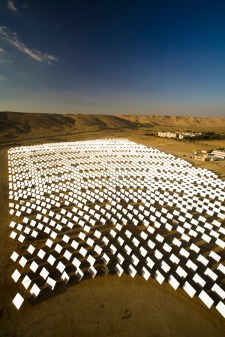
While BrightSource’s technology is untested on a large scale, the company has built a six-megawatt demonstration plant in Israel, where its technology development arm is headquartered. BrightSource deploys arrays of mirrors called heliostats that concentrate sunlight on a water-filled boiler that sits atop a tower. The intense heat vaporizes the water to create high-pressure steam that drives a standard electricity-generating turbine.

Woolard says an independent engineering firm, R.W. Beck, has validated the technology at the Negev Desert demo plant. That no doubt helped persuade PG&E, which has sent executives to Israel to inspect the project, to supersize its contract. (And while BrightSource represents the biggest solar deal PG&E has signed, it’s probably far more likely to be fulfilled than the utility’s agreement in April to buy electricity from a space-based solar farm to be built by Southern California startup Solaren.)

“What it came down to is that they saw us delivering,” Woolard says. “Our plant in Israel performed above expectations. The fact that we have a solar plant producing the highest quality, highest temperature, highest pressure steam anywhere in the world is the most important thing.”

The company’s pedigree also provides a certain amount of corporate comfort. BrightSource was founded by American-Israeli solar pioneer Arnold Goldman, whose Luz International built nine large-scale solar trough power plants in the Mojave Desert in the 1980s that continue to generate electricity for Southern California Edison. BrightSource has also raised more than $160 million from a blue-chip group of investors that includes Google (GOOG), Morgan Stanley (MS) and VantagePoint Venture Partners as well as a clutch of oil giants – Chevron (CVX), BP (BP) and Norway’s StatoilHydro.

Read Full Post »

solara

photo: BrightSource Energy

As the Nevada legislature debates extending tax breaks for large-scale solar power plants, a new report finds that ramping up solar development in the Silver State could produce thousands of good-paying green jobs while generating nearly $11 billion in economic benefits.

The study from San Francisco-based non-profit Vote Solar concludes that 2,000 megawatts’ worth of big solar thermal and photovoltaic farms — needed to meet Nevada’s electricity demand — would result in 5,900 construction jobs a year during the plants’ building phase, 1,200 permanent jobs and half a billion dollars in tax revenues.

“It is likely that such an investment in solar generating facilities could bring solar and related manufacturing to Nevada,” the reports authors wrote. “The economic impact of such manufacturing development is not included in this analysis, but would add significant additional benefits.”

Vote Solar’s job projections are based on an economic model developed by the National Renewable Energy Laboratory to project the impact of solar trough power plants, the most common, if dated, type of Big Solar technology.

The different solar technologies set to come online in the next couple of years could change that equation. No doubt thousands of jobs will be generated by Big Solar but just how many will depend on the mix of solar thermal and photovoltaic power plants that ultimately come online. New technologies like BrightSource Energy’s “power tower,” Ausra’s compact linear fresnel reflector and Stirling Energy Systems’s solar dish may generate similar numbers of jobs. But then there’s eSolar’s power tower solar farms – which uses fields of mirrors called heliostats to focus the sun on a water-filled boiler, creating steam that drives an electricity-generating turbine.  eSolar’s small and prefabricated heliostat arrays cut out much of the skilled labor typically needed on such projects as they can be installed by two workers using a wrench.

Photovoltaic farms essentially take rooftop solar panels and put them on the ground and thus don’t require highly skilled laborers to build turbine power blocks, miles of piping and other infrastructure needed in solar thermal facilities. (They also can be built much more quickly than a solar thermal plant, which is why utilities have been striking deals with companies like First Solar (FSLR) and SunPower (SPWRA) for PV farms.)

A second report released this week — from the Large-Scale Solar Association, an industry group — found that Nevada could gain an edge over Arizona and California in luring solar power plant builders if it extended and sweetened tax incentives.  The three states form something of a golden triangle of solar, offering the nation’s most intense sunshine and vast tracts of government-owned desert land that are being opened up for solar development.

The timing of the reports was no accident. The Nevada Legislature held hearings earlier this week on extending tax breaks for Big Solar that expire in June, and Vote Solar’s utility-scale solar policy director, Jim Baak, went to Carson City to lobby legislators, hoping to head off one proposal to tax renewable energy production.

The Large-Scale Solar report, prepared by a Las Vegas economic consulting firm, found that if legislators let the tax breaks sunset, as it were, the developer of a 100-megawatt solar power plant would pay $55.1 million in taxes in Nevada during the first 15 years of the facility’s operation compared to $26.1 million in Arizona and between $36.1 and $37.9 million in California. If the current incentives are kept, tax payments drop to $25.1 million. A bigger tax break would reduce the tax burden to $14.3 million.

Read Full Post »

desert-tortoise1

photo: Wild Rose Images

California Senator Dianne Feinstein’s move to put a large swath of the Mojave Desert off-limits to renewable energy development is splitting the environmental movement and could derail some two dozen solar and wind power projects the state needs to comply with its ambitious climate change laws.

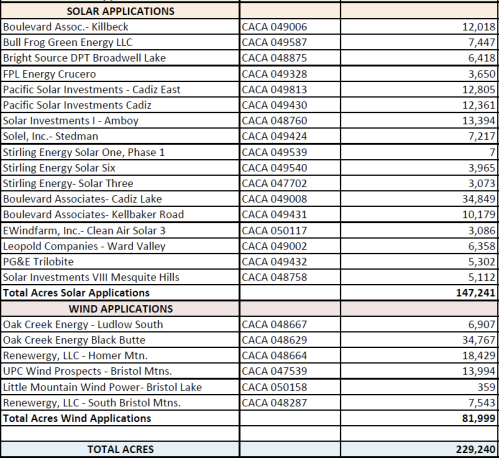
On the firing line are 17 massive solar power plants and six wind farms planned for federal land — land that would be designated a national monument under legislation Feinstein intends to introduce. The solar projects in question would be built by a range of companies, from startups BrightSource Energy and Stirling Energy Systems to corporate heavyweights Goldman Sachs (GS) and FPL (FPL), according to federal documents. (For the complete list, see below.)

The companies are among scores that have filed lease claims on a million acres of acres of desert dirt controlled by the U.S. Bureau of Land Management. California utilities PG&E (PCG) and Southern California Edison (EIX) have signed long-term power purchase agreements for some of the projects now in jeopardy and are counting on the electricity they would produce to meet state-mandated renewable energy targets. PG&E itself has filed a solar power plant land claim in the proposed national monument.

The area of the desert in dispute is some 600,000 acres formerly owned by Catellus, the real estate arm of the Union Pacific Railroad, and donated to the federal government a decade ago by the Wildlands Conservancy, a Southern California environmental group. About 210,000 of those acres are managed by the U.S. Bureau of Land Management, which opened part of the land to renewable energy projects.

“Many of the sites now being considered for leases are completely inappropriate and will lead to the wholesale destruction of some of the most pristine areas in the desert,” Feinstein wrote in a letter to Interior Secretary Ken Salazar released last week, notifying him that she will introduce legislation to designate the former Catellus lands a national monument. “Beyond protecting national parks and wilderness from development, the conservation of these lands has helped to ensure the sustainability of the entire desert ecosystem by preserving the vital wildlife corridors.”

The Catellus land controlled by the BLM forms something of a golden triangle between the Joshua Tree National Park and the Mojave National Preserve in Southern California and are particularly coveted for renewable energy development because of its proximity to transmission lines.

Alan Stein, a deputy district manager for the BLM in California, told Green Wombat that the solar and wind lease claims are in areas that are not designated as wilderness or critical habitat for protected species like the desert tortoise. “This is public domain land, ” he says.

Tortoises, however, are found across the Mojave, and battles over Big Solar’s impact on endangered wildlife are quietly brewing in several solar power plant licensing cases now being reviewed by the California Energy Commission.  Environmentalists find themselves walking a thin green line, trying to balance their interest in promoting carbon-free energy with protecting fragile desert landscapes and a host of threatened animals and plants.

Take BrightSource Energy’s Ivanpah 400-megawatt solar power plant complex on the California-Nevada border. The three solar power plants to be built by the Oakland-based company will supply electricity to PG&E and Southern California Edison. But the project will also destroy some 4,000 acres of desert tortoise habitat and at least 25 tortoises will have to be relocated – a somewhat risky proposition as previous efforts in other cases have resulted in the deaths of the animals.

On Wednesday, the California Energy Commission granted two national environmental groups – the Defenders of Wildlife and the Sierra Club – the right to intervene in the Ivanpah case. “Defenders strongly supports … the development of renewable energy in California,” Kim Delfino, California program director for Defenders of Wildlife, wrote to the energy commission in a Jan. 23 letter.  “Defenders has several serious concerns about the potential impacts of this project on a number of rare, declining and listed species and on their associated desert habitat and waters.”

Natural Resources Defense Council attorney Johanna Wald wrote a letter with the Wilderness Society expressing concern over the impact of Ivanpah project on the desert tortoise but also made a strong statement of support for renewable energy development. “Our public lands harbor substantial wind, solar, and geothermal resources,” wrote Wald, who serves on a state task force to identify appropriate areas for renewable energy development. “Developing some of these resources will be important to creating a sustainable energy economy and combating climate change.”

The big national enviro groups are working with the government and power plant developers to create zones in the Mojave where renewable energy projects would be permitted while setting aside other areas that are prime habitat and wildlife corridors. A similar effort is underway on the federal level to analyze the desert-wide impact of renewable energy development.

Local environmental organizations, however, have split with the Big Green groups over developing the desert and other rural areas. In San Luis Obispo County,  Ausra, SunPower (SPWRA) and First Solar’s (FSLR) plans to build three huge solar farms within miles of each other has prompted some local residents worried about the impact on wildlife to organize in opposition to the projects.

And some small Mojave Desert green groups pledge to go to court to stop big solar projects. “We don’t want to see the Endangered Species Act gutted for the sake of mega solar projects,” veteran grass roots activist Phil Klasky told Green Wombat last year for a story on the solar land rush in the Mojave. “I can say the smaller environmental organizations I’m involved with are planning to challenge these projects.”

It would be unwise to underestimate Klasky. In the 1990s, he helped lead a long-running  and successful campaign to scuttle the construction of a low-level radioactive waste dump in tortoise territory in the Mojave’s Ward Valley – now a prime solar spot.

Still, while California’s senior senator’s move in the Mojave may exacerbate rifts in the environmental movement over renewable energy, it also could galvanize efforts to resolve critter conflicts in a comprehensive way. Otherwise, environmentalists of varying hues may find themselves fighting each other rather than global warming.

Update: I just had a conversation with BrightSource spokesman Keely Wachs, who takes issue with my characterization that the Ivanpah project will “destroy” desert tortoise habitat. He points out that the company is taking care to minimize the impact of the power plant on the surrounding desert and that wildlife may still occupy the site. It would be more accurate to say that the project will remove desert tortoise habitat from active use during Ivanpah’s construction and operation.

(Below is a list of solar and wind projects that fall within the proposed Mojave national monument. Note: Solar Investments is a subsidiary of Goldman Sachs and Boulevard Associates is a subsidiary of FPL.)

source:  BLM
blm-nm2

Read Full Post »

esolar-field_wide_2b
photo: eSolar

SAN FRANCISCO — “It’s all about the software,” says eSolar CEO Bill Gross.

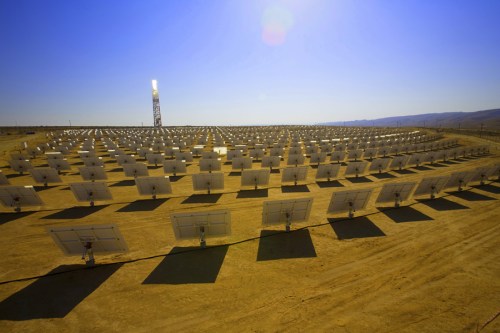
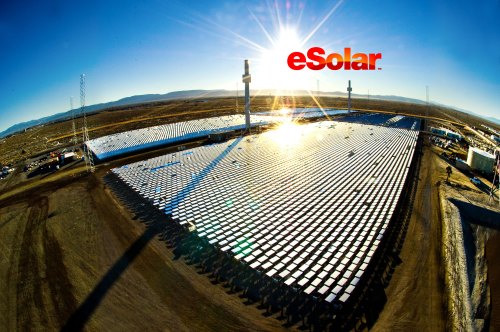
The tech entrepreneur and founder of startup incubator Idealab is explaining how eSolar’s solar power plants can produce carbon-free electricity cheaper than planet-warming natural gas. At the Cleantech Forum in San Francisco, Gross flashes a photo of eSolar’s demonstration solar farm outside the Southern California town of Lancaster, where 24,000 mirrors called heliostats surround two 150-foot towers.  The heliostats concentrate sunlight on a tower containing water-filled boilers and the resulting heat creates steam that drives an electricity-generating turbine. Rivals like BrightSource Energy use similar “power tower” technology but according to Gross, eSolar’s mirror-controlling software and modular plant design will allow it to produce cheaper solar electricity.

For instance, Gross says competitors use large, slightly curved mirrors to focus sunlight. That require big and expensive steel frames to hold the glass in place.  eSolar’s solution: make small flat mirrors the size of an LCD television screen that clamp on to a  5 x 12-inch frame and then use software and Big Iron computing to position the mirrors to create a parabola out of the entire heliostat field.

“We use Moore’s law rather than more steel,” quipped Gross, referring to Intel co-founder Gordon Moore’s maxim that computing power doubles every two years.

The heliostats roll off an assembly line in China with the wiring and sun-tracking motors built in. “The only tool required to install mirrors in the field is a hand wrench,” Gross says. “There’s  no welding in field, you just install the mirrors on the base. We’ve taken all the labor in the field and moved it to an automated factory.”

The heliostats also do not have to be precisely placed in the solar field, which saves time. “The rows can be wavy as the software will correct for it,” Gross notes. “We don’t need to do extensive surveys to design the field; we just need to leave enough space between mirrors.”

The bottom line: The five-megawatt Palmdale project was built in less than six months. “We think we can finish plants before other people start,” Gross told Green Wombat.

Gross says eSolar has also signed a 92-megawatt deal with a New Mexico utility, which he declined to identify until the agreement is announced. He said his Pasadena, Calif.-based company will also soon unveil a contract to build 500 megawatt’s worth of solar farms in Asia. So far, eSolar has spent $30 million acquiring land – mainly privately owned agricultural property – for solar power plants, according to Gross. He told Cleantech Forum participants that eSolar expects internal rates of return for its partners of between 11% and 14% for U.S. power plants and returns of 20% to 30% for overseas projects.

Also saving time and money are the power towers, which are made from two sections of a windmill tower. At 150 feet they’re half the size of competitors’ towers – again, less steel is needed. The lower height and the software systems that allow more mirrors to be crammed into smaller spaces means that eSolar’s power plants can be placed closer to urban areas where transmission lines are available.

Also unique is the boiler that sits atop the tower. Gross gave Green Wombat a close-up look the proprietary technology. About the size of a cargo shipping container, the “cavity receiver” has openings on either side. The heliostats focus sunlight into the interior of the boiler, which is lined with water-filled pipes.

“The benefit is that the light comes in and even if some light is reflected it can have multiple bounces and still hit the pipes,” Gross says. “We can get all the light inside the cavity all because of the software that controls the mirrors.”

Whether Google (GOOG)-backed eSolar’s plants produce electricity at the low rates Gross is claiming won’t be known until they start coming online. But utilities are betting that this solar software works. Southern California Edision (EIX) last year signed a 20-year-contract with eSolar for 245 megawatts of electricity while coal-dependent NRG Energy (NRG) this week agreed to invest $10 million in eSolar in exchange for the right to develop up to 500 megawatts using the company’s technology. (Southern California Edison is betting even bigger on BrightSource Energy’s power tower technology – two weeks ago the utility signed a 1,300 megawatt power purchase agreement with the Oakland startup – also backed by Google – the world’s largest solar deal to date.)

Read Full Post »

topaz-solar-farm-app

In the green stimulus sweepstakes, big potential winners are companies like Silicon Valley startup OptiSolar.

The solar-cell maker came out of nowhere last year to score a deal with utility PG&E to build the world’s largest photovolaic power plant, a 550-megawatt monster that would cover some 9 1/2 square miles on California’s central coast. OptiSolar subsequently began construction of a factory in Sacramento to produce the thousands of thin-film solar panels needed for the project. Then the economy tanked and as financing dried up, OptiSolar laid off half its workforce – some 300 employees – and halted construction of the Sacramento facility.

With a Colorado solar company executive joining President Barack Obama as he signed the $787 billion stimulus legislation into law Tuesday at a solar-powered museum in Denver, OptiSolar and other renewable energy companies stalled by the financial crisis may see their fortunes revive. The package allows builders of big renewable energy projects to apply for a government cash grant to cover 30% of construction costs in lieu of claiming a 30% investment tax credit. A dearth of investors who finance solar power plants and wind farms in exchange for the tax credits has put in jeopardy green energy projects planned for the desert Southwest and the Great Plains. The cash grant would shave about $300 million off the projected $1 billion price tag for OptiSolar’s Topaz Solar Farm.

The stimulus package also includes $2.3 billion to fund a 30% manufacturing tax credit for equipment used to make components for green energy projects, a provision OptiSolar can tap to help finance its solar cell factories. And the company may be able to take advantage of the legislation’s government loan guarantees for large renewable energy projects.

“It will lower the cost of the factory we’re building in Sacramento and make it easier to attract financing,” OptiSolar spokesman Alan Bernheimer told Green Wombat, noting the company’s priority is to complete the facility and begin production of solar panels. “The factory is more than shovel ready – our shovels are hanging on the wall where we put them when we had stop work in November.” (OptiSolar currently manufactures solar modules at its Hayward, Calif., plant.)

Fred Morse, senior adviser to Spanish solar energy giant Abengoa, says the stimulus package puts back on track a $1 billion, 280-megawatt solar thermal power plant the company will build outside Phoenix to produce electricity for utility Arizona Public Service. “With the stimulus bill we’re very confident we’ll be able to finance the project,” says Morse. He says Abengoa expects to use the government loan guarantees to obtain debt financing to fund construction of the project and then apply for the 30% cash refund. “I think the entire industry is very optimistic that these two aspects of the stimulus package, the grants and the temporary loan guarantees, should allow a lot of projects to be built.”

Mark McLanahan, senior vice president of corporate development for MMA Renewable Ventures, agrees. “I expect the government grants to attract new investors,” says McLanahan, whose San Francisco firm finances and owns commercial and utility-scale solar projects.

There are some strings attached, though.

To qualify for the cash grants, developers need to start shoveling dirt by Dec. 31, 2010. That means only a handful of big solar thermal power plants planned for California, for instance, are likely to make it through a complicated two-year licensing process in time to break ground by the deadline. One of those could be the first phase of BrightSource Energy’s 400-megawatt Ivanpah power plant on the California-Nevada border. But BrightSource’s biggest projects, part of a 1,300 megawatt deal signed with Southern California Edison (EIX) last week, won’t start coming online until 2013 at the earliest.

Another Big Solar project, Stirling Energy Systems’ 750-megawatt solar dish farm for San Diego Gas & Electric (SRE), will be racing to meet the 2010 deadline. The project is in the middle of a long environmental review by the California Energy Commission and the U.S. Bureau of Land Management which currently is scheduled to stretch into 2010.

SolarReserve CEO Terry Murphy says his Santa Monica-based startup has a couple of solar power plant projects in the works that should be able to take advantage of the stimulus provisions. “The likelihood of us being able to close on a financial deal has increased,” Murphy says.

Solar analyst Nathan Bullard of research firm New Energy Finance expects the stimulus package to prompt a push for large photovoltaic power projects. That’s because in California such solar farms – which essentially take rooftop solar panels and mount them in huge arrays on the ground – do not need approval from the California Energy Commission and can be built relatively quickly.

That’s good news for companies like thin-film solar cell maker First Solar (FSLR), which builds smaller scale photovoltaic power plants, and SunPower (SPWRA), which has a long-term contract with PG&E (PCG) for the electricity generated from a planned 250-megawatt PV solar farm to be built near OptiSolar’s project.

“It’s great for PV because you can definitely can get construction done by the end of 2010,” says Bullard. “It’s also good news for smaller and mid-sized developers who couldn’t access tax-equity financing.”

The catch, however, is that renewable energy companies still must raise money from investors in a credit-crunched market to cover construction costs, as the government doesn’t pay out the cash until 60 days after a solar power plant or wind farm goes online. And as McLanahan points out, the cost of raising capital from private equity investors is typically higher and will add to the cost of renewable energy projects. Those costs will only rise if the government is late in paying out refunds.

MMA Renewable finances large commercial arrays and solar power plants and then sells the electricity under long-term contracts to customers who host the solar systems. The loan guarantee provision of the stimulus legislation will help secure financing from investors skittish that some of MMA Renewable’s customers may default on their agreements, according to McLanahan.

Says Murphy: “The fact that we’re getting iron into the ground and getting things moving helps us.”

The wind industry also stands to gain from the stimulus package through a three-year extension of the production tax credit for generating renewable electricity as well as the government cash grants and manufacturing tax credit. Despite a record year for wind farm construction in 2008, projects have come to a standstill in recent months as the financial crisis froze development and forced the European-dominated industry to lay off workers.

“I think it’s good down payment on what needs to happen,” says Doug Pertz, CEO of Clipper Windpower, one of two U.S. wind turbine makers. “A lot more needs to be done but I think this will start to bring a lot of people back into the marketplace.”

Read Full Post »

« Newer Posts - Older Posts »

Design a site like this with WordPress.com
Get started