Feeds:
Posts
Comments

I wrote this story for Grist, where it first appeared.

Have the Texas oil companies backing Proposition 23 surrendered in the fundraising battle over the ballot measure that would suspend California’s global warming law?

Since Thursday, the No on 23 forces have raised more than $7.3 million as the Silicon Valley-Hollywood-environmental-industrial complex revved up for the final push before Election Day on Nov. 2.

The Yes campaign’s take since Thursday? $10,000.

The No on 23 campaign now has raised $25.8 million to the Yes effort’s $9.1 million as money from the petrochemical industry backing Prop 23 has all but dried up in recent weeks, according to California Secretary of State records.

The tsunami of cash flooding into the No campaign indicates the breadth of support from California’s establishment for the state’s global warming law, known as AB 32, which requires greenhouse gas emissions be cut to 1990 levels by 2020.

Avatar director James Cameron attracted the most attention with his $1 million donation on Friday. But Gordon Moore, the legendary co-founder of chip giant Intel, also dropped $1 million into the No coffers that day, and so did Pacific Gas & Electric ($250,000), California’s largest utility and a leading proponent of climate change legislation. Google co-founder Sergey Brin also donated $200,000 on Thursday, and an organization of Silicon Valley tech companies contributed $125,000.

On Tuesday, a group of some 66 investors controlling more than $400 billion in assets are scheduled to hold a press conference to announce their opposition to Prop 23.

In the meantime, national environmental groups and non-profits continued to pour cash into the No campaign last week. The National Wildlife Federation contributed $3 million on Friday. ClimateWorks Foundation, a San Francisco non-profit, gave $900,000. New York’s Rockefeller Family Fund kicked in $300,000 on Thursday and the Natural Resources Defense Council, a top No on 23 donor, added $300,000 more Friday.

Environmentalists are also starting to focus on Proposition 26, a little-noticed California ballot measure that would reclassify environmental impact fees as taxes and require a two-thirds vote of the state legislature to impose them rather than a simple majority. Green groups and AB 32 supporters fear Prop 26 could cripple efforts to levy fees to implement the global warming law.

The oil, alcohol, and tobacco companies backing Prop 26 have so far raised $13.6 million while opponents have managed to collect only $2.8 million, according to state campaign records.

Still, a spokesman for the No on 23 told the Los Angeles Times that the No campaign would not redirect its cash to the Prop 26 fight, saying the battle over the global warming law has yet to be won.

photo: Todd Woody

I wrote this story for Grist, where it first appeared.

Defeat Proposition 23? There’s an app for that.

Laurene Powell Jobs, the wife of Apple founder Steve Jobs, on Tuesday donated $200,000 to the campaign against Prop 23, the California ballot measure that would suspend the state’s global warming law.

With less than three weeks to go until Election Day, the enviro-green tech coalition’s fundraising machine continued to outpace the Texas oil companies backing Prop 25. As of Thursday, the No on 23 campaign had collectively raised $17.9 million to the Yes campaign’s $9 million, according to California Secretary of State records.

Also on Tuesday, Vinod Khosla, the prominent Silicon Valley green tech investor, dropped $1.04 million into the No campaign coffers while executives from Google, Bloom energy, and other Valley tech and renewable energy firms made high five-figure donations.

(Alan Salzman, a leading Silicon Valley green tech investor who is chief executive of VantagePoint Venture Partners, is hosting a No on Prop 23 fundraiser at his Atherton home on Oct. 22 that features a performance by Elvis Costello. Get out your wallets, though. Tickets are $500; for $100,000 you can score four backstage passes, 10 VIP seats, and 10 general admission tickets.)

The Sierra Club, which is headquartered in San Francisco, weighed in Wednesday with its first sizeable contributions, giving a total of $300,000 to various No campaigns. The No forces also received their first utility industry donation, a $25,000 contribution from Sempra Energy, owner of San Diego Gas & Electric. Nike gave $20,958.

The Yes campaign has received only two six-figure contributions over the past week, a $150,000 donation from oil refiner CVR Energy of Sugar Land, Texas, on Tuesday, and $500,000 from Marathon Petroleum of Findlay, Ohio, last Friday.

But No on 23 spokesperson Steven Maviglio, a longtime Democratic operative in California, takes cold comfort in those low numbers. He told me on Friday that he fully expects the oil industry to put millions of dollars into the campaign in the final weeks leading to Nov. 2.

Prop 23 would suspend California’s global warming law, known as AB 32, until the state unemployment rate dropped to 5.5 percent for four consecutive quarters, something that has happened only three times in the past four decades. AB 32 requires California to cut its greenhouse gas emissions to 1990 levels by 2020.

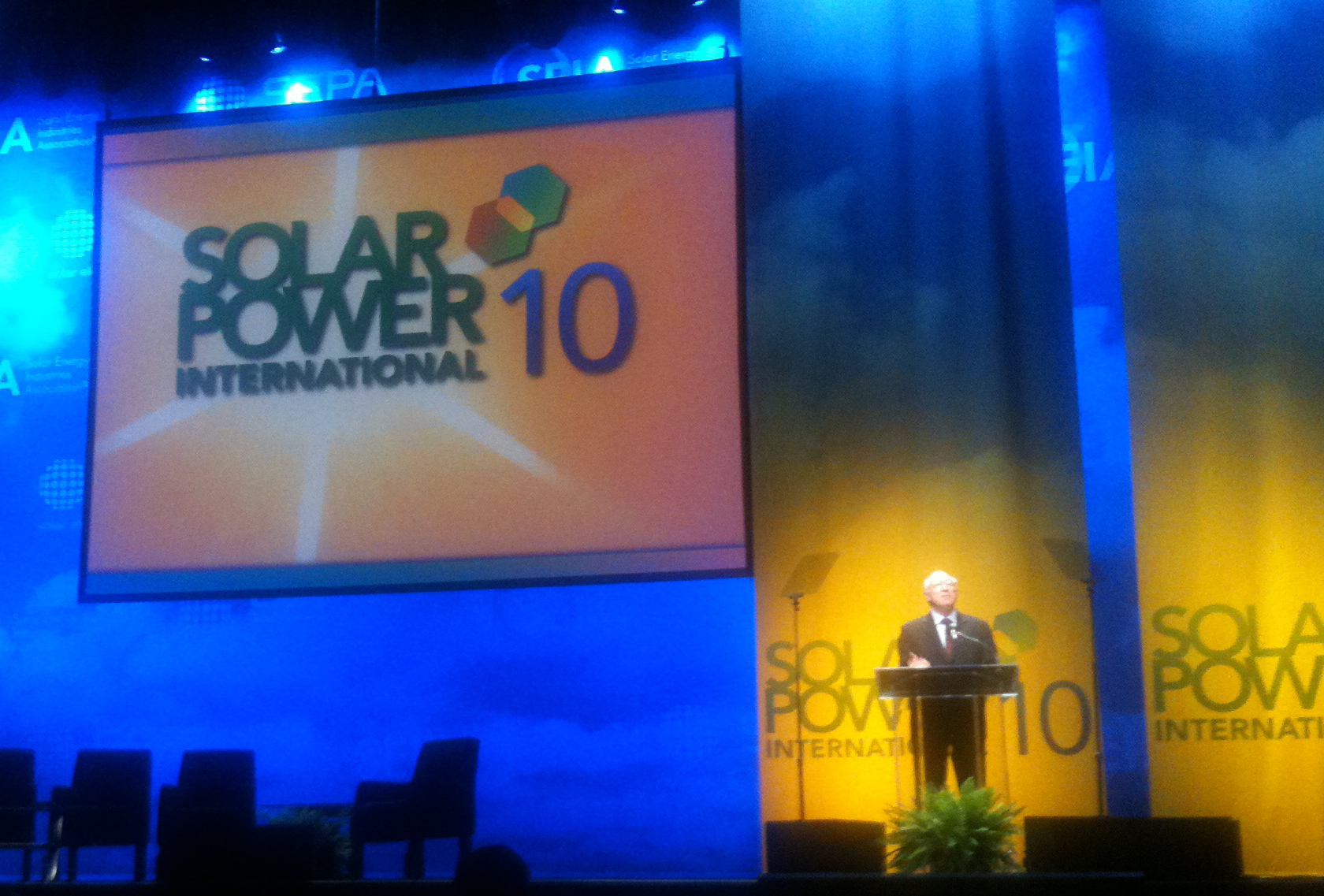
At the giant Solar Power International conference in Los Angeles this week, attendees sported No on 23 buttons and the confab’s organizers tried to rally executives to oppose the ballot measure.

One company, Silicon Valley solar panel installer SunRun, staged a “protest” Wednesday evening against Prop 23 on the floor of the Los Angeles Convention Center, draping booths with anti-23 signs and dispatching employees with picket signs.

On Thursday, meanwhile, environmental justice activists were planning to march on a refinery operated by Tesoro, one of the Texas oil companies bankrolling Prop 23, in a low-income Los Angeles community.

photo: Todd Woody

I wrote this story for Grist, where it first appeared.

The Obama administration’s solar building boom continues. On Wednesday, Interior Secretary Ken Salazar signed the first lease to build a large-scale photovoltaic project on federal land in Nevada.

“Yes, it’s about jobs and finding a new way forward but it’s also about dealing with the crises of our time facing America,” said Salazar during a speech in Los Angeles at the Solar Power International conference, the industry’s big annual get-together. “America’s foreign policy is held hostage by the politics of oil. It is imperative that we grab this new energy future.”

It’s a significant move. The U.S. Bureau of Land Management controls a huge chunk of Nevada, prime territory for big solar power projects due to the state’s intense sunshine and a licensing process that is far less arduous than the one in neighboring California.

On stage at the conference, Salazar signed a lease for the 60-megawatt Silver State photovoltaic farm to be built by First Solar outside of Las Vegas. The secretary said it will supply enough electricity to power more than 15,000 homes.

In recent weeks, Salazar has signed off on leases for three other solar projects in Southern California that would generate 1,124 megawatts of electricity.

“We’re not done yet, we’re not done yet. Our work is just beginning,” said Salazar, who left his trademark 10-gallon hat back in Washington.

A report released Wednesday by the Solar Foundation, a non-profit research group, said that there are 93,000 people employed in the solar business in the U.S. and that a survey of employers found that they plan to add 24,000 more jobs by August 2011.

Rhone Resch, chief executive of the Solar Energy Industries Association, noted that a decade ago U.S. companies supplied 40 percent of the world’s photovoltaic products while today it’s just 10 percent.

“We hope this is a sign of a turnaround and that policymakers take note,” he said Wednesday, referring to the solar employment study.

While solar jobs exist in all 50 states, the study found that nearly 40 percent of them were created in California, the state with the most aggressive renewable energy targets.

But expect the federal government to be driving demand for solar power — for its own use.

“It’s important we all walk the talk,” Salazar said, noting that the Interior Department alone has installed more than 2,000 renewable energy projects.

photo: Todd Woody

In The New York Times Green blog on Wednesday, I follow up on my print story about the impact of low-cost Chinese solar manufacturers on high-tech Silicon Valley startups:

In an article in Wednesday’s paper, I write about how high-tech Silicon Valley solar companies are retooling their strategies to compete with low-cost Chinese manufacturers.

Over the last two years, Chinese solar panel makers like Suntech and Yingli Green Energy have moved aggressively into the United States and now supply about 40 percent of the California market, according to Bloomberg New Energy Finance, a research firm.

China’s growing dominance of the global solar market has been on display in Los Angeles this week at the Solar Power International conference, one of the industry’s biggest annual get-togethers. In a vast exhibition hall, the booth of one Silicon Valley start-up, Solyndra, is surrounded by a sea of Chinese solar companies offering their wares.

As prices for conventional silicon-based solar panels plummet, pressure has increased on Silicon Valley start-ups like Solyndra that make a type of photovoltaic cell called copper indium gallium selenide, or CIGS. Though less efficient at converting sunlight into electricity, the promise of the technology was that it could be made cheaply – at least until the cost of conventional solar module prices fell 40 percent over the past year.

That led Solyndra to start production two months ahead of schedule at its new $733 million factory in Fremont, Calif., and to speed up development of its next-generation solar panel.

“It definitely puts more pressure on us to bring our costs down as quickly as possible by ramping up volume,” said Ben Bierman, Solyndra’s executive vice president for operations and engineering, as driverless carts shuttled stacks of photovoltaic parts to large orange robots at Fab 1, the company’s original factory.

Nathaniel Bullard, a solar analyst with Bloomberg New Energy Finance in San Francisco, said that success for high-tech Silicon Valley solar companies may depend on finding a big market niche they can dominate.

Solyndra, for instance, makes lightweight solar panels that snap together like Legos and can be installed on large commercial rooftops unable to support heavier conventional panels. On the roof of the company’s headquarters, Mr. Bierman recently gave me an advance look at its new solar panel, which is more powerful but requires far less labor to install.

“We really took a lot of the cost out and accelerated development in response to the Chinese,” Mr. Bierman said.

China presents different challenges for SunPower, which was founded in 1985 and is the granddaddy of Silicon Valley solar companies.

SunPower makes conventional solar panels but has also pursued a high-technology strategy and says it produces the world’s most efficient photovoltaic modules. (Architects and fashion-forward homeowners also favor the company’s sleek jet-black panels.)

In recent years SunPower has increasingly focused on building big photovoltaic power plants to supply electricity to utilities that put a premium on technological performance, reliability and a company’s ability to manage complex projects.

You can read the rest of the story here.

photo: The White House

In The New York Times on Wednesday, I take a look at how the rapid rise of low-cost Chinese solar panel companies have forced Silicon Valley’s high-tech solar startups to retool for a global market they had not anticipated:

FREMONT, Calif. — A few years ago, Silicon Valley start-ups like Solyndra, Nanosolar and MiaSolé dreamed of transforming the economics of solar power by reinventing the technology used to make solar panels and deeply cutting the cost of production.

Founded by veterans of the Valley’s chip and hard-drive industries, these companies attracted billions of dollars in venture capital investment on the hope that their advanced “thin film” technology would make them the Intels and Apples of the global solar industry.

But as the companies finally begin mass production — Solyndra just flipped the switch on a $733 million factory here last month — they are finding that the economics of the industry have already been transformed — by the Chinese. Chinese manufacturers, heavily subsidized by their own government and relying on vast economies of scale, have helped send the price of conventional solar panels plunging and grabbed market share far more quickly than anyone anticipated.

As a result, the California companies, once so confident that they could outmaneuver the competition, are scrambling to retool their strategies and find niches in which they can thrive.

“The solar market has changed so much it’s almost enough to make you want to cry,” said Joseph Laia, chief executive of MiaSolé. “We have spent a lot more time and energy focusing on costs a year or two before we thought we had to.”

The challenges come despite extensive public and private support for the Silicon Valley companies. Solyndra, one of the biggest firms, has raised more than $1 billion from investors. The federal government provided a $535 million loan guarantee for the company’s new robot-run, 300,000-square-foot solar panel factory, known as Fab 2.

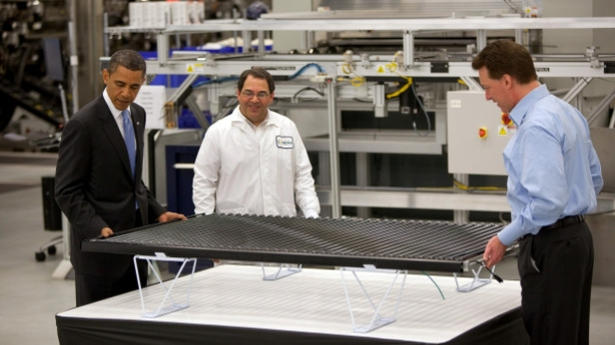
“The true engine of economic growth will always be companies like Solyndra,” President Obama said in May during an appearance at the then-unfinished factory.

But during the year that Solyndra’s plant was under construction, competition from the Chinese helped drive the price of solar modules down 40 percent. Solyndra rushed to start cranking out panels on Sept. 13, two months ahead of schedule, and it has increased marketing efforts to make the case to customers that Solyndra’s more expensive panels are cost-effective when installation charges are factored in.

“It definitely puts more pressure on us to bring our costs down as quickly as possible by ramping up volume,” said Ben Bierman, Solyndra’s executive vice president for operations and engineering, as driverless carts shuttled stacks of photovoltaic parts to large orange robots at Fab 1, the company’s original factory.

To be sure, Silicon Valley companies like Solyndra, Nanosolar and MiaSolé continue to receive hundreds of millions of dollars in customer orders and some plan to expand local manufacturing. But the rapid rise of low-cost Chinese manufacturers has made investors — who once envisioned the region’s future as Solar Valley — skittish about backing new capital-intensive start-ups.

“I don’t see another Solyndra being done,” said Anup Jacob, whose private equity firm, Virgin Green Fund, has invested significantly in Solyndra. “It’s very difficult today to show a business plan to investors and say, ‘I need hundreds of millions to a billion dollars to get to scale.’ ”

In the third quarter of 2010, venture capital investment in solar companies plummeted to $144 million from $451 million in the year-ago quarter, according to the Cleantech Group, a San Francisco research firm.

The paucity of capital and the sheer size of Chinese solar panel makers have proved particularly problematic for companies like Solyndra and MiaSolé, which make photovoltaic cells using a material called copper indium gallium selenide, or CIGS.

Unlike conventional solar cells, which are made from silicon wafers, CIGS cells can be deposited on glass or flexible materials, much as ink is printed on rolls of newspaper. Though the technology is less efficient at converting sunlight into electricity, the promise of “thin film” solar cells was that they could be made cheaply.

However, producing CIGS cells on a mass scale has turned out to be a formidable technological challenge, requiring the invention of specialized manufacturing equipment.

While Silicon Valley companies were working on the problem, silicon prices fell and Chinese companies like JA Solar, Suntech and Yingli Green Energy rapidly expanded production of conventional solar panels, supported by tens of billions of dollars in inexpensive credit from the Chinese government as well as other subsidies like cheap land.

Arno Harris, chief executive of Recurrent Energy, a San Francisco solar developer acquired by Sharp last month, said he chose to sign a supply deal with Yingli because the Chinese company offered low prices, quality products and financing.

“We realized that would enable us to bid competitive power prices from projects that could also be efficiently financed,” Mr. Harris said in an e-mail. “It may seem obvious to state it this simply, but declining prices are the key to driving the next era of demand for solar.”

Chinese solar panel makers now supply about 40 percent of the California market, the largest in the United States, and the bulk of the European market, according to Bloomberg New Energy Finance, a research and consulting firm.

“We grow every year with double revenue and almost double capacity,” said Fang Peng, the chief executive of JA Solar, in a telephone interview from the company’s Shanghai headquarters. “At end of the year, we will have 1.8 gigawatts of capacity and will have grown from 4,000 employees at the beginning of this year to more than 11,000.”

By comparison, Solyndra expects to have a total production capacity of 300 megawatts by the end of 2011.

The competition from the Chinese has prompted some Silicon Valley companies, like AQT Solar, to pursue new strategies to survive.
You can read the rest of the story here.

In The New York Times on Monday, I write about how opponents of Proposition 23, the California ballot measure that would suspend the state’s global warming law, are outspending the oil industry interests backing the initiative:

At the start of the campaign for California’s Proposition 23, the ballot measure that would suspend the state’s global warming law, opponents darkly warned that the Texas oil companies backing the initiative would spend as much as $50 million to win the election.

But with three weeks until Election Day, it is the No on 23 coalition of environmentalists, investors and Silicon Valley technology companies that is raking in the cash, taking in nearly twice as much money as the Yes on 23 campaign.

As of Monday, the No on 23 forces had raised $16.3 million to the Yes campaign’s $8.9 million, according to California Secretary of State records. Over the past two weeks, nearly $7 million has flowed into No campaign coffers while contributions to the Yes effort had fallen off dramatically.

With the failure of federal climate change legislation, considerable national attention is focused on Proposition 23, which marks the first time a global warming law has been put before voters.

Representatives from the Yes campaign did not return a request for comment. But Steven Maviglio, a spokesman for the main No campaign, said he still expects the oil and petrochemical interests that account for 97 percent of the Yes contributions to “drop a nuclear bomb” in the coming weeks.

“You don’t launch this kind of campaign without knowing from the get-go what you’re going to spend,” said Mr. Maviglio, a longtime Democratic operative in California. “Did we catch them off guard on how much the business community in the state would spend to defend the law? Yes. But they’re still going to blitz us.”

A few hours after the interview with Mr. Maviglio on Friday, the Yes campaign reported its first sizable donation since Sept. 13, with Marathon Petroleum of Findlay, Ohio, contributing $500,000.

California’s Global Warming Solutions Act of 2006 requires the state to cut greenhouse gas emissions to 1990 levels by 2020. Proposition 23 would suspend the law, known as A.B. 32, until the state unemployment rate fell to 5.5 percent for four consecutive quarters, something that has happened only three times in the past 40 years

A recent Los Angeles Times/University of Southern California poll showed voters evenly split over Proposition 23, with 21 percent undecided. But a Reuters/Ipsos poll published Tuesday found the ballot initiative losing 49 percent to 37 percent.

Campaign finance records show that the No campaign has attracted big donations from Silicon Valley venture capitalists, New York hedge fund managers, national environmental groups and green technology executives.

You can read the rest of the story here.

I wrote this story for Grist, where it first appeared.

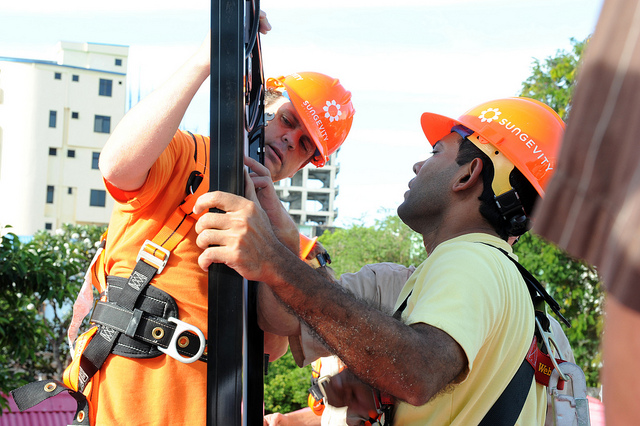
The president of the Maldives, Mohamed Nasheed (on right in above photo), didn’t just agree to have solar panels installed on the presidential mansion; he helped put them in. Nasheed scrambled up to the roof this week, screwdriver in hand, and joined the crew from California’s Sungevity, which installed the 11.5-kilowatt photovoltaic array.

(Don’t expect to see Barack Obama in a hard hat any time soon, even though his administration just gave the OK to the solarization of the White House.)

The Maldives, of course, is the poster country for global warming. The Indian Ocean archipelago rests, on average, fewer than five feet above sea level and the nation of some 305,000 people would be rendered uninhabitable by rising waters.

“For the Maldives, climate change is a real challenge,” said Nasheed on a conference call Wednesday. “It’s not a problem in the future, it’s a problem we face every day.”

“We have 16 islands that have serious erosion problems,” he added. “We’ve had to relocate people from one island to another. We also have severe saltwater contamination. We have a serious food security issue.”

Sungevity and Bill McKibben’s 350.org were behind the campaign to put solar on the U.S. White House. The Maldives rooftop installation is part of this Sunday’s 10/10/10 “Global Work Party,” another McKibben initiative to get people to take action against climate change.

Nasheed, 43, has shown himself adept at focusing media attention on the impact of global warming on the world’s low-lying island nations — last October, he and his cabinet donned scuba gear to hold an underwater meeting.

But putting solar panels on the presidential home is not so much a PR stunt as part of the nation’s aggressive efforts to wean itself from the imported oil it relies on to generate electricity.

In January, Nasheed pledged to the United Nations that the Maldives would go carbon neutral by 2020. Making good on his pledge won’t turn back the rising tide, but Nasheed said the Maldives can show other island nations that it is possible to replace fossil fuels with renewable energy. “If it can work here in the Maldives it can work anywhere with 300,000 people,” he said. “We’re going to see a very big technology shift. There’s going to be another industrial revolution. If you’re not clever enough to embrace the future, you cannot be a world leader.”

According to an official in the president’s office, the Maldives total electricity demand is 200 megawatts.

A Finnish company, WinWind, has proposed building a 25-megawatt wind farm on the Maldives’ Gaaf Alif atoll, while Indian wind turbine maker Suzlon is investigating the feasibility of constructing a 15-megawatt wind farm on the Addu atoll. Japan has provided financial assistance for a project to install a megawatt’s worth of rooftop arrays on schools and government buildings in Male, the country’s capital.

International donors, meanwhile, have promised $30 million for renewable projects. Scotland and the Maldives have signed an agreement to investigate the potential for developing wave and tidal power in the archipelago, according to the president’s office.

To provide electricity when there’s no wind or sun, the Maldives is considering biomass power plants that would run on coconut husks. Outlying islands, however, would probably have to continue burning oil until the price of batteries used to store renewable energy became affordable.

LG, the Korean company, donated the panels for the presidential solar array and the inverters were contributed by the German company Kaco. Sungevity used satellite images and its proprietary software to size and design the solar system at its Oakland, Calif., headquarters, then flew a crew to the Maldives to install it.

“We’re averting about 200 tons of C02 from the system and there’s a 27 percent return on investment,” said Danny Kennedy, Sungevity’s co-founder and a former Greenpeace activist, who traveled to the Maldives for the installation. “President Nasheed is demonstrating this is a wise and affordable investment.”

Or as Nasheed put it, “For us, it is an issue of life or death. We have been living in the middle of the Indian Ocean and have a written history that goes back 1,000 years. We cannot relocate.”

“We have to take direct action,” he continued. “As the president, it’s difficult for me to talk like this. This has to involve a fair amount of direct action on the streets.”

photo: Todd Woody

I wrote this story for Grist, where it first appeared.

Interior Secretary Ken Salazar on Tuesday gave the green light to the first two big solar power plants to be built on federal land in the California desert, promising more approvals of solar projects in the coming weeks.

The granting of leases to Tessera Solar’s massive 709-megawatt Imperial Valley Solar Project and to a smaller 45-megawatt photovoltaic farm to be built by Chevron come four years after the solar land rush began in the Mojave Desert.

With nearly 200 applications filed on hundreds of thousands of acres of Bureau of Land Management (BLM) property, the federal government soon became overwhelmed trying to weed out viable projects from speculators. Environmentalists, meanwhile, grew alarmed at the potential impact of such huge industrial projects on a plethora of imperiled wildlife, as well as on water supplies and desert vistas.

The Obama administration beefed up BLM staff devoted to solar projects and began collaborating with California agencies to streamline the approval process.

“Today’s projects are proof that we can cut red tape without cutting corners,” Salazar said Tuesday during a press conference.

The looming expiration of federal tax incentives for large renewable energy projects also lit a fire under state and federal regulators to license power plants so that developers could begin construction by the end of the year.

For instance, since Aug. 25, the California Energy Commission has licensed six solar thermal power plants that would cover some 39 square miles of desert land and generate 2,829 megawatts. That’s nearly six times as much solar capacity as was installed in the United States last year.

“I am excited to join Secretary Salazar today in announcing the first solar projects to ever get permits on federal land, both of which will be located in the Golden State,”  California Gov. Arnold Schwarzenegger said in a statement. “Today’s announcement only further cements California’s national leadership in renewable energy development.”

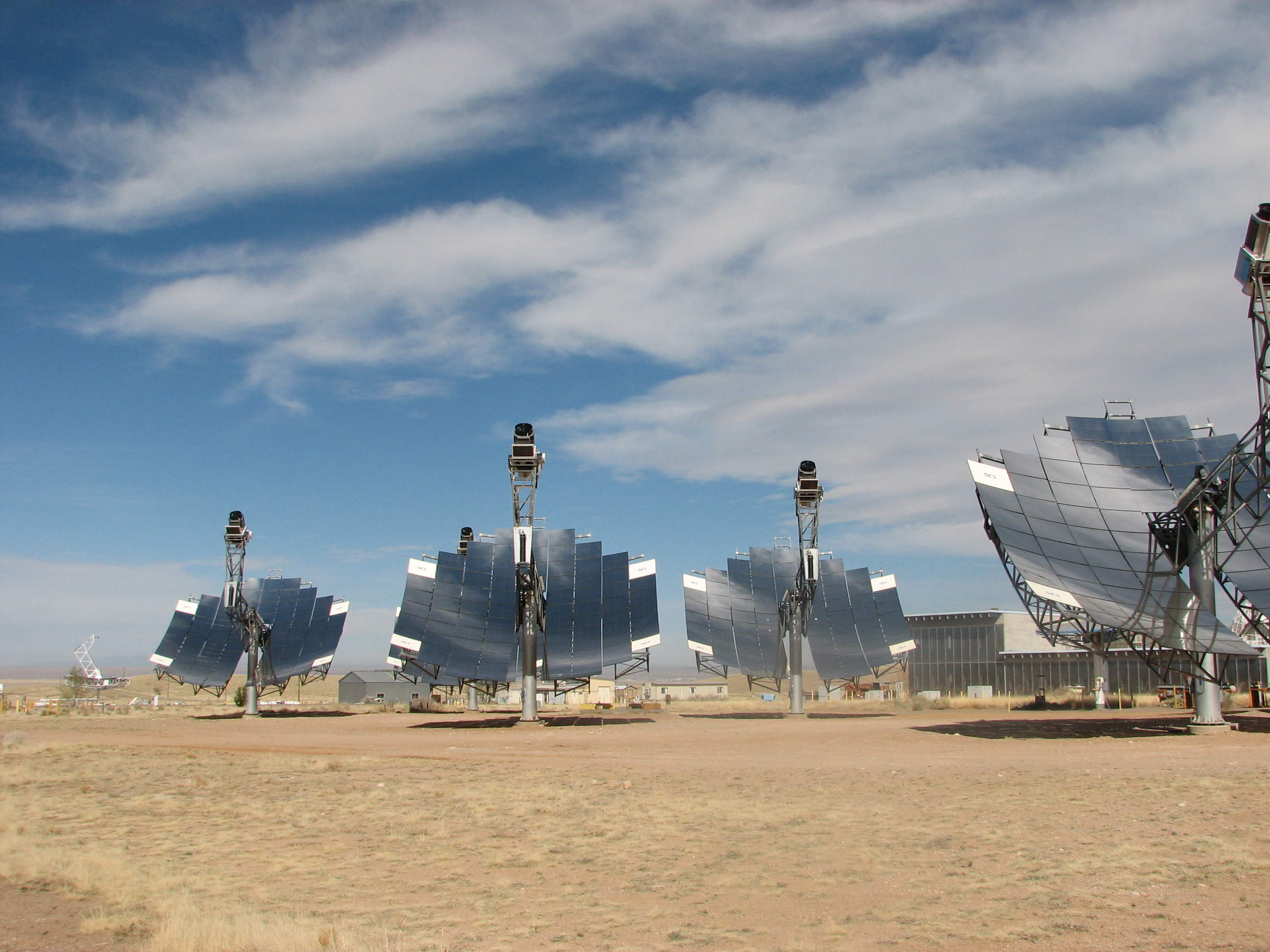
Some environmental groups initially raised concerns about the Imperial Valley project, which will place 19,000, 38-foot by 40-foot Stirling solar dishes on 6,400 acres of desert land near the Mexican border east of San Diego. Of particular concern was the project’s impact on the flat-tailed horn lizard and the Peninsular bighorn sheep. A Native American tribe, meanwhile, objected to the power plant’s presence on their ancestral lands.

But Johanna Wald, a senior attorney at the Natural Resources Defense Council in San Francisco, said the developer’s willingness to shrink the project to mitigate degradation of wildlife habitat and to minimize its water consumption won over her group and other environmentalists.

“The company sat down with NRDC and our conservation partners and agreed to a number of important measures that were above and beyond the requirements that were imposed by the state and federal regulators,” Wald said in an interview.

Nevertheless, the Sierra Club, the Center for Biological Diversity, and Native Americans have continued to object to the Imperial Valley solar farm.

Wald singled out the much smaller Chevron project as one where developers’ selection of a site near transmission lines and away from protected wildlife paid off in the unanimous support from major environmental groups.

“Chevron,” she said, “is a project we all would agree was smart from the start.”

I wrote this story for Grist, where it first appeared.

Talk about student activism: Lucy Southworth, a Stanford University doctoral student, has given $100,000 to the campaign to defeat Proposition 23, the California ballot initiative that would suspend the state’s global warming law.

If the name doesn’t ring a bill, try Googling. In Silicon Valley, Southworth is better known as the wife of Google co-founder Larry Page.

Her contribution follows the $500,000 earlier donated to the No campaign by Wendy Schmidt, wife of Google Chief Executive Eric Schmidt. (Disclosure: Wendy Schmidt serves on Grist’s board of directors.)

The No forces took in $200,580 in campaign contributions on Monday, following a $5 million haul in the previous week, according to California Secretary of State records. Applied Materials, the world’s biggest manufacturer of the machines that make computer chips, gave $25,000 on Monday; Chicago-based wind developer Invenergy donated $10,000; and William S. Fisher, San Francisco investor and an heir to the Gap clothing empire, donated $25,000, as did Sakurako D. Fisher.

All this check writing is to protect California’s climate change law, known as AB 32. The law requires the state to cut greenhouse gases to 1990 levels by 2020. Prop 23 would suspend AB 32 until the unemployment rate fell to 5.5 percent for four consecutive quarters, a rare occurrence in recent decades.

The Yes campaign, which is largely funded by two Texas oil companies, continues to lag far behind in the fundraising department of late. It logged one $5,000 contribution on Monday, from a Mississippi barge company that hauls petroleum and petrochemicals.

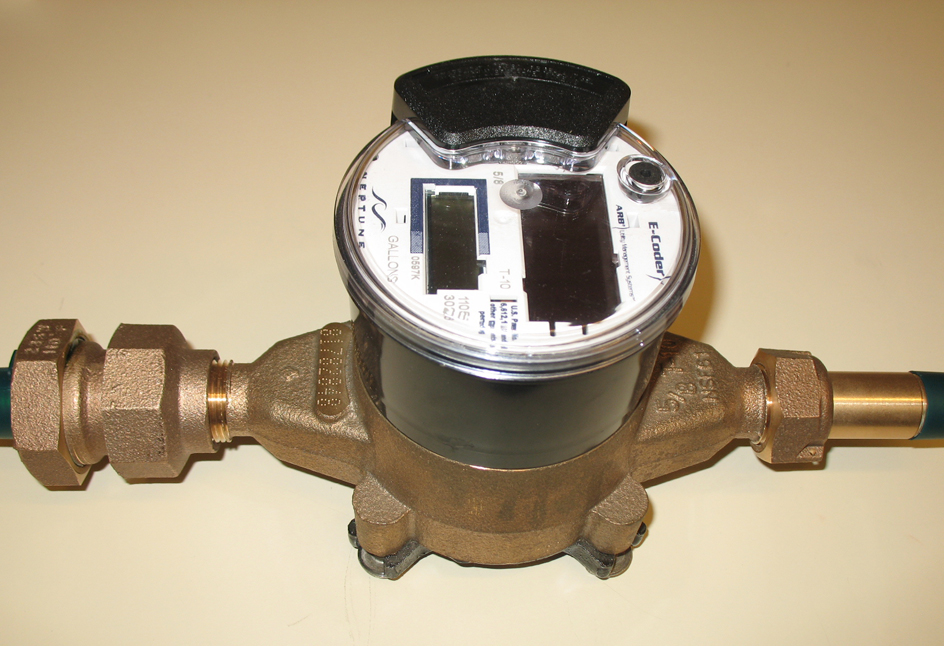
In The New York Times on Tuesday, I write about an IBM pilot project in Dubuque, Iowa, to install smart water meters in 311 homes to give residents’ real-time information on their water consumption:

While some California cities move to ban smart electricity meters over fears about their impact on human health, residents of Dubuque, Iowa, are embracing smart water meters.

Like smart electricity meters, smart water meters measure consumption and wirelessly transmit the data to utilities. In Dubuque, 311 households have volunteered to have smart water meters installed as part of a pilot project between the city and I.B.M. to see if giving residents information on their water use in real time will prompt them to conserve. The project is also designed to help city officials spot and repair leaks in the water system as they happen.

“The more frequently water use is monitored, the more quickly things like leaks can be detected and addressed,” Milind Naphade, program director for I.B.M.’s smarter city services, said in an e-mail. “Also, we’ll be able to better identify trends and patterns over time more quickly with this frequency.”

Many water bills are issued quarterly, so residents may not notice a spike in consumption as a result of leaks or other problems for months. The smart meters in Dubuque, on the other hand, will transmit data on a home’s water use to I.B.M. computers every 15 minutes.

Residents can go to a Web site to monitor their water use.

“Water isn’t generally seen as something of value — even though water managers in 36 states expect to face water shortages in the next few years,” Mr. Naphade wrote. “By providing this level of detailed information to program participants, we can help them really understand where their water is going, and where they can make changes in terms of how and when they use water to reduce the overall amount they’re using on a daily basis.”

Cutting water use also saves the city energy costs as less electricity is needed for pumping, city officials noted.

You can read the rest of the story here.

Design a site like this with WordPress.com
Get started