Feeds:
Posts
Comments

photo: Todd Woody

In a follow up to my story in Friday’s New York Times on the beginning of a solar building boom in the desert Southwest, I take a look at California regulators’ approval of the seventh Big Solar farm in two months, the 663.5-megawatt Calico project:

In an article in Friday’s paper, I write about the solar thermal power plant building boom now under way in California’s Mojave Desert. The looming expiration of crucial federal financial support for the multibillion-dollar projects, though, could turn the boom to bust.

But that hasn’t deterred California regulators, who on Thursday approved the seventh large-scale solar thermal farm since late August.

After years of painstaking environmental review, the California Energy Commission has been green-lighting the massive solar power plants at warp speed so developers can break ground before year’s end and qualify for a government cash grant that covers 30 percent of the cost of construction.

The latest approval goes to Tessera Solar’s Calico project, to be built in the San Bernardino County desert in Southern California. Originally proposed to generate 850 megawatts -– at peak output, that’s close to the production of a nuclear power plant -– the project was whittled down to 663.5 megawatts to lessen the impact on wildlife like the desert tortoise and the bighorn sheep.

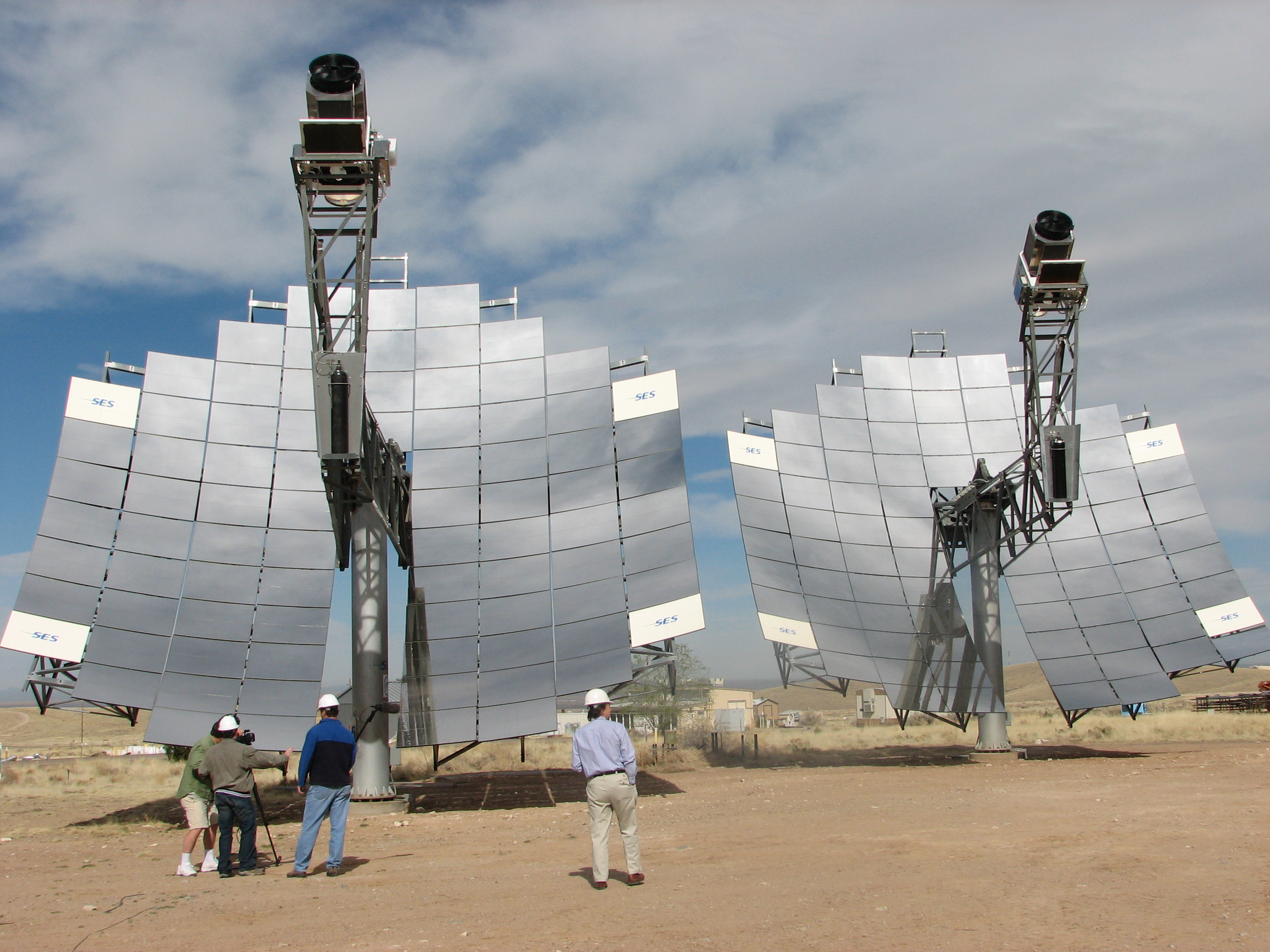
It’s difficult to appreciate the sheer scale of even the smaller version of the Calico project until you’ve seen Tessera’s Suncatcher solar dishes on the ground. A few years ago I had the opportunity to visit a prototype six-dish Suncatcher solar farm at the Sandia National Laboratories in New Mexico.

Resembling a giant mirrored satellite receiver, each Suncatcher stands 40 feet tall and 38 feet wide with a Stirling engine suspended on an arm over the center of the dish. As the dish tracks the sun, its mirrors concentrate sunlight on the hydrogen gas-filled heat engine. As the superheated gas expands, it drives pistons, which generates 25 kilowatts of electricity.

Now imagine planting 26,540 Suncatchers on 4,613 acres of federal land for the Calico project. Tessera, based in Houston, has also received approval for a 709-megawatt solar power plant to be built in California near the Mexico border. That will require the installation of 28,360 Suncatchers.

“These desert solar projects will provide clean power for our schools, homes, and businesses while reducing fossil fuel consumption, creating local jobs, and reducing the greenhouse gas emissions that threaten California’s economy and environment,” Anthony Eggert, a member of the California Energy Commission, said in a statement on Thursday.

The cost to build the two projects will exceed $4.6 billion, according to Tessera, and it’s highly unlikely that they’ll go online unless the company receives federal loan guarantees that allow developers to borrow up to 80 percent of construction costs on favorable terms. That program expires next September, and Tessera needs to start putting steel into the ground by the end of the year to qualify for the cash grant program.

You can read the rest of the story here.


photo: Todd Woody

In Friday’s New York Times, I write about the beginning of the long-awaited solar boom in the Mojave Desert and how it may well be short-lived if crucial federal incentives for renewable energy are allowed to expire in the coming months:

NIPTON, Calif. — The long-promised solar building boom in the desert Southwest is finally under way. Here in the Mojave Desert, a dice throw away from the Nevada border, giant road graders and a small army of laborers began turning the dirt for BrightSource Energy’s $2 billion Ivanpah project, the first large-scale solar thermal power plant to be built in the United States in two decades.

The Ivanpah plant is the first of nine multibillion-dollar solar farms in California and Arizona that are expected to begin construction before the end of the year as developers race to qualify for tens of billions of dollars in federal grants and loan guarantees that are about to expire. The new plants will generate nearly 4,000 megawatts of electricity if built — enough to power three million homes.

But this first wave may very well be the last for a long time, according to industry executives. Without continued government incentives that vastly reduce the risks to investors, solar companies planning another dozen or so plants say they may not be able to raise enough capital to proceed.

“I think we’re going to see a burst of projects over the next two months and then you’re going to hear the sounds of silence for quite a while,” said David Crane, chief executive of NRG Energy, on Wednesday after he announced that his company would invest $300 million in the Ivanpah plant.

Solar developers depend on two federal programs to make their projects financially viable. The most crucial is a loan guarantee program, expiring next September, that allows them to borrow money on favorable terms to finance up to 80 percent of construction costs.

The other is the option to take a 30 percent tax credit in the form of a cash payment once a project is built. Although the tax credit does not expire until the end of 2016, the option to take it as a cash payment disappears this year, making it far less valuable to a start-up company that is just beginning to generate revenue.

With both Democrats and Republicans promising to rein in the federal budget, it is unclear whether lawmakers will extend the programs in any form. “That could stall a number of projects and even lead to the failure of some,” said Ted Sullivan, an analyst with Lux Research, a consulting firm in New York.

Yet no one in the desert here wants to think too much about those looming clouds.

“Ivanpah represents a transformational moment in our energy equation,” said John Woolard, BrightSource’s chief executive, who was joined Wednesday by Gov. Arnold Schwarzenegger of California and Interior Secretary Ken Salazar at Ivanpah’s groundbreaking ceremony. “It demonstrates that the U.S. can lead in the drive for renewable energy at scale by building the largest solar plant in the world with new technology.”

The eight California projects that are expected to break ground this year will turn 46 square miles of the desert into a futuristic landscape of mirrors, towers and solar dishes. State officials estimate the plants will create 8,000 jobs in a state with a 12.4 percent unemployment rate.

During its three years of construction, Ivanpah will employ as many as 1,000 laborers in a recession-scarred region.

“In the last year, I haven’t worked,” said Basilio Yniguez, a 36-year-old pipefitter and father of seven, as he helped build a holding pen last week for threatened desert tortoises on the Ivanpah site. “Thanks to the green thing going up, I’m working.”

The state is supporting the industry in part by mandating that California utilities get a third of their electricity from renewable sources by 2020.

“When you look at the raw number of kilowatt-hours we need, I don’t see how you get there without large central station solar projects,” said Pedro Pizarro, a top executive with Southern California Edison, one of the state’s largest utilities.

Unlike the photovoltaic panel systems found on rooftops, most of the new solar plants will use thousands of large mirrors to heat liquids to generate steam that drives conventional electricity-generating turbines.

“Without the Department of Energy coming in to assume a lot of the risk, you might not find lenders willing to lend, particularly if you’re a start-up with untried technology,” said Nathaniel Bullard, a solar analyst at Bloomberg New Energy Finance.

Other hurdles also stand in the way of the solar expansion. For some plants, multibillion-dollar transmission lines must be built to carry electricity from the desert to cities. Some environmentalists continue to oppose the projects’ impact on imperiled wildlife, such as the desert tortoise, and may sue to stop construction.

The competitiveness of large-scale solar thermal plants in California also depends on the cost of natural gas, the state’s dominant source of electricity. According to Mr. Bullard, gas-fueled plants can produce electricity for about 10 cents a kilowatt-hour. After including the government subsidies, solar thermal plants are expected to generate power at 13 to 17 cents a kilowatt-hour, which the industry says is close enough in price to be competitive.

So far, Ivanpah is the only California solar thermal project to win a government loan guarantee, although other projects have applied and are awaiting decisions from the Energy Department.

“We are sensitive to the deadlines and are doing everything we can so that these projects can move forward,” said Jonathan Silver, the executive director of the department’s loan program. “There’s a significant demand for these funds.”

The uncertainty has left even some of the licensed solar projects in limbo.

You can read the rest of the story here.

I wrote this story for Grist, where it first appeared.

Installation of new wind power capacity in the United States is expected to decline 39 percent this year, according to a report released Thursday.

Now that would be a brutal blow for any industry battered by a vicious recession. But it’s particularly bad news for the American wind industry, which had defied the downturn by installing a record 10,000 megawatts of new capacity in 2009. New wind capacity had grown an average 39 percent annually over the previous five years and represented 39 percent of all new electrical generation that came online last year.

China, meanwhile, has become the world wind leader and is projected to install 14,000 megawatts of new capacity this year, a 25 percent spike from 2009, according to Bloomberg New Energy Finance, a renewable power research and consulting firm.

“Approximately one in two wind turbines to go online in 2010 will be in China,” the Bloomberg report states. “The U.S. market continues to be challenged by fallout from the financial crisis, low power prices and an uncertain medium-to-long term policy environment.”

In other words, the inability of the United States to enact federal climate change legislation or a national renewable energy standard and its Lucy-Charlie-Brown-and-the-football approach to financial incentives for wind power — no, really I won’t yank those tax breaks away this time, come on kick the ball — has made investing in multibillion-dollar wind projects a gamble.

China, on the other hand, has poured billions into its domestic wind industry with the avowed goal of becoming a global leader in the industry. It’s largely because of Chinese demand that new worldwide capacity only declined an estimated 2 percent in 2010.

“The emergence of China as the world’s leading wind market in the last two years is driving a fundamental rebalancing of industrial focus,” William Young, Bloomberg New Energy Finance’s chief of wind industry research, said in a statement. “Chinese turbine manufacturers have muscled their way onto the top table.”

So is the U.S. just tilting at turbines?

In the U.S., plummeting natural gas prices may be just as a big a culprit as a dysfunctional political system. When natural gas-fired electricity is dirt cheap, utilities think twice about signing contracts to buy much more expensive wind power — especially if they’re located in a state without a strong mandate to purchase renewable energy.

On Wednesday, I happened to be talking to Stuart Hemphill, senior vice president of power procurement at utility Southern California Edison, about the impact of low natural gas prices on the competitiveness of renewable energy projects.

Hemphill noted that over the past couple of years, natural gas prices have plunged from $14 per million BTU to $2 per million BTU.

“Natural gas as fuel has become extraordinarily competitive,” he said, noting that the boom in shale gas production is contributing to the downward pressure on prices.

There was some good news in the Bloomberg New Energy Finance report: The industry should bounce back in 2011. The question, of course, is just where that bounce back will happen.

I wrote this story for Grist, where it first appeared.

Every day seems to be green day for California Gov. Arnold Schwarzenegger as his term terminates and he works to cement his environmental legacy

On Wednesday, the governator started his morning in the Mojave Desert at the official groundbreaking for BrightSource Energy’s Ivanpah 370-megawatt solar power plant, the first large-scale solar thermal farm to be built in the United States in two decades.

By the afternoon, Schwarzenegger had materialized in Silicon Valley. He joined Avatar director James Cameron for a live webcast from tech company Applied Materials to unveil a new online commercial opposing Proposition 23, the ballot measure that would suspend California’s landmark global warming law. The governor considers the climate change law, known as AB 32, to be one of his crowning achievements in office.

Backed by two Texas oil companies, Prop 23 would effectively kill the global warming law — which requires California to slash greenhouse gas emissions to 1990 levels by 2020 — by suspending it until the state unemployment rate falls to 5.5 percent for four consecutive quarters. (Something as likely to happen anytime soon as Schwarzenegger giving up his trademark cigars.)

“The people who tried to take out AB 32 through Proposition 23 are the people who are really the biggest polluters of our state, Texan oil companies,” said Schwarzenegger, sharing the stage with Cameron, who directed him in the Terminator movies and True Lies, and Tom Steyer, the founder of a $20 billion San Francisco hedge fund and the chair of the No on 23 campaign.

(Before the webcast began, an open microphone caught Schwarzenegger chatting with Cameron and Steyer. Alas, no racy reminiscences of the Terminator’s Hollywood days — just the governor enthusing over the BrightSource Energy project.)

The ad opens with a wide shot of Cameron sitting in an office surrounded by movie mementos.

“I’ve made movies about a cyborg assassin sent to annihilate humanity, an unsinkable ship on a collision course with an iceberg, and about a mineral-rich alien moon facing environmental destruction,” says the director, who has donated $1 million to the No on 23 campaign. “Those are movies. But we face a real threat right now in California. Two oil companies from Texas are pushing Prop 23. This deceptive ballot measure would be the ultimate real-life disaster, terminating our air pollution standards, sinking our clean energy economy and exploiting our environment for profit.”

“We can do something as people who care about the future of California,” Cameron continues. “We can say no on Prop 23, to stop the dirty energy proposition. Tell your friends and family, cyborgs, and avatars, to vote no on 23 before it’s too late. ”

The camera pans to Schwarzenegger, holding up a robotic arm, saying, “Why do you keeping calling me a cyborg?”

With less than a week to go until Election Day, the “no” forces appear to be on a roll, holding a three-to-one advantage over the “yes” campaign in fundraising and with polls showing Prop 23 losing by a wide margin.

But with a Los Angeles Times/USC poll this week showing 15 percent of likely voters undecided, the Terminator apparently is determined not to stop. Ever.

photo of desert tortoise tagged with a radio transmitter at the Ivanpah solar farm site: Todd Woody

In Yale Environment 360 on Wednesday, I interview John Woolard, chief executive of BrightSource Energy, the California solar developer that has begun construction of the first large-scale solar thermal power plant to be built in the United States in two decades:

Today, California Gov. Arnold Schwarzenegger, Interior Secretary Ken Salazar, and other dignitaries gathered in the Mojave Desert to officially break ground on BrightSource Energy’s Ivanpah Solar Electric Generating System, the first large-scale solar thermal power plant to be built in the United States in nearly two decades.

BrightSource is one of a half-dozen big solar farms, with a combined electricity-generating capacity of 2,829 megawatts, licensed by the California Energy Commission over the past two months. By year’s end, California and federal regulators expect to approve additional projects that will produce a total of 4,143 megawatts. At peak output, that’s the equivalent of several nuclear power plants and more than seven times the solar capacity installed in the United States last year.

The approval of the projects comes after years of environmental review and controversies over the installations’ impact on water, wildlife, and fragile desert landscapes. The power plants licensed so far will cover some 39 square miles of desert land with a variety of new and old solar thermal technologies. Unlike rooftop photovoltaic panels that directly convert sunlight into electricity, solar thermal uses the sun to heat liquids to create steam that drives electricity-generating industrial turbines.

BrightSource’s 370-megawatt Ivanpah project, located just over the California border, 40 miles southwest of Las Vegas, is the world’s largest solar-thermal power plant project currently under construction. The company, led by CEO John Woolard, received a $1.37 billion loan guarantee from the United States Department of Energy to build the project, which will deploy 347,000 large mirrors that will surround three towers on 3,500 acres of federal land. The mirrors will focus the sun on a water-filled boiler that sits atop the tower to create high-temperature, high-pressure steam.

Woolard, 45, came to BrightSource as chief executive in 2004 after co-founding Silicon Energy, an energy efficiency software company, and stints at California utility PG&E, the Lawrence Berkeley National Laboratory, and VantagePoint Venture Partners, a leading Silicon Valley green tech venture capital firm. He sat down with Yale Environment 360 contributor Todd Woody at BrightSource’s Oakland, Calif., headquarters to talk about the future of Big Solar and the challenges the industry faces — from a woefully inadequate electricity grid to the imperative of minimizing water use — as multibillion-dollar projects finally begin to become a reality.

Yale Environment 360: Are we witnessing the birth of a major new solar industry in the United States?

John Woolard: I hope. The number I always go back to is that we have done 74,000 permits for oil and gas in the last 20 years and we finally have five or six for solar. That’s a good step forward. The agencies are learning how to permit, they’re learning how to move forward. It’s great for the industry and we can finally get some size and consequence.

e360: As the photovoltaic industry increasingly becomes dominated by overseas companies in China and elsewhere, does the sheer scale of these solar thermal projects in the U.S. give the country the opportunity to become the technological and market leader?

Woolard: Oh, yeah. Solar thermal is very different from [photovoltaic technology]. The power has different characteristics and is more reliable. They’re almost apples and oranges. Solar thermal has got very interesting We don’t have a quantity and energy problem; It’s a collection and distribution problem.” attributes and characteristics that make it unique.

In the U.S. we’re lucky. The southwestern U.S. has high desert, which means it’s closer to the sun, less atmosphere to go through. It’s the best solar resource anywhere, outside the Anaconda Desert in Chile or a few places. Harnessing that resource effectively is the most important thing. So we don’t have a quantity and energy problem; it’s a collection and distribution problem.

e360: BrightSource’s Ivanpah project is not only the first large-scale solar thermal project to break ground, it is the first to deploy a new power tower technology. Why is that significant?

Woolard: Our team was part of building older trough plants and you learn a lot. If you take a power tower, you get higher temperatures and pressures. That gives you higher thermo-to-electrical conversion efficiency. Think of that as more efficiency, less waste, lower cost. Because of that, you need fewer mirrors, less solar field, and you have a more efficient design.

The other gets down to how you actually build on the land. If you take the older trough designs or anything with a lot of mirrors, [it] would degrade the land. It’s more damaging from a soil and runoff perspective.

The big [problem] is water. What is the world going to look like over the next 20, 30, 40 years? Water in the desert is going to become a much more challenging proposition. So we’ve gotten water usage down to a minimum — the lowest of anybody in the world, basically.

You can read the rest of the interview here.

photo: Todd Woody

I wrote this story for Grist, where it first appeared.

The United States is on the verge of a solar boom that could provide 4.3 percent of the nation’s electricity by 2020, according to a new report from Bloomberg New Energy Finance.

There’s just a 12-figure catch: Investors need to put $100 billion into the solar industry to keep the generation of solar electricity growing by 42 percent a year for the next decade to expand capacity from the current 1.4 gigawatts to 44 gigawatts.

“Policy measures such as tax credits, capital expenditure grants, generation incentives and renewable electricity credits will remain a key driver of solar uptake in the U.S. for at least the next three years,” according to the report from Bloomberg New Energy Finance, a research and consulting firm. “The current drop in solar costs is taking place just as such policies are being implemented by the federal and various state governments, which is expected to lead to rapid growth in commercial, utility and residential solar power.”

Over the past two years, solar module prices have plunged by 50 percent as low-cost Chinese manufacturers expanded production and entered the U.S. market.

“Policy, rather than sunshine, will remain the U.S.’s greatest solar resource for the next few years,” Milo Sjardin, Bloomberg New Energy Finance’s head of U.S. research, said in a statement. “By the middle of this decade, however, the U.S. retail solar market will be driven by fundamental, unsubsidized competition, which should transform the U.S. into one of the world’s most dynamic solar markets.”

Exhibit A for such a phenomenon is Germany. With about as much sunshine as Maine, the European nation became the world’s solar stronghold through policies that rewarded homeowners, businesses, and farmers for generating their own electricity.

Such policies are needed in the U.S., according to the report, given that solar electricity remains four times as expensive to generate than coal-fired power.

Of course, the failure of Congress to pass national climate change legislation and the current attempt to kill California’s global warming law shows that progress on green energy issues is not guaranteed in the U.S. And Congress’ habit of offering short-lived tax incentives for renewable energy and then dithering about extending them when they expire has played havoc with the industry and investors.

Bloomberg New Energy Finance predicts photovoltaic panels will account for 30 gigawatts of the 44 gigawatts of solar electricity generation by 2020, with 14 gigawatts coming from solar thermal power plants. Solar thermal farms deploy huge arrays of mirrors to heat liquids to create steam that drives electricity-generating turbines.

That might be a conservative estimate, if the California and federal officials’ rush to green light big solar projects in recent weeks is any indication. On Monday, for instance, Interior Secretary Ken Salazar approved a 1,000-megawatt solar thermal power plant to be built in the Southern California desert.

By year’s end, nearly four gigawatts of solar thermal projects are expected to be licensed. Just 10 gigawatts to go until 2020.

I wrote this story for Grist, where it first appeared.

With a week to go until Election Day, a gusher of Texas oil money has begun to flow once more into California to support Proposition 23, the ballot measure that would suspend the state’s global warming law.

On Friday, Tesoro and Valero, the Texas oil companies that are largely funding Prop 23, contributed $1.5 million to the campaign in the first seven-figure donation since Sept. 2, when the billionaire Koch brothers dropped $1 million into campaign coffers, according to California Secretary of State records.

But in the intervening months, when contributions from the petrochemical industry dwindled mostly to a few five-figure donations, the No on 23 campaign revved up its fundraising efforts and now has taken in more than $30 million to the Yes forces’ $10.6 million.

Just in the last few days, San Francisco-based utility Pacific Gas & Electric has given another $250,000 to the No campaign while teachers and public employees unions donated a combined $300,000. (Tellingly, even an East Coast power company with coal-fired power plants in its portfolio, AES Corp., donated $25,000 to the No campaign on Friday.)

Also in the last couple of days, $500,000 has been given to No campaign committees targeting low-income and minority voters, which some strategists consider crucial to defeating Prop 23.

California’s climate change law, known as AB 32, requires the state to cut greenhouse gas emissions to 1990 levels by 2020. Prop 23 would suspend AB 32 until the state unemployment rate – currently at 12.4 percent – drops to 5.5 percent for four consecutive quarters. That has happened only three times in the past 40 years.

A new player in the No campaign is the California League of Conservation Voters and its parent organization, the League of Conservation Voters. The groups’ campaign committee has raised $4.2 million, including a $200,000 donation from a managing director at Goldman Sachs in New York.  The main No on 23 campaign has transferred $1.9 million to the committee in recent days, according to finance records.

“CLCV and LCV are contacting several hundred thousand California voters who are likely to support environmental values, explaining Prop 23 and asking them to vote no (either through absentee ballot or on Nov. 2), and turning out the vote on election day,” Jenesse Miller, a spokesperson for the California League of Conservation Voters, said in an e-mail. “Our campaign is a combination of phone calls, slate cards and other mail pieces.”

In a sign that the No forces may be feeling increasingly confident – a poll last week found Prop 23 losing – the League of Conservation Voters committee has been funneling money to other ballot initiatives important to environmentalists and green technology investors and entrepreneurs.

For instance, the committee has given more than $600,000 to defeat Proposition 26, a ballot measure supported by the oil, tobacco and alcohol industries that would reclassify environmental impact fees as taxes and require a two-thirds vote of the state legislature to impose them rather than a simple majority.

Green groups and AB 32 supporters fear Prop 26 could cripple efforts to levy fees to implement the global warming law

photo: Todd Woody

In The New York Times on Thursday, I wrote about the continuing legal battle over placing the American pika, a small mountain-dwelling critter, on state and federal endangered species lists due to climate change threats to the animal’s survival:

In an article in Wednesday’s paper, I wrote about an environmental law firm that persuaded thousands of San Francisco commuters to use their smartphones’ Foursquare application to “check in” at its advertisements in subway stations and raise money to save the American pika, a critter that may be threatened by climate change.

The nonprofit law firm, Earthjustice, scored a victory this week when a San Francisco judge ordered the California Fish and Game Commission to reconsider a decision to deny state endangered species protection to the pika.

A relative of the rabbit, the pika lives on the rocky slopes of alpine ranges in California and throughout the West. Even small increases in temperature prove fatal to the pika, which does not hibernate and maintains a high body heat to survive frigid winters. As temperatures rise in mountainous regions, some scientists have found that pika populations either have vanished at lower elevations or moved to higher ground. The pint-sized mammal is also at risk from melting snow packs, which it relies on to insulate its burrows during long winters.

Earthjustice represents the Center for Biological Diversity in its efforts to have the pika listed as a protected species under state and federal law. After initially finding that a listing may be warranted for the pika, the United States Fish and Wildlife Service in February concluded that the species could adapt to climate change.

In California, meanwhile, Earthjustice has been enmeshed in a three-year fight with the state Fish and Game Commission. The commission has twice rejected consideration of the Center for Biological Diversity’s petition to list the pika as a threatened species.

“The record in this case unequivocally demonstrates that the petition failed to include sufficient, if any, scientific information about population trend, population abundance, range, distribution, and degree and immediacy of threat to the pika throughout all or a significant portion of its range in California,” Cecilia L. Dennis, a California deputy attorney general, wrote in a motion filed Sept. 1 that opposed the environmentalists’ effort to re-open the listing proceedings.

But Greg Loarie, an attorney with Earthjustice, which is based in Oakland, Calif., argued that the Center for Biological Diversity offered more than ample evidence that a listing might be warranted for the pika, which would lead to a full investigation of the species’ status.

In court filings, Mr. Loarie said that the commission failed to properly consider new scientific evidence that his client presented in 2009 after Judge Peter Busch of the San Francisco Superior Court ordered the commission to reconsider the petition on the ground that it had used the wrong legal standard to reach its decision.

“As the expert agency charged with protecting California’s wildlife, the commission’s role is to evaluate the substance of the scientific evidence that it receives in support of and against a listing petition,” Mr. Loarie wrote in a brief.

You can read the rest of the story here.

photos: americanprogressaction, jmtimages, and jurvetson

I wrote this story for Grist, where it first appeared.

As a new poll showed that nearly half of likely California voters now oppose Proposition 23, the ballot measure that would suspend the state’s global warming law, heavy hitters from President Obama to Al Gore and Bill Gates came out against the initiative on Wednesday.

With the president on a West Coast campaign swing, a White House spokesperson told the Los Angeles Times that Obama “is opposed to Prop. 23,” calling the ballot measure backed by two Texas oil companies “a veiled attempt by corporate polluters to block progress towards a clean energy economy.”

“If passed, the initiative would stifle innovation, investment in R&D and cost jobs for the state of California,” the Obama spokesperson said.

Gore, meanwhile, issued a statement saying, “The fight for America’s clean energy future is taking place right now, and it’s come to California. This is a fight we simply cannot afford to lose.”

Gates, the Microsoft founder turned philanthropist, weighed in with a $700,000 contribution to the No on 23 campaign on Tuesday. The Nature Conservancy donated $500,000, bringing this week’s No on 23 fundraising total, so far, to more than $1.3 million. The Yes campaign, which is being underwritten by the petrochemical industry, has taken in $7,000.

As of Wednesday, the No forces had raised a total of more than $28 million, compared to the Yes campaign’s $9.1 million, according to California Secretary of State records.

Prop 23 would suspend California’s global warming law, known as AB 32, until the state unemployment rate drops to 5.5 percent for four consecutive quarters, which has happened only three times in the past four decades.

The No forces’ fundraising lead and statewide television commercials appear to be paying off in the polls. A September survey by the Public Policy of California found voters in the state evenly split over Prop 23. PPIC’s new survey finds that 48 percent of likely voters now oppose Prop 23, while 37 percent support the measure. Don’t pop that champagne yet, though. Fifteen percent of California voters are still undecided.

In a story in Wednesday’s New York Times, I write about how Earthjustice, a non-profit law firm, ran a successful successful fundraising campaign to help the climate change-endangered American pika by using Foursquare and location-based advertising:

SAN FRANCISCO

IN a city passionate about the environment and technology, commuters are using their smartphones to check in at a popular social networking service to help keep a critter threatened by climate change from checking out.

“What does it take to help save the endangered pika? About 20 seconds,” read ads from Earthjustice, a nonprofit environmental law firm, that line San Francisco transit stations and feature the cute rabbitlike American pika in its Sierra Nevada mountain redoubt. “Check in now at Foursquare at ‘Earthjustice ad.’ Every time you check in, an Earthjustice donor will donate $10 to protect endangered species.”

Foursquare, a rapidly growing social network, lets people use their mobile phones to announce their location to friends. When they arrive at a restaurant, bar or another site, they “check in” and can broadcast their whereabouts through other social networking sites like Facebook and Twitter.

The Earthjustice campaign appears to be among the first to let people check in at a physical billboard, a tactic that has proved successful for the firm and could be attractive to other advertisers, according to industry analysts and Foursquare executives.

“Tying in location allows the advertiser to see which particular ads are more successful at prompting responses,” said Noah Elkin, a mobile marketing analyst at eMarketer, a New York research firm. “Plus, checking in allows each person to share what they think is important about the ad campaign. If they post their check-ins to Facebook and Twitter, you’ve reached a much broader audience.”

Earthjustice’s foray in location-based fund-raising began after the group was offered free ad space to run public service announcements at several Bay Area Rapid Transit stations.

“Foursquare was becoming very popular, especially here in San Francisco, and the BP oil spill had happened not too long before, so it was this perfect storm,” said Ray Wan, the marketing manager for Earthjustice, which is based in Oakland, Calif. “A lot of the time people are standing around BART checking their phones as they wait for their train, so it was a no-brainer to use Foursquare as way to get them to engage with the ads and support our work.”

Earthjustice persuaded one of its donors in the Bay Area, whom Mr. Wan described as “very progressive” but who wished to remain anonymous, to pledge $50,000 toward the experimental campaign.

Human Ideas, a Minneapolis firm, created the wall-size ad featuring the pika, which many biologists consider the animal most at risk in the continental United States from global warming. Earthjustice represents the Center for Biological Diversity, an environmental group that is fighting to place the pika on state and federal endangered species lists.

The pint-size mammal lives mostly in mountainous areas in the western United States and Canada, and even a small spike in its body temperature is fatal. As temperatures have risen, pika populations have vanished from lower elevations, while other populations have remained stable. In February, federal officials declined to give endangered species status to the pika.

The ad for the pika is just one of three that Human Ideas has created for Earthjustice. Another ad, squeezed between billboards for banks and insurance companies, shows an offshore oil rig and declares, “Use your cellphone to drill the oil industry.” A third ad pictures Lake Tahoe, admonishing commuters, “Don’t just stand there. Stand there and help keep Tahoe’s water clean.”

“We want donor dollars to go to causes that are meaningful to Californians,” said Mr. Wan. “When you’re standing around in this urban environment, all the ads are for Starbucks or banks, so to see the pika staring at you turns your head.”

Commuters have checked in at the ads more than 5,700 times, meeting Earthjustice’s $50,000 fund-raising goal.

Many of those who use Foursquare automatically post their Earthjustice check-ins on their Twitter and Facebook pages, further spreading the group’s message.

You can read the rest of the story here.
Design a site like this with WordPress.com
Get started