Feeds:
Posts
Comments

MOUNT TAMALPAIS, Calif. – The folks at AT&T kindly sent Fortune’s San Francisco bureau an iPhone 3G on Friday to try out. Now, Green Wombat is a Mac kind of marsupial but no Apple (AAPL) fan boy. So over the weekend I was most interested in how the new phone performed in the Bay Area’s topographically diverse terrain, where mountains, valleys and exceedingly tall redwoods can play havoc with cell signals.
More to the point, how fast and useful is the GPS-enabled Jesus phone on the mountain bike trails that surround San Francisco? After all, this is a place where you can be sitting on the 19th floor one minute and a half hour later be bombing down a fire road on a stretch of state park that seems as remote as the Sierra. But we still want to be connected; witness the techies texting on the trails or the matchy-match Mill Valley cyclists pedaling their $6,000 rigs, BlackBerrys aloft,  to the next peak in search of a signal.

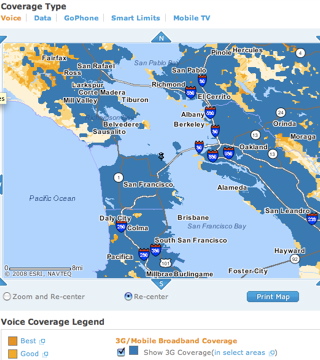
So what better place to put the iPhone 3G through its paces than Mount Tamalpais in Marin County, mountain biking’s birthplace? AT&T (T) claims 3G blankets most of the Bay Area, but that can depend on your altitude. As I throw the bike on the car rack at my home near the top of the Berkeley Hills, it’s clear I live on the EDGE – the iPhone is only picking up AT&T’s slower network. Rolling down the hill, the 3G kicks in. (This will happen occasionally elsewhere, such as in Fairfax, a Marin town sitting in the shadow of Mount Tam, or in my office tower in downtown San Francisco.)

On Mount Tam, I pick a trail I haven’t ridden before – one with a hard-to-find entrance – to test out the iPhone’s GPS. Although the mountain is an EDGE zone, the GPS-Google satellite maps mashup pinpoints my location with a luminecent blue dot, allowing me to zoom in and see that I’ve just passed the trailhead and that if I backtrack I’ll even find a small gravel parking lot hidden by a stand of trees. Sweet.

After riding a few miles through groves of bay laurel and redwood, I check my coordinates. Zooming out shows me just how long of a steep climb I’ve got ahead of me – maybe too much information. Still, this is pretty bloody cool and I snap a photo of myself that the iPhone geotags. I’m a happy rider. I compare the iPhone’s signal with my BlackBerry and they’re pulling the same number of bars, though I’ve noticed the iPhone can be much slower to grab a signal when rolling out of a dead zone.

At the crest of the hill there’s a turnoff to another trail I haven’t ridden. It’s hot and my legs are getting tired, but it looks like a fun run. Problem is, just how long and steep will this side trip be? Without the iPhone I might have given it a pass. But I move into a clearing, catch a signal and GPS myself and then take a virtual ride on the trail to see where it goes and check out the terrain. (It’s also a great way to cut down on the environmental impact of driving in the city by optimizing routes.)  Looks good. It turns out to be a great spur, taking me to the Bolinas-Fairfax Ridge overlooking the Pacific Ocean. While enjoying the view, I contemplate writing this blog post on the phone (WordPress has been iPhone-optimized for that) but ditch the idea, given iPhone’s lack of a cut-and-paste function and inability to import photos to the post.

There’s another problem: I’m about to enter the red zone on the battery meter. The phone has been on for just some four hours and the battery is already 80 percent depleted, though I haven’t been surfing the web much – mainly using the GPS and maps and listening to music on the drive to Mount Tam. (Unfortunately, while the iPhone will play music over the older iPod cable in my car and on my Soundock at home, it won’t charge while plugged in. I end up charging the phone twice a day over the weekend.)

While the prospect of not having enough juice to listen to tunes on the way home is no fun, the iPhone is a great biking companion. (An iPhone app I want to see: one that collects distance and altitude data from the bike’s wireless computer.) In fact, why go home? I finger-flick through the iPhone weather report for the beaches at Point Reyes. Sunny and 82.

When it comes to solar companies, First Solar is the Google of renewable energy. The Tempe, Ariz.-based solar cell maker backed by the Wal-Mart (WMT)’s Walton family has seen its stock skyrocket over the past year, hitting a high of $317 on May 14. (It was trading at $275 Friday.) Now First Solar, which makes “thin film” solar modules, is getting into the utility business, winning approval Thursday from California regulators to build the state’s first thin-film photovoltaic solar power plant. The 7.5 megawatt project – expandable to 21 megawatts – will sell electricity to Southern California Edison (EIX) under a 20-year contract.

While First Solar (FSLR) supplies solar modules to power plant builders in Europe, this is apparently the first time it has acted as a utility-scale solar developer itself. First Solar tends to keep quiet about its projects and did not return a request for comment. But a troll through the public records reveals some details of what is called the FSE Blythe project. The solar farm will be built in the Mojave Desert town of Blythe by a First Solar subsidiary, First Solar Electric. The company paid $350,000 in January for 120 acres of agricultural land in Blythe, providing a tidy profit for the seller, which had purchased the property for $60,000 in June 1999.

Approval of the contract by the California Public Utilities Commission Thursday came on the same day that SunPower (SPWR) announced a deal to build two photovoltaic power plants – a 25-megawatt one and a 10-megawatt version – in Florida for utility Florida Power & Light (FPL). PV plants are essentially supersized versions of rooftop solar panel systems found on homes and businesses. Thin-film solar prints solar cells on flexible material or glass and typically uses little or no expensive (and in short supply) polysilicon, the key material of conventional solar cells.

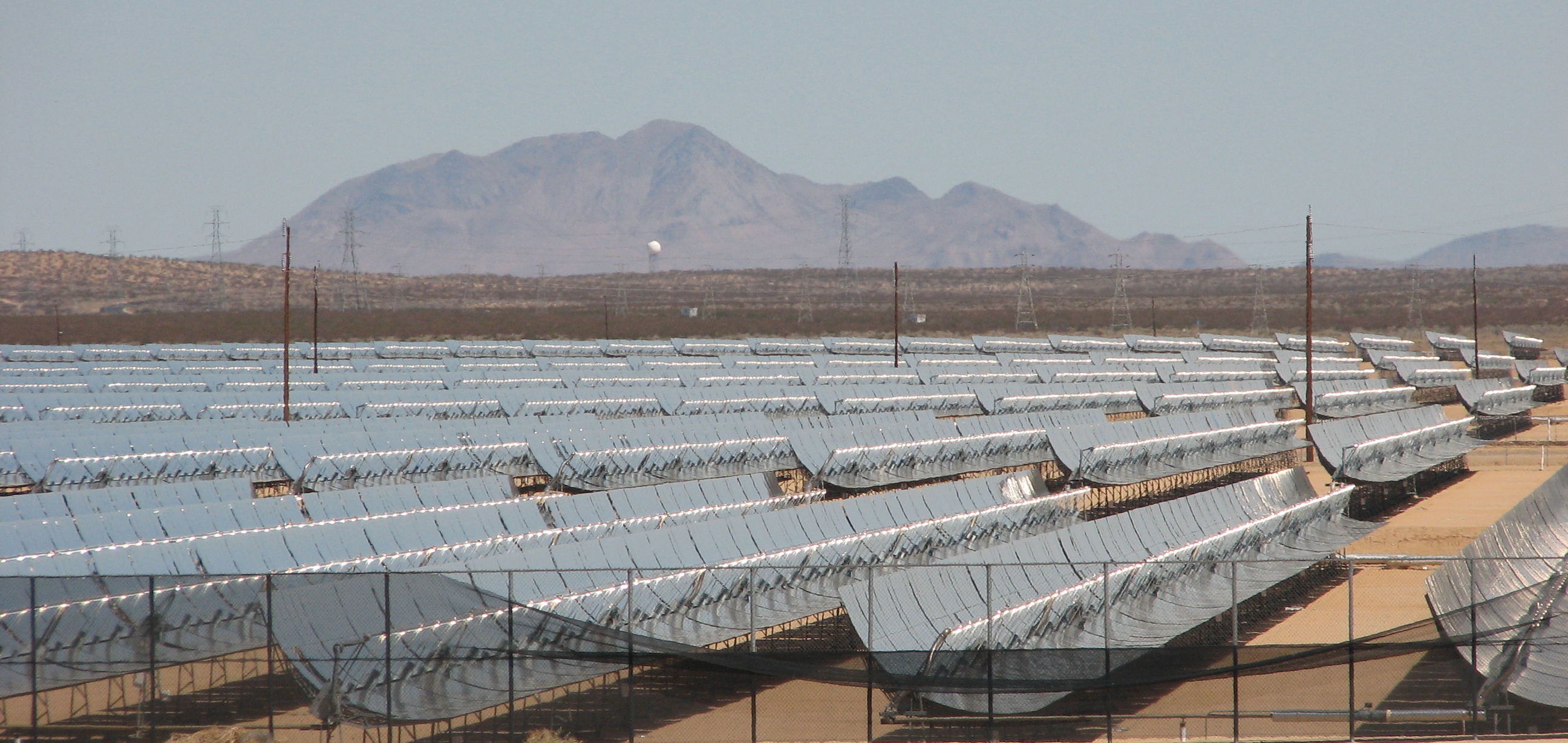
Most large-scale solar power plants being developed in the United States use solar thermal technology that relies on huge arrays of mirrors to heat liquids to create steam that drives electricity-generating turbines. In fact, there is a solar land rush underway in the desert Southwest as solar developers, investment banks like Goldman Sachs (GS), utilities and speculators of every stripe scramble to lock up hundreds of thousands of acres of federal land for solar power plants. (See Green Wombat’s feature story on the solar land rush in the July 21 issue of Fortune.)

PV power plants, on the other hand, have not been cost-competitive with solar thermal and have been most popular in countries like Germany, Spain and Portugal, where generous subsidies guarantee solar developers a high rate for the electricity they produce. The situation in the U.S. seems to be changing, though, judging by the deals utilties are striking with companies like First Solar and SunPower. Meanwhile, thin-film startup OptiSolar is moving to build a gigantic 550-megawatt thin-film solar power plant on California’s central coast but has yet to sign a power purchase agreement with a utility.

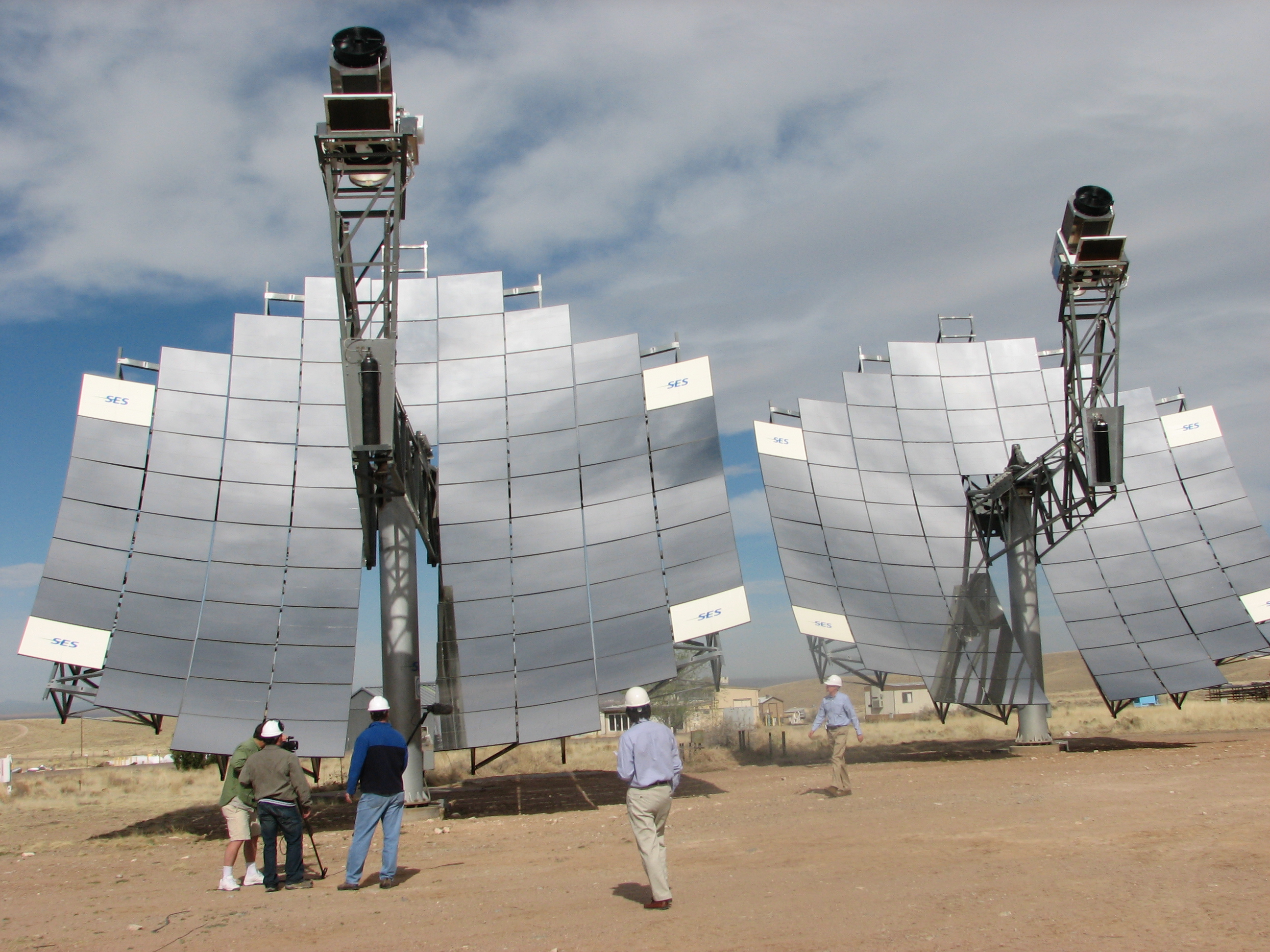
Nearly three years ago, two Southern California utilities caused a stir when they announced deals to buy up to 1.75 gigawatts of electricity from massive solar farms to be built by Stirling Energy Systems of Phoenix. The company had developed a Stirling solar dish – a 38-foot-high, 40-foot-wide mirrored structure that looks like a big shiny satellite receiver. The dish focuses the sun’s rays on a Stirling engine, heating hydrogen gas to drive pistons that generate electricity.

Plans called for as many as 70,000 solar dishes to carpet the desert. For Southern California Edison (EIX) and San Diego Gas & Electric (SRE) – both facing a state mandate to obtain 20 percent of their electricity from renewable sources by 2010 – it was a big gamble. As the years ticked by and Stirling tinkered with its technology, competitors like Ausra, BrightSource Energy and Solel came out of stealth mode and stole the limelight, signing deals with PG&E (PCG) and filing applications with California regulators to build solar power plants. By the time I visited Stirling’s test site in New Mexico in March 2007 for a Business 2.0 feature story, industry insiders were telling me – privately, of course – that Stirling would never make it; Stirling dishes were just too complex and too expensive to compete against more traditional solar technologies.

That may or may not end up being true, but Stirling has moved to silence the naysayers by filing a license application with the California Energy Commission for its first solar power plant – the world’s largest – a 30,000-dish, 750-megawatt project to be built 100 miles east of San Diego on 6,100 acres of federal land controlled by the U.S. Bureau of Land Management. (A energy commission licence application – an extremely detailed and expensive document; Stirling’s runs 2,600 pages – is considered a sign that a project has the wherewithal to move forward.)

The first phase of the SES Solar Two project will consist of 12,000 SunCatcher dishes generating 300 megawatts for San Diego Gas & Electric. While the Stirling solar dish is more complex and contains more moving parts than other solar thermal technologies – which use mirrors to heat liquids to generate steam to drive a standard electricity-generating turbine – or photovoltaic panels like those found on rooftops, it also offers some distinct advantages. For one thing, it’s the most efficient solar thermal technology, converting sunlight into electricity at a 31.25% rate.  Each 25-kilowatt dish is in fact a self-contained mini-power plant that can start generating electricity – and cash – as soon as it is installed. Stirling will build 1.5-megawatt clusters of 60 dishes that will begin paying for themselves as each pod goes online. A conventional solar thermal power plant, of course, must be completely built out – which can take a year or two depending on size – before generating electricity.

The 750-megawatt Stirling project will also use relatively little water – no small matter in the desert – compared to other solar thermal plants. According to Stirling, SES Solar Two will consume 33 acre-feet of water – to wash the dishs’ mirrors – which is equivalent to the annual water use of 33 Southern California households. In contrast, a solar power plant to be built by BrightSource Energy that is nearly half the size is projected to use 100 acre-feet of water annually while a 177-megawatt Ausra plant would use 22 acre-feet, according to the companies’ license applications.

Still, there’s some big hurdles for Stirling to overcome. While it did score a whopping $100 million in funding in April from Irish renewable energy company NTR, the company will need billions in project financing to build Solar Two. And the project’s second 450-megawatt phase is dependent on the utility completing a controversial new transmission line through the desert called the Sunrise Powerlink. Depending on how fast the project is approved, construction is expected to begin in 2009 and last more than three years.

The other big unknown is what environmental opposition may develop. Within 10 miles of the SES Solar Two site are proposals to build solar power plants on an additional 51,457 acres of BLM land. Then there are the wildlife issues. Several California-listed “species of special concern” have been found on the Stirling site, including the burrowing owl, flat-tailed horned lizard and the California horned lark.

Regardless it’s a big step forward for Stirling. As California Governor Arnold Schwarzenegger said in a statement, “This groundbreaking solar energy project is a perfect example of the clean renewable energy California can and will generate to meet our long-term energy and climate change goals.”

In a sign that solar industry and its political allies are starting to flex some real power, the federal government reversed course Wednesday and announced it would continue to accept new applications to build solar power plants on government land while developing an environmental policy for assessing the projects.

Green Wombat had been off the grid on holiday the past week and so was surprised to log back on to find the mainstream media and blogosphere ablaze over the Bush administration’s supposed move last month to halt big solar power plant projects in California’s Mojave Desert and elsewhere.

“Citing Need for Assessments, U.S. Freezes Solar Energy Projects,” read the headline on The New York Times story about the Bureau of Land Management’s decision to temporarily stop accepting new applications for solar power plants until it studies the environmental impact of industrializing the desert. “How to strangle an industry,” proclaimed Grist, a respected green policy blog about the move. Solar executives and politicians meanwhile slammed the BLM and predicted dark days for renewable energy. “This could completely stunt the growth of the industry,” the Times quoted Ausra exec Holly Gordon.

Problem is, those stories were dead wrong: The feds did not freeze a single solar power plant project currently under review. What was left unsaid, or just briefly mentioned, was the fact that the BLM is continuing to process the 125 solar power plant proposals already in the hopper. Those lease applications cover nearly a million acres for solar power plants that would produce 60 gigawatts of electricity if all are built, which they won’t be. Those projects alone will keep companies like Ausra, BrightSource Energy, FPL (FPL) and PG&E (PCG) busy for years to come, moratorium or not.

“We don’t even like to call it a moratorium,” says Alan Stein, a deputy district manager for the BLM in California. Stein called me on my mobile just as I was about to step into a kayak at Elkhorn Slough near Big Sur. I had spent several months talking to Stein and other BLM officials while criss-crossing the Mojave with solar energy executives for a forthcoming Fortune story and he seemed taken aback by the tone of the media coverage.

But the higher-ups in Washington got the message. “We heard the concerns expressed during the scoping period about waiting to consider new applications, and we are taking action,” said BLM Director James Caswell in a statement. “By continuing to accept and process new applications for solar energy projects, we will aggressively help meet growing interest in renewable energy sources while ensuring environmental protections.”

The head of the solar industry’s trade group, the Solar Energy Industries Association, declared victory. But SEIA president Rhone Resch complained in a statement that, “BLM has only resolved half the problem. They have yet to approve a single solar energy project. Expediting the permitting process is the next step in developing solar energy projects on federal lands.”

He’s right that the process – which is intertwined with California’s extensive environmental review of projects in that part of the Mojave – takes far too long. But developing a desert-wide environmental policy is absolutely essential for huge power plants that in total would cover hundreds of square miles of a fragile landscape home to protected wildlife and rare plants. Otherwise, watch each individual project get bogged down in endless environmental challenges.

What really threatens the nascent solar industry right now is not the BLM. Rather it’s the imminent expiration of the 30 percent investment tax credit that all these solar energy startups and their investors – which include companies such as Google (GOOG) and Morgan Stanley (MS) – are depending on make Big Solar economically viable. Congress has failed several times in recent months to extend the tax credit, which expires at the end of the year. If only solar energy execs and their supporters in Washington could exert the same influence on recalcitrant Republicans as they have on the BLM.

LAS VEGAS – Hard by the Las Vegas airport, the industrial infrastructure of the solar economy is rising in a former furniture factory. Phalanxes of orange robots swivel and dip as they practice assembling components for solar power plants to be built by Silicon Valley startup Ausra.

It’s North America’s first solar power plant factory and it went online Monday when Ausra CEO Robert Fishman and U.S. Senate majority leader Harry Reid, D-Nevada, flipped the switch to start the production line. Ausra’s automated 130,000-square-foot factory is key to the Palo Alto company’s aim of cutting manufacturing costs to make solar energy competitive with fossil fuels.

A large robot picks up 78-square-foot pieces of glass and places them on a conveyor belt so a machine can apply strips of adhesive. Other robots transfer the glass to another line where a dozen bots weld together 53-foot-long steel frames. The completed solar arrays will be trucked to California where Ausra is building a 177-megawatt solar power station for utility PG&E (PCG) on 640 acres of agricultural land in San Luis Obispo County. (To see a video of the robots in action, click here.)

The arrays focus sunlight on water-filled tubes to create steam to drive a turbine. Ausra manufacturing exec David McKay points to where standard-issue boiler pipe will be fed into a machine and treated with a proprietary coating that transforms it into a solar receiver. At peak production the plant will churn out more than 700 megawatts’ worth of equipment year to keep 1,400 solar power plant construction workers employed. “We can produce a lot faster than what we can install,” says McKay.

However, the future of those jobs – and billions in future investments in renewable energy – hangs on whether Congress extends a crucial investment tax credit that the solar industry and utilities are relying on to make large-scale solar power plants competitive with the carbon-spewing variety. The investment tax credit expires at the end of the year and several attempts to pass legislation extending the ITC have failed despite support on both sides of the aisle.

Green Wombat met with the chairman of the Solar Energy Industries Association, Chris O’Brien, last week when he was in San Francisco to get an update on the ITC’s chances. “It’s an election year and it has become part of the political stalemate,” says O’Brien, who heads North America market development and government relations for Swiss-based solar cell equipment maker Oerlikon Solar. “I don’t see an imminent breakthrough.”

The pending demise of the tax credit is “having a significant effect on the development of new business,” according to O’Brien. Solar energy executives, of course, are reluctant to admit that deals are getting dashed, but there’s no doubt the loss of a 30 percent tax credit gives financiers and utilities pause when considering whether to green-light solar power plants that can cost a billion or two to construct.

O’Brien thinks the best-case scenario for the long-term extension of the ITC will come after the presidential election during the lame-duck session of Congress. Otherwise, he says, don’t expect action until around September 2009.

In the meantime, Ausra will keep its robots busy cranking out components for its first California power plant, which is scheduled to start producing green electricity in 2010.

When Intel announced this week that it was spinning off a stealth in-house startup called SpectraWatt to develop solar cells, it appeared the chip giant was just the latest old-line Silicon Valley tech firm bitten by the green bug.

After all, crosstown chipmaker Cypress Semiconductor jumped into the solar game back in 2004 when it acquired SunPower (SPWR), now a leading manufacturer of solar cells and panels and an installer of large-scale solar arrays. Then the world’s biggest chip-equipment maker, Applied Materials (AMAT), retooled machines that make flat-screen video displays to produce thin-film solar panels. And just this month, Hewlett-Packard (HPQ) unveiled a deal to license solar technology to a solar cell startup while IBM (IBM) announced it would develop thin-film solar.

But it’s not just now jumping on the enviro-biz bandwagon – Intel’s solar efforts have been quietly under development since 2004. That’s when Andrew Wilson, an 11-year Intel (INTC) veteran, was chatting with a colleague while waiting for a conference call to begin. “We were shooting the breeze and I mentioned that I had replaced all the light bulbs in my house with compact fluorescent lights and my utility bill had come down by a third,” says Wilson, SpectraWatt’s CEO. “And he said, `Hey, did you know that solar cells are made of silicon?’ ”

“We started talking about what a business plan would look like, because if something is made out of silicon then Intel should be taking advantage of that market,” Wilson told Fortune. A year later, Wilson and his colleagues had developed a marketing plan and secured funding from Intel’s new-business incubator to develop a business strategy and hone its technology. (It’s no coincidence that the nascent solar industry is populated by computer industry veterans from companies that put the silicon in Silicon Valley.)

When it comes to cutting-edge solar technology, silicon-based cells are considered a bit old-school. Silicon is currently in short supply and the resulting high prices have led venture capitalists to invest hundreds of millions of dollars in thin-film solar startups that promise to dramatically lower the cost of solar by printing or otherwise applying non-silicon solar cells to glass or flexible materials that can be integrated into walls, windows and other building materials. While thin-film solar is less efficient at converting sunlight into electricity, the expectation is that it can be produced much more cheaply than conventional cells.

But thin-film solar is still largely an early-stage technology and silicon-based cells will continue to be the big market for the near-future. So the question is, how does Intel compete with established players like SunPower, China’s Suntech (STP) and Germany’s Q-Cells as solar cells become a commodity? Intel controls some 80 to 90 percent of the worldwide chip market but it’s unlikely that it – or any other player – will replicate that experience in solar cells.

Wilson’s view is that it’s early days for the solar market and that SpectraWatt’s ace in the hole is Intel’s global manufacturing experience and history of technological innovation. “The solar industry today looks like the microelectronics industry in the late ‘70s – there’s very few standards and no one is manufacturing at scale,” says Wilson. “It’s all about manufacturing processes and material sciences that will lead to fundamental breakthroughs. The product is vastly simpler than a microprocessor but the fundamental nature of a solar cell isn’t all that different. When you think of what it takes to manufacture globally and manage supply chains, that’s Intel’s core competence.”

There certainly is room for more players, given that solar was a $30 billion market in 2007 and is expected to continue to grow at a clip of 30 to 40 percent in the coming years.

Wilson says SpectraWatt has secured silicon supplies and is developing technology that will give it a competitive edge. He’s keeping mum about the details of that technology for now. “We do believe we will have a technological advantage when we get what we’re doing in the lab to manufacturing,” Wilson says.

The company is set to begin building its manufacturing facility in Oregon later this year, with production to begin in mid-2009.

SpectraWatt launches with a $50 million investment lead by Intel Capital, the company’s investing arm. Other investors include Goldman Sachs (GS), PCG Clean Energy and Technology Fund, and German solar giant Solon. (As Green Wombat has written, Solon has invested in an array of solar startups in the United States, including Sungevity and thin-film solar company Global Solar.)

California utility PG&E will buy 106.8 megawatts of electricity from a hybrid biofuel solar power plant to be built by a Portuguese firm in the state’s Central Valley.

The hybrid technology will allow two 53.4 megawatt plants to tap the sun and agricultural waste produced in surrounding Fresno County to generate green energy around the clock, according to San Joaquin Solar, a subsidiary of Portugal’s Martifer Renewables. For PG&E (PCG), 107 megawatts is just enough to keep the air conditioners running for some 75,000 homes. But if the biofuel solar hybrid performs as billed and can be scaled up, it’s a win-win – recycling ag waste – a huge and expensive problem in California – into electricity.

The percentage of electricity to be produced by solar versus biofuel and other details of the project’s design are sketchy. Andrew Byrnes, an executive with Spinnaker Energy – the San Diego company developing the project for Martifer – told Fortune that such information is “confidential” as are images of what the hybrid plant will look like and the identities of the company’s U.S. investors.

Here’s what we do know: San Joaquin Solar 1 and 2 will be built on private land outside the farming town of Coalinga. They will use long arrays of curved mirrors called solar troughs to focus the sun on liquid-filled tubes to produce steam that will drive electricity-generating turbines. That’s a standard solar technology currently operating in California and elsewhere. The biomass component of the plant will use agricultural waste, green waste and livestock manure to create heat that will generate steam.

It appears the biofuel will be used to keep the plant running at night or on overcast days. “The technologies can run simultaneously,” said Byrnes in an e-mail. “And when a cloud passes overhead (and after the sun sets) the solar facility can still generate energy, since the generation process is dependent on heat rather than direct solar radiation.”

While there is a natural gas-solar hybrid power plant under development in Southern California – see Green Wombat’s “The Prius of power plants” – San Joaquin Solar 1 and 2 will apparently be the world’s first biofuel solar hybrid.

Each power plant will each need 250,000 pounds of biomass a year to operate. Finding that fuel shouldn’t be a problem: Byrnes says a study shows that Fresno County alone produces nearly 2 million tons of ag waste annually.

In another sign that technological innovation will drive solutions to global warming and the United States’ energy dependence, technology born of Hewlett-Packard’s imaging and printing research will be used to make more efficient and cheaper solar panels. HP is licensing its transparent transistor technology, which will eliminate the need for mechanical trackers to follow the sun, to a Livermore, Calif., startup called Xtreme Energetics

Here’s how it’s supposed to work: XE’s solar panels concentrate sunlight onto highly efficient solar cells that use a fraction of the expensive silicon found in standard solar modules. A layer of HP’s clear transistors will funnel light to the solar cell as the sun moves across the sky.

“Basically, we don’t have any mechanical gears or cogs,” says XE chief executive Colin Williams, a veteran of JPL/Caltech and a former Stanford University professor. “From an outward appearance the panel appears to be fixed, but internally light is being steered to the solar cell through the electronics.”

Doing away with bulky mechanical trackers means that more panels can be packed onto commercial rooftops, allowing energy-hungry facilities like data centers to draw more of their power from the sun. The panels will be transparent and can be colorized to blend in with building facades. Williams says XE will also produce panels for large-scale solar power plants.

That’s the goal, at least. XE, which is currently funded by its founders, is two years away from producing solar panels with HP’s (HPQ) technology and its claim that they will be twice as efficient at half the cost of conventional solar systems has yet to be proven.

For HP, the solar licensing deal is an unanticipated benefit of collaborative research by HP Labs, engineers at its imaging and printing operation in Oregon and researchers at Oregon State University. “They were looking for future ways to display images,” say Joe Beyers, HP’s vice president of intellectual property licensing. “It just turned out that Colin and his team became aware of the work we were doing with Oregon State and started the dialog.”

Beyers says other potential applications for the technology – developed as part of HP’s new approach to commercializing R&D that my colleague Jon Fortt wrote about recently – include video displays for car windshields.

eSolar, the solar energy startup founded by Idealab’s Bill Gross and backed by Google, has signed a 20-year contract to supply utility Southern California Edison with 245 megawatts of green electricity.

The solar power plant will be built in 35-megawatt modules, with the first phase set to go online in 2011. As Green Wombat reported in April, eSolar scored $130 million in funding from Google.org, Google’s (GOOG) philanthropic arm, and other investors to develop solar thermal technology that Gross claims will produce electricity as cheaply as coal-fired power plants.

Like Ausra and BrightSource Energy – which have deals with PG&E (PCG) – eSolar will use fields of mirrors to heat water to create steam that drives electricity-generating turbines. Gross says that eSolar’s software allows the company to individually control smaller sun-tracking mirrors – called heliostats – which can be cheaply manufactured and which are more efficient and take up less land than conventional mirrors. According to Gross, that means eSolar can build modular power plants near urban areas and transmission lines rather than out in the desert, lowering costs.

eSolar’s cost claims got Southern California Edison’s (EIX) attention. “It was a competitively priced proposal,” Stuart Hemphill, the utility’s VP for renewable and alternative power, told Fortune. “We found the eSolar team very competent, motivated and willing to do a deal.”

“When it comes down to different solar technologies, competitive pricing is going to be an important part of the equation,” he adds. “They do offer a unique solution.”

eSolar is keeping mum about the exact location of the power plant, only saying it will be in the Antelope Valley region of Southern California.

One potential hitch: Getting eSolar’s electricity to Southern California Edison will depend on the construction of a major new transmission line. That line, the Tehachapi Renewable Transmission Project, has been partially approved to date.

With the eSolar deal, the utility is hedging its bets. Back in 2005, Southern California Edison signed a highly publicized deal with Phoenix’s Stirling Energy Systems to buy up to 850 megawatts of solar electricity from massive solar power plants to be built in the Mojave Desert. (Around the same time, San Diego Gas & Electric (SRE) signed a power purchase agreement with Stirling for up to 900 megawatts. ) Stirling is still perfecting its technology and has yet to file a license application for its first plant. But the company received a $100 million investment earlier this year and Hemphill says Stirling is moving forward.

“We expect that Stirling will meet its contractural obligations,” he says. “Solar thermal is definitely an emerging industry. It’s too early to tell which technologies will be the winners over the long run. It’s a time to be having a portfolio of different technologies so we can figure that out.”

In the world’s single-largest investment in solar technology, the oil-rich emirate of Abu Dhabi announced Wednesday it will spend $2 billion to jumpstart a home-grown photovoltaics industry. The cash will fund what is undoubtedly the planet’s best-financed startup, Masdar PV, which will build manufacturing facilities in Germany and Abu Dhabi to produce thin-film solar modules that can be used in rooftop solar systems or solar power plants.

Masdar PV is the latest project of the Masdar Initiative, Abu Dhabi’s $15 billion renewable energy venture designed to transform the emirate into a green technology powerhouse. Masdar is best known for its plans to build Masdar City, a “zero-carbon, zero-waste” urban center.

Thin-film solar cells are essentially “printed” on glass or flexible metals, allowing them to be integrated into building materials like roofs and walls. Though thin-film solar is less efficient at converting light into electricity, it uses a fraction of the expensive silicon needed by conventional bulky solar modules and can be produced much more cheaply – provided economies of scale are achieved.

Thus Masdar PV’s big solar bet. “You have to be working at scale to drive costs out of the system,” Steve Geiger, Masdar’s director of special projects, told Fortune in a phone call from Abu Dhabi. “We have to do it at scale and we have to do it in volume in multiple markets.”

One of those markets is the United States, where Masdar PV could give established players like First Solar (FSLR) and startups such as Nanosolar, Heliovolts and Global Solar some formidable competition.

The gamble Masdar PV is taking is that it’s investing billions in an older but proven thin-film technology that may well be left in the dust by more exotic, cheaper and efficient technologies under development by a host of startups.

Masdar PV aims to have a gigawatt of annual production capacity in place by 2014. To get there, Geiger says the company has hired a management team that includes former top executives from First Solar and other thin-film industry veterans.

A leading solar technology company that Geiger declined to identify will provide the manufacturing equipment for Masdar PV’s factories. Judging from his description, the likely supplier is Applied Materials (AMAT), the world’s biggest computer-chip equipment maker that has a burgeoning business building the machines that make thin-film solar cells of the type that Masdar PV will produce.

“We usually partner with large companies that have managerial skills, technology and market access, but we were very fortune that we picked up a top management team and thought it was strong enough to do as a 100% Abu Dhabi Masdar company,” says Geiger, who will oversee Masdar’s thin-film solar venture.

Masdar PV’s first plant is scheduled to go online in Germany toward the end of 2009 with the second to begin production in Abu Dhabi by mid-2010. “Very clearly we need to look at expansion beyond those two physical facilities,” Geiger says. “We really have to look at America and the Asian markets as well.

Thin-film is just one of three solar strategies that Masdar is pursuing by funneling petrodollars into green energy startups. In March, Masdar unveiled Torresol Energy, a joint venture with a Spanish company that will build large-scale solar thermal power plants to supply electricity to utilities. Masdar has also made investments in other solar thermal companies as well as thin-film startups pursuing different technologies. Finally, Masdar wants to produce polysilicon, the basic material of conventional solar cells.

As Masdar chief Sultan Ahmed Al Jaber recently told Green Wombat, “We want to cover the whole value chain – from research to labs to manufacturing to the deployment of technologies.”

Geiger uses an analogy for Masdar’s green energy ambitions that may be more familiar to petroleum-dependent Americans – and should serve as a wake-up call to get serious about carbon-free energy. “The model might be the vertically integrated oil industry,” he says. “It clearly makes sense to have a consolidated power provider.”

Design a site like this with WordPress.com
Get started