Feeds:
Posts
Comments

first-solar-11

With Big Solar thermal power plants bogged down in bureaucracy and facing environmental and financial hurdles, utilities are turning to smaller-scale thin-film solar stations that can be built in a matter of months.

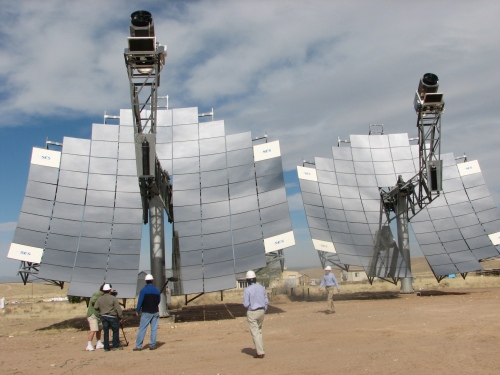
In late December, PG&E (PCG), for instance, signed a 20-year contract for electricity generated  from a 10-megawatt thin-film solar power plant in Nevada owned by energy giant Sempra (SRE) that was officially dedicated on Thursday. The solar farm was built by First Solar (FSLR) in a scant six months. Meanwhile, the utility’s nearly two gigawatts worth of deals with solar thermal power companies won’t start producing power for another two years at the earliest. (Southern California Edison (EIX) and San Diego Gas & Electric signed agreements with solar dish developer Stirling Energy Systems for 1.75 gigawatts in 2005 and those projects are just now beginning to move through the regulatory approval process.) And the financial crisis has made it more difficult for solar thermal developers to obtain the billions of dollars needed to finance the construction of a massive megawatt power plant.

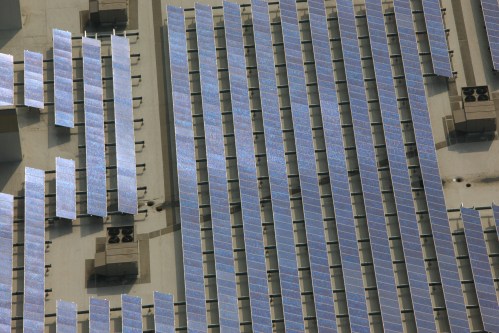
Solar thermal power plants typically use miles of mirrors to heat a fluid to create steam which drives an electricity-generating turbine. Photovoltaic (or PV) solar farms essentially take solar panels similar to those found on residential rooftops and mount them on the ground in huge arrays. (Thin-film solar panels are made by depositing layers of photovoltaic materials on glass or flexible materials.)

“In terms of construction, photovoltaic tends to have a much faster development and construction track,” Roy Kuga, PG&E’s vice president for energy supply, told Green Wombat. “There is a segment of mid-sized projects – in the two to 20 megawatt size – where PV shows a distinct advantage in that market. There’s a huge potential for the PV market to expand.”

That’s good news for companies like First Solar – the Tempe, Ariz.-based company backed by the Walton family that is often called the Google of solar for its stock price and market prowess – and SunPower (SPWRA), the Silicon Valley solar cell maker that’s moved into the power plant-building business.

The speed at which the Sempra-First Solar project went online owes much to the fact that it was built on the site of an existing fossil fuel power plant. “It was already permitted for power generation, transmission existed and it did not have to go through the laborious California permitting process,” says Reese Tisdale, a solar analyst with Emerging Energy Research. “As such, First Solar was able to essentially plug and play.”

Nathaniel Bullard, a solar analyst with New Energy Finance, says he expects utilities increasingly to bet on smaller-scale photovoltaic farms to help meet state mandates to obtain a growing percentage of their electricity from renewable sources. Just this week, PG&E CEO Peter Darbee said his utility plans to invest in solar power plant projects rather than just buy the power they produce.

“I think a utility could easily integrate, technically and financially, 100 megawatts of PV,” Bullard says.  If something is falling behind on your big solar thermal projects, you can plug in PV. I think you’ll see more of this with California utilities and I expect to see it more in Florida and North Carolina. It’s a great runaround to issues of siting and transmission.”

That’s because in California photovoltaic power plants do not need approval from the California Energy Commission. And smaller-scale plants take up far less land and can be built close to existing transmission lines. Most large solar thermal power plants typically are planned for the Mojave Desert and require the construction of expensive power lines to connect them to the grid.

The modular nature of PV solar farms means they can begin generating electricity as each segment is completed while a solar thermal plant only goes online once the entire project is finished.

“Certainly there is a sweet spot in which the project is large enough to gain advantages of scale,” says Tisdale. “Also, these small-to-mid-size systems can be spread about a transmission network, instead of at one site.”

thinkcity_006

photo: Think

Here’s a bit of good news from the otherwise dreary alternative automotive world: Norwegian electric carmaker Think has put 44 laid-off employees back to work following the completion of a round of interim financing.

In December, Think halted production of its City battery-powered urban runabout and laid off half its workforce as financing to expand the company’s operations dried up. Then last week Think announced that it had obtained a $5.7 million bridge loan from investors led by Ener1, a battery maker who is supplying the City with lithium-ion power plants.

The financing has been completed and Think said Friday that it had rehired 44 workers in management, sales and supplier operations. But Think is hardly out of the Norwegian woods yet. The company still needs to raise around $40 million to resume full-scale production of the City and proceed with its plans to sell the electric car in select European markets outside Norway before expanding to the United States. Think has raised more than $100 million from European and U.S. investors, including General Electric (GE) and Silicon Valley and East Coast venture capitalists.

“We are very content that this first visible step in our plan towards restart now is in place,” said Think CEO Richard Canny, a former Ford (F) executive, in a statement. “We still need to raise the permanent capital, but this first call-back signals both internally and externally that Think is committed and able to turn the situation into a positive direction for the company.”

img_1223

photo: Todd Woody

As President Barack Obama embraced renewable energy in his inaugural speech Tuesday, Clipper Windpower laid off 90 employees – about 11% of its workforce – as the global financial crisis throws a spanner in the once-booming wind industry.

The Carpinteria, Calif.-based turbine maker has seen business slow as customers delay existing orders and put off new ones because they cannot obtain financing for wind farms, Clipper CEO Doug Pertz told Green Wombat.

“In the short-term, the impact to Clipper is a reduction in 2009 turbine production,” he said. “We know that 2009 will be a challenging year, however, remain optimistic that this economic situation is temporary.  We trust that the new Obama administration will, in the not-too-distant future, enact policy to enable better financing options for wind energy projects and aggressively promote the growth of renewable energy development.”

Clipper is one of only two U.S.-owned turbine makers – the other being General Electric (GE) – in an industry dominated by European manufacturers and wind farm developers.

Like their counterparts in the solar industry – which also has been shedding workers in recent weeks – wind companies depend on tax incentives to lure investors. But with traditional investment banks all but extinct on Wall Street and other investors hoarding their cash, there’s been little appetite of late for investing in so-called tax equity partnerships to provide funding for massive wind farms or solar power plants.

Pertz said Clipper’s production is down 20% from the 750 megawatts worth of turbines it manufactured in 2008 and that he expects double-digit declines for 2009. “Customers with large balance sheets are being much more conservative and smaller independent wind developers are seeing that it is much more difficult to obtain tax-equity financing,” he noted.

Wind and solar industry lobbyists are pushing Congress to make the investment tax credit and the production tax credit refundable so those companies that don’t have tax liabilities can trade the credits for cash that can be used to finance renewable energy projects.

Founded in 2001 by wind industry veteran James Dehlsen – his first wind company is now owned by GE –  Clipper makes a 2.5-megawatt turbine called the Liberty at its Cedar Rapids, Iowa, factory that powers wind farms built by FPL (FPL) and BP (BP). Other customers include Queen Elizabeth II, who bought the prototype of a 10-megawatt offshore turbine being developed by Clipper in the U.K.

One bright spot for the wind industry, said Pertz, is an expected move by well-capitalized utilities to take ownership stakes in wind farms if a national standard is enacted requiring them to obtain a certain percentage of their electricity from renewable sources.

stirling-dishes

photo: Todd Woody

Fifty-four billion dollars is nothing to sneeze at, of course. That’s the amount in the $825 billion economic stimulus package –  introduced by House Democrats Thursday – set aside for renewable energy, electric car batteries, energy efficiency and other green projects.

It’s a start, but that’s less than 7% of the entire stimulus package (or, about enough to pay for the Iraq war for five months, or somewhat more than what the federal government is spending to bail out Bank of America). The lion’s share of the cash is devoted to smart grid technology and transmission lines, with a second big chunk going toward energy efficiency retrofits of public housing and weatherization of low-income homes.

That’s good news for a host of startups developing smart grid technology. But the the bill does not address the most pressing issue facing renewable energy companies today: the credit crunch has dried up financing just as billions are needed to fund factories and the construction of solar power plants and wind farms that will be connected to smart grids and new transmission lines. In recent weeks, layoffs have hit the solar industry. OptiSolar – a Bay Area thin-film solar startup that’s building a 550-megawatt photovoltaic power plant to supply electricity to utility PG&E (PCG) – reported to have furloughed half its workforce. And according to The Oregonian newspaper,  SpectraWatt, a solar cell maker spun off from chip giant Intel (INTC) last year, has shelved plans for a factory in Hillsboro, Ore.  Friday morning, Kate Galbraith at The New York Times’ Green Inc. blog reported that layoffs have now hit the wind industry.

The retrenchment comes as utilities are counting on solar power plants and wind farms to come online in the next two years to help them meet mandates to obtain a growing percentage of the electricity they sell from renewable sources. In California, for instance, PG&E, Southern California Edison (EIX) and San Diego Gas & Electric (SRE) have signed more than four gigawatts’ worth of contracts for electricity to be produced by large-scale solar power stations that will cost billions to build.

Solar startups rely on a provision that allows them to take a 30% tax credit on the cost of building a power plant. Now most of these companies are startups and have no way to use those tax credits as they’re not profitable. Instead, a solar company must essentially trade the tax credits to a firm that can use them in exchange for cash to finance construction. But investors in these deals have all but disappeared as the financial crisis takes its toll. Which is why solar and wind lobbyists are pushing Congress to make the tax credits “refundable” – meaning those companies that don’t have tax liabilities can trade the credits for cash that can be used to finance power plants. “Due to the recession, projects are now being put on hold, factories are closing and workers face potential layoffs unless Congress refines the tax credits now so they work as originally intended,” said Solar Energy Industries Association CEO Rhone Resch in a statement.

The stimulus package unveiled Thursday undoubtedly will be subject to change, but as written it will boost efforts to modernize and digitize the United States’ aging analog power grid. The bill includes:

  • $11 billion for smart grid research and development, pilot projects and the construction of new transmission lines to connect green energy power plants to the power grid. The government will fund 50% of the cost of utilities’ smart grid investments.
  • $8 billion in loan guarantees for renewable energy transmission projects.
  • $6.9 billion in grants to state and local governments for energy efficiency and carbon reduction programs.
  • $6.7 billion for renovation of federal buildings, of which $6 billion must be used for energy efficiency retrofits.
  • $6.2 billion for home weatherization programs for low-income families.
  • $2.5 billion for energy efficiency retrofits of public housing.
  • $2.4 billion for carbon sequestration – so-called clean coal – demonstration projects.
  • $2 billion for energy efficiency and renewable energy research (which includes $800 million for biomass and $400 million for geothermal research).
  • $2 billion in loan guarantees and grants for advanced vehicle battery research.

The smart grid billions will be a boon to companies like Silver Spring Networks, Gridpoint and eMeter that develop software to allow utilities to monitor and manage electricity use in real-time and provide that data to their customers.  “We think 2009 is going to be a good year for us,” eMeter president Larsh M. Johnson told Green Wombat last month. “We’ve seen continued demand from utilities for our services.”

But the billions for the smart grid can be considered a down payment: According to an estimate by research firm New Energy Finance, the price tag for modernizing the power grid over the next 15 years will be $450 billion.

b_342

photo: Better Place

Electric cars, eh?

Silicon Valley startup Better Place on Thursday unveiled a deal with the government of Ontario – the Michigan of Canada – to build an electric car charging network in the automaking province. The announcement comes on the heels of agreements Better Place — the electric car infrastructure company founded by former software executive Shai Agassi — has made with governments in Australia, California, Denmark, Hawaii, Israel and Japan.  Better Place is working with the Canadian arm of Sydney-based infrastructure finance giant Macquarie to develop the Ontario electric car network.

“We need to be where the puck is going and in this case bring the puck to Ontario,” said Ontario minister of international trade Pupatello at a press conference in Toronto Thursday morning.

The Canadian deal comes amid turmoil in the nascent electric car industry. While EV companies like Think and Tesla struggle to survive the credit crisis, the big automakers – Ford (F), General Motors (GM), Toyota (TM), Honda (HMC) and Chrysler – have announced they’re accelerating plans to build electric cars and, in GM’s case, a battery-making factory.

On Thursday, the premier of Ontario, Dalton McGuinty, said his government will conduct a study on how to expedite the introduction of electric cars in the province. When the study is released in May, Better Place will detail its plan and investment timeline for building the network of charging posts and battery-swapping stations.

Better Place, said McGuinty,  “is a model with the power to reshape our province. It’s going to create new green jobs, it’s going to make life more convenient for car drivers of the future and it’s going to signal to the world that Ontario is electric-car friendly and will make it a more attractive place to build electric cars.”

Agassi has now committed to raising billions in capital to simultaneously build charging networks in five far-flung countries over the next three years. When Green Wombat talked to Agassi in November after he signed a deal to build a $1 billion San Francisco Bay Area charging network, he insisted the financial crisis would not hamper efforts to raise funding.

Under Better Place’s system, consumers will buy the electric cars while Better Place will own the batteries, charging subscribers to its network a fee per-mile (or kilometer) driven. Renault-Nissan is supplying electric cars for Better Place’s other networks. An electric Nissan SUV – emblazoned with little wind turbines – was parked at the press conference but company spokeswoman Julie Mullins said an electric car supplier had not yet been selected for Ontario. “Ultimately, we expect a wide range of vehicle makes and models to be available to drivers,” she wrote in an e-mail. “We are currently in talks with several car companies.”

Ontario-based Bullfrog Power will provide renewable energy – 80% hydro, 20% wind – for the Better Place network. “We’re going to create a virtual oil field across the province,” said Agassi.

solarcells

Solar cells may generate clean green electricity but manufacturing them involves a witches brew of toxic chemicals that could harm the environment if millions of solar panels end up in landfills, according to a report issued Wednesday by the Silicon Valley Toxics Coalition.

The California environmental group is calling for solar manufacturers to take back and recycle their panels at the end of their 20-to-25 year lifespan. “We feel it’s a very important time for the solar industry because it is getting ready to take off and before that happens it’s time to look at important issues around designing out some of the toxics,” Silicon Valley Toxics Coalition executive director Sheila Davis told Green Wombat. “The big issue is whether there is a transparent supply chain and whether solar companies monitor their supply chains.”

The solar industry’s trade group says it embraces the report’s recommendations. “We completely support take-back and recycling,” says Monique Hanis, a spokeswoman for the Solar Energy Industries Association in Washington. “We’re in a fortunate position in that we’re still an emerging industry and have an opportunity now to establish standards and proactively set up processes before we end up with solar panels on every rooftop.”

Julie Blunden, vice president of public policy at San Jose solar cell maker SunPower, points out that an industry-backed group called PV Cycle in Europe is developing worldwide standards for the take-back and recycling of solar panels. “It’s not uncharted territory for the solar industry – we have actually been working on it for a while,” she says. “The idea is for industry to design something that makes sense for a global value chain and a global market.”

The toxics coalition was born in the early 1980s after chip plants were found to be contaminating groundwater with carcinogenic chemicals, setting off years of litigation and turning Silicon Valley into a Superfund hot spot. In more recent years, the toxics coalition has pressed computer manufacturers to take back and recycle PCs and reduce the use of toxic materials that often ended up discarded in Third World countries.

Silicon is the key material used in both semiconductors and conventional solar cells and its production and refinement involve various toxic chemicals.

“Although the solar PV boom is still in its early stages, disturbing global trends are beginning to emerge,” the report states. “For example, much of the polysilicon feedstock material (the highly refined silicon used as the basic material for crystalline silicon PV cells) is produced in countries like China, where manufacturing costs and environmental regulatory enforcement are low.”

But unlike computer makers in the 1980s and ’90s, solar companies like SunPower (SPWRA), Suntech (STP) and Sharp are not about to resist efforts to green up their business. “The people working for these companies are completely committed to preserving the environment and it drives the reason for being in solar,” notes Hanis.

And recycling solar panels can be good for business. When Green Wombat visited SolarWorld’s new solar cell factory in Oregon in October,  COO Boris Klebensberger touted the German company’s recycling program as a competitive advantage, both with customers and as a way to reduce manufacturing costs by recovering expensive polysilicon.

For instance, thin-film solar manufacturer First Solar (FSLR), whose cells are made from cadmium telluride, pre-funds the cost of its take-back program through an insurance program so customers are assured that the panels they buy will be properly disposed of at the end of their lifespan. That addresses a particular challenge the solar industry faces: Will the company that makes a particular solar panel be around a quarter century later to take back and recycle its products? And if not, who takes responsibility for doing so?

Davis says the toxics coalition has approached some solar companies but declined to identify them. “We haven’t talked to a lot of them but the ones we have talked to have been responsive,” she says. “I think that’s because most people in these companies do have an interest in being green. They’re much more receptive to looking at models that would promote their environmental performance.”

Beyond corporate self-interest, government policy considerations are likely to drive the solar industry to devise alternative manufacturing processes and implement recycling programs. For instance, European Union restrictions on various toxic materials in electronic products have encouraged computer makers to green their machines lest they be shut out of a major market. And these days, Dell (DELL) and even Apple (AAPL) see a marketing advantage to touting environmentally friendly computing.

The solar industry has time on its side when it comes to developing toxic reduction and recycling programs. While an iPod may end up on the trash heap in 18 months, the typical solar panel won’t come off the roof for decades.

think-city-8_imagelarge

photo: Think

Norwegian electric carmaker Think said Tuesday it has obtained a $5.7 million bridge loan from battery maker Ener1 Group and other investors to allow the company to resume limited production of its City urban runabout.

In December Think idled its assembly line and laid off workers as the global credit crunch took its toll and the company was unable to obtain funding to finance continued production of its electric vehicles.

Think CEO Richard Canny said in a statement Tuesday that the company is continuing negotiations to raise capital but the interim financing from Ener1, which is supplying lithium-ion batteries to Think, will allow the recall of some workers to complete cars from parts on hand.  “We have encouraging engagement with a number of potential new equity investors for our recapitalization process,” said Canny.

The Think financing comes as Ford (F), Toyota (TM), Honda (HMC) and other major automakers unveil prototypes for new electric cars and plug-in hybrids at the Detroit Auto Show.

Green Wombat on holiday

green-wombat

Green Wombat will be mostly off the grid in Australia, riding some waves and communing with the wombats, until January 14.

See you in the New Year.

thinkcity_0122

photo: Think

Think Global, the innovative Norwegian electric car company, has temporarily halted production of its City urban runabout and laid off half its workforce as it considers a sale to survive the credit crisis, Think CEO Richard Canny told Green Wombat Tuesday.

“Think is in a situation where we can’t grow anymore,” Canny said from Think’s Oslo headquarters, where the management team was still working at midnight. “We have started an emergency shutdown to protect our capital and our brand. We’ll need a new and stronger partner, whether that is a 25% owner or a majority owner or someone who buys the company.”

The Norwegian government said on Tuesday that it would not make an equity investment in the automaker but is considering Think’s request to guarantee up to $29 million in short-term loans. “Even a small participation from the Norwegian government will give investors confidence,” Canny said, noting that the company needs to raise $40 million to continue manufacturing its electric car. “The financial crisis has hit at a very critical stage as we’re ramping up production and when external financing is hard to bring into the company and internal funding is limited.”

He said a rescue package might include aid from from the Norwegian government and an infusion of cash from new investors or strategic partners. “We’re putting a hand out. People who would like to work with us should pick up the phone.”

Ford (F) acquired the startup in 1999 and sold it a few years later. Norwegian solar entrepreneur Jan-Olaf Willums and other investors rescued Think from bankruptcy in 2006, aiming to upend a century-old automotive paradigm by changing the way cars are made, sold and driven to create a sustainable auto industry.

As Green Wombat wrote in a 2007 feature story on Think, “Taking a cue from Dell, the company will sell cars online, built to order. It will forgo showrooms and seed the market through car-sharing services like Zipcar. Every car will be Internet-and Wi-Fi-enabled, becoming, according to Willums, a rolling computer that can communicate wirelessly with its driver, other Think owners, and the power grid. In other words, it’s Web 2.0 on wheels. ‘We want to sell mobility,’ Willums says. ‘We don’t want to sell a thing called the Think.’

The company sells the car but leases the battery so buyers don’t have to fork over cash upfront for an electric vehicle’s single most expensive component – an idea subsequently adopted embraced by everyone from Shai Agassi’s Better Place electric car infrastructure company to General Motors (GM).

The failure of the new Think would be a blow at a time when the auto industry desperately needs to reinvent itself. While Think is a niche player and faces formidible competition as Toyota (TM)  and other big automakers go electric, it has pioneered  the idea of a new automotive infrastructure that includes tech companies and utilities like PG&E (PCG).

Whether Think can survive the global financial crisis remains to be seen, but Willums, who stepped aside as CEO recently but remains on the board, is a prodigious networker with deep contacts in Silicon Valley and elsewhere. In little more than a year he raised around $100 million from an A-list of U.S. and European investors that includes General Electric (GE), Keiner Perkins Caulfield & Byers and Rockport Capital Partners – the latter two marquee venture capital firms formed a joint venture with Think to sell the City in North America. Canny said the U.S. expansion plans are now on hold.

The question now is whether Think’s investors, absent a government bailout, will step up to save the company just as it has started to gain a foothold in the market. In a presentation made Monday, Canny, a Ford veteran, said eight to 10 two-seater City cars a day had been rolling off the company’s assembly line outside Oslo.  Think has a blacklog of 550 orders and 150 cars will be delivered by January.  The company was set to begin selling a 2+2 version of the City in mid-2009. (Think had planned to begin selling its next model, a five-seat crossover car called the Think Ox, in 2011.)

“There are limited possibilities of funding working capital through bank credits without extra guarantees in today’s financial market,” Canny said, noting that the company hopes to resume production in the first quarter of 2009. “Think’s automotive suppliers are severely hit by the overall industry crisis, leading to tougher terms of parts delivery to Think.”

Green Wombat will throw out one potential savior of Think: Google (GOOG). Many aspects of Think’s innovative business model were born at a brainstorming session that the search giant hosted in 2006 for Willums at the Googleplex in Mountain View, Calif. Given that Google.org, the company’s philanthropic arm, has poured tens of millions of dollars in green energy companies and electric car research, an investment in Think would be another way to drive progress toward its goal of a carbon-free economy.

Solar jobs head south

Amid the daily drumbeat of mass layoffs, here’s some sunny news: Solar startup Suniva cut the ribbon Thursday on a photovoltaic cell factory outside Atlanta.

As solar factories go, Suniva’s plant – the first such facility in the Southeast – is relatively small, making 32 megawatts of solar cells annually until  production is fully ramped up to 175 megawatts in 2010. But the factory will create 100 green collar jobs and it follows the opening of  SolarWorld’s new solar cell fab outside Portland, Ore., that will  produce 500 megawatts’ worth of solar cells, and thin-film solar startup HelioVolt’s factory in Austin. Meanwhile, Solyndra, a Silicon Valley thin-film solar startup, is expanding its production facilities while Bay Area rival OptiSolar is building a Sacramento factory that will employ 1,000 workers to produce solar cells for the power plant the company is building for utility PG&E (PCG). (Leading thin-film solar company First Solar (FSLR) operates a factory in Ohio as well as plants in Malaysia.) But Chinese solar giant Suntech (STP) last week said it has put plans for U.S. factories on hold due to the credit crunch.

The Suniva grand opening comes on a good news-bad news day for the solar industry. On one hand, President-elect Barack Obama is expected to nominate alternative energy proponent and Nobel laureate Steven Chu, director of the Lawrence Berkeley National Laboratory, as Secretary of Energy. But the solar industry faces a tough year ahead. On Thursday, research firm New Energy Finance, echoing other analysts, predicted prices for polysilicon – the base material of conventional solar cells – would fall 30% in 2009. That’s bad news for conventional solar cell makers like SunPower (SPWRA) and Suntech if they’ve locked in silicon supplies at higher prices but provides an opening for further growth for thin-film solar companies that make solar cells that use little or no polysilicon.

“We expect to see significant drops in the price of modules next year,” wrote New Energy Finance CEO Michael Liebreich.  “Any manufacturer who does not have access to cheap silicon and who has not focused on manufacturing costs is going to be in trouble. The big shake-out is about to begin. The next two years will change the economics of PV electricity out of recognition.”

Design a site like this with WordPress.com
Get started