
Feeds:
Posts
Comments

solyndra-rooftop-2

photo: Solyndra

It’s been a good news, bad news Friday for the solar industry. Silicon Valley startup Solyndra received a half billion-dollar loan guarantee from the U.S. Department of Energy to build a solar module factory while further up Interstate 880 OptiSolar moved to shut down its manufacturing operations.

OptiSolar too had asked for a federal loan guarantee to complete work on its Sacramento thin-film solar cell plant but a decision on the $300 million application couldn’t come soon enough to save the startup. “We continued to be unable to find a buyer for the technology and manufacuring business, and the board of directors decided that we needed to limit ongoing operational expense,” wrote OptiSolar spokesman Alan Bernheimer in an e-mail.

First reported by the San Francisco Chronicle’s David Baker, OptiSolar will shut down factories in Sacramento and Hayward, Calif., and lay off 200 workers.  Earlier this month, OptiSolar sold its pipeline of solar power plants – including a 550-megawatt solar farm that will supply electricity to PG&E (PCG) – to rival First Solar  in a $400 million stock deal. At the time, OptiSolar said it intended to focus on manufacturing solar modules.

The news was definitely brighter Friday for Solyndra, which emerged from stealth mode last September with $600 million in funding and $1.2 billion in orders for its solar panels composed of cylindrical tubes imprinted with solar cells. Conventional rooftop solar panels must be tilted to absorb direct sunlight as they aren’t efficient at producing electricity from diffuse light. But the round Solyndra module collects sunlight from all angles, including rays reflected from rooftops. That allows the modules, 40 to a panel,  to sit flat and packed tightly together on commercial rooftops, maximizing the amount of space for power production.

The $535 million federal loan guarantee will allow the Fremont, Calif.-based company to build a second factory, which is expected to create 3,000 construction jobs and more than 1,000 other jobs once the plant is in operation. The factory will be able to produce 500 megawatts’ worth of solar panels a year.

“The DOE Loan Guarantee Program funding will enable Solyndra to achieve the economies of scale needed to deliver solar electricity at prices that are competitive with utility rates,” Solyndra CEO Chris Gronet said in a statement. “This expansion is really about creating new jobs while meaningfully impacting global warming.”

Friday’s grant makes good on Secretary of Energy Steven Chu’s pledge to speed up processing of renewable energy loan guarantee applications. The department had come under fire during the previous administration for taking years to dole out grants and loan guarantees for electric car and green energy projects.

Meanwhile, First Solar (FSLR) announced on Friday that it had manufactured 1 gigawatt of thin-film solar cells since beginning commercial production in 2002. It took the Tempe, Ariz., company six years to hit 500 megawatts and only eight months to produce the second 500 megawatts. First Solar’s annual production capacity will reach 1 gigawatt by year’s end, according to the company.

powerstring-picMost people think of National Semiconductor as a chip company. But the Silicon Valley mainstay has been moving into the solar business and on Thursday it scooped up Act Solar, a startup that makes equipment designed to maximize power production from photovoltaic panels.

Act Solar, a three-year-old Santa Clara, Calif.-based company, developed the PowerString, a device that recirculates energy in a rooftop solar array to keep all panels producing electricity in the event that shade, dirt or glitches affecting one solar module don’t impact others. PowerString also allows solar array owners to wirelessly monitor the performance of their systems.

National Semiconductor (NSM) already makes diagnostic and measuring equipment for use in maximizing electricity production from solar panels and will fold Act Solar into that division. “Early field tests and historical modeling have shown that this [Act Solar] solution can cumulatively deliver 40 to 80 percent more power over the operating life of a solar panel installation,” National Semiconductor said in a statement.

thnk-goes-amsterdam77

photo: Think

For a company in the breakdown lane of near-bankruptcy, Norwegian electric carmaker Think keeps hitting the accelerator. On Wednesday, Think said it has signed an agreement to sell 500 of its City electric cars this year to a subsidiary of Mobility Service Netherlands, a Dutch automotive leasing company.

The deal follows Think’s announcement last week that it plans to open an assembly plant in the United States by 2010 to produce the urban runabout.

Think sales director Richard Waitz told Green Wombat that the company will supply cars to ElmoNet, a subsidiary of Mobility Service Netherlands that will lease only electric cars. Earlier this year the Dutch government launched a 10 million euro ($13 million) incentive program for electric cars.

“We’ve entered into a similar agreement in Austria,” Waitz said. That deal, signed last month, calls for Think to supply up to 100 cars to a consortium of Austrian companies.

First, however, Think must raise the capital to resume full production of the City. The Oslo company idled its Norwegian assembly plant and laid off workers late last year as the financial crisis cut off funding. Think obtained a $5.7 million bridge loan in January and said last week it expects to raise more money from its existing European and U.S. investors.

recurent-energy

Another day, another solar deal. San Francisco’s Recurrent Energy on Wednesday will announce that it is acquiring a 350-megawatt portfolio of photovoltaic projects from UPC Solar of Chicago as the industry continues to consolidate.

“Since the financial crisis set in last year we’ve kept an eye out for opportunities to pick up a pipeline of projects,” Recurrent CEO Arno Harris told Green Wombat. “You’re seeing companies like Recurrent that are well-capitalized take advantage of the market consolidation.”

Recurrent, which last year scored $75 million in funding from private equity firm Hudson Clean Energy Partners, installs large-scale solar arrays on commercial rooftops and at government facilities and then sells the electricity generated back to the hosts under long-term power purchase agreements.

The deal puts Recurrent in the power plant business as UPC’s portfolio includes a number of 10-megawatt projects in Ontario designed to take advantage of the province’s generous feed-in tariff for solar farms. “It’s a significant addition to our project pipeline,” Harris said. The projects are in various stages of development but Recurrent expects that 100 megawatts will be completed by 2012. The company stands to benefit from an expected decline in the price of solar panels this year.

Harris declined to reveal the financial terms of the deal but said that Recurrent is putting relatively little money up front. “We wrote a small check to compensate UPC Solar for the work done so far and we’ve committed to continue funding projects,” Harris said. “Then they’ll get a bonus paid at end for completed projects.”

The deal follows thin-film solar company First Solar’s (FSLR)’s $400 million acquisition this month of Silicon Valley startup OptiSolar’s 1,850 megawatt pipeline of photovoltaic power projects, including a 550-megawatt power plant to be built for California utility PG&E (PCG). The same day as the OptiSolar deal, Spanish solar developer Fotowatio bought San Francisco solar financier MMA Renewable Ventures’ project portfolio.

Infighting among U.S. federal agencies over regulation of wind and wave energy development on the outer continental shelf ended Tuesday with an accord that gives the Department of the Interior oversight of offshore wind farms while the Federal Energy Regulatory Commission gets jurisdiction over wave and tidal projects.

While the deal brokered by Interior Secretary Ken Salazar and acting FERC chairman Jon Wellinghoff will allow wind and wave projects to proceed, it’s still unclear what the impact will be on proposals to build combined offshore wind-and-wave farms.

As Green Wombat wrote earlier this month, a Seattle company called Grays Harbor Ocean Energy has filed applications with FERC to build such combo plants off several states. Among them, California, where the city of San Francisco is attempting to scuttle Grays’ proposed 100 megawatt project that would be located in a marine sanctuary in favor of its own 30 megawatt wave farm that would be built closer to shore.

Environmentalists, surfers and sailors also have objected to the Grays Harbor wave farm and the Department of the Interior’s Minerals Management Service had challenged FERC’s right to approve combined wind-wave projects.

northern-hairy-nosed-wombat-alan-horsup-qpws

photo: Alan Horsup, Queensland Parks and Wildlife Service

In the ultimate in green corporate branding, Swiss mining conglomerate Xstrata is spending millions of dollars to save one of the world’s most imperiled large mammals, Australia’s northern hairy-nosed wombat. It’s the first time a corporation has agreed to finance the recovery of an endangered species, and in return Xstrata gets its name on everything from wombat websites to educational DVDs to the shirts worn by wildlife workers. Not to mention lots of green goodwill.

My story on Xstrata and the northern hairy-nosed wombat appears in the March 23 issue of Time Magazine. (See “Wombat Love” and the accompanying photo gallery.)

Only about 115 northern hairy-nosed wombats — a nocturnal, bearlike burrowing marsupial — survive in a single colony at Epping Forest National Park in a remote part of Queensland. The Xstrata money is paying for the creation of a second colony some 700 kilometers away as an insurance policy against a calamity at Epping that could wipe out the species.

I’ve been following the efforts of a small band of dedicated wildlife officials, led by conservation officer Alan Horsup, to save the northern hairy-nosed for the past couple of years. I have been privileged on a few occasions to encounter the extremely reclusive critter, which has rarely even been photographed. (Warren Clarke, who took the photos for my Time Magazine story, captured some of the best shots of the northern hairy-nose ever taken.)

Below is a video I shot of a wombat grazing during my most recent visit to Epping in January. It’s not the best quality but is notable for the fact that once we spotted the wombat it did not disappear down a burrow but let us get an extended glimpse of its behavior.

487207673_hpim1983

photo: IBM

IBM on Friday unveiled a series of  “smart water” services to deploy sensor networks and data-crunching software to help environmental officials better manage an increasingly scarce commodity.

“What we got back from people who monitor water systems is that they had a huge amount of data, that they were often entering the data by hand, and that they didn’t have time to analyze the data,” says Sharon Nunes, vice president for Big Green Innovations at IBM. “What we’re trying to to do is build more intelligence into their water systems.”

Here’s how it works in a nutshell: Sensors are scattered throughout a water district’s infrastructure – from reservoirs to the pipes that deliver H20 to homes – and gather information on water quality, leakage and other conditions. IBM (IBM) software analyzes that data and organizes it on a computer dashboard so water managers can at a glance detect problems and balance supply and demand.

A demonstration of the IBM technology and its reach is underway in Ireland’s Galway Bay. Working with Marine Institute Ireland, IBM’s SmartBay project has equipped several hundred buoys like the one in the photo above with sensors that are networked through wireless links. The sensors measure such things as water temperature, salinity and oxygen content. Nunes said some sensors measure wave height to determine the best locales for wave energy production while another experimental intelligent sensor detects phosphates and then essentially does a science experiment in a box to determine whether the data is of sufficient quality to beam back to the home base.

The project also uses fishermen as “nodes on the network,” allowing them to text-message reports of floating debris on the bay. SmartBay crunches that data and sends back a map showing the likely position of flotsam over the next 24 hours so boats can avoid collisions.

Nunes says all this data – presented on a computer dashboard – allows the Galway harbor master to get a quick snapshot of the the bay’s health and potential navigation hazards so decisions can be made quickly – like whether to close the beaches because of a spike in pollution.

She estimates the potential market for smart water technology to be between $15 billion and $20 billion. The $64,000 question, though, is whether IBM’s likely customers – cash-strapped municipalities and state and local governments – can afford to get smart.

The answer, Nunes says, is that federal stimulus package money is available for water projects while other countries like China have set aside cash – $53 billion in China’s case – for water quality projects.

thnk-city-michigan-usa_imagelarge

photo: Think

Norwegian electric car company Think announced Thursday that it will open a factory in the United States in 2010 to produce its City urban runabout.

Think CEO Richard Canny, a former Ford executive, is in Ann Arbor, Mich., this week meeting with officials from eight states vying for the factory. But don’t put in your order just yet – only 2,500 cars will roll off the assembly line the first year and they will be reserved for demonstration projects and fleet sales.

“The U.S. is quickly overtaking Europe as an attractive market for EVs and is an ideal location to engineer and build EVs,” Canny said in a statement. “We see ourselves playing a small but potentially growing role in re-inventing the U.S. auto industry by bringing back new manufacturing jobs to the U.S.”  Think has not yet responded to Green Wombat’s inquiry about which states, other than Michigan, is in talks with the company for the factory.

How Think will finance its North American expansion remains an open question. Just three months ago the company was teetering on the edge of bankruptcy as the global financial crisis cut off capital and forced Think to idle its Norwegian factory and lay off workers. The company obtained $5.7 million interim financing in January and recalled some workers. A report on Treehugger Thursday cited sources that said Think was contemplating relocating to Sweden or the U.K.

Think spokeswoman Katinka Von Der Lippe told Green Wombat on Thursday that the interim financing has been extended but that the company is still seeking a new infusion of capital to resume full production of the City, a two-seater that goes 112 miles on a charge with a top speed of about 62 miles per hour.  Update: Think’s U.S. spokesman, Brendan Prebo, tells Green Wombat that Think will raise most of the new capital from its existing European and U.S. investors, which include General Electric (GE), so it can resume full production of the City in Norway.

The company said that it will apply for a low-interest loan from the U.S. Department of Energy under its Advanced Technology Vehicle Manufacturing program to help pay for the factory. Prebo declined to reveal the size of the DOE loan the company will seek but noted it “will be a substantial investment for Think” but small compared to what some of the big automakers want.

After the first-year startup phase, the U.S. factory will initially employ 300 workers and produce 16,000 cars annually, according to Think. Capacity would eventually be expanded to 60,000 cars and a workforce of 900. A research and development center will employ about 70 people.

But calling a Think facility a factory is somewhat misleading. It’s really an assembly plant and the one Green Wombat visited in 2007 in Aurskog, Norway, was more Ikea than Henry Ford, with plastic-bodied Think City models quietly gliding through clean well-lighted spaces.

The question for Think, Tesla Motors other EV startups is whether they can gain a foothold in the market before the major players big-foot them with their own electric and plug-in electric cars. Ford (F), General Motors (GM), Honda (HMC), Toyota (TM), Renault-Nissan and other global automakers all are accelerating plans to introduce electric vehicles.

Thursday’s announcement follows the formation of Think North America, unveiled in April 2008 at Fortune’s Brainstorm Green conference.  A bicoastal group of venture capital firms – Silicon Valley’s Kleiner Perkins Caufield & Byers and Boston’s Rockport Capital Partners – signed on as lead investors.

header_cngAT&T said Wednesday that over the next decade it will replace 15,000 vehicles, or about 20% of its fleet, with cars and trucks powered by compressed natural gas, electricity and other alternative fuels.
“AT&T is making the largest-ever commitment by any U.S. company to purchase alternative fuel vehicles,” AT&T chief executive Randall Stephenson said Wednesday morning in a speech in Washington.

He said the $565 million initiative will cut AT&T(T)’s gasoline bill by an estimated 49 million gallons and reduce carbon emissions by 211 million metric tons over ten years as its alt fuel fleet grows from about 100 vehicles now on the road. “That’s good for the environment and it will reduce our reliance on foreign oil – my new neighbor Boone Pickens and I have talked a lot about that,” Stephenson said.

Pickens, the Texas oil wildcatter-turned-wind magnate, advocates using natural gas as fuel for cars and trucks rather than to make electricity, which would be supplied by massive wind farms.

“Smart American companies can be green and profitable and they don’t have to trade one for the other,” Pickens said in a statement Wednesday.

The communications giant will spend $350 million to buy 8,000 compressed natural gas, or CNG, vehicles and $215 million on electric hybrid cars made in the United States. That could be a small boost for battered automakers General Motors (GM) and Ford (F). (Of course, it could also be good news for those other leading “domestic” alt fuel manufacturers, Honda (HMC) and Toyota (TM).)

A U.S. car maker will build the chassis for the CNG vehicles and AT&T will have them converted to run on compressed natural gas. The company will also build a network CNG fueling stations. All told, AT&T said 5,000 jobs will be created or saved through the program in the first five years. About 7,100 AT&T passenger cars wi
ll be retired in favor of electric hybrids and other alt fuel vehicles.

clean-edge-report

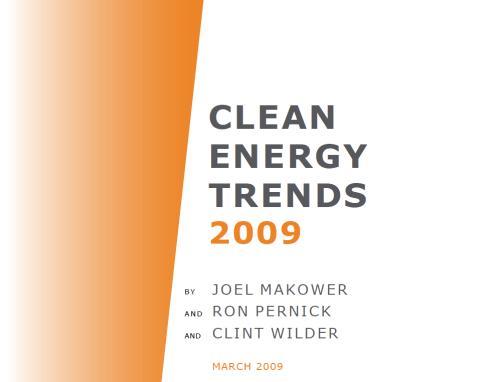
Worldwide revenues from the solar photovoltaic, wind and biofuels industries jumped 53% in 2008 to $116 billion and is on track to grow to $325 billion by 2018, according to a report released Tuesday by West Coast market research firm Clean Edge.

Last year’s boom, however, is unlikely to be repeated in 2009, given the global financial crisis. Signs of the slowdown were apparent last year as new global investment in green energy grew by a paltry 4.7% to $155 billion, compared to a 60% rise between 2006 and 2007. In the United States, however, venture capital investments in green tech grew 22% last year to $3.3 billion, representing 12% of all VC investments, according to figures compiled by research firm New Energy Finance.

“2009 is a year to get through,” said report author Ron Pernick during a conference call.

Of course, growth projections for renewable energy are inherently speculative. Green energy investment is strongly dependent on government policy and what the Obama administration gives today in the form of billions in subsidies and incentives a successor can take away. And then there are calamities like the extent of the meltdown of the global economy that few foresaw even a year ago.

The wind industry accounted for a third of renewable energy revenues in 2008, becoming a $50 billion business. Clean Edge projects that employment in the wind and solar industries will grow from a combined 600,000 jobs in 2008 to 2.7 million by 2018.

“As the market transitions to low-carbon fuel and electricity sources, conservation and efficiency efforts, and the deployment of a smart, 21st century grid, we believe clean energy offers one of the greatest opportunities for both local and global economies to compete and thrive,” wrote Pernick and co-authors Joel Makower and Clint Wilder.

They identified as growth areas smart grid technologies, energy storage for wind and solar farms, the Eastern Eureopean market,  power grid infrastructure and micro power grids that provide electricity to self-contained facilities or areas.

Design a site like this with WordPress.com
Get started