Feeds:
Posts
Comments

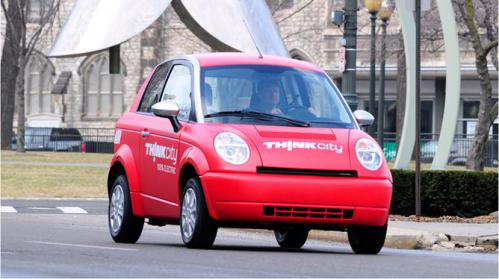
TH!NK-city-Michigan-USA_imagelarge

photo: Think

Norwegian electric carmaker Think is going into the drive-train businesses with battery maker EnerDel and their first big customer is the Japanese postal service.

Think makes the City, a two-seater urban runabout currently sold in Europe. EnerDel supplies (ENER1) lithium-ion batteries for the car and will be the provider of batteries for Think’s new electric drive-train business.

“We have seen increased interest in Think’s proprietary EV drive system from a variety of third parties, which represents a significant and exciting new business line and revenue opportunity for the company,” said Think CEO Richard Canny in a statement.

The company is selling the drive trains to Zero Sports, a Japanese company that converts cars to battery power and which is working with the Japanese postal service to electrify its 22,000-vehicle fleet.

Think, previously owned by Ford (F), was forced to halt production of the City late last year as the global financial crisis cut off access to capital. The company subsequently obtained new funding and has announced plans to build a factory in the United States.

Global investment in green technology rose 12% to $1.2 billion in the second quarter after two quarters of sharp declines, according to a report released Wednesday by the Cleantech Group and Deloitte.

Electric cars attracted the most investment at $236 million while solar fell to a low of $114 million. Biofuels scored $206 million and advanced batteries received $165 million from investors.

“It looks like things have leveled out and have stabilized,” said Brian Fan, senior director of research for the Cleantech Group, a San Francisco-based research and consulting firm.

Still, the second quarter numbers are down 44% from a year ago.

North America grabbed 66% of green tech investment while Europe and Israel captured 21% percent, India 11% and China 1%.

Fan said that while investors were hot on smart grid companies at the end of 2008 their ardor has cooled so far this year.

In a sign that the green tech industry has been consolidating as the recession drags on, mergers and acquisitions jumped 291% in the second quarter to $12.2 billion.

Stirling SunCatcher

photo: Tessera Solar

When it comes to renewable energy, Texas has been all about Big Wind. But this week the Lone Star State took on its first Big Solar project when San Antonio utility CPS Energy signed a 27-megawatt deal with Tessera Solar.

Houston-based Tessera is the solar farm developer for Stirling Energy Systems, which makes a Stirling solar dish. Resembling a giant mirrored satellite receiver, the 25-kilowatt solar dish focuses the sun’s rays on a Stirling engine, heating hydrogen gas to drive pistons that generate electricity. (Last year Irish green energy firm NTR pumped $100 million into Scottsdale, Ariz.-based Stirling Energy Systems and created Tessera to develop solar power plants using the Stirling dish, called the SunCatcher.

Stirling Energy Systems previously signed deals with Southern California Edison (EIX) and San Diego Gas & Electric (SRE) to supply up to 1,750 megawatts of electricity from some 70,000 solar dishes to be planted in the Mojave and Sonoran deserts.

Other solar developers privately have cast doubt on Stirling’s ability to make good on those contracts, arguing the SunCatcher is just too expensive and complex to compete against solar thermal technologies that rely on mirrors to heat liquids to create steam that drives electricity-generating turbines.

But earlier this week, Stirling unveiled the latest generation of the SunCatcher at Sandia National Laboratories in Albuquerque, N.M. The new SunCatcher has shed 5,000 pounds and its Stirling hydrogen engine contains 60% fewer parts than the previous version, according to the company.

The SunCatcher also uses a fraction of the water consumed by competing solar thermal technologies being developed by startups like BrightSource Energy and Ausra — no small deal in the desert. Tessera solar farms also can be built in modules, meaning that when a 1.5 megawatt pod of 60 SunCatchers is installed it can immediately begin generating electricity — and cash.

California utility PG&E also went modular Thursday when it signed a 92-megawatt deal with New Jersey’s NRG (NRG) for electricity to be generated by a Southern California solar power plant using eSolar’s technology. Google-backed (GOOG) eSolar’s builds its solar power tower plants in 46-megawatt modules. The power plants take up much less land than competing solar thermal technologies, thanks to eSolar’s use of sophisticated software to control small mirrors that are packed close together.

NRG earlier this month signed a deal to build a 92-megawatt eSolar-powered solar farm in New Mexico near the Texas border.

eSolar CEO Bill Gross says his solar farms will generate electricity cheaper than natural gas-fired power plants, a claim PG&E (PCG) appears to confirm in its submission of the deal to the regulators. (Thanks to Vote Solar for pointing to the document.)

IMG_0783

photo: Todd Woody

With the U.S. House of Representatives set to vote on the Waxman-Markey climate change bill this week, a report issued Thursday predicts the American Clean Energy and Security Act will create a huge market in carbon offset projects like reforestation.

In its current form, the legislation allows companies to comply with a cap on greenhouse gas emissions in part by purchasing carbon offset credits generated by domestic and international projects that reduce CO2 — such as capturing methane gas leaking from landfills. According to an analysis by research firm New Energy Finance, demand — for up to 5.7 billion tons of offsets — will far outstrip supply, with domestic projects contributing fewer than 30% of the offsets.

“Waxman-Markey will induce cumulative production…of offsets until 2020 to satisfy demand for reductions,” wrote the report’s authors. “We estimate that Waxman-Markey’s targets and lenient offset limits will create high levels of offset project development – both domestic and international.”

In other words, U.S. climate change legislation could goose a global market for offsets. In the U.S. alone, New Energy Finance estimates that the offset market will grow 27-fold by 2015, becoming a $46.7 billion business by 2020.

Some environmentalists have slammed Waxman-Markey for its generous use of offsets, arguing that U.S. companies could actually increase their carbon pollution while meeting the cap by buying other people’s emissions reductions. Relying on overseas projects to supply the majority of offsets also raises questions about how those efforts will be verified and overseen, especially if a carbon boom develops.

On the plus side, New Energy Finance expects tree projects to “play a pivotal role” in the offset market, which could slow the rapid rate of deforestation afflicting the planet.

Stirling Energy Systems Solar One project

image: URS

Green Wombat spent several months looking into allegations that California labor unions are using environmental laws to pressure  solar developers to hire union workers to build large-scale solar power plants. The story was published last Friday in The New York Times:

SACRAMENTO — When a company called Ausra filed plans for a big solar power plant in California, it was deluged with demands from a union group that it study the effect on creatures like the short-nosed kangaroo rat and the ferruginous hawk.

By contrast, when a competitor, BrightSource Energy, filed plans for an even bigger solar plant that would affect the imperiled desert tortoise, the same union group, California Unions for Reliable Energy, raised no complaint. Instead, it urged regulators to approve the project as quickly as possible.

One big difference between the projects? Ausra had rejected demands that it use only union workers to build its solar farm, while BrightSource pledged to hire labor-friendly contractors.

As California moves to license dozens of huge solar power plants to meet the state’s renewable energy goals, some developers contend they are being pressured to sign agreements pledging to use union labor. If they refuse, they say, they can count on the union group to demand costly environmental studies and deliver hostile testimony at public hearings.

If they commit at the outset to use union labor, they say, the environmental objections never materialize.

You can read the rest of the story here.

ibm-smarter-planet

While the U.S. Department of Energy on Tuesday issued nearly $8 billion in loans to Ford (F), Nissan and Tesla Motors to manufacture electric cars and batteries, IBM unveiled an initiative to develop a next-generation battery technology that would allow those vehicles to travel 400 miles or more on a charge.

Big Blue will investigate the potential of lithium air technology to replace current state-of-the-art lithium ion batteries. Lithium air potentially could pack 10 times the energy density of lithium ion storage devices by drawing oxygen into the batteries to use as a reactant. As a result lithium air batteries would weigh less than lithium ion batteries, C. Spike Narayan, manager of science and technology at IBM’s Almaden Research Center, told Green Wombat.

So besides powering cars, lithium air batteries could store electricity generated from solar power plants and wind farms, turning them into 24/7 energy sources.

But don’t expect to see the super-charged batteries anytime soon.”This is a five-to-10-year project,” says Narayan. “The first phase is to go after the big science problems. Then we’re ready to engage with automotive companies and battery manufacturers.”

The technological hurdles are high and even IBM (IBM), with its expertise in nanotechnology, green chemistry and supercomputing, won’t try to go it alone. It’s seeking partners at research universities and government laboratories to crack the tech challenges, which include developing a membrane that will strip water out of the air before it enters the battery and the development of nano materials to prevent layers of lithium oxide from interfering with chemical reactions.

IBM intends to limit its role in the battery business to R&D. “We have no desire to make batteries,” says Rich Lechner, IBM’s vice president for energy and the environment. “We will license the IP.”

In another sign that climate change and the imminent imposition of carbon caps are creating opportunities for Big Business and rearranging the competitive landscape, IBM also announced “Green Sigma,” an alliance of erstwhile competitors that will offer solutions to companies seeking to shrink their carbon footprint.

Green Sigma includes business software giant SAP (SAP), Cisco (CSCO), Johnson Controls (JCI) and Honeywell (HON). Dave Lebowe, an IBM executive with the Green Sigma program, acknowledged the potential for conflicts of interests among these frenemies but said such problems were outweighed by the upside of bringing together a broad range of expertise to help customers cut their CO2 emissions and save money.

eSolar Sierra
photo: eSolar

California may be in the midst of licensing dozens of massive megawatt solar power plants but New Mexico may be first state out of the gate with a big project using next-generation solar thermal technology. On Thursday, New Mexico Governor Bill Richardson announced that Pasadena, Calif.-based eSolar and utility giant NRG Energy will build a 92-megawatt solar thermal power plant — the state’s first — near the Texas border that will go online in 2011.

“The New Mexico Public Utilities Commission has approved the project, we have the permits and  we already have the land so we’ll be breaking ground in 2010,” eSolar CEO Bill Gross told Green Wombat. “We already have the equipment and the financing partner, NRG. We’re ready to go.”

In February, Google-backed (GOOG) eSolar agreed to supply its technology to NRG (NRG) to develop solar farms generating 500 megawatts.

eSolar will use fields of mirrors to focus the sun on water-filled boilers that sit atop towers. The heat vaporizes the water and the resulting steam drives electricity-generating turbines. Competitors use large, slightly curved — parabolic — mirrors to focus sunlight. That requires big and expensive steel frames to hold the glass in place.  eSolar’s solution: make small flat mirrors the size of an LCD television screen that clamp on to a  5 x 12-inch frame and then use software and Big Iron computing to position the mirrors to create a “dynamic parabola” out of the entire heliostat field.  Gross says eSolar’s small heliostats can be cheaply manufactured take up less land than conventional mirrors.

That means eSolar can build modular power plants near urban areas and transmission lines, lowering costs and avoiding some of the endangered species fights that have slowed Big Solar projects in California. (See Green Wombat’s column on Grist for a first-hand look at eSolar’s Sierra demonstration plant in Southern California.)

The New Mexico solar farm will be built on 450 acres of agricultural land about 10 miles from El Paso, Texas. Utility El Paso Electric (EE), which serves parts of New Mexico, will buy the electricity generated by the solar power plant — enough to power 74,000 homes  — under a 20-year power purchase agreement. Terms of the deal were not disclosed.

“We think there’s room for a lot more solar power plants at this price,” says Gross. “The sun is very good in New Mexico and all the economics that make this project work are very good there.”

In March, First Solar (FSLR) said it would build a 30-megawatt thin-film photovoltaic solar farm in northeastern New Mexico.

eSolar’s five-megawatt Sierra demo plant outside Los Angeles, pictured above, has begun producing steam and will soon start generating electricity — “It’s the only solar power tower operating in North America,” Gross says.

Next year, ground will be broken on an eSolar power plant in India and NRG and eSolar have a deal to supply utility Southern California Edison (EIX) with 245 megawatts of solar electricity.

“The idea of these plants dotting the desert and producing electricity has been our dream for a long time,” says Gross, “and now it’s a reality.”

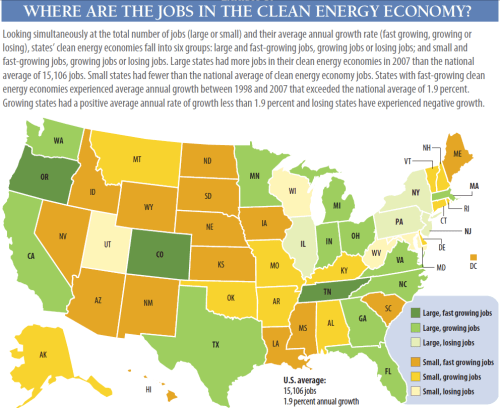
Pew clean energy report

graphic: The Pew Charitable Trusts

Clean energy jobs grew 9.1% over the past decade and now number 770,000 as the green tech economy makes inroads in every U.S. state and outstrips conventional job creation, according to a new study released Wednesday by The Pew Charitable Trusts.

Non-green energy jobs, in contrast, grew by 3.7% between 1998 and 2007. The traditional fossil fuel industry employed 1.27 million workers in 2007.

Pew worked with California research firm Collaborative Economics to conduct an actual count of 68,200 businesses engaged in its definition of the clean energy economy — activity that “generates jobs, businesses and investments while expanding clean energy production, increasing energy efficiency, reducing greenhouse gas emissions, waste and pollution, and conserving water and other natural resources.”

Clean energy economy jobs were divided into five sectors: clean energy, energy efficiency, environmentally friendly production, conservation and pollution mitigation, and training and support.

“Americans are struggling to get a sense of the nation’s economic future,” Lori Grange, interim deputy director of the Pew Center on the States, said on a conference call Wednesday morning.  “The nation’s clean energy economy is poised for explosive growth.”

“It just isn’t California,” she added. “Every state has a piece of the clean energy economy.”

Nevertheless, California remains a clean-energy unto itself and boasted 125,390 jobs generated by 10,209 green businesses in 2007. The Golden State, not surprisingly, attracted $6.6 billion in venture capital funding between 2006 and 2008, six times the amount captured by the runner-up, Massachusetts. Startups focused on clean energy and energy efficiency scored 80% of venture capital investments. California also led in clean energy patents, with 1,401 granted between 1998 and 2007 compared to New York’s 909.

California, however, is getting a run for its money from Oregon, Colorado and other states. Oregon had one of the fastest rates of clean energy job creation and those jobs accounted for the highest percentage of overall employment compared to other states — between .82% and 1.02%.

And Texas, for instance, is the world’s sixth-largest producer of wind energy, Pew researchers said.

The report’s patent numbers offer one indication of where the clean energy economy is headed. Between 1999 and 2008, batteries accounted for 46.6% of the patents while fuel cells took 25.6%. Solar had 8.7% of all clean energy patents and wind had 5%.  However, the growth rate in battery patents fell 33% between 1999 and 2008 while fuel cell patents jumped 96% and hybrid system patents grew 147%. Solar patents fell 15% as wind patents grew 155%.

The average annual salaries for clean energy jobs ranged from $21,000 to $111,000, according to the Pew report.

State policies requiring renewable energy production and energy efficiency measures have played a significant role in driving green energy job growth, the Pew authors said. A map showing regions with the biggest green job growth correlate with a map of states with the strongest renewable energy policies.
Sierra Club Green Home

At Fortune’s recent Brainstorm Green conference, Green Wombat had a chance to get a guided tour of Sierra Club Green Home — the new for-profit online venture of the venerable Sierra Club — from Jennifer Schwab, the startup’s  sustainability director.

As interesting as the site is the business model being pursued by the 117-year-old non-profit. As I wrote in my Green State column on Grist:

It’s not unusual these days for big green groups to get in bed with business, but one of the oldest and most-respected environmental organizations—the Sierra Club—is going them one better by getting into business itself.

The San Francisco-based Sierra Club has launched a for-profit online venture called Sierra Club Green Home as a one-stop shop for information and services to green up your lifestyle and decarbonize your abode.

Sierra Club Green Home is a joint venture between the 117-year-old institution and a group of individual investors—or “donors” as they like to call themselves. “It’s the social entrepreneurship model,” says Gordon Wangers, the company’s marketing chief and one of the donor/investors. “A non-profit finds some enterprising business types who are committed to a cause but bring business savvy to a venture and have the skills and wherewithal to run it.”

Wangers thinks it’s a model for other green groups as the economic collapse zaps the fortunes of their well-heeled donors.

You can read the rest of the column here.

AV Solar Ranch

California utility PG&E on Friday announced a contract to buy 230 megawatts of electricity from a photovoltaic solar farm to be built by San Francisco-based NextLight Renewable Power.

NextLight — backed by private equity firm Energy Capital Partners — will build the AV Solar Ranch on agricultural land in Los Angeles County’s Antelope Valley.  PG&E (PCG) says the solar power plant will begin producing electricity in 2011. When fully built out by 2013, it will generate enough power for 90,000 homes, according to the utility.

Since the project will deploy solar panels rather than solar thermal technology that uses mirrors to heat liquids to drive a turbine, it does not need to go through the laborious California Energy Commission permitting process.

NextLight apparently also plans to build solar thermal farms — the company has filed lease claims on some 20,000 acres of Mojave Desert land owned by the U.S. Bureau of Land Management for two 500-megawatt solar trough power plants.

Friday’s agreement follows PG&E’s deal in May with BrightSource Energy to buy 1,300 megawatts of solar electricity to be produced by seven solar power plants.

Design a site like this with WordPress.com
Get started