October 30, 2009 by Todd Woody
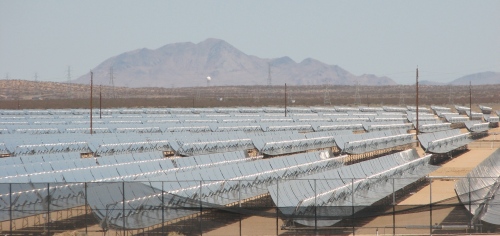
photo: Todd Woody
California utility PG&E on Monday announced two new Big Solar deals that will likely to ramp up the debate over solar thermal power plants’ thirst for water in the desert Southwest. As I write in The New York Times:
The West’s water wars are likely to intensify with Pacific Gas and Electric’s announcement on Monday that it would buy 500 megawatts of electricity from two solar power plant projects to be built in the California desert.
The Genesis Solar Energy Project would consume an estimated 536 million gallons of water a year, while the Mojave Solar Project would pump 705 million gallons annually for power-plant cooling, according to applications filed with the California Energy Commission.
With 35 big solar farm projects undergoing licensing or planned for arid regions of California alone, water is emerging as a contentious issue.
The Genesis and Mojave projects will use solar trough technology that deploys long rows of parabolic mirrors to heat a fluid to create steam that drives an electricity-generating turbine. The steam must be condensed back into water and cooled for re-use.
Solar trough developers prefer to use so-called wet cooling in which water must be constantly be replenished to make up for evaporation. Regulators, meanwhile, are pushing developers to use dry cooling, which takes about 90 percent less water but is more expensive and reduces the efficiency –- and profitability – of a power plant.
NextEra Energy Resources, a subsidiary of the utility giant FPL Group, is developing the Genesis project in the Chuckwalla Valley in the Sonoran Desert. The twin solar farms would tap about 5 percent of the valley’s available water.
You can read the rest of the story here.
Posted in Abengoa Solar, alternative energy, energy, environment, green policy, NextEra Energy Resources, PG&E, solar energy, solar power plants | Tagged Abengoa Solar, California, NextEra Energy Resources, PG&E, solar energy, solar power plants, water | Leave a Comment »
October 23, 2009 by Todd Woody
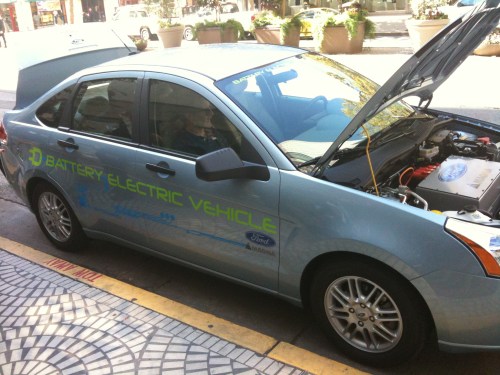
photo: Todd Woody
Ford executives brought a battery-powered Focus sedan to San Francisco on Thursday (along with a plug-in hybrid Escape). It was clear from the presentation by Nancy Gioia, Ford’s director of global electrification, that the automaker is aiming for a mass market and is spending a great deal of effort on helping create an entire electric car infrastructure. As I wrote in The New York Times on Friday:
At a press event in San Francisco on Thursday, Ford showed off a prototype of what might be called the Model T of the automaker’s electric car strategy: the battery-powered Focus sedan.
“This is about affordable transportation for the masses — this is not about a small niche,” said Nancy Gioia, Ford’s director of global electrification.
To keep costs down, the Focus and plug-in electric hybrids will be built — in small numbers at first — on what the company calls its global “C” platform, which produces two million cars a year.
“The assembly line in Michigan will produce the battery-electric Focus and also, with minor modifications, the gas Focus,” Ms. Gioia said. “We can change production as the market shifts.”
The Focus will hit the market in 2011 followed the next year by a plug-in electric Escape sport-utility vehicle, which Ford also showed off in San Francisco. Ms. Gioia said she expects electric and plug-in hybrids will account for 10 to 25 percent of the market by 2020.
You can read the rest of the story here.
But the cars seemed almost beside the point as Ford executives focused on their strategy to work with utilities and other groups to create open standards for electric cars and ensure that a charging infrastructure is in place when buyers hit showrooms.
Posted in climate change, corporate green, electric cars, green cars, green policy | Tagged battery-powered Focus, electric cars, Ford, Ford Escape, Ford Focus, Nancy Gioia, plug-in hybrids | Leave a Comment »
October 23, 2009 by Todd Woody
The Lawrence Berkeley National Laboratory this week released a comprehensive study on the cost of going solar in the United States. No surprise that the cost of installing a photovoltaic solar system has fallen 30 percent over the past decade, but there are some interesting developments. For instance, California may be the biggest solar state but it’s not the cheapest. As I write in The New York Times on Friday:
The cost of going solar fell last year, resuming a decade-long decline after several years of flat prices, according to a new study from Lawrence Berkeley National Laboratory.
The report found that the installed cost of residential and commercial photovoltaic systems in the United States dropped 30 percent overall between 1998 and 2008. But prices had become relatively stagnant between 2005 and 2007, as demand spiked and solar module makers ramped up production.
The global economic meltdown, however, along with a resulting oversupply of modules, led the cost of installing a solar system last year to fall from $7.80 in a watt to $7.50 a watt — though the actual cost to homeowners actually increased slightly as state incentives for installing solar arrays fell faster than module prices.
In states like California, the per-watt rebate declines as more solar systems are installed.
Among other findings: the researchers, who reviewed data from the installations of 52,356 solar systems, discovered that it is 10 percent less expensive to install a solar array on a new home than to retrofit an existing home.
And although California is by far the largest solar market in the United States with 81 percent of all installed photovoltaic systems, it isn’t the cheapest place to install small-scale solar.
That distinction goes to Arizona, where the installed cost of solar systems smaller than 10 kilowatts was $7.30 per watt compared to $8.20 per watt in California.
You can read the rest of the story here.
Posted in alternative energy, green policy, solar energy | Tagged cost of solar, Lawrence Berkeley National Laboratory, photovoltaic, solar energy | Leave a Comment »
October 22, 2009 by Todd Woody
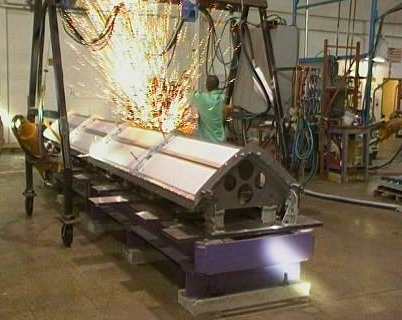
photo: Skyline Solar
Silicon Valley startup Skyline Solar has joined other green energy companies beating a path to Detroit to take advantage of the down-and-out auto industry’s manufacturing might. As I write in the Los Angeles Times on Thursday:
Skyline Solar, a Silicon Valley start-up, has become the latest green energy company to tap the struggling auto industry’s manufacturing muscle.
The company announced today that components for its solar power plants were being made in a Troy, Mich., car factory operated by Cosma International, a division of auto manufacturing giant Magna International.
The same machines that stamp out doors, hoods and other car body parts are now making long metal arrays that hold Skyline’s photovoltaic panels.
“It’s literally just carving out a piece of an existing facility and putting through a product that for all intents and purposes could be a new make and model of the next family sedan,” said Bob MacDonald, Skyline’s chief executive. “Every time there’s a new model year for a Ford Mustang, they have a tool and die set they put into this press. So you just have a different tool and die in there that forms a new shape for Skyline.”
The bottom line, said MacDonald, is that Skyline has slashed its capital costs by taking advantage of Cosma’s existing manufacturing capability. He said Skyline of Mountain View, Calif., has contracts in place for small-scale solar farms. He said he could not divulge the details of those contracts but noted that Skyline has begun to receive shipments of arrays from Michigan.
It’s also a good deal for Cosma, whose parent company has agreed to acquire Opel from General Motors.
“Renewable energy trends and forecast data suggest significant growth potential for this market — we expect to participate in this growth potential,” Tracy Fuerst, a Magna spokeswoman, said in an e-mail.
You can read the rest of the story here.
Posted in alternative energy, climate change, enviro capitalism, enviro startups, environment, green startups, green tech, solar energy, solar power plants | Tagged Cosma International, green manufacturing, Magna International, Skyline Solar | Leave a Comment »
October 22, 2009 by Todd Woody
 There are a growing number of “green” software applications for the iPhone. One of the newest is an app that turns the gadget into an anemometer to clock wind speeds for those considering installing a backyard turbine. As I write in The New York Times on Thursday:
Thinking of putting a wind turbine in your backyard? Mariah Power is introducing a program that will let you measure the wind speed around your house by pointing your iPhone toward the sky.
The application uses the phone’s microphone to capture wind noise. It filters out ambient sound and an algorithm converts the result into a decibel rating that corresponds to wind speed, according to Bill Westerman, a principal at Create with Context, a Silicon Valley digital design company that developed the app for Mariah.
“If you go out in your backyard and do a few measurements it gives you a pretty good idea of the wind speed and tells you what kinds of things you could power with a wind turbine,” said Mr. Westerman.
Mariah, based in Reno, Nev., makes the Windspire, 1.2-kilowatt residential turbine with horizontal blades that looks more like a piece of modern art than a conventional windmill.
You can read the rest of the story here.
Posted in alternative energy, energy, green marketing, green tech, wind power | Tagged Create with Context, iPhone, iPhone wind speed app, Mariah Power | Leave a Comment »
October 21, 2009 by Todd Woody
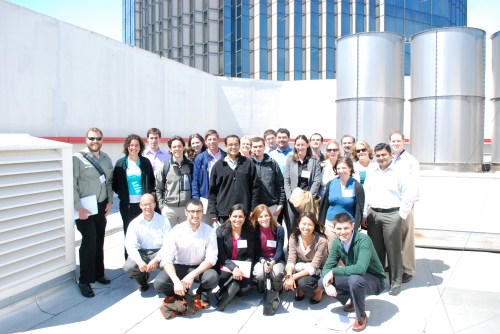
photo: EDF
In my new Green State column on Grist, I catch up with the Climate Corps, a group of green MBA students sponsored by the Environmental Defense Fund. The Climate Corps recently finished 10-week internships with Fortune 500 companies, saving them an estimated $54 million through energy efficiency measures the students identified:
Back in May I wrote about the Environmental Defense Fund’s (EDF) Climate Corps, a cadre of 26 MBA students who were then prepping for summer internships at Fortune 500 companies. Their mission was to green up corporate operations to save money and cut carbon emissions.
With winter on the way and school back in session, I checked in to see how successful the Climate Corps was at combining the students’ financial smarts, technological know-how—half are engineers by training—and environmental ethic.
Pretty successful, it turns out. According to EDF, the interns identified energy efficiency measures that will collectively save an estimated $54 million at 22 companies (and one university), including eBay, Dell and Sony Pictures Entertainment. That translates into 100,000 metric tons of greenhouse gases avoided a year with an annual energy savings of 160 million kilowatt hours.
A couple of caveats are in order. Energy efficiency programs were already under way at many of the companies. And whether the projected $54 million in savings will actually be realized won’t be known until the energy efficiency efforts are completed—actual results may vary.
Still, anything close to $54 million is quite a return on investment, given that the companies altogether spent only $260,000 on intern salaries during the 10-week program.
But the long-term payoff is likely to be the emergence of a new corporate class- – the green financial engineer—and future CEOs—who reflexively view environmental performance as a bottom-line concern.
You can read the rest of the column here.
Posted in corporate green, corporate sustainability, energy efficiency, Environmental Defense | Tagged Climate Corps, Environmental Defense Fund, Fortune 500, Green MBAs | Leave a Comment »
October 16, 2009 by Todd Woody

That was quick: Just days after California Gov. Arnold Schwarzenegger vetoed legislation that would have limited utilities’ ability to buy out-of-state renewable energy, utility PG&E on Thursday asked regulators to approve a deal with an Arizona solar farm to supply 290 megawatts of electricity. As I write in The New York Times on Friday:
Pacific Gas & Electric, the big California utility, asked regulators on Thursday to approve the purchase of electricity from an Arizona solar power plant, only days after Gov. Arnold Schwarzenegger vetoed legislation that would have limited utilities’ ability to tap out-of-state projects to meet renewable energy mandates.
NextLight Renewable Power will construct the 290-megawatt Aqua Caliente photovoltaic farm on private land in Yuma County, Ariz. The company, based in San Francisco, signed a deal with P.G.&E. in June to supply 230 megawatts from a solar power plant to be built outside of Los Angeles.
The legislation vetoed by Mr. Schwarzenegger on Sunday would have required California utilities to obtain 33 percent of their electricity from renewable sources by 2020, mostly from in-state projects.
Environmental groups and unions supported that provision as a way to limit the need to build new transmission lines and to keep construction jobs in California. But the governor said it would hamstring utilities from complying with the 33 percent target, which he supports.
According to the filing the utility made Thursday, Arizona regulators have already approved the project and NextLight expects to obtain county building permits within a few months. In contrast, the licensing of a solar power plant in California can take years. The Agua Caliente project is also located near existing transmission lines that connect to California’s power grid.
You can read the rest of the story here.
Posted in alternative energy, energy, environment, green policy, NextLight Renewable Power, PG&E, solar energy, solar power plants | Tagged Arizona, Arnold Schwarzenegger, NextLight Renewable Power, PG&E, renewable portfolio standard | Leave a Comment »
October 15, 2009 by Todd Woody

Image: Pacific Northwest National Laboratory
Next month the United States Department of Energy will release a study finding that China contains huge underground repositories that could be used to store 100 years of carbon emissions. As I write in The New York Times on Thursday:
China has vast underground repositories that could store more than a century’s worth of carbon emissions from coal-fired power plants and industrial facilities, according to a report to be released by the United States Department of Energy’s Pacific Northwest National Laboratory.
The study, conducted with scientists at the Chinese Academy of Sciences, found that the geologic formations are in close to a large percentage of the country’s power plants.
That could permit “the continued use of cheap, domestic coal within China while supporting CO2 emissions reductions via the capture and geologic storage of the associated CO2,” according to an eight-page summary of the study.
The full report will be released in November.
“A lot of the policy dialogue and technical discussions have this really sharp dichotomy — either you use coal and bad things happen to the environment, or you forgo coal and bad things happen to the economy,” James Dooley, a scientist at the laboratory and an author of the report, said in an interview. “We’re trying to say maybe there’s a third way here.”
Such technology, which remains untried on a commercial scale, comes with high costs, because capturing and storing carbon emissions consumes significant amounts of energy and water. The potential environmental impact of putting billions of tons of carbon dioxide underground also remains unknown.
You can read the rest of the story here.
Posted in energy, environment, global warming | Tagged carbon capture and storage, China, climate change, Department of Energy, global warming, Pacific Northwest National Laboratory | 1 Comment »
October 14, 2009 by Todd Woody

photo: Stefano Paltera/DOE
In my new Green State column on Grist (I’m stealing the above headline from Grist executive editor Russ Walker), I take a look at the state of green tech venture investing gleaned from a recent seminar at the University of California, Berkeley:
Silicon Valley is by nature an optimistic place. After all, inventing the carbon-free future and making boatloads of money along the way is fun. And even though California is slouching toward apocalyptic collapse these days, there’s always another innovation wave to ride.
So it’s always interesting to get a more-or-less unvarnished assessment of the state of green tech, as happened last week when a group of regulators, venture capitalists and entrepreneurs gathered at the University of California, Berkeley’s business school. They were there for the Cleantech Institute, one of those pricey, closed-door seminars for executives and government officials. (I was present to “facilitate.”)
The good news: Speakers reported that investors are starting to turn on the taps again when it comes to funding green tech startups.
But don’t expect a return to the halcyon days of 2008 when $4 billion poured into all manner of green technology companies. In the wake of the “Great Recession,” VCs are reassessing their investment strategies as it becomes clear that the success of their portfolios will be influenced to a large degree by government policy and incentives.
You can read the rest of the column here.
Posted in alternative energy, BrightSource Energy, climate change, enviro startups, environment, global warming, green financing, green policy, green startups, investment tax credit | Tagged BrightSource Energy, Department of Energy, green tech startups, green technology, Silicon valley, venture capital | Leave a Comment »
October 12, 2009 by Todd Woody
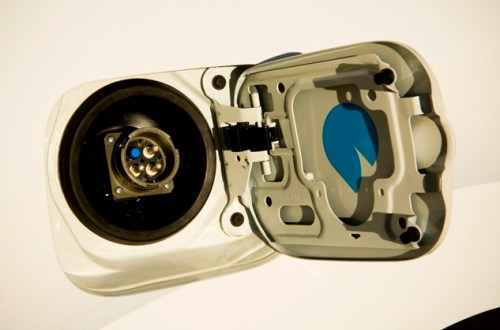
photo: Better Place
With electric cars months away from hitting the road, the California Public Utilities Commission has begun the complex task of establishing a regulatory framework for the state’s emerging electric vehicle infrastructure. The biggest fight is likely to be over whether to regulate companies like Better Place, which plans to build an electric car charging network in the state. As I write in The New York Times on Monday:
With electric cars set to hit the mass market next year, a skirmish is breaking out in California over who will control the state’s electric vehicle infrastructure.
The California Public Utilities Commission will write the rules of the electric road and is just starting to grapple with the complex regulatory issues surrounding the integration of battery-powered cars into the state’s electrical grid.
One of the biggest questions is whether to regulate Better Place, Coulomb Technologies and other companies that plan to sell electricity to drivers through a network of battery charging stations.
California’s three big investor-owned utilities have split over the issue.
“The commission should establish its authority to regulate third-party providers of electricity for electric vehicles,” Christopher Warner, an attorney for Pacific Gas & Electric, wrote in a filing with the utilities commission. “Managing the increased electricity consumption and load attributable to electric vehicles in order to avoid adverse impacts on the safety and reliability of the electric grid may be one of the most difficult management challenges that electric utilities will face.”
Southern California Edison, meanwhile, urged the commission to move cautiously, calibrating any regulation to the specific business models of the companies.
San Diego Gas & Electric said the commission does not have the right to regulate companies like Better Place.
You can read the rest of the story here.
Posted in Better Place, electric cars, energy, environment, green cars, green grid, green policy, PG&E, San Diego Gas & Electric, Southern California Edison | Tagged Better Place, California Public Utilities Commission, electric car charging networks, electric car infrastructure, PG&E, San Diego Gas & Electric, Southern California Edison | Leave a Comment »
« Newer Posts - Older Posts »
 Green Wombat