December 21, 2009 by Todd Woody
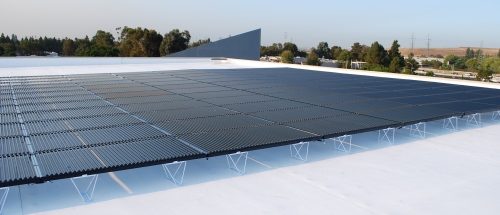
photo: Solyndra
In The New York Times on Friday, I write that Solyndra, a Silicon Valley photovoltaic module maker, has become the first solar startup in years to brave the public markets:
Solyndra, a well-financed solar module maker, filed a registration statement for an initial public offering on Friday to raise $300 million to expand its manufacturing capacity.
It would be the biggest solar-related offering in years and follows the stock-market debut of the electric car battery-maker A123 Systems in September.
Based in Fremont, Calif., Solyndra emerged from stealth mode in October 2008 having secured $600 million in venture financing and $1.2 billion in orders. The company, founded in 2005 by veterans of the chip equipment maker Applied Materials, has since raised nearly $200 million more in venture funds.
The company makes cylindrical thin-film solar modules designed for commercial rooftops. The round modules collect sunlight from all angles, allowing the solar panels to be placed horizontally and packed close together, increasing efficiency and lowering installation costs, according to Solyndra.
Solyndra secured a $535 million loan guarantee from the United States Department of Energy in March to help finance the construction of a second factory near its headquarters. In September, the company applied for an additional government loan guarantee to help pay for the second phase of the $1.38 billion factory, according to the registration statement.
You can read the rest of the story here.
Posted in alternative energy, enviro startups, environment, green startups, green tech, solar energy, Solyndra | Tagged IPO, solar energy, Solyndra | Leave a Comment »
December 15, 2009 by Todd Woody
 In my latest Green State column for Grist, I take a look at AlertMe, a British startup that’s making a play to become a consumer brand for managing home energy use:
I’m sitting in a conference room at a PR agency on the San Francisco waterfront when the chief executive of AlertMe, a British energy management startup, pulls out his iPhone to check on a colleague’s kilowatt consumption back in the U.K.
The executive, who has the Vonnegutian name of Pilgrim Beart, taps the “history” icon on the screen. “I can see that his wife has arrived home,” he says before touching the energy button.
“They’re watching TV right now,” Beart notes, staring at the iPhone screen. “I could turn the TV off if I wanted to wind them up. I won’t do that. But I will turn off the microwave as no one is using it right now.”
He touches the screen and, voila, 5,300 miles away, the microwave blinks off, saving its owners a few pence and reducing the load on the grid by a watt.
All very cool. And a bit creepy.
Beart has a window into his colleague’s home life because the house is outfitted with AlertMe smart plugs that monitor appliances’ electricity use. Other gadgets track the home’s temperature. Key fobs carried by the homeowners keep tabs on their comings and goings so AlertMe’s software can adjust heating and cooling and turn appliances on and off to maximize energy efficiency.
Of course, Beart’s use of the iPhone as Big Brother was purely for demo purposes. In real life, AlertMe customers’ data remains anonymous. However, homeowners can monitor and control their electricity use on their smartphones.
AlertMe is one of a growing number of startups competing to help consumers cut their electricity use by providing real-time data and services to manage energy consumption. The company is backed by Silicon Valley and European venture capital firms, including VantagePoint Venture Partners, Good Energies, and Index Ventures.
What caught my attention is AlertMe’s strategy. Beart is attempting to build a consumer brand and he’s doing it without relying on digital smart meters, which utilities are slowly rolling out to provide real-time data on electricity use.
You can read the rest of the column here.
Posted in energy efficiency, enviro startups, environment, green startups | Tagged AlertMe, home energy management, Pligrim Beart, smart grid | Leave a Comment »
December 11, 2009 by Todd Woody
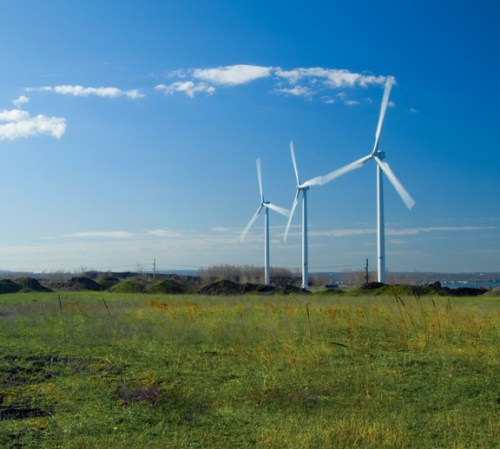
photo: Clipper Windpower
Tech and defense industry conglomerate United Technologies has shown growing interest in alternative energy and this week it bought nearly half of California wind turbine maker Clipper Windpower. As I write Friday in The New York Times:
United Technologies, a global industrial heavyweight, will invest $270 million for a 49.5 percent stake in Clipper Windpower, a struggling California-based turbine maker.
The deal, announced this week, marks a change in the ownership structure for one of the few major American-owned turbine makers. (Another is General Electric.)
United Technologies, a Hartford-based parent company to businesses such as jet engine maker Pratt & Whitney and elevator maker Otis, has recently shown interest in alternative energy. For example, it has licensed its molten salt storage technology to solar power plant builder SolarReserve.
In a statement on Wednesday, United Technologies said that it “expects to work closely with Clipper Windpower to improve the company’s core technology, manufacturing, product quality, and supply management capabilities.”
The agreement, the company added, “allows U.T.C. to expand its power generation portfolio and enter the high-growth wind power segment.”
Clipper, which is listed on London’s A.I.M. stock exchange, began to look for investors earlier this year as the global recession took its toll and customers delayed turbine orders. Millions of dollars spent fixing defects in some older turbines further sapped Clipper’s cash flow. Its share price rose by close to 20 percent on Thursday, after the deal was announced.
Douglas Pertz, Clipper’s chief executive, said in an interview on Friday that he expects to see the market revive in the latter half of 2010. (On Thursday, G.E. announced a $1.4 billion deal to supply turbines to what would be the nation’s largest wind farm, in Oregon.)
United Technologies has agreed not to acquire additional shares of Clipper for two years following the close of the deal.
Mr. Pertz argued that there are similarities between General Electric and United Technologies — as well as a bit of history.
You can read the rest of the story here.
Posted in alternative energy, Clipper Windpower, wind power | Tagged Clipper Windpower, United Technologies, wind energy | 2 Comments »
December 10, 2009 by Todd Woody
 I’ve written before about the coming collision between green energy projects and endangered wildlife. Now we have a federal court decision in a case involving an endangered bat and a West Virginia wind farm. As I write Thursday in The New York Times:
A federal judge’s ruling that stopped construction of a West Virginia wind farm to protect an endangered bat underscores the growing conflicts between green energy and imperiled wildlife.
But the case, thought to be the first of its kind involving a wind energy project, seems unlikely to derail other projects, as some wind energy advocates have feared, unless the operators ignore endangered species laws.
In the West Virginia dispute, a subsidiary of wind developer Invenergy called Beech Ridge Energy applied to build a 122-turbine project along an Appalachian ridgeline in Greenbrier County. The county is home to the Indiana bat, which the federal government listed as endangered in 1967.
“This is a case about bats, wind turbines, and two federal policies, one favoring the protection of endangered species, and the other encouraging development of renewable energy resources,” wrote Judge Roger W. Titus of the Federal District Court in Maryland in Tuesday’s ruling. “The two vital federal policies at issue in this case are not necessarily in conflict.”
That’s because under the Endangered Species Act, developers can apply for an “incidental take permit” that allows the inadvertent killing of protected wildlife if other measures are taken to protect the animals.
Invenergy told federal wildlife officials that surveys had not detected the Indiana bat at the West Virginia wind farm site. Although officials at the Fish and Wildlife Service had urged the company’s consultants to conduct more extensive surveys, a West Virginia state agency approved the project and construction of the wind turbines began.
The Animal Welfare Institute, a Washington-based nonprofit group, sued to stop construction. An initial assessment of the project had estimated that it would annually kill 6,746 bats of all kinds.
After listening to expert testimony from both sides, Judge Titus concluded that Invenergy’s consultants avoided undertaking surveys that would have shown the presence of Indiana bats at the project site.
“By a preponderance of the evidence, that, like death and taxes, there is a virtual certainty that Indiana bats will be harmed, wounded, or killed imminently by the Beech Ridge Project,” the judge wrote in his ruling. “This court has concluded that the only avenue available to defendants to resolve the self-imposed plight in which they now find themselves is to do belatedly that which they should have done long ago: apply for an I.T.P.” (I.T.P. refers to incidental take permit.)
You can read the rest of the story here.
photo: U.S. FIsh and Wildlife Service
Posted in alternative energy, endangered species, green policy, wind power | Tagged Beech Ridge Energy, Endangered Species Act, Indiana bat, Invenergy, wind farms | Leave a Comment »
December 9, 2009 by Todd Woody
 In my new Green State column on Grist, I write about the latest political machinations in Australia that derailed carbon cap-and-trade legislation at the 11th hour and sets the stage for a national election fought largely over climate change:
As I boarded my flight back to California in Brisbane, Australia, last Wednesday, I received an email alert that the Australian Senate had just defeated the Labor government’s climate change legislation. Only days earlier victory seemed all but assured, allowing Australia to go to Copenhagen with an iron-clad, albeit weak, agreement in hand to reduce the nation’s greenhouse gas emissions, which per capita are among the highest in the world.
Then in the course of 24 hours the conservative opposition Liberal Party sacked its leader—who had pledged to pass the government’s cap-and-trade legislation—and replaced him with a one-time global warming denier and quickly voted down the government’s Carbon Pollution Reduction Scheme.
The defeat gives Prime Minister Rudd the trigger for an early election that would largely be fought over climate change. (If Parliament twice rejects a government bill, the prime minister can ask that the legislature be dissolved and a snap election called.)
In August, after the Senate first rejected the center-left government’s cap-and-trade legislation, I wrote in Grist that the defeat reflected the peculiarities of the Australian political system rather than the viability of a cap-and-trade system.
I’m not so sure any more after watching the latest reversal unfold during a visit to the Lucky Country.
Just as Australia is the proverbial canary in the coal mine for the environmental affects of climate change, a national election waged over cap-and-trade will offer a preview of voters’ willingness to pull the lever for action on climate change.
You can read the rest of the column here.
image: courtesy cinephobia via Flickr
Posted in alternative energy, Australia, climate change, environment, green policy | Tagged Australia, cap-and-trade, climate change, Kevin Rudd, Labor Party, Liberal Party, Tony Abbott | 2 Comments »
December 4, 2009 by Todd Woody

photo: Aurora Biofuels
In the Los Angeles Times on Friday, I write about the Obama administration’s move to issue $600 million in grants for biofuel refinery pilot projects. California startups grabbed a fair share of the money:
The federal government this morning announced it will hand out $600 million for next-generation biofuels projects, including those being developed by several California companies.
“Advanced biofuels are critical to building a cleaner, more sustainable transportation system in the U.S.,” Secretary of Energy Steven Chu said in a statement. “These projects will help establish a domestic industry that will create jobs here at home and open new markets across rural America.”
Second-generation biofuels produce ethanol, diesel and jet fuel from wood waste, nonfood crops, algae and other feedstocks. San Diego in particular has become a hotbed for companies developing biofuel from algae.
Sapphire Energy, based in San Diego, will receive $50 million from the Department of Energy for the construction of a pilot biofuel facility in Columbus, N.M. Algae grown in ponds will be transformed into jet fuel and diesel. The company also scored a $54.5-million loan guarantee from the Department of Agriculture to build the New Mexico project.
You can read the rest of the story here.
Posted in biofuels, green policy, green startups | Tagged Amyris, biofuels, federal grants, Sapphire Energy, Solazyme, ZeaChem | Leave a Comment »
December 4, 2009 by Todd Woody

In The New York Times on Friday, I write about environmentalists’ less-than-enthusiastic reaction to the Obama administration’s proposed efficiency standards for water heaters, one of a home’s biggest energy hogs:
Environmentalists have had a lukewarm reaction to the Obama administration’s proposed energy efficiency standards for home water heaters.
The standards, which would take effect in 2015, could save consumers as much as $15.6 billion over 30 years, cut energy consumption and avoid emitting 154 million tons of carbon dioxide, according to the United States Department of Energy.
That’s good but not nearly good enough, said Andrew deLaski, executive director of the Appliance Standards Awareness Project, a Boston-based group backed by energy efficiency advocates and environmental organizations.
“They fall short because they fail to take advantage of the advanced technology where the big savings are,” said Mr. deLaski. “The question is, do you just tweak existing technology or push the market to technologies that get you enormous savings?”
You can read the rest of the story here.
Posted in energy efficiency, green policy | Tagged Appliance Standards Awareness Project, Department of Energy, energy efficiency, Obama administration, water heaters | 1 Comment »
December 3, 2009 by Todd Woody

image: Mafic Studios
Could this be another sign that Jerry Brown’s return to the California governorship is imminent? As I write Thursday in The New York Times, the state’s public utilities commission has greenlighted a contract for the world’s first orbiting solar power plant:
California regulators on Thursday went where no regulators have gone before — approving a utility contract for the nation’s first space-based solar power plant.
The 200-megawatt orbiting solar farm would convert solar energy collected in space into radio frequency waves, which would be beamed to a ground station near Fresno, Calif. The radio waves would then be transformed back into electricity and fed into the power grid.
“At the conceptual level, the advantages of space-based systems are significant,” said Michael Peevey, president of the California Public Utilities Commission, during a hearing on Thursday. “This technology would offer around-the-clock access to clean renewable energy, and while there’s no doubt this project has many hurdles to overcome, both regulatory and technological, it’s hard to argue with the audacity of the project.”
“It’s hard to argue with the audacity of the project.”
— Michael Peevey, California Public Utilities Commission
A Southern California startup called Solaren will loft components for the solar power plant into orbit and sell the electricity it generates to Pacific Gas & Electric, the major utility in northern California, under a 15-year contract. The project is supposed to be turned on in 2016.
You can read the rest of the story here.
Posted in green policy, green startups, solar energy, solar power plants, Solaren | Tagged California Public Utilities Commission, solar power plant, Solaren, space-based solar | Leave a Comment »
November 25, 2009 by Todd Woody
In Monday’s Los Angeles Times, I write about the migration of renewable energy firms from California and the Southwest to the nation’s industrial heartland to tap the down-and-out region’s manufacturing might:
At a recent solar energy conference in Anaheim, economic development officials from Ohio talked up a state that seemed far removed from the solar panels and high-tech devices that dominated the convention floor.
Ohio, long known for its smokestack auto plants and metal-bending factories, would be an ideal place for green technology companies to set up shop, they said.
“People don’t traditionally think of Ohio when they think of solar,” said Lisa Patt-McDaniel, director of Ohio’s economic development agency. But in fact, the Rust Belt goes well with the Green Belt, she said.
In years past, Sunbelt governors recruited Midwestern businesses to set up shop in their states, dangling tax breaks and the lure of a union-free workforce.
Now the tables have turned as solar start-ups, wind turbine companies and electric carmakers from California and the Southwest migrate to the nation’s industrial heartland. They’re looking to tap its manufacturing might and legions of skilled workers, hit hard by the near-collapse of the United States auto industry and eager for work.
For all of green tech’s futuristic sheen, solar power plants and wind farms are made of much of the same stuff as automobiles: machine-stamped steel, glass and gearboxes.
That has renewable energy companies hitting the highway for Detroit and Northeastern industrial states, driven in part by the federal stimulus package’s incentives and buy-American mandates.
You can read the rest of the story here.
Posted in alternative energy, corporate green, enviro startups, renewable energy, solar energy, solar power plants, Stirling Energy Systems | Tagged Detroit, Magna International, Skyline Solar, solar energy, Stirling Energy Systems, Tower Automotive | 1 Comment »
November 19, 2009 by Todd Woody
 photo: Todd Woody
In Thursday’s New York Times, I write about the latest trend to come out of Southern California — sustainable surfing:
SAN CLEMENTE, Calif.
A few blocks from the beach, the pungent smell of polyester resin wafts from the surfboard factories that crowd an alley known as the surf ghetto in this Southern California town. Inside warrens of rooms painted ocean blue, young men wearing face masks shape slabs of snow-white polyurethane foam into surfboards, the cast-off chemical dust covering floors and filling trash barrels.
Despite its nature-boy image, the American surfing industry often relies on toxic manufacturing processes and generates tons of waste to make surfboards and other products. While surfers have long fought polluters that befoul beaches and oceans, the surfing industry — which has annual revenue of $7.2 billion, according to the Surf Industry Manufacturing Association, a trade group — is also focusing on cleaning up its own backyard.
“The dirtiest thing about surfing is under our feet — a conventional surfboard is 100 percent toxic,” said Frank Scura, a surfer and executive director of the Action Sports Environmental Coalition, an organization that promotes green retailing.
In San Clemente, a start-up company called Green Foam Blanks is out to change a half-century of surfboard-making tradition. Its founders, Joey Santley and Steve Cox, have created what is thought to be the world’s first recycled polyurethane blank — the foam core of a surfboard.
They collect polyurethane cuttings from surfboard factories and, using a proprietary process, mix the trimmings with virgin foam to create a blank that is 60 to 65 percent recycled waste. The goal is to reduce production of new foam, which is typically made with a carcinogenic compound called toluene diisocyanate, or TDI.
“Every day in Southern California, about 800 boards are being shaped and as much as 40 percent of each blank, which contains toxic materials, ends up being put into landfills,” said Mr. Santley, who is 44 and a veteran of the surfing industry.
You can read the rest of the story here.
Posted in corporate sustainability, enviro capitalism, green startups, green tech | Tagged Action Sports Environmental Coalition, Frank Scura, Green Foam Blanks, Joey Santley, Lost Enterprises, Matt Biolos, Steve Cox, sustainable surfing | 1 Comment »
« Newer Posts - Older Posts »




 Green Wombat