Feeds:
Posts
Comments

photo: TXU Energy

In The New York Times on Thursday, I wrote about Texas utility TXU Energy hooking up with Silicon Valley’s SolarCity to offer its Dallas area customers the option of going solar:

TXU Energy, a Texas utility with two million customers, is making it possible for homeowners in the Dallas area to lease or buy rooftop solar-power systems in one of the first programs of its kind.

The energy provider said Wednesday that it had signed a deal with SolarCity, a Silicon Valley start-up that finances and installs residential rooftop arrays, to manage the initiative.

“Our vision is to supply solar power to millions of homes and businesses,” said Lyndon Rive, SolarCity’s chief executive. “The only way to achieve this is by partnering with companies that are providing power today. If we can partner with energy providers, adoption will happen much faster.”

Homeowners will sign up for the TXU Energy Solar Program through the utility, and SolarCity will design and install the solar-panel systems. Under the lease program, the owner of a three- to four-bedroom house would typically pay about $35 a month after tax incentives, according to TXU Energy.

SolarCity retains ownership of the photovoltaic arrays and responsibility for their maintenance. The solar-power system could be bought outright for about $26,000, TXU Energy said.

SolarCity will pay a referral fee to TXU Energy for each system leased or sold.

You can read the rest of the story here.

photo: Todd Woody

In Wednesday’s New York Times, I have a story on Bloom Energy, which has revealed its fuel cell technology with much fanfare after remaining in stealth mode for eight years:

SUNNYVALE, Calif. — A Silicon Valley company is claiming a breakthrough in a decades-old quest to develop fuel cells that can supply affordable and relatively clean electricity. Google, Bank of America, Wal-Mart and other large corporations have been testing the devices, which will be formally introduced on Wednesday.

The start-up, Bloom Energy, has raised about $400 million from investors and spent nearly a decade developing a new variety of solid oxide fuel cell, considered the most efficient but most technologically challenging fuel-cell technology.

K. R. Sridhar, Bloom’s co-founder and chief executive, said devices made by his company were generating electricity at a cost of 8 to 10 cents a kilowatt hour, using natural gas. That is lower than commercial electricity prices in some parts of the country.

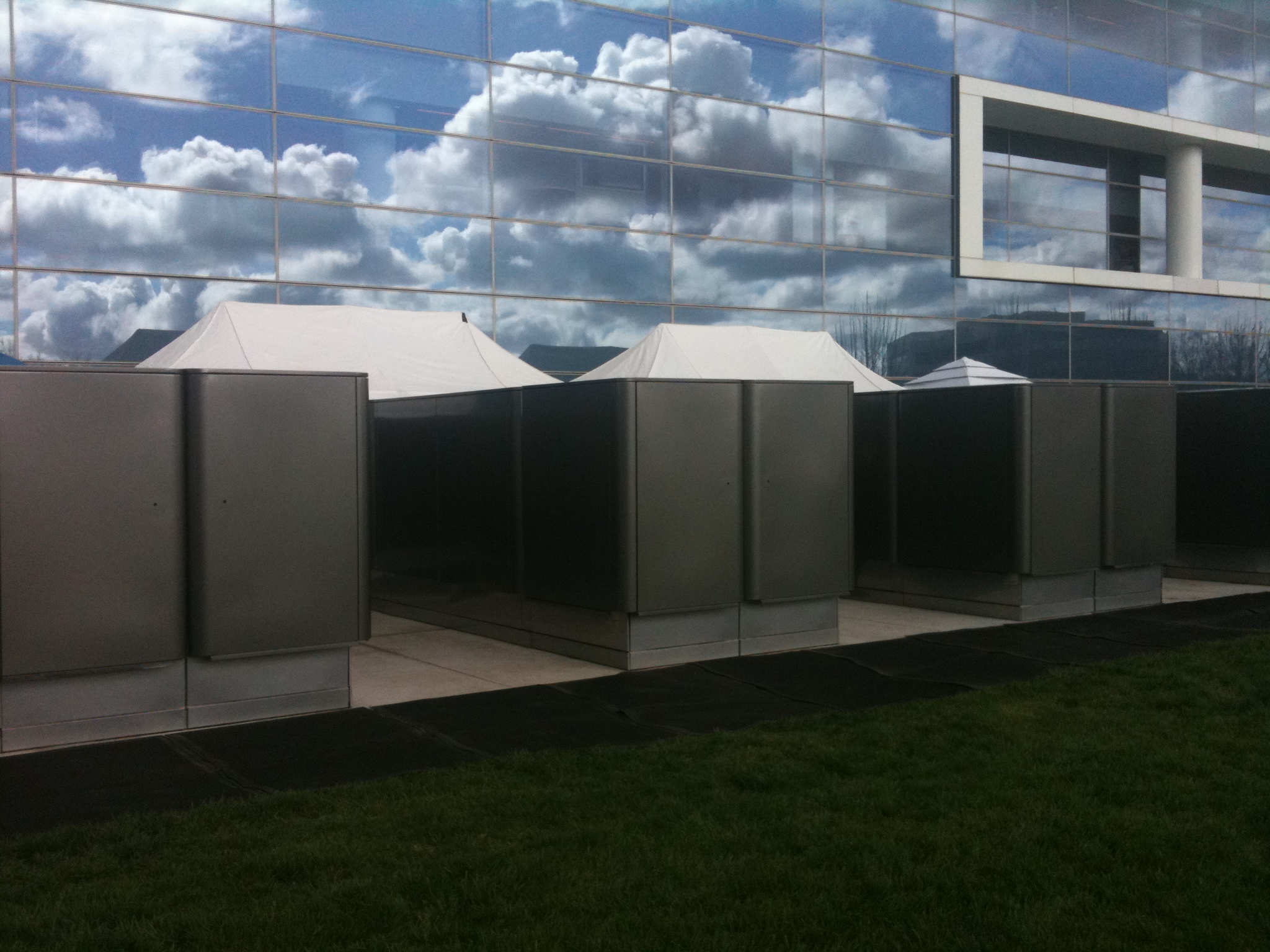
“We got into this business to make affordable electricity, not fuel cells,” Mr. Sridhar said Tuesday as workers assembled stacks of fuel cells in tall, round cylinders and installed them in silver metal cubes at Bloom’s headquarters in a Silicon Valley office park.

The company has been working on the technology for eight years while saying little. The secrecy, and the prominence of the venture capitalists backing Bloom, have fueled both hype and skepticism about its efforts. Bloom is scheduled to unveil the technology Wednesday at a news conference attended by Gov. Arnold Schwarzenegger of California and Colin Powell, the former secretary of state and a member of Bloom’s board.

You can read the rest of the story here.

I followed up the piece with an online story in The Times offering a more detailed look at Bloom:

In The New York Times on Wednesday, I wrote about Bloom Energy, the once-secretive Silicon Valley start-up that has apparently made a big breakthrough in developing a fuel cell that can generate electricity at competitive prices while minimizing greenhouse gas emissions.

The company is officially unveiling its Bloom Energy Server at a news conference on Wednesday morning featuring Gov. Arnold Schwarzenegger of California; Colin L. Powell, the former secretary of state and a Bloom board member; and John Doerr, Silicon Valley’s leading green-tech investor. But on Monday and Tuesday, I had the opportunity to spend some time at the start-up’s headquarters in Sunnyvale and to see the Bloom box up close.

In contrast to the usual Silicon Valley practice of announcing a coming product, Bloom spent nearly a decade developing its fuel-cell technology while saying nary a word. Over the past year and a half, it has quietly sold and installed 100-kilowatt Bloom boxes at Google, Bank of America, Wal-Mart and other big companies. The boxes cost $700,000 to $800,000 apiece.

“Silicon Valley is learning some hard and important skills, mainly making stuff again,” said Mr. Doerr, a partner at the venture-capital firm Kleiner Perkins Caufield & Byers and a Bloom Energy board member.

Making stuff, particularly solid-oxide fuel cells, is very hard work. Such fuel cells have been something of a holy grail as they can operate at extremely high temperatures to maximize efficiency and can use a variety of fuels, like natural gas and biogas. Since the heat allows the fuel to be directly transformed into electricity through an electrochemical process, the expensive precious metals and rare-earth elements used in other fuel cells to act as catalysts could theoretically be eliminated.

But finding cheap common materials as substitutes and ensuring fuel cells don’t crack and leak under such conditions have stymied scientists for more than 30 years.

So how did Bloom crack the fuel-cell conundrum?

You can read the rest of the story here.

In my latest Green State column on Grist, I explore new strategies to pay for commercial energy efficiency retrofits:

On the heels of San Francisco’s announcement last week that it plans to spend $150 million greening up homes, comes a new report that studies a slew of other innovative ways to finance energy efficiency improvements for all types of buildings.

It’s no big surprise that the key to ramping up the energy efficiency industry and fostering technological advances is no-money-down financing so building owners can avoid the capital costs of retrofits.  And that’s exactly what the California Clean Energy Fund (CalCEF) is working toward.

Energy efficiency “immediately saves money for end-users, improves the bottom line for companies, reduces local exposure to electricity grid outages and offsets the need for new power plants,” wrote the authors of the report from the CalCEF, a non-profit venture capital outfit based in San Francisco. “Yet, efficiency upgrades and their respective financing options are often out of reach for most end-users, as the initial capital cost exceeds near-term savings.”

Yes, you read that right—CalCEF is a non-profit VC, a product of the California energy crisis of 2000-2001—remember Enron?—that resulted in the bankruptcy of Pacific Gas and Electric, Northern California’s dominant utility. As part of the bankruptcy settlement, CalCEF was created to accelerate energy innovation and was seeded with $30 million from PG&E.

The best known such program is Property Assessed Clean Energy, or PACE, in which cities float bonds to finance retrofits and homeowners pay back the cost through a surcharge on their property tax bills over 20 years.

While that can work well for middle and upper-middle class homeowners in environmentally conscious communities, PACE is not as useful for commercial buildings, office towers, and industrial sites, whose owners may be solely motivated by the bottom line, according to the CalCEF report.

“High upfront costs are preventing large entities from addressing energy inefficiencies,” says Paul Frankel, the managing director of CalCEF Innovations, the organization’s initiative that focuses on developing green energy financing and policy.

That led CalCEF to investigate possible solutions to the dollar dilemma, some of which are currently being implemented.

One workaround is something called on-bill financing. For instance, San Diego Gas & Electric will finance up to $100,000 in energy efficiency retrofits for commercial customers (and up to $250,000 for school and government buildings). Recipients then pay back the loans through a surcharge on their monthly utility bill.

Best of all, the loans carry zero percent interest, though business customers have to repay them in five years. In the first two years of the program, San Diego Gas & Electric financed 180 retrofits and has another 100 in the queue. Over the next two years, the utility will make $41.5 million available for on-bill retrofits.

You can read the rest of the column here.

In The New York Times on Wednesday, I write about a survey of U.S. utility industry executives and insiders conducted by Black & Veatch:

American utility industry executives see nuclear energy as the most promising carbon-free power source, are skeptical of climate change science, and are uncertain about the future, according to a report to be issued Thursday by Black & Veatch, the engineering and consulting giant.

The survey of 329 executives, managers and engineers, which Black & Veatch shared with The New York Times, comes as the utility industry faces slow growth in energy consumption and a two-year fall in capital spending, the first such decline since the Great Depression.

“The industry is facing a lot of demands to spend more money to fix up an aging infrastructure, build smart grids and deal with cyber security while cutting carbon emissions,” said Bill Kemp, a Black & Veatch vice president, in an interview. “In the near term, we’ll have a difficult economic environment and a slow sales growth as regulators are reluctant to push through large rate increases while voters are still in pain.”

The stalled emissions trading legislation in Congress has added to the confusion about the future shape of the electricity market, Black & Veatch found. Despite a high-profile campaign by some utility executives to support an emissions trading market, more than 70 percent of the industry insiders surveyed oppose the current legislation and 52 percent said the United States cannot afford the proposal to cap greenhouse gas emissions.

More than 75 percent think there is a future for coal-fired power plants.

In fact, 44 percent of those surveyed don’t believe global warming is caused by human activity, according to the report, while 7 percent don’t believe the planet is warming.

“Utility respondents generally appear to be less certain of the threat of global warming than the general public and scientific community, as well as many political and policy leaders,” the report’s authors wrote.

“Utility professionals also seem to be quite disturbed about the direction of the global warming movement,” they added, “and the likelihood that their organizations will be facing what many of them seem to view as draconian changes in the short term.”

You can read the rest of the story here.

Image: Picarro

In the Green Inc. column I wrote for Monday’s New York Times and International Herald Tribune, I go hunting for greenhouse gases in the San Francisco Bay Area with Picarro, a Silicon Valley company that makes analyzers that measure CO2 and methane emissions in real-time:

SAN FRANCISCO — The recent Copenhagen climate talks faltered in part over how to verify that nations are actually reducing their carbon emissions. Likewise, the integrity of emissions trading markets, like the one under consideration by the U.S. Congress, will depend on the ability to accurately measure greenhouse gases.

That’s creating a burgeoning global business for Picarro, a Silicon Valley company that makes portable analyzers that take precise real-time measurements of carbon dioxide, methane and other greenhouse gases. The machines also allow scientists to pinpoint the source of emissions.

To get a real-life demonstration of the machine’s potential to zero in on the source of carbon emissions, I went hunting for greenhouse gas emissions with Chris Rella, Picarro’s director of research and development.

Mr. Rella rolled up in a white Dodge Sprinter van and slid back a door to reveal a rack of Picarro analyzers connected to a video screen that was displaying the concentration of methane, a potent greenhouse gas, in the atmosphere around us.

A translucent tube connected to the analyzers snaked through the roof of the van to collect air samples, while a GPS device continuously tracked the van’s location and a wireless modem transmitted all the data back to the Picarro headquarters in Sunnyvale, California. It’s all very “Mission: Impossible.”

You can read the column here.

Image: NextEra Energy

In Sunday’s Los Angeles Times, I write about how a seemingly intractable dispute about the environmental impact of a big solar power plant in California is being resolved with some innovative compromises:

A developer who proposes to cut down hundreds of trees to make way for a massive project could expect to provoke a fair amount of environmental outrage.

Not in California City. Officials in this sprawling desert community east of Bakersfield are thrilled at NextEra Energy’s move to break out the chain saws.

The firm, a subsidiary of utility giant FPL Group, is seeking to build a solar power plant in the area that would consume a large amount of water. The trees are tamarisks, a water-hungry invasive species, and removing them could help recharge the aquifer in this arid region.

“The water that normally would go into the tamarisk will go down into the basin — it’s a big environmental win,” said Michael Bevins, California City’s public works director.

The tree deal is just one way that what threatened to become another intractable fight over the environmental effect of desert solar power plants is turning into a blueprint for the resolution of similar disputes.

You can read the rest of the story here.

photo: Todd Woody

In a story I wrote with Clifford Krauss in Monday’s New York Times, I look at how the San Francisco Bay Area has is scrambling to prepare for the arrival of mass-market electric cars later this year:

SAN FRANCISCO — If electric cars have any future in the United States, this may be the city where they arrive first.

The San Francisco building code will soon be revised to require that new structures be wired for car chargers. Across the street from City Hall, some drivers are already plugging converted hybrids into a row of charging stations.

In nearby Silicon Valley, companies are ordering workplace charging stations in the belief that their employees will be first in line when electric cars begin arriving in showrooms. And at the headquarters of Pacific Gas and Electric, utility executives are preparing “heat maps” of neighborhoods that they fear may overload the power grid in their exuberance for electric cars.

“There is a huge momentum here,” said Andrew Tang, an executive at P.G.& E.

As automakers prepare to introduce the first mass-market electric cars late this year, it is increasingly evident that the cars will get their most serious tryout in just a handful of places. In cities like San Francisco, Portland, Ore., and San Diego, a combination of green consciousness and enthusiasm for new technology seems to be stirring public interest in the cars.

The first wave of electric car buying is expected to begin around December, when Nissan introduces the Leaf, a five-passenger electric car that will have a range of 100 miles on a fully charged battery and be priced for middle-class families.

Several thousand Leafs made in Japan will be delivered to metropolitan areas in California, Arizona, Washington state, Oregon and Tennessee. Around the same time, General Motors will introduce the Chevrolet Volt, a vehicle able to go 40 miles on electricity before its small gasoline engine kicks in.

“This is the game-changer for our industry,” said Carlos Ghosn, Nissan’s president and chief executive. He predicted that 10 percent of the cars sold would be electric vehicles by 2020.

You can read the rest of the story here.

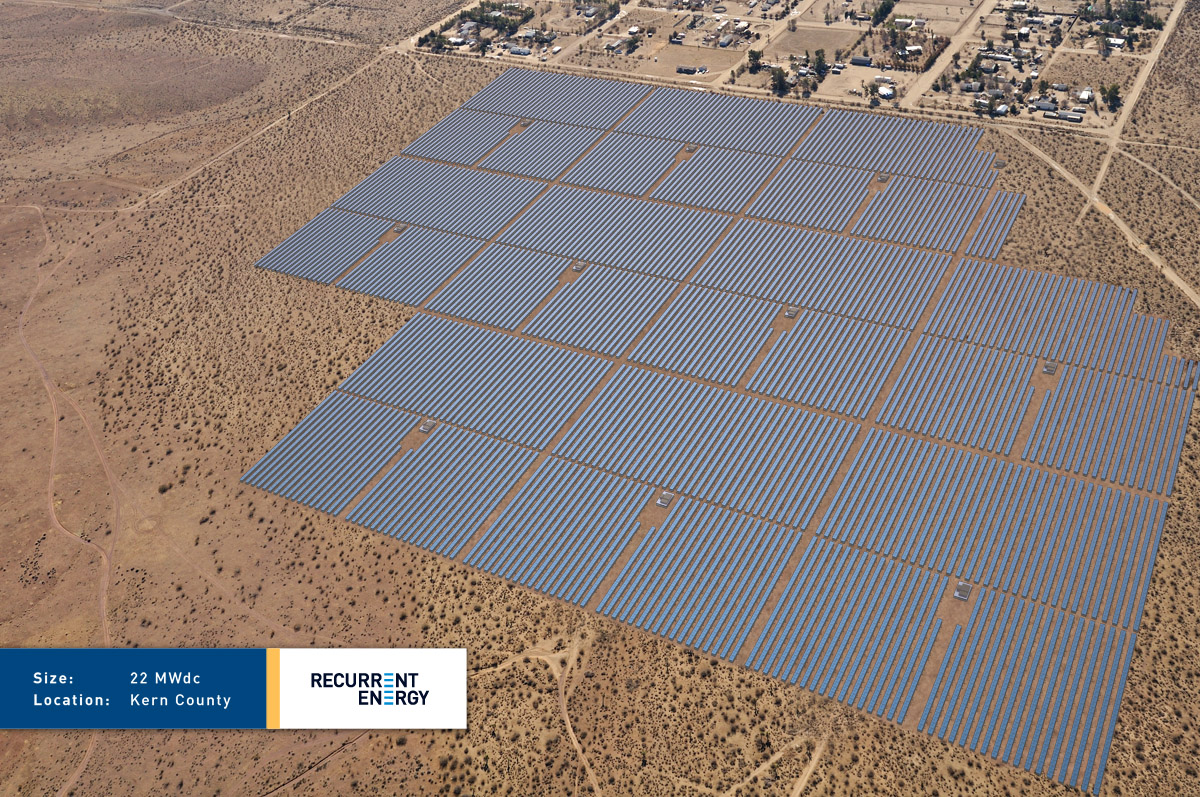
Artist rendering: Recurrent Energy

A couple of stories on the boom in distributed solar. As I wrote the New York Times:

As big solar power plants planned for the desert Southwest remain bogged down in environmental disputes, utilities increasingly are turning to so-called distributed solar rooftop arrays and small photovoltaic farms that can be built close to transmission lines.

Over the past few weeks, some 1,300 megawatts’ worth of distributed solar deals and initiatives have been announced or approved. At peak output, that is the equivalent of a big nuclear power plant.

Two weeks ago in California, regulators authorized the utility Southern California Edison’s program to install 500 megawatts of solar on commercial rooftops. A few days later, they recommended that Pacific Gas and Electric, the dominant utility in Northern California, be given the green light for its own 500-megawatt initiative that aims to install ground-mounted photovoltaic arrays near electrical substations and urban areas.

The Sacramento Municipal Utility District said in January that it took only a week to sell out its 100-megawatt solar program, which offers developers the opportunity to build photovoltaic projects of up to five megawatts.

And last week, the New York Power Authority announced a program to install 100 megawatts of solar arrays around the state.

“All of this is a great indication that solar prices are continuing to get a lot cheaper and that results in scale,” said Adam Browning, executive director of Vote Solar, a San Francisco nonprofit that promotes renewable energy.

You can read the rest of the story here.

In my Grist column, I took a deeper dive into distributed solar:

I spotted a rare critter on the streets of San Francisco this week—a smiling, optimistic businessperson.

Then again, Ron Kenedi is in the solar panel business.

“The big news as I see it is the demand—demand keeps growing everywhere,” says Kenedi, vice president of Sharp Solar, the renewable energy arm of the Japanese conglomerate. “What really amazes me every day is how much demand has grown throughout the world.”

Kenedi is not one for Pollyannaish optimism—he started in the business around the time Ronald Reagan took down Jimmy Carter’s solar panels from the White House roof.

“I used to have to go out there with a sandwich board on to get people interested in solar,” he says. “Now I can’t even walk down the street without people talking to me about solar and wanting it on their home and businesses.”

That’s because there’s a boom in so-called distributed generation under way—placing solar panels and pint-sized photovoltaic farms at or near where electricity is consumed.

Until very recently, distributed generation just couldn’t compete on cost with Big Solar—massive megawatt solar thermal power plants usually located in the desert.

Big Solar has had the edge by the dint of the gigawatt-size deals utilities have struck with developers like BrightSource Energy, eSolar, and Solar Millennium. Large solar thermal power plants—which use mirrors to heat liquids to create steam that drives a generator—could make electricity cheaper than photovoltaic panels, which produce electrons when the sun strikes semiconducting materials.

Now that’s all changing. Over the past year, a number of Big Solar thermal projects have become mired in disputes over their impact on fragile desert ecosystems and the lack of transmission lines to connect them to cities. In December, California’s powerful Democratic senator, Dianne Feinstein, introduced legislation to ban renewable energy development on more than a million acres of the Mojave Desert she wants to protect as national monument.

Photovoltaic module prices, meanwhile, have plummeted by about 30 percent over the past year thanks to an oversupply of modules and the rise of low-cost Chinese manufacturers. Thin-film solar companies, which make solar cells that use little or no expensive polysilicon and which layer or print them on glass or metal, began to produce solar modules for less than a one dollar a watt—long considered a key milestone for making solar competitive with fossil fuels. Though less efficient than conventional crystalline solar modules, thin-film solar cells can be manufactured more cheaply, making it particularly suited for use by photovoltaic power plants.

You can read the rest of the column here.

photo: Chris Kennedy / USFWS

Late last week, the Obama administration denied endangered species protection to the American pika, which environmentalists and some scientists believe is imperiled by global warming. As I wrote Monday in The New York Times:

The Obama administration has determined that the American pika, a small rabbit-like mammal, is not threatened by climate change.

The decision underscores how the Endangered Species Act has become the latest battlefield in the fight over global warming.

Environmentalists consider the pika to be the animal most vulnerable to climate change in the continental United States due to its inability to survive even small increases in temperature.

The pika lives on alpine mountain ranges throughout the West, and as average temperatures have increased in recent decades, some populations have disappeared at lower elevations while others have moved to higher peaks, according to scientific studies.

In an initial finding issued last April, the U.S. Fish and Wildlife Service said that protecting the pika under the Endangered Species Act “may be warranted because of the present or threatened destruction, modification, or curtailment of its habitat or range as a result of effects related to global climate change.”

But after a full review, government scientists have concluded that the pika could survive temperatures projected to increase 3 degrees Celsius in its mountain habitat as well as the loss of snow pack, which the animals depend on for shelter. “The American pika has demonstrated flexibility in its behavior and physiology that can allow it to adapt to increasing temperature,” the scientists wrote in the finding released Friday.

Greg Loarie, an attorney who represents the Center for Biological Diversity, the environmental group that petitioned to list the pike as endangered, said studies do not support the government’s position.

You can read the rest of the story here.

photo: Ausra

The week kicked off with French nuclear energy giant Areva’s acquisition of Silicon Valley solar company Ausra. As I wrote Monday in the Los Angeles Times:

French nuclear energy giant Areva has jumped into the U.S. renewable energy market with the acquisition of Ausra, a Silicon Valley solar power plant startup backed by high-profile venture capitalists.
Terms of the deal were not disclosed, but in an interview on Monday, Areva executive Anil Srivastava said that the price the company paid for Ausra was in line with the $418 million that rival Siemens spent last year to acquire Solel, an Israel solar power plant builder.

That would be a decent payday for Ausra’s investors, which include marquee Silicon Valley venture capital firms Kleiner Perkins Caufield & Byers and Khosla Ventures.

“The current shareholders are very well-reputed venture capitalists and I can assure you they negotiated very well,” said Srivastava, the chief executive of Areva’s renewable energy division.

You read the rest of the story here.

And the week is ending with Thursday’s announcement of another Silicon Valley-European deal. This time, as I write in The New York Times, California’s SunPower is acquiring a European solar developer:

SunPower, a leading Silicon Valley solar company, said on Thursday that it has agreed to acquire SunRay Renewable Energy, a European photovoltaic power plant builder, in a $277 million deal.

The acquisition follows Monday’s purchase of Ausra, another Silicon Valley solar technology company, by Areva, the French nuclear energy giant in a deal that an Areva executive valued at around $400 million.

SunPower has previously supplied solar panels to SunRay, which has a pipeline of projects in Europe and Israel that totals 1,200 megawatts. SunRay, which is headquartered in Malta, is owned by its management and Denham Capital.

You can read the rest of that story here.

Design a site like this with WordPress.com
Get started