Feeds:
Posts
Comments

Archive for the ‘solar power plants’ Category

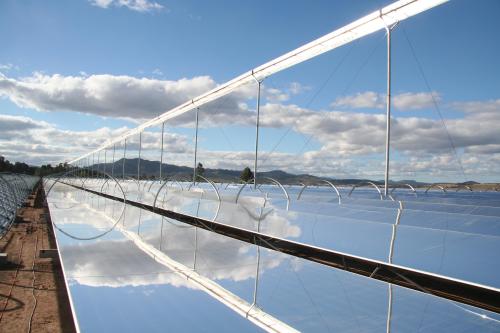
ausra-16

photo: Ausra

Silicon Valley solar company Ausra has sold its sole remaining solar power plant project in the United States, all but completing its exit from solar farming. As I write Thursday in The New York Times:

Ausra is continuing its exit from the business of building solar power plants, announcing on Wednesday that it has sold a planned California solar farm to First Solar.

The Carrizo Energy Solar Farm was one of the three large solar power plants planned within a few miles of each other in San Luis Obispo County on California’s central coast.

Together they would supply nearly 1,000 megawatts of electricity to the utility Pacific Gas and Electric.

First Solar will not build the Carrizo project, and the deal has resulted in the cancellation of Ausra’s contract to provide 177 megawatts to P.G.&E. — a setback in the utility’s efforts to meet state-mandated renewable energy targets.

But it could speed up approval of the two other solar projects, which have been bogged down in disputes over their impact on wildlife, and face resistance from residents concerned about the concentration of so many big solar farms in a rural region.

First Solar is only buying an option on the farmland where the Ausra project was to be built, according to Alan Bernheimer, a First Solar spokesman. Terms of the sale were not disclosed.

The deal will let First Solar revamp its own solar farm, a nearby 550-megawatt project called Topaz that will feature thousands of photovoltaic panels arrayed on miles of ranchland.

“This will allow us to reconfigure Topaz in a way that lessens its impact and creates wildlife corridors,” said Mr. Bernheimer.

You can read the rest of the story here.
Read Full Post »

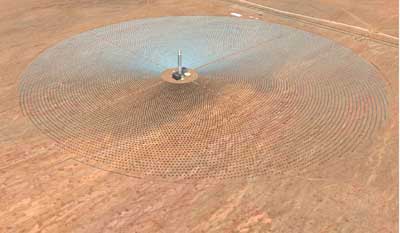
artist_picture_of_project

Image: SolarReserve

Ok, I’m exaggerating a bit in the headline above but we’re getting closer to solar farms that will provide baseload power, operating at night and under cloudy conditions. As I write on Tuesday in The New York Times:

The holy grail of renewable energy is a solar power plant that continues producing electricity after the sun goes down.

A Santa Monica, Calif., company called SolarReserve has taken a step toward making that a reality, filing an application with California regulators to build a 150-megawatt solar farm that will store seven hours’ worth of the sun’s energy in the form of molten salt.

Heat from the salt can be released when it’s cloudy or at night to create steam that drives an electricity-generating turbine.

The Rice Solar Energy Project, to be built in the Sonoran Desert east of Palm Springs, will “generate steady and uninterrupted power during hours of peak electricity demand,” according to SolarReserve’s license application.

So-called dispatchable solar farms would in theory allow utilities to avoid spending billions of dollars building fossil fuel power plants that are fired up only a few times a year when electricity demand spikes, like on a hot day.

SolarReserve is literally run by rocket scientists, many of whom formerly worked at Rocketdyne, a subsidiary of the technology giant United Technologies. Rocketdyne developed the solar salt technology, which was proven viable at the 10-megawatt Solar Two demonstration project near Barstow, Calif., in the 1990s.

You can read the rest of the story here.
Read Full Post »

img_2914

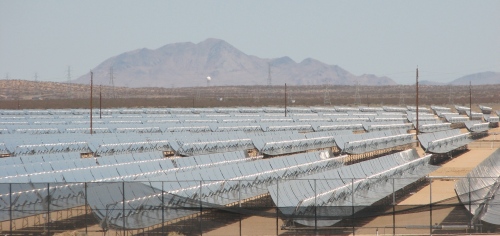
photo: Todd Woody

California utility PG&E on Monday announced two new Big Solar deals that will likely to ramp up the debate over solar thermal power plants’ thirst for water in the desert Southwest. As I write in The New York Times:

The West’s water wars are likely to intensify with Pacific Gas and Electric’s announcement on Monday that it would buy 500 megawatts of electricity from two solar power plant projects to be built in the California desert.

The Genesis Solar Energy Project would consume an estimated 536 million gallons of water a year, while the Mojave Solar Project would pump 705 million gallons annually for power-plant cooling, according to applications filed with the California Energy Commission.

With 35 big solar farm projects undergoing licensing or planned for arid regions of California alone, water is emerging as a contentious issue.

The Genesis and Mojave projects will use solar trough technology that deploys long rows of parabolic mirrors to heat a fluid to create steam that drives an electricity-generating turbine. The steam must be condensed back into water and cooled for re-use.

Solar trough developers prefer to use so-called wet cooling in which water must be constantly be replenished to make up for evaporation. Regulators, meanwhile, are pushing developers to use dry cooling, which takes about 90 percent less water but is more expensive and reduces the efficiency –- and profitability – of a power plant.

NextEra Energy Resources, a subsidiary of the utility giant FPL Group, is developing the Genesis project in the Chuckwalla Valley in the Sonoran Desert. The twin solar farms would tap about 5 percent of the valley’s available water.

You can read the rest of the story here.
Read Full Post »

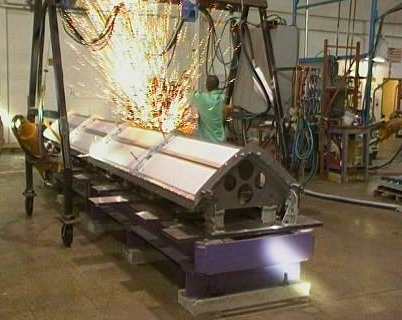
Rack Welding

photo: Skyline Solar

Silicon Valley startup Skyline Solar has joined other green energy companies beating a path to Detroit to take advantage of the down-and-out auto industry’s manufacturing might. As I write in the Los Angeles Times on Thursday:

Skyline Solar, a Silicon Valley start-up, has become the latest green energy company to tap the struggling auto industry’s manufacturing muscle.

The company announced today that components for its solar power plants were being made in a Troy, Mich., car factory operated by Cosma International, a division of auto manufacturing giant Magna International.

The same machines that stamp out doors, hoods and other car body parts are now making long metal arrays that hold Skyline’s photovoltaic panels.

“It’s literally just carving out a piece of an existing facility and putting through a product that for all intents and purposes could be a new make and model of the next family sedan,” said Bob MacDonald, Skyline’s chief executive.  “Every time there’s a new model year for a Ford Mustang, they have a tool and die set they put into this press. So you just have a different tool and die in there that forms a new shape for Skyline.”

The bottom line, said MacDonald, is that Skyline has slashed its capital costs by taking advantage of Cosma’s existing manufacturing capability. He said Skyline of Mountain View, Calif., has contracts in place for small-scale solar farms. He said he could not divulge the details of those contracts but noted that Skyline has begun to receive shipments of arrays from Michigan.

It’s also a good deal for Cosma, whose parent company has agreed to acquire Opel from General Motors.

“Renewable energy trends and forecast data suggest significant growth potential for this market — we expect to participate in this growth potential,” Tracy Fuerst, a Magna spokeswoman, said in an e-mail.

You can read the rest of the story here.

Read Full Post »

nextlight renewable power agua caliente

That was quick: Just days after California Gov. Arnold Schwarzenegger vetoed legislation that would have limited utilities’ ability to buy out-of-state renewable energy, utility PG&E on Thursday asked regulators to approve a deal with an Arizona solar farm to supply 290 megawatts of electricity. As I write in The New York Times on Friday:

Pacific Gas & Electric, the big California utility, asked regulators on Thursday to approve the purchase of electricity from an Arizona solar power plant, only days after Gov. Arnold Schwarzenegger vetoed legislation that would have limited utilities’ ability to tap out-of-state projects to meet renewable energy mandates.

NextLight Renewable Power will construct the 290-megawatt Aqua Caliente photovoltaic farm on private land in Yuma County, Ariz. The company, based in San Francisco, signed a deal with P.G.&E. in June to supply 230 megawatts from a solar power plant to be built outside of Los Angeles.

The legislation vetoed by Mr. Schwarzenegger on Sunday would have required California utilities to obtain 33 percent of their electricity from renewable sources by 2020, mostly from in-state projects.

Environmental groups and unions supported that provision as a way to limit the need to build new transmission lines and to keep construction jobs in California. But the governor said it would hamstring utilities from complying with the 33 percent target, which he supports.

According to the filing the utility made Thursday, Arizona regulators have already approved the project and NextLight expects to obtain county building permits within a few months. In contrast, the licensing of a solar power plant in California can take years. The Agua Caliente project is also located near existing transmission lines that connect to California’s power grid.

You can read the rest of the story here.

Read Full Post »

ausra-16

photo: Ausra

Silicon Valley solar startup Ausra in January decided to get out of the solar power plant business and focus on supply solar steam systems to developers. As I write in The New York Times today, the company has announced deals in Australia, Jordan and, soon, the United States:

Ausra, a Silicon Valley solar start-up, burst on to the green-tech scene in 2007, bankrolled by marquee venture capitalists and armed with ambitions to build gigawatts of solar farms.

Earlier this year, though, the company abruptly changed course, abandoning its solar power plant business to focus on supplying solar thermal technology to other developers.

Now the deals are starting to roll in.

On Wednesday, Ausra said it has signed a contract to provide a solar steam system to a German developer, MENA Cleantech. MENA plans to build a 100-megawatt hybrid solar farm in Jordan that will rely on an oil-fired boiler to generate electricity when the sun does not shine.

Robert Fishman, Ausra’s chief executive, said his company also has agreed to build a 23-megawatt solar steam plant adjacent to a 750-megawatt coal-fired power station in Queensland, Australia. The company’s mirror arrays and boilers will produce supplemental steam to boost the coal plant’s electricity production.

You can read the rest of the story here.
Read Full Post »

Stirling Energy Systems Solar One project

image: Tessera Solar

In a feature published in today’s New York Times, I look at a water war breaking out in the desert Southwest over plans to build dozens of large-scale solar power projects on hundreds of thousands of acres of land:

AMARGOSA VALLEY, Nev. — In a rural corner of Nevada reeling from the recession, a bit of salvation seemed to arrive last year. A German developer, Solar Millennium, announced plans to build two large solar farms here that would harness the sun to generate electricity, creating hundreds of jobs.

But then things got messy. The company revealed that its preferred method of cooling the power plants would consume 1.3 billion gallons of water a year, about 20 percent of this desert valley’s available water.

Now Solar Millennium finds itself in the midst of a new-age version of a Western water war. The public is divided, pitting some people who hope to make money selling water rights to the company against others concerned about the project’s impact on the community and the environment.

“I’m worried about my well and the wells of my neighbors,” George Tucker, a retired chemical engineer, said on a blazing afternoon.

Here is an inconvenient truth about renewable energy: It can sometimes demand a huge amount of water. Many of the proposed solutions to the nation’s energy problems, from certain types of solar farms to biofuel refineries to cleaner coal plants, could consume billions of gallons of water every year.

“When push comes to shove, water could become the real throttle on renewable energy,” said Michael E. Webber, an assistant professor at the University of Texas in Austin who studies the relationship between energy and water.

Conflicts over water could shape the future of many energy technologies. The most water-efficient renewable technologies are not necessarily the most economical, but water shortages could give them a competitive edge.

In California, solar developers have already been forced to switch to less water-intensive technologies when local officials have refused to turn on the tap. Other big solar projects are mired in disputes with state regulators over water consumption.

To date, the flashpoint for such conflicts has been the Southwest, where dozens of multibillion-dollar solar power plants are planned for thousands of acres of desert. While most forms of energy production consume water, its availability is especially limited in the sunny areas that are otherwise well suited for solar farms.

You can read the rest of the story here.

Read Full Post »

solarh

Photo: BrightSource Energy

In today’s New York Times, I write about how Harvey Whittemore — one of Nevada’s biggest power brokers and a confident of Senate majority leader Harry Reid — has responded to the housing crash by leasing desert land at his mega-home development to BrightSource Energy for a 960-megawatt solar farm complex.

What to do when building a 159,000-home city in the Nevada desert and the housing market collapses?

Go solar.

The Coyote Springs Land Company this week expanded a deal with BrightSource Energy, a solar power developer based in Oakland, Calif., to carve out 12 square miles of it its 43,000-acre mega-development for solar power plants that would generate up to 960 megawatts of electricity.

Harvey Whittemore, Coyote Springs’s chairman, said his plan always was to include some renewable energy in the massive golfing community under development 50 miles northeast of Las Vegas. But, Mr. Whittemore said, he decided to go bigger as the housing market crashed and solar developers like BrightSource began to sign deals with utilities.

“We’ve always said we’ll adjust the land use plan to the market,” said Mr. Whittemore in an interview. “At the end of the day we have approvals for 159,000 units and we looked at what we could do to reduce the number of units while at same time coming up with a functional business plan that takes advantage of private land.”

Private land is in short supply in Nevada, where the federal government owns about 87 percent of the state. That has forced solar developers like BrightSource – which is under the gun to supply 2,610 megawatts to California utilities — to seek leases on desert property managed by the United States Bureau of Land Management, a years-long process involving extensive environmental review.

By dealing with Mr. Whittemore, BrightSource is sidestepping all of that and acquiring an ally who knows how to get things done in the Silver State.

You can read the rest of the story here.
Read Full Post »

esolar_8
photo: eSolar

In Sunday’s Los Angeles Times, I write about how the rise of green technology is changing the way Silicon Valley venture capitalists do business:

Silicon Valley venture capitalists have always been about inventing the future — taking a wild idea, nurturing it with cash and creativity and giving birth to new products, companies and industries we once couldn’t imagine and now can’t conceive of living without: the Web, Google, the iPhone, Twitter.

But as green technology becomes the latest tech wave to break from the nation’s entrepreneurial epicenter, it’s now all about companies reinventing the past. Solar power companies, electric car start-ups and algae biofuel ventures aim to remake century-old trillion-dollar industries on a global scale.

Venture capitalists poured $4 billion into green-tech start-ups in 2008 — nearly 40% of all tech investments in the U.S., according to a survey by PricewaterhouseCoopers. Green-tech investment plunged in the first half of 2009 to $513 million as the recession dragged on, but there are signs of a rebound: Silicon Valley’s Khosla Ventures announced this month that it had raised $1.1 billion — the biggest first-time fund in a decade — that would be largely devoted to investing in green-tech start-ups, many in Southern California.

But green-tech companies face unique challenges, including global markets, tough technological hurdles and a future shaped by government incentives and regulatory policy. Those challenges are changing the game on Sand Hill Road.

“If you’re starting a Web 2.0 company, your basic needs are personnel and servers — there is no physical product, no manufacturing capacity, no inventory, no steel in the ground,” VantagePoint’s Salzman said, referring to software-based companies that provide services over the Internet.

Green-tech start-ups, he said, often need big money and investors steeped in big science and big government.

You can read the rest of the story here.

Read Full Post »

_MG_7360-01

photo: Nanosolar

A day after First Solar made waves with its agreement with the Chinese government to build a 2,000-megawatt solar farm in Mongolia, Silicon Valley startup Nanosolar took the wraps off its much-hyped thin-film photovoltaic technology and announced it has booked $4.1 billion in orders from solar developers. As I write in today’s New York Times:

Since its founding in 2002, Nanosolar has raised a lot of money – half a billion dollars to date – and made a lot of noise about upending the solar industry, but the Silicon Valley start-up has been a bit vague on specifics about why it’s the next big green thing.

On Wednesday, Nanosolar pulled back the curtain on its thin-film photovoltaic cell technology — which it claims is more efficient and less expensive than that of industry leader First Solar — and announced that it has secured $4.1 billion in orders for its solar panels.

Martin Roscheisen, Nanosolar’s chief executive, said customers include solar power plant developers like NextLight, AES Solar and Beck Energy of Germany.

The typical Nanosolar farm will be between 2 and 20 megawatts in size, Mr. Roscheisen said in an e-mail message from Germany, where he was attending the opening of Nanosolar’s new factory near Berlin. “This is a sweet spot in terms of ease of permitting and distributed deployment without having to tax the transmission infrastructure.”

You can read the rest of the story here.

Read Full Post »

« Newer Posts - Older Posts »

Design a site like this with WordPress.com
Get started