Feeds:
Posts
Comments

Archive for the ‘solar power plants’ Category

photo: Todd Woody

In a followup to my story in Wednesday’s New York Times about recycling farmland and toxic waste sites for renewable energy projects, I take a deeper dive into why some farmers in the California’s San Joaquin Valley want to stop raising crops and start growing electrons:

In an article in The New York Times on Wednesday, I wrote about an ambitious plan to build one of the world’s largest solar energy complexes on 30,000 acres of farmland in the San Joaquin Valley of California.

Elsewhere, big renewable energy projects have encountered opposition from farmers, ranchers and environmentalists who worry about the impact of solar power plants on agriculture, wildlife and scarce water supplies.

But farmers in the San Joaquin Valley’s Westlands Water District are embracing solar power as a solution to their water woes. And environmental groups are backing the project as a way to avoid fights over building solar power plants in pristine desert areas.

In the 1960s, the west side of the San Joaquin Valley was transformed from a desert to one of the nation’s most productive agricultural centers thanks to a huge irrigation project that transports water from Northern California and distributes it to 600,000 acres of farmland through 1,034 miles of underground pipes.

Decades of irrigation and drainage problems led to a buildup of salt in the soil that forced the water district to spend $100 million to acquire and retire 100,000 acres of land from most agricultural production. Drought and environmental disputes over the impact of water diversions on endangered fish, meanwhile, slashed water deliveries to Westlands farmers.

The water district hopes to make money off salt-contaminated land by providing an initial 12,000 acres to Westside Holdings, a firm that has proposed building a 5,000-megawatt photovoltaic power complex called the Westlands Solar Park.

And farmers like Mark Shannon have agreed to lease their parched land to Westside, reluctantly concluding there’s more money to be made by growing electrons than crops.

“Last year, we received only 10 percent of our water supply and we idled 85 percent of this ranch,” said Mr. Shannon of the 5,300-acre property that his family has farmed for three generations. “My dad is 67 and I can’t believe how many times I’ve called him and he’s in tears — he just always figured he’d pass this land on to me.”

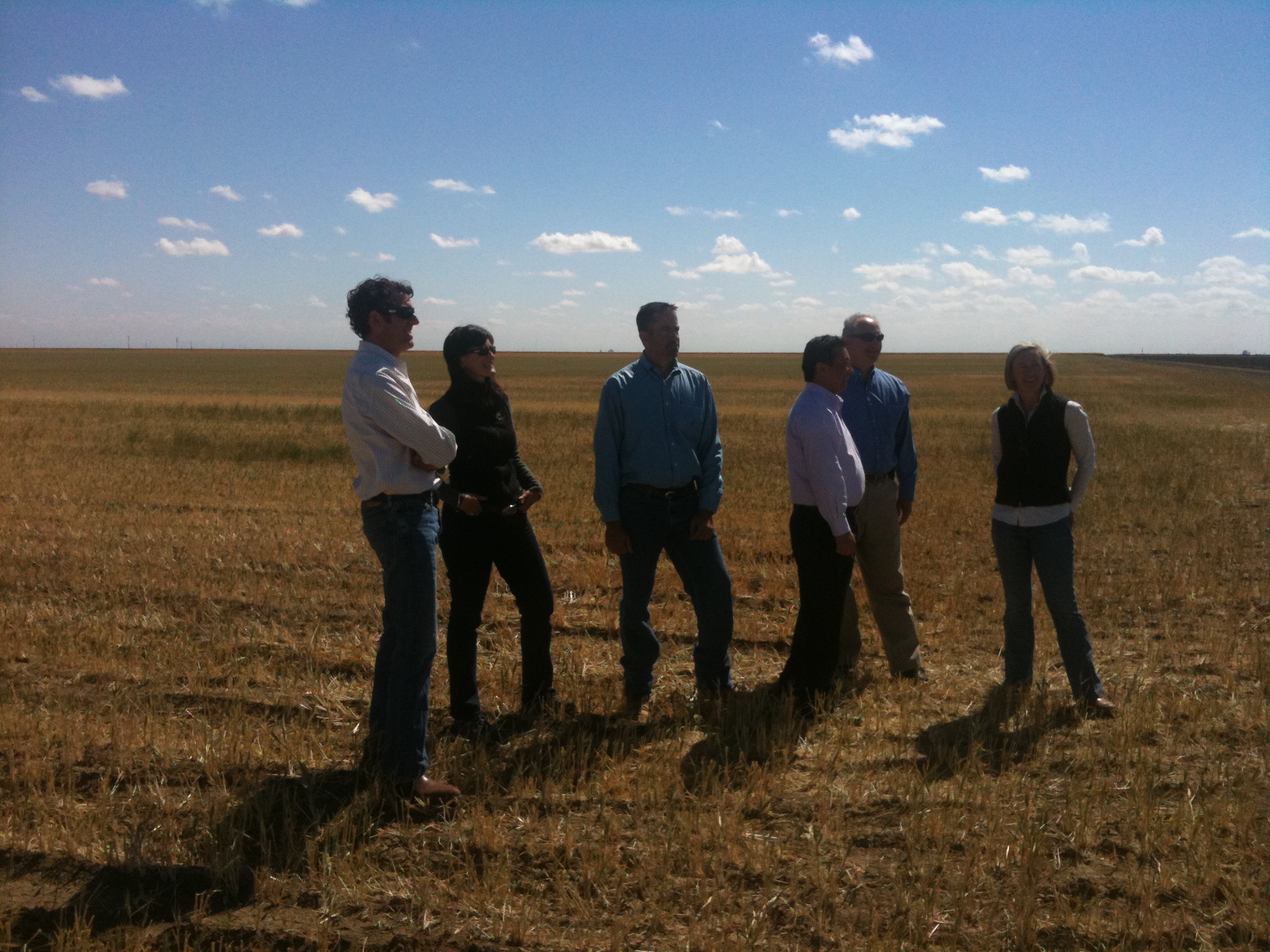
Mr. Shannon took me up in a small plane for a bird’s-eye view of the impact of the water crisis on his land, where brown fields surround green patches of almonds and pistachios. Beyond his farm are dry lands that stretch to the horizon, property owned by the Westlands Water District and taken out of irrigated production.

“Last year, we had over 250,000 acres in the district that didn’t get farmed,” said Sarah Woolf, a Westlands spokeswoman. “Then you have drainage issues coupled with the long-term reliability of the water supply.”

Desperate farmers have been spending millions of dollars drilling hundreds of deep groundwater wells, which in turn has caused subsidence problems.

In other parts of California, the prospect of covering square miles of farmland with solar panels has stirred outrage among some rural residents. But Mr. Shannon and Westlands officials don’t expect any significant opposition in the San Joaquin Valley.

The reason: if farmers such convert their land to solar farms, their water allocations will be redistributed to their neighbors.

You can read the rest of the story here.

Read Full Post »

photo: Todd Woody

In Wednesday’s New York Times, I write about a growing movement to repurpose farmland and toxic waste sites for big renewable energy projects:

LEMOORE, Calif. — Thousands of acres of farmland here in the San Joaquin Valley have been removed from agricultural production, largely because the once fertile land is contaminated by salt buildup from years of irrigation.

But large swaths of those dry fields could have a valuable new use in their future — making electricity.

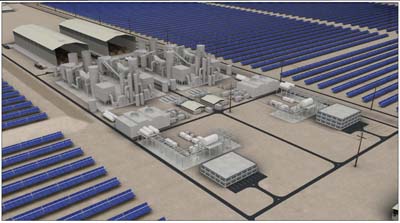
Farmers and officials at Westlands Water District, a public agency that supplies water to farms in the valley, have agreed to provide land for what would be one of the world’s largest solar energy complexes, to be built on 30,000 acres.

At peak output, the proposed Westlands Solar Park would generate as much electricity as several big nuclear power plants.

Unlike some renewable energy projects blocked by objections that they would despoil the landscape, this one has the support of environmentalists.

The San Joaquin initiative is in the vanguard of a new approach to locating renewable energy projects: putting them on polluted or previously used land. The Westlands project has won the backing of groups that have opposed building big solar projects in the Mojave Desert and have fought Westlands for decades over the district’s water use. Landowners and regulators are on board, too.

“It’s about as perfect a place as you’re going to find in the state of California for a solar project like this,” said Carl Zichella, who until late July was the Sierra Club’s Western renewable programs director. “There’s virtually zero wildlife impact here because the land has been farmed continuously for such a long time and you have proximity to transmission, infrastructure and markets.”

Recycling contaminated or otherwise disturbed land into green energy projects could help avoid disputes when developers seek to build sprawling arrays of solar collectors and wind turbines in pristine areas, where they can affect wildlife and water supplies.

The United States Environmental Protection Agency and the National Renewable Energy Laboratory, for instance, are evaluating a dozen landfills and toxic waste sites for wind farms or solar power plants. In Arizona, the Bureau of Land Management has begun a program to repurpose landfills and abandoned mines for renewable energy.

In Southern California, the Los Angeles Department of Water and Power has proposed building a 5,000-megawatt solar array complex, part of which would cover portions of the dry bed of Owens Lake, which was drained when the city began diverting water from the Owens Valley in 1913. Having already spent more than $500 million to control the intense dust storms that sweep off the lake, the agency hopes solar panels can hold down the dust while generating clean electricity for the utility. A small pilot project will help determine if solar panels can withstand high winds and dust.

“Nothing about this is simple, but it’s worth doing,” Austin Beutner, the department’s interim general manager, said of the pilot program.

All of the projects are in early stages of development, and many obstacles remain. But the support they’ve garnered from landowners, regulators and environmentalists has attracted the interest of big solar developers such as SunPower and First Solar as well as utilities under pressure to meet aggressive renewable energy mandates.

Those targets have become harder to reach as the sunniest undeveloped land is put off limits.

Last December, Senator Dianne Feinstein, Democrat of California, introduced legislation to protect nearly a million acres of the Mojave Desert from renewable energy development.

But the senator’s bill also includes tax incentives for developers who build renewable energy projects on disturbed lands.

For Westlands farmers, the promise of the solar project is not clean electricity, but the additional water allocations they will get if some land is no longer used for farming.

“Westlands’ water supply has been chronically short over the past 18 years, so one of the things we’ve tried to do to balance supply and demand is to take land out of production,” said Thomas W. Birmingham, general manager of the water district, which acquired 100,000 acres and removed the land from most agricultural production. “The conversion of district-owned lands into areas that can generate electricity will help to reduce the cost of providing water to our farmers.”

You can read the rest of the story here:

Read Full Post »

photo: Todd Woody

I wrote this story for Grist, where it first appeared.

The anemic economic recovery may have hit the dog days of summer with consumer spending and factory orders slowing, but the new energy economy continues to surge, according to a report released Tuesday by Ernst & Young.

Venture capital (VC) investment in renewable energy, electric cars, energy efficiency, and other green technology jumped to $1.5 billion in the United States in the second quarter of 2010, a nearly 64 percent spike over the second quarter of last year. Green tech investment now has returned to the record levels of the third quarter of 2008, before the global economic collapse shut down the VC’s ATM.

So where’s the money going? Between March and June, at least, investors hitched a ride with startups developing electric cars and the infrastructure to support them. Better Place, the Palo Alto company building electric vehicle charging networks around the world, snagged $350 million. Fisker Automotive, a Southern California startup building a sexy and pricy plug-in hybrid sports sedan called the Karma, scored $35 million, according to the report.

Solar remains a hot opportunity for venture capitalists, with nearly $439 million invested in the second quarter, a 183 percent increase from the year-ago quarter.

It’s no coincidence that the beneficiaries of investors’ largesse are also those startups that received federal loan guarantees to build big solar power plants. (Raising additional capital usually is a requirement for obtaining such federal loan guarantees.)

BrightSource Energy, for instance, secured a $1.37 billion loan guarantee from the U.S. Department of Energy to build its first solar power plant, now undergoing licensing in California. It then quickly raised $180 million from investors.

VCs also continue to pour cash — nearly $200 million in the second quarter — into energy efficiency startups, which tend to be far less capital-intensive than renewable energy companies.

So it’s a good time to go pitch that great green tech idea you’ve been kicking around, right?

Not necessarily. Ernst & Young notes that nearly 59 percent of investment in the second quarter went to so-called later-stage startups that are well on their way to rolling out products.

In other words, venture capitalists seem to be more interested in priming the pipeline for initial public offerings or acquisitions that will produce a big pay day than in financing what green tech investor Vinod Khosla calls “science experiments.”

Read Full Post »

photo: PG&E

I wrote this post for Grist, where it first appeared.

Amid the hullabaloo over government-chartered mortgage giants derailing the green financing program known as Property Assessed Clean Energy, or PACE, the march toward distributed generation of renewable energy — that is, generating electricity from decentralized sources such as rooftop solar panels or backyard wind turbinescontinues.

Case in point: The Sacramento Municipal Utility District (SMUD) announced Wednesday that it had awarded contracts to San Francisco’s Recurrent Energy to install 60 megawatts’ worth of solar panels in the region surrounding California’s state capital.

Rather than construct a central solar power station, Recurrent will scatter a dozen five-megawatt installations around two cities in Sacramento County. Each installation will be located near an existing substation, which means that the solar arrays can be plugged directly into the grid without requiring any expensive transmission upgrades.

As I wrote earlier this year in Grist, when SMUD put 100 megawatts of renewable energy contracts out for bid, the allocation sold out within a week. The utility is paying the solar developers a standard premium for their photovoltaic energy — called a feed-in-tariff. But according to calculations done by Vote Solar, a San Francisco non-profit that promotes solar energy, SMUD will pay no more for this clean green solar electricity than it does for fossil-generated power at peak demand times. A 40-percent plunge in solar module costs over the past year has made solar photovoltaic energy increasingly competitive with natural gas, the main fossil fuel used in California to generate electricity.

California’s two big investor-owned utilities, PG&E and Southern California Edison, have launched similar distributed generation programs, which will bring 1,000 megawatts of photovoltaic installations online over the next five years. At peak oputput, that’s the equivalent of a nuclear power plant.

Two weeks ago, PG&E cut the ribbon on the first project to come online as part of its 500-megawatt distributed generation initiative. The two-megawatt Vaca-Dixon Solar Station is built near a utility substation 50 miles north of San Francisco.

It took just nine months to install the fields of solar panels for the Vaca-Dixon station — that’s light speed in a state where the first new big solar thermal power plant in 20 years, BrightSource Energy’s Ivanpah project, has been undergoing licensing for nearly three years.

Solar thermal power plants generate electricity by using mirrors to focus the sun on a liquid-filled boiler. The process creates create steam that drives a conventional turbine which can generate hundreds of megawatts of electricity. Solar thermal projects, by nature, are large centralized facilities, the clean and green versions of a big fossil-fuel power plant.

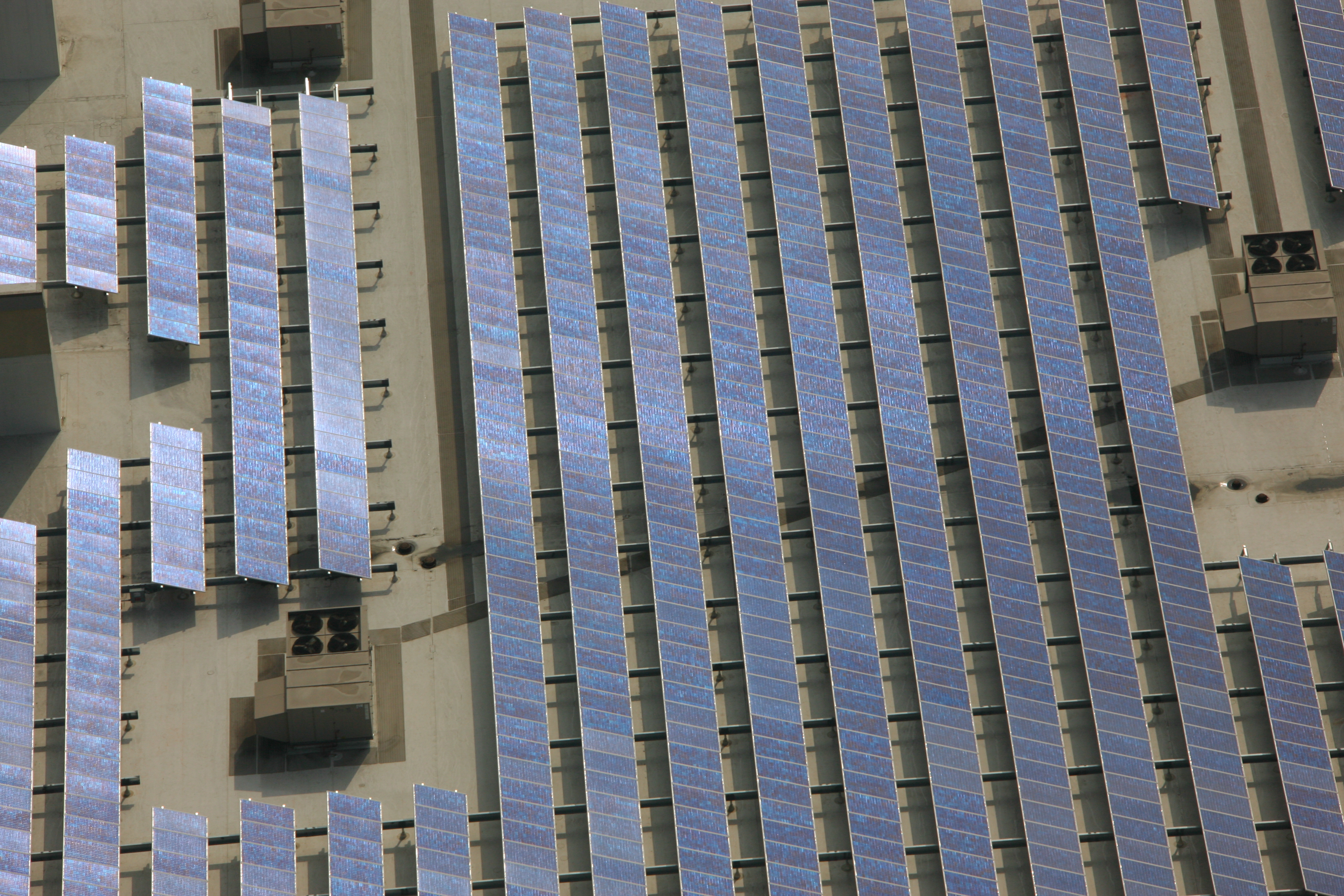
Photovoltaic farms, on the other hand, generate electricity when sunshine strikes semiconducting materials in a solar cell. If you want to produce more power, you just keep adding solar panels.

While BrightSource hopes to secure a license for its solar thermal project soon, the developer of a hybrid biomass solar trough power plant to be built in California’s Central Valley pulled the plug on the project last month, after spending 18 months and untold millions of dollars in the licensing process before the California Energy Commission.

PG&E has been depending on both those solar thermal projects to supply electricity to help it meet its renewable energy mandates. No wonder then, the utility’s growing enthusiasm for solar panel power. Photovoltaic farms do not have to be approved by California Energy Commission and can be built on already degraded land or close to cities.

And as I reported last month, the developer of another project being built to generate electricity for PG&E, the Alpine SunTower, decided to drop solar thermal technology made by its partner, eSolar, in favor of photovoltaic panels. The official explanation for the switch was that project was being downsized due to transmission constraints and solar panels proved a better fit.

But one has to wonder if economics as much as energy was behind the change. If so, deals like the one SMUD struck could be a recurrent theme.

Read Full Post »

image: California Energy Commission

In The New York Times on Friday, I write about another setback in California’s scramble to meet its renewable energy targets:

The developer of a hybrid biomass solar power plant to be built in California has abruptly canceled the project, underscoring the challenges the state faces in meeting its ambitious renewable energy goals.

Martifer Renewables, a Portuguese company, had signed a 20-year power purchase agreement with the California utility PG&E for 106.8 megawatts. The power was to be generated from a pair of power plants called San Joaquin Solar 1 and 2 that would be built on 640 acres of agricultural land in Fresno County. The facility would produce electricity from a solar field by day and burn biomass collected from area farms by night. But 18 months into an extensive licensing process and after recently depositing $250,000 for a transmission study, Martifer notified the California Energy Commission last month that it was withdrawing its license application.

The developer’s representatives did not return a request for comment. But in a June 17 letter to the energy commission, Miguel Lobo, a Martifer executive, wrote, “We were not able at this time to resolve some of our issues regarding project economics and biomass supply amongst other things.”

Although local residents and regulators had raised issues about the proposed solar farm’s water consumption and other impacts, it was the project’s plan to operate around the clock by burning biomass that proved problematic, according to energy commission records.

You can read the rest of the story here.
Read Full Post »

photo: Todd Woody

This post first appeared on Grist.

The California Assembly has passed legislation that takes the first step to requiring that a percentage of electricity generated in the state be stored.

Electricity, of course, is the ultimate perishable commodity. If the bill is approved by the California Senate and signed by Gov. Arnold Schwarzenegger, it would apparently be the first time a state will move toward mandating that electricity generated by wind farms, solar power plants, and other intermittent sources be stored for use during peak demand.

That’s key if California is to meet its ambitious mandates to obtain 33 percent of its electricity from renewable sources by 2020.

“Electric energy storage is an emerging industry that offers the possibility to solve a number of major obstacles to the achievement of a sustainable electricity future,” according to an analysis of the legislation prepared by the California Public Utilities Commission in May. “It can effectively address problems such as the integration of intermittent renewables.”

Sponsored by Assembly member Nancy Skinner, a Berkeley Democrat, the bill has been watered down to make it palatable to the state’s utilities and regulators. It originally required the state’s utilities to obtain energy storage systems capable of providing at least 2.25 percent of average peak electrical demand by 2014. By 2020 the target would rise to at least 5 percent.

The latest version of the bill now wending its way through the state Senate requires the California Public Utilities Commission to open proceedings on energy storage and by October 2013 to adopt an initial target — if appropriate — for utilities to meet by the end of 2015.

California Attorney General Jerry Brown, the Democratic candidate for governor, is sponsoring the legislation, which is backed, not surprisingly, by the renewable energy industry and venture capitalists.

“It’s part of our bigger effort to deal with climate change,” Cliff Rechtschaffen, Special Assistant Attorney General, told me. “When we looked at how to develop renewables, the technology is here but stalled by lack of regulatory focus.”

Utilities spend billions of dollars building so-called peaker plants that operate just hours a year to supply electricity and avoid blackouts when demand spikes — say, on a hot day when everyone cranks up their air conditioners.

Such costs — and greenhouse gas emissions — could be cut or reduced if electricity stored from wind farms or solar power plants could be dispatched when demand rises.

A report prepared for the California Energy Commission and released this month concluded that adding gigawatts of wind and solar energy to the grid to meet renewable energy mandates would require “major alterations to system operations.”

Without storage, more natural gas power plants or hydroelectric facilities would need to be built to smooth out grid operations as increasing amounts of solar and wind energy comes online, according to the report prepared by Kema, an energy consulting firm.

“Storage can be up to two to three times as effective as adding a combustion turbine to the system,” the report stated.

The cost and feasibility of such storage systems is another matter, as it remains a nascent industry.

Most efforts focus on using batteries or mechanical systems like flywheels to store electricity. California utility PG&E has launched a pilot project to store electricity in the form of compressed air. Some developers of solar power plants intend to use molten salt to capture heat that can be released and used to drive an electricity-generating turbine after the soon goes down.

“This bill moves storage to the top of the regulatory agenda where it belongs,” says Rechtschaffe

Read Full Post »

photo: eSolar

This post first appeared on Grist.

Amid all the hope and hype about the nascent solar boom under way in California, there’s long been an elephant in the room – transmission. Billions and billions of dollars must be spent to build and upgrade transmission lines to connect dozens of proposed solar power plants to the grid.

Now that elephant has rolled over and squashed one project’s use of innovative solar technology. Last year, California utility PG&E signed a deal with NRG Energy, a New Jersey-based electricity provider, to buy power from a 92-megawatt solar farm called the Alpine SunTower to be built near the desert town of Lancaster, northeast of Los Angeles.

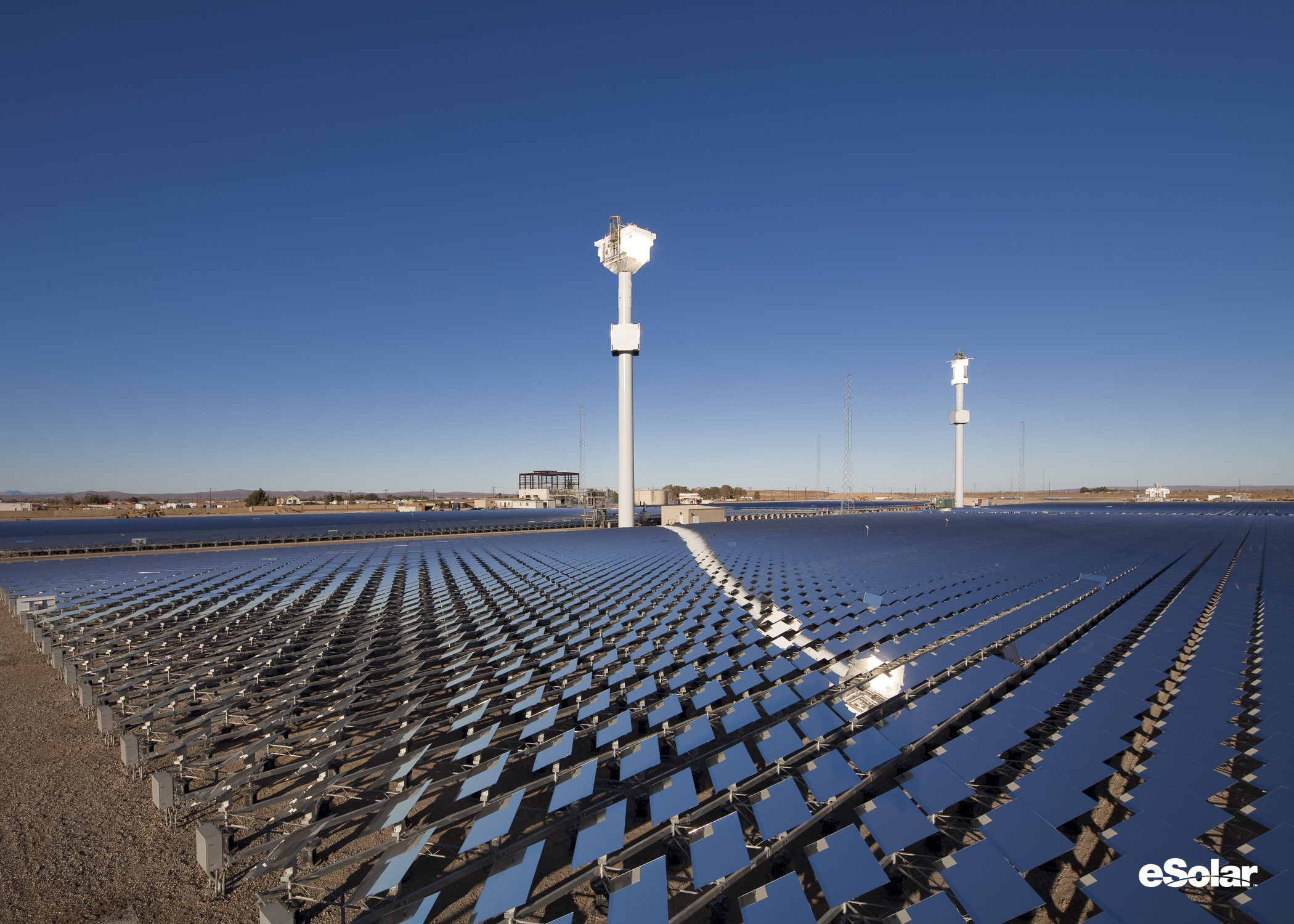
The power plant would deploy solar thermal technology developed by eSolar, a Pasadena startup founded by serial technology entrepreneur Bill Gross. NRG and eSolar earlier had inked a partnership to build 500 megawatts’ worth of solar farms. In January, eSolar reached an agreement with a Chinese company to supply technology for solar farms that would generate a massive 2,000 megawatts of electricity.

PG&E, however, submitted a letter recently to the California Public Utilities Commission  asking approval for a re-negotiated deal with NRG that has resulted in a downsizing of the Alpine SunTower project to 66 megawatts. And instead of deploying eSolar’s fields of mirrors that focus the sun on a water-filled boiler that sits atop a tower to create steam to drive a turbine, the power plant will generate electricity from photovoltaic panels like those found on residential rooftops.

The utility gave no reason for the technology switch. “NRG has not finalized the exact type of panels or the manufacturer of the panels,” a PG&E executive wrote in the letter. “Solar PV panels have been used in installations throughout the world, in both small and utility scale applications.”

However, when I contacted eSolar about the change, I received a joint statement from the company and NRG:

“NRG is returning the project to its originally proposed size to match the transmission capacity available to the project at this time,” it said. “Maintaining the project as previously announced would require waiting for additional interconnection studies and potential transmission upgrades that would delay the project delivery date.”

While solar panels are not as efficient as eSolar’s solar thermal technology in generating electricity, they are modular – meaning you can just keeping adding them to produce a desired amount of power or to match the transmission capacity in an area. ESolar’s power plants, on the other hand, are designed to be built in 46-megawatt units so there’s far less flexibility in scaling them up or down.

It’s too early to say whether this portends other switches from solar thermal to photovoltaic technology, especially as solar cell prices fall and California utilities scramble to meet a mandate requiring they obtain 20 percent of their electricity from renewable sources by the end of this year and 33 percent by 2020.

But the elephant is getting restless.

Read Full Post »

photo: Todd Woody

In The New York Times on Thursday, I write about the solar industry’s dismay over the rent and other fees the United States government will charge developers to build big solar power plants on federal land in the desert Southwest:

The nation’s biggest landlord, the United States government, has set the rent it will charge developers who build solar power plants on federal land, and some prospective tenants are not happy.

Solar developers will actually pay two fees – the lease for the land along with what the Bureau of Land Management calls a “megawatt capacity fee” based on how much electricity a project generates.

“Since we don’t have authority to collect royalties for wind and solar projects, we had to come up with a methodology to convert that electrical generation into an upfront rent payment,” Ray Brady, manager of the bureau’s renewable energy team, said in an interview.

But potential developers see a disparity. “The proposed B.L.M. rental fees are in many cases two times higher than market rates for private land,” Monique Hanis, a spokeswoman for the Solar Energy Industries Association, said in an e-mail message. “The B.L.M. must collect ‘fair market value’ from developers, but this seems to go beyond that threshold.”

That methodology is a work in progress as the agency tries to adapt decades-old formulas designed for oil and gas leasing and mineral extraction to renewable energy production.

Some 23 million acres of federal property are suitable for large-scale solar development, according to the bureau, and the agency has received more than 200 lease applications from developers who covet hot and sunny desert real estate in the Southwest.

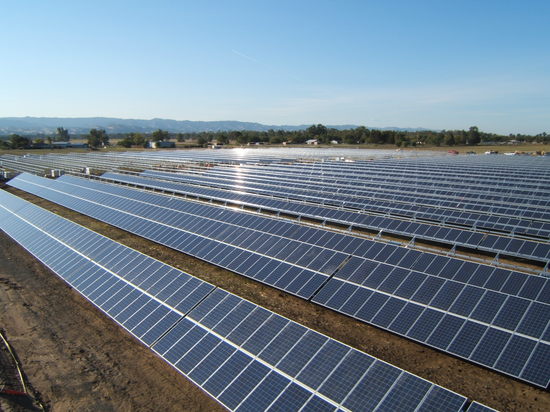
Solar farms typically require vast swaths of land, meaning the lease fees can be considerable depending on a project’s location and local property values. The Bureau of Land Management’s solar rents range from $15.70 an acre in Hidalgo County, N.M., to $313.88 an acre in Riverside County, Calif.

For instance, BrightSource Energy will pay the government about $427,000 a year in rent for its 3,400-acre Ivanpah Solar Electric Generating System in San Bernardino, Calif., now undergoing licensing. The company, based in Oakland, Calif., will also pay an annual megawatt capacity fee of $2.6 million for the 392-megawatt solar thermal power plant. Fees over the 25-year life of the contracts that BrightSource has signed with California utilities would total about $76 million.

In neighboring Riverside County, First Solar, a solar module maker and developer based in Tempe, Ariz., plans to build a 550-megawatt photovoltaic farm on 4,410 acres of federal land. Lease and capacity fees for the Desert Sunlight project will total about $4.3 million a year.

The agency is charging different capacity fees for different solar technologies. Photovoltaic power plants, which deploy solar panels like those found on residential rooftops, are assessed $5,256 a megawatt.

Developers of more efficient solar thermal power plant, which uses mirrors to heat liquids to generate steam that drives a turbine, pay $6,570 a megawatt. The same rate is charged for concentrating photovoltaic farms that use mirrors to focus the sun on a highly efficient solar cell.

If either technology uses energy storage systems to produce electricity when the sun doesn’t shine, the fee jumps to $7,884 a megawatt. The fees will be phased in over the first five years of a power plant’s operation.

Some developers and environmentalists argue that such a fee structure penalizes technologies that are more efficient and thus use less land.

“This is an unfortunate way of emphasizing one technology over another,” said Bobby McEnaney, a land program expert at the Natural Resources Defense Council.

You can read the rest of the story here.
Read Full Post »

photo: Skyline Solar

This post first appeared on Grist.

Grist’s David Roberts sent out a Tweet to his Tweeps today asking which city has installed the most solar. I’ve got an answer for you, David: Nipton, California.

The desert micropolis – population 38 – announced Thursday that it had installed a solar array that will provide 85 percent of its electricity. (The population of the outpost on the edge of Mojave National Preserve spikes to 250 or so during tourist season.)

The solar system is ground-mounted rather than on rooftops and only generates 82 kilowatts. But what is notable is the technology developed by Skyline Solar, a Silicon Valley startup I first wrote about for Grist last year.

The company’s power plants resemble solar thermal parabolic trough installation that deploy long rows of mirrors to heat tubes of liquid suspended over the arrays to create steam that drives an electricity-generating turbine.

Skyline’s system is purely solid state, however. Each 120-foot-long trough concentrates the sun on photovoltaic modules attached to the edges of the arrays. That boosts the solar cell’s electricity production as does a tracking mechanism that allows the arrays to follow the sun throughout the day.

Such concentrating photovoltaic systems – which Skyline calls “high gain solar “ – have been a niche market due to their relatively high costs. But as solar cell prices decline and solar thermal projects get bogged down in environmental disputes, they have become increasingly attractive as they can be built near utility substations and plugged directly into the grid without the need to build expensive new transmission systems.

Skyline has pushed to lower costs by using common materials – glass, steel – and designing the arrays so their components can be mass-produced by automotive manufacturers. The company last year struck a deal with the Michigan subsidiary of Canadian auto manufacturing giant Magna International to make components for its HGS 1000 solar system.

In other news on the solar frontier Thursday, Silicon Valley startup MiaSolé said the National Renewable Energy Laboratory had confirmed that the company’s copper indium gallium selenide solar cells have 13.8 percent efficiency in production. Such thin-film cells typically have a lower efficiency than standard polysilicon solar cells but are cheaper to manufacture. But with an efficiency approaching 14 percent, MiaSolé could give some standard module makes a run for their money.

Read Full Post »

This post first appeared on Grist.

Legislation pending in New York that would require the state to install 5,000 megawatts of solar power by 2025 could generate 22,198 jobs and boost the economy by $20 billion, according to a report released by Vote Solar on Wednesday.

The cost to consumers would be just a 39-cent-a-month hike on their utility bills, the report found.

Vote Solar, a San Francisco non-profit that is backing the bills in the New York legislature along with the Natural Resources Defense Council and other environmental groups, commissioned the study conducted by Crossborder Energy. Described as an independent consultant, Crossborder relied on economic models developed by the National Renewable Energy Laboratory to make its projections.

“We note that in an effort to be conservative in our assumptions, these benefits are calculated without taking into account any potential new manufacturing,” the report stated. “Precedent shows that states that make a clear commitment to clean energy see reciprocal investment on behalf of manufacturing companies. For example, in both Arizona and California, the states’ strong and transparent policies were fundamental to the decisions of two major global solar manufacturers…to locate their first domestic manufacturing operations in those states.”

New York currently has less than 25 megawatts of solar installed. The New York Solar Jobs and Development Act would require the state’s utilities to install enough solar to account for at least 2.5 percent of their electricity sales by 2025. Those targets could be reached through residential and commercial rooftop solar installations or by building solar power plants. Utilities could own and operate their own solar power facilities to meet 25 percent of their mandate.

But the legislation does not specify incentives or other policies to encourage solar installations, which would inevitably affect the cost of the program for developers and consumers.

Read Full Post »

« Newer Posts - Older Posts »

Design a site like this with WordPress.com
Get started