Feeds:
Posts
Comments

Archive for the ‘solar power plants’ Category

In the world’s single-largest investment in solar technology, the oil-rich emirate of Abu Dhabi announced Wednesday it will spend $2 billion to jumpstart a home-grown photovoltaics industry. The cash will fund what is undoubtedly the planet’s best-financed startup, Masdar PV, which will build manufacturing facilities in Germany and Abu Dhabi to produce thin-film solar modules that can be used in rooftop solar systems or solar power plants.

Masdar PV is the latest project of the Masdar Initiative, Abu Dhabi’s $15 billion renewable energy venture designed to transform the emirate into a green technology powerhouse. Masdar is best known for its plans to build Masdar City, a “zero-carbon, zero-waste” urban center.

Thin-film solar cells are essentially “printed” on glass or flexible metals, allowing them to be integrated into building materials like roofs and walls. Though thin-film solar is less efficient at converting light into electricity, it uses a fraction of the expensive silicon needed by conventional bulky solar modules and can be produced much more cheaply – provided economies of scale are achieved.

Thus Masdar PV’s big solar bet. “You have to be working at scale to drive costs out of the system,” Steve Geiger, Masdar’s director of special projects, told Fortune in a phone call from Abu Dhabi. “We have to do it at scale and we have to do it in volume in multiple markets.”

One of those markets is the United States, where Masdar PV could give established players like First Solar (FSLR) and startups such as Nanosolar, Heliovolts and Global Solar some formidable competition.

The gamble Masdar PV is taking is that it’s investing billions in an older but proven thin-film technology that may well be left in the dust by more exotic, cheaper and efficient technologies under development by a host of startups.

Masdar PV aims to have a gigawatt of annual production capacity in place by 2014. To get there, Geiger says the company has hired a management team that includes former top executives from First Solar and other thin-film industry veterans.

A leading solar technology company that Geiger declined to identify will provide the manufacturing equipment for Masdar PV’s factories. Judging from his description, the likely supplier is Applied Materials (AMAT), the world’s biggest computer-chip equipment maker that has a burgeoning business building the machines that make thin-film solar cells of the type that Masdar PV will produce.

“We usually partner with large companies that have managerial skills, technology and market access, but we were very fortune that we picked up a top management team and thought it was strong enough to do as a 100% Abu Dhabi Masdar company,” says Geiger, who will oversee Masdar’s thin-film solar venture.

Masdar PV’s first plant is scheduled to go online in Germany toward the end of 2009 with the second to begin production in Abu Dhabi by mid-2010. “Very clearly we need to look at expansion beyond those two physical facilities,” Geiger says. “We really have to look at America and the Asian markets as well.

Thin-film is just one of three solar strategies that Masdar is pursuing by funneling petrodollars into green energy startups. In March, Masdar unveiled Torresol Energy, a joint venture with a Spanish company that will build large-scale solar thermal power plants to supply electricity to utilities. Masdar has also made investments in other solar thermal companies as well as thin-film startups pursuing different technologies. Finally, Masdar wants to produce polysilicon, the basic material of conventional solar cells.

As Masdar chief Sultan Ahmed Al Jaber recently told Green Wombat, “We want to cover the whole value chain – from research to labs to manufacturing to the deployment of technologies.”

Geiger uses an analogy for Masdar’s green energy ambitions that may be more familiar to petroleum-dependent Americans – and should serve as a wake-up call to get serious about carbon-free energy. “The model might be the vertically integrated oil industry,” he says. “It clearly makes sense to have a consolidated power provider.”

Read Full Post »

The souring economy hasn’t dissuaded green tech investors from making big bets on renewable energy. On Wednesday, solar power plant builder BrightSource Energy announced it had raised $115 million from a group of investors that include Google.org, the search giant’s philanthropic arm, and oil giants Chevron and BP.

The investment in the Oakland, Calif.-based startup is Google’s (GOOG) second big solar energy play in the past two months. In April, Google.org joined a $130 million round for eSolar, a Pasadena solar power plant company whose chairman is Idealab founder Bill Gross.

BrightSource Energy, started by American-Israeli solar pioneer Arnold Goldman, has contracts to supply California utility PG&E (PCG) with up to 900 megawatts of solar electricity from power plants to be built in the Mojave Desert on the California-Nevada border. BrightSource has developed a new solar technology, dubbed distributed power tower, that focuses fields of sun-tracking mirrors called heliostats on a tower containing a water-filled boiler. The sun’s rays superheat the water and the resulting steam drives an electricity-generating turbine. (Artist rendering of BrightSource’s planned Ivanpah plant above.)

Given that a 500-megawatt solar power plant can cost more than $1 billion to build, $115 million is but a drop in the bucket. But it will allow BrightSource, which previously raised $45 million, to proceed with the development of its technology as it seeks project financing for construction of its first power plants.

And it can’t hurt to have such high-profile backers when you negotiate power purchase agreements with utilities. Besides Google, BP Alternative Energy (BP) and Chevron Technology Ventures (CVX), previous investors participating in the new round include Morgan Stanley (MS), VantagePoint Venture Partners, Draper Fisher Jurvetson and DBL Investors.

Another new BrightSource investor is Norweigan oil and gas behemoth StatoilHydro (STO). Apparently, even Big Oil has seen the light when it comes to hedging its bets with green energy.

Read Full Post »

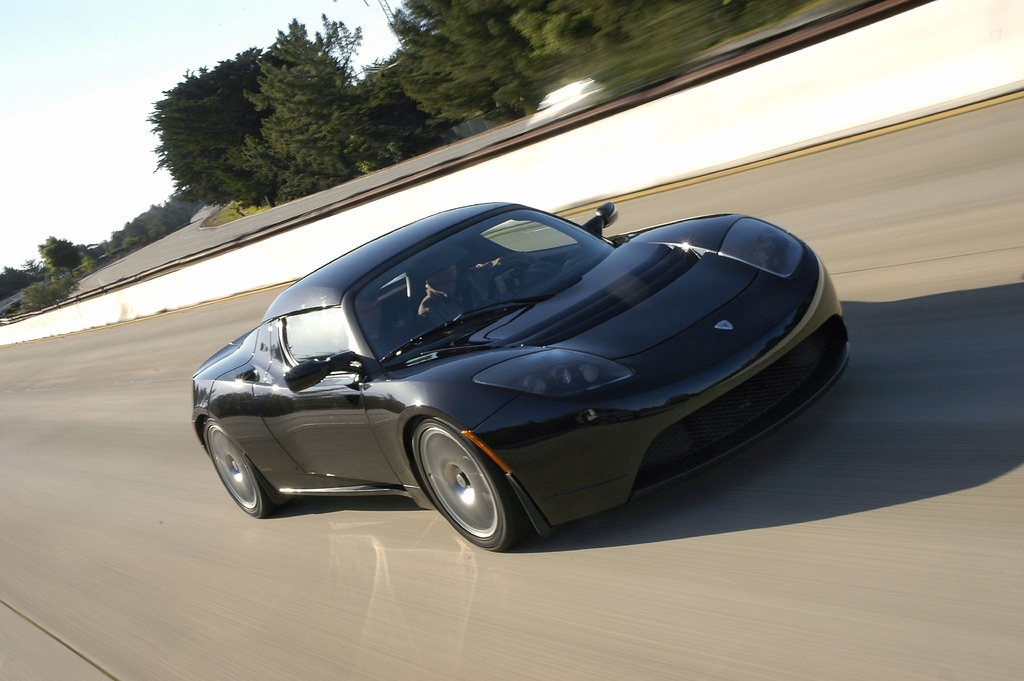
Monday night, Green Wombat swung by SF Green, one of a growing number of green tech networking events sprouting up around San Francisco and Silicon Valley. The draw – beyond drinks with a standing-room-only crowd of bright-eyed twenty-and-thirtysomethings in a San Francisco art gallery – was the appearance of leading venture capitalist Ray Lane of Kleiner Perkins Caufield & Byers and Darryl Siry of Tesla Motors, maker of the Roadster electric supercar.

Despite the fact that Tesla has sued a Kleiner company, Fisker Automotive – which is producing an electric hybrid sports sedan – for alleged intellectual property theft, no sparks flew. (Though at Fortune’s recent Brainstorm Green conference, Lane couldn’t resist taking a jab at allegations that Fisker founder Henrik Fisker appropriated Tesla technology when he did design work for the Silicon Valley startup: “It’s ridiculous,” Lane said. “Henry Fisker wouldn’t know a drive train from a glass of water. He’s a designer.)

Siry, Tesla’s vp of sales, marketing & service, said five of the $100,000 Roadsters have rolled off the assembly line so far with one car tooling around Los Angeles, and others in the Bay Area and London. By year’s end, Tesla, which has been wrestling with drive train problems, should have more than 100 cars on Bay Area roads, home to many the company’s tech titan customers.

Tesla has raised $145 million, Siry noted, and will do another round before an IPO. The Roadster will always be a limited production marquee car but to mass produce its next vehicle, a five-seat sports sedan code-named White Star, Tesla will need that IPO or project financing. Siry also sketched a future where Tesla might supply electric drive trains to automakers in exchange for project financing.

“Tesla is a tech company wrapped in an automotive brand,” he said at the event co-sponsored by VentureBeat.

Lane and Kleiner Perkins have gone beyond investing in electric car companies to running one. Lane is chairman of Think North America, the U.S. arm of Norwegian electric carmaker Think Global. Kleiner and Rockport Capital took a 50 percent stake in the North American operation, which launched last month.

The Think and Fisker investments are emblematic of a new direction for VCs who have jumped into the green tech game. Unlike the first dot-com era or even the current Web 2.0 age, there’s no quick exit on the horizon for investments in green tech companies that may be years away from producing a product and require hundreds of millions, if not billions, in project financing to build car factories or solar energy power plants.

Lane compared investing in green tech to the long-term horizon needed for investing in biotech startups, where the key is to hit milestones that allow investors to calculate valuations.

Still, it’s a big gamble, given rising commodity prices and global economic upheaval.

Kleiner is also an investor in solar power plant startup Ausra. “Steel prices are killing us,” Lane said. Ausra’s power plants consist of hundred of acres of mirrors mounted on steel frames. “With Ausra, we [calculate] we could deliver solar thermal electricity at 12 cents a kilowatt-hour. But with steel prices, who knows?”

A shortage of qualified green tech workers has become an issue, according to Lane. The nascent solar power plant business relies on recruiting engineers and project developers from the carbon-based industry. “Talented people in project development at companies like Bechtel are maxed out for years on building projects,” he said.

Read Full Post »

“Years ago we came to the conclusion that global warming was a problem, it was an urgent problem and the need for action is now. The problem appears to be worse and more imminent today, and the need to take action sooner and take more significant action is greater than ever before” — PG&E Chairman and CEO Peter Darbee

The head of one of the nation’s largest utilities seemed to be channeling Al Gore on Tuesday when he met with a half-dozen environmental business writers, including Green Wombat, in the PG&E (PCG) boardroom in downtown San Francisco. While a lot of top executives talk green these days, for Darbee green has become the business model, one that represents the future of the utility industry in a carbon-constrained age.

As Katherine Ellison wrote in a feature story on PG&E that appeared in the final issue of Business 2.0 magazine last September, California’s large utilities — including Southern California Edison (EIX) and San Diego Gas & Electric (SRE) — are uniquely positioned to make the transition to renewable energy and profit from green power.

First of all, they have no choice. State regulators have mandated that California’s investor-owned utilities obtain 20 percent of their electricity from renewable sources by 2010 with a 33 percent target by 2020. Regulators have also prohibited the utilities from signing long-term contracts for dirty power – i.e. with the out-of-state coal-fired plants that currently supply 20 percent of California’s electricity. Second, PG&E and other California utilities profit when they sells less energy and thus emit fewer greenhouse gases. That’s because California regulators “decouple” utility profits from sales, setting their rate of return based on things like how well they encourage energy efficiency or promote green power.

Still, few utility CEOs have made green a corporate crusade like Darbee has since taking the top job in 2005. And the idea of a staid regulated monopoly embracing technological change and collaborating with the likes of Google (GOOG) and electric car company Tesla Motors on green tech initiatives still seems strange, if not slightly suspicious, to some Northern Californians, especially in left-leaning San Francisco where PG&E-bashing is local sport.

In a wide-ranging conversation, Darbee, 54, sketched sketched a future where being a successful utility is less about building big centralized power plants that sit idle until demand spikes and more about data management – tapping diverse sources of energy — from solar, wind and waves to electric cars — and balancing supply and demand through a smart grid that monitors everything from your home appliances to where you plugged in your car. “I love change, I love innovation,” says Darbee, who came to PG&E after a career in telecommunications and investment banking.

Renewable energy

“On renewable energy what we’ve seen is the market is thin,” says Darbee. “Demand just from ourselves is greater than supply in terms of reliable, well-funded companies that can provide the service.”

PG&E so far has signed power purchase agreements with three solar startups — Ausra, BrightSource Energy and Solel — for up to 1.6 gigawatts of electricity to be produced by massive solar power plants. Each company is deploying a different solar thermal technology and uncertainty over whether the billion-dollar solar power stations will ultimately be built has prompted PG&E to consider jumping into the Big Solar game itself.

“We’re looking hard at the question of whether we can get into the business ourselves in order to do solar and other forms of renewables on a larger scale,” Darbee says. “Let’s take some of the work that’s been done around solar thermal and see if we can partner with one of the vendors and own larger solar installations on a farm rather than on a rooftop.”

“I like the idea of bringing the balance sheet of a utility, $35 billion in assets, to bear on this problem,” he adds.

It’s an approach taken by the renewable energy arm of Florida-based utility FPL (FPL), which has applied to build a 250-megawatt solar power plant on the edge of the Mojave Desert in California.

For now, PG&E is placing its biggest green bets on solar and wind. The utility has also signed a 2-megawatt deal with Finavera Renewables for a pilot wave energy project off the Northern California coast. Given the power unleashed by the ocean 24/7, wave energy holds great promise, Darbee noted, but the technology is in its infancy. “How does this technology hold up against the tremendous power of the of the Pacific Ocean?”

Electric cars

Darbee is an auto enthusiast and is especially enthusiastic about electric vehicles and their potential to change the business models of both the utility and car industries. (At Fortune’s recent Brainstorm Green conference, Darbee took Think Global’s all-electric Think City coupe for a spin and participated in panels on solar energy and the electric car.)

California utilities look at electric cars and plug-in hybrids as mobile generators whose batteries can be tapped to supply electricity during peak demand to avoid firing up expensive and carbon-spewing power plants. If thousands of electric cars are charged at night they also offer a possible solution to the conundrum of wind power in California, where the breeze blows most strongly in the late evenings when electricity demand falls, leaving electrons twisting in the wind as it were.

“If these cars are plugged in we would be able to shift the load from wind at night to using wind energy during the day through batteries in the car,” Darbee says.

The car owner, in other words, uses wind power to “fill up” at night and then plugs back into the grid during the day at work so PG&E can tap the battery when temperatures rise and everyone cranks up their air conditioners.

Darbee envisions an electricity auction market emerging when demand spikes. “You might plug your car in and say, ‘I’m available and I’m watching the market and you bid me on the spot-market and I’ll punch in I’m ready to sell at 17 cents a kilowatt-hour,” he says. “PG&E would take all the information into its computers and then as temperatures come up there would be a type of Dutch auction and we start to draw upon the power that is most economical.”

That presents a tremendous data management challenge, of course, as every car would need a unique ID so it can be tracked and the driver appropriately charged or credited wherever the vehicle is plugged in. Which is one reason PG&E is working with Google on vehicle-to-grid technology.

“One of the beneficiaries of really having substantial numbers of plug-in hybrid cars is that the cost for electric utility users could go down,” says Darbee. “We have a lot of plants out there standing by for much of the year, sort of like the Maytag repairman, waiting to be called on for those super peak days. And so it’s a large investment of fixed capital not being utilized.” In other words, more electric and plug-in cars on the road mean fewer fossil-fuel peaking power plants would need to be built. (And to answer a question that always comes up, studies show that California currently has electric generating capacity to charge millions of electric cars.)

Nuclear power

Nuclear power is one of the hotter hot-button issues in the global warming debate. Left for dead following the Three Mile Island and Chernobyl disasters, the nuclear power industry got a new lease on life as proponents pushed its ability to produce huge amounts of carbon-free electricity.

“The most pressing problem that we have in the United States and across the globe is global warming and I think for the United States as a whole, nuclear needs to be on the table to be evaluated,” says Darbee.

That’s unlikely to happen, however in California. The state in the late 1970s banned new nuclear power plant construction until a solution to the disposal of radioactive waste is found. PG&E operates the Diablo Canyon nuclear plant, a project that was mired in controversy for years in the ’70s as the anti-nuke movement protested its location near several earthquake faults.

“It’s a treasure for the state of California – It’s producing electricity at about 4 cents a kilowatt hour,” Darbee says of Diablo Canyon. “I have concerns about the lack of consensus in California around nuclear and therefore even if the California Energy Commission said, `Okay, we feel nuclear should play a role,’ I’m not sure we ought to move ahead. I’d rather push on energy efficiency and renewables in California.”

The utility industry

No surprise that Darbee’s peers among coal-dependent utilities haven’t quite embraced the green way. “I spent Saturday in Chicago meeting with utility executives from around the country and we’re trying to see if we can come to consensus on this very issue,” he says diplomatically. “There’s a genuine concern on the part of the industry about this issue but there are undoubtedly different views about how to proceed and what time frames to proceed on.”

For Darbee one of the keys to reducing utility carbon emissions is not so much green technology as green policy that replicates the California approach of decoupling utility profits from sales. “If you’re a utility CEO you’ve got to deliver earnings per share and you’ve got to grow them,” he says. “But if selling less energy is contradictory to that you’re not going to get a lot of performance on energy efficiency out of utilities.”

“This is a war,” Darbee adds, “In fact, some people describe [global warming] as the greatest challenge mankind has ever faced — therefore what we ought to do is look at what are the most cost-effective solutions.”

Read Full Post »

Stealth Bay Area solar startup OptiSolar has quietly revealed plans to build the world’s largest photovoltaic solar farm on the central California coast — a $1 billion, 550-megawatt monster that would be nearly 40 times as large as the biggest such power plant operating today.

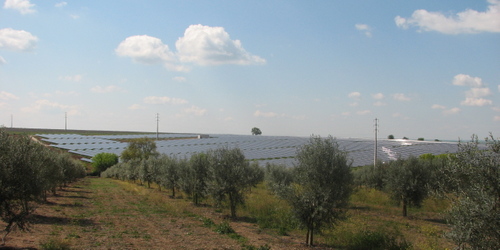
PV solar power plants essentially take solar panels similar to those found on suburban rooftops and put them on the ground. Unlike solar thermal power plants that use mirrors to heat a liquid to produce steam that drives an electricity-generating turbine, photovoltaic power stations generate power directly when the sun strikes the panel’s semiconducting cells. That means there’s virtually no moving parts or need for industrial infrastructure like power blocks, turbines and piping. (A photo of a PV solar farm in Serpa, Portugal, is above.)

But because photovoltaic solar is less efficient at converting sunlight into electricity than solar thermal and requires big swaths of land, it has not been considered economical to build large-scale PV power plants in the United States. (Unlike in Portugal, Spain and other European countries where utilities pay a premium rate for green energy.)

Furthermore, OptiSolar makes thin-film solar cells, which are even less efficient than traditional solar panels. The hoped for advantage of thin-film solar is that the cells can be printed on rolls of metal much more cheaply than bulky conventional solar cells. They also use far less polysilicon –an expensive semiconducting material — than standard solar cells.

Still, hardly any thin-film solar companies in the U.S. have begun mass production, let alone tried to build a huge power plant. OptiSolar intends to both produce solar panels and build and operate solar power plants. It currently has deals to build more than 20 solar farms representing more than 200 megawatts in Canada, which pays higher rates for electricity generated from renewable sources.

“We have propriety technology and a business approach that we’re convinced will let us deploy PV at large scale and be competitive with other forms of renewable energy,” OptiSolar executive vice president Phil Rettger told Green Wombat recently in an interview about the Hayward, Calif.-based company’s plans.

Says Reese Tisdale, a solar energy analyst with Emerging Energy Research: “At this point I see it as an announcement with plenty to prove.” He says the benefits of a large-scale photovoltaic plants are low operation and maintenance costs and the fact that thin-film prices are falling. But he notes that thin-film solar’s low efficiency and inability to store the electricity generated — solar thermal plants can store heat in water or molten salt to create steam when the sun sets — puts such power plants at a disadvantage.

And the large tracts of land needed for such solar farm could create conflicts, particularly when threatened or endangered animals and plants are present. “Environmental groups will go crazy,” Tisdale says.

OptiSolar has kept a low profile and has said little about its technology or how efficent it is, other than that it uses just 1% of the silicon needed in conventional solar cells. Many thin-film solar cells have efficiencies of five to six percent though Global Solar Energy CEO Mike Gering recently told Green Wombat that his company has achieved 10 percent efficiency in production runs.

Founded by veterans of the carbon-intensive Canadian oil sands industry, OptiSolar has a factory in Hayward and just signed a deal to build another manufacturing facility in Sacramento.

The company’s Topaz solar farm would be constructed on nine-and-a-half square miles of ranch land in San Luis Obispo County near the site of the 177-megawatt Carizzo Plains solar thermal power plant planned by Silicon Valley startup Ausra. Optisolar spokesman Jeff Lettes told Green Wombat that the company has taken options to buy the 6,080 acres of land from farming families if the county approves the project.

Who would buy Topaz’s electricity remains to be seen. The plant would be in PG&E’s (PCG) territory and Rettger acknowledged that the company has been in talks with big California utilities such as Southern California Edison (EIX) and San Diego Gas & Electric (SRE). Lettes says the company is currently negotiating a power purchase agreement for Topaz but could not comment further.

OptiSolar says its solar farm would generate electricity for about 190,000 homes. Unlike other PV power plants, OptiSolar will not place its panels on trackers that follow the sun throughout the day. That will lower the cost of the plant but also reduce its efficiency. If approved by the county, construction would begin in 2010. Unlike solar thermal plants, photovoltaic power stations do not need to be licensed by the California Energy Commission, a process that can take a year or two to complete.

Still, OptiSolar will face challenges. Some residents have objected to the size and environmental impact of Ausra’s project and the prospect of another large-scale solar facility in their backyard will raise new concerns. The OptiSolar site is also habitat for the protected California kit fox.

Read Full Post »

PASADENA, Calif. — Solar power plant builder eSolar has raised $130 million from Google’s philanthropic arm, Google.org, and other investors.

That was the headline news that eSolar chairman and Idealab founder Bill Gross slipped to Green Wombat during dinner Sunday night as Fortune’s Brainstorm Green conference kicked off in Pasadena. The other investors include Idealab and Oak Investment Partners. Big numbers grab attention but the far more interesting angle is the technology that eSolar is developing. If it lives up to its claims, eSolar could help break the logjam that has put Big Solar on the slow track in California.

“We just completed tests at our test site this week and we will be able to produce electricity that is competitive with coal,” said an animated Gross Sunday evening.

That is the Holy Grail of renewable energy and the charge set out by Google (GOOG) founders Sergey Brin and Larry Page when they launched their green power initiative, RE<C (Renewable Energy less than Coal), in November. Google.org subsequently invested $10 million in Pasadena-based eSolar. (eSolar did not say how much of the $130 million Google.org ponied up in the latest round.)

eSolar has been operating in stealth mode but Gross shared details of the company’s technology and how it intends to produce greenhouse gas-free electricity so cheaply — a claim sure to be met with some skepticism by competitors like Ausra, BrightSource Energy and Solel.

At first glance, there doesn’t seem much radically different about an eSolar solar thermal power plant — it’ll use fields of mirrors to focus the sun’s rays on a tower containing a water-filled boiler. The resulting heat will create steam that will drive an electricity-generating turbine.

The tipping-point innovation, according to Gross, is the mirrors and the software that controls them as well as the modular design of the power plants.

While Oakland, Calif.-based BrightSource is developing a similar system, Gross says eSolar is able to use smaller mirrors — called heliostats — that can be cheaply mass produced from off-the-shelf glass like that used in bathroom mirrors. Proprietary software developed by eSolar controls each sun-tracking mirror, increasing their efficiency to produce more electricity. “It’s all about the software,” Gross said.

Smaller more powerful solar fields means that eSolar can build power plants on far less land than competitors for less money, according to Gross. For instance, a 500-megawatt solar power plant can cost more than $1 billion to build and requires thousands of acres of land — which is why most will built in remote deserts. But eSolar plans to build modular, 33-megawatt power plants that can be constructed on a couple hundred acres and plugged into existing transmission lines near urban areas.

“We’ve already bought up rights to enough land to produce more than a gigawatt of electricity,” said Gross, showing Green Wombat a map of California polk-a-dotted with the locations of potential eSolar power plants. A gigawatt can power about 750,000 homes.

The small size of each power plant has another benefit — solar thermal power stations under 50 megawatts do not have to be licensed by the California Energy Commission. That means eSolar can cut at least a year or two off the process of getting a solar power plant online.

That will certainly be attractive to the Golden State’s big utilities — PG&E (PCG), Southern California Edison (EIX) and San Diego Gas & Electric (SRE) — which face a mandate to obtain 20 percent of their electricity from renewable sources by 2010 and 33 percent by 2020.

Although all those utilities have signed massive megawatt deals with solar energy companies, no plant has been yet built.

Gross says that while eSolar has been talking to the utilities it’s not going to wait to have a power purchase agreement in hand before building its first plant.

“Sergey said to go for it and we are.”

Read Full Post »

brightsource_energy.jpgCalifornia utility PG&E on Tuesday announced contracts to buy up to 900 megawatts of electricity generated by solar power plants to be built in the Mojave Desert by BrightSource Energy. It’s one of the biggest solar deals to date — enough to power some 600,000 homes — and is another sign that that the shift from fossil fuels to carbon-free energy is well underway, at least in California.

But is it too late? PG&E (PCG) first announced it was negotiating a power purchase agreement with BrightSource, then called Luz II, on Aug. 10, 2006. Around that time, the United States’ leading climate scientist, NASA’s James Hansen, warned that the world had only a decade to take drastic action to cut carbon emissions and avert future catastrophe from global warming.

It took nearly two years alone to just hammer out the PG&E-BrightSource deal and the world now has eight years left to radically ramp up alternative energy sources. By the time the first BrightSource 100-megawatt solar power plant (image above) goes online it will be 2011 and the last one will begin generating electricity for PG&E just as the climate change alarm clock goes off. If you believe Hansen, hitting the snooze button will not be an option.

Of course, there’s no guarantee the BrightSource plants will actually be built — it will take billions to construct them and the investment climate is not exactly sunny these days, clouded by Wall Street’s meltdown and the looming expiration of a crucial solar investment tax credit. (Personally, Green Wombat is betting BrightSource pulls it off — though April Fool’s Day probably was not the best date to unveil such a deal. The Oakland, Calif.-based company was founded by solar pioneer Arnold Goldman, its CEO, John Woolard, hails from Silicon Valley and the startup is backed by Morgan Stanley (MS) and some savvy venture capitalists. )

Given the moral and regulatory imperative — California utilities must obtain 20 percent of their electricity from renewable sources by 2010 and a third by 2020 — why is large-scale solar proceeding at the pace of a Mojave Desert tortoise? (Almost three years ago, for instance, Southern California Edison (EIX) and San Diego Gas & Electric (SRE) unveiled agreements with Phoenix’s Stiring Energy Systems to buy up to 1,750 megawatts of solar electricity. Ground has yet to be broken on any of the planned power plants.)

Partly it’s because the years-long negotiations between utilities and solar power plant companies is something of a black box. Details of these power purchase agreements are kept confidential but are estimated to be worth billions — if a recent $4 billion dealstruck by utility Arizona Public Service with solar power plant builder Abengoa Solar is any indication. Regulated utilities are by their nature big and bureaucratic and can be expected to be extra-cautious when they’re placing bets on untried solar technology from companies like BrightSource and Ausra.

“Transactions of this magnitude require a fair amount of time to negotiate and due diligence must also be performed,” PG&E spokeswoman Jennifer Zerwer told Green Wombat in an e-mail. “The original [BrightSource agreement] announced in August 2006 was for 500 megawatts; the final agreement expanded on the original . . . and culminated in the execution of five separate power purchase agreements for up to 900 MW.”

Another factor is a regulatory structure that is an artifact of the fossil fuel age. California requires extensive environmental review of new power plant projects — be they clean and green or down and dirty — a process that can take a 18 months or more. And the best solar sites often are on federal land in the Mojave — securing a lease for that land is another 18-month-long process.

Still, one looks to history. When the United States entered World War II, it retooled its factories in a matter of months to produce planes and tanks. Climate change is an amorphous but no less dangerous threat and speeding up the regulatory timetable will be crucial in the fight against global warming.

The clock, after all, is ticking.

Read Full Post »

torresol2.gif

Abu Dhabi is not content to just sell you the oil that fuels your SUV; now its going to sell you sunshine to keep your lights on and power your electric car when the internal combustion engine goes the way of the buggy whip. Masdar, the oil-rich emirate’s $15 billion renewable energy venture, and Spanish technology company Sener on Wednesday announced a joint venture called Torresol Energy to build large-scale solar power plants in Australia, Europe, the Middle East, North Africa and the United States.

Torresol initially will invest $1.2 billion in three solar power plants to be built in Spain but the company is targeting the global “sunbelt” for future expansion. Masdar will take a 60 percent ownership stake in Torresol with Sener holding a 40 percent stake. A Torresol spokesman declined to reveal the dollar amount of the investment. A prime market for Torresol will be the U.S. desert Southwest, where companies like Ausra, BrightSource Energy, Solel and Abengoa Solar are competing for contracts with utilities PG&E (PCG), Arizona Public Service (PNW) and Southern California Edison (EIX). Torresol potentially could shake up that market, given its very deep pockets and ability to independently finance billion-dollar solar power plants.

The venture is just the latest move by Abu Dhabi to control what Masdar CEO Sultan Ahmed Al Jaber described to Green Wombat recently as “the whole value chain” of renewable energy, from research and development to manufacturing silicon for solar cells to the large-scale deployment of green technology.

The irony is too rich to leave unsaid: A leading oil producer invests billions in carbon-free energy while a leading consumer of fossil fuels – the United States – continues to subsidize Big Oil while while offering only tepid support for green technology. It is inevitable that climate change will foster the rise of renewable energy – the only question is which countries and companies will profit from the new energy economics. It is entirely possible that the U.S. will trade energy dependence of one kind – on Middle East oil – for another – on Middle East and European solar technology – in the era of global warming. It’s no coincidence that most of the solar energy companies with contracts to build utility-scale power plants in California and the Southwest have overseas roots – Ausra hails from Australia, BrightSource was founded by American-Israeli pioneer Arnold Goldman, Solel is based in Israel and Abengoa is headquartered in Spain.

Torresol plans to build solar power plants using a technology it calls a Central Tower Receiver system. It’s similar to technology used by competitors like BrightSource in that fields of mirrors called heliostats focus the sun’s rays on tower that contains a receiver. In this case the receiver is filled with salt which when heated vaporizes water to create steam that drives an electricity-generating turbine. The company says it intends to have 500 megawatts of solar electricity online by 2012.

Read Full Post »

solana1.jpgArizona Public Service, Arizona’s largest utility, announced plans Thursday for a 280-megawatt solar power plant to be built 70 miles southwest of Phoenix by Spanish company Abengoa Solar. What’s striking about the deal is that it offers a rare glimpse inside the economics of Big Solar. And as the renewable energy industry pushes Congress to extend crucial green tax credits, the jobs that will be spawned by the Solana Generating Station and the economic ripple effect of the huge construction project is Exhibit A in why fighting global warming can be a win-win when it comes to the economy and the environment.

All the previous contracts for 100+ megawatt solar power plants have been in California, where utilities PG&E (PCG), Southern California Edison (EIX) and San Diego Gas & Electric (SRE) have shrouded power purchase agreements in secrecy.

APS (PNW), on the other hand, has lifted the green veil a bit, giving some indication of the current cost of producing utility-scale solar electricity and the larger economic impact. According to APS, the utility will pay around $4 billion over 30 years for the greenhouse gas-free electricity generated by Solana that will light 70,000 homes. That comes to about $133 million a year for the life of the power purchase agreement.

Abengoa spokesman Peter Kelley told Green Wombat that the exact kilowatt per hour rate the company is paying APS is confidential. No doubt though that the utility will pay a premium per kilowatt/hour for its first large-scale solar energy deal compared to electricity produced by a coal or natural-gas fired power plant. That cost disparity is likely to evaporate when the United States moves to price carbon — either through a carbon tax (unlikely) or a cap-and-trade system that requires fossil-fuel power plants to pay if they exceed limits on CO2 emissions. And the cost of financing carbon-spewing power plants will grow in coming years as Wall Street shies way from projects that carry climate change risks. And as solar power plant components and systems go from being one-off prototypes to mass-produced commodities, the cost of solar electricity is expected to drop even further.

Abengoa and APS are not revealing the construction cost of Solana but solar power plants of that size can run half a billion dollars or more. Of course, once built their operating costs are significantly lower than conventional power plants; the fuel — the sun — after all is free.

In the meantime, the Solana Generation Station is expected to inject about $1 billion into the Arizona economy as Abengoa hired 1,500 workers to build the power station and 85 others to operate it, according to APS. The utility estimates that the ripple affect will create another 11,000 to 15,000 jobs.

Abengoa is using a solar trough design for the plant. A tried and true technology, solar trough plants deploy long rows of parabolic mirrors to heat liquid-filled tubes to produce steam that drives electricity-generating turbines. The Solana plant will also store heat in silos of molten salt. The heat can be released when the sun is not shining to run the turbines. “The molten storage will extend the operating hours of the plant both during cloud cover and when sun goes down,” Kelley says. That means Solana can continue to generate electricty as long as six hours after sunset.

The big “if” for Solana is the 30 percent investment tax credit that expires at the end of 2008. If Congress fails to extend the credit, the cost of such solar power plants will jump, jeopardizing their economic viability

Solana is likely to be just the first big solar power plant in Arizona. Utilities there must obtain 15 percent of their electricity from renewable sources by 2025 and with little wind or geothermal available in Arizona, the state is likely to place a big bet on Big Solar.

Read Full Post »

infinia-stirling-dish.jpgA passel of high-profile high-tech investors  — including Khosla Ventures, Paul Allen’s Vulcan Capital and Bill Gross’ Idealab — are backing yet another new player in the increasingly hot market for large-scale solar power, pumping $50 million into Infinia, a Kennewick, Wash., company manufacturing a Stirling solar dish.

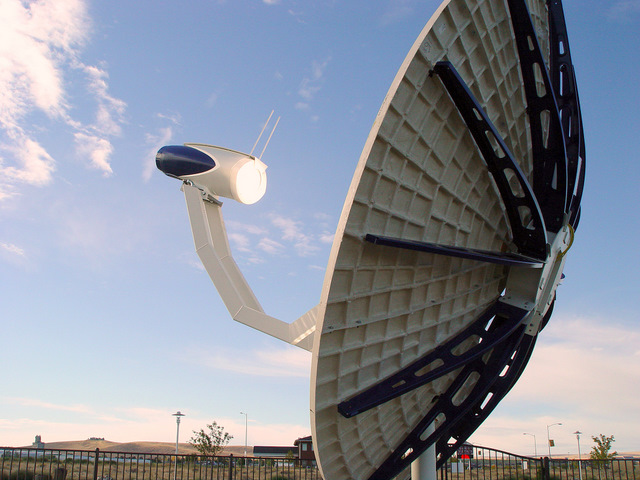
The Stirling dish has a storied — if unfulfilled – history in the annals of solar energy. It marries a Stirling heat engine, 17th-century invention, with a mirrored dish that looks like a super-sized version of a home satellite receiver. The solar dish focuses the sun’s rays on the Stirling engine, heating a gas inside that drives pistons to generate electricity. Stirling dishes are much more efficient at converting sunlight into electricity than solar thermal technologies that use mirrors to heat liquid-filled tubes to create steam to drive electricity-generating turbines. But while solar thermal plants exist today, the Stirling solar dish has never been deployed on a large scale since work on the technology began in earnest following the oil shocks of the 1970s.

Stirling Energy Systems of Phoenix in 2005 signed contracts with utilities Southern California Edison (EIX) and San Diego Gas & Electric (SRE) to build up to build tens of thousands of Stirling dishes to produce up to 1.75 gigawatts of greenhouse gas-free electricity. Though the company operates a six dishes in a prototype power plant at Sandia National Laboratories New Mexico, it is still working to get production costs down and rivals have questioned whether Stirling Energy Systems will be able to fulfill its deals. (See Green Wombat’s 2007 Business 2.0 magazine article on Stirling Energy Systems here. )

infinia-stirling-engine.jpgBut Infinia CEO J.D. Sitton tells Green Wombat that his company has perfected the Stirling dish to make it competitive with large-scale solar thermal as well as new photovoltaic technologies like thin-film solar. Infinia aims to deploy its Stirling dishes in smaller configurations so that solar power plants can be located near cities and at other sites that don’t require vast stretches of desert land where solar thermal plants are typically built. Each 21-foot-high, 15-foot-wide solar dish can generate 3-kilowatts (compared to 25 kilowatts for Stirling Energy Systems’ dish).

Infinia won’t itself become a solar developer but will provide its dishes to for power plants that range in size from 1 megawatt to 150 megawatts or more. In contrast, most solar thermal power plants now being planned are in the 400-500 megawatt range.

“We fly in the face of what has been the conventional wisdom in the solar thermal field that to be competitive you have to have a very large system,” says Sitton. “We can be deployed within city limits and be connected to existing transmission systems. No additional transmission capacity is required.”

“Our approach is that the winning solutions will be those that generate for most kilowatts for the least cost,” he adds. “This is a game about capital efficiency.”

That, of course, has been the mantra of leading green tech investor Vinod Khosla, who has disparaged photovolatic solar systems as too expensive to displace fossil-fuel generated power. Khosla also is backing Palo Alto solar thermal startup Ausra, which last year signed a deal to supply solar electricity to California’s largest utility, PG&E (PCG). Serial entrepreneur Bill Gross’ Idealab is funding solar thermal startup eSolar, which also is being backed by Google (GOOG).

Infinia contends the design of its Stirling dish system makes it competitive with solar thermal technologies. First, the Stirling engine uses helium rather than hydrogen, which typically must be periodically replenished. “We have no lubrication inside the machine and it needs no maintenance,” Sitton says. “We use helium in a hermetically sealed system.”

Second, he says the Infinia dish is made of six panels of glass rather than the 76 panels on the Stirling Energy Systems dish. “That gives us lower production costs and lower capital costs,” says Sitton. “We brought in large-scale manufacturer from the beginning. It’s not like we built a prototype and now have to reduce the cost to produce it.”

The first prototype went online last October and Sitton says Infinia is building a second at Sandia. Field tests will be conducted later this year in California and Nevada. He says Infinia is currently negotiating with solar developers and full-scale production is set to begin in November. Infinia has been in business since the 1980s, building Stirling engines for other applications. But the green tech boom and demands from utilities for renewable energy led the company to focus on solar.

Whether Infinia beats Stirling Energy Systems to market remains to be seen but look for the deals it signs with solar developers for a good indication of just how viable its technology is likely to be.

Read Full Post »

« Newer Posts - Older Posts »

Design a site like this with WordPress.com
Get started