Feeds:
Posts
Comments

Archive for the ‘solar power plants’ Category

photo: eSolar

After months of failed attempts in Congress to extend crucial renewable energy tax credits, the end-game came with lightning speed Friday afternoon: The House of Representatives passed the green incentives attached to the financial bailout package approved by the Senate Wednesday night and President Bush promptly signed the legislation into law.

There were goodies for wind, geothermal and alternative fuels, but the big winner by far was the solar industry.

“It feels like we should be popping the champagne,” said a Silicon Valley solar exec Green Wombat met for lunch minutes after Bush put pen to paper.

That it took the biggest financial crisis since the Great Depression to save billions of dollars of renewable projects in the pipeline for the sake of political expediency does not bode well for a national alternative energy policy. But the bottom line is that the legislation passed Friday sets the stage for a potential solar boom.

  • The 30% solar investment tax credit has been extended to 2016, giving solar startups, utilities and financiers the certainty they need for the years’ long slog it takes to get large-scale power plants and other projects online. The extension is particularly important to those Big Solar projects that need to arrange project financing in the next year or so.
  • The $2,000 tax credit limit for residential solar systems has been lifted, meaning that homeowners can get a 30% tax credit on the solar panels they install after Dec. 31. That will save a bundle – especially for those who live in states with generous state rebates – and goose demand for solar panel makers and installers like SunPower (SPWRA) and First Solar (FSLR). (If you buy a $24,000 3-kilowatt solar array in California – big enough to power the average home –  you can claim a $7,200 federal tax credit. Add in the state solar rebate and the cost of the system is cut in half.)
  • Utilities like PG&E (PCG), Southern California Edison (EIX) and FPL (FPL) can now themselves claim the 30% investment tax credit for large-scale solar power projects. That should encourage those well-capitalized utilities to build their own solar power plants rather than just sign power purchase agreements with startups like Ausra and BrightSource Energy.

“The brakes are off,” says Danny Kennedy, co-founder of Sungevity, a Berkeley, Calif., solar installer that uses imaging technology to remotely size and design solar arrays. “In just six months since our launch we’ve sold about a hundred systems. With an uncapped tax credit for homeowners going solar, we expect business to boom.”

While elated sound bites from solar executives have been flooding the inbox all afternoon – along with invites to celebratory after-work drinks – solar stocks took a drubbing (along with the rest of the still-spooked market) after initially soaring on the news.

SunPower ended the trading day down 5% while First Solar shares dropped 8%. The bright spot was China’s Suntech (STP), which on Thursday announced a joint venture with financier MMA Renewable Ventures to build solar power plants as well as the acquisition of California-based solar panel installer EI Solutions.

Congress didn’t treat the wind industry so generously. The production tax credit for generating renewable energy was extended by just one year, guaranteeing the industry’s will continue to live year by year (at least through 2009). But given that 30% of all new power generation built in the United States in 2007 was wind, and that the amount of wind power installed by the end of 2008 is expected to rise 60% over the record set last year, the wind biz should do just fine.

But Congress did give a break to those who buy small-scale wind turbines. Systems under 100 kilowatts qualify for a 30% tax credit up to $4,000. Homeowners get a $1,000 tax credit for each kilowatt of wind they install, though the credit is capped at $4,000.

“This is a huge breakthrough for small wind,” says Scott Weinbrandt, president of Helix Wind, a San Diego-based manufacturer of 2-and-4-kilowatt turbines.


Read Full Post »

In another sign that the financial crisis is not slowing the solar industry, Suntech, the giant Chinese solar module maker, made a big move into the United States market on Thursday. The company announced a joint venure with green energy financier MMA Renewable Ventures to build solar power plants and said it would acquire California-based solar installer EI Solutions.

Founded in 2001, Suntech (STP) recently overtook its Japanese and German rivals to become the world’s largest solar cell producer. The company has focused on the lucrative European market and only opened a U.S. outpost, in San Francisco, last year.  The joint venture with MMA Renewable Ventures (MMA) – called Gemini Solar – will build photovoltaic power plants bigger than 10 megawatts.

Most solar panels are produced for commercial and residential rooftops, but in recent months utilities have been signing deals for massive megawatt photovoltaic power plants. Silicon Valley’s SunPower (SPWRA) is building a 250-megawatt PV power station for PG&E (PCG) while Bay Area startup OptiSolar inked a contract with the San Francisco-based utility for a 550-megawatt thin-film solar power plant. First Solar (FSLR), a Tempe, Ariz.-based thin-film company, has contracts with Southern California Edision (EIX) and Sempre to build smaller-scale solar power plants.

Suntech’s purchase of EI Solutions gives it entree into the growing market for commercial rooftop solar systems. EI has installed large solar arrays for Google, Disney, Sony and other corporations.

“Suntech views the long-term prospects for the U.S. solar market as excellent and growing,” said Suntech CEO  Zhengrong Shi in a statement.

Other overseas investors seem to share that sentiment, credit crunch or not.  On Wednesday, Canadian, Australian and British investors lead a $60.6 million round of funding for Silicon Valley solar power plant builder Ausra. “So far the equity market for renewable energy has not been affected by the financial crisis,” Ausra CEO Bob Fishman told Green Wombat.

The solar industry got more good news Wednesday night when the U.S. Senate passed a bailout bill that included extensions of crucial renewable energy investment and production tax credits that were set to expire at the end of the year.

Read Full Post »

photo: eSolar

If Wall Street’s implosion can feel remote on the West Coast, where green tech startups largely rely on Silicon Valley venture capital, there may be no escaping the fallout from the credit crunch.

Still, even those renewable energy companies tapping East Coast cash have powered ahead amid the chaos on the Street. Take SolarReserve, a Santa Monica, Calif.-based solar power plant developer. A day after Lehman Brothers filed for bankruptcy last week, the stealth startup announced a $140 million round of funding from investors that included Citigroup (C) and Credit Suisse (CS).

Lehman does hold small stakes in wind turbine maker Clipper Windpower of Carpinteria, Calif., and Ormat Technologies, a Reno, Nev., geothermal developer. “Lehman’s exit from wind is not good news, but it’s not the end of the world,” says Ethan Zindler, head of North American research for New Energy Finance, a London-based research firm. And while Lehman holds stock lent to it from solar cell companies like SunPower (SPWR) and Evergreen Solar – potentially diluting their earnings per share if the stock is not returned – Lehman is not a big player in solar.

That’s not the case with Goldman Sachs (GS) and Morgan Stanley (MS). Both are major solar and wind investors and both were forced this week to reorganize themselves into bank holding companies to stave off shotgun marriages with other institutions. Spokespeople for Goldman and Morgan Stanley told Green Wombat that the firms’ transformation into more conventional commercial banks – at least a two-year process- will not change their green investing strategies.

But if there appears to be little immediate collateral damage from the financial crisis for green tech startups, there are longer-term consequences. Solar power plants, wind farms and other large-scale renewable energy projects require billions of dollars in bank financing.

“Credit is just going to get more expensive,” says Zindler. “We’ve already seen some pull-back for some big solar and wind deals. Bigger developers who have solid balance sheets will be OK but the smaller guys could be in trouble.”

Says Bill Gross, chairman of solar power plant developer eSolar: “I think if you’re going to get project financing, you’re just going to have to show higher returns to get people to take the money out of the mattress.”

But Gross, the founder of Pasadena, Calif.-based startup incubator Idealab, argues that given soaring electricity demand and fossil fuel prices, large-scale renewable energy projects will be an attractive investment, paricularly since utilities typically sign 20-year contracts for the power they produce. eSolar, which is backed by Google and other investors, has a long-term contract to supply Southern California Edison with 245 megawatts of green electricity. Gross says eSolar has a pipeline of other projects and interest in the company remains high, particularly overseas.

“If you can make projects that can compete with fossil fuels on a parity basis, those projects are going to be financed,” he says, “because they’re safe returns for 20 years and I think money is going to flow to them.”

Rob Lamkin, CEO of solar power plant startup Cool Earth, echoed that sentiment. “The credit crisis does give me pause,” says Lamkin, whose Livermore, Calif.-company has raised $21 million in venture funding and is developing “solar balloons” that use air pressure to concentrate sunlight on solar cells. “But the energy problem is so big that I don’t see problems raising project financing.”

The key for developers of utility-scale projects – particularly solar power plants – will be keeping their costs under control; not an easy thing when deploying new technologies amid a commodities boom.

Dita Bronicki, CEO of geothermal power plant developer Ormat Technologies (ORA), does not anticipate trouble obtaining project financing. “I think the cost of money is going to go up, but a company like Ormat with an operating fleet and operating cash flow will not be as affected,” Bronicki says. “Small companies will find that lenders will be more picky in what they will invest.”

Green entrepreneurs tend to be an optimistic bunch, so it’s not surprising they still think the future looks bright. But they had reason to be sunny this week – amid Wall Street’s meltdown, the U.S. Senate on Tuesday passed, at long last,  extensions of crucial renewable energy investment tax credits and other goodies to goose green tech, such as a tax credit worth up to $7,500 for buyers of plug-in electric cars. The Senate action now must be reconciled with similar legislation in the House of Representatives.

Solar projects, for instance, would qualify for a 30% investment tax credit through 2016.

“That is one thing that will help project finance,” says Gross. “So many people are sitting on the sidelines right now and if the investment tax credit passes that will help get these projects financed.”

Read Full Post »

After a year of stalemate that threatened to strangle the nascent United States solar industry, the U.S. Senate on Tuesday passed energy legislation that extends a key investment tax credit until 2016.

The 30% solar tax credit was part of a package of green energy incentives that includes a one-year extension of the production tax credit crucial to the wind industry and a $2,500-$7,500 tax credit for people who buy plug-in electric vehicles. (That should make General Motors (GM) happy as it prepares to roll out its ever-increasingly expensive Volt plug-in electric hybrid.)

Homeowners also won an extension of a tax credit for installing solar panels and the $2,000 cap on such systems was lifted. Put in a small wind turbine or a geothermal heat pump and you can claim up to a $4,000 and $2,000 tax credit, respectively.

The big winner was the solar industry. Congress’ failure to extend the investment tax credit threatened to scuttle scores of multibillion-dollar solar power plants in the pipeline and undermine mandates that utilities like PG&E (PCG) and Southern California Edison (EIX) obtain a growing percentage of their electricity from renewable sources.

The legislation now returns to the House of Representatives, which earlier passed a similar version of the Senate bill.

Read Full Post »

photo: Todd Woody

Green Wombat’s story in the new issue of Fortune magazine on the solar power plant-fueled boom in demand for wildlife biologists is now online here. The photo above of the blunt-nosed leopard lizard was taken at a state reserve in San Luis Obispo County.

Or you can read the story below.

The hottest tech job in America

Giant solar plants are being built where dozens of protected species live. That’s good news for wildlife biologists.

By Todd Woody, senior editor

(Fortune Magazine) — It looks like a scene from an old episode of The X-Files: As a red-tailed hawk circles overhead and a wild pronghorn sheep grazes in the distance, a dozen people in dark sunglasses move methodically through a vast field of golden barley, eyes fixed to the ground, GPS devices in hand. They’re searching for bodies.

In this case, however, the bodies belong to the endangered blunt-nosed leopard lizard, and the crew moving through the knee-high grain are wildlife biologists hired by Ausra, a Silicon Valley startup that’s building a solar power plant for utility PG&E on this square mile of central California ranchland.

With scores of solar power stations planned for sites in the Southwest, demand for wildlife biologists is hot. They’re needed to look for lizards and other threatened fauna and flora, to draw up habitat-protection plans, and to comply with endangered-species laws to ensure that a desert tortoise or a kit fox won’t be inadvertently squashed by a solar array.

That has engineering giants like URS (URS, Fortune 500) in San Francisco and CH2MHill of Englewood, Colo., scrambling to hire biologists to serve their burgeoning roster of solar clients. “It’s a good time to be a biologist – it’s never been busier in my 15 years in the business,” says Angela Leiba, a senior project manager for URS, which is staffing the $550 million Ausra project. URS has brought onboard 40 biologists since 2007 to keep up with the solar boom. Salaries in the industry, which typically start around $30,000 and run up to about $120,000, have spiked 15% to 20% over the past year.

The work is labor-intensive. “It can take a 30- to 50-person team several weeks to complete just one wildlife survey,” says CH2MHill VP David Stein.

The economics of Big Solar ensure that wildlife biology will be a growth field for years to come. For one thing, there’s the mind-boggling scale of solar power plants. Adjacent to the Ausra project in San Luis Obispo County, for instance, OptiSolar of Hayward, Calif., is building a solar farm for PG&E that will cover 9 1/2 square miles with solar panels. Nearby, SunPower of San Jose will do the same on 3.4 square miles. Every acre must be scoured for signs of “species of special concern” during each phase of each project.

That adds up to a lot of bodies on the ground. URS, for instance, has dispatched 75 biologists to Southern California where Stirling Energy Systems of Phoenix is planting 12,000 solar dishes in the desert. “The biologists are critical to move these projects forward,” notes Stirling COO Bruce Osborn. For one project Stirling had to pay for two years’ worth of wildlife surveys before satisfying regulators.

Just about every solar site is classified as potential habitat for a host of protected species whose homes could be destroyed by a gargantuan power station. (Developers of California solar power plants, for example, have been ordered to capture and move desert tortoises out of harm’s way.) The only way to determine if a site is crawling with critters is to conduct surveys.

While that means a lot of jobs for wildlife biologists, it’s not all red-tailed hawks and pronghorn sheep for these nature boys and girls. The work can get a bit Groundhog Dayish, say, after spending 1,400 hours plodding through the same barley field in 90-degree heat in search of the same blunt-nosed leopard lizard. No wonder then when URS crew boss Theresa Miller asks for volunteers to reconnoiter a decrepit farmhouse for some protected bats on the Ausra site, hands shoot up like schoolchildren offered the chance to take the attendance to the principal’s office.

PG&E (PCG, Fortune 500) renewable-energy executive Hal La Flash worries that universities aren’t cranking out enough workers of all stripes for the green economy. “It could really slow down some of these big solar projects,” he says. Osborn can vouch for that: Biological work on the Stirling project has ground to a halt at times while the company waits for its consultants to finish up surveys on competitors’ sites.

For the young graduate, veteran biologist Thomas Egan wants to say just three words to you: Mohave ground squirrel. The rare desert dweller is so elusive that the only way to detect it on a solar site is to set traps and bag it. “There’s a limited number of people authorized to do trapping for Mohave ground squirrels,” says Egan, a senior ecologist with AMEC Earth & Environmental. “If you can work with the Mohave ground squirrel, demand is intense.”

Read Full Post »

The looming expiration of a crucial renewable energy investment tax credit doesn’t seem to have spooked investors. Silicon Valley thin-film solar startup Nanosolar said Wednesday that it has secured another $300 million in funding and is jumping into the Big Solar game as well.

Writing on the Nanosolar blog,  CEO Martin Roscheisen said that the latest financing round – the company’s funding now totals half a billion dollars –  comes from oldline utility AES (AES), French utility giant EDF and the Carlyle Group, among other investors. Nanosolar, which prints solar cells on flexible materials, will supply solar panels to the newly formed AES Solar, which will build medium-scale – up to 50 megawatts – photovoltaic power plants.

The Nanosolar news is just the latest of a spate of deals to take solar panels off rooftops and plant them on the ground to generate massive megawattage. Two weeks ago, thin-film solar startup Optisolar won a contract from utility PG&E (PCG) for a 550-megawatt PV solar power plant while SunPower (SPWR) will build a 250-megawatt photovoltaic solar farm for the utility. Leading  thin-film company First Solar (FSLR), meanwhile, has inked deals over the past few months to build smaller-scale PV power plants for Southern California Edison (EIX) and Sempre (SRE). And thin-film solar company Energy Conversion Devices is assembling a 12-megawatt array for a General Motors plant in Spain.

Read Full Post »

photos: Energy Conversion Devices

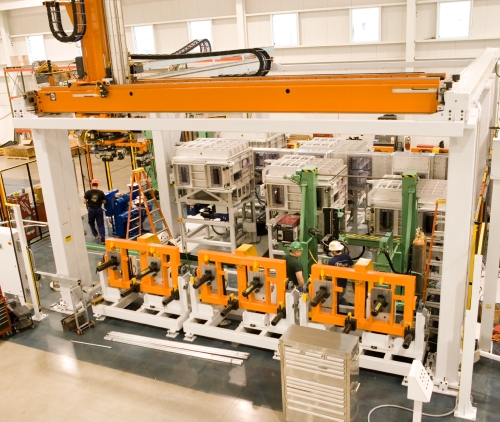
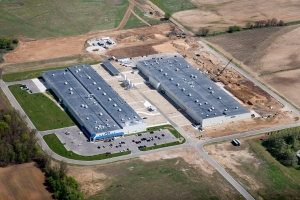
As Detroit automakers shutter SUV and truck factories, the decades-long de-industrialization of the Midwest continues apace. But amid the idled assembly lines, a new wave of manufacturing has taken root as solar energy companies set up shop in the heartland.

Just in the past week, First Solar (FSLR) announced an expansion of its Ohio plant that makes thin-film solar panels. German company Flabeg will break ground on a factory outside Pittsburgh that will manufacture parabolic solar mirrors for large-scale solar power plants planned for the Southwest. Thin-film solar company Energy Conversion Devices (ENER), meanwhile, operates three factories in Michigan and is currently doubling the production capacity of one of its plants.

In fact, nearly all the United States’ current solar manufacturing capacity is in the Midwest, save for Silicon Valley company Ausra’s factory in Las Vegas. (Thin-film startup Nanosolar is building a factory in San Jose, Calif.)

“Our processes really require high productivity, so what makes it competitive here in the Midwest is that we have a great labor force that is eager to work and well-trained already,” ECD chief executive Mark Morelli told Green Wombat on Monday.
For instance, when appliance maker Electrolux shut down its Greenville, Mich., factory it left 2,700 workers unemployed in the same town where ECD is expanding its thin-film factory (see photos). The company also has recruited top executives from the ever-shrinking auto industry.

“We do a test of the available labor pool and hire the cream of the crop,” Morelli says.

Just as important are a plethora of state tax breaks and grants to retrain industrial workers for the green tech economy.

Although 70 percent of ECD’s flexible solar laminate panels are sold to European customers, Morelli anticipates the U.S. market will take off, with domestic manufacturers garnering a competitive advantage.

That all depends on whether Congress extends a crucial investment tax credit that expires this year and the policies of the next administration in Washington. Even so, demand for solar cells is expected to spike, especially given the recent unveiling of Big Solar projects by California utilities. Southern California Edison (EIX), for instance, is installing 250-megawatts’ worth of solar panels on commercial rooftops while PG&E (PCG) this month announced contracts to buy 800 megawatts of electricity from two photovoltaic power plants, including 500-megawatt thin-film solar farm being built by OptiSolar.

“As utilities begin to embrace distributed power generation, these type of things play into our natural advantage,” says Morelli, referring to his company’s lightweight solar panels that are especially suited for large rooftop arrays.

Of course, a handful of solar factories are not going to revive the Midwest’s industrial fortunes. (First Solar, for instance, operates factories in Germany and Malaysia, and Morelli doesn’t rule out locating manufacturing overseas.) But imagine a national policy that promotes the wide adoption of solar and the expansion of manufacturing in the rustbelt states becomes increasingly attractive. Shipping solar panels and mirror arrays from halfway around the world starts to make much less environmental and financial sense.

ECD’s proximity to the auto industry has already paid off. After installing solar arrays on two of General Motors (GM)’s California facilities, it won a contract in July to build a 12-megawatt rooftop array – the world’s largest by orders of magnitude – at a GM assembly plant in Spain.

Read Full Post »

photo: David Lena

In a move that could alter the economics of the global solar industry, California utility PG&E on Thursday announced that it will buy 800 megawatts of electricity produced from two massive photovoltaic power plants to be built in San Luis Obsipo County on the state’s central coast. The 550-megawatt thin-film plant from Bay Area startup OptiSolar and a 250-megawatt PV plant from Silicon Valley’s SunPower dwarf by orders of magnitude the five-to-15 megawatt photovoltaic power stations currently in operation around the world.

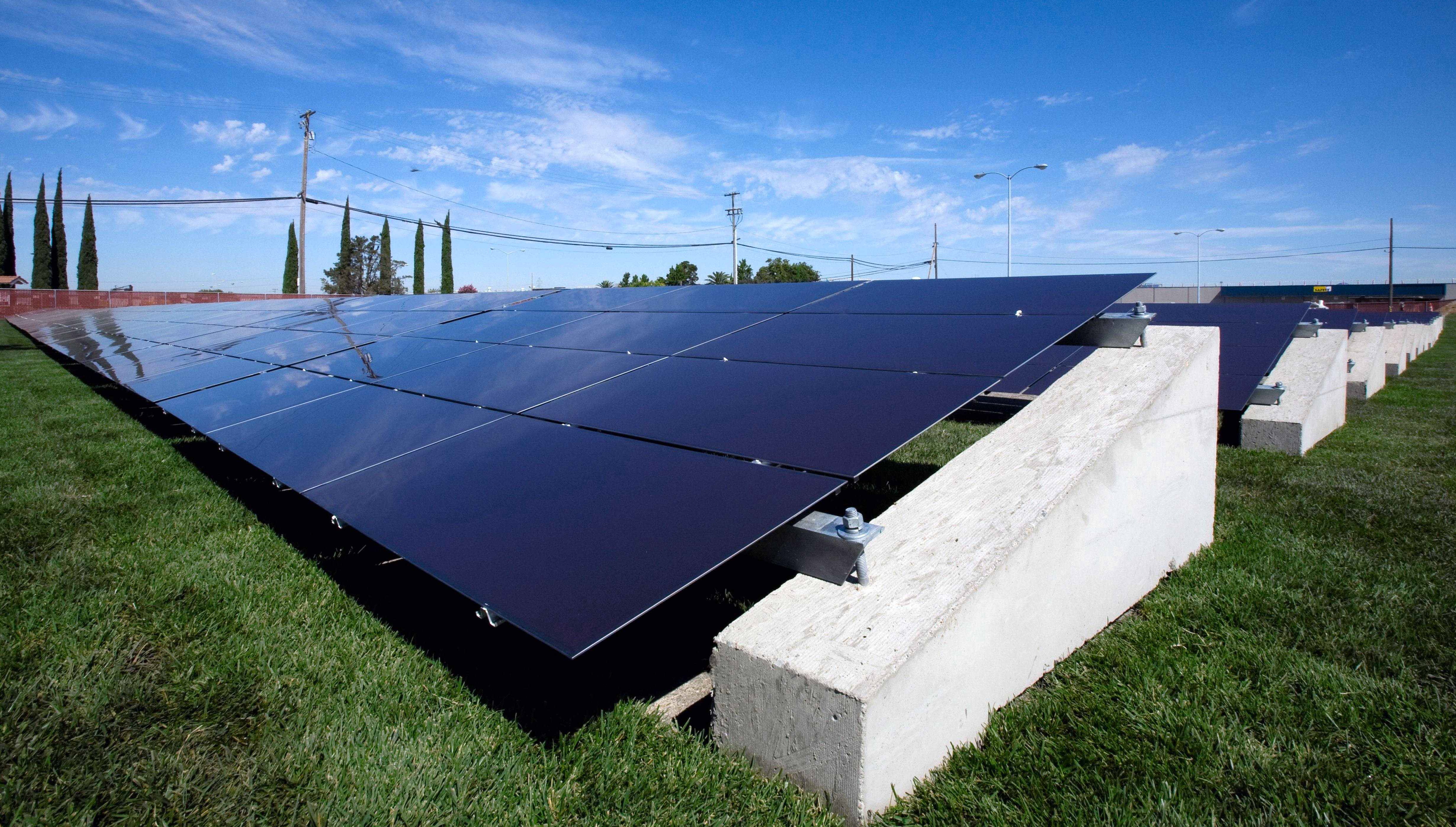
Most of the industrial-scale solar plants designed to replace fossil-fuel power use solar thermal technology, meaning they deploy mirrors to heat liquids to produce steam that drives electricity-generating turbines. Photovoltaic power plants essentially take the solar panels found on suburban rooftops and put them on the ground in gigantic arrays. How gigantic? OptiSolar’s Topaz Solar Farm will cover 9 1/2 square miles of ranch land with thin-film panels like the ones in the photo above. Combined, the two solar plants would produce enough electricity to power 239,000 California households, according to PG&E (PCG).

“Obviously this is huge and a bold move,” says Reese Tisdale, a senior analyst who studies the economics of solar power for Emerging Energy Research in Cambridge, Mass. “It’s a pretty big jump in manufacturing capacity and a big opportunity for the PV industry, particularly for thin-film.”

If the power plants are ultimately built – and that’s a big if, given the challenges to get such facilities online – and other utilities follow PG&E’s lead, demand for solar modules could skyrocket. (Thin-film cells like those made by OptiSolar are deposited or printed in layers on glass or flexible metals. They are less efficient at converting sunlight into electricity than standard solar modules but they use far less expensive polysilicon and can be produced much more cheaply.)

First Solar (FSLR), a leading thin-film maker, has an annual manufacturing capacity of around 275 megawatts – which will rise to a gigawatt by the end of 2009. (First Solar is building two small-scale solar power plants for Southern California Edison (EIX) and Sempra (SRE).) SunPower (SPWR) is expected to produce 250 megawatts worth of solar modules this year; its California Valley Solar Ranch project for PG&E alone will be consume 250 megawatts.

“If we were trying to do it this year, it would be all of our production,” says Julie Blunden, SunPower’s vice president for public policy. “SunPower is ramping very quickly. By 2010 our production will be at least 650 megawatts.” SunPower’s solar power plant is set to begin producing electricity in 2010.

The PG&E deal puts OptiSolar in the spotlight. Founded by veterans of the Canadian oil sands industry, the stealth Hayward, Calif., startup has kept its operations under cover, avoiding the media as it quietly set up a manufacturing plant in the East Bay and prepared to break ground on a million-square-foot factory in Sacramento.

OptiSolar CEO Randy Goldstein told Green Wombat that the company will have no problem producing enough solar cells to build Topaz, which is scheduled to go online in 2011, as well as fulfill contracts for some 20 small-scale power plants in Canada.

“Our plan has always been to produce solar energy on a very large scale to make it cost-competitive, even in a market like California,” Goldstein says.

The terms of utility power purchase agreements like the ones OptiSolar and SunPower have signed with PG&E are closely held secrets, but it has long been an open secret that building massive photovoltaic power plants was not economically viable. Last year when I attended the opening of an 11-megawatt PV power station in Portugal – which offers generous solar subsidies – that was built by SunPower’s PowerLight subsidiary, PowerLight’s CEO told me that pursuing such projects in the U.S. was not an attractive proposition due to market incentives and public policy.

So what has changed too make constructing gargantuan PV power plants profitable?

“Lots of things have changed,” says SunPower’s Blunden. “Power prices are going up and public policy is requiring utilities to have a portfolio of renewables.”  And after building some 40 megawatts of power plants in Spain, SunPower has been able to improve its manufacturing processes and cut costs, according to Blunden.  “We could see where the cost reductions were coming down and the benefits of scale,” she says. “We saw there was a way for us to be competitive with other renewables.”

Goldstein says OptiSolar’s business model of owning the supply chain – from building its own machines to make solar cells to constructing, owning and operating power plants – will allow it to reduce costs. “By taking control of the value chain from start to finish, by being vertically integrated and cutting out the middleman,” he says, “we can be competitive not only with other renewable energy but with conventional energy.”

Photovoltaic power plants do have certain advantages over their solar thermal cousins. They don’t need to be built in the desert, thus avoiding the land rush now underway in the Mojave. PV is a solid-state technology and with no moving parts – other than the sun tracking devices used in some plants – they make little noise and are relatively unobtrusive. Most importantly in drought-stricken California, they consume minimal water. And the modular nature of solar panels means that a power plant can start producing electricity in stages rather after the entire facility has been constructed.

“The economies of scale does make PV cost competitive with other renewable energy generating technologies, and wouldn’t be possible without advances that SunPower and OptiSolar have been working on,” says PG&E spokeswoman Jennifer Zerwer. “We take a stringent look at all technologies and we’re not wedded to a particular one.”

With the PV plants, PG&E now has contracts to obtain 24 percent of its electricity from renewable sources.

But contracts are no guarantee the even a watt will be generated. The Topaz and California Valley projects must overcome a number of obstacles, not the least of which is the U.S. Congress’ failure so far to extend a crucial 30 percent investment tax credit for solar projects that expires at the end of the year. SunPower’s Blunden acknowledges the PG&E project is contingent on the tax credit being renewed.

PG&E executive Fong Wan said as much at a press conference Thursday afternoon: “That is a major hurdle. If the investment tax credit is not extended, I expect many of our projects will be delayed.”

Then there’s the question of how welcoming rural San Luis Obispo County residents will be to two massive solar power plants in the neighborhood. Along with a 177-megawatt solar thermal power plant being built by Silicon Valley startup Ausra for PG&E adjacent to the Topaz project, the county has become a solar hot spot. Ausra has run into some community opposition and state officials are growing concerned about the impact of the power plants on protected wildlife.

“The challenge is going to be the magnitude of these projects,” says Tisdale, the energy analyst. “Other projects are already facing opposition from the environmentalists.”

But for solar power companies like OptiSolar the impetus is to get big and get big fast. “I think it’s going to demonstrate that photovoltaics have the ability to be part of the energy mix,” says Goldstein of Topaz. “We can scale up and have a big impact. There’s not going to be a lot of room for niche players in the long run.”

Read Full Post »

photo: Southern California Edison

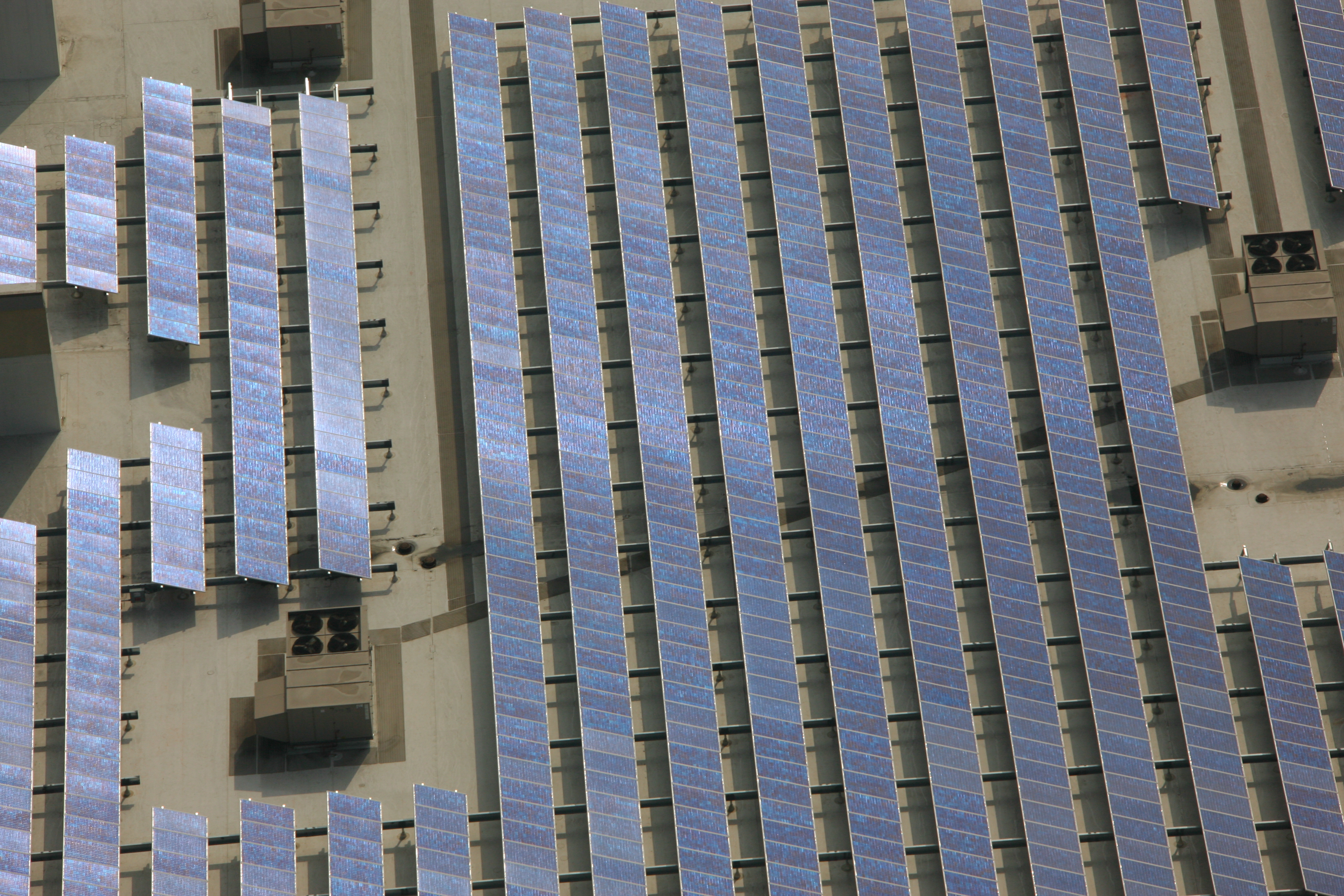
When Southern California Edison unveiled plans to install 250 megawatts’ worth of solar panels on warehouse roofs back in March, it was hailed as a ground-breaking move. In one fell swoop, the giant utility would cut the cost of photovoltaic power, expand the solar market and kick-start efforts to transform untold acres of sun-baked commercial roof space into mini-power plants.

There’s just one problem: the solar industry is fighting the billion-dollar plan. In briefs filed with the California Public Utilities Commission, solar companies, industry trade groups and consumer advocates argue that allowing a utility to own and operate such massive green megawattage will crowd out competitors who can’t hope to compete with a project financed by Edison’s ratepayers.  (In California, shareholders of investor-owned utilities are guaranteed a rate of return for approved projects, while utility customers bear a portion of the costs in the form of higher rates.)

The five-year plan “would establish SCE as the monopoly developer of commercial-scale distributed solar in its service territory,” wrote Arno Harris, CEO of Recurrent Energy, a San Francisco company that sells solar electricity to commercial customers. “This would irreparably impair the development of a competitive solar industry.”

Southern California Edison (EIX) is the first utility in the United States to propose such a “distributed generation” scheme and the dispute is being watched closely as a test case for the viability of producing renewable electicity from hundreds of millions of square feet of commercial rooftops. Such systems can be plugged directly into existing transmission lines and tend to generate the most solar power when electricity demand spikes – typically on summer afternoons when people crank their air conditioners. Having such green energy on tap would save utilities from having to build expensive and planet-warming fossil fuel-powered “peaker plants” that sit idle except when demand suddenly rises.

Even critics hail Edison’s move as “bold” and “visionary” and no one disputes that in California the development of big rooftop solar has lagged. For instance, the state’s $3.3 billion “million solar roofs” initiative is designed to put smaller-scale solar panels on homes and businesses and provides generous rebates for systems under 1 megawatt. At the other end of the scale, the state’s big utilities have been signing contracts to buy electricity from solar thermal power plants to be built in the desert. Left out of the subsidy game are incentives for the 1-to-2 megawatt arrays well-suited for commercial buildings.

Southern California Edison says it’s filling that gap and will energize the solar industry, not crush it. The utility plans to lease 65 million square feet of commercial rooftop space in the “Inland Empire” region of Southern California for solar arrays that would generate enough electricity to power 162,000 homes.

“SCE’s financial stability and business reputation will increase the probability that 250 MW of solar PV systems will be available to meet the state’s solar rooftop goals over the next five years,” the utility’s attorneys wrote in a brief filed with the utilities commission, which must approve the program. “In so doing, a solar PV program can improve efficiencies … to reduce costs and jump start the competitiveness of solar PV for widespread application on California roofs.”

There’s no doubt the program will be a boon for solar module makers. For instance, thin-film solar cell company First Solar (FSLR) is supplying 33,000 panels for the program’s first project, a 600,000-square-foot roof array in the inland city of Fontana. However, Southern California Edison intends to contract for union labor to install the solar systems and tap its own capital and a rate hike to finance the project. That won’t leave many opportunities for solar installers and financiers like SunPower (SPWR), SunEdison and MMA Renewable Ventures (MMA).

“Even though this program is kind of taking bread out of our own mouth, the demand for solar will keep going up,” says Mark McLanahan, senior vice president of corporate development at MMA Renewable Ventures, a San Francisco firm that finances commercial solar arrays.

“What they have announced is extremely visionary,” McLanahan tells Green Wombat. “It’s game changing and opens up whole new realms of what solar can do. That’s exciting.”  On the other hand, he says, “It’s certainly possible that a young, growing industry that is pretty fragmented could be hurt by this rather than helped.”

A solution advanced by some solar industry critics is for Southern California Edison to open up the entire program to competitive bidding, not just the procurement of solar panels. The utility vehemently opposes the idea, arguing it would work against the economies of scale it says it can bring to the program.

Whether regulators will approve Southern California Edison’s request for a rate hike to pay for the initiative – and at electricity rates that are significantly higher than those set for other solar programs – remains to be seen. The commission’s own ratepayer advocate has questioned whether utility customers will get their money’s worth.

The utilities commission is unlikely to issue a final decision until next year. In the meantime, you can bet the state’s other big utilities – PG&E (PCG) and San Diego Gas & Electric (SRE) – and solar companies will be watching to see whether the sky’s the limit for big rooftop solar or whether a ceiling is about to be placed on the industry’s ambitions.

Read Full Post »

In late 2006, there was something of an exodus from Australia as solar startups decamped for California, frustrated by the long-entrenched conservative government’s tepid support for renewable energy. On one Sydney-to-San Francisco flight alone could be found David Mills, co-founder of solar power plant company Ausra, and Danny Kennedy, chief of solar installer startup Sungevity.

Flash forward 18 months and solar energy companies are beating a path back to Australia. Ausra recently opened up operations Down Under, and last week Silicon Valley solar company SunPower (SPWR) acquired an Australian solar installer called Solar Sales. So is Oz the next hot solar market? By all accounts, the sun-baked environmentally conscious country should be. But the move into the South Pacific is another example of how governments’ ever-morphing renewable energy policies are spurring solar companies to move operations around the globe.

“Obviously there’s a lot of sun in Australia but with the recent change in government there’s a policy environment that could be much more favorable for us,” Peter Aschenbrenner, SunPower’s vice president of corporate strategy, told Green Wombat. “We decided to get in now. It was a little opportunistic as the owners of  Solar Sales were looking to monetize their investment. It follows a model of a previous acquisition in Italy where we got in before the market headed north.”

Last November, a left-leaning Labor government took power in Australia, immediately signed the Kyoto Accord and expanded a national subsidy for rooftop solar panels. Meanwhile, individual Australian states, much like their American counterparts, have enacted their own incentives. Three states – Queensland, South Australia and Victoria – have adopted “feed-in-tariffs” that pay homeowners a premium for electricty produced from solar panels – up to four times the prevailing power rates. Solar homeowners that return  more electricity to the grid than they consume can zero out their power bill or even earn cash from their utility.

But the government of Prime Minister Kevin Rudd has shown the same propensity to alter the rules of the game mid-stream as its predecessor, which wreaked havoc on the wind industry several years ago when it abruptly curtailed a renewable energy target. The Rudd government already has changed course on a national solar subsidy – which provides rebates up to $A8,000 for photovoltaic systems – to make it available only to households earning less than $A100,000 – which qualifies as middle middle-class in Australia’s big cities. Some of the states in turn have limited their subsidies. Victoria – Australia’s second-most populous state – will pay premium solar rates to only 100,000 households.

Given that solar is a game that moves as you play and the relatively small size of the Australian market (population: 20 million) Kennedy for one is cautious about doing business in his homeland.

“I think that it’s potentially a good market in the future,” says Kennedy, a former longtime Greenpeace activist who’s close to Australia’s environment minister and other government officials. “But it’s not living up to its potential because there’s a set of mixed signals from the federal and state governments and no certainty from one year to the next.”

Just how quickly the market can change has been illustrated by Spain, a solar hotspot that has attracted SunPower and other solar power plant builders as well as financiers like GE Energy Financial Services (GE)  with its lucrative premium rates for green electricity. But now the Spanish government is considering cutting its feed-in-tariff and limiting it to an annual 300 megawatts of installed solar, 100 megawatts of which must be rooftop photovoltaic systems. By contrast, some 1,100 megawatts of solar were expected to be installed this year. That would dramatically change the economics for solar energy companies that have moved into the Spanish market.

“This is something we’ve been preparing for,” says Aschenbrenner of SunPower, which has focused on building photovoltaic power plants in Spain. “With our global footprint, we are well placed to move allocation around as these markets wax and wane. In Spain, we’ve been working on building a dealer network to focus on the residential and small commercial markets.”

In Australia, SunPower will need to ramp up its new acquisition since Solar Sales operates on the country’s isolated West Coast while most of the country’s population is concentrated on the eastern seaboard. About half of Solar Sales business has been building off-the-grid power systems for Outback communities that rely on diesel generators for power. Aschenbrenner says he expects that business to continue but the focus will switch to residential solar.

photos: Todd Woody

Read Full Post »

« Newer Posts - Older Posts »

Design a site like this with WordPress.com
Get started