Feeds:
Posts
Comments

Archive for the ‘solar energy’ Category

In a sign that solar industry and its political allies are starting to flex some real power, the federal government reversed course Wednesday and announced it would continue to accept new applications to build solar power plants on government land while developing an environmental policy for assessing the projects.

Green Wombat had been off the grid on holiday the past week and so was surprised to log back on to find the mainstream media and blogosphere ablaze over the Bush administration’s supposed move last month to halt big solar power plant projects in California’s Mojave Desert and elsewhere.

“Citing Need for Assessments, U.S. Freezes Solar Energy Projects,” read the headline on The New York Times story about the Bureau of Land Management’s decision to temporarily stop accepting new applications for solar power plants until it studies the environmental impact of industrializing the desert. “How to strangle an industry,” proclaimed Grist, a respected green policy blog about the move. Solar executives and politicians meanwhile slammed the BLM and predicted dark days for renewable energy. “This could completely stunt the growth of the industry,” the Times quoted Ausra exec Holly Gordon.

Problem is, those stories were dead wrong: The feds did not freeze a single solar power plant project currently under review. What was left unsaid, or just briefly mentioned, was the fact that the BLM is continuing to process the 125 solar power plant proposals already in the hopper. Those lease applications cover nearly a million acres for solar power plants that would produce 60 gigawatts of electricity if all are built, which they won’t be. Those projects alone will keep companies like Ausra, BrightSource Energy, FPL (FPL) and PG&E (PCG) busy for years to come, moratorium or not.

“We don’t even like to call it a moratorium,” says Alan Stein, a deputy district manager for the BLM in California. Stein called me on my mobile just as I was about to step into a kayak at Elkhorn Slough near Big Sur. I had spent several months talking to Stein and other BLM officials while criss-crossing the Mojave with solar energy executives for a forthcoming Fortune story and he seemed taken aback by the tone of the media coverage.

But the higher-ups in Washington got the message. “We heard the concerns expressed during the scoping period about waiting to consider new applications, and we are taking action,” said BLM Director James Caswell in a statement. “By continuing to accept and process new applications for solar energy projects, we will aggressively help meet growing interest in renewable energy sources while ensuring environmental protections.”

The head of the solar industry’s trade group, the Solar Energy Industries Association, declared victory. But SEIA president Rhone Resch complained in a statement that, “BLM has only resolved half the problem. They have yet to approve a single solar energy project. Expediting the permitting process is the next step in developing solar energy projects on federal lands.”

He’s right that the process – which is intertwined with California’s extensive environmental review of projects in that part of the Mojave – takes far too long. But developing a desert-wide environmental policy is absolutely essential for huge power plants that in total would cover hundreds of square miles of a fragile landscape home to protected wildlife and rare plants. Otherwise, watch each individual project get bogged down in endless environmental challenges.

What really threatens the nascent solar industry right now is not the BLM. Rather it’s the imminent expiration of the 30 percent investment tax credit that all these solar energy startups and their investors – which include companies such as Google (GOOG) and Morgan Stanley (MS) – are depending on make Big Solar economically viable. Congress has failed several times in recent months to extend the tax credit, which expires at the end of the year. If only solar energy execs and their supporters in Washington could exert the same influence on recalcitrant Republicans as they have on the BLM.

Read Full Post »

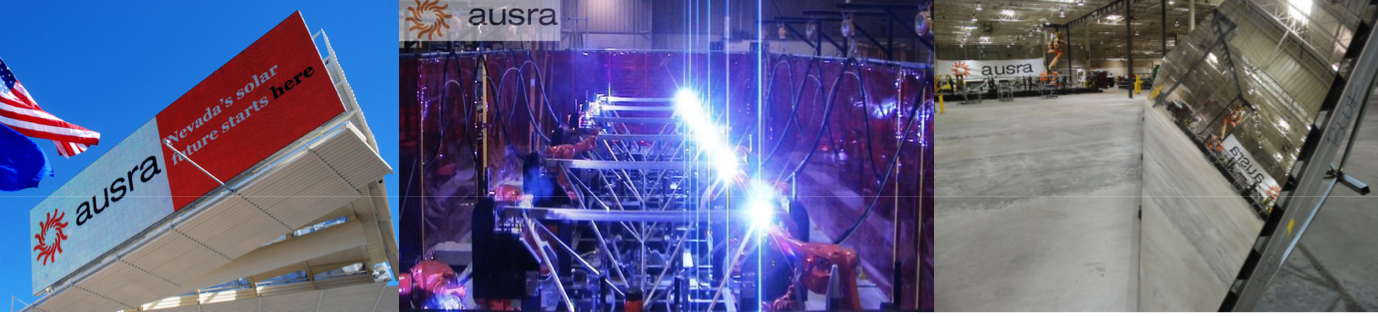
LAS VEGAS – Hard by the Las Vegas airport, the industrial infrastructure of the solar economy is rising in a former furniture factory. Phalanxes of orange robots swivel and dip as they practice assembling components for solar power plants to be built by Silicon Valley startup Ausra.

It’s North America’s first solar power plant factory and it went online Monday when Ausra CEO Robert Fishman and U.S. Senate majority leader Harry Reid, D-Nevada, flipped the switch to start the production line. Ausra’s automated 130,000-square-foot factory is key to the Palo Alto company’s aim of cutting manufacturing costs to make solar energy competitive with fossil fuels.

A large robot picks up 78-square-foot pieces of glass and places them on a conveyor belt so a machine can apply strips of adhesive. Other robots transfer the glass to another line where a dozen bots weld together 53-foot-long steel frames. The completed solar arrays will be trucked to California where Ausra is building a 177-megawatt solar power station for utility PG&E (PCG) on 640 acres of agricultural land in San Luis Obispo County. (To see a video of the robots in action, click here.)

The arrays focus sunlight on water-filled tubes to create steam to drive a turbine. Ausra manufacturing exec David McKay points to where standard-issue boiler pipe will be fed into a machine and treated with a proprietary coating that transforms it into a solar receiver. At peak production the plant will churn out more than 700 megawatts’ worth of equipment year to keep 1,400 solar power plant construction workers employed. “We can produce a lot faster than what we can install,” says McKay.

However, the future of those jobs – and billions in future investments in renewable energy – hangs on whether Congress extends a crucial investment tax credit that the solar industry and utilities are relying on to make large-scale solar power plants competitive with the carbon-spewing variety. The investment tax credit expires at the end of the year and several attempts to pass legislation extending the ITC have failed despite support on both sides of the aisle.

Green Wombat met with the chairman of the Solar Energy Industries Association, Chris O’Brien, last week when he was in San Francisco to get an update on the ITC’s chances. “It’s an election year and it has become part of the political stalemate,” says O’Brien, who heads North America market development and government relations for Swiss-based solar cell equipment maker Oerlikon Solar. “I don’t see an imminent breakthrough.”

The pending demise of the tax credit is “having a significant effect on the development of new business,” according to O’Brien. Solar energy executives, of course, are reluctant to admit that deals are getting dashed, but there’s no doubt the loss of a 30 percent tax credit gives financiers and utilities pause when considering whether to green-light solar power plants that can cost a billion or two to construct.

O’Brien thinks the best-case scenario for the long-term extension of the ITC will come after the presidential election during the lame-duck session of Congress. Otherwise, he says, don’t expect action until around September 2009.

In the meantime, Ausra will keep its robots busy cranking out components for its first California power plant, which is scheduled to start producing green electricity in 2010.

Read Full Post »

When Intel announced this week that it was spinning off a stealth in-house startup called SpectraWatt to develop solar cells, it appeared the chip giant was just the latest old-line Silicon Valley tech firm bitten by the green bug.

After all, crosstown chipmaker Cypress Semiconductor jumped into the solar game back in 2004 when it acquired SunPower (SPWR), now a leading manufacturer of solar cells and panels and an installer of large-scale solar arrays. Then the world’s biggest chip-equipment maker, Applied Materials (AMAT), retooled machines that make flat-screen video displays to produce thin-film solar panels. And just this month, Hewlett-Packard (HPQ) unveiled a deal to license solar technology to a solar cell startup while IBM (IBM) announced it would develop thin-film solar.

But it’s not just now jumping on the enviro-biz bandwagon – Intel’s solar efforts have been quietly under development since 2004. That’s when Andrew Wilson, an 11-year Intel (INTC) veteran, was chatting with a colleague while waiting for a conference call to begin. “We were shooting the breeze and I mentioned that I had replaced all the light bulbs in my house with compact fluorescent lights and my utility bill had come down by a third,” says Wilson, SpectraWatt’s CEO. “And he said, `Hey, did you know that solar cells are made of silicon?’ ”

“We started talking about what a business plan would look like, because if something is made out of silicon then Intel should be taking advantage of that market,” Wilson told Fortune. A year later, Wilson and his colleagues had developed a marketing plan and secured funding from Intel’s new-business incubator to develop a business strategy and hone its technology. (It’s no coincidence that the nascent solar industry is populated by computer industry veterans from companies that put the silicon in Silicon Valley.)

When it comes to cutting-edge solar technology, silicon-based cells are considered a bit old-school. Silicon is currently in short supply and the resulting high prices have led venture capitalists to invest hundreds of millions of dollars in thin-film solar startups that promise to dramatically lower the cost of solar by printing or otherwise applying non-silicon solar cells to glass or flexible materials that can be integrated into walls, windows and other building materials. While thin-film solar is less efficient at converting sunlight into electricity, the expectation is that it can be produced much more cheaply than conventional cells.

But thin-film solar is still largely an early-stage technology and silicon-based cells will continue to be the big market for the near-future. So the question is, how does Intel compete with established players like SunPower, China’s Suntech (STP) and Germany’s Q-Cells as solar cells become a commodity? Intel controls some 80 to 90 percent of the worldwide chip market but it’s unlikely that it – or any other player – will replicate that experience in solar cells.

Wilson’s view is that it’s early days for the solar market and that SpectraWatt’s ace in the hole is Intel’s global manufacturing experience and history of technological innovation. “The solar industry today looks like the microelectronics industry in the late ‘70s – there’s very few standards and no one is manufacturing at scale,” says Wilson. “It’s all about manufacturing processes and material sciences that will lead to fundamental breakthroughs. The product is vastly simpler than a microprocessor but the fundamental nature of a solar cell isn’t all that different. When you think of what it takes to manufacture globally and manage supply chains, that’s Intel’s core competence.”

There certainly is room for more players, given that solar was a $30 billion market in 2007 and is expected to continue to grow at a clip of 30 to 40 percent in the coming years.

Wilson says SpectraWatt has secured silicon supplies and is developing technology that will give it a competitive edge. He’s keeping mum about the details of that technology for now. “We do believe we will have a technological advantage when we get what we’re doing in the lab to manufacturing,” Wilson says.

The company is set to begin building its manufacturing facility in Oregon later this year, with production to begin in mid-2009.

SpectraWatt launches with a $50 million investment lead by Intel Capital, the company’s investing arm. Other investors include Goldman Sachs (GS), PCG Clean Energy and Technology Fund, and German solar giant Solon. (As Green Wombat has written, Solon has invested in an array of solar startups in the United States, including Sungevity and thin-film solar company Global Solar.)

Read Full Post »

California utility PG&E will buy 106.8 megawatts of electricity from a hybrid biofuel solar power plant to be built by a Portuguese firm in the state’s Central Valley.

The hybrid technology will allow two 53.4 megawatt plants to tap the sun and agricultural waste produced in surrounding Fresno County to generate green energy around the clock, according to San Joaquin Solar, a subsidiary of Portugal’s Martifer Renewables. For PG&E (PCG), 107 megawatts is just enough to keep the air conditioners running for some 75,000 homes. But if the biofuel solar hybrid performs as billed and can be scaled up, it’s a win-win – recycling ag waste – a huge and expensive problem in California – into electricity.

The percentage of electricity to be produced by solar versus biofuel and other details of the project’s design are sketchy. Andrew Byrnes, an executive with Spinnaker Energy – the San Diego company developing the project for Martifer – told Fortune that such information is “confidential” as are images of what the hybrid plant will look like and the identities of the company’s U.S. investors.

Here’s what we do know: San Joaquin Solar 1 and 2 will be built on private land outside the farming town of Coalinga. They will use long arrays of curved mirrors called solar troughs to focus the sun on liquid-filled tubes to produce steam that will drive electricity-generating turbines. That’s a standard solar technology currently operating in California and elsewhere. The biomass component of the plant will use agricultural waste, green waste and livestock manure to create heat that will generate steam.

It appears the biofuel will be used to keep the plant running at night or on overcast days. “The technologies can run simultaneously,” said Byrnes in an e-mail. “And when a cloud passes overhead (and after the sun sets) the solar facility can still generate energy, since the generation process is dependent on heat rather than direct solar radiation.”

While there is a natural gas-solar hybrid power plant under development in Southern California – see Green Wombat’s “The Prius of power plants” – San Joaquin Solar 1 and 2 will apparently be the world’s first biofuel solar hybrid.

Each power plant will each need 250,000 pounds of biomass a year to operate. Finding that fuel shouldn’t be a problem: Byrnes says a study shows that Fresno County alone produces nearly 2 million tons of ag waste annually.

Read Full Post »

In another sign that technological innovation will drive solutions to global warming and the United States’ energy dependence, technology born of Hewlett-Packard’s imaging and printing research will be used to make more efficient and cheaper solar panels. HP is licensing its transparent transistor technology, which will eliminate the need for mechanical trackers to follow the sun, to a Livermore, Calif., startup called Xtreme Energetics

Here’s how it’s supposed to work: XE’s solar panels concentrate sunlight onto highly efficient solar cells that use a fraction of the expensive silicon found in standard solar modules. A layer of HP’s clear transistors will funnel light to the solar cell as the sun moves across the sky.

“Basically, we don’t have any mechanical gears or cogs,” says XE chief executive Colin Williams, a veteran of JPL/Caltech and a former Stanford University professor. “From an outward appearance the panel appears to be fixed, but internally light is being steered to the solar cell through the electronics.”

Doing away with bulky mechanical trackers means that more panels can be packed onto commercial rooftops, allowing energy-hungry facilities like data centers to draw more of their power from the sun. The panels will be transparent and can be colorized to blend in with building facades. Williams says XE will also produce panels for large-scale solar power plants.

That’s the goal, at least. XE, which is currently funded by its founders, is two years away from producing solar panels with HP’s (HPQ) technology and its claim that they will be twice as efficient at half the cost of conventional solar systems has yet to be proven.

For HP, the solar licensing deal is an unanticipated benefit of collaborative research by HP Labs, engineers at its imaging and printing operation in Oregon and researchers at Oregon State University. “They were looking for future ways to display images,” say Joe Beyers, HP’s vice president of intellectual property licensing. “It just turned out that Colin and his team became aware of the work we were doing with Oregon State and started the dialog.”

Beyers says other potential applications for the technology – developed as part of HP’s new approach to commercializing R&D that my colleague Jon Fortt wrote about recently – include video displays for car windshields.

Read Full Post »

eSolar, the solar energy startup founded by Idealab’s Bill Gross and backed by Google, has signed a 20-year contract to supply utility Southern California Edison with 245 megawatts of green electricity.

The solar power plant will be built in 35-megawatt modules, with the first phase set to go online in 2011. As Green Wombat reported in April, eSolar scored $130 million in funding from Google.org, Google’s (GOOG) philanthropic arm, and other investors to develop solar thermal technology that Gross claims will produce electricity as cheaply as coal-fired power plants.

Like Ausra and BrightSource Energy – which have deals with PG&E (PCG) – eSolar will use fields of mirrors to heat water to create steam that drives electricity-generating turbines. Gross says that eSolar’s software allows the company to individually control smaller sun-tracking mirrors – called heliostats – which can be cheaply manufactured and which are more efficient and take up less land than conventional mirrors. According to Gross, that means eSolar can build modular power plants near urban areas and transmission lines rather than out in the desert, lowering costs.

eSolar’s cost claims got Southern California Edison’s (EIX) attention. “It was a competitively priced proposal,” Stuart Hemphill, the utility’s VP for renewable and alternative power, told Fortune. “We found the eSolar team very competent, motivated and willing to do a deal.”

“When it comes down to different solar technologies, competitive pricing is going to be an important part of the equation,” he adds. “They do offer a unique solution.”

eSolar is keeping mum about the exact location of the power plant, only saying it will be in the Antelope Valley region of Southern California.

One potential hitch: Getting eSolar’s electricity to Southern California Edison will depend on the construction of a major new transmission line. That line, the Tehachapi Renewable Transmission Project, has been partially approved to date.

With the eSolar deal, the utility is hedging its bets. Back in 2005, Southern California Edison signed a highly publicized deal with Phoenix’s Stirling Energy Systems to buy up to 850 megawatts of solar electricity from massive solar power plants to be built in the Mojave Desert. (Around the same time, San Diego Gas & Electric (SRE) signed a power purchase agreement with Stirling for up to 900 megawatts. ) Stirling is still perfecting its technology and has yet to file a license application for its first plant. But the company received a $100 million investment earlier this year and Hemphill says Stirling is moving forward.

“We expect that Stirling will meet its contractural obligations,” he says. “Solar thermal is definitely an emerging industry. It’s too early to tell which technologies will be the winners over the long run. It’s a time to be having a portfolio of different technologies so we can figure that out.”

Read Full Post »

In the world’s single-largest investment in solar technology, the oil-rich emirate of Abu Dhabi announced Wednesday it will spend $2 billion to jumpstart a home-grown photovoltaics industry. The cash will fund what is undoubtedly the planet’s best-financed startup, Masdar PV, which will build manufacturing facilities in Germany and Abu Dhabi to produce thin-film solar modules that can be used in rooftop solar systems or solar power plants.

Masdar PV is the latest project of the Masdar Initiative, Abu Dhabi’s $15 billion renewable energy venture designed to transform the emirate into a green technology powerhouse. Masdar is best known for its plans to build Masdar City, a “zero-carbon, zero-waste” urban center.

Thin-film solar cells are essentially “printed” on glass or flexible metals, allowing them to be integrated into building materials like roofs and walls. Though thin-film solar is less efficient at converting light into electricity, it uses a fraction of the expensive silicon needed by conventional bulky solar modules and can be produced much more cheaply – provided economies of scale are achieved.

Thus Masdar PV’s big solar bet. “You have to be working at scale to drive costs out of the system,” Steve Geiger, Masdar’s director of special projects, told Fortune in a phone call from Abu Dhabi. “We have to do it at scale and we have to do it in volume in multiple markets.”

One of those markets is the United States, where Masdar PV could give established players like First Solar (FSLR) and startups such as Nanosolar, Heliovolts and Global Solar some formidable competition.

The gamble Masdar PV is taking is that it’s investing billions in an older but proven thin-film technology that may well be left in the dust by more exotic, cheaper and efficient technologies under development by a host of startups.

Masdar PV aims to have a gigawatt of annual production capacity in place by 2014. To get there, Geiger says the company has hired a management team that includes former top executives from First Solar and other thin-film industry veterans.

A leading solar technology company that Geiger declined to identify will provide the manufacturing equipment for Masdar PV’s factories. Judging from his description, the likely supplier is Applied Materials (AMAT), the world’s biggest computer-chip equipment maker that has a burgeoning business building the machines that make thin-film solar cells of the type that Masdar PV will produce.

“We usually partner with large companies that have managerial skills, technology and market access, but we were very fortune that we picked up a top management team and thought it was strong enough to do as a 100% Abu Dhabi Masdar company,” says Geiger, who will oversee Masdar’s thin-film solar venture.

Masdar PV’s first plant is scheduled to go online in Germany toward the end of 2009 with the second to begin production in Abu Dhabi by mid-2010. “Very clearly we need to look at expansion beyond those two physical facilities,” Geiger says. “We really have to look at America and the Asian markets as well.

Thin-film is just one of three solar strategies that Masdar is pursuing by funneling petrodollars into green energy startups. In March, Masdar unveiled Torresol Energy, a joint venture with a Spanish company that will build large-scale solar thermal power plants to supply electricity to utilities. Masdar has also made investments in other solar thermal companies as well as thin-film startups pursuing different technologies. Finally, Masdar wants to produce polysilicon, the basic material of conventional solar cells.

As Masdar chief Sultan Ahmed Al Jaber recently told Green Wombat, “We want to cover the whole value chain – from research to labs to manufacturing to the deployment of technologies.”

Geiger uses an analogy for Masdar’s green energy ambitions that may be more familiar to petroleum-dependent Americans – and should serve as a wake-up call to get serious about carbon-free energy. “The model might be the vertically integrated oil industry,” he says. “It clearly makes sense to have a consolidated power provider.”

Read Full Post »

The souring economy hasn’t dissuaded green tech investors from making big bets on renewable energy. On Wednesday, solar power plant builder BrightSource Energy announced it had raised $115 million from a group of investors that include Google.org, the search giant’s philanthropic arm, and oil giants Chevron and BP.

The investment in the Oakland, Calif.-based startup is Google’s (GOOG) second big solar energy play in the past two months. In April, Google.org joined a $130 million round for eSolar, a Pasadena solar power plant company whose chairman is Idealab founder Bill Gross.

BrightSource Energy, started by American-Israeli solar pioneer Arnold Goldman, has contracts to supply California utility PG&E (PCG) with up to 900 megawatts of solar electricity from power plants to be built in the Mojave Desert on the California-Nevada border. BrightSource has developed a new solar technology, dubbed distributed power tower, that focuses fields of sun-tracking mirrors called heliostats on a tower containing a water-filled boiler. The sun’s rays superheat the water and the resulting steam drives an electricity-generating turbine. (Artist rendering of BrightSource’s planned Ivanpah plant above.)

Given that a 500-megawatt solar power plant can cost more than $1 billion to build, $115 million is but a drop in the bucket. But it will allow BrightSource, which previously raised $45 million, to proceed with the development of its technology as it seeks project financing for construction of its first power plants.

And it can’t hurt to have such high-profile backers when you negotiate power purchase agreements with utilities. Besides Google, BP Alternative Energy (BP) and Chevron Technology Ventures (CVX), previous investors participating in the new round include Morgan Stanley (MS), VantagePoint Venture Partners, Draper Fisher Jurvetson and DBL Investors.

Another new BrightSource investor is Norweigan oil and gas behemoth StatoilHydro (STO). Apparently, even Big Oil has seen the light when it comes to hedging its bets with green energy.

Read Full Post »

Monday night, Green Wombat swung by SF Green, one of a growing number of green tech networking events sprouting up around San Francisco and Silicon Valley. The draw – beyond drinks with a standing-room-only crowd of bright-eyed twenty-and-thirtysomethings in a San Francisco art gallery – was the appearance of leading venture capitalist Ray Lane of Kleiner Perkins Caufield & Byers and Darryl Siry of Tesla Motors, maker of the Roadster electric supercar.

Despite the fact that Tesla has sued a Kleiner company, Fisker Automotive – which is producing an electric hybrid sports sedan – for alleged intellectual property theft, no sparks flew. (Though at Fortune’s recent Brainstorm Green conference, Lane couldn’t resist taking a jab at allegations that Fisker founder Henrik Fisker appropriated Tesla technology when he did design work for the Silicon Valley startup: “It’s ridiculous,” Lane said. “Henry Fisker wouldn’t know a drive train from a glass of water. He’s a designer.)

Siry, Tesla’s vp of sales, marketing & service, said five of the $100,000 Roadsters have rolled off the assembly line so far with one car tooling around Los Angeles, and others in the Bay Area and London. By year’s end, Tesla, which has been wrestling with drive train problems, should have more than 100 cars on Bay Area roads, home to many the company’s tech titan customers.

Tesla has raised $145 million, Siry noted, and will do another round before an IPO. The Roadster will always be a limited production marquee car but to mass produce its next vehicle, a five-seat sports sedan code-named White Star, Tesla will need that IPO or project financing. Siry also sketched a future where Tesla might supply electric drive trains to automakers in exchange for project financing.

“Tesla is a tech company wrapped in an automotive brand,” he said at the event co-sponsored by VentureBeat.

Lane and Kleiner Perkins have gone beyond investing in electric car companies to running one. Lane is chairman of Think North America, the U.S. arm of Norwegian electric carmaker Think Global. Kleiner and Rockport Capital took a 50 percent stake in the North American operation, which launched last month.

The Think and Fisker investments are emblematic of a new direction for VCs who have jumped into the green tech game. Unlike the first dot-com era or even the current Web 2.0 age, there’s no quick exit on the horizon for investments in green tech companies that may be years away from producing a product and require hundreds of millions, if not billions, in project financing to build car factories or solar energy power plants.

Lane compared investing in green tech to the long-term horizon needed for investing in biotech startups, where the key is to hit milestones that allow investors to calculate valuations.

Still, it’s a big gamble, given rising commodity prices and global economic upheaval.

Kleiner is also an investor in solar power plant startup Ausra. “Steel prices are killing us,” Lane said. Ausra’s power plants consist of hundred of acres of mirrors mounted on steel frames. “With Ausra, we [calculate] we could deliver solar thermal electricity at 12 cents a kilowatt-hour. But with steel prices, who knows?”

A shortage of qualified green tech workers has become an issue, according to Lane. The nascent solar power plant business relies on recruiting engineers and project developers from the carbon-based industry. “Talented people in project development at companies like Bechtel are maxed out for years on building projects,” he said.

Read Full Post »

“Years ago we came to the conclusion that global warming was a problem, it was an urgent problem and the need for action is now. The problem appears to be worse and more imminent today, and the need to take action sooner and take more significant action is greater than ever before” — PG&E Chairman and CEO Peter Darbee

The head of one of the nation’s largest utilities seemed to be channeling Al Gore on Tuesday when he met with a half-dozen environmental business writers, including Green Wombat, in the PG&E (PCG) boardroom in downtown San Francisco. While a lot of top executives talk green these days, for Darbee green has become the business model, one that represents the future of the utility industry in a carbon-constrained age.

As Katherine Ellison wrote in a feature story on PG&E that appeared in the final issue of Business 2.0 magazine last September, California’s large utilities — including Southern California Edison (EIX) and San Diego Gas & Electric (SRE) — are uniquely positioned to make the transition to renewable energy and profit from green power.

First of all, they have no choice. State regulators have mandated that California’s investor-owned utilities obtain 20 percent of their electricity from renewable sources by 2010 with a 33 percent target by 2020. Regulators have also prohibited the utilities from signing long-term contracts for dirty power – i.e. with the out-of-state coal-fired plants that currently supply 20 percent of California’s electricity. Second, PG&E and other California utilities profit when they sells less energy and thus emit fewer greenhouse gases. That’s because California regulators “decouple” utility profits from sales, setting their rate of return based on things like how well they encourage energy efficiency or promote green power.

Still, few utility CEOs have made green a corporate crusade like Darbee has since taking the top job in 2005. And the idea of a staid regulated monopoly embracing technological change and collaborating with the likes of Google (GOOG) and electric car company Tesla Motors on green tech initiatives still seems strange, if not slightly suspicious, to some Northern Californians, especially in left-leaning San Francisco where PG&E-bashing is local sport.

In a wide-ranging conversation, Darbee, 54, sketched sketched a future where being a successful utility is less about building big centralized power plants that sit idle until demand spikes and more about data management – tapping diverse sources of energy — from solar, wind and waves to electric cars — and balancing supply and demand through a smart grid that monitors everything from your home appliances to where you plugged in your car. “I love change, I love innovation,” says Darbee, who came to PG&E after a career in telecommunications and investment banking.

Renewable energy

“On renewable energy what we’ve seen is the market is thin,” says Darbee. “Demand just from ourselves is greater than supply in terms of reliable, well-funded companies that can provide the service.”

PG&E so far has signed power purchase agreements with three solar startups — Ausra, BrightSource Energy and Solel — for up to 1.6 gigawatts of electricity to be produced by massive solar power plants. Each company is deploying a different solar thermal technology and uncertainty over whether the billion-dollar solar power stations will ultimately be built has prompted PG&E to consider jumping into the Big Solar game itself.

“We’re looking hard at the question of whether we can get into the business ourselves in order to do solar and other forms of renewables on a larger scale,” Darbee says. “Let’s take some of the work that’s been done around solar thermal and see if we can partner with one of the vendors and own larger solar installations on a farm rather than on a rooftop.”

“I like the idea of bringing the balance sheet of a utility, $35 billion in assets, to bear on this problem,” he adds.

It’s an approach taken by the renewable energy arm of Florida-based utility FPL (FPL), which has applied to build a 250-megawatt solar power plant on the edge of the Mojave Desert in California.

For now, PG&E is placing its biggest green bets on solar and wind. The utility has also signed a 2-megawatt deal with Finavera Renewables for a pilot wave energy project off the Northern California coast. Given the power unleashed by the ocean 24/7, wave energy holds great promise, Darbee noted, but the technology is in its infancy. “How does this technology hold up against the tremendous power of the of the Pacific Ocean?”

Electric cars

Darbee is an auto enthusiast and is especially enthusiastic about electric vehicles and their potential to change the business models of both the utility and car industries. (At Fortune’s recent Brainstorm Green conference, Darbee took Think Global’s all-electric Think City coupe for a spin and participated in panels on solar energy and the electric car.)

California utilities look at electric cars and plug-in hybrids as mobile generators whose batteries can be tapped to supply electricity during peak demand to avoid firing up expensive and carbon-spewing power plants. If thousands of electric cars are charged at night they also offer a possible solution to the conundrum of wind power in California, where the breeze blows most strongly in the late evenings when electricity demand falls, leaving electrons twisting in the wind as it were.

“If these cars are plugged in we would be able to shift the load from wind at night to using wind energy during the day through batteries in the car,” Darbee says.

The car owner, in other words, uses wind power to “fill up” at night and then plugs back into the grid during the day at work so PG&E can tap the battery when temperatures rise and everyone cranks up their air conditioners.

Darbee envisions an electricity auction market emerging when demand spikes. “You might plug your car in and say, ‘I’m available and I’m watching the market and you bid me on the spot-market and I’ll punch in I’m ready to sell at 17 cents a kilowatt-hour,” he says. “PG&E would take all the information into its computers and then as temperatures come up there would be a type of Dutch auction and we start to draw upon the power that is most economical.”

That presents a tremendous data management challenge, of course, as every car would need a unique ID so it can be tracked and the driver appropriately charged or credited wherever the vehicle is plugged in. Which is one reason PG&E is working with Google on vehicle-to-grid technology.

“One of the beneficiaries of really having substantial numbers of plug-in hybrid cars is that the cost for electric utility users could go down,” says Darbee. “We have a lot of plants out there standing by for much of the year, sort of like the Maytag repairman, waiting to be called on for those super peak days. And so it’s a large investment of fixed capital not being utilized.” In other words, more electric and plug-in cars on the road mean fewer fossil-fuel peaking power plants would need to be built. (And to answer a question that always comes up, studies show that California currently has electric generating capacity to charge millions of electric cars.)

Nuclear power

Nuclear power is one of the hotter hot-button issues in the global warming debate. Left for dead following the Three Mile Island and Chernobyl disasters, the nuclear power industry got a new lease on life as proponents pushed its ability to produce huge amounts of carbon-free electricity.

“The most pressing problem that we have in the United States and across the globe is global warming and I think for the United States as a whole, nuclear needs to be on the table to be evaluated,” says Darbee.

That’s unlikely to happen, however in California. The state in the late 1970s banned new nuclear power plant construction until a solution to the disposal of radioactive waste is found. PG&E operates the Diablo Canyon nuclear plant, a project that was mired in controversy for years in the ’70s as the anti-nuke movement protested its location near several earthquake faults.

“It’s a treasure for the state of California – It’s producing electricity at about 4 cents a kilowatt hour,” Darbee says of Diablo Canyon. “I have concerns about the lack of consensus in California around nuclear and therefore even if the California Energy Commission said, `Okay, we feel nuclear should play a role,’ I’m not sure we ought to move ahead. I’d rather push on energy efficiency and renewables in California.”

The utility industry

No surprise that Darbee’s peers among coal-dependent utilities haven’t quite embraced the green way. “I spent Saturday in Chicago meeting with utility executives from around the country and we’re trying to see if we can come to consensus on this very issue,” he says diplomatically. “There’s a genuine concern on the part of the industry about this issue but there are undoubtedly different views about how to proceed and what time frames to proceed on.”

For Darbee one of the keys to reducing utility carbon emissions is not so much green technology as green policy that replicates the California approach of decoupling utility profits from sales. “If you’re a utility CEO you’ve got to deliver earnings per share and you’ve got to grow them,” he says. “But if selling less energy is contradictory to that you’re not going to get a lot of performance on energy efficiency out of utilities.”

“This is a war,” Darbee adds, “In fact, some people describe [global warming] as the greatest challenge mankind has ever faced — therefore what we ought to do is look at what are the most cost-effective solutions.”

Read Full Post »

« Newer Posts - Older Posts »

Design a site like this with WordPress.com
Get started