Feeds:
Posts
Comments

Archive for the ‘solar energy’ Category

kimberlina0089l1

photo: Ausra

When Green Wombat sat down for a chat with Ausra founder David Mills back in September 2007, he allowed that it was not unreasonable to expect the Silicon Valley solar startup to soon be building several massive megawatt solar power plants a year. The optimism was not unwarranted. After all, in the space of 12 months Ausra had relocated from Sydney to Palo Alto, raised $40 million from A-list venture capitalists and was about to ink a deal with utility PG&E for a 177-megawatt  solar power project.

That was then. This month Ausra laid off 10% of its 108 employees amid a move to stop building Big Solar projects – for now – to focus on providing its solar thermal technology to other power plant developers and to industries that use steam. (Ausra’s compact linear fresnel reflector technology deploys flat mirrors that sit low to the ground and concentrate sunlight on water-filled pipes that hang over the mirrors. The superheated water creates steam which drives an electricity-generating turbine.)

“I think our competitors will figure this out sooner or later but nobody’s going from a five-megawatt project to a 500-megawatt project. No one’s going to finance that,” Ausra CEO Bob Fishman told Green Wombat. “If you look at the amount of money it takes to be involved in the project development business, that’s not something a startup can do.”

At least any time soon. Ausra last year opened a robotic factory in Las Vegas to make mirror arrays and other components for the many power plant projects it had on the drawing boards. Just three months ago the company flipped the switch on its five-megawatt Kimberlina demonstration power plant outside Bakersfield. But as the credit crunch hit, financing for billion-dollar solar power projects evaporated. Then in October, Congress passed legislation allowing utilities like PG&E (PCG), Southern California Edison (EIX) and San Diego Gas & Electric (SRE) to claim a 30% investment tax credit for solar projects. As the only well-capitalized institutions left standing in the energy game, utilities are stepping forward as investors.

PG&E CEO Peter Darbee says he’s prepared to make direct investments in solar power plants – projects the utility needs to comply with a California mandate to obtain 20% of its electricity from renewable sources by 2010 and 33% by 2020. Under pressure to meet those targets, California utilities have signed more than four gigawatts worth of power purchase agreements with solar power plant startups like BrightSource Energy, Solel, Stirling Energy Systems and eSolar. Utilities also have begun signing deals for electricity produced by smaller scale photovoltaic power plants built by companies like First Solar (FSLR) and SunPower (SPWRA).

Fishman said Ausra will complete the 177-megawatt Carrizo Energy Solar Farm in San Luis Obispo County on California’s central coast to supply electricity to PG&E. “If Peter Darbee wants to own Carrizo rather than buy the electricity, we’re willing to do it. It makes sense,” he says.

Ausra will also will complete a second big solar power plant planned for Arizona. But the company has quietly let drop a Florida project for utility FPL (FPL) and is negotiating to offload lease claims it filed on federal land in Arizona and Nevada for solar power plants during the solar land rush.

“Other projects in the pipeline we’ll be selling to utilities or developers for a modest amount of cash with a commitment that those developers must use our technology,” says Fishman.

Fishman notes that the cost of licensing a solar power plant can be $5 million to $10 million a year – and in California it’s a multi-year process – so Ausra will realize some immediate savings by morphing into a technology provider.

Customers for Ausra’s technology include oil companies that could inject solar-generated steam in oil wells to enhance recovery of thick petroleum as well as food processing plants and other heavy users of steam. Fishman just returned from a trip to the Middle East where he says he held talks in Kuwait, Qatar and Dubai about using Ausra’s technology for oil recovery and desalinization.

Going forward, he says Ausra’s focus will be on medium-sized power plants. “Maybe next year we’ll do four projects of 50 megawatts a year. It’s a walk before you run situation,” says Fishman. “The financial customers and financial community are going to insist we do medium scale before we do large scale. We’ll still want to do very large projects but given the project finance market, it’ll be a few years from now.”


Read Full Post »

bio_wellinghoff_j_high

photo: FERC

The Federal Energy Regulatory Commission, or FERC, is one of those acronym agencies that regulates a key aspect of the United States economy – the electricity grid – but tends to operate under the radar.

Not any more. With President Barack Obama’s appointment of FERC Comissioner and renewable energy advocate Jon Wellinghoff as the agency’s acting chairman, FERC will play a key role in the administration’s efforts to digitize the nation’s aging analog power grid to promote solar and wind energy while creating green jobs. The largest chunk of the stimulus package devoted to renewable energy – some $54 billion – has been set aside for modernizing the grid.

At a Nov. 18 briefing on Capitol Hill, Wellinghoff showed that he’s been thinking extensively about how to upgrade the grid to connect renewable energy produced in remote areas to population centers on the coasts. “In the whole Midwest of this country there are virtually no high- voltage transmission lines,” he said, displaying Google’s  (GOOG) proposal to wean the U.S. from fossil fuels by 2030.  “If you overlay where the wind is, all the wind is in the middle of this country – all those areas where we do not have sufficient transmission. Hopefully we can get the structure to put renewables on the grid and improve the grid to make it a smart system that can ultimately deliver these resources in an efficient way.”

Wellinghoff in a December interview with EnergyWashington.com advocated reviving domestic manufacturing of big transformers – now made overseas – to support the expansion of high-voltage power lines across the U.S.

On Monday, Wellinghoff called for electric cars to be integrated into the electric grid, according to a report by Dow Jones. He said FERC could structure rates to pay car owners for returning electricity to the grid from their vehicle batteries to help balance the power supply as more solar, wind and other intermittent sources of energy come online.

At the November briefing, Wellinghoff called electric cars part of “the glue” that will hold a green grid together and said the federal government should consider giving automakers like General Moters (GM) and Ford (F) incentives to produce plug-in hybrids.

“To modernize the grid, we need to define our goals and define a national tranmission planning process,” he said. “Let’s do it. We just need to get it done.”

Read Full Post »

first-solar-11

With Big Solar thermal power plants bogged down in bureaucracy and facing environmental and financial hurdles, utilities are turning to smaller-scale thin-film solar stations that can be built in a matter of months.

In late December, PG&E (PCG), for instance, signed a 20-year contract for electricity generated  from a 10-megawatt thin-film solar power plant in Nevada owned by energy giant Sempra (SRE) that was officially dedicated on Thursday. The solar farm was built by First Solar (FSLR) in a scant six months. Meanwhile, the utility’s nearly two gigawatts worth of deals with solar thermal power companies won’t start producing power for another two years at the earliest. (Southern California Edison (EIX) and San Diego Gas & Electric signed agreements with solar dish developer Stirling Energy Systems for 1.75 gigawatts in 2005 and those projects are just now beginning to move through the regulatory approval process.) And the financial crisis has made it more difficult for solar thermal developers to obtain the billions of dollars needed to finance the construction of a massive megawatt power plant.

Solar thermal power plants typically use miles of mirrors to heat a fluid to create steam which drives an electricity-generating turbine. Photovoltaic (or PV) solar farms essentially take solar panels similar to those found on residential rooftops and mount them on the ground in huge arrays. (Thin-film solar panels are made by depositing layers of photovoltaic materials on glass or flexible materials.)

“In terms of construction, photovoltaic tends to have a much faster development and construction track,” Roy Kuga, PG&E’s vice president for energy supply, told Green Wombat. “There is a segment of mid-sized projects – in the two to 20 megawatt size – where PV shows a distinct advantage in that market. There’s a huge potential for the PV market to expand.”

That’s good news for companies like First Solar – the Tempe, Ariz.-based company backed by the Walton family that is often called the Google of solar for its stock price and market prowess – and SunPower (SPWRA), the Silicon Valley solar cell maker that’s moved into the power plant-building business.

The speed at which the Sempra-First Solar project went online owes much to the fact that it was built on the site of an existing fossil fuel power plant. “It was already permitted for power generation, transmission existed and it did not have to go through the laborious California permitting process,” says Reese Tisdale, a solar analyst with Emerging Energy Research. “As such, First Solar was able to essentially plug and play.”

Nathaniel Bullard, a solar analyst with New Energy Finance, says he expects utilities increasingly to bet on smaller-scale photovoltaic farms to help meet state mandates to obtain a growing percentage of their electricity from renewable sources. Just this week, PG&E CEO Peter Darbee said his utility plans to invest in solar power plant projects rather than just buy the power they produce.

“I think a utility could easily integrate, technically and financially, 100 megawatts of PV,” Bullard says.  If something is falling behind on your big solar thermal projects, you can plug in PV. I think you’ll see more of this with California utilities and I expect to see it more in Florida and North Carolina. It’s a great runaround to issues of siting and transmission.”

That’s because in California photovoltaic power plants do not need approval from the California Energy Commission. And smaller-scale plants take up far less land and can be built close to existing transmission lines. Most large solar thermal power plants typically are planned for the Mojave Desert and require the construction of expensive power lines to connect them to the grid.

The modular nature of PV solar farms means they can begin generating electricity as each segment is completed while a solar thermal plant only goes online once the entire project is finished.

“Certainly there is a sweet spot in which the project is large enough to gain advantages of scale,” says Tisdale. “Also, these small-to-mid-size systems can be spread about a transmission network, instead of at one site.”

Read Full Post »

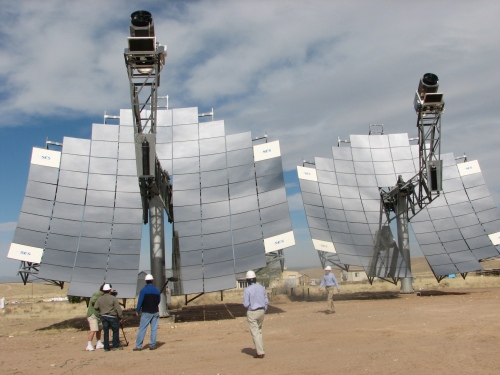
stirling-dishes

photo: Todd Woody

Fifty-four billion dollars is nothing to sneeze at, of course. That’s the amount in the $825 billion economic stimulus package –  introduced by House Democrats Thursday – set aside for renewable energy, electric car batteries, energy efficiency and other green projects.

It’s a start, but that’s less than 7% of the entire stimulus package (or, about enough to pay for the Iraq war for five months, or somewhat more than what the federal government is spending to bail out Bank of America). The lion’s share of the cash is devoted to smart grid technology and transmission lines, with a second big chunk going toward energy efficiency retrofits of public housing and weatherization of low-income homes.

That’s good news for a host of startups developing smart grid technology. But the the bill does not address the most pressing issue facing renewable energy companies today: the credit crunch has dried up financing just as billions are needed to fund factories and the construction of solar power plants and wind farms that will be connected to smart grids and new transmission lines. In recent weeks, layoffs have hit the solar industry. OptiSolar – a Bay Area thin-film solar startup that’s building a 550-megawatt photovoltaic power plant to supply electricity to utility PG&E (PCG) – reported to have furloughed half its workforce. And according to The Oregonian newspaper,  SpectraWatt, a solar cell maker spun off from chip giant Intel (INTC) last year, has shelved plans for a factory in Hillsboro, Ore.  Friday morning, Kate Galbraith at The New York Times’ Green Inc. blog reported that layoffs have now hit the wind industry.

The retrenchment comes as utilities are counting on solar power plants and wind farms to come online in the next two years to help them meet mandates to obtain a growing percentage of the electricity they sell from renewable sources. In California, for instance, PG&E, Southern California Edison (EIX) and San Diego Gas & Electric (SRE) have signed more than four gigawatts’ worth of contracts for electricity to be produced by large-scale solar power stations that will cost billions to build.

Solar startups rely on a provision that allows them to take a 30% tax credit on the cost of building a power plant. Now most of these companies are startups and have no way to use those tax credits as they’re not profitable. Instead, a solar company must essentially trade the tax credits to a firm that can use them in exchange for cash to finance construction. But investors in these deals have all but disappeared as the financial crisis takes its toll. Which is why solar and wind lobbyists are pushing Congress to make the tax credits “refundable” – meaning those companies that don’t have tax liabilities can trade the credits for cash that can be used to finance power plants. “Due to the recession, projects are now being put on hold, factories are closing and workers face potential layoffs unless Congress refines the tax credits now so they work as originally intended,” said Solar Energy Industries Association CEO Rhone Resch in a statement.

The stimulus package unveiled Thursday undoubtedly will be subject to change, but as written it will boost efforts to modernize and digitize the United States’ aging analog power grid. The bill includes:

  • $11 billion for smart grid research and development, pilot projects and the construction of new transmission lines to connect green energy power plants to the power grid. The government will fund 50% of the cost of utilities’ smart grid investments.
  • $8 billion in loan guarantees for renewable energy transmission projects.
  • $6.9 billion in grants to state and local governments for energy efficiency and carbon reduction programs.
  • $6.7 billion for renovation of federal buildings, of which $6 billion must be used for energy efficiency retrofits.
  • $6.2 billion for home weatherization programs for low-income families.
  • $2.5 billion for energy efficiency retrofits of public housing.
  • $2.4 billion for carbon sequestration – so-called clean coal – demonstration projects.
  • $2 billion for energy efficiency and renewable energy research (which includes $800 million for biomass and $400 million for geothermal research).
  • $2 billion in loan guarantees and grants for advanced vehicle battery research.

The smart grid billions will be a boon to companies like Silver Spring Networks, Gridpoint and eMeter that develop software to allow utilities to monitor and manage electricity use in real-time and provide that data to their customers.  “We think 2009 is going to be a good year for us,” eMeter president Larsh M. Johnson told Green Wombat last month. “We’ve seen continued demand from utilities for our services.”

But the billions for the smart grid can be considered a down payment: According to an estimate by research firm New Energy Finance, the price tag for modernizing the power grid over the next 15 years will be $450 billion.

Read Full Post »

solarcells

Solar cells may generate clean green electricity but manufacturing them involves a witches brew of toxic chemicals that could harm the environment if millions of solar panels end up in landfills, according to a report issued Wednesday by the Silicon Valley Toxics Coalition.

The California environmental group is calling for solar manufacturers to take back and recycle their panels at the end of their 20-to-25 year lifespan. “We feel it’s a very important time for the solar industry because it is getting ready to take off and before that happens it’s time to look at important issues around designing out some of the toxics,” Silicon Valley Toxics Coalition executive director Sheila Davis told Green Wombat. “The big issue is whether there is a transparent supply chain and whether solar companies monitor their supply chains.”

The solar industry’s trade group says it embraces the report’s recommendations. “We completely support take-back and recycling,” says Monique Hanis, a spokeswoman for the Solar Energy Industries Association in Washington. “We’re in a fortunate position in that we’re still an emerging industry and have an opportunity now to establish standards and proactively set up processes before we end up with solar panels on every rooftop.”

Julie Blunden, vice president of public policy at San Jose solar cell maker SunPower, points out that an industry-backed group called PV Cycle in Europe is developing worldwide standards for the take-back and recycling of solar panels. “It’s not uncharted territory for the solar industry – we have actually been working on it for a while,” she says. “The idea is for industry to design something that makes sense for a global value chain and a global market.”

The toxics coalition was born in the early 1980s after chip plants were found to be contaminating groundwater with carcinogenic chemicals, setting off years of litigation and turning Silicon Valley into a Superfund hot spot. In more recent years, the toxics coalition has pressed computer manufacturers to take back and recycle PCs and reduce the use of toxic materials that often ended up discarded in Third World countries.

Silicon is the key material used in both semiconductors and conventional solar cells and its production and refinement involve various toxic chemicals.

“Although the solar PV boom is still in its early stages, disturbing global trends are beginning to emerge,” the report states. “For example, much of the polysilicon feedstock material (the highly refined silicon used as the basic material for crystalline silicon PV cells) is produced in countries like China, where manufacturing costs and environmental regulatory enforcement are low.”

But unlike computer makers in the 1980s and ’90s, solar companies like SunPower (SPWRA), Suntech (STP) and Sharp are not about to resist efforts to green up their business. “The people working for these companies are completely committed to preserving the environment and it drives the reason for being in solar,” notes Hanis.

And recycling solar panels can be good for business. When Green Wombat visited SolarWorld’s new solar cell factory in Oregon in October,  COO Boris Klebensberger touted the German company’s recycling program as a competitive advantage, both with customers and as a way to reduce manufacturing costs by recovering expensive polysilicon.

For instance, thin-film solar manufacturer First Solar (FSLR), whose cells are made from cadmium telluride, pre-funds the cost of its take-back program through an insurance program so customers are assured that the panels they buy will be properly disposed of at the end of their lifespan. That addresses a particular challenge the solar industry faces: Will the company that makes a particular solar panel be around a quarter century later to take back and recycle its products? And if not, who takes responsibility for doing so?

Davis says the toxics coalition has approached some solar companies but declined to identify them. “We haven’t talked to a lot of them but the ones we have talked to have been responsive,” she says. “I think that’s because most people in these companies do have an interest in being green. They’re much more receptive to looking at models that would promote their environmental performance.”

Beyond corporate self-interest, government policy considerations are likely to drive the solar industry to devise alternative manufacturing processes and implement recycling programs. For instance, European Union restrictions on various toxic materials in electronic products have encouraged computer makers to green their machines lest they be shut out of a major market. And these days, Dell (DELL) and even Apple (AAPL) see a marketing advantage to touting environmentally friendly computing.

The solar industry has time on its side when it comes to developing toxic reduction and recycling programs. While an iPod may end up on the trash heap in 18 months, the typical solar panel won’t come off the roof for decades.

Read Full Post »

Amid the daily drumbeat of mass layoffs, here’s some sunny news: Solar startup Suniva cut the ribbon Thursday on a photovoltaic cell factory outside Atlanta.

As solar factories go, Suniva’s plant – the first such facility in the Southeast – is relatively small, making 32 megawatts of solar cells annually until  production is fully ramped up to 175 megawatts in 2010. But the factory will create 100 green collar jobs and it follows the opening of  SolarWorld’s new solar cell fab outside Portland, Ore., that will  produce 500 megawatts’ worth of solar cells, and thin-film solar startup HelioVolt’s factory in Austin. Meanwhile, Solyndra, a Silicon Valley thin-film solar startup, is expanding its production facilities while Bay Area rival OptiSolar is building a Sacramento factory that will employ 1,000 workers to produce solar cells for the power plant the company is building for utility PG&E (PCG). (Leading thin-film solar company First Solar (FSLR) operates a factory in Ohio as well as plants in Malaysia.) But Chinese solar giant Suntech (STP) last week said it has put plans for U.S. factories on hold due to the credit crunch.

The Suniva grand opening comes on a good news-bad news day for the solar industry. On one hand, President-elect Barack Obama is expected to nominate alternative energy proponent and Nobel laureate Steven Chu, director of the Lawrence Berkeley National Laboratory, as Secretary of Energy. But the solar industry faces a tough year ahead. On Thursday, research firm New Energy Finance, echoing other analysts, predicted prices for polysilicon – the base material of conventional solar cells – would fall 30% in 2009. That’s bad news for conventional solar cell makers like SunPower (SPWRA) and Suntech if they’ve locked in silicon supplies at higher prices but provides an opening for further growth for thin-film solar companies that make solar cells that use little or no polysilicon.

“We expect to see significant drops in the price of modules next year,” wrote New Energy Finance CEO Michael Liebreich.  “Any manufacturer who does not have access to cheap silicon and who has not focused on manufacturing costs is going to be in trouble. The big shake-out is about to begin. The next two years will change the economics of PV electricity out of recognition.”

Read Full Post »

solarcells

photo: Southern California Edison

While demand for solar panels is expected to continue to grow by double-digits in the years ahead, 2009 could be a make-or-break year for some companies, according to an analysis from HSBC Global Research.

After grappling with a shortage of polysilicon – the base material of conventional solar cells – for the past couple years, the industry now faces falling prices. The spot market for polysilicon has plummeted 35% since October, writes HSBC alternative energy analyst Christine Wang, who predicts prices will fall 30% next year.

That’s bad news for solar module makers who locked in long-term contracts at higher prices – which looked like a smart move when polysilicon was in short supply and prices rising rapidly. “The winners will likely be the companies with competitive cost structures, scale, good product  quality, strong balance sheets, and strong customer relationships,” according to Wang. “We believe that new entrants and small players will suffer the most as they lack brand recognition.”

The culprits are the usual suspects – the global financial crisis as well as some cutbacks in subsidies from countries like Spain. Solar cell companies that have rapidly ramped up production over the past two years now may be saddled with too many high-priced products.

Wang downgraded Chinese solar giant Suntech (STP) and set a price target of $4.50 – down sharply from HSBC’s earlier target of $55. Suntech was trading at near $10 Monday afternoon but still nearly 90% off its 2008 high.  (SunPower (SPWRA), First Solar (FSLR) and other solar cell makers have also seen their share prices nose-dive.) “High portion of polysilicon based on contract prices will hurt Suntech,” writes Wang, who estimated that 80% of Suntech’s polysilicon supply is locked into contracts “on less favorable fixed prices.”

Falling panel prices is good news for solar system installers like Sungevity and Akeena Solar (AKNS) and their residential and commercial customers. When Green Wombat ran into Akeena CEO Barry Cinnamon in San Francisco at the announcement of Better Place’s Bay Area electric car project, he said he was in no rush to enter into long-term contracts with solar cell suppliers as he expects prices will continue to fall in 2009.

Still, not all the news is gloomy for the industry. Wang expects that the financial crisis won’t derail government support for solar, given climate change pressures and state mandates to increase the use of renewable energy. The move by utilities like PG&E (PCG) and Southern California Edison (EIX) to sign long-term contracts for electricity from photovoltaic power plants will also keep demand high in coming years.

Wang projects solar cell demand will grow 45% between 2008 and 2012. “Developed countries are increasingly focused on environmental protection and curtailing the causes of climate change, and we do not believe this trend will shift just because of a (hopefully) short-term financial crisis,” she wrote.

Read Full Post »

solana1The credit crunch is taking a toll on the United States’ nascent solar industry, scuttling big renewable energy projects and curtailing expansion plans, solar executives said Wednesday as they proposed the inclusion of green incentives in the Obama economic stimulus plan.

Spanish energy giant Abengoa, for instance, has put on hold plans to build its 280-megawatt Solana solar power plant outside Phoenix to supply electricity to utility Arizona Public Service (PNW) in a $4 billion deal, said Fred Morse, senior advisor to Abengoa Solar.

“We have serious issues getting financing,” said Morse during a conference call held by the Solar Energy Industries Association. Congress in October passed a 30% investment tax credit crucial to the solar industry. But Wall Street’s meltdown has scared off investors that normally would finance large solar projects in exchange for the tax credits.

“The investment tax credit was passed but unfortunately there was no ‘I’ in the ITC,” Morse added. “We have trouble finding tax-equity investors, the financing is gone.”

Suntech America president Roger Efird said that after Congress passed the investment tax credit, the Chinese solar cell maker immediately doubled its sales force in the U.S. That expansion has now hit a wall.

“Plans to double our sales force by the end of 2009 are currently on hold, primarily because business has slowed in fourth quarter because of the credit crunch,” he said. “We had been considering establishing manufacturing in the U.S. The timing of those plans depend on the growth of the market in the U.S. and how long it takes to get through this downturn.”  Suntech’s (STP) stock – like those of rivals SunPower (SPWRA) and First Solar (FSLR) – has been walloped by the market chaos and is down 94% from its 52-week high.

Ron Kenedi of Sharp Solar said the dealers and installers who buy the Japanese solar module maker’s products have had a hard time securing credit to finance their operations.

In response, the solar industry’s trade group on Wednesday proposed that the federal government cut through the credit crunch by adopting tax and investment policies to stimulate the solar sector and create 1 million jobs.

The centerpiece of the plan is a $10 billion program to install 4,000 megawatts of solar energy on federal buildings and at military installations. “The Department of Defense alone could jump start this industry and it could have widespread impact on the use of solar, similar to what it did for the Internet,” said Nancy Bacon, an executive with Michigan thin-film solar cell maker Energy Conversion Devices (ENER).

Bacon noted that the federal government is the world’s largest utility customer, spending $5.6 billion annually on electricity. “This would create 350,000 sustainable jobs,” she said. “The solar industry is ready to deploy these systems immediately.”

The Solar Energy Industries Association also wants Congress to enact a 30% tax refundable tax credit for the purchase of solar manufacturing equipment to encourage solar companies to build their factories in the U.S. That would result in an estimated 315,000 new jobs. Making the current investment tax credit refundable would also help loosen up financing for solar projects, the association said.

Other policies on the SEIA agenda:

  • Establishment of a national Renewable Portfolio Standard that would require states to obtain a minimum of 10% of their electricity from green sources by 2012 and 25% by 2025, with 30% of the total coming from solar.
  • Rapid deployment of new transmission lines to connect cities to remote areas where wind and solar power is typically produced.
  • Expedited approval of solar power plant projects on federal land in the Southwest.
  • Creation of an Office of Renewable Energy in President-elect Obama’s office to coordinate the procurement and permitting of solar power and transmission lines.

“We are working closely with the Obama energy transition team and have been in contact with Congress,” said SEIA president Rhone Resch. “These polices are exactly the kind of shot in the arm our economy needs today.”

Read Full Post »

betterplaceplugElectric cars are as good for the economy as the environment and could put $80 billion in consumers’ pockets by 2030, according to a new study from the University of California.

Not surprisingly, the oil industry would take a $175 billion hit under the scenario sketched by UC Berkeley’s Global Venture Lab, while a booming battery business would gain $130 billion as the internal combustion engine sputters out. “There will also be significant changes in the balance of payments among nations as petroleum imports decline,” the authors wrote. “We find the net imports of the U.S. will decline by $20 billion.”

The report makes several assumptions to arrive at its optimistic conclusions: The Cal researchers are counting on 39% of cars on the road to be electric by 2030 and powered by electricity generated from renewable sources like wind and solar.

Electric car owners would save an estimated $7,203 in operating costs, mainly because with no engines to maintain, battery-powered vehicles rarely see the inside of mechanic’s garage.

Left unexplored in the report was the impact of electric cars on the United States auto industry. If General Motors (GM), Ford (F) and Chrysler survive – and that’s a big if these days – they stand to benefit assuming they retool for the electric age and produce cars consumers want to buy before rivals like Toyota (TM), Honda (HMC) and Renault-Nissan beat them to the punch. But their dealer networks are sure to suffer once their lucrative repair and maintenance business evaporates.

Another winner in the electric car economy will be solar and wind companies and utilities, particularly those like PG&E (PCG) and Southern California Edison (EIX) that are making multi billion-dollar investments in renewable energy.

One of the biggest assumption the Cal report makes involves the rise of a U.S. battery industry. “We don’t have a battery industry today,” said Shai Agassi, CEO of electric car infrastructure startup Better Place, on Friday at a panel Green Wombat moderated for the University of California’s Global Technology Leaders Conference. “Either we make them here or they’re going to be made in China.”

Agassi and the mayors of San Francisco, San Jose and Oakland on Friday announced that Better Place would build a $1 billion network of charging stations throughout the Bay Area. Renault-Nissan has agreen to provide Better Place with the hundreds of thousands of electric cars it’ll need to put on the road make its business model profitable.

photo: Better Place

Read Full Post »

deutsche-bank-green-bankPresident-elect Barack Obama may dismiss notions of a New New Deal to stave off a Great Depression 2.0, but signs of a Rooseveltian shift in thinking abound.

Case in point: This week, Deutsche Bank called for the establishment of a “national infrastructure bank” to create “green” jobs, fight global warming and ensure U.S.  energy independence by investing in an array of projects – from energy efficiency to upgrading the Eisenhower-era power grid to large-scale renewable energy power plants.

The idea of a national infrastructure bank is not new – versions have been proposed by Obama and Senators Chris Dodd (D-Conn.) and Chuck Hagel (R-Neb.) to finance the repair of the nation’s crumbling highways, water systems and cities. Deutsche’s twist is to give such an institution a green mission.

“We believe this confluence opens up an historic opportunity for a new U.S. administration and Congress to take a global leadership position on the issue of the environment and energy security, while addressing current financial problems,”  wrote Deutsche Bank’s Climate Change Investment Research team in its report.

“We’re calling for the national infrastructure bank to go green because in the long run it will save us money and create more jobs,” Deutsche senior investment analyst Bruce Kahn told Green Wombat.

He says Deutsche Bank is not putting a dollar figure on the capitalization of such bank, but the report notes others have suggested a $100 billion investment would generate two million green jobs.

Deutsche Bank (DB) recommends a green infrastructure bank focus on energy efficiency, the transmission grid, renewable energy and public transportation. The green bank would dispense federal funding, make grants to states and cities, issue loans to governments and companies, underwrite public and private bonds, and provide tax credits for public and private projects.

In Deutsche Bank’s analysis, the biggest bang for the buck would come from a massive retrofit program to increase the energy efficiency of the nation’s commercial buildings and make sure the 1.8 million new homes constructed every year are green. Buildings consume as much as 50% of the electricity generated in urban areas and emit about 20% of the country’s greenhouse gases. The work of installing energy-efficient heating, lighting and air conditioning systems is labor intensive and would spike demand for green building materials.

Upgrading and digitizing the power grid to create a “transmission super highway” to bring solar and wind energy from the deserts and Great Plains to the cities could generate as many as 500,000 jobs, according to an estimate by the American Wind Energy Association. The price tag to modernize the grid: $450 billion over the next 15 years by New Energy Finance’s estimate.

One area given short shrift by the Deutsche report is how a green infrastructure bank would support large-scale renewable energy power plants. Wind farms and solar power stations typically require billions of dollars in financing to get built and rely on investors buying the tax credits the projects generate. Those investors have been in short supply thanks to the credit crunch and the collapse of the Wall Street banks that often put up the cash for such deals.

“Everyone’s lost money, there’s no tax equity to be had,”  says Kahn. “But we expect that tax credit equity investors will return to the market, not next month, but in the next couple of years.” Kahn says an infrastructure bank could support green energy power plant projects through loans and loan guarantees.

A green bank would also be good business for Deutsche Bank.

“We have large number of investments at stake, current investments in all these sectors,” says Kahn. “It provides an investment opportunity as this infrastructure bank would not be able to exist all on its own. It would need private capital to invest alongside it.”

Read Full Post »

« Newer Posts - Older Posts »

Design a site like this with WordPress.com
Get started