Feeds:
Posts
Comments

Archive for the ‘solar energy’ Category

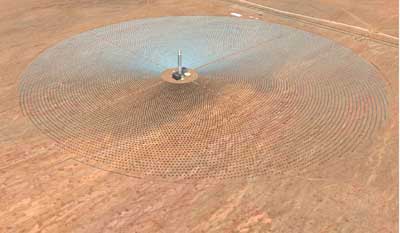
artist_picture_of_project

Image: SolarReserve

Ok, I’m exaggerating a bit in the headline above but we’re getting closer to solar farms that will provide baseload power, operating at night and under cloudy conditions. As I write on Tuesday in The New York Times:

The holy grail of renewable energy is a solar power plant that continues producing electricity after the sun goes down.

A Santa Monica, Calif., company called SolarReserve has taken a step toward making that a reality, filing an application with California regulators to build a 150-megawatt solar farm that will store seven hours’ worth of the sun’s energy in the form of molten salt.

Heat from the salt can be released when it’s cloudy or at night to create steam that drives an electricity-generating turbine.

The Rice Solar Energy Project, to be built in the Sonoran Desert east of Palm Springs, will “generate steady and uninterrupted power during hours of peak electricity demand,” according to SolarReserve’s license application.

So-called dispatchable solar farms would in theory allow utilities to avoid spending billions of dollars building fossil fuel power plants that are fired up only a few times a year when electricity demand spikes, like on a hot day.

SolarReserve is literally run by rocket scientists, many of whom formerly worked at Rocketdyne, a subsidiary of the technology giant United Technologies. Rocketdyne developed the solar salt technology, which was proven viable at the 10-megawatt Solar Two demonstration project near Barstow, Calif., in the 1990s.

You can read the rest of the story here.

Read Full Post »

RFK Jr

Image: Solar Power International

I had the chance to interview Robert F. Kennedy Jr., this week after he gave an impassioned speech at the Solar Power International conference in Anaheim, Calif. As I wrote in The New York Times:

In a barn-burning speech Wednesday at the Solar Power International conference in Anaheim, Calif., Robert F. Kennedy Jr., sounded a bit like a green Gordon Gekko.

“We are in process of overthrowing the incumbents in a $1.3 trillion industry,” said Mr. Kennedy, a veteran environmental activist, in a full-throated attack on one of his longtime foes, the coal industry. “We are going to democratize the energy industry and take it away from the incumbents.”

This year, Mr. Kennedy joined VantagePoint Venture Partners, a Silicon Valley firm that specializes in green technology investments — including several with solar start-ups.

After his speech, Mr. Kennedy retired to a Starbucks to huddle with the chief executive of BrightSource Energy, a VantagePoint-backed solar power plant builder, and then sat down for an interview with Green Inc.

“There’s been a coalescence of interests between the environmental and business communities,” said Mr. Kennedy. “For me, fighting the bad guys has been a David and Goliath battle for many years, because they have all the money on their side. This changes the odds for us,” he said. “Now we have industry on our side. We have our own industry.”

You can read the rest of the story here.
Read Full Post »

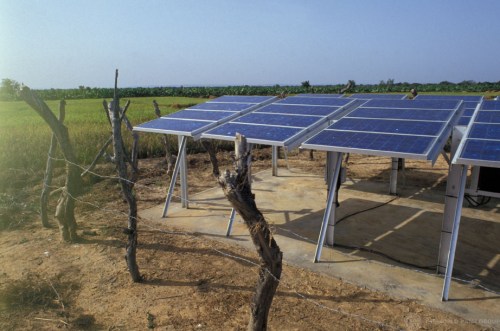
2765584331_7811d890d9_o
photo: Curt Carnemark /World Bank

At the Solar Power International conference this week, one of the more interesting panels was one that looked at bringing solar to the developing world. As I wrote in The New York Times:

By 2020, the world’s biggest potential solar markets will be found in the developing world, areas largely ignored by solar industry today, according to executives working to bring renewable energy to rural regions.

Just 1 percent of the world’s solar panel production has been installed in developing countries, said Michael Eckhart, the president of the American Council on Renewable Energy, during a panel discussion Tuesday at the Solar Power International conference in Anaheim, Calif.

“This is a scandal for our industry and we must find solutions,” said Mr. Eckhart, who has worked on solar projects in Africa and India.

The market in Africa, Asia and Latin America is potentially vast given that nearly 44 percent of the population of the developing world lacks access to electricity, according to Simon Rolland, a policy and development officer for the Alliance for Rural Electrification, based in Brussels.

Therein lies a conundrum: Bringing solar energy to those communities means building and financing off-the-grid solar arrays in remote locations that use batteries to store the electricity generated by the photovoltaic panels.

You can read the rest of the story here.

Read Full Post »

4055519813_53462058cc_b

photo: Solar Power International

I spent the week at the Solar Power International conference in Anaheim, Calif., where some 22,000 people gathered for the industry’s biggest get-together in the United States. As I wrote in The New York Times, solar industry leaders are taking an aggressive new approach to pushing their agenda:

A solar industry leader smacked down the oil and coal industries on Tuesday, calling for renewable energy proponents to open their wallets to level the playing field in Washington.

“The full promise of solar power is being restrained by the tyranny of policies that protect our competitors, subsidize wealthy polluters and disadvantage green entrepreneurs,” said Rhone Resch, chief executive of the Solar Energy Industries Association, according to prepared remarks for a speech he is to give at the opening of the Solar Power International conference.

The event, being held in Anaheim, Calif., is the solar industry’s biggest annual get-together in the United States, and is usually a celebration of the industry’s breakneck growth of recent years.

But Mr. Resch said that with the fossil fuel industry devoting tens of millions of dollars to defeat climate change legislation now before Congress, the solar industry needs to start throwing its weight around Washington.

You can read the rest of the story here.
Read Full Post »

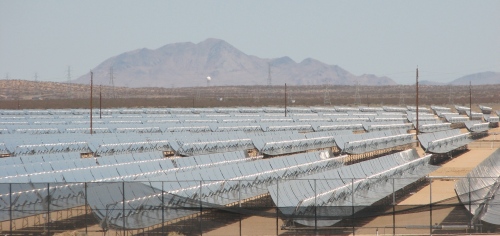
img_2914

photo: Todd Woody

California utility PG&E on Monday announced two new Big Solar deals that will likely to ramp up the debate over solar thermal power plants’ thirst for water in the desert Southwest. As I write in The New York Times:

The West’s water wars are likely to intensify with Pacific Gas and Electric’s announcement on Monday that it would buy 500 megawatts of electricity from two solar power plant projects to be built in the California desert.

The Genesis Solar Energy Project would consume an estimated 536 million gallons of water a year, while the Mojave Solar Project would pump 705 million gallons annually for power-plant cooling, according to applications filed with the California Energy Commission.

With 35 big solar farm projects undergoing licensing or planned for arid regions of California alone, water is emerging as a contentious issue.

The Genesis and Mojave projects will use solar trough technology that deploys long rows of parabolic mirrors to heat a fluid to create steam that drives an electricity-generating turbine. The steam must be condensed back into water and cooled for re-use.

Solar trough developers prefer to use so-called wet cooling in which water must be constantly be replenished to make up for evaporation. Regulators, meanwhile, are pushing developers to use dry cooling, which takes about 90 percent less water but is more expensive and reduces the efficiency –- and profitability – of a power plant.

NextEra Energy Resources, a subsidiary of the utility giant FPL Group, is developing the Genesis project in the Chuckwalla Valley in the Sonoran Desert. The twin solar farms would tap about 5 percent of the valley’s available water.

You can read the rest of the story here.
Read Full Post »

Lawrence Berkeley solar study

The Lawrence Berkeley National Laboratory this week released a comprehensive study on the cost of going solar in the United States. No surprise that the cost of installing a photovoltaic solar system has fallen 30 percent over the past decade, but there are some interesting developments. For instance, California may be the biggest solar state but it’s not the cheapest. As I write in The New York Times on Friday:

The cost of going solar fell last year, resuming a decade-long decline after several years of flat prices, according to a new study from Lawrence Berkeley National Laboratory.

The report found that the installed cost of residential and commercial photovoltaic systems in the United States dropped 30 percent overall between 1998 and 2008. But prices had become relatively stagnant between 2005 and 2007, as demand spiked and solar module makers ramped up production.

The global economic meltdown, however, along with a resulting oversupply of modules, led the cost of installing a solar system last year to fall from $7.80 in a watt to $7.50 a watt — though the actual cost to homeowners actually increased slightly as state incentives for installing solar arrays fell faster than module prices.

In states like California, the per-watt rebate declines as more solar systems are installed.

Among other findings: the researchers, who reviewed data from the installations of 52,356 solar systems, discovered that it is 10 percent less expensive to install a solar array on a new home than to retrofit an existing home.

And although California is by far the largest solar market in the United States with 81 percent of all installed photovoltaic systems, it isn’t the cheapest place to install small-scale solar.

That distinction goes to Arizona, where the installed cost of solar systems smaller than 10 kilowatts was $7.30 per watt compared to $8.20 per watt in California.

You can read the rest of the story here.
Read Full Post »

Rack Welding

photo: Skyline Solar

Silicon Valley startup Skyline Solar has joined other green energy companies beating a path to Detroit to take advantage of the down-and-out auto industry’s manufacturing might. As I write in the Los Angeles Times on Thursday:

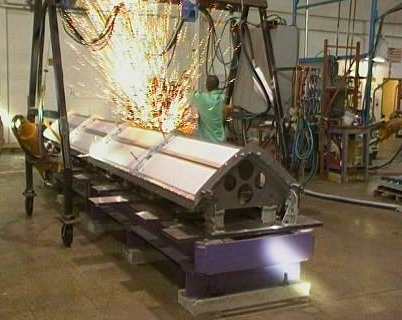
Skyline Solar, a Silicon Valley start-up, has become the latest green energy company to tap the struggling auto industry’s manufacturing muscle.

The company announced today that components for its solar power plants were being made in a Troy, Mich., car factory operated by Cosma International, a division of auto manufacturing giant Magna International.

The same machines that stamp out doors, hoods and other car body parts are now making long metal arrays that hold Skyline’s photovoltaic panels.

“It’s literally just carving out a piece of an existing facility and putting through a product that for all intents and purposes could be a new make and model of the next family sedan,” said Bob MacDonald, Skyline’s chief executive.  “Every time there’s a new model year for a Ford Mustang, they have a tool and die set they put into this press. So you just have a different tool and die in there that forms a new shape for Skyline.”

The bottom line, said MacDonald, is that Skyline has slashed its capital costs by taking advantage of Cosma’s existing manufacturing capability. He said Skyline of Mountain View, Calif., has contracts in place for small-scale solar farms. He said he could not divulge the details of those contracts but noted that Skyline has begun to receive shipments of arrays from Michigan.

It’s also a good deal for Cosma, whose parent company has agreed to acquire Opel from General Motors.

“Renewable energy trends and forecast data suggest significant growth potential for this market — we expect to participate in this growth potential,” Tracy Fuerst, a Magna spokeswoman, said in an e-mail.

You can read the rest of the story here.

Read Full Post »

nextlight renewable power agua caliente

That was quick: Just days after California Gov. Arnold Schwarzenegger vetoed legislation that would have limited utilities’ ability to buy out-of-state renewable energy, utility PG&E on Thursday asked regulators to approve a deal with an Arizona solar farm to supply 290 megawatts of electricity. As I write in The New York Times on Friday:

Pacific Gas & Electric, the big California utility, asked regulators on Thursday to approve the purchase of electricity from an Arizona solar power plant, only days after Gov. Arnold Schwarzenegger vetoed legislation that would have limited utilities’ ability to tap out-of-state projects to meet renewable energy mandates.

NextLight Renewable Power will construct the 290-megawatt Aqua Caliente photovoltaic farm on private land in Yuma County, Ariz. The company, based in San Francisco, signed a deal with P.G.&E. in June to supply 230 megawatts from a solar power plant to be built outside of Los Angeles.

The legislation vetoed by Mr. Schwarzenegger on Sunday would have required California utilities to obtain 33 percent of their electricity from renewable sources by 2020, mostly from in-state projects.

Environmental groups and unions supported that provision as a way to limit the need to build new transmission lines and to keep construction jobs in California. But the governor said it would hamstring utilities from complying with the 33 percent target, which he supports.

According to the filing the utility made Thursday, Arizona regulators have already approved the project and NextLight expects to obtain county building permits within a few months. In contrast, the licensing of a solar power plant in California can take years. The Agua Caliente project is also located near existing transmission lines that connect to California’s power grid.

You can read the rest of the story here.

Read Full Post »

IMG_1214

photo: Todd Woody

Can a state that gets 95 percent of its electricity from coal-fired power plants go green? The Natural Resources Defense Council thinks so. In a report released this week, the environmental group lays out how Indiana can become the California of the Midwest when it comes to renewable energy. As I write in The New York Times on Friday:

Coal-dependent Indiana could become one of the nation’s greenest states by tapping rural resources to generate renewable energy, according to a new report issued by the Natural Resources Defense Council.

The Hoosier State now obtains 95 percent of its electricity from plants running on coal — largely imported from Wyoming and elsewhere — but it could profit as an exporter of wind energy and machinery, the report said.

“Indiana has some of the best wind potential in the eastern U.S. and has a competitive advantage as a wind producer over most other states because of its location,” said the report’s author, Martin R. Cohen, said during a conference call on Wednesday.

Mr. Cohen noted that while the wind blows stronger in states like North Dakota and Nebraska, Indiana already has the transmission system in place to bring wind-generated electricity to eastern cities.

If Indiana increased wind energy production to 4,500 megawatts from its current 530 megawatts, it would create thousands of jobs and attract turbine manufacturers, according to the report. An owner of a 500-acre farm could earn $30,000 a year from leasing land for wind turbines, Mr. Cohen estimated.

Farmers also could profit, the report said, if Indiana starts harvesting corn stalks, wheat stalks and soybean residue and uses the biomass either for power production or to make ethanol.

You can read the rest of the story here.
Read Full Post »

POWERHOUSE1

photo: Dow Chemical

Industrial giant Dow Chemical is getting into the residential solar business with a potentially game-changing product: A “solar shingle” that can be integrated into any asphalt-tiled roof and installed by any roofer. As I wrote in The New York Times on Wednesday:

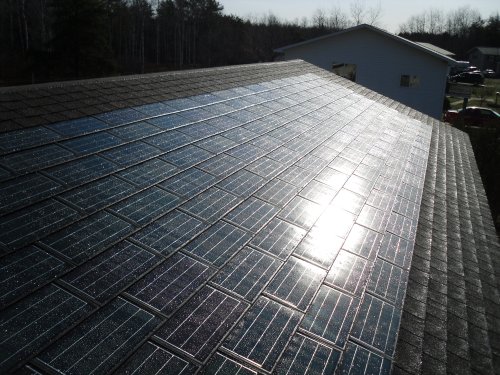
Dow Chemical has unveiled a residential roof shingle in the form of a solar panel designed to be integrated into asphalt-tiled roofs.

Jane Palmieri, managing director of Dow’s Solar Solutions unit, said the Powerhouse thin-film shingle slashes installation costs because it can be installed by a roofer who is already building or retrofitting a roof.

“As a roofer is nailing asphalt shingle on roof, wherever the array needs to be installed he just switches to solar shingle,” said Ms. Palmieri, who said the solar singles are similarly attached to the roof with nails.

“You don’t have to have a solar installation crew do the work or have an electrician on site,” she added. “The solar shingle can be handled like any other shingle – it can be palletized, dropped from a roof, walked on.”

An electrician is still needed to connect the completed array to an inverter and to a home’s electrical system, but unlike conventional solar panels that must be wired together, the solar shingles plug into each other to form the array.

Dow plans to begin test-marketing the solar shingle in mid-2010, initially targeting new-home construction. Ms. Palmieri said the market could be worth $5 billion by 2015 and noted that 90 percent of homes in the United States use asphalt shingles.

You can read the rest of the story here.

Read Full Post »

« Newer Posts - Older Posts »

Design a site like this with WordPress.com
Get started