Feeds:
Posts
Comments

Archive for the ‘renewable energy’ Category

photo: GE

I wrote this story for Grist, where it first appeared.

General Electric on Wednesday gave a jump-start to Better Place, the Silicon Valley startup developing an electric car infrastructure in several countries.

Better Place plans to deploy a network of urban charging posts and swapping stations where drivers can exchange depleted company-owned batteries for fresh ones when they need to make trips that exceed their car’s range. GE has agreed to help finance up to 10,000 of those batteries in Better Place’s first two markets: Denmark and Israel. That’s no small matter, given that Better Place faces huge capital outlays for battery purchases.

The global conglomerate will also make its WattStation, a sleek electric car charging post that it unveiled in July in San Francisco, compatible with Better Place’s network.

In addition, GE and Better Place will collaborate on an effort to persuade companies to electrify their vehicle fleets and plug into the electric car charging networks that Better Place plans to build in the San Francisco Bay Area; Ontario, Canada; Australia; and Europe.

It’s not the first time GE has dabbled in the nascent electric car industry. In 2008, the company invested $4 million in Think, the Norwegian electric carmaker.

In yet another deal involving a multinational conglomerate and a California startup, Sharp late Tuesday said it had acquired Recurrent Energy, a San Francisco-based solar developer, for $305 million in cash.

While most people may associate Sharp with televisions and other consumer electronics, the Japanese company is also one of the world’s biggest solar panel makers. Recurrent builds small-scale photovoltaic power plants. It has signed contracts for projects that would generate 330 megawatts, and has another nearly another 1,700 megawatts’ worth of deals in development.

During a conference call on Wednesday, Recurrent’s chief executive, Arno Harris, said Recurrent would retain its name and become a division of Sharp and that he and his team would remain in place.

While the buyout is another sign of the consolidating solar industry, it also indicates that big solar panel makers like Sharp feel pressure from the fast rise of low-cost Chinese manufacturers to diversify their business.

Acquiring Recurrent gives Sharp another source of revenue but it won’t necessarily provide a market for Sharp’s own solar panels. In a telling provision of the acquisition, Harris said Recurrent won’t be compelled to buy Sharp solar panels and can keep its current suppliers. Those include Yingli Green Energy, a Chinese company that captured a third of the California market last year thanks in large part to a big deal with Recurrent.


Read Full Post »

photo: California Energy Commission

In Friday’s New York Times, I wrote about California regulators’ licensing of a 1,000-megawatt solar thermal power plant, which would be the world’s largest solar energy complex:

California regulators have licensed what is for the moment the world’s largest solar thermal power plant, a 1,000-megawatt complex called the Blythe Solar Power Project to be built in the Mojave Desert.

By contrast, a total of 481 megawatts of new solar capacity was installed in the United States last year, mostly from thousands of rooftop solar arrays, according to the Solar Energy Industries Association, a trade group.

“Given the challenge of climate change at this time, it is very important to reduce fossil fuel use by moving forward with the largest solar project in California,” Robert Weisenmiller, a member of the California Energy Commission, said at a hearing Wednesday in Sacramento after a unanimous vote to approve the Blythe project.

“We’re taking a major step toward reducing the threat of future climate change impacts on the state, and at the same time the other real challenge for the state is the economy,” he added, referring to 604 construction jobs and 221 permanent jobs that the Blythe project would create in an area of California where the unemployment rate was 15 percent this summer.

After years of environmental reviews, the California Energy Commission has in the past three weeks licensed solar thermal farms that would generate 1,500 megawatts of electricity when completed.

A commission spokeswoman said the commissioners anticipated making licensing decisions by the end of 2010 on additional solar projects that would produce another 2,829 megawatts. At peak output, those solar farms would generate the equivalent electricity produced by several large nuclear power plants.

Developers are racing to start construction before federal tax incentives for big renewable energy projects expire at year’s end.

If all the projects are built, they would create 8,000 construction jobs and 1,000 permanent jobs, according to the energy commission.

At peak operation, the Blythe solar complex would supply enough electricity for 800,000 homes. The multibillion-dollar project will be built in four 250-megawatt phases.

It is notable for being the first big solar project to be licensed that would be built on federal land. The United States Bureau of Land Management is expected to decide by the end of October whether to approve the Blythe complex.

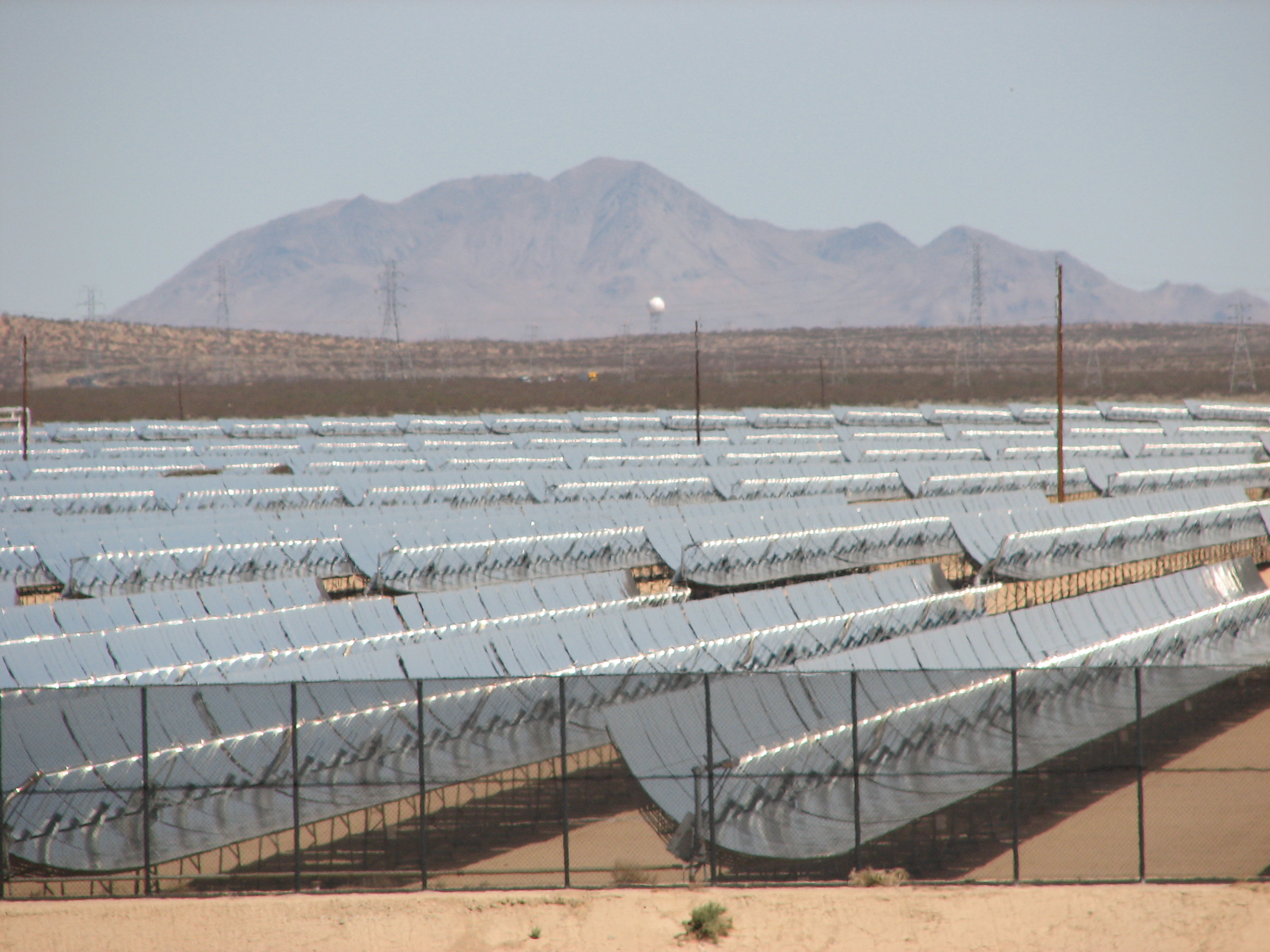
The project will be constructed by Solar Millennium, a German developer, and will cover 9.3 square miles in Riverside County in Southern California with long rows of parabolic troughs. The solar reflectors focus the sun on liquid-filled tubes suspended over the mirrors to create steam that drives an electricity-generating turbine housed in a central power block.

You can read the rest of the story here.

Read Full Post »

I wrote this story for Grist, where it first appeared.

The campaign against Proposition 23, the California ballot initiative that would suspend the state’s global warming law, took in more than a half million dollars in contributions this week. Meanwhile, fundraising by the oil companies backing the measure was so lackluster it prompted a plea for help from the petrochemical industry.

“A defeat for Proposition 23 in California could energize environmental fanatics around the country and in Washington to match California’s destructive policies with their own versions of AB32,” wrote Charles T. Drevna, president of the National Petrochemical & Refiners Association, in an email first reported by The New York Times. “We’ve raised about $6 million so far, but unfortunately in California’s expensive media market this is not enough to win the fight against environmental zealots led by Gov. Arnold Schwarzenegger, who seems hell-bent on becoming the real-life Terminator of our industry.”

“I am pleading with each you,” Drevna continued, “for our nation’s best interest and for your company’s own self-interest, please contact me and tell me how much you can contribute to this critical effort as soon as possible. Nov. 2 is drawing near.”

The Texas oil companies backing the initiative made news recently when they secured a $1 million donation from the billionaire Koch brothers, who bankroll various right-wing causes. But the only sizeable donation to the Yes on 23 campaign this week came from Tower Energy Group, a Southern California-based petroleum wholesaler, which contributed $100,000 on Monday. Meanwhile, according to campaign finance records, the anti-Prop 23 forces have been having a pretty good few weeks.

On Monday, Susan Packard Orr, yet another daughter of David Packard, the late co-founder of Hewlett-Packard, contributed $250,000 to the No campaign. She joins her two sisters who have given a total of $201,895 to the effort to defeat Prop 23.

On Wednesday, William Patterson of SPO Partners, a Marin County, Calif., private investment firm, also gave $250,000. The California chapter of the Audubon Society stepped up with a $100,000 donation last week. Earlier in the month, Environment California, a non-profit, made a $100,000 contribution.

Another non-profit, the San Francisco-based Tides Foundation, put in $40,000 while a high-profile San Francisco real estate magnate, Douglas Shorenstein, contributed $25,000.

The big Silicon Valley venture capitalists, who vociferously oppose a ballot initiative that could derail the billions of dollars they’ve invested in green technology startups, have largely remained no-shows on the No on 23 donor roll. Though Tom Baruch, founder of CMEA Capital, did give $25,000 on Wednesday, and John Doerr, a leading green tech investor with Kleiner Perkins Caufield & Byers, is a notable exception with his $500,000 investment to defeat Prop 23.

If Silicon Valley’s venture capitalists decide to open their checkbooks, game on.

Read Full Post »

I wrote this story for Grist, where it first appeared.

The same day this week that The New York Times published an extensive report by correspondent Keith Bradsher on China’s massive subsidies for renewable energy companies, Ernst & Young released a study showing that, not surprisingly, China has overtaken the United States as the most attractive place for green tech investment.

“China’s steady rise to pole position has been underpinned by strong and consistent government support for renewable energy,” Ben Warren, Ernst & Young’s environment and energy infrastructure advisory leader, said in a statement. “This, together with substantial commitment from industry and the sheer scale of its natural resources, means that its position as top spot for renewable energy investment is well merited.”

Some of that government support may violate World Trade Organization rules. On Thursday, an American union, the United Steelworkers, filed an unfair trade complaint against China with the Office of the United States Trade Representative.

But the Ernst & Young report points to failures on the part of the U.S. government to take action that would attract green investors.

For one thing, Congress has so far failed to establish a national Renewable Energy Standard that would require the country’s utilities to obtain a certain percentage of electricity from non-carbon-emitting sources.

Also, a federal tax subsidy program that is spurring construction of big solar power plants expires at the end of the year and legislation to extend the incentives is languishing in Congress.

“Although the United States remains a highly attractive location for investors in renewable energy, it is clear that recent events have eased momentum,” said Warren. “The U.S. market continues to have significant potential but requires consistent legislative support to provide investors with the long-term confidence they need.”

China, in contrast, “aims to reach an installed capacity of 300GW [gigawatts] of hydro, 70GW of nuclear, 100GW of wind, and 20GW of solar capacity by 2020,” according to the Ernst & Young study.

Reports by the U.S. Energy Information Agency provide a glimpse of the green imbalance of trade between the two countries. The figures from 2008 — apparently the latest available from the government — show that fewer than 1 percent of U.S.-made solar modules were shipped to China while nearly 23 percent of Chinese-made photovoltaic modules were exported to the U.S.

Since then, Chinese imports have risen dramatically. At the end of 2009, for instance, Chinese firms supplied about half the California solar market alone, according to Bloomberg New Energy Finance, a consulting firm.

What China is not exporting, of course, is green jobs.

Read Full Post »

I wrote this story for Grist, where it first appeared.

Talk about sporting greens: On Wednesday, all of the United States’ professional sports leagues said they would distribute a guide on how to switch to renewable energy and urge their teams to solarize their stadiums.

The guide was prepared by the Natural Resources Defense Council (NRDC) and the Bonneville Environmental Foundation and marks a new alliance between environmentalists and the nation’s baseball, football, hockey, and soccer teams.

“It’s not a league mandate, it’s not a requirement for stadiums and arenas to install solar panels, but it indicates an important cultural shift recognized by professional sports that all arenas and stadiums in the country should at least consider and evaluate the opportunity that solar power might provide,” Allen Hershkowitz, a senior scientist with the NRDC, said during a conference call Wednesday.

“Frankly, sports matter. Sports matter a lot,” he added. “Sports is one of the most iconic and influential sectors of our society and frankly we need to have a cultural shift as well as a technical and economic shift if we’re going to advance and move to sustainability.”

In other words, if Jill Six-Pack sees that the Yankees have gone solar she might consider doing the same.

“We really have the ability to shift the dial,” said Darryl Benge, the assistant general manager of Qwest Field in Seattle, home to the Seahawks and Sounders. “We basically bring together small cities on game day.”

Representatives from the National Basketball Association, the National Hockey League, and other stadiums said that economics as well as the environment were pushing them to go green.

Benge noted that Qwest Field’s electricity rates had jumped 18 percent this year, which played a part in the stadium’s decision to solicit bids to install a 600-kilowatt solar array.

In Los Angeles, the Staples Center flipped the switch on a 345.6-kilowatt photovoltaic system that has so far saved $100,000 in electricity costs, according to Lee Zeidman, executive vice president for operations for the facility.

The Staples Center has gone beyond solar to install waterless urinals that save seven million gallons of water annually, and switched to non-toxic cleaning products.

Other teams have tackled the waste issue. Scott Jenkins, the vice president of ballpark operations for the Seattle Mariners, said the team has saved $1 million over three years by recycling 80 percent of the waste generated at games.

Gary Betteman, commissioner of the National Hockey League, said 30,000 shopping bags were replaced with reusable totes during the Stanley Cup, and he noted that several NHL venues have installed solar panels.

Stadium managers acknowledged that sports’ biggest carbon footprint comes from fans driving to and from games. The challenge, they said, will be to get more fans to take public transportation as well as to build arenas in urban areas with accessible mass transit.

For his part, Hershkowitz said he was astounded that it has taken the environmental movement 40 years to forge a strong alliance with professional sports.

“If you want to change the world you don’t emphasize how different you are from everybody else,” he said. “You focus on your similarities.”

Read Full Post »

photo: Southern California Edison

I wrote this story for Grist, where it first appeared.

The California Legislature started out the week in the green by passing the nation’s first energy storage bill. But legislators quickly ran into the red Wednesday when they failed to approve legislation to impose a statewide ban on plastic bags, or codify Governor Arnold Schwarzenegger’s executive order that utilities obtain a third of their electricity from renewable sources by 2020.

But don’t go crying in your organic beer yet. On Thursday, the California Public Utilities Commission signed off on 650 megawatts of new solar energy contracts and programs.

Whch all goes to show that in the Golden State, environmental politics are not green and brown. And despite the fate of Proposition 23, the oil company-bankrolled ballot initiative to suspend California’s global warming law, the state’s panoply of green laws allows progress to be made on various fronts.

The utilities commission, for instance, approved contracts for two giant photovoltaic solar farms to be built in the Mojave Desert by First Solar. Together they will supply 550 megawatts of electricity to the utility Southern California Edison.

Commissioner Timothy Simon noted at Thursday’s energy commission meeting in San Francisco that the price for that electricity is lower than previous solar contracts, another sign that photovoltaic power is edging ever closer to edging out fossil fuels. The price also speaks to the ability of First Solar, the Tempe, Ariz.-based thin-film solar company, to win and begin to execute big projects.

The commission also greenlighted San Diego Gas & Electric’s proposal for 100-megawatt’s worth of small-scale photovoltaic projects.

Most installations will be 1 or 2 megawatts and built in parking lots or other open spaces where they can be plugged into the grid without expensive transmission upgrades. The move comes on top of 1,000 megawatts of distributed solar generation that the utilities commission previously approved for California’s two other big utilities.

Michael R. Peevey, the president of the utilities commission, said despite the failure of the state legislature to institutionalize the 33 percent renewable portfolio standard — currently subject to reversal by the next governor — California was on a solar streak.

“With approval of this project we’ll have added 1,100 megawatts of photovoltaic electricity by the three utilities,” said Peevey, noting that separately the California Solar Initiative will add another 3,000 megawatts and that by year’s end regulators are poised to approve big solar farms that will generate 4,700 megawatts of electricity.

“These are big, big numbers,” Peevey added. “Independent of the legislature, we’re moving to a RPS economy.”

Read Full Post »

I wrote this story for Grist, where it first appeared.

The California Legislature has passed the nation’s first energy storage bill, which could result in the state’s utilities being required to bank a portion of the electricity they generate.

Assembly Bill 2514 now heads to the desk of Gov. Arnold Schwarzenegger, who has made climate change and green technology his political legacy as his final term winds down.

Energy storage is considered crucial for the mass deployment of wind farms, solar power plants, and other sources of intermittent renewable energy, as well to build out the smart grid.

On the West Coast, for instance, the wind tends to blow hardest at night when demand for electricity is low. If utilities can store that wind-generated power — and energy from solar farms — in batteries, flywheels, and other devices, they can avoid building and firing up those billion-dollar, greenhouse gas-emitting, fossil-fuel power plants that are only used when demand spikes.

AB 2514 won the support of Jerry Brown, the California attorney general who is the Democratic candidate for governor. The Sierra Club and union groups also support the measure. Various business organizations, including the California Chamber of Commerce, opposed the bill.

Sponsored by Assembly member Nancy Skinner, a Berkeley Democrat, the bill was stripped of its more stringent provisions by the time it emerged from the legislative sausage-making process on Friday.

Originally, AB 2514 required California’s three big investor-owned utilities — PG&E, Southern California, and San Diego Gas & Electric — to have energy storage systems capable of providing at least 2.25 percent of average peak electrical demand by 2015. By 2020 the target would rise to at least 5 percent of average peak demand.

The bill now only requires that the California Public Utilities Commission determine the appropriate targets — if any — for energy storage systems, and then require the Big Three utilities to meet those mandates by 2015 and 2020. Publicly-owned utilities must set energy storage system targets to be met by 2016 and 2021.

Still, AB 2514 is a significant step and could ultimately help jump-start the market for energy storage, which remains in its infancy.

PG&E, for instance, plans to build an experimental facility that would tap electricity generated during peak wind farm production to pump compressed air into an underground reservoir. When demand jumps, the reservoir would release the air to run electricity-generating turbines which are capable of producing 300 megawatts of power.

And last week, PG&E proposed building a “pumped hydro” storage system. As its name implies, the system would pump water from one reservoir to another reservoir at a higher elevation during times of peak renewable energy production. Water in the upper reservoir would then be sent back downhill to power a turbine when electricity demand begins to spike.

Read Full Post »

photo: Sonoma County

In The New York Times on Tuesday, I wrote about the latest nail in the coffin of Property Assessed Clean Energy, or PACE, programs:

Many homeowners who participated in a program that let them repay the cost of solar panels and other energy improvements through an annual surcharge on their property taxes must pay off the loans before they can refinance their mortgages, two government-chartered mortgage companies said Tuesday.

The guidance came from Fannie Mae and Freddie Mac as efforts to resolve a dispute over the program — called Property Assessed Clean Energy, or PACE — have failed.

Approved by 22 states, the programs let municipalities sell bonds to finance improvements in energy efficiency. Homeowners typically pay back the loans over 20 years through an annual property tax assessment. As is the case with other property tax assessments, a lien is placed on the home that has priority over the mortgage if the homeowner defaults.

In July, the Federal Housing Finance Agency, which oversees Fannie and Freddie, effectively derailed the program when it issued guidance to lenders stating that the liens violated the agency’s underwriting standards. Fannie and Freddie buy and sell most of the nation’s home mortgages.

That guidance led to the halt of most PACE programs and left in limbo those homeowners who had already taken out energy improvement loans.

On Tuesday, Fannie and Freddie issued guidance to lenders stating that borrowers with sufficient equity in their homes must pay off the loans before refinancing. Those homeowners without enough equity to take cash out of their home to pay off the lien can refinance with the loan in place.

“Fannie Mae will not purchase mortgage loans secured by properties with an outstanding PACE obligation unless the terms of the PACE program do not permit priority over first mortgage liens,” according to the guidance.

The program’s proponents have argued that it overcomes obstacles to installing expensive solar panels and making other energy efficiency improvements that reduce greenhouse-gas emissions while creating jobs.

In response to the Federal Housing Finance Agency’s actions, the California attorney general’s office filed a lawsuit in July against Fannie and Freddie, as did the Sierra Club. Meanwhile, legislation has been introduced in Congress to allow the program to go forward.

“It’s absolutely clear now that the F.H.F.A. is not at all interested in working out a solution that would allow PACE to proceed — the agency appears intent only on obstructing the program,” Janill L. Richards, a California supervising deputy attorney general, wrote in an e-mail.

You can read the rest of the story here.

Read Full Post »

photo: PG&E

I wrote this story for Grist, where it first appeared.

It’s been a big week for Big Solar.

On Wednesday, the California Energy Commission approved a license for the nation’s first new large-scale solar thermal power plant in two decades. Over the next month, the energy commission is expected to green-light three more big solar farms to be built in the Mojave Desert. The projects would collectively generate nearly 2,000 megawatts of electricity. At peak output, that’s the equivalent of a couple of large nuclear power plants.

Less noticed but equally momentous were developments this week on the small-scale solar front.

On Tuesday, an administrative law judge with the California Public Utilities Commission (CPUC) issued a proposed decision that would establish a world-first reverse auction system for renewable energy projects. The idea is to build 1,000 megawatts of decentralized energy generation by allowing developers to bid on projects that would each produce between one and 20 megawatts of electricity. Projects could include small solar farms built on vacant suburban land, or photovoltaic arrays placed on top of wastewater treatment plants or on any other large structures with unused rooftop space.

Think of it as eBay for green energy.

The goal is to accelerate the market for small-scale photovoltaic systems by requiring California’s three big investor-owned utilities to hold auctions twice a year where developers bid on projects that can be built quickly — within 18 months — and plugged into the existing power grid.

By letting the market essentially determine electricity prices rather than the government setting a premium rate to be paid for renewable energy, California hopes to avoid the boom-and-bust cycles that have whipsawed the European solar industry when subsidies have been cut.

“This mechanism would also allow the state to pay developers a price that is sufficient to bring projects online but that does not provide surplus profits at ratepayers’ expense,” utilities commission staff wrote in proposing the so-called reverse auction mechanism last year. “Providing a clear and steady long-term investment signal rather than providing a pre-determined price can create a competitive market.”

While the program would initially set up an auction for 1,000 megawatts, administrative law judge Burton W. Mattson wrote in his decision that that cap could be raised in the future if the auction system is successful.

The proposed decision now needs the approval of the CPUC, which seems a foregone conclusion.

In a sign that there will be no shortage of bidders for solar projects, utility Southern California Edison this week submitted for regulatory approval contracts for eight distributed photovoltaic farms that would generate a total of 140 megawatts.

Most of the mini-power plants will generate 20 megawatts and can be located near utility substations, avoiding the need for expensive new transmission projects.

Southern California Edison also requested approval of contracts for two small biomass power plants and three wind energy projects, one of which will generate 4 megawatts while the other two would each produce 20 megawatts at peak output. Altogether the power purchase agreements are worth $556 million.

The utility said that while it was soliciting contracts for a total of 250 megawatts, it received applications to build projects that would generate nearly twice that amount of electricity.

Read Full Post »

photo: Todd Woody

In Wednesday’s New York Times, I write about the California Energy Commission green-lighting the nation’s first big solar power plant in 20 years:

California regulators on Wednesday approved a license for the nation’s first large-scale solar thermal power plant in two decades.

The licensing of the 250-megawatt Beacon Solar Energy Project after a two-and-a-half-year environmental review comes as several other big solar farms are set to receive approval from the California Energy Commission in the next month.

“I hope this is the first of many more large-scale solar projects we will permit,” said Jeffrey D. Byron, a member of the California Energy Commission, at a hearing in Sacramento on Wednesday. “This is exactly the type of project we want to see.”

Developers and regulators have been racing to license solar power plants and begin construction before the end of the year, when federal incentives for such renewable energy projects expire. California’s three investor-owned utilities also face a deadline to obtain 20 percent of their electricity from renewable sources by the end of 2010.

Still, it has been long slog as solar power plants planned for the Mojave Desert have become bogged down in disputes over their impact on protected wildlife and scarce water supplies.

In March 2008, NextEra Energy Resources filed an application to build the Beacon project on 2,012 acres of former farmland in California’s Kern County. Long rows of mirrored parabolic troughs will focus sunlight on liquid-filled tubes to create steam that drives an electricity-generating turbine.

Some rural residents immediately objected to the 521 million gallons of groundwater the project would consume annually in an arid region on the western edge of the Mojave Desert. After contentious negotiations with regulators, NextEra agreed to use recycled water that will be piped in from a neighboring community.

“It’s been a lengthy process, an almost embarrassingly long lengthy process,” said Scott Busa, NextEra’s Beacon project manager, at Wednesday’s hearing. “Hopefully, we’re going from a lengthy process to a timely process.”

You can read the rest of the story here.

Read Full Post »

« Newer Posts - Older Posts »

Design a site like this with WordPress.com
Get started