Feeds:
Posts
Comments

Archive for the ‘renewable energy’ Category

cool-earth-solar-balloon1

Image: Cool Earth

LIVERMORE, Calif. – It sounds like something out of one of those do-it-your-self magazines: Stitch together two buck’s worth of thin-film plastic – the stuff potato chip bags are made of – stick in a photovoltaic cell, inflate with air and, voilà, you’ve got yourself a “solar balloon” that will generate a kilowatt of electricity. String together 10,000 balloons and you’ve got a solar power plant that can power a town.

California startup Cool Earth Solar believes this high-low tech approach is what will make its solar power plants competitive with fossil fuels. Green Wombat visited Cool Earth’s Livermore headquarters recently for a Fortune Magazine story and got a look at the technology.  “We wanted to do solar in a very different way,” says Cool Earth CEO Rob Lamkin.

Different it is. We’re standing in Cool Earth’s back shop in front of an eight-foot-high solar balloon. Two pounds of plastic are pumped with a third of a pound of air per square inch to make the balloon taut. The curved top two-thirds of the balloon is transparent and the bottom is made of the silvery reflective plastic you’d find lining a bag of junk food. A steel strut inside will hold a tiny but highly efficient solar cell, which is the most high-tech component of the balloon.

Here’s the ingenious part of the technology, developed by scientists at Caltech: Instead of using expensive optics to concentrate sunlight on the solar cell, Cool Earth manipulates the air pressure inside the balloon to change the shape of the mirrored surface so that it focuses the maximum amount of sunlight on the solar cell, boosting electricity generation 300 to 400 times.

By replacing expensive materials like steel with cheap-as-chips plastic and air, Cool Earth aims to dramatically lower the price of solar electricity. “We strongly believe it’s all about cost,” says Lamkin, “not how clever the technology is or if it is 1% more efficient.”  For instance, the amount of aluminum in a can of Coke would provide enough reflective material for 750 balloons, he notes.

The company, founded in 2007, has raised $21 million so far. It plans to build solar power stations in the 10-megawatt to 30-megawatt range. Two to six balloons will be suspended on wood poles and anchored with cables about 10 feet off the ground. That means the earth won’t have to be graded, reducing the environmental impact of Cool Earth’s power plants – a growing issue given that most solar thermal power stations will be built in the desert, home to a plethora of protected wildlife. The relatively compact size of Cool Earth’s power stations also means they can be located close to existing transmission lines.

A prototype power plant is being built in a field across the street from Cool Earth’s offices and Lamkin says a 1.5 megawatt plant will be constructed early next year in the Central Valley town of Tracy. The electricity probably will be sold to utility PG&E (PCG) under a state renewable energy program.

Unlike big solar thermal plants, photovoltaic power stations do not need to obtain a license from the California Energy Commission, which can be an expensive two-year ordeal. Lamkin estimates that a Cool Earth power plant can be up and running in six months, which should appeal to utilities like PG&E, Southern California Edison (EIX) and San Diego Gas & Electric (SRE), which are under the gun to meet state mandates to obtain 20% of their electricity from renewable sources by 2010.

Now Cool Earth just needs to make the technology work in the field. It has yet to produce electricity from its balloons, as the solar cells are still being produced. Also unknown is how the balloons will operate in real-world conditions. Lamkin says they can withstand 125-mile-an-hour winds. They have a lifespan of just five years, but Cool Earth expects to replace the balloons every year, given their low cost.

“Our major structural element is air, which so far is free,” Lamkin says. “And the sun isn’t taxed either.”

Yet.

Read Full Post »

The economy may be all trick and no treat, but you wouldn’t know it from First Solar, one of the few public solar cell makers and thus a bellwether for the industry. This week the Tempe, Ariz.-based company reported solid third-quarter earnings and unveiled two deals that mark a big expansion in the U.S. market.

It agreed to supply solar installer SolarCity with 100 megawatts of thin-film modules and made a $25 million investment in the Silicon Valley startup – which represents a 10% stake, valuing SolarCity at $250 million. The other deal didn’t get much attention – it was buried in the earnings report – but is significant nonetheless. First Solar (FSLR) will team up with utility giant Edison International (EIX)‘s power plant subsidiary, Edison Mission Energy, to develop large-scale solar power stations. (First Solar just completed a 2.4 megawatt project for Southern California Edison as part of the utility’s 250-megawatt commercial rooftop initiative and will finish by year’s end a 12-megawatt solar power plant in Nevada for Sempra (SRE).)

“By combining Mission’s extensive track record of power project development with First Solar’s low-cost systems and construction capability, we believe we’ve created a powerful engine for future growth in the U.S. utilities segment,” First Solar CEO Mike Ahearn said during the company’s earnings call Wednesday, according to a transcript published by the Seeking Alpha business blog.

But it was Ahearn’s comments on the European market – 85% of First Solar’s business is in Germany, for instance – that is of most interest to investors.

While he predicts the European market will remain strong – First Solar expects its 2009 net sales to range from $2 billion to $2.1 billion, up from $1.22 to $1.24 for 2008 – he did note some red flags, particularly for utility-scale solar power stations.

“Our review indicates that solar projects lending outside of Germany has essentially stopped for the time being,” Ahearn said. “Today, we have identified potential financial risk in our customer base that represent approximately 15% to 20% of our planned sales in Europe in 2009.”

“We believe most of our European customers outside of Germany have sufficient balance sheet strength to bridge any near-term projects delays,” he added.

During the Solar Power International conference in San Diego this month, there was much buzz that solar companies that had ramped up their production capacity over the past couple of years would be hit by an oversupply of solar modules just as customers get crunched by the credit crisis.

But Ahearn told analysts on Wednesday that First Solar’s thin-film modules – which are made by depositing solar cells on plates of glass and use minimal amounts of expensive silicon – would continue to sell for less than conventional cells and thus remain attractive to customers. “We therefore assume that any price competition is unlikely to have a sustained impact on First Solar,”  he said.

Despite First Solar’s moves into the U.S. market, Ahearn acknowledged the immediate future is uncertain. While Congress extended a key investment tax credit for eight years as part of the financial bailout package, investors have lost their appetite for tax equity partnerships that would buy those credits from solar companies in exchange for financing the construction of power plants.

“In the short-term, our review indicates that the traditional investors in tax equity – financial institutions – have largely stopped participating,” Ahearn said. “We assume some of these investors will return to the market in 2009, but the timing and future cost of this funding is difficult to predict. The possibility of more expensive tax equity and its impact on solar electricity prices for both new and pending projects remains a major uncertainty going into 2009.”

Read Full Post »

photo: Todd Woody

CEDAR RAPIDS, Iowa – For the past four years, the global wind industry has grown at a Google-like 30% clip as wind farm developers and turbine makers met demand for the one renewable energy source that has become competitive with fossil fuels. In the United States alone, new wind capacity will have jumped 50% in 2008.

Now the credit crunch is taking its toll – at least when it comes to forecasts for the industry’s prospects in 2009. Over the past week, analysts and industry insiders have ratcheted back growth predictions due to uncertainty over whether developers will be able to secure financing for the ever-bigger wind farms on the drawing boards.

“There is little visibility into the project finance market over the next 18 months,” wrote HSBC analysts Robert Clover, Charanjit Singh and James Magness in a report issued last week. “Thus far, company management in the wind sector continues to say that it is not experiencing a slowdown in growth, although developers say that finance is more expensive than it was. We do not believe that the long-term growth story has been undermined, but expect a period of reduced growth.”

The HSBC analysts predict the industry won’t grow at all next year. Meanwhile, the American Wind Energy Association, a Washington, D.C., trade group, also expects a slowdown in 2009.

“Clearly the market’s perception of growth for the wind industry has declined dramatically, but against a backdrop of virtually no industry data points,” the HSBC analysts acknowledged.

Ah, there’s the rub. Aside from the fear of the future that threatens to paralyze just about every industry, absent a complete collapse of capitalism the wind industry would seem poised to continue its run, albeit at a slower pace. (The nascent Big Solar business, in contrast, finds itself in a more precarious situation.)

In the U.S., state mandates that require utilities to obtain a growing percentage of electricity from renewable sources will drive growth for years into the future. That’s the reason you’re seeing plans for gigawatt-sized wind farms like the 4-gigawatt one T. Boone Pickens is building in Texas. As analysts were souring on the industry’s prospects last week, oil giant BP’s (BP) wind subsidiary finalized a deal with California turbine maker Clipper Windpower to build a five-gigawatt project – the world’s largest, sorry T. Boone – in South Dakota. (Of course, that’s little comfort to investors who have seen wind stocks take big hits in recent weeks. Nor is it good news for two U.S. startups that have filed for IPOs –  First Wind and Noble Environmental.)

The wind developers and turbine makers Green Wombat has talked to in recent weeks for an upcoming Fortune magazine story say the long-term impact of the financial crisis remains unknown at this point. A large pipeline of orders for windmills – Danish turbine king Vestas’ orders spiked 52% from the first quarter to the second, according to HSBC – suggests that growth will continue unless wind farm developers start canceling projects – something that hasn’t happened to date.

The wombat happened to be at Clipper’s Cedar Rapids, Iowa, turbine factory on Tuesday and put the question to Bob Gates, the Carpinteria, Calif.-based company’s vice president of operations. Clipper is only one of two U.S. turbine makers, the other being General Electric (GE). (GE acquired its turbine operations from a bankrupt Enron, which itself had bought the business in 1997 from Clipper’s founder.)

“I think growth will be flat next year and that may continue to 2010 and then go back up,” said Gates as workers assembed gigantic drive trains for Clipper’s 2.5-megawatt Liberty turbine. “You have to put in your order for some components a year in advance, so if demand drops in 2009 you’ll have fewer turbines to bring to market in 2010.”

Read Full Post »

photo: Ausra

The promise and peril of large-scale renewable energy was on display Thursday as California’s first solar power plant of the 21st century went online near Bakersfield. Under blue skies, Governor Arnold Schwarzenegger and other politicians heralded the five-megawatt Ausra solar station as the vanguard of a new era of alternative energy that would combat the effects of climate change while building a green economy.

Then the CEO of one of the nation’s largest utilities stepped up to the podium and delivered a reality check. “As we all know the capital markets are in disarray,” said PG&E chief Peter Darbee, whose utility has a contract to buy 177 megawatts of electricity from Ausra. “They’re down 40%. The capital markets are going to distinguish between high-risk projects and low-risk projects and the high-risk projects are not going to get financed in the future.”

But he added, “PG&E stands ready to take on the challenge of financing renewables.”

The utility may just have to.

At the solar industry’s big annual conference in San Diego last week, renewable energy executives were euphoric over Congress’ 11th-hour passage this month of an eight-year investment tax credit that would allow big solar power plants to get up and running, eventually allowing for economies of scale crucial to driving down the price of green electricity. Then a dark clouded drifted over the sun-splashed proceedings in the form of three somber-suited men bearing ominous PowerPoint presentations.

The message from Wall Street: The credit crunch will wallop big solar plant projects that need billions of dollars in financing to get built.

Here’s why. It gets a bit arcane but bear with the wombat. The renewable energy legislation passed as part of the financial bailout package allows solar companies to take a 30% tax credit on the cost of building a power plant. Now most of these companies are startups and have no way to monetize, as they say on the Street and in Silicon Valley, those tax credits as they’re not profitable. Instead, a solar company must essentially trade the tax credits to a firm that can use them in exchange for cash to finance construction.

So investors form something called a tax equity partnership, in which they agree to finance, say, a solar power plant in exchange for the tax credits generated by the project. The problem, according Tim Howell, managing director of renewable energy for GE (GE) Energy Financial Services, is that investors’ appetite for tax equity partnerships has taken a nose dive just as the market will be flooded with solar tax credits from a growing number of projects currently being licensed. For instance, he said, 1,000 megawatts of solar projects would generate $1.5 billion in tax credits.

That means there has to be enough investment dollars – or “capacity” in Wall Street lingo – available to buy those tax credits from the solar power companies.  “Competition for tax capacity, which is a scarce resource in tough financial times, is a problem we have to solve,” Howell told a packed ballroom in San Diego.

John Eber, managing director of JPMorgan Capital (JPM), flashed a PowerPoint that showed the total value of the tax equity market at $15 billion last year with 40% going to renewable energy projects, mainly wind. Now that investment banks-which put together the partnerships and sometimes invested their own capital-are all but an extinct species on Wall Street, only an estimated $875 million will be available for all solar projects in 2008. In contrast, he noted, just the solar power plant projects already announced  would need between $6 billion and $8.5 billion in tax equity funding.

“Tax equity is becoming increasingly hard to raise for renewable energy projects,” said Keith Martin, a project finance attorney at the Washington firm Chadbourne & Parke. “Several large institutional investors who put money into renewable energy deals in the last three years have dropped out of the market.”

That, they said, means untried technologies from startups will face higher hurdles to attract investors.

In conversations Green Wombat has had with solar power plant executives over the past couple of weeks, they acknowledge that financing will be much harder to come by but they’re hardly ready to throw in the towel.

“There’s probably a gigawatt of press releases and 200 megawatt of plants that acutally will go live in 2010,” says John Woolard, CEO of Oakland-based BrightSource Energy, which has a contract with PG&E to deliver up to 900 megawatts of electricity.

His point: Despite gigawatts of signed utility deals, only a few power plants will actually be built in the next couple of years when financing is expected to be the toughest to obtain. “In 2011, it’s reasonable that 500 to 600 megawatts could happen,” he says. “Those aren’t big numbers for the tax equity market, but if you believe everything that’s been announced is going to be built, then it is a big market.”

California utilities, however, are counting on that big market to meet a state mandate to obtain 20% of their electricity from renewable sources by 2010 with a 33% target for 2020. PG&E (PCG), for instance, has signed 20-year power purchase agreements for more than 2.5 gigawatts of solar electricity.

When Congress extended the solar investment tax credit it also lifted a ban on utilities claiming the tax subsidy. Hence PG&E chief Peter Darbee’s statement Thursday that his utility would be willing to make sure its projects get funded by using the company’s considerable capital clout.

“We certainly could look at potentially funding or investing in renewable projects,” PG&E senior vice president Greg Pruett told Green Wombat Thursday. While he said PG&E has no specific projects in mind, it might consider financing construction of solar power plants through a tax equity partnership or a direct investment.

“Say we have a solar thermal company and they have a proven technology and they have done a demonstration plant, but because of the markets they can’t get financing,” says Pruett. “We might consider investing so they can build the plant and get it online.”

He says it’s less likely that PG&E would get into the solar construction business itself.

While it’s anyone’s guess how the markets will shake out by the time solar companies start making the rounds in New York, it’s clear that a shakeup in the nascent solar power plant business is in the offing.

Read Full Post »

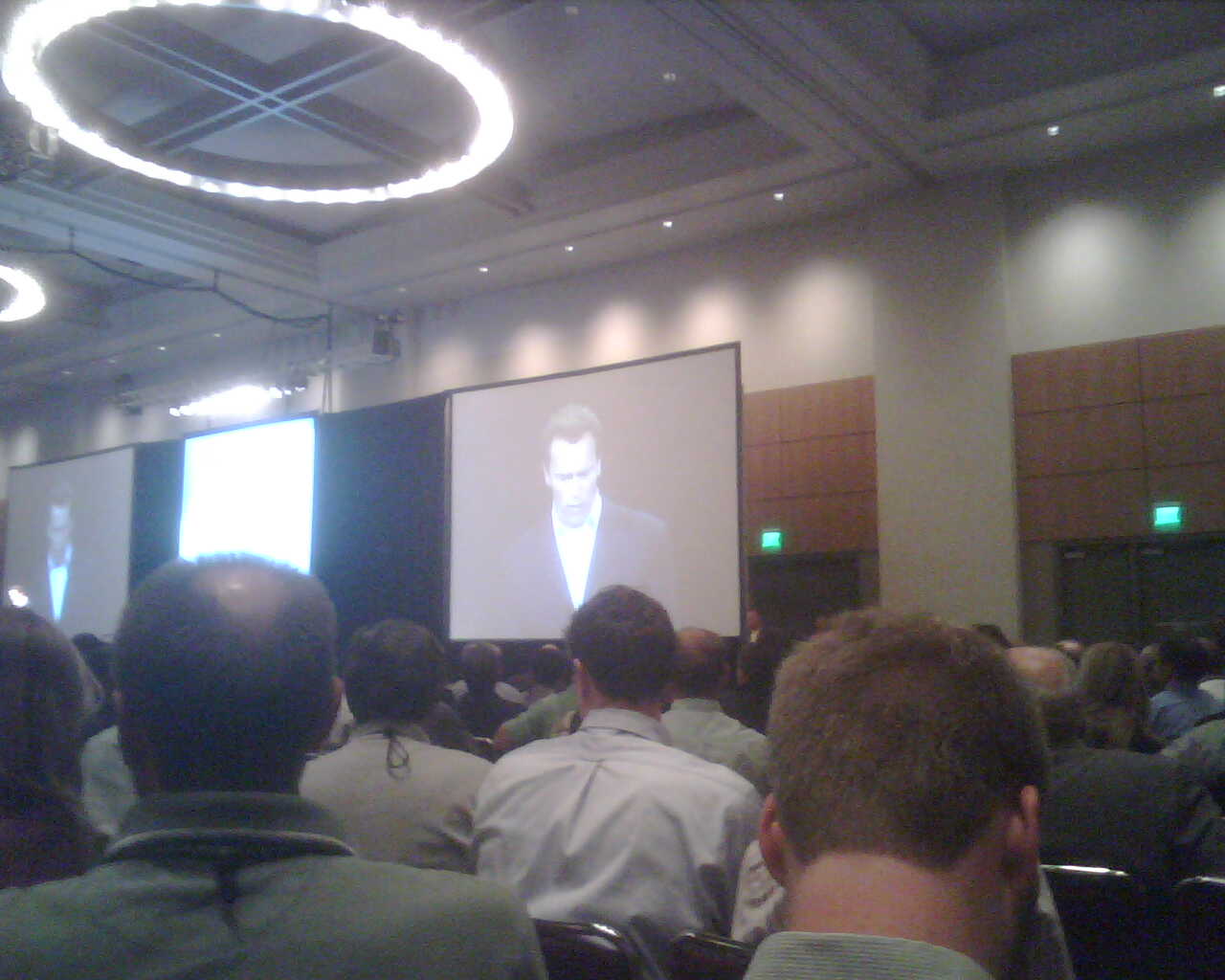
SAN DIEGO – California Governor Arnold Schwarzenegger made a surprise appearance at the solar industry’s annual confab Monday night, warning not to use the financial crisis as an excuse to abandon the fight against global warming.

“We should not give in to those who say environmental goals should take a back seat until the economy improves,” said Schwarzenegger, kicking off the Solar Power International conference. “That’s short-sighted thinking. Tough economic times mean we need more solar, more green jobs.”

The governator’s championing of solar energy through California’s million solar roofs initiative and its landmark global warming law has made Schwarzenegger something of a patron saint of the solar industry, and the audience was on its feet cheering the perma-tanned politician.

The solar power conference is a barometer of the industry’s growth. When Schwarzenegger last appeared at the conference in 2006, 6,000 attendees crammed the San Jose Convention center. This week an estimated 20,000 people have descended upon San Diego for the event. (For techies, think of it as the Consumer Electronics Show and Macworld rolled into one.)

The crowd was in a festive mood. Solar stocks were up dramatically Monday with the bounce back on Wall Street – First Solar (FSLR) spiked nearly 23% and Suntech (STP) rose 21% as was SunPower (SPWRA). And ten days ago Congress slipped into the financial bailout package an eight-year extension of a crucial 30% solar investment tax credit, lifted a $2,000 tax credit limit for homeowners who install solar arrays and allowed utilities to claim the investment tax credit for solar installations. “Imagine it took a financial rescue plan to get a tax credit for solar,” Schwarzenegger remarked.

The Republican governor used the occasion to champion California, as he is his wont, giving kudos to Southern California Edison (EIX) for the utility’s plans to install 250-megawatts’ worth of solar panels on warehouse roofs. “I can envision going up in a helicopter and up and down California and see no more warehouses without solar panels.”

“Solar is the future, it cannot be stopped,” he added.

Read Full Post »

Photos: Solyndra

SAN FRANCISCO – The chatter of the Financial District types who lunch at One Market is a bit deafening, so I’m sure I’ve misheard when Solyndra CEO Chris Gronet tells me how much funding his stealth solar startup has raised. “You said $60 million, right?” I ask.

“$600 million,” he replies.

That pile of cash from investors ranging from Silicon Valley venture capitalists to Richard Branson to the Walton family wasn’t the only big number Solyndra revealed to Green Wombat in anticipation of the solar panel manufacturer’s public debut Tuesday after operating undercover for more than three years. “We have $1.2 billion in orders under contract,” says Kelly Truman, the Fremont, Calif.-based company’s vice president for marketing and business development.

The stealth startup is a Silicon Valley archetype, along with the baby-faced Web 2.0 mogul and the millionaire stock-option secretary. But perhaps no company in recent memory has managed to hire more than 500 people and build a state-of-the-art thin-film solar factory – in plain view of one of the Valley’s busiest freeways – without attracting much attention beyond a few enterprising green business blogs.

Thin-film solar has been something of a Holy Grail in Silicon Valley, with high-profile startups like Nanosolar – with nearly $500 million in funding itself – all vying to be first to market with copper indium gallium selenide solar cells. CIGS cells can essentially be printed on flexible materials or glass without using expensive silicon. While such solar cells are less efficient at converting sunlight into electricity, production costs are expected to be significantly lower than making traditional silicon-based modules. (Thin-film companies like First Solar (FSLR) – also backed by the Waltons – use an older technology.)

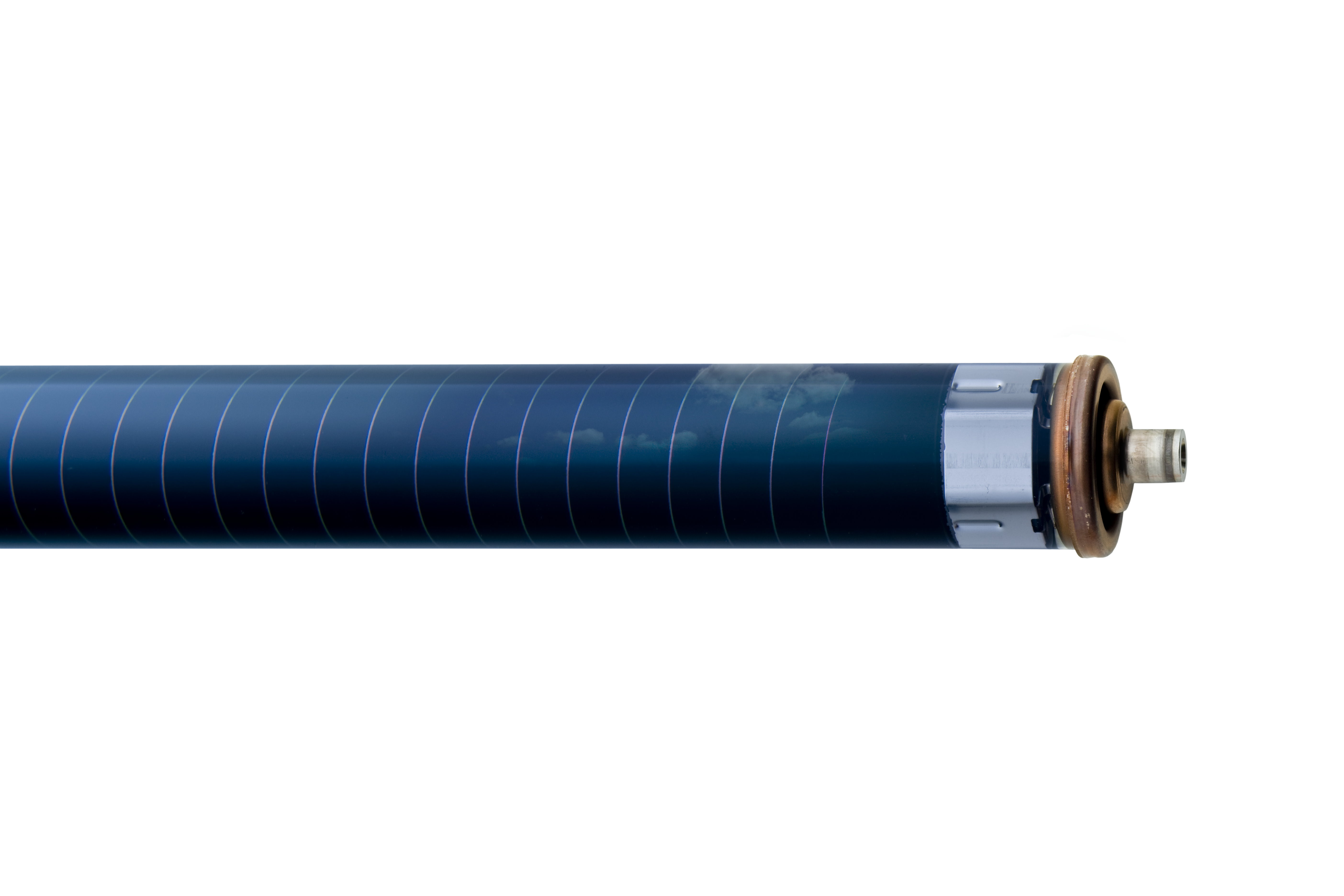
Yet Solyndra bursts onto the scene with a factory operating 24/7 and a billion-dollar book of business. The reason for Solyndra’s secrecy – and success with investors and customers – is sitting in a bazooka-sized cylinder propped up beside Truman at the restaurant. He pulls out a long, black glass tube that is darkened by a coating of solar cells.

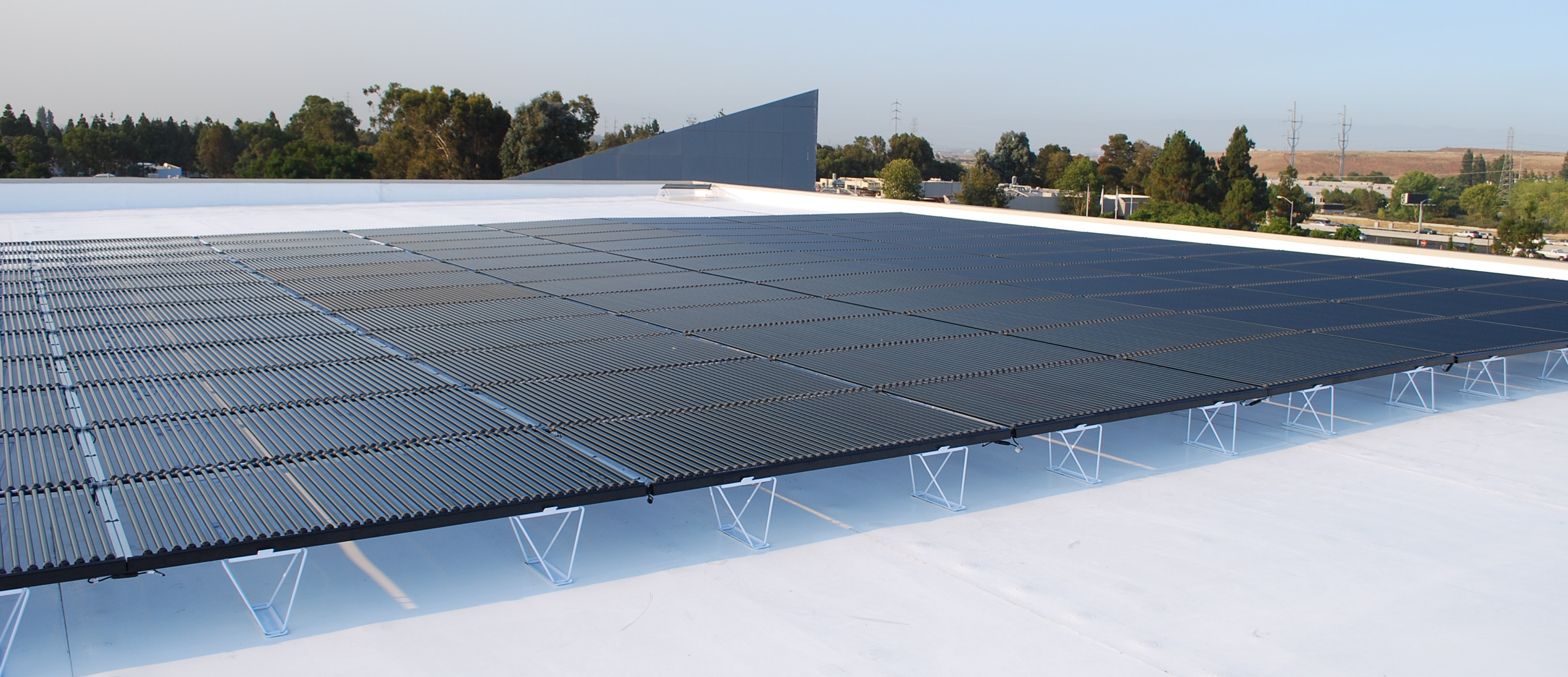
The cylindrical shape is the key, according to CEO Gronet. Conventional rooftop solar panels must be tilted to absorb direct sunlight as they aren’t efficient at producing electricity from diffuse light. But the round Solyndra module collects sunlight from all angles, including rays reflected from rooftops. That allows the modules, 40 to a panel,  to sit flat and packed tightly together on commercial rooftops, maximizing the amount of space for power production.

“We can cover twice as much roofspace as conventional solar panels and they can be installed in one-third the time,” says Gronet, a boyish 46-year-old who holds a Stanford Ph.D. in semiconductor processing and was an 11-year veteran of chip equipment maker Applied Materials (AMAT) before he started Solyndra in May 2005.

And because air flows through the panels they stay cooler and don’t need to be attached to the roof to withstand strong winds. That means installers simply clip on mounting stands and then snap the panels together like Legos.

“For flat commercial rooftops this is game-changing technology,” said Manfred Bachler, chief technical officer at European solar installation giant Phoenix Solar, in a statement.

Solyndra’s target is the 30 billion square feet of flat roofspace found on big box stores and other buildings in the U.S., according to Navigant Consulting – a potential $650 billion solar market.  The emerging business model is for a solar developer to finance, install and operate a commercial solar array and then sell the electricity to the rooftop owner. Solyndra’s business is to supply the solar panels to the installers, a market crowded with competitors like SunPower (SPWRA) and Suntech (STP).

A good chunk of the $600 million the company has raised has gone toward building its 300,000-square-foot solar fab. A video Gronet and Truman played for me shows a highly automated factory, with robotic assembly lines and robot carts moving the solar modules through the production process.

The fab – which can produce 110 megawatts’ worth of solar cells a year – already is shipping panels to big customers like Solar Power in the U.S. and Germany’s Phoenix Solar – three-quarters of its $1.2 billion in orders are destined for European companies. Solyndra is in the process of obtaining permits for a second 420-megawatt fab in Fremont; upon its completion, Solyndra would become one of the biggest solar cell manufacturers in North America. (Gronet says a third fab will be built in Europe, Asia or the Middle East.)

That has helped Solyndra attract a long list of investors, from Silicon Valley VCs like CMEA and US Venture Partners to Madrone Capital – the Walton family’s (WMT) private equity fund – and Masdar, the Abu Dhabi company whose mission is to transform the oil-rich emirate into a green tech powerhouse. Another high-profile investor is Richard Branson’s Virgin Green Fund.

“We looked at 117 solar companies and have made two investments, including Solyndra,” says Anup Jacob, a partner at Virgin Green Fund and a Solyndra board member. “Dr. Chris Gronet and his team came out of Applied Materials and really took the best and brightest of Silicon Valley. They’re great scientists and operations people.”

Jacob told Green Wombat that Virgin hired Stanford scientists to evaluate Solyndra’s technology and engineering firms to vet its solar factory. “Because we’re late-stage investors, we were able to look at all their major competitors,” he says. “There’s a number of well-heeled solar companies that have said they are going to do a lot of things but haven’t delivered.”

Virgin concluded that Solyndra could make good on its promise to make solar competitive with traditional sources of electricity. “As a rooftop owner, all you care about is how much electricity you can get from your rooftop at the cheapest price possible,” he says.

One challenge, he adds, was keeping mum about Solyndra. “I gotta tell you that Richard Branson is a guy who loves to talk about what’s he’s doing and it was real effort to honor Solyndra’s wishes to keep quiet.”

Read Full Post »

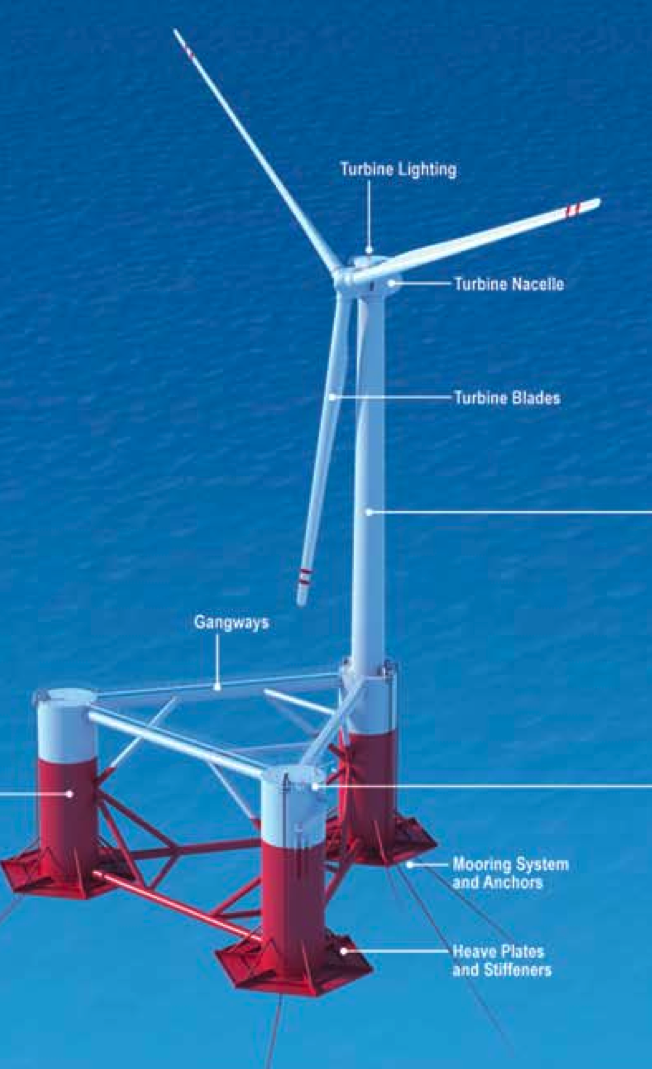
Illustration: Principle Power

A Seattle-based renewable energy startup, Principle Power, has signed an agreement to build a deep-sea, 150-megawatt wind farm to be constructed on floating platforms off the Oregon coast.

The deal with the Tillamook Intergovernmental Development Agency – which includes the local utility for a coastal county west of Portland – is very early stage but foreshadows two technological trends in the wind industry: massive megawatt turbines placed on deep-ocean platforms.

Principle Power co-founder Jon Bonanno tells Green Wombat that each floating platform – called a WindFloat – will feature a 5-megawatt turbine. By contrast, the biggest biggest land-based turbines are typically 2.5 megawatts, while General Electric (GE) makes a 3.6-megawatt turbine designed for offshore use.

Bigger turbines offer better economies of scale (important given the steep cost of developing offshore wind farms), and since a deep-ocean wind turbine is not visible from the coast, they avoid the not-in-my-backyard fights that dog near-shore projects. (Clipper Windpower of Carpinteria, Calif., is developing a ten-megawatt monster for England’s Crown Estate, while European wind companies like Enercon has been testing turbines in the six megawatt range.)

“It’s becoming an increasingly important component of the mix in Europe,” says Ethan Zindler, head of North American research for New Energy Finance, a London-based firm. “I think a lot of it is conceptual at this point. There’s still a lot of barriers in turbine design and transport.”

Beyond the technological challenges of supersizing a turbine, there’s the issue of how to get a 300-foot-tall windmill out to sea without breaking the bank. Various wind companies are tackling the problem but Principle Power’s solution is to license the WindFloat technology from a Berkeley, Calif.-based startup called Marine Innovation & Technology. The company’s founders, who previously worked on offshore platforms for the oil industry, designed the WindFloat to be semi-submersible. “The design and size of the WindFloat enables the overall structure to be assembled onshore and towed to its final location, significantly reducing construction costs,” according to Principle Power.

“The WindFloat has undergone concept development validation through numerical modeling, third party engineering verification and extensive wave tank testing,” Bonanno said in an e-mail, noting that he expects a full-scale prototype to be built within a year.

Depending on the permitting process and Principle’s ability to obtain project financing, Bonanno anticipates the wind farm to be up and operating between 2013 and 2015.  Early estimates peg the cost of the wind farm at about $375 million.

Pat Ashby, the general manager of the 19,000-customer Tillamook People’s Utility District, says his utility has a capacity of 50 megawatts so it would most likely serve as an interconnection point to transmit electricity from the wind farm to the regional power grid. “Our substations are all along the coast,” he says. “There’s only a dozen miles or less to get to a substation.”

According to Ashby, the cost of laying a transmission line is about $1 million a mile. On the other hand, if the wind farm is too close to shore, residents will likely get riled up about the impact on their views. “We’ve already had an organized group come forward to express their concerns,” he says.

Bonanno notes that if the wind farm was placed five miles off the coast, the turbines would appear to be the size of a thumb from the shore; at ten miles they would not be visible.

Read Full Post »

photo: eSolar

After months of failed attempts in Congress to extend crucial renewable energy tax credits, the end-game came with lightning speed Friday afternoon: The House of Representatives passed the green incentives attached to the financial bailout package approved by the Senate Wednesday night and President Bush promptly signed the legislation into law.

There were goodies for wind, geothermal and alternative fuels, but the big winner by far was the solar industry.

“It feels like we should be popping the champagne,” said a Silicon Valley solar exec Green Wombat met for lunch minutes after Bush put pen to paper.

That it took the biggest financial crisis since the Great Depression to save billions of dollars of renewable projects in the pipeline for the sake of political expediency does not bode well for a national alternative energy policy. But the bottom line is that the legislation passed Friday sets the stage for a potential solar boom.

  • The 30% solar investment tax credit has been extended to 2016, giving solar startups, utilities and financiers the certainty they need for the years’ long slog it takes to get large-scale power plants and other projects online. The extension is particularly important to those Big Solar projects that need to arrange project financing in the next year or so.
  • The $2,000 tax credit limit for residential solar systems has been lifted, meaning that homeowners can get a 30% tax credit on the solar panels they install after Dec. 31. That will save a bundle – especially for those who live in states with generous state rebates – and goose demand for solar panel makers and installers like SunPower (SPWRA) and First Solar (FSLR). (If you buy a $24,000 3-kilowatt solar array in California – big enough to power the average home –  you can claim a $7,200 federal tax credit. Add in the state solar rebate and the cost of the system is cut in half.)
  • Utilities like PG&E (PCG), Southern California Edison (EIX) and FPL (FPL) can now themselves claim the 30% investment tax credit for large-scale solar power projects. That should encourage those well-capitalized utilities to build their own solar power plants rather than just sign power purchase agreements with startups like Ausra and BrightSource Energy.

“The brakes are off,” says Danny Kennedy, co-founder of Sungevity, a Berkeley, Calif., solar installer that uses imaging technology to remotely size and design solar arrays. “In just six months since our launch we’ve sold about a hundred systems. With an uncapped tax credit for homeowners going solar, we expect business to boom.”

While elated sound bites from solar executives have been flooding the inbox all afternoon – along with invites to celebratory after-work drinks – solar stocks took a drubbing (along with the rest of the still-spooked market) after initially soaring on the news.

SunPower ended the trading day down 5% while First Solar shares dropped 8%. The bright spot was China’s Suntech (STP), which on Thursday announced a joint venture with financier MMA Renewable Ventures to build solar power plants as well as the acquisition of California-based solar panel installer EI Solutions.

Congress didn’t treat the wind industry so generously. The production tax credit for generating renewable energy was extended by just one year, guaranteeing the industry’s will continue to live year by year (at least through 2009). But given that 30% of all new power generation built in the United States in 2007 was wind, and that the amount of wind power installed by the end of 2008 is expected to rise 60% over the record set last year, the wind biz should do just fine.

But Congress did give a break to those who buy small-scale wind turbines. Systems under 100 kilowatts qualify for a 30% tax credit up to $4,000. Homeowners get a $1,000 tax credit for each kilowatt of wind they install, though the credit is capped at $4,000.

“This is a huge breakthrough for small wind,” says Scott Weinbrandt, president of Helix Wind, a San Diego-based manufacturer of 2-and-4-kilowatt turbines.

Read Full Post »

In another sign that the financial crisis is not slowing the solar industry, Suntech, the giant Chinese solar module maker, made a big move into the United States market on Thursday. The company announced a joint venure with green energy financier MMA Renewable Ventures to build solar power plants and said it would acquire California-based solar installer EI Solutions.

Founded in 2001, Suntech (STP) recently overtook its Japanese and German rivals to become the world’s largest solar cell producer. The company has focused on the lucrative European market and only opened a U.S. outpost, in San Francisco, last year.  The joint venture with MMA Renewable Ventures (MMA) – called Gemini Solar – will build photovoltaic power plants bigger than 10 megawatts.

Most solar panels are produced for commercial and residential rooftops, but in recent months utilities have been signing deals for massive megawatt photovoltaic power plants. Silicon Valley’s SunPower (SPWRA) is building a 250-megawatt PV power station for PG&E (PCG) while Bay Area startup OptiSolar inked a contract with the San Francisco-based utility for a 550-megawatt thin-film solar power plant. First Solar (FSLR), a Tempe, Ariz.-based thin-film company, has contracts with Southern California Edision (EIX) and Sempre to build smaller-scale solar power plants.

Suntech’s purchase of EI Solutions gives it entree into the growing market for commercial rooftop solar systems. EI has installed large solar arrays for Google, Disney, Sony and other corporations.

“Suntech views the long-term prospects for the U.S. solar market as excellent and growing,” said Suntech CEO  Zhengrong Shi in a statement.

Other overseas investors seem to share that sentiment, credit crunch or not.  On Wednesday, Canadian, Australian and British investors lead a $60.6 million round of funding for Silicon Valley solar power plant builder Ausra. “So far the equity market for renewable energy has not been affected by the financial crisis,” Ausra CEO Bob Fishman told Green Wombat.

The solar industry got more good news Wednesday night when the U.S. Senate passed a bailout bill that included extensions of crucial renewable energy investment and production tax credits that were set to expire at the end of the year.

Read Full Post »

photo: eSolar

If Wall Street’s implosion can feel remote on the West Coast, where green tech startups largely rely on Silicon Valley venture capital, there may be no escaping the fallout from the credit crunch.

Still, even those renewable energy companies tapping East Coast cash have powered ahead amid the chaos on the Street. Take SolarReserve, a Santa Monica, Calif.-based solar power plant developer. A day after Lehman Brothers filed for bankruptcy last week, the stealth startup announced a $140 million round of funding from investors that included Citigroup (C) and Credit Suisse (CS).

Lehman does hold small stakes in wind turbine maker Clipper Windpower of Carpinteria, Calif., and Ormat Technologies, a Reno, Nev., geothermal developer. “Lehman’s exit from wind is not good news, but it’s not the end of the world,” says Ethan Zindler, head of North American research for New Energy Finance, a London-based research firm. And while Lehman holds stock lent to it from solar cell companies like SunPower (SPWR) and Evergreen Solar – potentially diluting their earnings per share if the stock is not returned – Lehman is not a big player in solar.

That’s not the case with Goldman Sachs (GS) and Morgan Stanley (MS). Both are major solar and wind investors and both were forced this week to reorganize themselves into bank holding companies to stave off shotgun marriages with other institutions. Spokespeople for Goldman and Morgan Stanley told Green Wombat that the firms’ transformation into more conventional commercial banks – at least a two-year process- will not change their green investing strategies.

But if there appears to be little immediate collateral damage from the financial crisis for green tech startups, there are longer-term consequences. Solar power plants, wind farms and other large-scale renewable energy projects require billions of dollars in bank financing.

“Credit is just going to get more expensive,” says Zindler. “We’ve already seen some pull-back for some big solar and wind deals. Bigger developers who have solid balance sheets will be OK but the smaller guys could be in trouble.”

Says Bill Gross, chairman of solar power plant developer eSolar: “I think if you’re going to get project financing, you’re just going to have to show higher returns to get people to take the money out of the mattress.”

But Gross, the founder of Pasadena, Calif.-based startup incubator Idealab, argues that given soaring electricity demand and fossil fuel prices, large-scale renewable energy projects will be an attractive investment, paricularly since utilities typically sign 20-year contracts for the power they produce. eSolar, which is backed by Google and other investors, has a long-term contract to supply Southern California Edison with 245 megawatts of green electricity. Gross says eSolar has a pipeline of other projects and interest in the company remains high, particularly overseas.

“If you can make projects that can compete with fossil fuels on a parity basis, those projects are going to be financed,” he says, “because they’re safe returns for 20 years and I think money is going to flow to them.”

Rob Lamkin, CEO of solar power plant startup Cool Earth, echoed that sentiment. “The credit crisis does give me pause,” says Lamkin, whose Livermore, Calif.-company has raised $21 million in venture funding and is developing “solar balloons” that use air pressure to concentrate sunlight on solar cells. “But the energy problem is so big that I don’t see problems raising project financing.”

The key for developers of utility-scale projects – particularly solar power plants – will be keeping their costs under control; not an easy thing when deploying new technologies amid a commodities boom.

Dita Bronicki, CEO of geothermal power plant developer Ormat Technologies (ORA), does not anticipate trouble obtaining project financing. “I think the cost of money is going to go up, but a company like Ormat with an operating fleet and operating cash flow will not be as affected,” Bronicki says. “Small companies will find that lenders will be more picky in what they will invest.”

Green entrepreneurs tend to be an optimistic bunch, so it’s not surprising they still think the future looks bright. But they had reason to be sunny this week – amid Wall Street’s meltdown, the U.S. Senate on Tuesday passed, at long last,  extensions of crucial renewable energy investment tax credits and other goodies to goose green tech, such as a tax credit worth up to $7,500 for buyers of plug-in electric cars. The Senate action now must be reconciled with similar legislation in the House of Representatives.

Solar projects, for instance, would qualify for a 30% investment tax credit through 2016.

“That is one thing that will help project finance,” says Gross. “So many people are sitting on the sidelines right now and if the investment tax credit passes that will help get these projects financed.”

Read Full Post »

« Newer Posts - Older Posts »

Design a site like this with WordPress.com
Get started