Feeds:
Posts
Comments

Archive for the ‘PG&E’ Category

picture-2

California utility PG&E has signed a deal for the world’s first space-based solar power plant, to be built by a secretive Southern California startup staffed by veterans of the U.S. Air Force, Boeing and Lockheed Martin.

In papers filed Friday with the California Public Utilities Commission, San Francisco-based PG&E asked for approval of a 15-year, 200-megawatt contract with Solaren, a Manhattan Beach, Calif.-based company that plans to put satellites in geosynchronous orbit by 2016 to collect solar energy. The sunlight would then be transmitted to a ground station in Fresno, Calif., in the form of radio frequency waves and converted into electricity to be distributed into the power grid. Since the sun shines 24/7 in space, a Solaren solar farm could theoretically supply “baseload” green electricity to coal-dependent regions without access to abundant sources of renewable energy.

While PG&E won’t spend any money until Solaren beams down electricity, it’s uncertain whether regulators will be willing to count a contract for such unproven, bleeding-edge technology toward the utility’s state-mandated obligation to obtain 20% of its power from renewable sources by 2010 and 33% by 2020. After all, the utilities commission last year rejected PG&E’s contract with a wave energy firm on the grounds that the technology was too early stage. PG&E’s discussion of the Solaren project’s viability was filed under a request for confidentiality.

“Solaren is using an innovative space-based solar technology, which, if successful, would represent a break-through in the renewable power industry,” Brian Cherry, PG&E’s vice present of regulatory relations, wrote in the utility’s 24-page application. “While emerging technologies like space solar face considerable hurdles under a traditional viability analysis, PG&E believes that potential, significant benefits to its customers from a successful space solar installation outweigh the challenges associated with a new and unproven technology.”

Space-based solar has long been a dream and numerous studies have been conducted on its potential viability. In the documents filed with the utilities commission, PG&E (PCG) asserted that the biggest technological obstacle is building satellites that can collect megawatts’ worth of sunlight rather than transmitting the energy miles to a ground station.

“The engineering challenge of building a Space Solar Power Plant is not the energy conversion process itself, but the need to engineer and build MW-class SSP satellites, which are much larger than current kW-class communications satellites,” Cherry wrote. “Solaren’s patented SSP Plant design employs the SSP concept described above to deliver renewable electricity to PG&E.”

Solaren’s website offers a single page that contains no information on the company other than the slogan, “Energy for Tomorrow with Technology of Today.”

In its filing, PG&E said that, “Solaren was founded in 2001 to develop, engineer, test, construct, and operate space solar generating stations. Solaren has informed PG&E that its team is comprised of experienced satellite engineers and space scientists with 20 to 45 years of experience in the leading edge space industry and come from various aerospace organizations that include the U.S. Air Force, Hughes Aircraft Company, Boeing (BA), and Lockheed Martin (LMT).

Not all the hurdles to space-based solar are likely to be technological. While there are no desert tortoises in space or other protected wildlife that live on earth-bound sites for big solar power plants, any orbiting solar farm will have to pass muster with a long list of state, federal and international government agencies. Among them, the U.S. Department of Defense, NASA and the United Nations, according to PG&E.

Read Full Post »

siting1

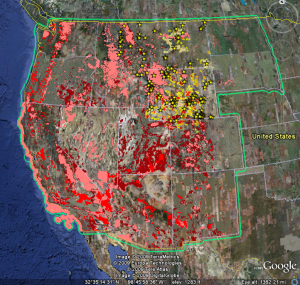
Can Google help defuse a simmering green civil war between renewable energy advocates and wildlife conservationists in the American West?

That’s the idea behind a new Google Earth mapping project launched Wednesday by the Natural Resources Defense Council and the National Audubon Society. Path to Green Energy will identify areas in 13 western states potentially suitable for massive megawatt solar power plants, wind farms, transmission lines and other green energy projects. The app will also pinpoint critical habitat for protected wildlife such as the desert tortoise in California and Wyoming’s sage grouse as well as other environmentally sensitive lands.

“This was information that was unavailable or very scattered,” said Google.org program director David Bercovich at a press conference. “The potential cost savings from this will be enormous. If we can get people to the right areas and streamline the process that will have enormous benefits in getting clean energy online faster.”

NRDC senior attorney Johanna Wald said her group already is using Path to Green Energy in New Mexico to help plan a new transmission project. “Careful siting is the key to renewable energy development,” she said, noting that NRDC has mapped 860 million acres. “We’re not greenlighting development on places that are on our map but we’re providing a framework for discussion.”

siting2The unveiling of Path to Green Energy comes two weeks after California Senator Dianne Feinstein announced she would introduce legislation to put as many as 600,000 acres of the Mojave Desert off limits to renewable energy development to protect endangered wildlife and their habitats.  Solar developers have filed lease claims on a million acres of federal land in the California Mojave and there are state and federal efforts already under way to identify green energy zones across the West.

Path to Green Energy is designed to give regulators and developers a tool to choose the best potential sites for solar and wind farms so they don’t get bogged down in years-long and multimillion-dollar fights over wildlife.  Ausra, BrightSource Energy and other developers of the first half-dozen solar power plant projects moving through the licensing process in California have spent big sums on hiring wildlife consultants who spend thousands of hours surveying sites for desert tortoises, blunt-nosed leopard lizards and other protected species.

The Google Earth app won’t do away with the need to do such detailed environmental review but puts in one package a variety of information that developers must now cobble together themselves — if they can find it. Path to Green Energy could also prove valuable to utilities like PG&E (PCG) and Southern California Edison (EIX) as more and more projects are proposed and regulators scrutinize the cumulative impact of Big Solar power plants across regions.

For instance, in California’s San Luis Obispo County, three large-scale solar farms are being planned within a few miles of each other by Ausra, SunPower (SPWRA) and First Solar (FSLR). That has resulted in delays as wildlife officials initiate studies looking at how all those projects affect the movement of wildlife throughout the area. Going forward, Path to Green Energy will give developers a snapshot of where the wild things are, as well as wildlife corridors to help them avoid siting one plant too close to another in a way that may impede animals’ migration. That could save millions of dollars in mitigation costs – money builders must spend to acquire land to replace wildlife habitat taken for a power plant project as well as avoid fights with environmental groups that have become increasingly uneasy about Big Solar projects.

If the desert tortoise is the critter to avoid when building solar power plants in the Mojave, the sage grouse poses problems for Wyoming wind farms. Brian Rutledge, executive director of Audubon Wyoming, said Path to Green Energy shows the densities of sage grouse across the state, allowing developers to stay clear of those areas.

“We get a solid indication of where energy development shouldn’t go,” he said. “Just as important, we get a better sense of the places that should be evaluated for wind turbine farms and transmission lines. The maps make clear that there is plenty of room for green energy.”

The payback from using Web 2.0 software could indeed be tremendous, given that Google (GOOG) spent a scant $50,000 in donations to NRDC and Audubon to create the maps.

Read Full Post »

desert-tortoise1

photo: Wild Rose Images

California Senator Dianne Feinstein’s move to put a large swath of the Mojave Desert off-limits to renewable energy development is splitting the environmental movement and could derail some two dozen solar and wind power projects the state needs to comply with its ambitious climate change laws.

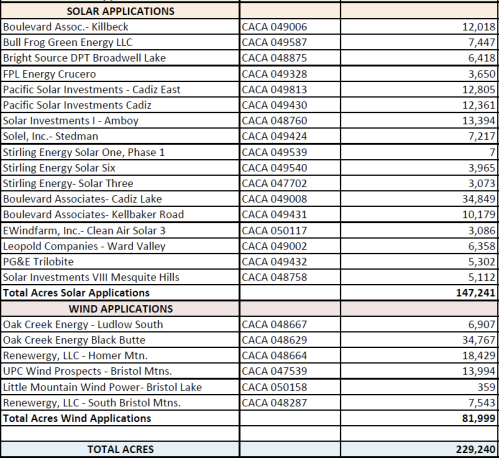
On the firing line are 17 massive solar power plants and six wind farms planned for federal land — land that would be designated a national monument under legislation Feinstein intends to introduce. The solar projects in question would be built by a range of companies, from startups BrightSource Energy and Stirling Energy Systems to corporate heavyweights Goldman Sachs (GS) and FPL (FPL), according to federal documents. (For the complete list, see below.)

The companies are among scores that have filed lease claims on a million acres of acres of desert dirt controlled by the U.S. Bureau of Land Management. California utilities PG&E (PCG) and Southern California Edison (EIX) have signed long-term power purchase agreements for some of the projects now in jeopardy and are counting on the electricity they would produce to meet state-mandated renewable energy targets. PG&E itself has filed a solar power plant land claim in the proposed national monument.

The area of the desert in dispute is some 600,000 acres formerly owned by Catellus, the real estate arm of the Union Pacific Railroad, and donated to the federal government a decade ago by the Wildlands Conservancy, a Southern California environmental group. About 210,000 of those acres are managed by the U.S. Bureau of Land Management, which opened part of the land to renewable energy projects.

“Many of the sites now being considered for leases are completely inappropriate and will lead to the wholesale destruction of some of the most pristine areas in the desert,” Feinstein wrote in a letter to Interior Secretary Ken Salazar released last week, notifying him that she will introduce legislation to designate the former Catellus lands a national monument. “Beyond protecting national parks and wilderness from development, the conservation of these lands has helped to ensure the sustainability of the entire desert ecosystem by preserving the vital wildlife corridors.”

The Catellus land controlled by the BLM forms something of a golden triangle between the Joshua Tree National Park and the Mojave National Preserve in Southern California and are particularly coveted for renewable energy development because of its proximity to transmission lines.

Alan Stein, a deputy district manager for the BLM in California, told Green Wombat that the solar and wind lease claims are in areas that are not designated as wilderness or critical habitat for protected species like the desert tortoise. “This is public domain land, ” he says.

Tortoises, however, are found across the Mojave, and battles over Big Solar’s impact on endangered wildlife are quietly brewing in several solar power plant licensing cases now being reviewed by the California Energy Commission.  Environmentalists find themselves walking a thin green line, trying to balance their interest in promoting carbon-free energy with protecting fragile desert landscapes and a host of threatened animals and plants.

Take BrightSource Energy’s Ivanpah 400-megawatt solar power plant complex on the California-Nevada border. The three solar power plants to be built by the Oakland-based company will supply electricity to PG&E and Southern California Edison. But the project will also destroy some 4,000 acres of desert tortoise habitat and at least 25 tortoises will have to be relocated – a somewhat risky proposition as previous efforts in other cases have resulted in the deaths of the animals.

On Wednesday, the California Energy Commission granted two national environmental groups – the Defenders of Wildlife and the Sierra Club – the right to intervene in the Ivanpah case. “Defenders strongly supports … the development of renewable energy in California,” Kim Delfino, California program director for Defenders of Wildlife, wrote to the energy commission in a Jan. 23 letter.  “Defenders has several serious concerns about the potential impacts of this project on a number of rare, declining and listed species and on their associated desert habitat and waters.”

Natural Resources Defense Council attorney Johanna Wald wrote a letter with the Wilderness Society expressing concern over the impact of Ivanpah project on the desert tortoise but also made a strong statement of support for renewable energy development. “Our public lands harbor substantial wind, solar, and geothermal resources,” wrote Wald, who serves on a state task force to identify appropriate areas for renewable energy development. “Developing some of these resources will be important to creating a sustainable energy economy and combating climate change.”

The big national enviro groups are working with the government and power plant developers to create zones in the Mojave where renewable energy projects would be permitted while setting aside other areas that are prime habitat and wildlife corridors. A similar effort is underway on the federal level to analyze the desert-wide impact of renewable energy development.

Local environmental organizations, however, have split with the Big Green groups over developing the desert and other rural areas. In San Luis Obispo County,  Ausra, SunPower (SPWRA) and First Solar’s (FSLR) plans to build three huge solar farms within miles of each other has prompted some local residents worried about the impact on wildlife to organize in opposition to the projects.

And some small Mojave Desert green groups pledge to go to court to stop big solar projects. “We don’t want to see the Endangered Species Act gutted for the sake of mega solar projects,” veteran grass roots activist Phil Klasky told Green Wombat last year for a story on the solar land rush in the Mojave. “I can say the smaller environmental organizations I’m involved with are planning to challenge these projects.”

It would be unwise to underestimate Klasky. In the 1990s, he helped lead a long-running  and successful campaign to scuttle the construction of a low-level radioactive waste dump in tortoise territory in the Mojave’s Ward Valley – now a prime solar spot.

Still, while California’s senior senator’s move in the Mojave may exacerbate rifts in the environmental movement over renewable energy, it also could galvanize efforts to resolve critter conflicts in a comprehensive way. Otherwise, environmentalists of varying hues may find themselves fighting each other rather than global warming.

Update: I just had a conversation with BrightSource spokesman Keely Wachs, who takes issue with my characterization that the Ivanpah project will “destroy” desert tortoise habitat. He points out that the company is taking care to minimize the impact of the power plant on the surrounding desert and that wildlife may still occupy the site. It would be more accurate to say that the project will remove desert tortoise habitat from active use during Ivanpah’s construction and operation.

(Below is a list of solar and wind projects that fall within the proposed Mojave national monument. Note: Solar Investments is a subsidiary of Goldman Sachs and Boulevard Associates is a subsidiary of FPL.)

source:  BLM

blm-nm2

Read Full Post »

cstste_eldorado_13850021

photo: First Solar

The arid Southwest has no shortage of sun but has been rather slow to embrace Big Solar power plants, at least compared to California, where more than a half-dozen massive megawatt solar farms are being licensed.

That appears to be changing. On Tuesday, First Solar said it will give New Mexico its first big solar power plant, a 30 megawatt photovoltaic farm that will generate electricity from the company’s thin-film panels. Once the plant is built in Colfax County in northeastern New Mexico, First Solar will sell the electricity it generates to the Tri-State Generation and Transmission Association under a 25-year power purchase agreement. Tri-State is an electric cooperative.

The deal continues First Solar’s (FSLR) move into the power plant business. Earlier this month, the Tempe, Ariz.-based company acquired OptiSolar’s 1.85 gigawatt project portfolio – including a 550-megawatt photovolatic power plant for California utility PG&E (PCG) – in a $400 million stock transaction.

First Solar has also signed contracts for smaller-scale solar farms with Southern California Edison (EIX) and Sempre (SRE).

Read Full Post »

solyndra-rooftop-2

photo: Solyndra

It’s been a good news, bad news Friday for the solar industry. Silicon Valley startup Solyndra received a half billion-dollar loan guarantee from the U.S. Department of Energy to build a solar module factory while further up Interstate 880 OptiSolar moved to shut down its manufacturing operations.

OptiSolar too had asked for a federal loan guarantee to complete work on its Sacramento thin-film solar cell plant but a decision on the $300 million application couldn’t come soon enough to save the startup. “We continued to be unable to find a buyer for the technology and manufacuring business, and the board of directors decided that we needed to limit ongoing operational expense,” wrote OptiSolar spokesman Alan Bernheimer in an e-mail.

First reported by the San Francisco Chronicle’s David Baker, OptiSolar will shut down factories in Sacramento and Hayward, Calif., and lay off 200 workers.  Earlier this month, OptiSolar sold its pipeline of solar power plants – including a 550-megawatt solar farm that will supply electricity to PG&E (PCG) – to rival First Solar  in a $400 million stock deal. At the time, OptiSolar said it intended to focus on manufacturing solar modules.

The news was definitely brighter Friday for Solyndra, which emerged from stealth mode last September with $600 million in funding and $1.2 billion in orders for its solar panels composed of cylindrical tubes imprinted with solar cells. Conventional rooftop solar panels must be tilted to absorb direct sunlight as they aren’t efficient at producing electricity from diffuse light. But the round Solyndra module collects sunlight from all angles, including rays reflected from rooftops. That allows the modules, 40 to a panel,  to sit flat and packed tightly together on commercial rooftops, maximizing the amount of space for power production.

The $535 million federal loan guarantee will allow the Fremont, Calif.-based company to build a second factory, which is expected to create 3,000 construction jobs and more than 1,000 other jobs once the plant is in operation. The factory will be able to produce 500 megawatts’ worth of solar panels a year.

“The DOE Loan Guarantee Program funding will enable Solyndra to achieve the economies of scale needed to deliver solar electricity at prices that are competitive with utility rates,” Solyndra CEO Chris Gronet said in a statement. “This expansion is really about creating new jobs while meaningfully impacting global warming.”

Friday’s grant makes good on Secretary of Energy Steven Chu’s pledge to speed up processing of renewable energy loan guarantee applications. The department had come under fire during the previous administration for taking years to dole out grants and loan guarantees for electric car and green energy projects.

Meanwhile, First Solar (FSLR) announced on Friday that it had manufactured 1 gigawatt of thin-film solar cells since beginning commercial production in 2002. It took the Tempe, Ariz., company six years to hit 500 megawatts and only eight months to produce the second 500 megawatts. First Solar’s annual production capacity will reach 1 gigawatt by year’s end, according to the company.

Read Full Post »

solfocus-puertollano-200kw-low

photo: SolFocus

Silicon Valley solar power company SolFocus on Monday said it has signed a deal to install 10 megawatts of concentrating photovoltaic panels in Greece and expects to build its first project in the United States later this year.

SolFocus’ solar panels use small curved mirrors to focus sunlight on a high-efficiency solar cell to maximize production of electricity while reducing the use of expensive silicon. SolFocus claims its panels are up to twice as efficient as conventional photovoltaics. But given the relatively high costs of such systems, the company decamped for Europe where governments in Spain and Greece pay a premium rate for solar energy through “feed-in tariffs.”

But the recently enacted federal economic stimulus package, which includes billions of dollars dedicated to renewable energy projects, is luring SolFocus home.

“Now with the new stimulus package we believe the big year for us in the U.S. will be 2010,” Nancy Hartsoch, SolFocus’ vice president of corporate marketing, told Green Wombat.

Meanwhile, utilities are ramping up installations of photovoltaic solar projects. California utility PG&E (PCG) two weeks ago, for instance, unveiled a program to install 500 megawatts of ground-mounted solar panels over the next five years. The projects would essentially be small-scale solar farms generating between one and 20 megawatts of electricity and built on utility-owned land near substations.

“That‘s the perfect spot for our technology,” says Hartsoch.

Not so perfect is PG&E’s Northern California territory. SolFocus’ power plants need direct sunlight to most efficiently produce electricity. But Hartsoch says the southern reaches of PG&E’s service area offer sufficient sunlight and as production costs fall it’ll become cost effective by 2012 to build concentrating photovoltaic power plants in Silicon Valley and elsewhere in Northern California.

She says SolFocus’ first solar farms will likely be built for municipal-owned utilities and the company currently is in discussions with cities in the Southwest.

The deal announced Monday with Greece’s Samaras Group expands a 1.6 megawatt agreement the companies signed last year.

Read Full Post »

clintonbill1Another reason Green Wombat will be spending Earth Day in Southern California this year: Former President Bill Clinton will deliver the keynote speech at Fortune Magazine’s Brainstorm Green conference on April 22.

Clinton will be joining a gathering of business and environmental leaders, including Ford (F) executive chairman Bill Ford, PG&E (PCG) chief executive Peter Darbee, SunPower (SPWRA) CEO Tom Werner and executives from Fortune 500 companies like IBM (IBM),  Wal-Mart (WMT) and General Electric (GE). On the green side of the aisle, execs from the Natural Resources Defense Council, Environmental Defense Fund and Greenpeace will be attending the confab in Laguna Niguel.  Former California State Treasurer Phil Angelides, now chairman of the Apollo Alliance, and green jobs guru Van Jones will also be present.

We now end the shameless self-promotion and return to our regular Green Wombat programming.

Read Full Post »

three_in_row_hi_medium

San Francisco on Friday made a bid to rule the waves, filing an application to build a 30-megawatt wave energy farm off its coast in a move to sink a Seattle company’s claim on a nearby patch of ocean.

The company, Grays Harbor Ocean Energy, has filed applications with the Federal Energy Regulatory Commission, or FERC, for wave projects to be built from New Jersey to Hawaii. Wave energy technology remains in its infancy but there’s been something of a land – or sea – rush to secure rights to the most promising ocean sites to produce clean green electricity.

Last October, Grays Harbor filed for a preliminary permit to test technology for a 100-megawatt wave park to be floated 20 to 25 miles off the San Francisco coast.  Grays’ San Francisco Ocean Energy Project “may also generate power from wind turbines” placed on the wave-energy converters, according to the company’s application.

So far the project has generated heated opposition from a coalition of environmental groups, surfers and commercial fishing organizations that have intervened in the case.  They argue that the wave farm’s location in federally protected marine sanctuaries near the Farallon Islands could harm endangered whales, turtles and seabirds as well as interfere with surfers, sailors and pose a navigation hazard for oil tankers and other ships.

“Wave energy projects raise many potential environmental concerns, including elevated hydrocarbon concentrations, electromagnetic field effects, interruption of migratory patterns, toxic releases from leaks or spills, impacts to sensitive spawning areas,” wrote the coalition, which includes the Natural Resources Defense Council, in a Jan. 26 letter to FERC.

The next day, the city of San Francisco moved to intervene in the Grays case, saying it would file a competing application. On Friday, the city did so, asking federal regulators to give priority to its Oceanside Wave Energy Project, arguing there’s only room for one wave farm off the San Francisco coast.

The city’s project would be located eight miles offshore, outside the marine sanctuaries. As San Francisco Mayor Gavin Newsom – a Democratic gubernatorial candidate for 2010 – blogged about the municipal wave farm on Friday, the city filed an affidavit from its consultant stating that the Grays project would “impact the nature, quality and direction of the waves” to be used by the Oceanside wave energy plant.

It’s not the first time that San Francisco has tried to scuttle other wave projects. In June 2007, the city unsuccessfully petitioned FERC to deny utility PG&E’s (PCG) application for wave farms hundreds of miles up the coast from San Francisco, contending companies were trying to lock up choice sites.

Despite the rush to file claims, there’s no guarantee that any wave farm will be built. The preliminary permit that San Francisco has applied for would give it the ability to conduct a feasibility study and test wave energy technology with first rights to secure a license build a full-scale wave energy plant.

Although a range of wave technologies are being developed, they generally involve devices that float or are anchored to the seabed that that transform the motion of waves into mechanical energy which drives an electricty generating turbine. The electricity is transmitted through undersea cables to an onshore substation.

In its application, San Francisco said it was considering a number of technologies but anticipates floating between ten and 30 1-megawatt wave energy converters.  The city estimates it would spend between $1 million and $3 million on the feasibility study over the next three years.

San Francisco’s green scheme isn’t the only headache for Grays. Like the company’s other proposed wave energy projects, the San Francisco wave farm would sit on the outer continental shelf. The U.S. Department of the Interior’s Minerals Management Service claims jurisdiction over projects on the outer continental shelf and a fight has broken out between the agency and FERC over who gets to issue permits for OCS wave projects. On Jan. 26, the agency filed a challenge to FERC’s right to license eight of Grays wave farms that would also feature wind turbines.

Wrote Interior Department attorneys: “Some believe the preliminary permit application is part of an attempt to stake a claim to certain areas through the FERC process with the objective of siting wind energy projects, over which FERC does not claim jurisdiction, or then, according to press accounts, selling those rights.”

image: Pelamis Wave Power

Read Full Post »

optisolar-panels
photo: Optisolar

SAN FRANCISCO — With the financial crisis dimming solar’s prospects to become a significant source of renewable energy, utility giant PG&E on Tuesday said it will spend $1.4 billion over five years to install 250 megawatts’ worth of photovoltaic panels in California while contracting with private developers for another 250 megawatts. PG&E chief executive Peter Darbee said the utility is also prepared to be a “green knight,” rescuing distressed big centralized solar power plant projects by providing financing so they can get built.

“We have contracted for 24% of our energy to be renewable and we’re concerned whether our [developers] will have access to capital,” Darbee said at PG&E’s San Francisco headquarters during a press conference. “We think financing for these projects may be in jeopardy. PG&E is well-positioned with its $35 billion balance sheet to step up and help.”

PG&E’s (PCG) move to take a direct role in obtaining the renewable energy it needs to comply with California’s global warming laws could be big business for solar module panel makers and installers like SunPower (SPWRA), Suntech (STP) and First Solar (FSLR). The action was prompted in part by a change in the tax laws that lets utilities claim a 30% investment tax credit for solar projects.

Fong Wan, PG&E’s vice president for energy procurement, said most of the 500 megawatts of solar panels will be installed on the ground in arrays of between one and 20 megawatts at utility substations or on other PG&E-owned property. (The utility is one of California’s largest landowners.) A small portion may be installed on rooftops, he said.

PG&E said the solar initiative will generate enough electricity to power 150,000 homes and will provide 1.3% of the utility’s electricity supply.

“There’s no or little need for new transmission and these projects can plug directly into the grid,” said Darbee. “Given our size and our credit ratings and our strength, we can move forward where smaller developers may not be able to do so.”

The California Public Utilities Commission must approve PG&E’s solar initiative, which Wan estimated would add about 32 cents to the average monthly utility bill.  An $875 million program unveiled by Southern California Edison (EIX) last year to install 250 megawatts of utility-owned rooftop solar panels has run into opposition from solar companies that argue it is  anti-competitive and from consumer advocates who contend the price is too high. The state’s third big utility, San Diego Gas & Electric (SRE), has also proposed a rooftop solar program.

Wan acknowledged that objections to Edison led PG&E to design its program so that private developers would have a 50% stake in the initiative. PG&E will sign 20-year power purchase agreements for privately owned solar installations.

PG&E will also need regulators’ approval to inject equity financing into companies developing big solar power plants. The utility has signed power purchase agreements for up to 2,400 megawatts of electricity to be produced by solar thermal  and photovoltaic power plants to be built by companies like Ausra, BrightSource Energy, OptiSolar and SunPower.

“We are looking at the least risky and most developed opportunities to see where we can be the most helpful,” Darbee said.

Read Full Post »

image001

photo: eSolar

NRG Energy, one of the United States’ most coal-dependent utilities, on Monday signed a deal with California startup eSolar to develop solar power plants.

The agreement calls for NRG  to invest $10 million in Pasadena-based eSolar for the right to use the startup’s technology to develop and operate three solar power projects in California and the Southwest that would generate 500 megawatts of greenhouse gas-free electricity.  NRG ranks as one of the nation’s dirtiest utilities,  spewing 70 million tons of carbon dioxide annually from its coal-fired power plants, according to a 2007 Fortune Magazine story.  But the Princeton, N.J.-based Fortune 500 company has sought to clean up its ways under CEO David Crane, pursuing carbon-capture technology and moving to build nuclear power plants.

Last year eSolar, founded by Idealab’s Bill Gross and backed by Google, won a 20-year contract to supply utility Southern California Edison (EIX) with 245 megawatts of green electricity annually. Last  April, eSolar scored $130 million in funding from Google.org, Google’s (GOOG) philanthropic arm, and other investors to develop solar thermal technology that Gross claims will produce electricity as cheaply as coal-fired power plants.

Like rivals Ausra and BrightSource Energy – which have deals with utility PG&E (PCG) – eSolar will use fields of mirrors to heat water to create steam that drives electricity-generating turbines. Gross says that eSolar’s software allows the company to individually control smaller sun-tracking mirrors – called heliostats – which can be cheaply manufactured and which are more efficient and take up less land than conventional mirrors. According to Gross, that means eSolar can build modular power plants near urban areas and transmission lines rather than out in the desert, lowering costs.

In October, eSolar’s then-CEO told Green Wombat that the company was more interested in being a solar technology provider than a power plant construction company.

The eSolar deal gives NRG (NRG), which operates coal-fired power plants in Texas and the Northeast, a foothold in the California renewable energy market. The first solar farm will go online in 2011 and NRG will have the right to develop 11 of eSolar’s 46-megawatt modular power plants. eSolar currently is building a five-megawatt demonstration power plant in Lancaster, Calif., that is expected to be completed this year.

“By coupling NRG’s construction capabilities and regional operating expertise with eSolar’s innovative … technology, we can advance NRG’s renewable energy portfolio while helping to accelerate development of these important projects on a commercial scale,” said NRG executive Michael Liebelson in a statement.

During a press conference Monday, Liebelson said NRG would be able to take advantage of the 30% investment tax credit for renewable energy projects and intends to apply for federal loan guarantees for such power plants that were included in the recently enacted stimulus package.

The deal, coming less than two weeks after BrightSource Energy signed a 1,300-megawatt power purchase agreement with Southern California Edison, shows that despite the financial crisis the market for renewable energy is showing renewed signs of life.

Read Full Post »

« Newer Posts - Older Posts »

Design a site like this with WordPress.com
Get started