Feeds:
Posts
Comments

Archive for the ‘green tech’ Category

photo: Genomatica

This post first appeared on Grist.

You can buy green jeans, green greens at the farmer’s market and green beer. But the reality is that many, if not most, products in our industrial society contain some petroleum-based chemicals.

In fact up to a quarter of oil consumption in some regions of the United States – such as on the Gulf Coast – goes for petrochemical production, according to the U.S. Energy Information Administration. A number of startups, however, are working on developing green chemicals that take the petro out of petrochemicals and eliminate the environmental and safety hazards from manufacturing industrial chemicals.

A couple of years ago I wrote about one of those companies, a San Diego startup called Genomatica, that had developed a green version of a chemical compound called 1,4‐butanediol, or BDO. Your skateboard wheels, sneakers, golf balls and host of other products are all made with the chemical, whose manufacture alone is a $3 billion business.

At the time, Genomatica, which was spun out of the University of California, San Diego, in 2000, had only produced batches of BDO in the lab. The startup’s scientists had bioengineered a microorganism that eats water and sugar and spits out BDO. Goodbye hydrocarbons, hello carbohydrates. The microorganisms are designed and tested “in-silico” – i.e., on computers, which also simulate chemical production.

Last year, the company, which is backed by top Silicon Valley venture capital firms Mohr Davidow Ventures and Draper Fisher Jurvetson, announced that it had also bioengineered a benign version of an industrial solvent called methyl ethyl ketone, or MEK. Better yet, Genomatica planned to produce MEK in shuttered ethanol plants.

On Tuesday, Genomatica executives said they had successfully moved from the lab to small-scale production, producing 3,000 liters of BDO in a pilot plant.

“By successfully implementing the manufacturing process at this scale, we have shown that our first product is ready for commercialization and that our platform delivers,” Mark Burk, Genomatica’s chief technology officer said in a statement.

The company claims its’s technology can cut chemical development costs and time by 50 percent to 75 percent.

Scaling up to industrial-scale production is another matter, of course. But if Genomatica and other green chemical startups succeed expect to see a lot more green products on the shelves in the coming years.


Read Full Post »

This post first appeared on Grist.

Eric Pooley came to San Francisco last Tuesday to talk about his new book, The Climate War, at the offices of the Environmental Defense Fund.

The book, subtitled “True Believers, Power Brokers and the Fight to Save the Earth,” is a riveting tale of the battle to pass climate change legislation in the United States. Pooley, deputy editor of Bloomberg BusinessWeek and the former editor of Fortune magazine, embedded himself with key combatants in the climate war, including Fred Krupp, EDF’s president. (Read a review by Grist’s David Roberts here.)

It is, of course, a book without an ending as efforts to enact a cap on greenhouse gas emissions start to resemble a not-so-funny legislative version of Bill Murray’s “Groundhog Day.”

The timing of Pooley’s Tuesday talk was appropriate, as that day a new front in the climate war opened up on the West Coast when an initiative to suspend California’s landmark global warming law qualified for the Nov. 2 ballot.

The Global Warming Solutions Act of 2006, popularly known by its legislative moniker, AB 32, requires California to reduce greenhouse gas emissions to 1990 levels by 2020. One of the options to do that is to implement a statewide cap-and-trade market to limit emissions by carbon polluters such as oil refiners.

Two Texas oil companies, Valero and Tesoro, are largely funding the anti-AB 32 ballot measure, which the California secretary of state in a bit of cosmic irony has designated Proposition 23 — a reversal of 32, get it?

Prop 23 would put AB 32 on hold until the unemployment rate falls to 5.5 percent for four straight quarters, which is as likely in California as the legislature delivering the state budget on time four years in a row.

It promises to be an epic battle of the Old Economy vs. the New Economy — Silicon Valley green tech startups, venture capitalists, and big corporations with a stake in the nascent renewable energy economy versus the old industrial giants with the most to lose from the new green order.

“If you look at investment in clean energy, China is now investing $9 billion a month with centralized control of the energy economy the likes of which we can’t equal,” Pooley told EDFers gathered on the 28th floor of a downtown San Francisco tower. “A price on carbon would change the rules of the road and take capital off the sidelines and put it to work building clean energy infrastructure and jobs here in this country. It could happen in California first as so many things have happened in California first.”

“But I really worry about this proposition,” he added. “It’s going to be tough to defeat.”

Pooley noted that the passage of AB 32 in 2006 helped put pressure on the federal government and an administration resolutely opposed to cap and trade. Suspension of AB 32 would take away a big playing card in the climate change poker game.

While the environment may be as Californian as the beach, redwood trees, and plastic surgery, the fight over Prop 23 makes environmentalists nervous, especially in a state with a sky-high unemployment rate.

Pooley asked Derek Walker, director of EDF’s California Climate Initiative, to handicap the electoral odds.

“When I’m asked that question, I would have said a year ago there’s no chance we’ll have a Republican senator from Massachusetts anytime soon,” Walker said. “But I think that all other things being equal, Californians have a very strong ethic for conservation and if there’s enough evidence of the green economy growing in California there’s a compelling case.”

As Pooley noted, “Nobody has done more than California to step up on this issue. There’s never going to be a perfect moment to do this. As if we all can wait for the golden day when all is in order and embrace the future. History does not work that way. Progress does not work that way. We have to rise up to meet the future or we’ll cede it to somebody else.”

Read Full Post »

photo: SunRun

In The New York Times on Tuesday, I write about SunRun, a San Francisco solar leasing company that has scored a whopping $55 million round of equity funding:

SunRun, a San Francisco start-up that leases rooftop solar arrays to homeowners, said Tuesday it had raised $55 million from investors.

The equity investment led by Sequoia Capital, a prominent Silicon Valley venture firm, is one of the largest made in a solar leasing firm and a sign that companies are poised for a major expansion beyond the industry’s core market in California.

The investment follows a $100 million tax equity fund PG&E Corporation, the utility holding company, created last week to finance residential solar installations for SunRun customers. PG&E Corporation in January formed a $60 million financing pool for SolarCity, a Silicon Valley competitor to SunRun. SolarCity is also tapping $190 million in tax equity funds created over the past year for the company by U.S. Bancorp.

“If the $55 million is going to actual corporate expansion, it is one of the largest corporate fund-raisings we’ve seen for that purpose in this space,” said Nathaniel Bullard, a solar analyst with Bloomberg New Energy Finance. “It speaks to the opportunity outside of California, in the Southwest and the Northeast.”

The investment is nearly double the $30 million SunRun had previously raised from Sequoia Capital, Accel Partners and Foundation Capital.

“We’re seeing early signs of an inflection point in the market where the cost of offering a solar solution is becoming cheaper than utility pricing,” said Warren Hogarth, a partner at Sequoia Capital, an early investor in Apple, Google and Yahoo. “We’re moving from people buying solar because it’s a nice thing to do to buying solar because it makes economic sense.”

You can read the rest of the story here.

Read Full Post »

This post first appeared on Grist.

I usually don’t write about companies’ funding announcements, unless the amount of money raised is particularly eye-popping. But when Recurve announced Wednesday that it had scored $8 million in its latest round of fund-raising, what caught my attention was who decided to invest in the San Francisco energy retrofit startup.

Along with the venture capital firms re-upping their investments — RockPort Capital Partners and Shasta Ventures — was a new investor, Lowe’s.

That the home improvement giant — $47 billion in sales, 1,700 stores — would invest in a relatively small “green energy remodeling” outfit is a sign that it sees potential in energy efficiency, at least enough to dip its corporate toe in the market.

The investment comes as companies like Recurve push Congress to pass legislation that would establish a $6 billion energy retrofit program called Home Star.

“Lowe’s 60-year history in the home improvement industry will be valuable in shaping Recurve’s growth,” said Pratap Mukherjee, Recurve’s chief executive.

Formerly called Sustainable Spaces, Recurve takes a Silicon Valley approach to energy retrofits. While the startup performs energy audits and dispatches crews to upgrade homes’ systems, it has also has developed software to automate the whole retrofit process for other green building companies in an industry dominated by mom-and-pop shops.

The software, delivered over the Internet, lets retrofitters enter data on a home’s energy profile in a laptop or handheld device during an audit, run electricity consumption simulations, calculate estimates and equipment needed for a retrofit, and generate reports for customers on the spot.

Contractors, of course, then can head down to their neighborhood Lowe’s to buy ducts, insulation, and other materials needed for a retrofit job. Which, in the end, may be one return on Lowe’s investment in Recurve.

Read Full Post »

photo: Skyline Solar

This post first appeared on Grist.

Grist’s David Roberts sent out a Tweet to his Tweeps today asking which city has installed the most solar. I’ve got an answer for you, David: Nipton, California.

The desert micropolis – population 38 – announced Thursday that it had installed a solar array that will provide 85 percent of its electricity. (The population of the outpost on the edge of Mojave National Preserve spikes to 250 or so during tourist season.)

The solar system is ground-mounted rather than on rooftops and only generates 82 kilowatts. But what is notable is the technology developed by Skyline Solar, a Silicon Valley startup I first wrote about for Grist last year.

The company’s power plants resemble solar thermal parabolic trough installation that deploy long rows of mirrors to heat tubes of liquid suspended over the arrays to create steam that drives an electricity-generating turbine.

Skyline’s system is purely solid state, however. Each 120-foot-long trough concentrates the sun on photovoltaic modules attached to the edges of the arrays. That boosts the solar cell’s electricity production as does a tracking mechanism that allows the arrays to follow the sun throughout the day.

Such concentrating photovoltaic systems – which Skyline calls “high gain solar “ – have been a niche market due to their relatively high costs. But as solar cell prices decline and solar thermal projects get bogged down in environmental disputes, they have become increasingly attractive as they can be built near utility substations and plugged directly into the grid without the need to build expensive new transmission systems.

Skyline has pushed to lower costs by using common materials – glass, steel – and designing the arrays so their components can be mass-produced by automotive manufacturers. The company last year struck a deal with the Michigan subsidiary of Canadian auto manufacturing giant Magna International to make components for its HGS 1000 solar system.

In other news on the solar frontier Thursday, Silicon Valley startup MiaSolé said the National Renewable Energy Laboratory had confirmed that the company’s copper indium gallium selenide solar cells have 13.8 percent efficiency in production. Such thin-film cells typically have a lower efficiency than standard polysilicon solar cells but are cheaper to manufacture. But with an efficiency approaching 14 percent, MiaSolé could give some standard module makes a run for their money.

Read Full Post »

photo: Duke University

In The New York Times on Thursday, I write about how scientists are using machines designed to measure greenhouse gas emissions to fingerprint the Gulf oil spill to calculate its size and movements:

Scientists from Texas A&M and the University of California, Santa Barbara, will try to measure the size of the gulf oil spill more precisely by taking continuous measurements of methane with machines that can also fingerprint deep-water oil plumes to track their dispersal.

“What’s coming out of the spill currently is 40 percent methane by weight,” Dr. John Kessler, an assistant professor of oceanography at Texas A&M, said in an interview. “We’ll be measuring methane in the water and the atmosphere every 10 seconds, which will gives us an unprecedented amount of data.”

After sailing to Gulfport, Miss., on their research vessel, the Cape Hatteras, Dr. Kessler’s team and a group of researchers from the University of California, Santa Barbara, are scheduled to set out on Saturday to conduct measurements. The voyage is being financed by a $160,000 grant from the National Science Foundation.

Other expeditions, including one led by Samantha Joye of the University of Georgia, have been measuring the extent of the oil spill and taking methane measurements. The difference in Texas A&M’s approach is in technology and technique, Dr. Kessler said.

As the Cape Hatteras travels around the gulf, water will be pumped into a device called a seawater equilibrator in which gases in the water are equalized with air. An analyzer made by Picarro, a Silicon Valley company, will then continuously measure the methane concentrations.

The $50,000 Picarro machines are about the size of a desktop computer and take precise, real-time measurements of greenhouse gases like carbon dioxide and methane. The company has sold its analyzers to the National Oceanic and Atmospheric Administration, governments in China and California, and to academic scientists.

A conventional gas chromatograph allows measurements to be taken only every 5 to 10 minutes, Dr. Kessler said.

You can read the rest of the story here.

Read Full Post »

In my new Green State column on Grist, I write about GreenRoad, a Silicon Valley startup that uses technology to change drivers’ behavior to cut fuel use — and greenhouse gas emissions — as well as accidents:

I recently took the Chevrolet Volt for a spin near San Francisco’s ballpark, checking another item off my electric-car life list. (Getting to drive pre-production EVs is one fringe benefit of covering green tech.)

Then the other week, I took a drive in another car that promised to help cut greenhouse gas emissions. The car itself was unremarkable — a Lexus RX hybrid that anyone with a spare $42,000 can buy. What was potentially revolutionary was the little black box sitting on the dashboard to the left of the steering wheel.

The box had three lights and when the car’s driver makes a fuel-wasting or dangerous move, such as slamming on the brakes, making fast, sharp turns or weaving through traffic — the LEDs go from green to yellow to red.

See, the problem, dear reader, isn’t just your carbon-spewing car, it’s you.

“There are habits that people fall into that they get away with all the time and by making slight changes in those habits you crash a lot less often and you burn less fuel,” says Dan Steere, chief executive of GreenRoad, a Silicon Valley startup that installs that little black box and other technology in commercial vehicle fleets. GreenRoad is backed by Richard Branson’s Virgin Green Fund and Al Gore’s Generation investment firm.

The road to a sustainable future, in other words, will be paved not just with shiny new gadgets that help cut fossil-fuel consumption, but also by new technology designed to change people’s planet-unfriendly behavior.

“Most of the focus around safety and fuel consumption has been about making a vehicle less lethal when it crashes or inventing entirely new systems like the Volt to try and make the vehicles better,” says Steere. “Ninety percent of crashes are caused by a bad decision the driver made, and the EPA has said that 33 percent of fuel consumption is due to driver behavior.”

GreenRoad attempts to change drivers’ fuel-wasting ways by giving them constant feedback — the little black box — and by sending them weekly emails that analyze their driving and offer tips for improvements.

The payoff for GreenRoad’s corporate customers, according to Steere, is fewer accidents and a lower bill at the pump, all without having to make capital investments in new vehicles.

You can read the rest of the column here.

Read Full Post »

photo: Todd Woody

Green Wombat has been in transition so I’m a bit behind on posting. In case you missed it, in the Sunday New York Times on May 9, I wrote a profile of David Gelbaum, one of the nation’s biggest — and until now — most reclusive green technology investors and environmental philanthropists:

AMID the $6 million homes perched on a beachfront cliff in this conservative Southern California enclave, the seven-year-old Honda Civic hybrid with the Obama bumper sticker is the giveaway.

It’s not the usual drive of choice for wealthy former hedge fund managers like David Gelbaum. Then again, there’s not much that is business as usual about Mr. Gelbaum, an intensely private person who happens to be one of the nation’s largest — and largely unknown — green technology investors and environmental philanthropists.

Mr. Gelbaum has invested $500 million in clean-tech companies since 2002 through his Quercus Trust, amassing a portfolio of some 40 businesses involved in nearly every aspect of the emerging green economy, be it renewable energy, the smart electric grid, sustainable agriculture, electric cars or biological remediation of oil spills. He has poured almost as much into environmental causes.

“I think his impact on green technology is huge,” says Bill Gross, the serial technology entrepreneur and founder of eSolar, a solar power start-up in which Mr. Gelbaum has invested. “He is supporting bolder and riskier bets, and he’s doing it from a different filter than a traditional venture capitalist, and I think that makes a wider opportunity for success.”

In this economic downturn, many venture capitalists have grown cautious about putting money into what Vinod Khosla, the prominent Silicon Valley green tech investor, calls “science experiments.” But Quercus Trust is still taking chances on blue-sky start-ups pursuing technological breakthroughs.

Working outside the clubby venture capital network, Mr. Gelbaum has, until recently, maintained an obsessively low profile. In Silicon Valley, he remains something of an unknown. Associates say his near-invisibility is owed to a genuine modesty and concerns over the security of his family because of his wealth. Recipients of his philanthropy, for instance, signed confidentiality agreements that forbade mention of his name.

Mr. Gelbaum says he decided to break his long silence upon becoming chief executive in February of Entech Solar, one of his portfolio companies that is publicly traded. “This is what’s best for the company,” he says, pointing out that Entech benefits if he maintains a more public profile.

It is too early to predict whether Mr. Gelbaum’s big green bets will pay off. But he’s been capitalizing on two trends: the rapid decline in the price of photovoltaic power, and a focus on cutting capital costs as solar power competition with China intensifies.

His environmental philanthropy also gives him an influence beyond laboratories and boardrooms. He has given $200 million to the Sierra Club and $250 million to the Wildlands Conservancy, a land trust he co-founded that has acquired and preserved 1,200 square miles of land in California, including more than a half million acres of the Mojave Desert.

You can read the rest of the story here.

Read Full Post »

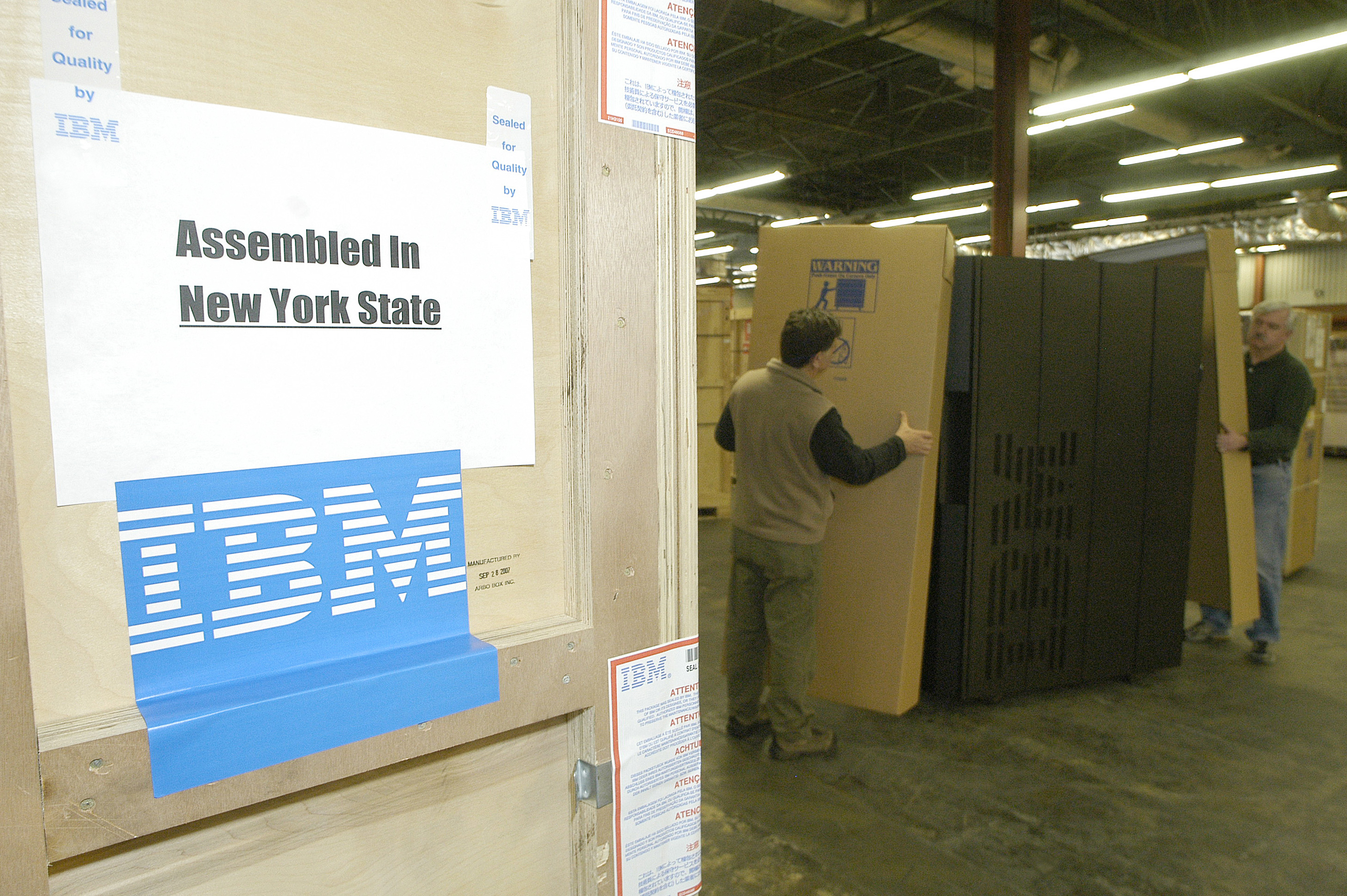
Photo: IBM

In a story in The New York Times on Wednesday, I write about IBM’s new initiative to green up its $40 billion global supply chain:

I.B.M. said on Wednesday that it will require its 28,000 suppliers in more than 90 countries to install management systems to gather data on their energy use, greenhouse gas emissions and waste and recycling.

Those companies in turn must ask their subcontractors to do the same if their products or services end up as a significant part of I.BM.’s $40 billion global supply chain. The suppliers must also set environmental goals and make public their progress in meeting those objectives.

“We will be amongst the first, if not the first, with these broad-based markers on our supply base and we’re going to have to spend an appropriate amount of time and money to help our suppliers do what we’re asking them to do,” John Patterson, vice president of I.B.M. global supply and chief procurement officer, said in a telephone interview from Hong Kong.

“It’s clear that there’s real financial benefits to be had for procurers across the world to get innovative with their suppliers,” Mr.  Patterson added. “In the long term, as the Earth’s resources get consumed, prices are going to go up. We’ve already seen large price increases and problems with water.”

The initiative follows Wal-Mart’s announcement in February that it would require its suppliers to eliminate 20 million metric tons of greenhouse gas emissions from the lifecycle of the products it sells.

I.B.M., one of the world’s largest technology companies, is not setting numerical targets for its suppliers to achieve. Rather, the goal is to institutionalize data-gathering systems that will collect information on a variety of measures of environmental performance, according to Wayne Balta, the company’s vice president of corporate environmental affairs and product safety.

“Our overall interest is to systemize environmental management and sustainability across our global supply chain so it helps our suppliers build their own capacity in a way that’s not only good for the environment but their business,” said Mr. Balta.  “It’s about creating a system that works regardless of who is in leadership and what’s in green vogue.”

You an read the rest of the story here.

Read Full Post »

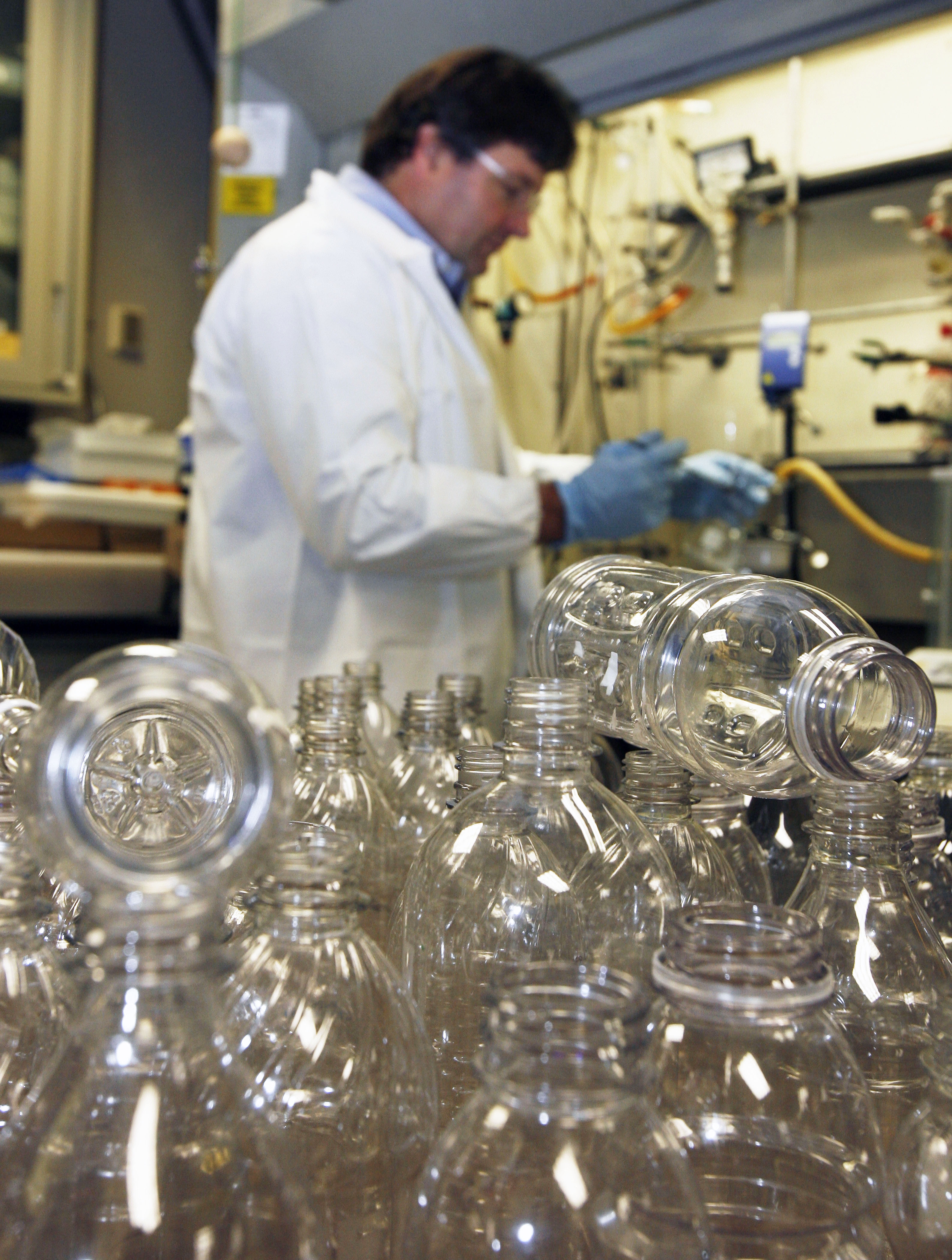
photo: IBM

In The New York Times on Tuesday, I wrote about how scientists at IBM and Stanford University have developed a new process for making plastic that could have major environmental implications:

Researchers at I.B.M. and Stanford University said Tuesday that they have discovered a new way to make plastics that can be continuously recycled or developed for novel uses in health care and microelectronics.

In a paper published in Macromolecules, a journal of the American Chemical Society, the California researchers describe how they substituted organic catalysts for the metal oxide or metal hydroxide catalysts most often used to make the polymers that form plastics.

Chandrasekhar Narayan, who leads I.B.M.’s science and technology team at its Almaden Research Center in San Jose, Calif., said the presence of metal catalysts in plastics means that they often can only be recycled once before ending up in a landfill.

“When you try to take a product and recycle it, the metal in the polymer continues to degrade the polymer so it gets increasingly less strong,” said Mr. Narayan. “If you use organic reactants, you can make certain types of new polymers that are quite different and have other properties plastics don’t have.”

That could give new life to the 13 billion plastic bottles that are thrown away each year in the United States.

“Plastic bottles can be converted to higher value plastics like body panels for cars,” said Mr. Narayan.

Organic catalysts could create a new class of biodegradable plastics to replace those that are difficult to recycle, such as polyethylene terephthalate, or PET, used in a variety of consumer products, including plastic beverage bottles.

You can read the rest of the story here.

Read Full Post »

« Newer Posts - Older Posts »

Design a site like this with WordPress.com
Get started