Feeds:
Posts
Comments

Archive for the ‘green tech’ Category

brightsource-ivanpah.png

When President Bush signed the energy bill into law last month, much was made of the legislation’s mandate that automakers dramatically boost the fuel efficiency of their fleets. Less noticed was that the bill dropped a provision that would have extended the solar investment tax credit — a measure viewed as essential to transforming solar energy from a niche business into a multi billion-dollar industry that can generate gigawatts of greenhouse gas-free electricity.

The timing couldn’t be worse. With the current solar credit set to sunset, as it were, at the end of 2008, Big Solar is at at a tipping point: Utilities and renewable energy companies are in the midst of negotiating massive megawatt power purchase deals whose financing depends on the 30 percent investment tax credit, or ITC.

“I think there is a major concern that this will stall all the beneficiaries of the ITC,” said Joshua Bar-Lev, vice president for regulatory affairs for solar power plant developer BrightSource Energy. The Oakland, Calif.-based startup is negotiating a 500-megawatt agreement with California utility PG&E and is proceeding with plans to build a 400-megawatt solar thermal power station on the Nevada border (artist rendering above).

Solar energy companies, utilities like PG&E (PCG) and Edison International (EIX) as well as financiers such as Morgan Stanley (MS) and GE Energy Financial Services (GE), had pushed for an eight-year extension of the investment tax credit to give Big Solar projects enough time to get off the ground and start to achieve economies of scale. The provision also would have allowed utilities to claim the credit for solar projects they build. The measure drew support from both sides of the aisle in Congress but died — by one vote in the Senate — when Bush threatened to veto the energy bill because the solar tax credit would be financed by repealing previous tax breaks given to Big Oil.

“The Congressional leadership is very strong in their support of the ITC; they will put this on the table In 2008,” said Chris O’Brien, a Sharp Solar executive and chairman of the Solar Energy Industries Association, in an e-mail. “The solar industry will continue to contact legislators in key states.”

House Speaker Nancy Pelosi and the Democratic leadership in the Senate have pledged to re-introduce renewable energy tax credit legislation this session. “Speaker Pelosi has said repeatedly that she hopes to address that this year,” Drew Hammill, a spokesman for Pelosi, told Green Wombat. “We’re just getting started but there’s bipartisan support for the tax credit.”

Publicly, at least, no one in the solar industry will say that the uncertainty over the tax credit is affecting planned projects. “Our expectation is that there will be another tax bill that will address this issue,” said Kevin Walsh, managing director of the renewable energy group at GE Energy Financial Services. “We’re working on a number of [solar thermal] deals but it’s too early to disclose them.”

In recent months, PG&E has signed deals for more than a gigawatt of electricity — enough to light more than 750,000 homes — with solar power plant developers. Such power purchase agreements can take more than a year to hammer out and the permitting and construction of a solar power station can take another three to five years.

“We’re continuing to move forward with negotiations and with contracts that have already been signed, but certainly the absence of the ITC could potentially impact future projects,” said PG&E spokesman Keely Wachs. “Without the credit, it does increase the cost of that energy and of course it also sends a very clear market signal as to our country’s energy priorities.”

Silicon Valley solar startup Ausra is building a 177-megawatt solar power plant on the Central California coast to supply electricity to PG&E and is pursuing deals with Florida’s FPL (FPL) and other utilities.

“Just like any business, the solar industry prefers a predictable system for the future,” wrote Holly Gordon, Ausra’s director of regulatory and legislative affairs, in an e-mail. “It will be more difficult to plan for our projects while the situation remains uncertain. While we are currently seeing excellent demand for solar energy at market prices, we need a long term extension of the renewable energy tax credits to ensure market stability and investor confidence as the market continues to grow.”

Read Full Post »

ecomotors-engine-diagram-012008_examples.jpg

Silicon Valley green tech investor Vinod Khosla caused a stir recently when he dissed plug-in electric hybrid cars as “toys” that would not contribute much in the way of fighting global warming. The blogs were buzzing from red-faced EV enthusiasts taking umbrage at Khosla, who has made big bets on biofuels and is never shy at expressing his opinions on all matters green.

But an investment Khosla Ventures announced this week in EcoMotors, a Detroit startup developing a high-efficiency diesel engines, shows that the legendary venture capitalist is more eclectic when it comes to electrics than his public pronouncements might make him seem.

EcoMotors founders Peter Hofbrauer and John Coletti, veterans of Volkswagen and Ford (F) respectively, are engineering engines that they hope will achieve 100 miles per gallon, run on gasoline, diesel or biofuels and be used to power — wait for it — plug-in hybrid electric cars.

What drove Khosla to change his mind on hybrids? He didn’t, really. To understand why, we need to look under the hybrid hood. There are two types of hybrids. A parallel” hybrid contains two drive trains — an electric motor to power the car at low speeds for short periods of time, and a conventional gasoline engine for higher speeds. The Toyota (TM) Prius and Honda (HMC) Civic hybrid and most other hybrids on the road today are parallel hybrids. (A plug-in version would allow for a more powerful battery pack that could be recharged from a standard electrical outlet.)

In contrast, a series hybrid takes some of the complexity — and presumably the cost — out of the design by using only an electric drive train to propel the car while relying on a small internal combustion engine to power a generator that charges the battery and provides power to the electric motor when needed. The Chevrolet Volt, General Motor’s (GM) plug-in electric hybrid under development, is a series plug-in hybrid. And the EcoMotors’ engine will be designed for use in a series hybrid.

“He was referring to parallel hybrids,” says Khosla Partner’s Ford Tamer of his boss’s anti-hybrid comments made in a speech at an investor conference. “We do believe a series hybrid is the way to go. He was also referring to the fact that the hybrid platform is inherently an expensive platform.”

So is a series platform at this point, but Khosla’s vision is to drive that cost down by creating high-efficiency engines and batteries. Hence the investment in EcoMotors. And hence the hiring last September of Tamer, a former top executive at chipmaker Broadcom and a co-founder of another chip company, Agere (later acquired by Lucent). “I’ve been focused on the efficiency side of Khosla — engines, motors, turbines, even solar and batteries,” says Tamer, Khosla Ventures’ operating partner.

Khosla is the sole funder of EcoMotors – and no, Tamer won’t reveal the size of the investment – which officially launched this month and remains so stealthy it doesn’t even have a website yet.

Tamer says EcoMotors CEO Hofbrauer developed a high-efficiency engine under contract with the Defense Advanced Research Projects Agency, of DARPA, for use in military vehicles. EcoMotors has now licensed the technology for commercial use.

Here’s how it works, as explained by Tamer: the EcoMotors engine is built of 2-cylindar “modules” that can be stacked depending on the need for power – one or two modules for a car, three or four for a big truck. “If you have two modules, you can shut down one module for city driving,” says Tamer. “But when you need to need to go uphill or need power for highway driving, you engage the second module. That gives you better fuel efficiency and reduces emissions.” (EcoMotors’ renderings of the engine’s design are above.)

With the recently enacted energy bill mandating automakers raise the average fuel efficiency of their fleets to 35 miles per gallon by 2020, EcoMotors aims to demo its first engine to potential customers by early 2009.

A plug-in electric hybrid drive train will be further down the road but Khosla Ventures already has made investments in companies developing components for such a system. One such startup is Seeo, a Berkeley, Calif.-based company whose website cryptically says it is “developing advanced materials to revolutionize electricity storage and delivery.” And Thursday morning, Khosla Ventures announced it had upped its investment in Transonic Combustion, a California startup developing  fuel injection systems designed to increase fuel efficiency.

“Our belief is that we have to get a fuel-efficient, emissions-conscious diesel engine on its own,” Tamer says. “Then going to a hybrid becomes a bonus.”

One of Vinod Khosla’s mantras is that green technology must become cheap and scalable enough to be adopted in China and India, countries whose impact on climate change is monumental. In other words, a $25,000 plug-in hybrid doesn’t stand a chance against a Tata Nano, the Indian people’s car unveiled last week.

Remarks Tamer: “$2,500 will buy a Tata – that’s a DVD upgrade on a Lexus.”

Read Full Post »

hp-enviro-1.pngOvershadowed by Google’s jump into the renewable energy business on Tuesday was Hewlett-Packard’s more modest move to go green by installing a 1-megawatt solar array at its San Diego facility, buying wind power for its Ireland operations and subsidizing employees’ home solar systems.

In Silicon Valley these days putting a whopping solar array up on your roof is akin to having the coolest corporate jet or your CEO back-ordered for a Tesla Roadster. Google (GOOG), of course, has the biggest, a 1.6-megawatt monster that covers buildings and carports at the Googleplex in Mountain View. Not to be outdone, Applied Materials (AMAT) is planning an even larger solar system for its headquarters in neighboring Santa Clara.

But there’s more at stake here than green bragging rights. Companies like HP (HPQ) are realizing that tapping renewable energy can also be good for the bottom line. Take HP’s solar array in San Diego, for instance. The 5,000-panel system carries no capital costs for HP as the array will be financed and operated by a third-party affiliated with solar cell maker SunPower (SPWR). The Silicon Valley company will install the array and perform maintenance for 15 years while HP purchases the electricity produced by the solar system at a guaranteed below-market rate. That gives the company a hedge against rising energy costs. (HP thinks it’ll save $750,000 over 15 years.) HP also retains ownership of any potentially marketable renewable energy credits associated with the array while the financier can take advantage of California’s solar subsidies.

SunPower wasn’t disclosing the identity of that financier when Green Wombat inquired on Tuesday, but this morning the company announced a $200 million deal with Morgan Stanley (MS) to provide financing for solar installations and power purchase agreements like the one HP signed. SunPower and Morgan Stanley have formed a jointly owned holding company to finance SunPower’s solar systems for customers, with the Wall Street firm kicking in up to $190 million and SunPower putting up as much as $10 million.

In Ireland, HP will buy a year’s worth of clean electricity generated by Airtricity’s European wind farms, saving the company an estimated $40,000 in 2008. Electricity generated by Airtricity’s wind farms is fed into Ireland’s national power grid rather than directly to HP facilities. But the additional power generated by the wind farms, as well as the solar electricity eventually produced by the San Diego array, will eliminate tons of greenhouse gas emissions from the atmosphere.

Last, SunPower will give HP employees a $2,000 rebate if they install the company’s residential solar systems, with HP providing another $2,000. That’s on top of state rebates under the California Solar Initiative program.

Read Full Post »

luz-power-plant.jpg

Google the jolly green giant?

In a move to shake up the nascent renewable energy industry, Google announced Tuesday it will spend hundreds of millions of dollars developing new solar and wind technologies while investing in green tech startups.

The goal, according to Google founders Sergey Brin and Larry Page: Send the fossil fuel industry to the coal bin of history by making renewable energy cheaper than coal, a main culprit in the global warming crisis.“

Assuming we can develop this, we want to deploy it as broadly as possible,” said Brin during a conference call. “Which means we’ll license the technology or put it in place ourselves.” Of particular interest is spreading renewable energy technology to rapidly industrializing but coal-dependent countries like China and India.

Dubbed RE<C (as in Renewable Energy Cheaper than Coal), the Google initiative will involve hiring green energy engineers and technologists for an in-house R&D program that will focus on developing breakthroughs in large-scale solar power plants. At the same time, Google’s (GOOG) philanthropic arm, Google.org, will invest in green energy companies. Within a few years Google wants to be able to produce a gigawatt of clean energy — enough to power a city the size of San Francisco — at a price that will undercut cheap electricity from coal-fired plants.

For solar energy companies, the double-headed approach raises the prospect of both a potential brain-drain to Google and the possibility of a payday if the search giant goes on a green tech shopping spree. Page said Google routinely acquires “dozens of companies” and would apply that strategy to the renewable energy initiative where appropriate.

John O’Donnell, executive vice president of Silicon Valley solar energy startup Ausra, said he welcomes Google’s bid to become a green energy player.”I think folks who have or are developing technologies that can deliver RE<C are going to get some speedup in moving to market,” he told Green Wombat. “That’s good news for the sector and for the planet.”

Ausra, backed by venture capital heavyweights Vinod Khosla and Kleiner Perkins Caufield & Byers, builds large-scale solar power plants and recently signed a long-term deal with California utility PG&E (PG&E).

“We’re at a more mainstream engineer/build stage, and don’t expect hiring problems,” O’Donnell added. “Google may encourage more smart folks to seek careers in clean energy.”

Given that a solar power plant can cost anywhere between half a billion and a billion dollars or more, it appears Google will concentrate on perfecting solar technology rather than get into the utility business. “In terms of building power plants, hundreds of millions of dollars is really not a large sum, so I hope they spend the money in a highly leveraged way to get the most out of it,” says John Woolard, CEO of solar power plant startup BrightSource Energy, which is negotiating with utilities to supply 1.5 gigawatts of solar electricity.

“We are very active in the Southwest, and would look forward to working with a group like Google on building out power plants,” he adds. “I never would have predicted that Google would emerge as a provocative leader in large scale solar, but I am very excited about thevisibility it brings to an area of technology that we know has real economic potential.”

Google already is working with two renewable energy startups. One is eSolar, a Pasadena, Calif., developer of utility-scale solar thermal power plants whose chairman is serial tech entrepreneur Bill Gross. The other is Makani Power, a stealth Bay Area startup that is developing what it calls “high-altitude wind energy extraction technologies aimed at the most powerful wind resources.”Page and Brin declined to say if Google has invested in those companies.

PG&E spokeswoman Jennifer Zerwer said RE<C is “clearly a sign of the growing awareness of and response to climate change — and that is a positive trend, especially for those concerned about climate change, as we are. While we did not work directly with Google on this announcement, we team with them on their energy efficiency and renewable efforts.”

Like other California utilities, such as Southern California Edison (EIX) and San Diego Gas & Electric (SRE), PG&E is under the gun to obtain 20 percent of its electricity from renewable sources by 2010 and 33 percent by 2020.

The move into green energy is Google’s biggest departure so far from its core search and advertising business. But Page noted it is not a change of mission for Google.org, which currently is managing initiatives to promote plug-in hybrid cars.

Brin and Page took pains to stress that RE<C makes good business sense, with the potential to profit from Google’s stake in green energy companies or technology the company develops. Still, acknowledged Brin, “We’re not going for huge margins. We want to deploy this fast.”

“This has the ability to change the world,” he added.

Read Full Post »

Google’s green power play

luz-power-plant.jpg

Google the jolly green giant?

In a move to shake up the nascent renewable energy industry, Google
announced Tuesday it will spend hundreds of millions of dollars
developing new solar and wind technologies while investing in green
tech startups.

The goal, according to Google founders Sergey Brin and Larry Page:
Send the fossil fuel industry to the coal bin of history by making
renewable energy cheaper than coal, a main culprit in the global
warming crisis.

Assuming we can develop this, we want to deploy it as broadly as
possible," said Brin during a conference call. Which means well
license the technology or put it in place ourselves. Of particular
interest is spreading renewable energy technology to rapidly
industrializing but coal-dependent countries like China and India.

Dubbed RE<C (as in Renewable Energy Cheaper than Coal), the
Google initiative will involve hiring green energy engineers and
technologists for an in-house R&D program that will focus on
developing breakthroughs in large-scale solar power plants. At the same
time, Google’s (GOOG) philanthropic arm, Google.org, will invest in
green energy companies. Within a few years Google wants to be able to
produce a gigawatt of clean energy — enough to power a city the size
of San Francisco — at a price that will undercut cheap electricity
from coal-fired plants.

For solar energy companies, the double-headed approach raises the
prospect of both a potential brain-drain to Google and the possibility
of a payday if the search giant goes on a green tech shopping spree.
Page said Google routinely acquires "dozens of companies" and would
apply that strategy to the renewable energy initiative where
appropriate.

John O’Donnell, executive vice president of Silicon Valley solar
energy startup Ausra, said he welcomes Google’s bid to become a green
energy player.

"I think folks who have or are developing technologies that can
deliver RE<C are going to get some speedup in moving to market," he
told Green Wombat. "That’s good news for the sector and for the planet."

Ausra, backed by venture capital heavyweights Vinod Khosla and
Kleiner Perkins Caufield & Byers, builds large-scale solar power
plants and recently signed a long-term deal with California utility
PG&E (PG&E). "We’re at a more mainstream engineer/build stage,
and don’t expect hiring problems," O’Donnell added. "Google may
encourage more smart folks to seek careers in clean energy."

Given that a solar power plant can cost anywhere between half a
billion and a billion dollars or more, it appears Google will
concentrate on perfecting solar technology rather than get into the
utility business. "In terms of building power plants, hundreds of
millions of dollars is really not a large sum, so I hope they spend the
money in a highly leveraged way to get the most out of it," says John
Woolard, CEO of solar power plant startup BrightSource Energy, which is negotiating with utilities to supply 1.5 gigawatts of solar electricity.

"We
are very active in the Southwest, and would look forward to working
with a group like Google on building out power plants,"  he adds.  "I
never would have predicted that Google would emerge as a provocative
leader in large scale solar, but I am very excited about the
visibility it brings to an area of technology that we know has real economic potential."

Google already is working with two renewable energy startups. One is
eSolar, a Pasadena, Calif., developer of utility-scale solar thermal
power plants whose chairman is serial tech entrepreneur Bill Gross. The
other is Makani Power, a stealth Bay Area startup that is developing
what it calls "high-altitude wind energy extraction technologies aimed
at the most powerful wind resources." Page and Brin declined to say if
Google has invested in those companies.

PG&E spokeswoman Jennifer Zerwer said RE<C is "clearly a sign
of the growing awareness of and response to climate change — and that
is a positive trend, especially for those concerned about climate
change, as we are. While we did not work directly with Google on this
announcement, we team with them on their energy efficiency and
renewable efforts."

Like other California utilities, such as Southern California Edison
(EIX) and San Diego Gas & Electric (SRE), PG&E is under the gun
to obtain 20 percent of its electricity from renewable sources by 2010
and 33 percent by 2020.

The move into green energy is Google’s biggest departure so far from
its core search and advertising business. But Page noted it is not a
change of mission for Google.org, which currently is managing
initiatives to promote plug-in hybrid cars.

Brin and Page took pains to stress that RE<C makes good business
sense, with the potential to profit from Google’s stake in green energy
companies or technology the company develops. Still, acknowledged Brin,
"We’re not going for huge margins. We want to deploy this fast."

"This has the ability to change the world," he added.

Read Full Post »

next-10-1.pngJust how green is California? Deep green. Very deep green, according to a new California Green Innovation Index compiled by Silicon Valley venture capitalist F. Noel Perry’s non-profit Next 10 foundation.

That might be taken as so much environmental chest-thumping by Golden State partisans, but the report — the product of Next 10 and public-interest consultants Collaborative Economics — offers some persuasive statistics about the role green innovation has played in California’s fortunes.

“The index analyzes key economic and environmental indicators,” writes Perry, “including energy consumption and efficiency, economic growth and carbon emissions, to help us better understand the role green innovation plays in achieving two goals critical to California’s future: 1) reducing the absolute level of the greenhouse gas emissions that cause global warming, and 2) increasing the state’s gross domestic product, which is the basis for our economic vitality ”

The conclusion echoes one repeatedly championed by green tech proponents, from Gov. Arnold Schwarzenegger to Silicon Valley venture capitalists: environmental innovation and economic prosperity go hand in hand.

Here’s some interesting data points from the report:

  • “If California’s annual statewide electricity bill was the same fraction of GDP as Texas…Californians would be paying almost $25 billion more for electricity.”
  • California holds 44% of United States patents in solar technologies and 37% in wind.
  • The Golden State has 36 percent of the U.S.’s green tech venture capital investment.
  • “California utility efficiency programs….reduced the need for 24 power plants between 1975 and 2003….The California Energy Commission estimates that building and appliance standards alone have saved residents and businesses $56 billion through 2003 and are projected to save another $23 billion by 2013.”
  • “More Californians recycle than vote” (More than 50 percent of Californians recycle.)
  • “Per capita CO2 emissions in Texas are double those of California. Per capita emissions levels in California today are slightly lower than they were 15 years ago.”
  • California has about 90 percent of the market for energy-efficient dishwasher and about 50 percent of the market for energy-efficient refrigerators and washing machines

Concludes Next 10: “The growing distance between the trend lines of GDP rising and emissions dropping represent the delinking of GHG emissions from economic growth.”

Read Full Post »

Next_10_1
Just how green is California? Deep green. Very deep green, according
to a new California Green Innovation Index compiled by Silicon Valley
venture capitalist F. Noel Perry’s non-profit Next 10 foundation.

That might be taken as so much environmental chest-thumping by Golden State partisans, but the report
— the product of Next 10 and public-interest consultants Collaborative
Economics — offers some persuasive statistics about the role green
innovation has played in California’s fortunes.

"The index analyzes key economic and environmental indicators,"
writes Perry, "including energy consumption and efficiency, economic
growth and carbon emissions, to help us better understand the role
green innovation plays in achieving two goals critical to Californias
future: 1) reducing the absolute level of the greenhouse gas emissions
that cause global warming, and 2) increasing the states gross domestic
product, which is the basis for our economic vitality "

The conclusion echoes one repeatedly championed by green tech
proponents, from Gov. Arnold Schwarzenegger to Silicon Valley venture
capitalists: environmental innovation and economic prosperity go hand
in hand.

Here’s some interesting data points from the report:

  • "If Californias annual statewide electricity bill was the same
    fraction of GDP as Texas…Californians would be paying almost $25
    billion more for electricity."
  • California holds  44% of United States patents in solar technologies and 37% in wind.
  • The Golden State has 36 percent of the U.S.’s  green tech venture capital investment.
  • "California utility efficiency programs….reduced the need for 24
    power plants between 1975 and 2003….The California Energy Commission
    estimates that building and appliance standards alone have saved
    residents and businesses $56 billion through 2003 and are projected to
    save another $23 billion by 2013."
  • "More Californians recycle than vote" (More than 50 percent of Californians recycle.)
  • "Per capita CO2 emissions in Texas are double those of California.
    Per capita emissions levels in California today are slightly lower than
    they were 15 years ago."
  • California has about 90 percent of the market for energy-efficient
    dishwasher and about 50 percent of the market for energy-efficient
    refrigerators and washing machines

Concludes Next 10: "The growing distance between the trend lines of
GDP rising and emissions dropping represent the delinking of GHG
emissions from economic growth."

Read Full Post »

berkeley-shoreline.jpgThe devastating San Francisco Bay oil spill brought out thousands of volunteers over the weekend eager to help clean up miles of beaches and shoreline contaminated with toxic bunker fuel and rescue hundreds of petroleum-coated birds. If ever there was a disaster area suited to exploit Internet technology to crowdsource an army of green berets and deploy them where they’re needed most, it’s this Twittering, Google map-mashing epicenter of Web 2.0, right?

Not quite. The masses may be wired but California authorities’ disaster response was strictly 1.0, as Green Wombat discovered when he showed up at a meeting on Saturday called by the state Department of Fish and Game to brief would-be volunteers about the oil spill from the Cosco Busan. The container ship hit the Bay Bridge last Wednesday, dumping 58,000 gallons of heavy oil into the water. A couple hundred people crammed a room at the Richmond Marina in the East Bay, spilling outside into the drizzling rain. As the crowd peppered officials with questions about how they could get to work — a few yards away a dull oily sheen streaked the harbor — DFG representatives patiently explained that volunteers must first receive training before they can be allowed to handle wildlife or clean beaches covered in a hazardous substance.

“We have to get information from you to place you,” said a representative from the DFG’s Office of Spill Prevention and Response as paper forms were handed out for volunteers to fill in. They soon ran out of forms — more than 500 people had shown up at another volunteer meeting held a few hours earlier in San Francisco. Many members of the audience, BlackBerries and Treos in hand, stared in disbelief. Paper? “I’m from Autodesk (ADSK) in Marin and we have 1,500 people that want to get to work on the cleanup,” said one woman. “Can’t you just put up a PDF on your site so we can download it?” Said another volunteer: Can’t we just send you an e-mail?”

To be fair, state officials were overwhelmed by the response from Bay Area residents. (“An oil spill in San Francisco is so different than any other place for one reason: the people,” one DFG official said at the meeting. “People here are passionate about where they live.”) And by Sunday morning, the oil response unit’s site had posted a Yahoo (YHOO) e-mail address (coscobusanspill@yahoo.com) so volunteers could send in their contact details. Still, if you wanted to report sightings of injured wildlife or contaminated shoreline, you had to spend a lot of time hitting redial to try to get through jammed phone lines.

bolinas-lagoon-oil1.jpgThe authorities’ old-media disaster response strategy of relying on newspapers and television to broadcast one-way messages to a population accustomed to Internet interactivity is missing an opportunity to coordinate a faster and better targeted cleanup operation. For instance, as the San Francisco Chronicle reported, residents of the coastal hamlet of Bolinas north of San Francisco were left on their own as they struggled to place a boom across the mouth of the Bolinas Lagoon to keep oil out of the environmentally sensitive Marin County estuary, home to a hundred bird species and a colony of harbor seals.

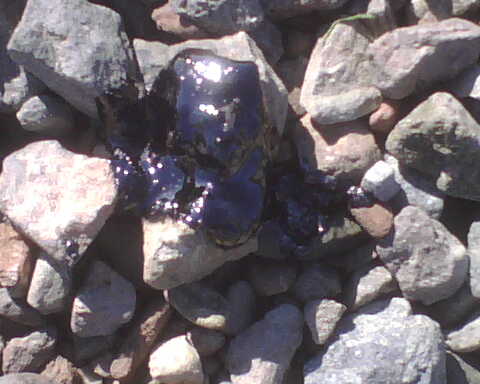
Now imagine if an Internet database of volunteers and their locations was mashed up with a Google (GOOG) map of oil-threatened areas. Would-be volunteers could go online to see where assistance was needed near them or they could be notified by e-mail or text message. Extra bodies and equipment might have helped avoid what Green Wombat found when he and his son visited the eastern shore of Bolinas Lagoon on Sunday: globs of thick purple-black oil dotting the rocks while a dozen endangered California brown pelicans floated off a nearby sandbar where seals bask during low tide. (Photo at right.)

An online map mashup or a wiki page would have also helped wildlife rescuers collect old sheets and towels and other materials needed to clean oil-soaked birds as well as coordinate volunteers to provide support to cleanup crews. As it was, Green Wombat happened to hear a volunteer at the Richmond meeting mention that you could drop off sheets at the Berkeley Marina, where rescued birds were being collected. Stopping by the marina on Sunday, we found another ad hoc group of volunteers helping along the shoreline cordoned off with yellow police tape.

This is not to say creating a Web 2.0 emergency response system would be easy — particularly when it means integrating such an operation with government agencies. But it sounds like an opportunity for some established Internet company or entrepreneur. In the meantime, Bay Area residents, environmental groups and local governments are organizing themselves online, turning to — where else? — Facebook to set up oil spill clearinghouses to exchange information and coordinate haz mat training sessions for volunteers.

Read Full Post »

Berkeley_shoreline
The devastating San Francisco Bay oil spill brought out thousands of
volunteers over the weekend eager to help clean up miles of beaches and
shoreline contaminated with toxic bunker fuel and rescue hundreds of
petroleum-coated birds. If ever there was a disaster area suited to
exploit Internet technology to crowdsource an army of green berets and
deploy them where they’re needed most, it’s this Twittering, Google
map-mashing epicenter of Web 2.0, right?

Not quite. The masses may be wired but California authorities’
disaster response was strictly 1.0, as Green Wombat discovered when he
showed up at a meeting on Saturday called by the state Department of
Fish and Game to brief would-be volunteers about the oil spill from the
Cosco Busan. The container ship hit the Bay Bridge last Wednesday,
dumping 58,000 gallons of heavy oil into the water. A couple hundred
people crammed a room at the Richmond Marina in the East Bay, spilling
outside into the drizzling rain. As the crowd peppered officials with
questions about how they could get to work — a few yards away a dull
oily sheen streaked the harbor — DFG representatives patiently
explained that volunteers must first receive training before they can
be allowed to handle wildlife or clean beaches covered in a hazardous
substance.

"We have to get information from you to place you," said a
representative from the DFG’s Office of Spill Prevention and Response
as paper forms were handed out for volunteers to fill in. They soon ran
out of forms — more than 500 people had shown up at another volunteer
meeting held a few hours earlier in San Francisco. Many members of the
audience, BlackBerries and Treos in hand, stared in disbelief. Paper?
"I’m from Autodesk (ADSK) in Marin and we have 1,500 people that want
to get to work on the cleanup," said one woman. "Can’t you just put up
a PDF on your site so we can download it?" Said another volunteer:
Can’t we just send you an e-mail?"

To be fair, state officials were overwhelmed by the response from
Bay Area residents. ("An oil spill in San Francisco is so different
than any other place for one reason: the people," one DFG official said
at the meeting. "People here are passionate about where they live.")
And by Sunday morning, the oil response unit’s site
had posted a Yahoo (YHOO) e-mail address (coscobusanspill@yahoo.com) so
volunteers could send in their contact details. Still, if you wanted to
report sightings of injured wildlife or contaminated shoreline, you had
to spend a lot of time hitting redial to try to get through jammed
phone lines.

Bolinas_lagoon_oil1
The
authorities’ old-media disaster response strategy of relying on
newspapers and television to broadcast one-way messages to a population
accustomed to Internet interactivity is missing an opportunity to
coordinate a faster and better targeted cleanup operation. For
instance, as the San Francisco Chronicle reported,
residents of the coastal hamlet of Bolinas north of San Francisco were
left on their own as they struggled to place a boom across the mouth of
the Bolinas Lagoon to keep oil out of the environmentally sensitive
Marin County estuary, home to a hundred bird species and a colony of
harbor seals.

Now imagine if an Internet database of volunteers and their
locations was mashed up with a Google (GOOG) map of oil-threatened
areas. Would-be volunteers could go online to see where assistance was
needed near them or they could be notified by e-mail or text message.
Extra bodies and equipment might have helped avoid what Green Wombat
found when he and his son visited the eastern shore of Bolinas Lagoon
on Sunday: globs of thick purple-black oil dotting the rocks while a
dozen endangered California brown pelicans floated off a nearby sandbar
where seals bask during low tide. (Photo at right.)

An online map mashup or wiki page would have also helped wildlife rescuers
collect old sheets and towels and other materials needed to clean
oil-soaked birds as well as coordinate volunteers to provide support to
cleanup crews. As it was, Green Wombat happened to hear a volunteer at
the Richmond meeting mention that you could drop off sheets at the
Berkeley Marina, where rescued birds were being collected. Stopping by
the marina on Sunday, we found another ad hoc group of volunteers
helping along the shoreline cordoned off with yellow police tape.

This is not to say creating a Web 2.0 emergency response system
would be easy — particularly when it means integrating such an
operation with government agencies. But it sounds like an opportunity
for some established Internet company or entrepreneur. In the meantime,
Bay Area residents, environmental groups and local governments are
organizing themselves online, turning to — where else? — Facebook to
set up oil spill clearinghouses to exchange information and coordinate
haz mat training sessions for volunteers.

Read Full Post »

Apple_green_3 Steve Jobs’s green manifesto is bubbling about the blogosphere and much is being made over whether  (AAPL) waived the white flag under pressure from a Greenpeace campaign, which labeled the company an ecotard – as Fake Steve might put it – for its past "failure to take a green initiative."  Of much more interest to Green Wombat than the pissing match between Jobs and the enviros, or the not-so-veiled jabs he made at rivals, is how Apple has raised the bar on environmental disclosure. Ironically enough, given Jobs’s obsession with keeping secrets, he detailed the amount of various toxic chemicals present in Apple’s computers and iPods and disclosed future manufacturing plans to remove them. Of course, all this served to show that Apple, despite its previous opaqueness, is greener than its competitors. Still, for all the press releases issued by Dell (DELL), Hewlett-Packard (HPQ) and Sun Microsystems (SUNW) trumpeting various environmental initiatives, few have discussed in detail such topics as the arsenic, mercury, cadmium and hexavalent chromium content of their products and specific plans to eliminate the chemicals. For instance, Jobs said Apple will begin to sell mercury-free Macs this year that use LED backlight technology for their screens and will also begin using arsenic-free glass. And he revealed that Apple phased out the use of some hazardous materials in recent years thanks to innovative design. Jobs pledged to completely end the use of others by the end of 2008. Apple has been slammed for its e-recycling polices and the fact that its flooding the planet with millions of iPods that will soon be discarded for the latest model. Jobs said the company this summer would expand its free take-back policy at U.S. Apple stores to all outlets worldwide. He also noted that Apple makes its computers with high-quality materials in demand by recyclers. "Few of our competitors do the same."

"We apologize for leaving you in the dark for this long," Jobs concluded, promising to provide updates on the company’s green deeds, including an examination of its products’ carbon foot print. "Apple is already a leader in innovation and engineering, and we are applying these same talents to become an environmental leader."  Coming from another company that might just be a standard-issue feel-good line. If Jobs’s becomes as obsessive about the environmental design of iPods and iPhones as he does their look, feel and function, then other consumer electronics makers are about to face some real competition on the green front.

Why Apple left increasingly eco-conscious customers unenlightened about what appears to be years of work to remove toxic chemicals from its computers and gadgets remains a public relations strategy best plumbed by bloggers like David Swain at Clean PR.

Read Full Post »

« Newer Posts - Older Posts »

Design a site like this with WordPress.com
Get started