Feeds:
Posts
Comments

Archive for the ‘green tech’ Category

The souring economy hasn’t dissuaded green tech investors from making big bets on renewable energy. On Wednesday, solar power plant builder BrightSource Energy announced it had raised $115 million from a group of investors that include Google.org, the search giant’s philanthropic arm, and oil giants Chevron and BP.

The investment in the Oakland, Calif.-based startup is Google’s (GOOG) second big solar energy play in the past two months. In April, Google.org joined a $130 million round for eSolar, a Pasadena solar power plant company whose chairman is Idealab founder Bill Gross.

BrightSource Energy, started by American-Israeli solar pioneer Arnold Goldman, has contracts to supply California utility PG&E (PCG) with up to 900 megawatts of solar electricity from power plants to be built in the Mojave Desert on the California-Nevada border. BrightSource has developed a new solar technology, dubbed distributed power tower, that focuses fields of sun-tracking mirrors called heliostats on a tower containing a water-filled boiler. The sun’s rays superheat the water and the resulting steam drives an electricity-generating turbine. (Artist rendering of BrightSource’s planned Ivanpah plant above.)

Given that a 500-megawatt solar power plant can cost more than $1 billion to build, $115 million is but a drop in the bucket. But it will allow BrightSource, which previously raised $45 million, to proceed with the development of its technology as it seeks project financing for construction of its first power plants.

And it can’t hurt to have such high-profile backers when you negotiate power purchase agreements with utilities. Besides Google, BP Alternative Energy (BP) and Chevron Technology Ventures (CVX), previous investors participating in the new round include Morgan Stanley (MS), VantagePoint Venture Partners, Draper Fisher Jurvetson and DBL Investors.

Another new BrightSource investor is Norweigan oil and gas behemoth StatoilHydro (STO). Apparently, even Big Oil has seen the light when it comes to hedging its bets with green energy.

Read Full Post »

Stealth Bay Area solar startup OptiSolar has quietly revealed plans to build the world’s largest photovoltaic solar farm on the central California coast — a $1 billion, 550-megawatt monster that would be nearly 40 times as large as the biggest such power plant operating today.

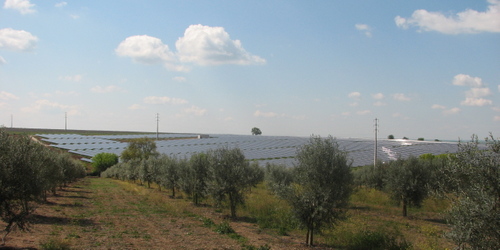
PV solar power plants essentially take solar panels similar to those found on suburban rooftops and put them on the ground. Unlike solar thermal power plants that use mirrors to heat a liquid to produce steam that drives an electricity-generating turbine, photovoltaic power stations generate power directly when the sun strikes the panel’s semiconducting cells. That means there’s virtually no moving parts or need for industrial infrastructure like power blocks, turbines and piping. (A photo of a PV solar farm in Serpa, Portugal, is above.)

But because photovoltaic solar is less efficient at converting sunlight into electricity than solar thermal and requires big swaths of land, it has not been considered economical to build large-scale PV power plants in the United States. (Unlike in Portugal, Spain and other European countries where utilities pay a premium rate for green energy.)

Furthermore, OptiSolar makes thin-film solar cells, which are even less efficient than traditional solar panels. The hoped for advantage of thin-film solar is that the cells can be printed on rolls of metal much more cheaply than bulky conventional solar cells. They also use far less polysilicon –an expensive semiconducting material — than standard solar cells.

Still, hardly any thin-film solar companies in the U.S. have begun mass production, let alone tried to build a huge power plant. OptiSolar intends to both produce solar panels and build and operate solar power plants. It currently has deals to build more than 20 solar farms representing more than 200 megawatts in Canada, which pays higher rates for electricity generated from renewable sources.

“We have propriety technology and a business approach that we’re convinced will let us deploy PV at large scale and be competitive with other forms of renewable energy,” OptiSolar executive vice president Phil Rettger told Green Wombat recently in an interview about the Hayward, Calif.-based company’s plans.

Says Reese Tisdale, a solar energy analyst with Emerging Energy Research: “At this point I see it as an announcement with plenty to prove.” He says the benefits of a large-scale photovoltaic plants are low operation and maintenance costs and the fact that thin-film prices are falling. But he notes that thin-film solar’s low efficiency and inability to store the electricity generated — solar thermal plants can store heat in water or molten salt to create steam when the sun sets — puts such power plants at a disadvantage.

And the large tracts of land needed for such solar farm could create conflicts, particularly when threatened or endangered animals and plants are present. “Environmental groups will go crazy,” Tisdale says.

OptiSolar has kept a low profile and has said little about its technology or how efficent it is, other than that it uses just 1% of the silicon needed in conventional solar cells. Many thin-film solar cells have efficiencies of five to six percent though Global Solar Energy CEO Mike Gering recently told Green Wombat that his company has achieved 10 percent efficiency in production runs.

Founded by veterans of the carbon-intensive Canadian oil sands industry, OptiSolar has a factory in Hayward and just signed a deal to build another manufacturing facility in Sacramento.

The company’s Topaz solar farm would be constructed on nine-and-a-half square miles of ranch land in San Luis Obispo County near the site of the 177-megawatt Carizzo Plains solar thermal power plant planned by Silicon Valley startup Ausra. Optisolar spokesman Jeff Lettes told Green Wombat that the company has taken options to buy the 6,080 acres of land from farming families if the county approves the project.

Who would buy Topaz’s electricity remains to be seen. The plant would be in PG&E’s (PCG) territory and Rettger acknowledged that the company has been in talks with big California utilities such as Southern California Edison (EIX) and San Diego Gas & Electric (SRE). Lettes says the company is currently negotiating a power purchase agreement for Topaz but could not comment further.

OptiSolar says its solar farm would generate electricity for about 190,000 homes. Unlike other PV power plants, OptiSolar will not place its panels on trackers that follow the sun throughout the day. That will lower the cost of the plant but also reduce its efficiency. If approved by the county, construction would begin in 2010. Unlike solar thermal plants, photovoltaic power stations do not need to be licensed by the California Energy Commission, a process that can take a year or two to complete.

Still, OptiSolar will face challenges. Some residents have objected to the size and environmental impact of Ausra’s project and the prospect of another large-scale solar facility in their backyard will raise new concerns. The OptiSolar site is also habitat for the protected California kit fox.

Read Full Post »

PASADENA, Calif. — Green tech guru Vinod Khosla probably didn’t win many friends among the chardonnay-and-carbon-offsets crowd Tuesday during an appearance at Fortune’s Brainstorm Green conference, where he castigated well-heeled enviros for thinking that driving a Toyota (TM) Prius and other “feel-good solutions” will save the planet

“The Prius is more greenwash than green,” the venture capitalist said on stage during a conversation with Fortune senior writer Adam Lashinsky. “Priuses sell a lot but so do Gucci bags. The hybridization of cars is the most expensive way to reduce carbon.”

“We do a lot of feel-good things like put solar panels up in foggy San Francisco so a few middle-class and upper-middle-class people feel good about themselves,” he added.

Ouch.

If Khosla was typically on the offensive, he’s been on the defensive a bit of late over early investments in corn-based biofuels. Alarm has escalated over the past year about the impact of taking food crops out of production to grow a gasoline substitute.

After Lashinsky read a recent quote from the Indian finance minister – “food-based biofuels are a crime against humanity,” Khosla agreed that “food-based biofuels are the wrong way to go. We have much better alternatives.” He has long championed cellulosic biofuels that can be produced from non-food plants like switchgrass or from wood waste and characterized his ethanol investments as a way to get the lay of the biofuels landscape.

Never shy about stirring the pot, he declared that, “People’s views on green are obsolete.” The way to fight climate, according to Khosla, is not to focus on putting solar panels on roofs or building electric cars but increasing the efficiency of things like engines and the operations of mainstream businesses.

Worried about the high price of oil? Don’t. “My forecast for 2030 is that price of oil will be below $25 a barrel,” Khosla said. No matter, he added, because by then biofuels will be cheaper.

So stick that in your Prius.

Read Full Post »

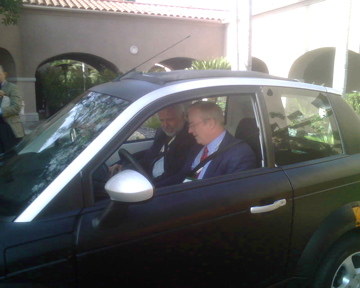
PASADENA, Calif. — If you wanted a snapshot of the emerging alliance between utilities and automakers, the car park of the Langham hotel here was the place to be Tuesday morning. There was the CEO of one of the largest utilities in the United States putting the pedal to the metal of the battery-powered Think City with Think Global CEO Jan-Olaf Willums riding shotgun.

“I liked it a lot,” PG&E (PCG) Chairman and CEO Peter Darbee told Green Wombat after a few spins around the hotel in the electric coupe. “The acceleration was fast, it handled well and it has a European feel.”

We had just finished a Fortune Brainstorm Green session on electric cars (along General Motors’ (GM) executive Beth Lowery), where Darbee declared, “We want to replace the oil industry” as the fuel supplier to the automakers. Fuel in this case is electricity, though unlike Big Oil, regulated utilities such as PG&E and Southern California Edison (EIX) will not make windfall profits no matter how many electrons they push into Chevy Volts.

The topic at hand was the potential for vehicle-to-grid, or V2G, if electric cars go mass market. The big idea: electric cars are essentially mobile generators and rolling energy storage devices. When hundreds of thousands of them are plugged in, they can not only download electricity but return power to the grid from their batteries, allowing utilities to meet peak demand without firing up expensive fossil fuel power plants that often sit idle until everyone cranks up their air conditioners.

PG&E is working with Google (GOOG) to develop technology to allow a smart power grid to detect where an electric car is plugged in so the owner can be charged or credited with consuming electricity or returning it to the grid. The smart grid would also be able to detect power demand spikes and then tap the appropriate number of car batteries to smooth out the electricity supply.

Utilities like PG&E are eager to forge alliances with electric carmakers for other reasons. In California, electric cars could be charged at night when greenhouse gas-free power sources like wind farms tend to produce the most electricity but when demand otherwise falls off. Utilities are also interested in buying used electric car batteries (which retain 80 percent of their capacity even after they’re no longer good for transportation) to store renewable energy that can be released when electricity demand spikes.

Lowery, GM’s vice president for environment, energy and safety policy, said such interest from utilities is prompting the automaker to think how electric cars could spawn new markets. “We’re definitely looking at different business models for batteries,” she said.

On Monday, Think Global and venture capital powerhouses Kleiner Perkins Caufield & Byers and Rockport Capital Partners announced the formation of Think North America as a joint venture between the Norwegian company and the VCs that will bring the Think City to California next year.

Rockport managing general partner and acting Think North America president Wilber James was at the panel and suggested Think supply some cars to PG&E. As the session ended, Darbee, James and Willums headed to the parking lot where Willums showed off the car’s Internet-enabled interactive features, including a video screen with a button already labeled “vehicle-to-grid.”

Read Full Post »

Fortune senior editor David Kirkpatrick reports from Fortune’s Brainstorm Green conference:

PASADENA, Calif — One of the more interesting observations I’ve heard at Fortune’s Brainstorm Green conference concerned genetically-modified foods and nuclear power. Someone commented that these two things — historically the object of huge vituperation from environmentally-minded critics — are both seeing a modulation of criticism.

The world is undergoing a food crisis caused, at least in part, by an undue emphasis on biofuels and in any case closely connected to the dramatically increased price of oil. (I certainly hope the issue of biofuels and food comes up when Adam Lashinsky interviews biofuel’s crown prince Vinod Khosla.) In the face of this food crisis, the antipathy toward GMOs may be starting to fade. The recent moves by Korea to allow in American beef after long resisting it, and by Japan to allow American rice, may just be early signs, this guy said. I’d speculate also that if it’s a question of starvation or survival, the southern African nations which have so adamantly opposed GMOs will almost certainly rethink their positions. (Aside from Zimbabwe’s Mugabe, of course, from whom rationality cannot be presumed.)

In a session on the topic of nuclear power, Fortune’s David Whitford asked the audience how many were unalterably opposed to increasing nuclear power in the U.S. for any reason. In this room of perhaps 300 environmentally-minded Americans, only about 20 raised their hands. With oil at $116 and global warming an ever-more urgent concern, minds are opening. Not that most of those in the room wouldn’t add substantial caveats to their unwillingness to rule nuclear out.

That said, the advocacy of nuclear power shown by Alex Flint of the Nuclear Energy Institute on Whitford’s panel drifted to some absurd extremes. For instance, he said that he would be willing to have a nuclear waste facility in his backyard, and that the location of a nuclear power plant “as close as possible” to his house “would be good for land values.” What is this guy smoking?

In answer to my question — one also raised by his co-panelist David Lockbaum of the Union of Concerned Scientists — about what happens if a jet piloted by a terrorist plows into a nuclear plant, Flint was unconvincing. He claims that studies show that plants’ containment vessels are strong enough to prevent any release of radiation. To which Lockbaum replied that all the studies pre-9/11 found that even if that were the case, the shaking that would be inevitable in such a scenario would sever essentially all pipes and cables in and out of a plant, making a meltdown likely. Studies since 9/11 are classified, he noted, adding “but the laws of physics did not change that day.”

In the random interesting comments category, I was struck by an amazing statistic proffered by IBM’s (IBM) Rich Lechner in a session on Greening the IT industry. There were plenty of convincing arguments being made in the room that IT and the intelligence bequeathed by computing can have a major impact on reducing energy use and carbon releases.

But Lechner noted that a virtual person in Second Life has a larger carbon footprint than the average person in Brazil. His point, presumably, was that as people enter a developed economy, their carbon footprint goes way up along with their increasing use of tech.

Read Full Post »

Fortune associate editor Julie Schlosser reports from Fortune’s Brainstorm Green conference:

PASADENA, Calif — Consumers are feeling the pressure to go green. And it’s hard to ignore. Drinking bottled water is a definite no no. Flying across the country? Buy offsets. The consumer is being bombarded with green marketing and advertising and the result might not be what you expected. All this green guilt and messaging just might be making consumers more skeptical about the growing assortment of green products.

When polled, most consumers overwhelmingly say they want to buy green, according to Joel Makower, head of Greener World Media and author of The Green Consumer. But they aren’t actually doing it. According to the research, Makower says, “If it is green, consumers assume it isn’t good.” And that means, in many cases, green products are entering the marketplace with a deficit.

That was part of the discussion at Monday afternoon’s panel, “The Green Consumer: Myth or reality?” Andrew Shapiro, founder and CEO of GreenOrder, a strategic consulting firm that works with big brands such as GE (GE), GM (GM), Starwood (HOT) and Office Depot (ODP), moderated the panel that included Stonyfield Farm founder Gary Hirschberg, Elizabeth Lowery of GM, and Makower.

Hirschberg, the CE-Yo (yes, you read that correctly) of Stonyfield Farm, the world’s largest organic yogurt company, has a fun story to tell. He took organic yogurt into the mainstream long before organics were cool, and he has built a $300 million-per-year business along the way. He has also managed to incorporate green principles throughout the product’s life cycle. “But we don’t even use the word green when we describe what we do,” he pointed out.

Still, he argues, there is obviously a green consumer. “But we think they are more focused on quality.” And the quality does something that millions of dollars in advertising can’t. It creates loyalty, says Hirschberg. “And if loyalty comes from an emotional place, authenticity is the key to creating it.”

What consumers are showing us is that if your company has a high “talk-to-do ratio” when it comes to going or being green, you’ll lose the consumer’s trust immediately. By adopting a sense of humility and focusing on communicating honestly with your consumers, Hirschberg argues, companies can build loyalty.

So how does a company build such a relationship with their customer? By offering them a premium product and one that isn’t just greener, but tastes better, lasts longer, or is more aesthetically pleasing. And as the economy continues to slow, the best way to get a consumer to go green is to give them the goods for less.

Read Full Post »

PASADENA, Calif. — Solar power plant builder eSolar has raised $130 million from Google’s philanthropic arm, Google.org, and other investors.

That was the headline news that eSolar chairman and Idealab founder Bill Gross slipped to Green Wombat during dinner Sunday night as Fortune’s Brainstorm Green conference kicked off in Pasadena. The other investors include Idealab and Oak Investment Partners. Big numbers grab attention but the far more interesting angle is the technology that eSolar is developing. If it lives up to its claims, eSolar could help break the logjam that has put Big Solar on the slow track in California.

“We just completed tests at our test site this week and we will be able to produce electricity that is competitive with coal,” said an animated Gross Sunday evening.

That is the Holy Grail of renewable energy and the charge set out by Google (GOOG) founders Sergey Brin and Larry Page when they launched their green power initiative, RE<C (Renewable Energy less than Coal), in November. Google.org subsequently invested $10 million in Pasadena-based eSolar. (eSolar did not say how much of the $130 million Google.org ponied up in the latest round.)

eSolar has been operating in stealth mode but Gross shared details of the company’s technology and how it intends to produce greenhouse gas-free electricity so cheaply — a claim sure to be met with some skepticism by competitors like Ausra, BrightSource Energy and Solel.

At first glance, there doesn’t seem much radically different about an eSolar solar thermal power plant — it’ll use fields of mirrors to focus the sun’s rays on a tower containing a water-filled boiler. The resulting heat will create steam that will drive an electricity-generating turbine.

The tipping-point innovation, according to Gross, is the mirrors and the software that controls them as well as the modular design of the power plants.

While Oakland, Calif.-based BrightSource is developing a similar system, Gross says eSolar is able to use smaller mirrors — called heliostats — that can be cheaply mass produced from off-the-shelf glass like that used in bathroom mirrors. Proprietary software developed by eSolar controls each sun-tracking mirror, increasing their efficiency to produce more electricity. “It’s all about the software,” Gross said.

Smaller more powerful solar fields means that eSolar can build power plants on far less land than competitors for less money, according to Gross. For instance, a 500-megawatt solar power plant can cost more than $1 billion to build and requires thousands of acres of land — which is why most will built in remote deserts. But eSolar plans to build modular, 33-megawatt power plants that can be constructed on a couple hundred acres and plugged into existing transmission lines near urban areas.

“We’ve already bought up rights to enough land to produce more than a gigawatt of electricity,” said Gross, showing Green Wombat a map of California polk-a-dotted with the locations of potential eSolar power plants. A gigawatt can power about 750,000 homes.

The small size of each power plant has another benefit — solar thermal power stations under 50 megawatts do not have to be licensed by the California Energy Commission. That means eSolar can cut at least a year or two off the process of getting a solar power plant online.

That will certainly be attractive to the Golden State’s big utilities — PG&E (PCG), Southern California Edison (EIX) and San Diego Gas & Electric (SRE) — which face a mandate to obtain 20 percent of their electricity from renewable sources by 2010 and 33 percent by 2020.

Although all those utilities have signed massive megawatt deals with solar energy companies, no plant has been yet built.

Gross says that while eSolar has been talking to the utilities it’s not going to wait to have a power purchase agreement in hand before building its first plant.

“Sergey said to go for it and we are.”

Read Full Post »

For longtime Australian Greenpeace activist Danny Kennedy, one of the environmental group’s more memorable moves was when the Sydney crew climbed the roof of the prime minister’s home and installed solar panels to protest the government’s preference for Big Coal over renewable energy. (Note: Do not try this on the White House.)

These days, there’s a new, greener PM in power and Kennedy is in California, running a solar startup that aims to minimize the time spent on rooftops by doing for the solar business what Dell did for personal computers: Digitizing the entire enterprise to cut costs and create a mass market.

Putting photovoltaic panels on residential rooftops remains largely a labor-­intensive cottage business, often involving multiple visits to a client’s home to make the sales pitch, measure the roof, and design a custom system. Sungevity, which officially launches Tuesday on Earth Day, takes all that online.

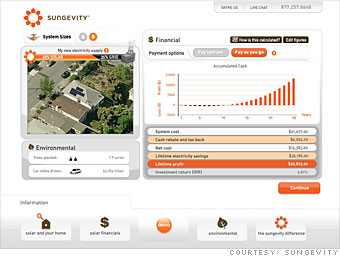
Enter your address on its website, and satellite-imaging software zooms in on your home, and Sungevity’s proprietary algorithm calculates the roof’s dimensions — the pitch and azimuth — selects appropriately sized solar arrays, and shows what they will look like installed — while computing your return on investment. Once the order is placed, one of five off-the-­shelf prepackaged solar arrays is shipped to the customer’s door, and an installation crew is dispatched. A database tracks local building and permit requirements, sending the necessary forms to the homeowner for their signature while beaming local regulations governing solar arrays to the installation crew.

“This changes the game,” says Kennedy, 37, who co-founded Sungevity last year after leaving Greenpeace and relocating from Sydney to Berkeley. (Full disclosure: Kennedy’s kids and Green Wombat’s son attend the same elementary school.)

Kennedy and his partners have raised $2.7 million from investors that include German solar giant Solon and actress Cate Blanchett. “Our technology allows us to size up an entire city remotely and work out what the solar potential of the roof space is,” adds Kennedy, who will be speaking at Fortune’s Brainstorm Green conference on Monday. “This is the real secret sauce, the thing that rocks the house.”

Says Joe Kastner, an executive with solar financier MMA (MMA) Renewable Ventures: “If you do a lot of site visits, that can end up being a big portion of the cost. Anything that can make these projects more efficient and cut the costs on the front end is good.” He adds that Sungevity may appeal to potential customers accustomed to managing their lives online and who are loathe to hang out at home waiting for solar sales or service people to show up. “I would be interested in doing as much as possible over the Internet,” Kastner says. “There’s definitely a market for it.”

Rather than employ its own installers, Sungevity will work with unions to train electricians and other contractors so that it can tap pools of green-­collar workers in local markets. “That’s probably long-term what’s most needed to achieve a million solar roofs,” says Kennedy, referring to California’s solar target. “[Solar panel] supply is not the big constraint. The real issue is labor — it’s the limiting factor in the growth of the industry.”

At the company’s Berkeley offices down the street from Chez Panisse, Kennedy and Andrew Birch, a board member and solar economics expert, run through a live demo of the Sungevity system. In about 15 minutes, a spokesmodel had walked a potential customer through the sales pitch and ordering process while on the backend a consultant is sizing up the roof with the software tools. Within a day or so an e-mail will be sent to the customer with different solar array options and the relative return on investment. “With a traditional solar installer, that would have been about a two week process,” says Kennedy.

Whether this all works so smoothly once volumes of real-life orders start coming over the transom remains to be seen, of course. And the limits of the system become apparent when Birch types in my Berkeley address and the picture shows a large Japanese maple overhanging my house, which would have ruled out a solar array except the tree had been removed a year and a half earlier. Kennedy acknowledges that leafy cities like Berkeley with its mishmash of architectural styles and every-which-way rooflines are problematic. Instead, Sungevity’s target market is middle-American suburbia, with its vast tracts of cookie-­cutter houses.

That’s just fine with potential rival SolarCity, the Foster City, Calif., solar installer backed by PayPal co-founder and Tesla Motors chairman Elon Musk. “Their technology works very well for track homes — that’s maybe 2% of our business,” says SolarCity CEO Lyndon Rive. “Our market is more retrofit homes, existing homes in well-established areas that are looking to go solar.”

“I like it when companies like Sungevity get into the market,” he adds. “They’re forcing innovation and the most important thing is the widespread adoption of solar.”

Sungevity’s launch comes as utilities like Southern California Edison (EIX) and PG&E (PCG) and tech giants like Google (GOOG) are pushing for a mass expansion of solar energy.

Nat Kreamer, president of San Francisco-based solar installer Sun Run, says Sungevity’s move to digitize the solar business is valuable but it will have to focus on the installation process to really get costs down. “Once you figure out how to size up someone’s system, the challenge is the speed you can get it built,” he says.

Installation costs account for roughly half of a solar system’s cost and solar installers like Akeena Solar have developed modular arrays containing wiring and other components to minimize the time spent on installation.

Sungevity will not focus on zeroing out customers’ electricity bills, but like Sun Run, will push the “hybrid home” – selling smaller, cheaper solar systems that will cover that portion of a home’s electricity use that is the most expensive to buy from a utility.

For instance, after rebates, a standardized Sungevity solar array for a four-bedroom home in Northern California will cost about $21,000 and deliver an estimated return on investment of 13% over the system’s 25-year life.

“We’re selling this as an economic asset,” says Kennedy, “not just as a way to go green.”

Read Full Post »

solana1.jpgArizona Public Service, Arizona’s largest utility, announced plans Thursday for a 280-megawatt solar power plant to be built 70 miles southwest of Phoenix by Spanish company Abengoa Solar. What’s striking about the deal is that it offers a rare glimpse inside the economics of Big Solar. And as the renewable energy industry pushes Congress to extend crucial green tax credits, the jobs that will be spawned by the Solana Generating Station and the economic ripple effect of the huge construction project is Exhibit A in why fighting global warming can be a win-win when it comes to the economy and the environment.

All the previous contracts for 100+ megawatt solar power plants have been in California, where utilities PG&E (PCG), Southern California Edison (EIX) and San Diego Gas & Electric (SRE) have shrouded power purchase agreements in secrecy.

APS (PNW), on the other hand, has lifted the green veil a bit, giving some indication of the current cost of producing utility-scale solar electricity and the larger economic impact. According to APS, the utility will pay around $4 billion over 30 years for the greenhouse gas-free electricity generated by Solana that will light 70,000 homes. That comes to about $133 million a year for the life of the power purchase agreement.

Abengoa spokesman Peter Kelley told Green Wombat that the exact kilowatt per hour rate the company is paying APS is confidential. No doubt though that the utility will pay a premium per kilowatt/hour for its first large-scale solar energy deal compared to electricity produced by a coal or natural-gas fired power plant. That cost disparity is likely to evaporate when the United States moves to price carbon — either through a carbon tax (unlikely) or a cap-and-trade system that requires fossil-fuel power plants to pay if they exceed limits on CO2 emissions. And the cost of financing carbon-spewing power plants will grow in coming years as Wall Street shies way from projects that carry climate change risks. And as solar power plant components and systems go from being one-off prototypes to mass-produced commodities, the cost of solar electricity is expected to drop even further.

Abengoa and APS are not revealing the construction cost of Solana but solar power plants of that size can run half a billion dollars or more. Of course, once built their operating costs are significantly lower than conventional power plants; the fuel — the sun — after all is free.

In the meantime, the Solana Generation Station is expected to inject about $1 billion into the Arizona economy as Abengoa hired 1,500 workers to build the power station and 85 others to operate it, according to APS. The utility estimates that the ripple affect will create another 11,000 to 15,000 jobs.

Abengoa is using a solar trough design for the plant. A tried and true technology, solar trough plants deploy long rows of parabolic mirrors to heat liquid-filled tubes to produce steam that drives electricity-generating turbines. The Solana plant will also store heat in silos of molten salt. The heat can be released when the sun is not shining to run the turbines. “The molten storage will extend the operating hours of the plant both during cloud cover and when sun goes down,” Kelley says. That means Solana can continue to generate electricty as long as six hours after sunset.

The big “if” for Solana is the 30 percent investment tax credit that expires at the end of 2008. If Congress fails to extend the credit, the cost of such solar power plants will jump, jeopardizing their economic viability

Solana is likely to be just the first big solar power plant in Arizona. Utilities there must obtain 15 percent of their electricity from renewable sources by 2025 and with little wind or geothermal available in Arizona, the state is likely to place a big bet on Big Solar.

Read Full Post »

img_2914.jpg

Israeli solar power plant developer Solel announced Monday it has scored $105 million in funding from London-based investment firm Ecofin — yet another sign that the market for large-scale solar energy projects is reaching critical mass.

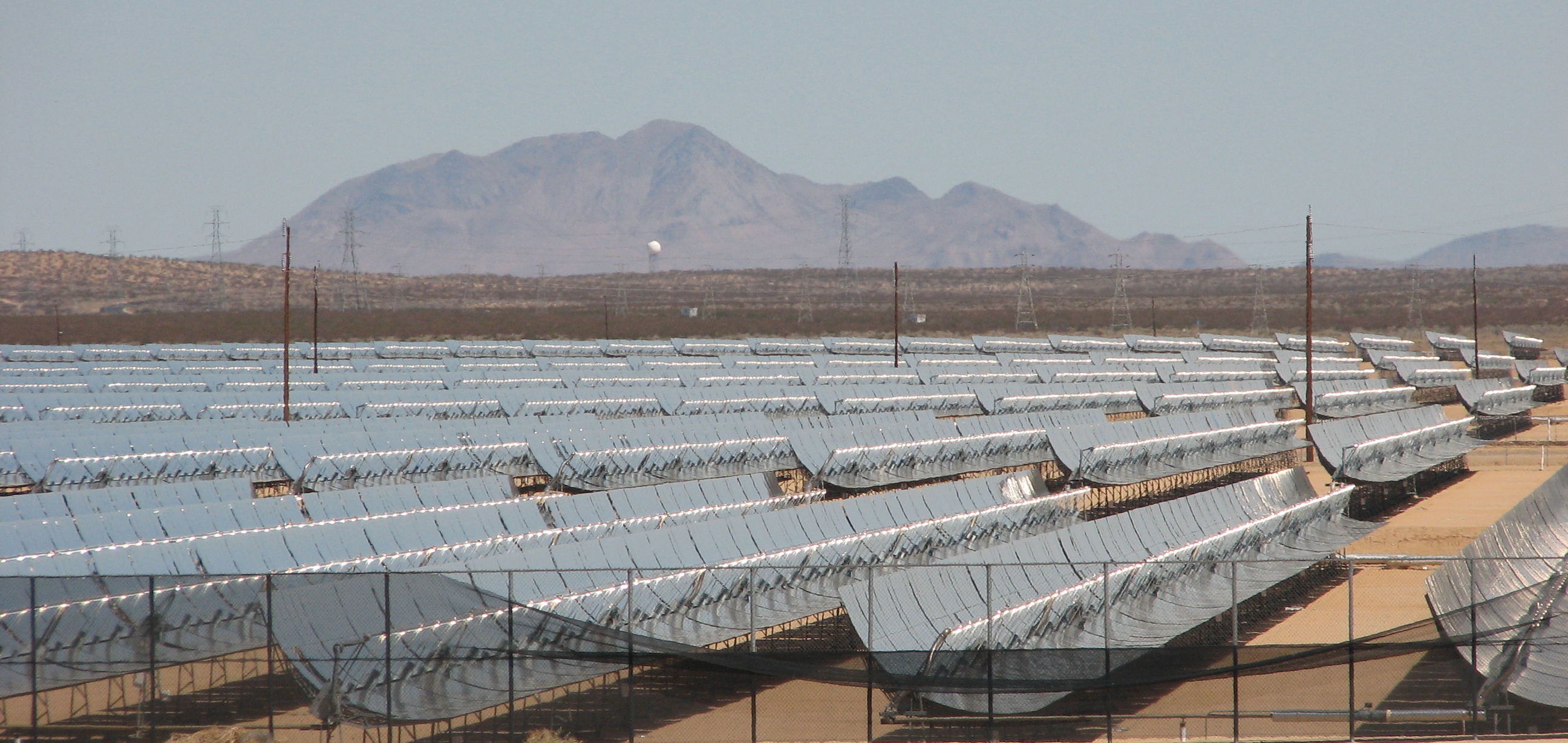
Solel last July signed the world’s largest solar power deal when it agreed to supply California utility PG&E (PCG) with 553 megawatts of green electricity to be produced by a massive solar thermal power plant to be built in the Mojave Desert. The company’s solar trough technology is also used in nine solar power plants (photo above) that were built in the Southern California desert in the 1980s. (In a solar trough power plant, long rows of parabolic mirrors focus the sun’s rays on tubes of liquid suspended over the arrays to create steam that drives an electricity-generating turbine.)

Raising $105 million is impressive and it’s certainly a big number. But given that a 500-megawatt solar power plant can easily cost $1 billion or more to build, it’s a relative drop in the bucket. However, it will allow Solel to move forward with the project and line up project financing for the PG&E plant while it negotiates more deals with other utilities — it won’t say which, but likely candidates are Southern California Edison (EIX) and San Diego Gas & Electric (SRE).

Competitors BrightSource Energy and Ausra have solar power plant applications before the California Energy Commission and have signed or are negotiating power purchase agreements with PG&E.

“Everyone is realizing that the market is there for thousands of megawatts of peaking power,” Solel CEO Avi Brenmiller recently told Green Wombat. “As time goes by we see energy prices rising and utilities are focusing their efforts to get solar thermal power because this is the right solution in the southwest United States.”

The Ecofin investment in Solel is notable also given the uncertainty surrounding solar power at the moment due to Congress’ failure to extend the solar investment tax credit in the recently enacted energy bill. The 30 percent credit is considered crucial to help solar energy companies secure financing for power plants and achieve economies of scale. The tax credit expires at the end of 2008 but solar energy proponents and their allies on Wall Street say they’re confident that Congress will take up legislation this session to extend it for as long as eight years.

Read Full Post »

« Newer Posts - Older Posts »

Design a site like this with WordPress.com
Get started