Feeds:
Posts
Comments

Archive for the ‘green startups’ Category

Illustration: Genomatica

Outside of ExxonMobil (XOM), petrochemical companies would seem to be the least likely to join the sustainability movement sweeping corporations worldwide. After all, how do you green an industry predicated on petroleum as a key ingredient?

The answer, according to San Diego startup Genomatica, is to replace hydrocarbons with carbohydrates. The company is announcing Tuesday that it has bioengineered a microorganism that ingests sugar and water to produce a chemical called 1,4‐butanediol. Commonly known as BDO, the chemical is a raw material found in everything from golf balls to skateboard wheels to spandex. Although Genomatica is planning a pipeline of bioengineered chemicals, BDO alone is a $4 billion business.

“By using carbohydrates versus hydrocarbons, we can produce BDO with less energy and that translates into a smaller carbon footprint,” Genomatica CEO Christopher Gann told Green Wombat.

So far, Genomatica – founded in 2000 and backed by marquee Silicon Valley venture capital firms Mohr Davidow Ventures and Draper Fisher Jurvetson – has only produced batches of BDO in the laboratory. But Gann,  a veteran of Dow Chemical (DOW), and company president Christophe Schilling claim that by the middle of 2009 they will be able to make bioengineered BDO cheaper than the petroleum-based chemical.

“This is a disruptive technology,” Gann says.

If Genomatica lives up to its claims of success in the lab, the technology indeed could potentially turn the petrochemical industry on its head.

First, anything that removes petroleum from a manufacturing process is going to get noticed. (While transportation accounts 70% of the 20.7 million barrels of oil consumed in the United States daily, a significant portion is used for chemicals  – up to 25% in the gulf states home to the nation’s petrochemical industry, according to the U.S. Energy Information Administration.)

Second, Genomatica’s microorganism leaves behind none of the nasty byproducts of petrochemical production, avoiding the health risks and costs of containing, storing and cleaning up toxic waste.

Lastly, Gann and Schilling say Genomatica’s technology frees BDO production from vast and accident-prone petrochemical complexes. “Since the raw materials are sugar and water, we can locate next to where there’s sugar and water or locate next to where the product can be consumed,” says Gann.

The startup was spun out of the University of California at San Diego, where Schilling and his mentor, Professor Bernhard Palsson, developed a technology platform to design virtual microorganisms. Schilling compares the process to the way airliners are designed entirely on computers.

“It allows us to model and simulate how microorganisms would survive and grow,” he says. “We can now go ahead and figure out the best way to engineer the organism to perform a particular task. We use off-the-shelf technologies and some proprietary ones to produce the organisms.”

Genomatica, which has raised $20 million from the Silicon Valley VCs as well as some Icelandic angel investors, will make money by licensing its technology to chemical companies. Gann and Schilling declined to identify other chemicals in their product pipeline but said they were related to the class of petrochemicals known as “cracker-plus-one.”

Read Full Post »

When Intel announced this week that it was spinning off a stealth in-house startup called SpectraWatt to develop solar cells, it appeared the chip giant was just the latest old-line Silicon Valley tech firm bitten by the green bug.

After all, crosstown chipmaker Cypress Semiconductor jumped into the solar game back in 2004 when it acquired SunPower (SPWR), now a leading manufacturer of solar cells and panels and an installer of large-scale solar arrays. Then the world’s biggest chip-equipment maker, Applied Materials (AMAT), retooled machines that make flat-screen video displays to produce thin-film solar panels. And just this month, Hewlett-Packard (HPQ) unveiled a deal to license solar technology to a solar cell startup while IBM (IBM) announced it would develop thin-film solar.

But it’s not just now jumping on the enviro-biz bandwagon – Intel’s solar efforts have been quietly under development since 2004. That’s when Andrew Wilson, an 11-year Intel (INTC) veteran, was chatting with a colleague while waiting for a conference call to begin. “We were shooting the breeze and I mentioned that I had replaced all the light bulbs in my house with compact fluorescent lights and my utility bill had come down by a third,” says Wilson, SpectraWatt’s CEO. “And he said, `Hey, did you know that solar cells are made of silicon?’ ”

“We started talking about what a business plan would look like, because if something is made out of silicon then Intel should be taking advantage of that market,” Wilson told Fortune. A year later, Wilson and his colleagues had developed a marketing plan and secured funding from Intel’s new-business incubator to develop a business strategy and hone its technology. (It’s no coincidence that the nascent solar industry is populated by computer industry veterans from companies that put the silicon in Silicon Valley.)

When it comes to cutting-edge solar technology, silicon-based cells are considered a bit old-school. Silicon is currently in short supply and the resulting high prices have led venture capitalists to invest hundreds of millions of dollars in thin-film solar startups that promise to dramatically lower the cost of solar by printing or otherwise applying non-silicon solar cells to glass or flexible materials that can be integrated into walls, windows and other building materials. While thin-film solar is less efficient at converting sunlight into electricity, the expectation is that it can be produced much more cheaply than conventional cells.

But thin-film solar is still largely an early-stage technology and silicon-based cells will continue to be the big market for the near-future. So the question is, how does Intel compete with established players like SunPower, China’s Suntech (STP) and Germany’s Q-Cells as solar cells become a commodity? Intel controls some 80 to 90 percent of the worldwide chip market but it’s unlikely that it – or any other player – will replicate that experience in solar cells.

Wilson’s view is that it’s early days for the solar market and that SpectraWatt’s ace in the hole is Intel’s global manufacturing experience and history of technological innovation. “The solar industry today looks like the microelectronics industry in the late ‘70s – there’s very few standards and no one is manufacturing at scale,” says Wilson. “It’s all about manufacturing processes and material sciences that will lead to fundamental breakthroughs. The product is vastly simpler than a microprocessor but the fundamental nature of a solar cell isn’t all that different. When you think of what it takes to manufacture globally and manage supply chains, that’s Intel’s core competence.”

There certainly is room for more players, given that solar was a $30 billion market in 2007 and is expected to continue to grow at a clip of 30 to 40 percent in the coming years.

Wilson says SpectraWatt has secured silicon supplies and is developing technology that will give it a competitive edge. He’s keeping mum about the details of that technology for now. “We do believe we will have a technological advantage when we get what we’re doing in the lab to manufacturing,” Wilson says.

The company is set to begin building its manufacturing facility in Oregon later this year, with production to begin in mid-2009.

SpectraWatt launches with a $50 million investment lead by Intel Capital, the company’s investing arm. Other investors include Goldman Sachs (GS), PCG Clean Energy and Technology Fund, and German solar giant Solon. (As Green Wombat has written, Solon has invested in an array of solar startups in the United States, including Sungevity and thin-film solar company Global Solar.)

Read Full Post »

think-production3.jpgIt was a year ago that venture capitalist and solar energy entrepreneur Jan-Olaf Willums appeared at the Cleantech Forum in San Francisco shortly after taking over Think Global, a Norwegian electric car maker once owned by Ford (F). Willums and his partners had just secured their first round of funding and unveiled plans to revive Think and a zippy urban runabout called the Think City. This week Willums made a return appearance at the 2008 Cleantech Forum and showed just how fast an automotive startup can move amid the lumbering dinosaurs of Detroit.

Green Wombat caught up with the ever-cheerful Willums over coffee Wednesday (unlike his American counterparts he meets the press without the PR minders that seem to accompany every exec everywhere). A day earlier on a panel about alternative transportation he dropped something of a bombshell: At the Geneva Auto Show on Tuesday Think will unveil its next-generation car, a sleek five-seat sedan and a collaboration with an unnamed Fortune 100 company. (See correction at the end of the story.)

Willums, who has raised $93 million from U.S. and European investors, was keeping mum on the identity of its big-league partner until Tuesday but he did say that new model was not just a concept car. “We have designed a five-seater show car but it really is much more than that,” says Willums (photo above). “It is very much a car that can be produced and it looks like the car that will produced.” The plan is to offer the next-gen Think in 2011 as an all-electric as well as well as a so-called series hybrid that uses a small engine to charge the battery and extend its range. (The current Think City has a range of 180 kilometers –112 miles.)

The drawing Willums briefly displayed on the panel showed an stylish aerodynamic four-door sedan. He says Think is planning to later produce a crossover SUV and coupe version of the car. Silicon Valley electric car startup Tesla’s next car also is a five-seater sedan, code-named White Star. “We won’t compete with Tesla,” says Willums. “The Tesla will be more a BMW; we’ll be more the Volkswagen.”

In the meantime, the two-seater Think City is rolling off the production line at the company’s factory outside Oslo and the first 500 cars are set for delivery to customers in March. (For the Think back-story and my 2007 Business 2.0 magazine feature on the company and its innovative business model click here.) Production will be fully ramped up by the end of 2008 and Think aims to produce 10,000 cars a year.

Willums, who will appear on a panel I’m moderating at Fortune’s Brainstorm: Green conference in April, also tells Green Wombat that Think later this week will introduce the City to London and Paris. Think’s strategy is to pursue urban markets that offer incentives for electric vehicles. For instance, for electric cars London waives the $15 congestion “congestion fee” charged for driving into the city and offers free parking. France gives EV buyers a $7,500 rebate. Think plans to begin selling the City in those markets in early 2009. Think has also established a subsidiary in Denmark

The company’s North American plans are still in flux. “We hope to have a plant in the U.S. in 2009,” he says. As with Europe, Think will target urban markets in the U.S., such as San Francisco and New York.

Think has markedly picked up the pace since I last met Willums in Oslo. That’s due in part, he says, because of the big automakers’ more aggressive moves to get into the electric car market, such as General Motors (GM) with its Chevy Volt electric hybrid.

It also seems increasingly clear that innovative startups like Think will survive by making strategic partnerships with bigger players and moving nimbly into select and potentially profitable markets. Whether Think will be a drive-away success remains to be seen but its clear Willums is hitting the accelerator.

Correction: An earlier version of this story said Think was collaborating with an unnamed Fortune 100 automaker. In fact, Think was collaborating with a Fortune 100 company, General Electric.

Read Full Post »

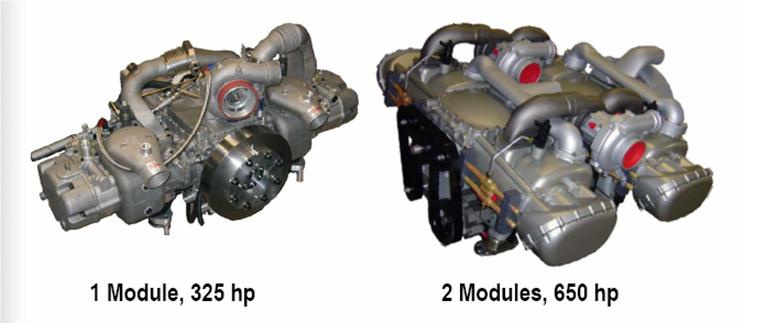
ecomotors-engine-diagram-012008_examples.jpg

Silicon Valley green tech investor Vinod Khosla caused a stir recently when he dissed plug-in electric hybrid cars as “toys” that would not contribute much in the way of fighting global warming. The blogs were buzzing from red-faced EV enthusiasts taking umbrage at Khosla, who has made big bets on biofuels and is never shy at expressing his opinions on all matters green.

But an investment Khosla Ventures announced this week in EcoMotors, a Detroit startup developing a high-efficiency diesel engines, shows that the legendary venture capitalist is more eclectic when it comes to electrics than his public pronouncements might make him seem.

EcoMotors founders Peter Hofbrauer and John Coletti, veterans of Volkswagen and Ford (F) respectively, are engineering engines that they hope will achieve 100 miles per gallon, run on gasoline, diesel or biofuels and be used to power — wait for it — plug-in hybrid electric cars.

What drove Khosla to change his mind on hybrids? He didn’t, really. To understand why, we need to look under the hybrid hood. There are two types of hybrids. A parallel” hybrid contains two drive trains — an electric motor to power the car at low speeds for short periods of time, and a conventional gasoline engine for higher speeds. The Toyota (TM) Prius and Honda (HMC) Civic hybrid and most other hybrids on the road today are parallel hybrids. (A plug-in version would allow for a more powerful battery pack that could be recharged from a standard electrical outlet.)

In contrast, a series hybrid takes some of the complexity — and presumably the cost — out of the design by using only an electric drive train to propel the car while relying on a small internal combustion engine to power a generator that charges the battery and provides power to the electric motor when needed. The Chevrolet Volt, General Motor’s (GM) plug-in electric hybrid under development, is a series plug-in hybrid. And the EcoMotors’ engine will be designed for use in a series hybrid.

“He was referring to parallel hybrids,” says Khosla Partner’s Ford Tamer of his boss’s anti-hybrid comments made in a speech at an investor conference. “We do believe a series hybrid is the way to go. He was also referring to the fact that the hybrid platform is inherently an expensive platform.”

So is a series platform at this point, but Khosla’s vision is to drive that cost down by creating high-efficiency engines and batteries. Hence the investment in EcoMotors. And hence the hiring last September of Tamer, a former top executive at chipmaker Broadcom and a co-founder of another chip company, Agere (later acquired by Lucent). “I’ve been focused on the efficiency side of Khosla — engines, motors, turbines, even solar and batteries,” says Tamer, Khosla Ventures’ operating partner.

Khosla is the sole funder of EcoMotors – and no, Tamer won’t reveal the size of the investment – which officially launched this month and remains so stealthy it doesn’t even have a website yet.

Tamer says EcoMotors CEO Hofbrauer developed a high-efficiency engine under contract with the Defense Advanced Research Projects Agency, of DARPA, for use in military vehicles. EcoMotors has now licensed the technology for commercial use.

Here’s how it works, as explained by Tamer: the EcoMotors engine is built of 2-cylindar “modules” that can be stacked depending on the need for power – one or two modules for a car, three or four for a big truck. “If you have two modules, you can shut down one module for city driving,” says Tamer. “But when you need to need to go uphill or need power for highway driving, you engage the second module. That gives you better fuel efficiency and reduces emissions.” (EcoMotors’ renderings of the engine’s design are above.)

With the recently enacted energy bill mandating automakers raise the average fuel efficiency of their fleets to 35 miles per gallon by 2020, EcoMotors aims to demo its first engine to potential customers by early 2009.

A plug-in electric hybrid drive train will be further down the road but Khosla Ventures already has made investments in companies developing components for such a system. One such startup is Seeo, a Berkeley, Calif.-based company whose website cryptically says it is “developing advanced materials to revolutionize electricity storage and delivery.” And Thursday morning, Khosla Ventures announced it had upped its investment in Transonic Combustion, a California startup developing  fuel injection systems designed to increase fuel efficiency.

“Our belief is that we have to get a fuel-efficient, emissions-conscious diesel engine on its own,” Tamer says. “Then going to a hybrid becomes a bonus.”

One of Vinod Khosla’s mantras is that green technology must become cheap and scalable enough to be adopted in China and India, countries whose impact on climate change is monumental. In other words, a $25,000 plug-in hybrid doesn’t stand a chance against a Tata Nano, the Indian people’s car unveiled last week.

Remarks Tamer: “$2,500 will buy a Tata – that’s a DVD upgrade on a Lexus.”

Read Full Post »

ausra-solar-field.jpg

Here’s another sign that Big Solar’s time has come: Silicon Valley startup Ausra is building the United States’ first solar power plant factory.

When the 130,000-square-foot facility goes online in April outside Las Vegas, robots will assemble mirror arrays and other equipment that will then be trucked to solar power plant building sites in California and the Southwest. Ausra, backed by venture capitalists Vinod Khosla and Kleiner Perkins Caufield & Byers, signed a deal with utility PG&E (PCG) in November to supply electricity generated by a 177-megawatt solar thermal power station to be built on California’s central coast.

“Steel, flat glass and standard boiler pipe flows into the factory and completed solar fields come out ready for installation,” John O’Donnell, Ausra’s  executive vice president, told Fortune’s Green Wombat from Nevada over the din of construction noise. “We wound up working with one of Australia’s leading builders of car production systems to develop robotic assembly, weld, bond and paint systems for the mirror units.”

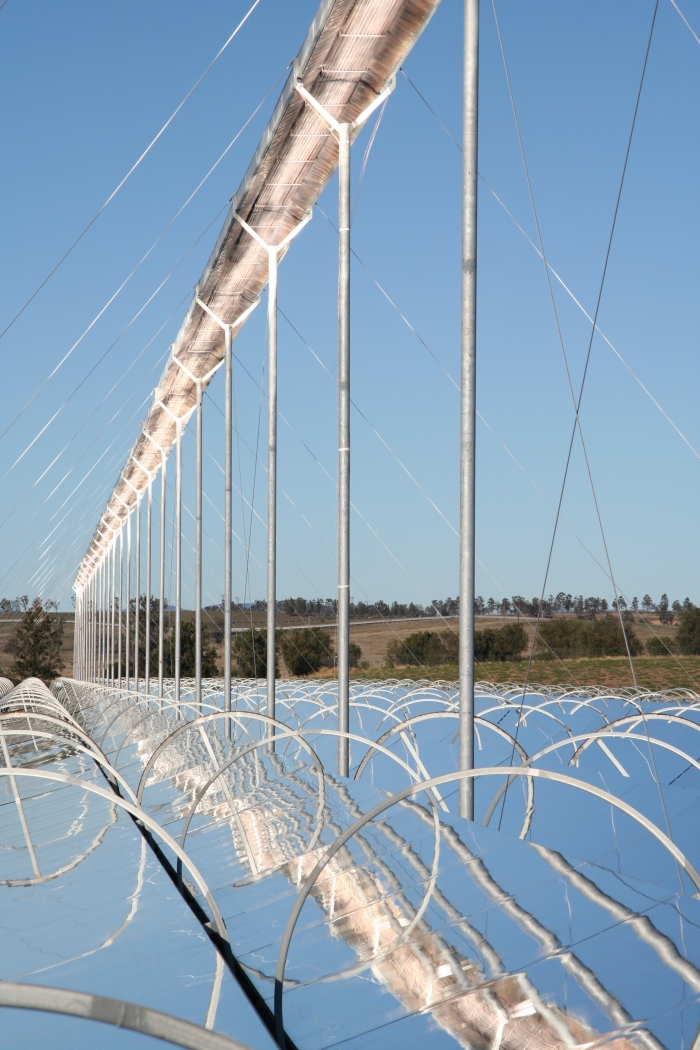
Ausra will deploy large arrays of long mirrors that concentrate sunlight on water-filled pipes that hang over the reflectors. As the water is heated up to 545 degrees Fahrenheit the resulting steam drives a standard turbine to generate electricity. O’Donnell says the Las Vegas factory, located near McCarran International Airport, will employ about 50 people and be able to produce 70 megawatts worth of solar equipment a month — implying Ausra has many more big power deals on the table.

The facility marks the emergence of Nevada as a player in the solar power industry. “We see Nevada as one of the best markets for solar power,” says O’Donnell. “It’s the business climate in Nevada, the solar resource and a rapidly growing market for electric power. The main reason for being here is the combination of a transportation center, a workforce and a central location for where we think all the power plants will be. We looked at locations in California, Phoenix and here. Taking the five-year view, we would like to build a lot of power plants in the Southwest so we asked, ‘Where is the best location. What are the transportation options?’ ”

Nevada’s proximity to California means that solar power plants can be built on its side of the border to ship electricity to densely populated Southern California as well as the booming Las Vegas region. O’Donnell says Nevada offered Ausra a standard package of tax incentives but nothing extra to locate the factory in the Silver State.

“As the world transitions to clean energy, Nevada will be a leader in building and delivering clean power to our state, to our region, and to our country,” said Nevada Development Authority CEO Somer Hollingsworth in a statement.

Nevada will get a run for its money from sun-drenched Arizona, where Phoenix-based Stirling Energy Systems plans to build factories to manufacture Stirling dishes for solar power plants that will supply electricity to Southern California Edison (EIX) and San Diego Gas & Electric (SRE).

Read Full Post »

ausra-mirrors-tilted.jpg

PG&E this morning finally consummated a long-expected solar power deal with Silicon Valley startup Ausra, agreeing to buy 177 megawatts of green electricity generated by a solar thermal plant to be built by the company on California’s central coast. As Green Wombat reported Friday, Ausra — backed by marquee venture capitalists Vinod Khosla and Kleiner Perkins Caufield & Byers — has filed a development and licensing application with the California Energy Commission for the project, called the Carrizo Solar Energy Farm.

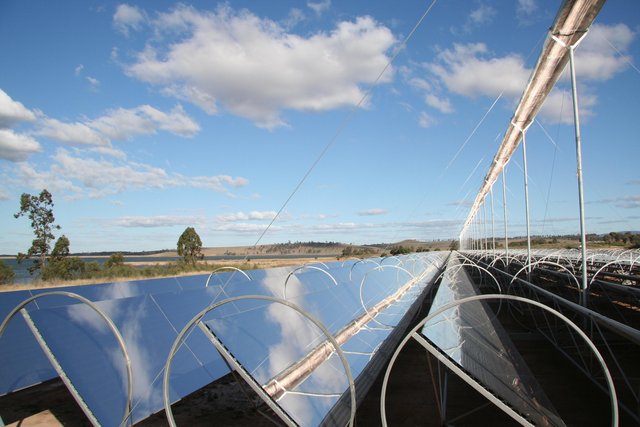
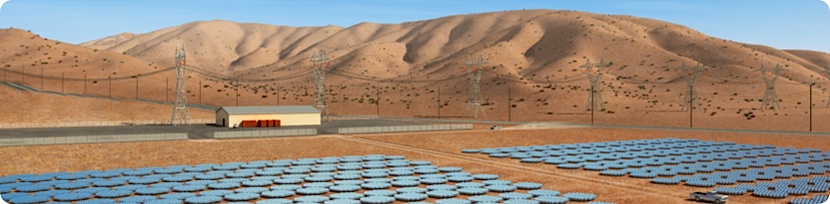
With its latest power purchase agreement, PG&E (PCG) has committed to buying more than 1.2 gigawatts of greenhouse-gas free electricity from three large-scale solar power plants — enough to light nearly a million homes. Construction of the Ausra power plant is expected to begin in 2009 and go online the following year. Terms were not disclosed — they never are in power purchase deals — but Ausra revealed in its Energy Commission application that the agreement runs for 20 years. The company, which decamped to Silicon Valley from Sydney last year, claims that its Compact Fresnel Linear Reflector system — long flat mirrors that focus the sun’s rays on water-filled tubes to create steam that drives electricity-generating turbines — will produce power at costs competitive with natural gas-fired plants. A pilot power plant (Ausra photo above) is up and running in Australia. The Carrizo solar farm will be a boon for the San Luis Obispo County economy, employing 350 workers during construction and creating 100 permanent jobs, according to Ausra.

Carrizo will be the company’s first solar power station in the U.S., though in September Florida utility FPL (FPL) announced it would build 10-megawatt demonstration plant using Ausra’s technology as well as a 300-megawatt version if all goes as planned. Ausra executives have told Green Wombat they anticipate rolling out enough solar farms to produce at least a gigawatt of electricity over the next few years.

That might be taken as so much Silicon Valley hype, and only time will tell if the technology lives up to its promise, but regulatory and economic trends indicate that deals like the PG&E-Ausra agreement is just the beginning of a wave of Big Solar projects. California’s investor-owned utilities — PG&E, Southern California Edison (EIX) and San Diego Gas & Electric (SRE) — face a 2010 deadline to source 20 percent of their electricity from renewable sources, with the ante rising to 30 percent by 2020. Those utilities are actively negotiating gigawatts of solar power deals, sources tell Green Wombat. Meanwhile, California-based solar power companies like Ausra and BrightSource Energy, as well as a host of overseas competitors, are moving to license prospective projects, confident they’ll secure power purchase agreements with utilities as well as the financing to build their solar power plants. That Morgan Stanley (MS) has quietly invested in BrightSource — the company is negotiating a 500-megawatt agreement with PG&E — is but the latest sign that Wall Street is looking to profit from Big Solar.

Even California’s green governator weighed in on the PG&E-Ausra deal. “Today’s agreement between PG&E and Ausra highlights how clean energy will create jobs in California while delivering a reliable source of renewable energy,” said Arnold Schwarzenegger in a statement. “I’m pleased to see California companies rising to the challenge of AB 32, California’s historic initiative to reduce carbon emissions and combat climate change. Clearly, California continues to lead the nation in clean energy research, development and generation.”

Read Full Post »

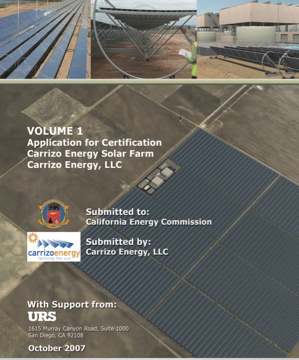
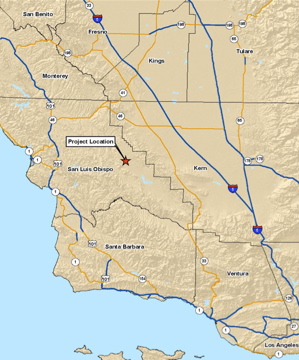
ausra-carrizo.jpgSilicon Valley’s solar boom continues with Ausra, a Palo Alto startup backed by venture capitalist heavyweights Vinod Khosla and Kleiner Perkins Caufield & Byers, filing an application to build a 177-megawatt solar power plant on California’s Central Coast.

Ausra’s lodging of its 1,000+ page “application for certification” with the California Energy Commission last week is another sign the company, which relocated to Silicon Valley from Sydney last year, is about to sign a major deal with a California utility. Khosla has previously said Ausra is negotiating with PG&E (PCG). In its application, the company stated that the San Luis Obispo County project, called the Carrizo Energy Solar Farm, would begin providing greenhouse gas-free electricity to “a major California utility” by June 2010 under a 20-year power purchase agreement. If the Commission licenses the project – at least a year-long process – construction would begin in 2009. In September, Florida utility FPL (FPL) announced it would use Ausra’s technology for a planned 300-megawatt solar power plant.

While there’s no shortage of solar startups with big plans for Big Solar, only three companies have actually taken the expensive and time-consuming step of filing a construction application with the California Energy Commission. (On Wednesday, Oakland, Calif.-based solar company BrightSource Energy cleared a major regulatory hurdle when the Commission signed off on its application for a 400-megawatt Mojave Desert power plant and began the licensing process.)

The Carrizo solar thermal power plant will deploy 195 long rows of flat mirrors to focus the sun’ausra-carrizo-map.jpgs rays on tubes of water suspended over the arrays. The superheated water creates saturated steam that will drive two electricity-generating turbines, to be supplied by either GE (GE) or Siemens (SI). While the efficiency of Ausra’s compact linear fresnel reflector system is lower than competing technologies, company executives claim they will able to drive down the costing of producing solar electricity to make it competitive with natural gas. (For more on Ausra, see Green Wombat’s previous post.) Unlike most solar power plants in the works for California, Ausra has chosen not to locate its facility in the Mojave Desert, where solar sites are sun-drenched but are often on government land and far from transmission lines. Instead, the Carrizo project will be built on 640 acres of old ranch land on the Carrizo Plain, where Ausra will just need to construct a 850-foot transmission line to connect to the power grid.

“Ausra Inc.’s (Ausra) proved, proprietary technology significantly reduces the cost of a solar thermal power plant and is thus capable of significantly reducing global carbon emissions by generating low-carbon electricity on a commercial scale at competitive prices,” the company stated in its application.

Read Full Post »

brightsource.png

Green Wombat happened to be chatting with BrightSource Energy CEO John Woolard yesterday at the solar power startup’s Oakland, Calif., offices when an executive burst into a conference room with big news: the California Energy Commission had accepted BrightSource’s application to build the first large-scale solar thermal power plant in the Golden State in 16 years. “We were found data adequate this morning by the CEC,” said Doug Divine, vice president of project development. “That’s huge,” replied Woolard. “It’s a big step.”

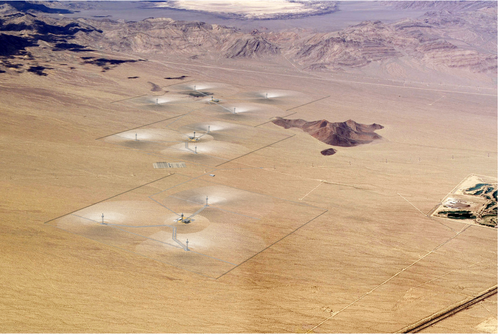
Indeed it is. In Commission-speak, being declared “data adequate” means the expensive, year-long process of assembling hundreds of pages of documents detailing the proposed 400-megawatt power plant and its environmental impact had passed bureaucratic muster. Now the Commission begins a 12-month process to review and license the project. If all goes well, ground could be broken in early 2009 on BrightSource’s Ivanpah Solar Electric Generating System, to be built in the Mojave Desert just across from the Nevada border in San Bernardino County. (BrightSource’s artist rendering above.)

BrightSource is currently negotiating a 500-megawatt power purchase agreement with California utility PG&E (PCG), and Woolard says the company is in talks with other utilities to supply another 1,000 megawatts from seven power plants. BrightSource has applied to lease a site from the U.S. Bureau of Land Management for a second solar power plant, a 500-megawatt project to be built near Broadwell Dry Lake in the Mojave. The company has relied on venture capital for funding but Woolard revealed Wednesday that the company has also secured investment from Morgan Stanley (MS).

There’s a certain historical symmetry in the Commission’s decision. BrightSource was founded by American-Israeli pioneer Arnold Goldman, whose Luz International built the last big solar power plant in California in 1991. That was Solar Electric Generating System IX, the last of nine solar trough power plants constructed by Luz in the Mojave Desert northeast of Los Angeles and that today are mostly operated by FPL (FPL).

BrightSource has developed a new solar technology, dubbed distributed power tower, that focuses fields of sun-tracking mirrors called heliostats on a tower containing a water-filled boiler. The sun’s rays superheat the water and the resulting steam drives an electricity-generating turbine. BrightSource is now building a 7-megawatt pilot power plant in Israel to show investors the distributed power tower is ready for prime-time. “The technology is locked down,” Woolard says.

Read Full Post »

greenvolts-image.jpg

Last year’s California Clean Tech Open winner GreenVolts is a poster child for how a startup can capitalize on the startup contest to bootstrap itself into some major deals. Working from a San Francisco office provided by utility PG&E (PCG) as part of its contest winnings, GreenVolts earlier this year scored a contract with its benefactor to build a 2-megawatt solar power station using the solar startup’s high concentration photovoltaic technology. The company’s microdishes track the sun and focus its rays on small but highly efficient solar cells. Rotating platforms each hold 176 of the dishes.

So it was appropriate that GreenVolts CEO Bob Cart announced last night at this year’s Clean Tech Open ceremony that the company had raised $10 million in its latest round of funding. The company also said that its demonstration solar power plant for Spokane, Wash.-based utility Avista (AVA) had begun generating electricity. Avista had made an earlier investment in GreenVolts and participated in the latest round, which was led by Greenlight Energy Resources.

Read Full Post »

If you want to know what enviro startups Silicon Valley movers and shakers think could be the next big green thing, the California Clean Tech Open is a good leading indicator. Last night in San Francisco the Open named six winners in its second annual startup competition. Each winner receives a $100,000 “startup in a box” package that includes $50,000 in cash from such sponsors as Google (GOOG), Advanced Micro Devices (AMD), Lexus (TM) and California’s Big Three utilities – PG&E (PCG), Southern California Edison (EIX) and San Diego Gas & Electric (SRE). The winners also get $50k worth of legal, marketing, accounting and public relations services from such heavyweights as Silicon Valley law firm Wilson Sonsini Goodrich & Rosati. The opportunity to mingle with the entrepreneurs, venture capitalists and potential clients who judge the contest probably represents the biggest win of all for these startups. Now the winners:

AMD Smart Power Award
The Lucid Design Group of Oakland, Calif., takes a Web 2.0 approach to environmental monitoring, providing real-time feedback on a building or home’s energy and water usage through an online dashboard. The idea: people will be motivated to cut their electricity and water consumption when they see how much and when power is being used by various appliances.

ENVIRON Foundation and Grundfos Air, Water and Waste Award
Overland Park, Kan., startup Microvi Biotech is using biotechnology to treat waste water, sewage and control pollution.

Google Green Building Award
BuildFast of San Carlos, Calif., makes environmentally sensitive prefab housing kits to erect buildings in disaster zones or in low-income areas.

Lexus Transportation Award
Los Angeles’ Syncromatics is developing technology that uses GPS and mobile phone networks for real-time online tracking of buses to improve efficiency and cut fuel costs.

PG&E, SCE and SDG&E Renewables Award
Rohnert Park, Calif.-based 1-Solar is designing lower-cost and longer-life power inverters for solar arrays and other renewable energy systems. Inverters convert the direct current produced by such systems into the alternating current used in households and businesses.

PG&E, SCE and SDG&E Energy Efficiency Award
Nila of Sherman Oaks, Calif., makes LED lighting systems for Hollywood that it says consume 50 to 75 percent less electricity than traditional lighting used in the entertainment industry.

To read older Green Wombat posts, click here.

Read Full Post »

« Newer Posts

Design a site like this with WordPress.com
Get started