Feeds:
Posts
Comments

Archive for the ‘green startups’ Category

solara
Images: BrightSource Energy

A ray of sunshine amid the economic gloom: While some solar companies struggle through the downturn, BrightSource Energy on Wednesday morning announced the world’s largest solar energy deal to date – a 20-year contract to supply utility Southern California Edison with 1,300 megawatts of greenhouse gas-free electricity.

That’s more than twice the size of the previous world’s-biggest-solar-deal, a 553-megawatt power purchase agreement in 2007 between California utility PG&E and Israel’s Solel. BrightSource itself last year inked a deal to provide PG&E (PCG) with 500-megawatts of solar electricity with an option for 400 megawatts more.

“This proves the energy industry is recognizing the role solar thermal will play as we de-carbonize our energy supply,”  BrightSource CEO John Woolard said Wednesday at a press conference.  “We believe now more than ever the time is right for large-scale solar thermal.”
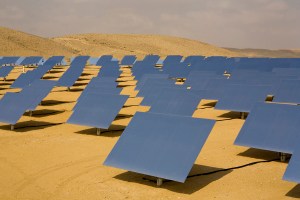
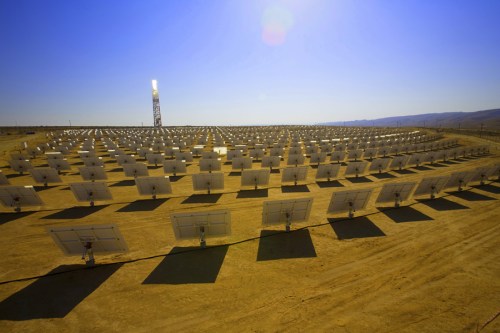
solarhOakland-based BrightSource will build seven solar power plants for Southern California Edison (EIX) using its “power tower” technology. Thousands of sun-tracking mirrors called heliostats focus the sun’s rays on a water-filled boiler that sits atop a tower. The intense heat creates steam which drives a turbine to generate electricity. BrightSource has built a prototype power plant in Israel.

BrightSource has raised more than $160 million from a blue-chip group of investors that includes Google (GOOG), Morgan Stanley (MS) and VantagePoint Venture Partners as well as a clutch of oil giants – Chevron (CVX), BP (BP) and Norway’s StatoilHydro.

If all the solar power plants are built, BrightSource’s deal with Southern California Edison will generate enough electricity to power about 845,000 homes. The agreement is a vote of confidence in the solar industry at a time when the financial crisis has forced BrightSource rivals like OptiSolar to lay off workers while Ausra retools its strategy to focus on supplying solar thermal technology to power plant developers rather than building projects itself.

Given the economic collapse, why are these massive megawatt deals still being done? First, California utilities are under tight deadlines to ratchet up the amount of electricity they obtain from renewable sources – 20% by the end of 2010 and 33% by 2020. Second, it costs nothing to sign a contract – no money has yet changed hands, and won’t unless the plants are built and begin producing electricity.

In fact, not a kilowatt of juice has been generated from the more than 5,000 megawatts of Big Solar contracts signed over the past four years by California’s three investor owned utilities (the third being San Diego Gas & Electric (SRE) ).  Still, a long-term utility contract is key for a startup like BrightSource to obtain the billions in financing required to build large-scale solar power plants. The terms of utility contracts – such as the cost of the solar electricity produced – are closely held secrets but are worth billions, if a 2008 power purchase agreement between Spanish solar company Abengoa and utility Arizona Public Service is any guide.

A significant hurdle for BrightSource – and many other solar developers – is the expansion of the transmission grid to connect remote power plants to cities. BrightSource spokesman Keely Wachs says the company has 4,200 megawatts of solar power plant projects under development.

The Southern California Edison deal is something of a homecoming for American-Israeli solar pioneer Arnold Goldman, BrightSource’s founder and chairman. In the 1980s, during the first solar boom, his Luz International built nine solar power plants in the Mojave. Those plants, most are now operated by FPL (FPL), continue to provide electricity to Edison.

The first BrightSource solar farm for Edison is expected to go online in early 2013. It’s a 100 megawatt power plant part of BrightSource’s Ivanpah complex to be built on federal land on the California-Nevada border in the Mojave Desert. That plant is currently wending its way through a complex state and federal licensing process.

Just how complex was illustrated by a meeting Green Wombat attended Tuesday in Sacramento, where a roomful of state and federal officials spent hours discussing the environmental impact of a 750-megawatt solar power plant to be built by Phoenix’s Stirling Energy Systems for San Diego Gas & Electric that would plant 30,000 solar dishes in the desert. A second Stirling solar farm will be built for Southern California Edision. When the deals were announced in 2005, they were the world’s largest at the time.

PG&E chief executive Peter Darbee recently said his utility will begin directly investing in solar power projects. On Wednesday, Southern California Edison renewable energy executive Stuart Hemphill said Edison would consider requests from solar power developers to take ownership stakes in their projects but prefers to sign power purchase agreements.

“We do see solar as the large untapped resource, particularly in Southern California,” said Hemphill.


Read Full Post »

kimberlina0089l1

photo: Ausra

When Green Wombat sat down for a chat with Ausra founder David Mills back in September 2007, he allowed that it was not unreasonable to expect the Silicon Valley solar startup to soon be building several massive megawatt solar power plants a year. The optimism was not unwarranted. After all, in the space of 12 months Ausra had relocated from Sydney to Palo Alto, raised $40 million from A-list venture capitalists and was about to ink a deal with utility PG&E for a 177-megawatt  solar power project.

That was then. This month Ausra laid off 10% of its 108 employees amid a move to stop building Big Solar projects – for now – to focus on providing its solar thermal technology to other power plant developers and to industries that use steam. (Ausra’s compact linear fresnel reflector technology deploys flat mirrors that sit low to the ground and concentrate sunlight on water-filled pipes that hang over the mirrors. The superheated water creates steam which drives an electricity-generating turbine.)

“I think our competitors will figure this out sooner or later but nobody’s going from a five-megawatt project to a 500-megawatt project. No one’s going to finance that,” Ausra CEO Bob Fishman told Green Wombat. “If you look at the amount of money it takes to be involved in the project development business, that’s not something a startup can do.”

At least any time soon. Ausra last year opened a robotic factory in Las Vegas to make mirror arrays and other components for the many power plant projects it had on the drawing boards. Just three months ago the company flipped the switch on its five-megawatt Kimberlina demonstration power plant outside Bakersfield. But as the credit crunch hit, financing for billion-dollar solar power projects evaporated. Then in October, Congress passed legislation allowing utilities like PG&E (PCG), Southern California Edison (EIX) and San Diego Gas & Electric (SRE) to claim a 30% investment tax credit for solar projects. As the only well-capitalized institutions left standing in the energy game, utilities are stepping forward as investors.

PG&E CEO Peter Darbee says he’s prepared to make direct investments in solar power plants – projects the utility needs to comply with a California mandate to obtain 20% of its electricity from renewable sources by 2010 and 33% by 2020. Under pressure to meet those targets, California utilities have signed more than four gigawatts worth of power purchase agreements with solar power plant startups like BrightSource Energy, Solel, Stirling Energy Systems and eSolar. Utilities also have begun signing deals for electricity produced by smaller scale photovoltaic power plants built by companies like First Solar (FSLR) and SunPower (SPWRA).

Fishman said Ausra will complete the 177-megawatt Carrizo Energy Solar Farm in San Luis Obispo County on California’s central coast to supply electricity to PG&E. “If Peter Darbee wants to own Carrizo rather than buy the electricity, we’re willing to do it. It makes sense,” he says.

Ausra will also will complete a second big solar power plant planned for Arizona. But the company has quietly let drop a Florida project for utility FPL (FPL) and is negotiating to offload lease claims it filed on federal land in Arizona and Nevada for solar power plants during the solar land rush.

“Other projects in the pipeline we’ll be selling to utilities or developers for a modest amount of cash with a commitment that those developers must use our technology,” says Fishman.

Fishman notes that the cost of licensing a solar power plant can be $5 million to $10 million a year – and in California it’s a multi-year process – so Ausra will realize some immediate savings by morphing into a technology provider.

Customers for Ausra’s technology include oil companies that could inject solar-generated steam in oil wells to enhance recovery of thick petroleum as well as food processing plants and other heavy users of steam. Fishman just returned from a trip to the Middle East where he says he held talks in Kuwait, Qatar and Dubai about using Ausra’s technology for oil recovery and desalinization.

Going forward, he says Ausra’s focus will be on medium-sized power plants. “Maybe next year we’ll do four projects of 50 megawatts a year. It’s a walk before you run situation,” says Fishman. “The financial customers and financial community are going to insist we do medium scale before we do large scale. We’ll still want to do very large projects but given the project finance market, it’ll be a few years from now.”

Read Full Post »

first-solar-11

With Big Solar thermal power plants bogged down in bureaucracy and facing environmental and financial hurdles, utilities are turning to smaller-scale thin-film solar stations that can be built in a matter of months.

In late December, PG&E (PCG), for instance, signed a 20-year contract for electricity generated  from a 10-megawatt thin-film solar power plant in Nevada owned by energy giant Sempra (SRE) that was officially dedicated on Thursday. The solar farm was built by First Solar (FSLR) in a scant six months. Meanwhile, the utility’s nearly two gigawatts worth of deals with solar thermal power companies won’t start producing power for another two years at the earliest. (Southern California Edison (EIX) and San Diego Gas & Electric signed agreements with solar dish developer Stirling Energy Systems for 1.75 gigawatts in 2005 and those projects are just now beginning to move through the regulatory approval process.) And the financial crisis has made it more difficult for solar thermal developers to obtain the billions of dollars needed to finance the construction of a massive megawatt power plant.

Solar thermal power plants typically use miles of mirrors to heat a fluid to create steam which drives an electricity-generating turbine. Photovoltaic (or PV) solar farms essentially take solar panels similar to those found on residential rooftops and mount them on the ground in huge arrays. (Thin-film solar panels are made by depositing layers of photovoltaic materials on glass or flexible materials.)

“In terms of construction, photovoltaic tends to have a much faster development and construction track,” Roy Kuga, PG&E’s vice president for energy supply, told Green Wombat. “There is a segment of mid-sized projects – in the two to 20 megawatt size – where PV shows a distinct advantage in that market. There’s a huge potential for the PV market to expand.”

That’s good news for companies like First Solar – the Tempe, Ariz.-based company backed by the Walton family that is often called the Google of solar for its stock price and market prowess – and SunPower (SPWRA), the Silicon Valley solar cell maker that’s moved into the power plant-building business.

The speed at which the Sempra-First Solar project went online owes much to the fact that it was built on the site of an existing fossil fuel power plant. “It was already permitted for power generation, transmission existed and it did not have to go through the laborious California permitting process,” says Reese Tisdale, a solar analyst with Emerging Energy Research. “As such, First Solar was able to essentially plug and play.”

Nathaniel Bullard, a solar analyst with New Energy Finance, says he expects utilities increasingly to bet on smaller-scale photovoltaic farms to help meet state mandates to obtain a growing percentage of their electricity from renewable sources. Just this week, PG&E CEO Peter Darbee said his utility plans to invest in solar power plant projects rather than just buy the power they produce.

“I think a utility could easily integrate, technically and financially, 100 megawatts of PV,” Bullard says.  If something is falling behind on your big solar thermal projects, you can plug in PV. I think you’ll see more of this with California utilities and I expect to see it more in Florida and North Carolina. It’s a great runaround to issues of siting and transmission.”

That’s because in California photovoltaic power plants do not need approval from the California Energy Commission. And smaller-scale plants take up far less land and can be built close to existing transmission lines. Most large solar thermal power plants typically are planned for the Mojave Desert and require the construction of expensive power lines to connect them to the grid.

The modular nature of PV solar farms means they can begin generating electricity as each segment is completed while a solar thermal plant only goes online once the entire project is finished.

“Certainly there is a sweet spot in which the project is large enough to gain advantages of scale,” says Tisdale. “Also, these small-to-mid-size systems can be spread about a transmission network, instead of at one site.”

Read Full Post »

think-city-8_imagelarge

photo: Think

Norwegian electric carmaker Think said Tuesday it has obtained a $5.7 million bridge loan from battery maker Ener1 Group and other investors to allow the company to resume limited production of its City urban runabout.

In December Think idled its assembly line and laid off workers as the global credit crunch took its toll and the company was unable to obtain funding to finance continued production of its electric vehicles.

Think CEO Richard Canny said in a statement Tuesday that the company is continuing negotiations to raise capital but the interim financing from Ener1, which is supplying lithium-ion batteries to Think, will allow the recall of some workers to complete cars from parts on hand.  “We have encouraging engagement with a number of potential new equity investors for our recapitalization process,” said Canny.

The Think financing comes as Ford (F), Toyota (TM), Honda (HMC) and other major automakers unveil prototypes for new electric cars and plug-in hybrids at the Detroit Auto Show.

Read Full Post »

tendril

In case you missed it, this Green Wombat story appears in the current issue of Fortune.

A house that thinks

The high-tech networks that Reliant Energy is installing in the homes of its 1.8 million customers will help them save electricity.

By Todd Woody, senior editor

(Fortune Magazine) — Inside a white-brick house nestled in Houston’s leafy Montrose neighborhood, a gray handheld video display sits on the living room coffee table. But this is no ordinary remote control. Called the Insight and made by Tendril, a Boulder startup, the device communicates wirelessly with the home’s utility meter, letting you track real-time information about the cost of the electricity you consume.

The house is actually a demonstration project set up by Reliant Energy (RRI), a reseller of electricity with $12 billion a year in sales. Glen Stancil, Reliant’s vice president for smart energy R&D, taps the Insight’s screen. “Right now we’re spending $1.40 per hour,” he says, noting that the electricity prices and usage are updated every ten seconds. (Customers can also access the same data on the web or their iPhones.)

Stancil presses another button. “The bill so far is $86, and for the month it looks like it’s headed to $367,” he says. The Insight system also warns that you’ll fork over another $100 this month if you crank up the air conditioner a couple of notches. So keep your hands off the thermostat.

That’s just the kind of behavior that Reliant Energy CEO Mark Jacobs would like to see. Until now, Reliant has made its money by entering contracts with utilities for a fixed amount of power at a fixed price and then reselling it to its 1.8 million customers. If demand unexpectedly soars on a hot afternoon as everyone turns up the air conditioning, Reliant often must buy extra power on the spot market, where prices can spike as much as 60%.

That cuts into profits. “It’s like running a beachfront hotel, charging the same room rate all year round, and then building more rooms to guarantee that everyone has a room on the busiest weekends,” says Jacobs.

In November, Reliant started installing the Insight in homes, which means it will be able to pass along those high spot prices to its customers, or better yet, in sweltering Texas, let customers buy a month’s worth of cool at a set price – say, 72 degrees for $200 or 74 degrees for $160.

The Insight offers another advantage – Jacobs believes it will encourage his customers to cut back on electric use and save money. “What if you knew you could run your clothes dryer at five o’clock, and it would cost $3,” says Jacobs, “or you could wait until eight o’clock at night, and it would be only a dollar?”

PG&E (PCG), Southern Edison International (EIX) and other utilities are rolling out smart meters but have yet to to integrate them with smart energy systems for the home. But Reliant operates in a competitive, deregulated electricity market. If homeowners get cool technology that helps them avoid the unpleasant surprise of a big electric bill, Jacobs believes Reliant will retain more customers. And then there’s the green angle. “We as an industry are the single largest emitter of greenhouse gas, and our goal is to help our customers use less, spend less, and emit less,” says Jacobs.

For Jacobs, a 46-year-old Goldman Sachs (GS) veteran, smart energy technology is just the wedge to shake up what he calls “an industry in the Dark Ages” while opening new markets for his company, whose stock has been walloped by the one-two punch of Houston’s Hurricane Ike and the credit crunch.

Hurdles, however, remain. Will consumers already suffering from information overload want to obsessively monitor their electricity habit? Will a sweating Houstonite on a 104-degree day say to hell with the cost and crank up the AC anyway? Jacobs isn’t worried. He believes nothing influences behavior better than knowing the true price of what you’re buying.

Read Full Post »

better20place206

photo: Todd Woody

SAN FRANCISCO – As Congress considers bailing out a U.S. auto industry damaged by its dependence on fossil fuel-hogging SUVs, San Francisco Bay Area leaders on Thursday unveiled plans for a $1 billion regional network of charging stations for electric cars.

Silicon Valley startup Better Place will construct the network, deploying thousands of chargers for electric cars on the streets of San Francisco, San Jose and Oakland. The cities will be linked by battery swapping stations so drivers can travel longer distances. Better Place, founded by former SAP executive Shai Agassi, previously struck deals with governments in Israel, Denmark and Australia to build electric car networks. This is the well-funded startup’s first move in the U.S. market. Construction on the Bay Area network will begin in 2010 with commercial rollout in 2012.

“This is the start of a regional effort to become the capital of electric vehicles in the United States,” proclaimed San Francisco Mayor Gavin Newsom at a press conferences at city hall attended by the mayors of San Jose and Oakland as well as representatives from state and federal environmental agencies.

California Governor Arnold Schwarzenegger threw his support to the project and the the cities of San Jose, San Francisco and Oakland have pledged to expedite permitting of Better Place charging stations, standardize regulations and offer incentives for employers to install chargers at workplaces.

Read Full Post »

schwarzenegger-optisolarjpeg
photo: California Governor’s Office

California Governor Arnold Schwarzenegger on Monday terminated talk that the recession will crimp California’s fight against global warming when he ordered every utility in the state to obtain a third of its electricity from renewable sources by 2020. And in a move that will shake up the land rush to build solar power plants in the desert, Schwarzenegger signed an executive order to streamline and prioritize the licensing of such projects.

“One of the great things about California, of course, is that we always push the envelope,” said Schwarzenegger at startup OptiSolar’s solar cell factory in Sacramento, surrounded by a triptych of solar panels, utility executives and environmentalists. “That is why today I’m proposing that we set our sights even higher. This will be the most aggressive target in the nation.”

California currently requires the state’s Big Three investor-owned utilities – PG&E (PCG), Southern California Edison (EIX) and San Diego Gas & Electric (SRE) – to secure 20% of their electricity from green energy sources like wind, solar and geothermal by 2010. Monday’s move turns what had been a 33% renewables goal into a mandate and extends responsibility for meeting it to every electricity retailer in California.

Utilities, however, have struggled to reach even the 20% target as renewable energy projects become bogged down in California’s extensive environmental review and licensing process that involves a host of state and federal agencies.

Many proposed massive megawatt solar power plants will be built on environmentally sensitive land in the Mojave and Colorado deserts in California, threatening to trigger years-long battles over endangered species and water.

Take, for instance, the Ivanpah Solar Electric Generating System, 400-megawatt solar thermal power plant  to be built by Bay Area startup BrightSource Energy on U.S. Bureau of Land Management property. BrightSource, which has a 20-year contract to sell the power plant’s electricity to PG&E, is dealing with the California Energy Commission, the California Department of Fish and Game, the BLM and the U.S. Fish and Wildlife Service as well as the agencies that control access to the transmission grid.

Then there’s environmental fights over extending power lines to connect such projects to coastal metropolises. Late last month, state regulators rejected San Diego Gas & Electric’s plan to build $1.3 billion transmission line called the Sunrise Powerlink due to the environmental impact of routing it through sensitive desert lands.  A final decision on the project to bring green energy from the Imperial Valley to coastal metropolises will be made next month.

Schwarzenegger’s executive order requires various state agencies to collaborate to create a one-stop shopping permit process to cut in half the time it takes to license a renewable energy project – which now can be a two-year slog. The U.S. Fish and Wildlife Service and BLM also agreed to participate in a Renewable Energy Action Team to expedite the licensing of solar power plants and other green energy projects.

“We will streamline the permitting process and the siting of new plants and transmission lines,” Schwarzenegger said. “We will complete the environmental work up front, dramatically reducing the time and the uncertainty normally associated with any of those projects.”

By March 1, the action team will identify and prioritize those areas of the desert that should be developed first for renewable energy projects based on environmental impacts and access to transmission. The group will also work with another task force that is identifying where power lines should be extended into the desert.

That will affect the fortunes of dozens of solar startups, financiers and speculators — everyone from Goldman Sachs (GS) to Chevron (CVX) — that have filed lease claims on nearly a million areas of desert land that the BLM is opening up for solar power plants. Those with land claims in areas at the top of the list for renewable energy development will find it easier to obtain financing – currently in short supply – to build billion-dollar projects. Those at the bottom of the list may rue the six-figure application fees they paid to stake claims on thousands of acres of desert land.

Behind the optimistic talk and smiles at Monday’s press conference, utility execs and environmentalists who praised the governor’s latest green initiative also signaled that political fights over how to achieve the state’ ambitious renewable energy goals are not over.

“Transmission is absolutely critical to get those renewables from the Imperial Valley,” San Diego Gas & Electric CEO Deborah Reed told the audience. “Assuming a positive decision on Sunrise Powerlink next month, we’ll get to 33% by 2020.”

But when the Nature Conservancy’s Rebecca Shaw took the microphone, she offered a cautionary note. “In our urgency to create a more sustainable future, we must be careful not to destroy the very environment that we are trying to protect,” said Shaw, associate state director for the environmental group.

California’s aggressive renewable energy policies already have had one desired consequence: spurring the creation of green collar jobs. OptiSolar, which earlier this year signed a long-term contract to supply PG&E with 550 megawatts of electricity from a massive photovoltaic solar farm, employs 500 people at its Bay Area headquarters and factory. CEO Randy Goldstein said his company will hire another 1,000 for its new Sacramento factory.

Read Full Post »

cool-earth-solar-balloon1

Image: Cool Earth

LIVERMORE, Calif. – It sounds like something out of one of those do-it-your-self magazines: Stitch together two buck’s worth of thin-film plastic – the stuff potato chip bags are made of – stick in a photovoltaic cell, inflate with air and, voilà, you’ve got yourself a “solar balloon” that will generate a kilowatt of electricity. String together 10,000 balloons and you’ve got a solar power plant that can power a town.

California startup Cool Earth Solar believes this high-low tech approach is what will make its solar power plants competitive with fossil fuels. Green Wombat visited Cool Earth’s Livermore headquarters recently for a Fortune Magazine story and got a look at the technology.  “We wanted to do solar in a very different way,” says Cool Earth CEO Rob Lamkin.

Different it is. We’re standing in Cool Earth’s back shop in front of an eight-foot-high solar balloon. Two pounds of plastic are pumped with a third of a pound of air per square inch to make the balloon taut. The curved top two-thirds of the balloon is transparent and the bottom is made of the silvery reflective plastic you’d find lining a bag of junk food. A steel strut inside will hold a tiny but highly efficient solar cell, which is the most high-tech component of the balloon.

Here’s the ingenious part of the technology, developed by scientists at Caltech: Instead of using expensive optics to concentrate sunlight on the solar cell, Cool Earth manipulates the air pressure inside the balloon to change the shape of the mirrored surface so that it focuses the maximum amount of sunlight on the solar cell, boosting electricity generation 300 to 400 times.

By replacing expensive materials like steel with cheap-as-chips plastic and air, Cool Earth aims to dramatically lower the price of solar electricity. “We strongly believe it’s all about cost,” says Lamkin, “not how clever the technology is or if it is 1% more efficient.”  For instance, the amount of aluminum in a can of Coke would provide enough reflective material for 750 balloons, he notes.

The company, founded in 2007, has raised $21 million so far. It plans to build solar power stations in the 10-megawatt to 30-megawatt range. Two to six balloons will be suspended on wood poles and anchored with cables about 10 feet off the ground. That means the earth won’t have to be graded, reducing the environmental impact of Cool Earth’s power plants – a growing issue given that most solar thermal power stations will be built in the desert, home to a plethora of protected wildlife. The relatively compact size of Cool Earth’s power stations also means they can be located close to existing transmission lines.

A prototype power plant is being built in a field across the street from Cool Earth’s offices and Lamkin says a 1.5 megawatt plant will be constructed early next year in the Central Valley town of Tracy. The electricity probably will be sold to utility PG&E (PCG) under a state renewable energy program.

Unlike big solar thermal plants, photovoltaic power stations do not need to obtain a license from the California Energy Commission, which can be an expensive two-year ordeal. Lamkin estimates that a Cool Earth power plant can be up and running in six months, which should appeal to utilities like PG&E, Southern California Edison (EIX) and San Diego Gas & Electric (SRE), which are under the gun to meet state mandates to obtain 20% of their electricity from renewable sources by 2010.

Now Cool Earth just needs to make the technology work in the field. It has yet to produce electricity from its balloons, as the solar cells are still being produced. Also unknown is how the balloons will operate in real-world conditions. Lamkin says they can withstand 125-mile-an-hour winds. They have a lifespan of just five years, but Cool Earth expects to replace the balloons every year, given their low cost.

“Our major structural element is air, which so far is free,” Lamkin says. “And the sun isn’t taxed either.”

Yet.

Read Full Post »

photo: Ausra

The promise and peril of large-scale renewable energy was on display Thursday as California’s first solar power plant of the 21st century went online near Bakersfield. Under blue skies, Governor Arnold Schwarzenegger and other politicians heralded the five-megawatt Ausra solar station as the vanguard of a new era of alternative energy that would combat the effects of climate change while building a green economy.

Then the CEO of one of the nation’s largest utilities stepped up to the podium and delivered a reality check. “As we all know the capital markets are in disarray,” said PG&E chief Peter Darbee, whose utility has a contract to buy 177 megawatts of electricity from Ausra. “They’re down 40%. The capital markets are going to distinguish between high-risk projects and low-risk projects and the high-risk projects are not going to get financed in the future.”

But he added, “PG&E stands ready to take on the challenge of financing renewables.”

The utility may just have to.

At the solar industry’s big annual conference in San Diego last week, renewable energy executives were euphoric over Congress’ 11th-hour passage this month of an eight-year investment tax credit that would allow big solar power plants to get up and running, eventually allowing for economies of scale crucial to driving down the price of green electricity. Then a dark clouded drifted over the sun-splashed proceedings in the form of three somber-suited men bearing ominous PowerPoint presentations.

The message from Wall Street: The credit crunch will wallop big solar plant projects that need billions of dollars in financing to get built.

Here’s why. It gets a bit arcane but bear with the wombat. The renewable energy legislation passed as part of the financial bailout package allows solar companies to take a 30% tax credit on the cost of building a power plant. Now most of these companies are startups and have no way to monetize, as they say on the Street and in Silicon Valley, those tax credits as they’re not profitable. Instead, a solar company must essentially trade the tax credits to a firm that can use them in exchange for cash to finance construction.

So investors form something called a tax equity partnership, in which they agree to finance, say, a solar power plant in exchange for the tax credits generated by the project. The problem, according Tim Howell, managing director of renewable energy for GE (GE) Energy Financial Services, is that investors’ appetite for tax equity partnerships has taken a nose dive just as the market will be flooded with solar tax credits from a growing number of projects currently being licensed. For instance, he said, 1,000 megawatts of solar projects would generate $1.5 billion in tax credits.

That means there has to be enough investment dollars – or “capacity” in Wall Street lingo – available to buy those tax credits from the solar power companies.  “Competition for tax capacity, which is a scarce resource in tough financial times, is a problem we have to solve,” Howell told a packed ballroom in San Diego.

John Eber, managing director of JPMorgan Capital (JPM), flashed a PowerPoint that showed the total value of the tax equity market at $15 billion last year with 40% going to renewable energy projects, mainly wind. Now that investment banks-which put together the partnerships and sometimes invested their own capital-are all but an extinct species on Wall Street, only an estimated $875 million will be available for all solar projects in 2008. In contrast, he noted, just the solar power plant projects already announced  would need between $6 billion and $8.5 billion in tax equity funding.

“Tax equity is becoming increasingly hard to raise for renewable energy projects,” said Keith Martin, a project finance attorney at the Washington firm Chadbourne & Parke. “Several large institutional investors who put money into renewable energy deals in the last three years have dropped out of the market.”

That, they said, means untried technologies from startups will face higher hurdles to attract investors.

In conversations Green Wombat has had with solar power plant executives over the past couple of weeks, they acknowledge that financing will be much harder to come by but they’re hardly ready to throw in the towel.

“There’s probably a gigawatt of press releases and 200 megawatt of plants that acutally will go live in 2010,” says John Woolard, CEO of Oakland-based BrightSource Energy, which has a contract with PG&E to deliver up to 900 megawatts of electricity.

His point: Despite gigawatts of signed utility deals, only a few power plants will actually be built in the next couple of years when financing is expected to be the toughest to obtain. “In 2011, it’s reasonable that 500 to 600 megawatts could happen,” he says. “Those aren’t big numbers for the tax equity market, but if you believe everything that’s been announced is going to be built, then it is a big market.”

California utilities, however, are counting on that big market to meet a state mandate to obtain 20% of their electricity from renewable sources by 2010 with a 33% target for 2020. PG&E (PCG), for instance, has signed 20-year power purchase agreements for more than 2.5 gigawatts of solar electricity.

When Congress extended the solar investment tax credit it also lifted a ban on utilities claiming the tax subsidy. Hence PG&E chief Peter Darbee’s statement Thursday that his utility would be willing to make sure its projects get funded by using the company’s considerable capital clout.

“We certainly could look at potentially funding or investing in renewable projects,” PG&E senior vice president Greg Pruett told Green Wombat Thursday. While he said PG&E has no specific projects in mind, it might consider financing construction of solar power plants through a tax equity partnership or a direct investment.

“Say we have a solar thermal company and they have a proven technology and they have done a demonstration plant, but because of the markets they can’t get financing,” says Pruett. “We might consider investing so they can build the plant and get it online.”

He says it’s less likely that PG&E would get into the solar construction business itself.

While it’s anyone’s guess how the markets will shake out by the time solar companies start making the rounds in New York, it’s clear that a shakeup in the nascent solar power plant business is in the offing.

Read Full Post »

photo: eSolar

If Wall Street’s implosion can feel remote on the West Coast, where green tech startups largely rely on Silicon Valley venture capital, there may be no escaping the fallout from the credit crunch.

Still, even those renewable energy companies tapping East Coast cash have powered ahead amid the chaos on the Street. Take SolarReserve, a Santa Monica, Calif.-based solar power plant developer. A day after Lehman Brothers filed for bankruptcy last week, the stealth startup announced a $140 million round of funding from investors that included Citigroup (C) and Credit Suisse (CS).

Lehman does hold small stakes in wind turbine maker Clipper Windpower of Carpinteria, Calif., and Ormat Technologies, a Reno, Nev., geothermal developer. “Lehman’s exit from wind is not good news, but it’s not the end of the world,” says Ethan Zindler, head of North American research for New Energy Finance, a London-based research firm. And while Lehman holds stock lent to it from solar cell companies like SunPower (SPWR) and Evergreen Solar – potentially diluting their earnings per share if the stock is not returned – Lehman is not a big player in solar.

That’s not the case with Goldman Sachs (GS) and Morgan Stanley (MS). Both are major solar and wind investors and both were forced this week to reorganize themselves into bank holding companies to stave off shotgun marriages with other institutions. Spokespeople for Goldman and Morgan Stanley told Green Wombat that the firms’ transformation into more conventional commercial banks – at least a two-year process- will not change their green investing strategies.

But if there appears to be little immediate collateral damage from the financial crisis for green tech startups, there are longer-term consequences. Solar power plants, wind farms and other large-scale renewable energy projects require billions of dollars in bank financing.

“Credit is just going to get more expensive,” says Zindler. “We’ve already seen some pull-back for some big solar and wind deals. Bigger developers who have solid balance sheets will be OK but the smaller guys could be in trouble.”

Says Bill Gross, chairman of solar power plant developer eSolar: “I think if you’re going to get project financing, you’re just going to have to show higher returns to get people to take the money out of the mattress.”

But Gross, the founder of Pasadena, Calif.-based startup incubator Idealab, argues that given soaring electricity demand and fossil fuel prices, large-scale renewable energy projects will be an attractive investment, paricularly since utilities typically sign 20-year contracts for the power they produce. eSolar, which is backed by Google and other investors, has a long-term contract to supply Southern California Edison with 245 megawatts of green electricity. Gross says eSolar has a pipeline of other projects and interest in the company remains high, particularly overseas.

“If you can make projects that can compete with fossil fuels on a parity basis, those projects are going to be financed,” he says, “because they’re safe returns for 20 years and I think money is going to flow to them.”

Rob Lamkin, CEO of solar power plant startup Cool Earth, echoed that sentiment. “The credit crisis does give me pause,” says Lamkin, whose Livermore, Calif.-company has raised $21 million in venture funding and is developing “solar balloons” that use air pressure to concentrate sunlight on solar cells. “But the energy problem is so big that I don’t see problems raising project financing.”

The key for developers of utility-scale projects – particularly solar power plants – will be keeping their costs under control; not an easy thing when deploying new technologies amid a commodities boom.

Dita Bronicki, CEO of geothermal power plant developer Ormat Technologies (ORA), does not anticipate trouble obtaining project financing. “I think the cost of money is going to go up, but a company like Ormat with an operating fleet and operating cash flow will not be as affected,” Bronicki says. “Small companies will find that lenders will be more picky in what they will invest.”

Green entrepreneurs tend to be an optimistic bunch, so it’s not surprising they still think the future looks bright. But they had reason to be sunny this week – amid Wall Street’s meltdown, the U.S. Senate on Tuesday passed, at long last,  extensions of crucial renewable energy investment tax credits and other goodies to goose green tech, such as a tax credit worth up to $7,500 for buyers of plug-in electric cars. The Senate action now must be reconciled with similar legislation in the House of Representatives.

Solar projects, for instance, would qualify for a 30% investment tax credit through 2016.

“That is one thing that will help project finance,” says Gross. “So many people are sitting on the sidelines right now and if the investment tax credit passes that will help get these projects financed.”

Read Full Post »

« Newer Posts - Older Posts »

Design a site like this with WordPress.com
Get started