
Feeds:
Posts
Comments

Archive for the ‘green policy’ Category

image: Mafic Studios

Could this be another sign that Jerry Brown’s return to the California governorship is imminent? As I write Thursday in The New York Times, the state’s public utilities commission has greenlighted a contract for the world’s first orbiting solar power plant:

California regulators on Thursday went where no regulators have gone before — approving a utility contract for the nation’s first space-based solar power plant.

The 200-megawatt orbiting solar farm would convert solar energy collected in space into radio frequency waves, which would be beamed to a ground station near Fresno, Calif. The radio waves would then be transformed back into electricity and fed into the power grid.

“At the conceptual level, the advantages of space-based systems are significant,” said Michael Peevey, president of the California Public Utilities Commission, during a hearing on Thursday. “This technology would offer around-the-clock access to clean renewable energy, and while there’s no doubt this project has many hurdles to overcome, both regulatory and technological, it’s hard to argue with the audacity of the project.”

“It’s hard to argue with the audacity of the project.”
— Michael Peevey, California Public Utilities Commission
A Southern California startup called Solaren will loft components for the solar power plant into orbit and sell the electricity it generates to Pacific Gas & Electric, the major utility in northern California, under a 15-year contract. The project is supposed to be turned on in 2016.

You can read the rest of the story here.
Read Full Post »

photo: Solyndra

In my Green State column in Grist this week, I talk to Ryan Pletka, a renewable energy expert at engineering and consulting firm Black & Veatch, who has been conducting economic analysis for California’s Renewable Energy Transmission Initiative.  The rapid evolution of the solar market has prompted Pletka to rethink the the need for massive new transmission projects in California:

California’s ambitious goal of obtaining a third of its electricity from renewable sources by 2020 has spawned a green energy boom with thousands of megawatts of solar, wind, and biomass power plants planned for … the middle of nowhere.

And therein lies the elephant in the green room: transmission. Connecting solar farms and geothermal plants in the Mojave Desert and wind farms in the Tehachapis to coastal metropolises means building a massive new transmission system. The cost for 13 major new power lines would top $15.7 billion, according to a report released in August by the state’s Renewable Energy Transmission Initiative.

The initiative, called RETI, is an attempt to build a statewide green grid in an environmentally sensitive way that will avoid the years-long legal battles that have short-circuited past transmission projects.

But the rapidly evolving solar photovoltaic market may moot the need for some of those expensive and contentious transmission lines, requiring transmission planners to rethink their long-term plans, according to Black & Veatch, the giant consulting and engineering firm that does economic analysis for RETI.

In short, solar panel prices have plummeted so much as to make viable the prospect of generating gigawatts of electricity from rooftops and photovoltaic farms built near cities.

“This has pretty significant implications in terms of transmission planning,” Ryan Pletka, Black & Veatch’s renewable energy project manager, told me last week. “What we thought would happen in a five-year time frame has happened in one year.”

You can read the rest of the column here.

Read Full Post »

RFK Jr

Image: Solar Power International

I had the chance to interview Robert F. Kennedy Jr., this week after he gave an impassioned speech at the Solar Power International conference in Anaheim, Calif. As I wrote in The New York Times:

In a barn-burning speech Wednesday at the Solar Power International conference in Anaheim, Calif., Robert F. Kennedy Jr., sounded a bit like a green Gordon Gekko.

“We are in process of overthrowing the incumbents in a $1.3 trillion industry,” said Mr. Kennedy, a veteran environmental activist, in a full-throated attack on one of his longtime foes, the coal industry. “We are going to democratize the energy industry and take it away from the incumbents.”

This year, Mr. Kennedy joined VantagePoint Venture Partners, a Silicon Valley firm that specializes in green technology investments — including several with solar start-ups.

After his speech, Mr. Kennedy retired to a Starbucks to huddle with the chief executive of BrightSource Energy, a VantagePoint-backed solar power plant builder, and then sat down for an interview with Green Inc.

“There’s been a coalescence of interests between the environmental and business communities,” said Mr. Kennedy. “For me, fighting the bad guys has been a David and Goliath battle for many years, because they have all the money on their side. This changes the odds for us,” he said. “Now we have industry on our side. We have our own industry.”

You can read the rest of the story here.

Read Full Post »

2765584331_7811d890d9_o
photo: Curt Carnemark /World Bank

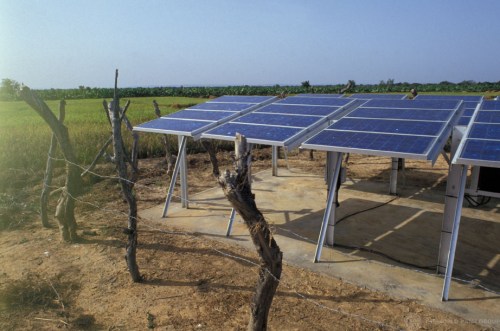
At the Solar Power International conference this week, one of the more interesting panels was one that looked at bringing solar to the developing world. As I wrote in The New York Times:

By 2020, the world’s biggest potential solar markets will be found in the developing world, areas largely ignored by solar industry today, according to executives working to bring renewable energy to rural regions.

Just 1 percent of the world’s solar panel production has been installed in developing countries, said Michael Eckhart, the president of the American Council on Renewable Energy, during a panel discussion Tuesday at the Solar Power International conference in Anaheim, Calif.

“This is a scandal for our industry and we must find solutions,” said Mr. Eckhart, who has worked on solar projects in Africa and India.

The market in Africa, Asia and Latin America is potentially vast given that nearly 44 percent of the population of the developing world lacks access to electricity, according to Simon Rolland, a policy and development officer for the Alliance for Rural Electrification, based in Brussels.

Therein lies a conundrum: Bringing solar energy to those communities means building and financing off-the-grid solar arrays in remote locations that use batteries to store the electricity generated by the photovoltaic panels.

You can read the rest of the story here.
Read Full Post »

4055519813_53462058cc_b

photo: Solar Power International

I spent the week at the Solar Power International conference in Anaheim, Calif., where some 22,000 people gathered for the industry’s biggest get-together in the United States. As I wrote in The New York Times, solar industry leaders are taking an aggressive new approach to pushing their agenda:

A solar industry leader smacked down the oil and coal industries on Tuesday, calling for renewable energy proponents to open their wallets to level the playing field in Washington.

“The full promise of solar power is being restrained by the tyranny of policies that protect our competitors, subsidize wealthy polluters and disadvantage green entrepreneurs,” said Rhone Resch, chief executive of the Solar Energy Industries Association, according to prepared remarks for a speech he is to give at the opening of the Solar Power International conference.

The event, being held in Anaheim, Calif., is the solar industry’s biggest annual get-together in the United States, and is usually a celebration of the industry’s breakneck growth of recent years.

But Mr. Resch said that with the fossil fuel industry devoting tens of millions of dollars to defeat climate change legislation now before Congress, the solar industry needs to start throwing its weight around Washington.

You can read the rest of the story here.

Read Full Post »

img_2914

photo: Todd Woody

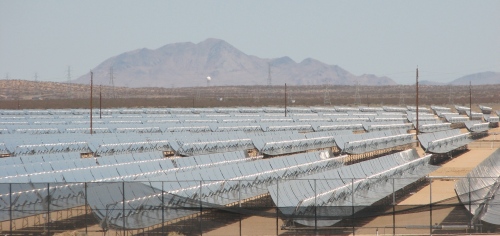
California utility PG&E on Monday announced two new Big Solar deals that will likely to ramp up the debate over solar thermal power plants’ thirst for water in the desert Southwest. As I write in The New York Times:

The West’s water wars are likely to intensify with Pacific Gas and Electric’s announcement on Monday that it would buy 500 megawatts of electricity from two solar power plant projects to be built in the California desert.

The Genesis Solar Energy Project would consume an estimated 536 million gallons of water a year, while the Mojave Solar Project would pump 705 million gallons annually for power-plant cooling, according to applications filed with the California Energy Commission.

With 35 big solar farm projects undergoing licensing or planned for arid regions of California alone, water is emerging as a contentious issue.

The Genesis and Mojave projects will use solar trough technology that deploys long rows of parabolic mirrors to heat a fluid to create steam that drives an electricity-generating turbine. The steam must be condensed back into water and cooled for re-use.

Solar trough developers prefer to use so-called wet cooling in which water must be constantly be replenished to make up for evaporation. Regulators, meanwhile, are pushing developers to use dry cooling, which takes about 90 percent less water but is more expensive and reduces the efficiency –- and profitability – of a power plant.

NextEra Energy Resources, a subsidiary of the utility giant FPL Group, is developing the Genesis project in the Chuckwalla Valley in the Sonoran Desert. The twin solar farms would tap about 5 percent of the valley’s available water.

You can read the rest of the story here.
Read Full Post »

IMG_0021
photo: Todd Woody

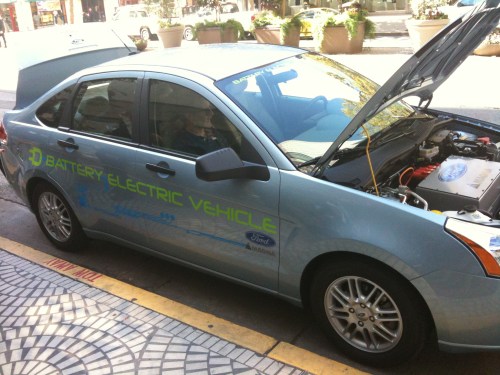
Ford executives brought a battery-powered Focus sedan to San Francisco on Thursday (along with a plug-in hybrid Escape). It was clear from the presentation by Nancy Gioia, Ford’s director of global electrification, that the automaker is aiming for a mass market and is spending a great deal of effort on helping create an entire electric car infrastructure. As I wrote in The New York Times on Friday:

At a press event in San Francisco on Thursday, Ford showed off a prototype of what might be called the Model T of the automaker’s electric car strategy: the battery-powered Focus sedan.

“This is about affordable transportation for the masses — this is not about a small niche,” said Nancy Gioia, Ford’s director of global electrification.

To keep costs down, the Focus and plug-in electric hybrids will be built — in small numbers at first — on what the company calls its global “C” platform, which produces two million cars a year.

“The assembly line in Michigan will produce the battery-electric Focus and also, with minor modifications, the gas Focus,” Ms. Gioia said. “We can change production as the market shifts.”

The Focus will hit the market in 2011 followed the next year by a plug-in electric Escape sport-utility vehicle, which Ford also showed off in San Francisco. Ms. Gioia said she expects electric and plug-in hybrids will account for 10 to 25 percent of the market by 2020.

You can read the rest of the story here.
But the cars seemed almost beside the point as Ford executives focused on their strategy to work with utilities and other groups to create open standards for electric cars and ensure that a charging infrastructure is in place when buyers hit showrooms.

Read Full Post »

Lawrence Berkeley solar study

The Lawrence Berkeley National Laboratory this week released a comprehensive study on the cost of going solar in the United States. No surprise that the cost of installing a photovoltaic solar system has fallen 30 percent over the past decade, but there are some interesting developments. For instance, California may be the biggest solar state but it’s not the cheapest. As I write in The New York Times on Friday:

The cost of going solar fell last year, resuming a decade-long decline after several years of flat prices, according to a new study from Lawrence Berkeley National Laboratory.

The report found that the installed cost of residential and commercial photovoltaic systems in the United States dropped 30 percent overall between 1998 and 2008. But prices had become relatively stagnant between 2005 and 2007, as demand spiked and solar module makers ramped up production.

The global economic meltdown, however, along with a resulting oversupply of modules, led the cost of installing a solar system last year to fall from $7.80 in a watt to $7.50 a watt — though the actual cost to homeowners actually increased slightly as state incentives for installing solar arrays fell faster than module prices.

In states like California, the per-watt rebate declines as more solar systems are installed.

Among other findings: the researchers, who reviewed data from the installations of 52,356 solar systems, discovered that it is 10 percent less expensive to install a solar array on a new home than to retrofit an existing home.

And although California is by far the largest solar market in the United States with 81 percent of all installed photovoltaic systems, it isn’t the cheapest place to install small-scale solar.

That distinction goes to Arizona, where the installed cost of solar systems smaller than 10 kilowatts was $7.30 per watt compared to $8.20 per watt in California.

You can read the rest of the story here.
Read Full Post »

nextlight renewable power agua caliente

That was quick: Just days after California Gov. Arnold Schwarzenegger vetoed legislation that would have limited utilities’ ability to buy out-of-state renewable energy, utility PG&E on Thursday asked regulators to approve a deal with an Arizona solar farm to supply 290 megawatts of electricity. As I write in The New York Times on Friday:

Pacific Gas & Electric, the big California utility, asked regulators on Thursday to approve the purchase of electricity from an Arizona solar power plant, only days after Gov. Arnold Schwarzenegger vetoed legislation that would have limited utilities’ ability to tap out-of-state projects to meet renewable energy mandates.

NextLight Renewable Power will construct the 290-megawatt Aqua Caliente photovoltaic farm on private land in Yuma County, Ariz. The company, based in San Francisco, signed a deal with P.G.&E. in June to supply 230 megawatts from a solar power plant to be built outside of Los Angeles.

The legislation vetoed by Mr. Schwarzenegger on Sunday would have required California utilities to obtain 33 percent of their electricity from renewable sources by 2020, mostly from in-state projects.

Environmental groups and unions supported that provision as a way to limit the need to build new transmission lines and to keep construction jobs in California. But the governor said it would hamstring utilities from complying with the 33 percent target, which he supports.

According to the filing the utility made Thursday, Arizona regulators have already approved the project and NextLight expects to obtain county building permits within a few months. In contrast, the licensing of a solar power plant in California can take years. The Agua Caliente project is also located near existing transmission lines that connect to California’s power grid.

You can read the rest of the story here.

Read Full Post »

2009 Solar Decathlon

photo: Stefano Paltera/DOE

In my new Green State column on Grist (I’m stealing the above headline from Grist executive editor Russ Walker), I take a look at the state of green tech venture investing gleaned from a recent seminar at the University of California, Berkeley:

Silicon Valley is by nature an optimistic place. After all, inventing the carbon-free future and making boatloads of money along the way is fun. And even though California is slouching toward apocalyptic collapse these days, there’s always another innovation wave to ride.

So it’s always interesting to get a more-or-less unvarnished assessment of the state of green tech, as happened last week when a group of regulators, venture capitalists and entrepreneurs gathered at the University of California, Berkeley’s business school. They were there for the Cleantech Institute, one of those pricey, closed-door seminars for executives and government officials. (I was present to “facilitate.”)

The good news: Speakers reported that investors are starting to turn on the taps again when it comes to funding green tech startups.

But don’t expect a return to the halcyon days of 2008 when $4 billion poured into all manner of green technology companies. In the wake of the “Great Recession,” VCs are reassessing their investment strategies as it becomes clear that the success of their portfolios will be influenced to a large degree by government policy and incentives.

You can read the rest of the column here.

Read Full Post »

« Newer Posts - Older Posts »

Design a site like this with WordPress.com
Get started