Feeds:
Posts
Comments

Archive for the ‘green policy’ Category

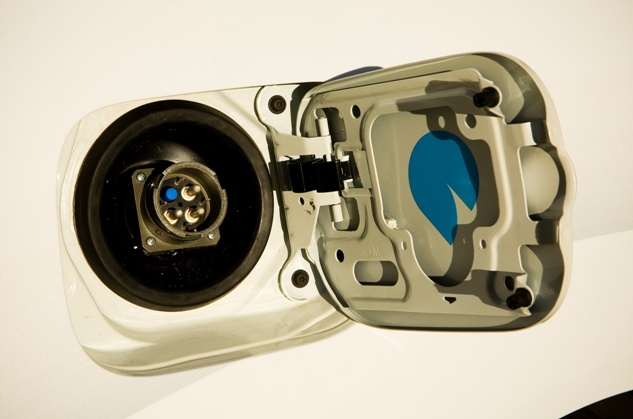
photo: Better Place

In The New York Times on Friday, I wrote about the latest developments in California’s efforts to write the rules of the road for an electric car infrastructure:

California officials have indicated they are not inclined to regulate electric car infrastructure companies that plan to sell electricity to drivers through networks of charging stations.

Whether to treat such companies as quasi-utilities has been a contentious issue. The state’s three big utilities have split on the topic, while battery charging start-ups like Better Place and Coulomb Technologies have warned that regulation could stifle innovation and scare off investors.

Now the president of the California Public Utilities Commission, Michael R. Peevey, has signaled he is siding with the companies as the commission moves to put electric car regulations in place.

“Facilities that are solely used to provide electricity as a transportation fuel do not constitute ‘electric plant,’” wrote Mr. Peevey in a recent ruling. “As such, the commission would not have regulatory authority regarding the price that an electric vehicle charging facility operator charges for charging services or other aspects of the operation of such facilities.”

That is not likely to be the final word on the subject. Mr. Peevey, who is overseeing the electric car rule-making process, invited utilities, automakers and charging station companies to file briefs on his proposed interpretation of the law.

With several mass-market electric cars set to hit showrooms by the end of the year, the utilities commission is moving unusually swiftly to resolve a variety of outstanding issues. In his ruling, Mr. Peevey set an April deadline to issue a preliminary decision on the most of them.

You can read the rest of the story here.

Read Full Post »

Could we really be as dependent on fossil fuels in 2034 as we are today? In The New York TImes on Friday, I write about a projection from energy consultants Black & Veatch that sees fossil fuels continuing to play a dominant role in the United States a quarter century from now:

A quarter century from now the United States’ reliance on fossil fuels will have declined only marginally, according to a projection from Black & Veatch, the engineering and energy consulting firm.

In 2034, a mix of coal, natural gas and other fossil fuels will supply 68 percent of the nation’s energy needs, compared to 76 percent today. The share of energy production from renewable sources, including solar and wind, in 2034 will rise to 13 percent from 5 percent. Nuclear power will supply only 2 percent more electricity than it does in 2010, the firm said.

Those numbers were part of a presentation that Black & Veatch made to utility executives and other clients in Sacramento this week and which Mark Griffith, a managing director at the company, shared with The Times.

“We’re not assuming that greenhouse gas legislation leads to a immediate shutdown of all coal plants, nor does it lead to going directly to natural gas or renewables,” said Mr. Griffith.

However, Mr. Griffith acknowledged that a number of factors remain in flux that could change those dynamics, including the final shape of a cap-and-trade system – if one is implemented – and whether the United States imposes a requirement that all states obtain a percentage of their electricity from renewable sources.

You can read the rest of the story here.

Read Full Post »

photo: Think

In The New York Times on Monday, I write about a new McKinsey report that looks at the potential for electric cars in three of the world’s “megacities” — New York, Paris and Shanghai:

New Yorkers, start your electric cars.

A report from the consulting firm McKinsey, scheduled to be issued Monday, found that about a fifth of New York City residents are “early adopters” likely to purchase an electric car. Such vehicles could account for 16 percent of automobile sales by 2015, with 70,000 electric and plug-in hybrid electric cars on city streets.

Even so, the city would only see a net two percent reduction in carbon emissions from the replacement of gasoline-powered cars by electric vehicles, or EVs, according to a summary of the report provided to The Times.

“Achieving a visible carbon effect from EV penetration will require a higher penetration of the fleet and further improvements in local power generation, with a higher share of renewables and less carbon-intensive technology in the future,” the report said.

Those findings were part of a study gauging the appeal of electric cars in three large cities – New York, Paris and Shanghai. The report’s release comes as electric vehicles take center stage at the opening of the Detroit auto show Monday.

You can read the rest of the story here.
Read Full Post »

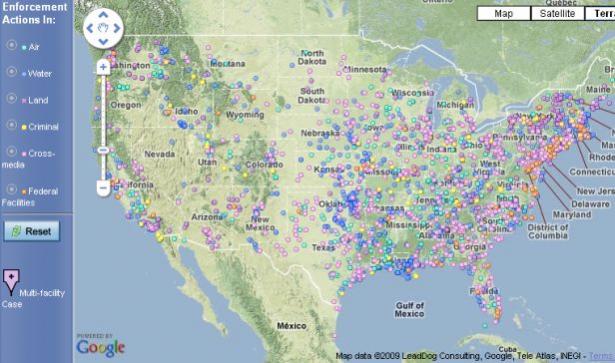
Image: U.S. EPA

In my new Green State column on Grist, I write about how the U.S. Environmental Protection Agency has made its annual year-end enforcement report relevant to the average citizen by creating a Google map mashup that let’s you quickly pinpoint any environmental violations in your neighborhood:

‘Tis the season for the annual year-in-review column, beloved by writers and editors desperate to fill pages and screens of blank space during these slow news weeks.

I’m going to forgo that annual holiday journalism tradition—sort of. While perusing various year-end and year-ahead trend story pitches that had popped into my in-box since Thanksgiving, I came across one from the United States Environmental Protection Agency that caught my attention.

The EPA was releasing its annual enforcement stats for 2009. Usually that’s a big yawn, given that for most of the past decade prosecuting polluters was not high on the must-do list of the former administration. But in 2009 not only was there a much more enforcement-minded EPA administrator in Washington (in the person of Lisa Jackson), the agency for the first time created a Google map mashup of its enforcement actions for the year.

The map lets you zoom in on your city, county, or state and see the civil and criminal cases filed by the EPA for violations of its clean air and water laws and other environmental statutes. Click on the air, water, land, and criminal buttons and colored markers start to populate the map showing you the location of various violations. When you click on a marker a link to detailed information about the case pops up. You can also review any past violations.

You can read the rest of the column here.

Read Full Post »

image: Tessera Solar

In a follow-up to my New York Times story Tuesday on Senator Dianne Feinstein’s bill to ban renewable energy production in parts of California’s Mojave Desert, I take a look at some of the incentives in the legislation that could speed green energy projects:

In Tuesday’s Times, I write about Senator Dianne Feinstein’s bill to create two Mojave Desert monuments in California that would ban renewable energy projects on lands that are both coveted for solar farms and valued for their sweeping vistas and populations of rare wildlife.

The mere prospect of the legislation has derailed several massive solar power plants planned by Goldman Sachs and other developers. But Mrs. Feinstein, a California Democrat, has included provisions in the bill that could, if enacted, accelerate renewable energy development and ease tensions over endangered species that are slowing other solar projects outside the monument area.

In a big concession to renewable-energy advocates, Mrs. Feinstein would allow transmission lines to be built through existing utility rights-of-way in the monument to transmit renewable energy from other desert areas to coastal metropolises. That will not likely sit well with some of the senator’s environmental allies. (Nor will a provision that permanently designates areas of the desert for off-road vehicle use.)

The legislation also features a pilot program to assemble huge tracts of land -– at least 200,000 acres — to be used as endangered species habitat to make up for areas lost to renewable energy production.

You can read the rest of the story here.

Read Full Post »

In Tuesday’s New York Times, I write about California Senator Dianne Feinstein’s move to ban renewable energy production in two proposed national monuments in the Mojave Desert:

AMBOY, Calif. — Senator Dianne Feinstein introduced legislation in Congress on Monday to protect a million acres of the Mojave Desert in California by scuttling some 13 big solar plants and wind farms planned for the region.

But before the bill to create two new Mojave national monuments has even had its first hearing, the California Democrat has largely achieved her aim. Regardless of the legislation’s fate, her opposition means that few if any power plants are likely to be built in the monument area, a complication in California’s effort to achieve its aggressive goals for renewable energy.

Developers of the projects have already postponed several proposals or abandoned them entirely. The California agency charged with planning a renewable energy transmission grid has rerouted proposed power lines to avoid the monument.

“The very existence of the monument proposal has certainly chilled development within its boundaries,” said Karen Douglas, chairwoman of the California Energy Commission.

For Mrs. Feinstein, creation of the Mojave national monuments would make good on a promise by the government a decade ago to protect desert land donated by an environmental group that had acquired the property from the Catellus Development Corporation.

“The Catellus lands were purchased with nearly $45 million in private funds and $18 million in federal funds and donated to the federal government for the purpose of conservation, and that commitment must be upheld. Period,” Mrs. Feinstein said in a statement.

The federal government made a competing commitment in 2005, though, when President George W. Bush ordered that renewable energy production be accelerated on public lands, including the Catellus holdings. The Obama administration is trying to balance conservation demands with its goal of radically increasing solar and wind generation by identifying areas suitable for large-scale projects across the West.

Mrs. Feinstein heads the Senate subcommittee that oversees the budget of the Interior Department, giving her substantial clout over that agency, which manages the government’s landholdings. Her intervention in the Mojave means it will be more difficult for California utilities to achieve a goal, set by the state, of obtaining a third of their electricity from renewable sources by 2020; projects in the monument area could have supplied a substantial portion of that power.

“This is arguably the best solar land in the world, and Senator Feinstein shouldn’t be allowed to take this land off the table without a proper and scientific environmental review,” said Robert F. Kennedy Jr., the environmentalist and a partner with a venture capital firm that invested in a solar developer called BrightSource Energy. In September, BrightSource canceled a large project in the monument area.

You can read the rest of the story here.

Read Full Post »

I’ve written before about the coming collision between green energy projects and endangered wildlife. Now we have a federal court decision in a case involving an endangered bat and a West Virginia wind farm. As I write Thursday in The New York Times:

A federal judge’s ruling that stopped construction of a West Virginia wind farm to protect an endangered bat underscores the growing conflicts between green energy and imperiled wildlife.

But the case, thought to be the first of its kind involving a wind energy project, seems unlikely to derail other projects, as some wind energy advocates have feared, unless the operators ignore endangered species laws.

In the West Virginia dispute, a subsidiary of wind developer Invenergy called Beech Ridge Energy applied to build a 122-turbine project along an Appalachian ridgeline in Greenbrier County. The county is home to the Indiana bat, which the federal government listed as endangered in 1967.

“This is a case about bats, wind turbines, and two federal policies, one favoring the protection of endangered species, and the other encouraging development of renewable energy resources,” wrote Judge Roger W. Titus of the Federal District Court in Maryland in Tuesday’s ruling. “The two vital federal policies at issue in this case are not necessarily in conflict.”

That’s because under the Endangered Species Act, developers can apply for an “incidental take permit” that allows the inadvertent killing of protected wildlife if other measures are taken to protect the animals.

Invenergy told federal wildlife officials that surveys had not detected the Indiana bat at the West Virginia wind farm site. Although officials at the Fish and Wildlife Service had urged the company’s consultants to conduct more extensive surveys, a West Virginia state agency approved the project and construction of the wind turbines began.

The Animal Welfare Institute, a Washington-based nonprofit group, sued to stop construction. An initial assessment of the project had estimated that it would annually kill 6,746 bats of all kinds.

After listening to expert testimony from both sides, Judge Titus concluded that Invenergy’s consultants avoided undertaking surveys that would have shown the presence of Indiana bats at the project site.

“By a preponderance of the evidence, that, like death and taxes, there is a virtual certainty that Indiana bats will be harmed, wounded, or killed imminently by the Beech Ridge Project,” the judge wrote in his ruling. “This court has concluded that the only avenue available to defendants to resolve the self-imposed plight in which they now find themselves is to do belatedly that which they should have done long ago: apply for an I.T.P.” (I.T.P. refers to incidental take permit.)

You can read the rest of the story here.

photo: U.S. FIsh and Wildlife Service

Read Full Post »

In my new Green State column on Grist, I write about the latest political machinations in Australia that derailed carbon cap-and-trade legislation at the 11th hour and sets the stage for a national election fought largely over climate change:

As I boarded my flight back to California in Brisbane, Australia, last Wednesday, I received an email alert that the Australian Senate had just defeated the Labor government’s climate change legislation. Only days earlier victory seemed all but assured, allowing Australia to go to Copenhagen with an iron-clad, albeit weak, agreement in hand to reduce the nation’s greenhouse gas emissions, which per capita are among the highest in the world.

Then in the course of 24 hours the conservative opposition Liberal Party sacked its leader—who had pledged to pass the government’s cap-and-trade legislation—and replaced him with a one-time global warming denier and quickly voted down the government’s Carbon Pollution Reduction Scheme.

The defeat gives Prime Minister Rudd the trigger for an early election that would largely be fought over climate change. (If Parliament twice rejects a government bill, the prime minister can ask that the legislature be dissolved and a snap election called.)

In August, after the Senate first rejected the center-left government’s cap-and-trade legislation, I wrote in Grist that the defeat reflected the peculiarities of the Australian political system rather than the viability of a cap-and-trade system.

I’m not so sure any more after watching the latest reversal unfold during a visit to the Lucky Country.

Just as Australia is the proverbial canary in the coal mine for the environmental affects of climate change, a national election waged over cap-and-trade will offer a preview of voters’ willingness to pull the lever for action on climate change.

You can read the rest of the column here.

image: courtesy cinephobia via Flickr

Read Full Post »

photo: Aurora Biofuels

In the Los Angeles Times on Friday, I write about the Obama administration’s move to issue $600 million in grants for biofuel refinery pilot projects. California startups grabbed a fair share of the money:

The federal government this morning announced it will hand out $600 million for next-generation biofuels projects, including those being developed by several California companies.

“Advanced biofuels are critical to building a cleaner, more sustainable transportation system in the U.S.,” Secretary of Energy Steven Chu said in a statement. “These projects will help establish a domestic industry that will create jobs here at home and open new markets across rural America.”

Second-generation biofuels produce ethanol, diesel and jet fuel from wood waste, nonfood crops, algae and other feedstocks. San Diego in particular has become a hotbed for companies developing biofuel from algae.

Sapphire Energy, based in San Diego, will receive $50 million from the Department of Energy for the construction of a pilot biofuel facility in Columbus, N.M. Algae grown in ponds will be transformed into jet fuel and diesel. The company also scored a $54.5-million loan guarantee from the Department of Agriculture to build the New Mexico project.

You can read the rest of the story here.

Read Full Post »

In The New York Times on Friday, I write about environmentalists’ less-than-enthusiastic reaction to the Obama administration’s proposed efficiency standards for water heaters, one of a home’s biggest energy hogs:

Environmentalists have had a lukewarm reaction to the Obama administration’s proposed energy efficiency standards for home water heaters.

The standards, which would take effect in 2015, could save consumers as much as $15.6 billion over 30 years, cut energy consumption and avoid emitting 154 million tons of carbon dioxide, according to the United States Department of Energy.

That’s good but not nearly good enough, said Andrew deLaski, executive director of the Appliance Standards Awareness Project, a Boston-based group backed by energy efficiency advocates and environmental organizations.

“They fall short because they fail to take advantage of the advanced technology where the big savings are,” said Mr. deLaski. “The question is, do you just tweak existing technology or push the market to technologies that get you enormous savings?”

You can read the rest of the story here.

Read Full Post »

« Newer Posts - Older Posts »

Design a site like this with WordPress.com
Get started