Feeds:
Posts
Comments

Archive for the ‘global warming’ Category

solarcells

photo: Southern California Edison

While demand for solar panels is expected to continue to grow by double-digits in the years ahead, 2009 could be a make-or-break year for some companies, according to an analysis from HSBC Global Research.

After grappling with a shortage of polysilicon – the base material of conventional solar cells – for the past couple years, the industry now faces falling prices. The spot market for polysilicon has plummeted 35% since October, writes HSBC alternative energy analyst Christine Wang, who predicts prices will fall 30% next year.

That’s bad news for solar module makers who locked in long-term contracts at higher prices – which looked like a smart move when polysilicon was in short supply and prices rising rapidly. “The winners will likely be the companies with competitive cost structures, scale, good product  quality, strong balance sheets, and strong customer relationships,” according to Wang. “We believe that new entrants and small players will suffer the most as they lack brand recognition.”

The culprits are the usual suspects – the global financial crisis as well as some cutbacks in subsidies from countries like Spain. Solar cell companies that have rapidly ramped up production over the past two years now may be saddled with too many high-priced products.

Wang downgraded Chinese solar giant Suntech (STP) and set a price target of $4.50 – down sharply from HSBC’s earlier target of $55. Suntech was trading at near $10 Monday afternoon but still nearly 90% off its 2008 high.  (SunPower (SPWRA), First Solar (FSLR) and other solar cell makers have also seen their share prices nose-dive.) “High portion of polysilicon based on contract prices will hurt Suntech,” writes Wang, who estimated that 80% of Suntech’s polysilicon supply is locked into contracts “on less favorable fixed prices.”

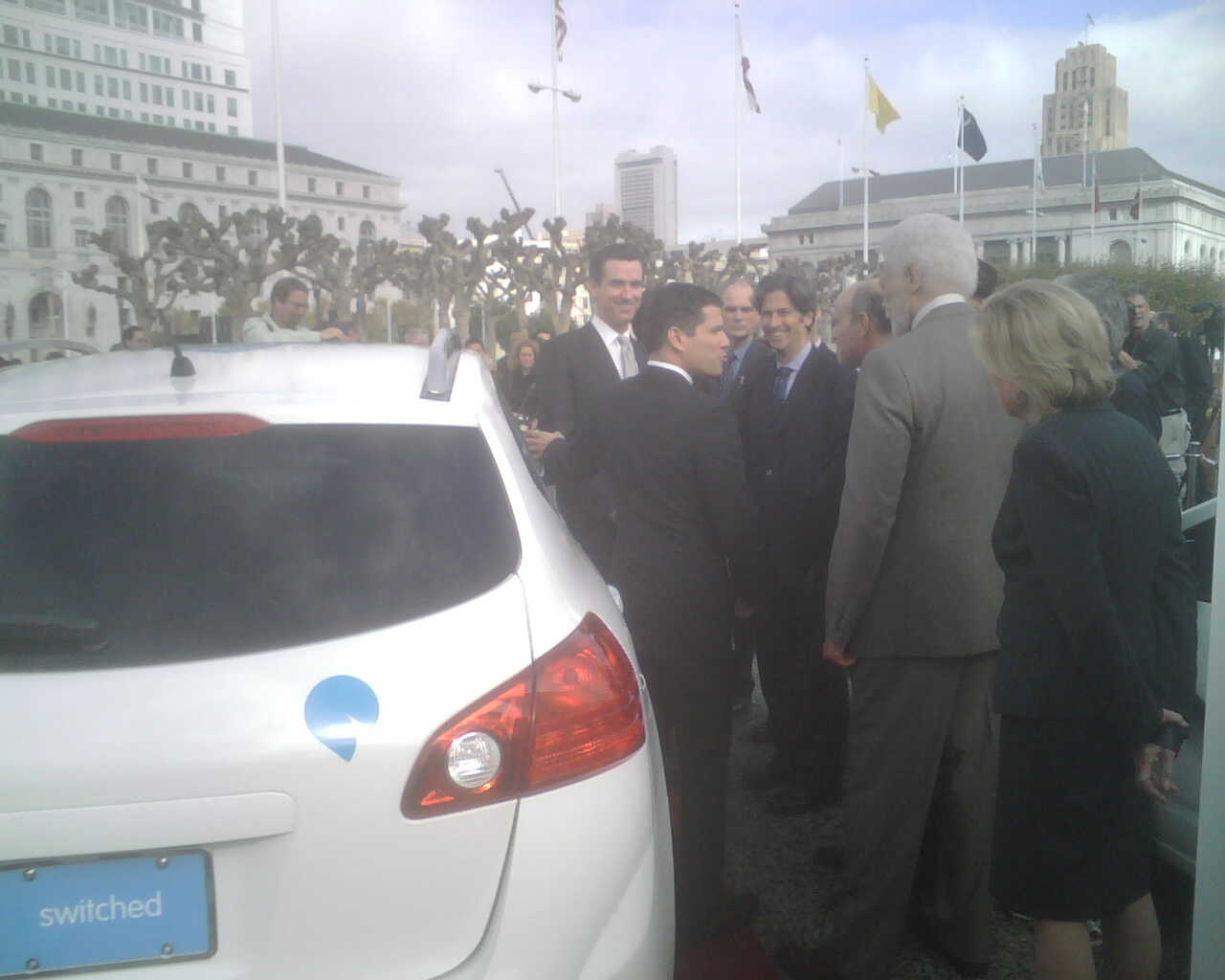
Falling panel prices is good news for solar system installers like Sungevity and Akeena Solar (AKNS) and their residential and commercial customers. When Green Wombat ran into Akeena CEO Barry Cinnamon in San Francisco at the announcement of Better Place’s Bay Area electric car project, he said he was in no rush to enter into long-term contracts with solar cell suppliers as he expects prices will continue to fall in 2009.

Still, not all the news is gloomy for the industry. Wang expects that the financial crisis won’t derail government support for solar, given climate change pressures and state mandates to increase the use of renewable energy. The move by utilities like PG&E (PCG) and Southern California Edison (EIX) to sign long-term contracts for electricity from photovoltaic power plants will also keep demand high in coming years.

Wang projects solar cell demand will grow 45% between 2008 and 2012. “Developed countries are increasingly focused on environmental protection and curtailing the causes of climate change, and we do not believe this trend will shift just because of a (hopefully) short-term financial crisis,” she wrote.

Read Full Post »

solana1The credit crunch is taking a toll on the United States’ nascent solar industry, scuttling big renewable energy projects and curtailing expansion plans, solar executives said Wednesday as they proposed the inclusion of green incentives in the Obama economic stimulus plan.

Spanish energy giant Abengoa, for instance, has put on hold plans to build its 280-megawatt Solana solar power plant outside Phoenix to supply electricity to utility Arizona Public Service (PNW) in a $4 billion deal, said Fred Morse, senior advisor to Abengoa Solar.

“We have serious issues getting financing,” said Morse during a conference call held by the Solar Energy Industries Association. Congress in October passed a 30% investment tax credit crucial to the solar industry. But Wall Street’s meltdown has scared off investors that normally would finance large solar projects in exchange for the tax credits.

“The investment tax credit was passed but unfortunately there was no ‘I’ in the ITC,” Morse added. “We have trouble finding tax-equity investors, the financing is gone.”

Suntech America president Roger Efird said that after Congress passed the investment tax credit, the Chinese solar cell maker immediately doubled its sales force in the U.S. That expansion has now hit a wall.

“Plans to double our sales force by the end of 2009 are currently on hold, primarily because business has slowed in fourth quarter because of the credit crunch,” he said. “We had been considering establishing manufacturing in the U.S. The timing of those plans depend on the growth of the market in the U.S. and how long it takes to get through this downturn.”  Suntech’s (STP) stock – like those of rivals SunPower (SPWRA) and First Solar (FSLR) – has been walloped by the market chaos and is down 94% from its 52-week high.

Ron Kenedi of Sharp Solar said the dealers and installers who buy the Japanese solar module maker’s products have had a hard time securing credit to finance their operations.

In response, the solar industry’s trade group on Wednesday proposed that the federal government cut through the credit crunch by adopting tax and investment policies to stimulate the solar sector and create 1 million jobs.

The centerpiece of the plan is a $10 billion program to install 4,000 megawatts of solar energy on federal buildings and at military installations. “The Department of Defense alone could jump start this industry and it could have widespread impact on the use of solar, similar to what it did for the Internet,” said Nancy Bacon, an executive with Michigan thin-film solar cell maker Energy Conversion Devices (ENER).

Bacon noted that the federal government is the world’s largest utility customer, spending $5.6 billion annually on electricity. “This would create 350,000 sustainable jobs,” she said. “The solar industry is ready to deploy these systems immediately.”

The Solar Energy Industries Association also wants Congress to enact a 30% tax refundable tax credit for the purchase of solar manufacturing equipment to encourage solar companies to build their factories in the U.S. That would result in an estimated 315,000 new jobs. Making the current investment tax credit refundable would also help loosen up financing for solar projects, the association said.

Other policies on the SEIA agenda:

  • Establishment of a national Renewable Portfolio Standard that would require states to obtain a minimum of 10% of their electricity from green sources by 2012 and 25% by 2025, with 30% of the total coming from solar.
  • Rapid deployment of new transmission lines to connect cities to remote areas where wind and solar power is typically produced.
  • Expedited approval of solar power plant projects on federal land in the Southwest.
  • Creation of an Office of Renewable Energy in President-elect Obama’s office to coordinate the procurement and permitting of solar power and transmission lines.

“We are working closely with the Obama energy transition team and have been in contact with Congress,” said SEIA president Rhone Resch. “These polices are exactly the kind of shot in the arm our economy needs today.”

Read Full Post »

20081117_5075_betterplace

photo: Better Place

Silicon Valley startup Better Place on Tuesday announced a deal with Hawaii’s governor and the state’s biggest utility to build an electric car charging network throughout the islands.

The agreement comes less than two weeks after Better Place CEO Shai Agassi and the mayors of Northern California’s three largest cities unveiled a plan to build an electric car infrastructure for the San Francisco Bay Area. Better Place also has signed similar deals with governments in Australia, Denmark and Israel.

Agassi said the network of charging posts and battery swapping stations will be ready by 2012. That’s roughly the target date for Better Place’s other projects, which means the year-old startup will be simultaneously building electric car networks in four countries while raising billions of dollars in project finance.

Renault-Nissan will supply electric cars for the network. Better Place will own the car batteries and charge drivers for the miles (or kilometers) driven. By removing the battery from the purchase price of electric cars – the most expensive component – Better Place hopes to sell vehicles at prices competitive with their fossil-fueled counterparts.

Appearing with Agassi at a press conference at the capitol in Honolulu, Hawaii Governor Linda Lingle said the Better Place partnership offers the state the opportunity to slash the $7 billion it spends annually on imported oil and provide a market for renewable energy. Hawaiians pay some of the highest gasoline prices in the U.S. and the state has set a goal of obtaining 70% of its energy from solar, wind and other renewable sources by 2030.

“It’s not a simple goal – we’re looking to end our dependence on oil,” said Agassi, who shed his customary dark suit for a gray polo shirt and wore a lei. “Any form of renewable energy – wind, solar, geothermal – is here in Hawaii.”

“This will be the blueprint where six or seven million visitors will come and experience first-hand what it’s like to drive an electric car,” added Agassi, 40, a former top executive at business software giant SAP. “You couldn’t ask for a better advertisement.”

Utility Hawaiian Electric (HE), which supplies 95% of the state’s power, will generate renewable electricity equal to what the Better Place network consumes and work with the company on developing the charging infrastructure.

“The price of oil is irrelevant to us – we have to reach a clean and secure energy future,” Lingle said.

Better Place’s latest deal came on the same day that General Motors (GM) and Ford, which have asked for a multi billion-dollar bailout from Congress, (F) announced plans ramp up production of hybrid and electric cars.

“It’s a win-win-win – the only loser in the equation is oil and that’s ok,” said Hawaiian Electric executive vice president Robbie Alm. “Green cars will provide the market for renewable energy.”

Read Full Post »

tendril

In case you missed it, this Green Wombat story appears in the current issue of Fortune.

A house that thinks

The high-tech networks that Reliant Energy is installing in the homes of its 1.8 million customers will help them save electricity.

By Todd Woody, senior editor

(Fortune Magazine) — Inside a white-brick house nestled in Houston’s leafy Montrose neighborhood, a gray handheld video display sits on the living room coffee table. But this is no ordinary remote control. Called the Insight and made by Tendril, a Boulder startup, the device communicates wirelessly with the home’s utility meter, letting you track real-time information about the cost of the electricity you consume.

The house is actually a demonstration project set up by Reliant Energy (RRI), a reseller of electricity with $12 billion a year in sales. Glen Stancil, Reliant’s vice president for smart energy R&D, taps the Insight’s screen. “Right now we’re spending $1.40 per hour,” he says, noting that the electricity prices and usage are updated every ten seconds. (Customers can also access the same data on the web or their iPhones.)

Stancil presses another button. “The bill so far is $86, and for the month it looks like it’s headed to $367,” he says. The Insight system also warns that you’ll fork over another $100 this month if you crank up the air conditioner a couple of notches. So keep your hands off the thermostat.

That’s just the kind of behavior that Reliant Energy CEO Mark Jacobs would like to see. Until now, Reliant has made its money by entering contracts with utilities for a fixed amount of power at a fixed price and then reselling it to its 1.8 million customers. If demand unexpectedly soars on a hot afternoon as everyone turns up the air conditioning, Reliant often must buy extra power on the spot market, where prices can spike as much as 60%.

That cuts into profits. “It’s like running a beachfront hotel, charging the same room rate all year round, and then building more rooms to guarantee that everyone has a room on the busiest weekends,” says Jacobs.

In November, Reliant started installing the Insight in homes, which means it will be able to pass along those high spot prices to its customers, or better yet, in sweltering Texas, let customers buy a month’s worth of cool at a set price – say, 72 degrees for $200 or 74 degrees for $160.

The Insight offers another advantage – Jacobs believes it will encourage his customers to cut back on electric use and save money. “What if you knew you could run your clothes dryer at five o’clock, and it would cost $3,” says Jacobs, “or you could wait until eight o’clock at night, and it would be only a dollar?”

PG&E (PCG), Southern Edison International (EIX) and other utilities are rolling out smart meters but have yet to to integrate them with smart energy systems for the home. But Reliant operates in a competitive, deregulated electricity market. If homeowners get cool technology that helps them avoid the unpleasant surprise of a big electric bill, Jacobs believes Reliant will retain more customers. And then there’s the green angle. “We as an industry are the single largest emitter of greenhouse gas, and our goal is to help our customers use less, spend less, and emit less,” says Jacobs.

For Jacobs, a 46-year-old Goldman Sachs (GS) veteran, smart energy technology is just the wedge to shake up what he calls “an industry in the Dark Ages” while opening new markets for his company, whose stock has been walloped by the one-two punch of Houston’s Hurricane Ike and the credit crunch.

Hurdles, however, remain. Will consumers already suffering from information overload want to obsessively monitor their electricity habit? Will a sweating Houstonite on a 104-degree day say to hell with the cost and crank up the AC anyway? Jacobs isn’t worried. He believes nothing influences behavior better than knowing the true price of what you’re buying.

Read Full Post »

20081117_3625_betterplace

Photo: Better Place/Acey Harper

SAN FRANCISCO – It was a day when the shift from the past to the future was almost palpable.

It started Thursday morning in Berkeley where Green Wombat was moderating a panel of tech luminaries gathered at the University of California’s Global Technology Leaders Conference. As Shai Agassi, founder of electric car infrastructure company Better Place, makes the case for harnessing Silicon Valley’s technological innovation to Detroit’s manufacturing might to create a sustainable car industry, dispatches from the automotive apocalypse roll down my BlackBerry: Ford (F) shares sink to $1.01…GM’s (GM) stock falls to its lowest level since World War II…U.S. automakers beg for a bailout…California Congressman Henry Waxman ousts Michigan’s John Dingell — the Duke of Detroit — from his 28-year chairmanship of the powerful House Energy and Commerce Committee.

Agassi slips out of the conference and an hour later I catch up with him across the Bay at San Francisco City Hall where he and representatives of Governor Arnold Schwarzenegger and the mayors of San Francisco, San Jose and Oakland announce a $1 billion project to build a regional network of electric car charging stations. Better Place has signed similar deals with governments in Israel, Denmark and Australia, but California is the company’s first foray into the U.S. market. Planning for the Bay Area network begins in 2009 with construction scheduled to start in 2010 and commercial rollout set for 2012.

better20place202The mood is ebullient. “This is the start of a regional effort to become the capital of electric vehicles in the United States,” proclaims San Francisco Mayor Gavin Newsom before an audience that includes representatives from state and federal environmental agencies, green groups. Silicon Valley business leaders and officials from GM and Toyota (TM).

For his part, Agassi says, ” We believe this is not just a model for California, but a blueprint for the United States.”

The blueprint works like this: The mayors of the Bay Area’s three largest cities agreed to expedite permitting and installation of electric car charging stations, standardize regional regulations to promote an electric car infrastructure and offer incentives to employers to install chargers at workplaces. The mayors also agreed to pool purchases of municipal electric car fleets.

Better Place will raise the capital to install thousands of charging spots on the streets of San Francisco, San Jose and Oakland as well as stations between California cities where drivers can swap depleted batteries for fresh ones when they make longer trips. The Palo Alto-based company will own the car batteries and charge drivers for the miles driven. Automaker Renault-Nissan is developing electric cars for the Better Place network.

The big idea: Only by building an electric car infrastructure first will automakers produce the tens of millions of electric cars needed to make a significant dent in greenhouse gas emissions and the nation’s dependence on foreign oil.

That business model elicited some skepticism earlier in the day at the Berkeley conference, where Michael Marks, former CEO of electric carmaker Tesla Motors, questioned Agassi’s claim that Better Place would be able to provide electric cars that cost no more than gasoline-powered vehicles. And Jim Davidson, co-founder of Silicon Valley private equity firm Silver Lake, asked if Better Place would essentially be tapping the power grid to create a monopoly. (No, Agassi said, the Better Place network would be open to all electric cars.)

When Green Wombat sat down with Agassi and Newsom in the mayor’s offices Thursday afternoon, I asked Agassi, who brings a charismatic messianism to his mission, how Better Place would raise the billions needed to roll out an electric car infrastructure in California amid a global economic meltdown. He noted that in Australia Better Place signed up investment giant Macquarie Bank to create an infrastructure fund to finance that project while in Denmark a utility will provide financing.

“We will do the same thing here; we’re working with Morgan Stanley (MS) and Goldman Sachs (GS),” Agassi says, recounting a conversation he recently had with investors who he said were eager to put money in Better Place projects.

If anything, Newsom, 41, and Agassi, 40, and their allies regard the confluence of the financial crisis, the great Detroit car crash and the consolidation of green power in the incoming Obama administration and Congress as a once-in-a-lifetime opportunity to launch a disruptive technology on a global scale and transform the U.S. automotive industry.

“We’re uniquely positioned in that our local representative is Speaker of the House,” notes Newsom, referring to his close political ally, San Francisco Democrat Nancy Pelosi, who on Thursday sent a message of support for the Better Place initiative. “That can elevate what we’re trying to achieve out here.”

There’s no doubt that Newsom has a knack for game-changing politics. (He launched the gay marriage movement in these offices.) But the nuts and bolts of getting the bureaucracy to fall in line will be a harder challenge, as anyone who has ever tried to get a permit to do a home renovation in San Francisco can tell you. And not all of San Francisco’s collaborations with Silicon Valley tech companies have gone well — witness the collapse of the citywide Wi-Fi initiative Newsom undertook with Google (GOOG).

Agassi hesitated when I asked about plans to extend the Bay Area electric car network to the rest of California, noting that negotiating agreements with the nearly 100 municipalities that make up Greater Los Angeles poses a challenge. “I got a call the other day from the mayor of L.A. asking where are we,” Agassi says. “We hope to eventually make it an electric charging corridor from California to Seattle to Vancouver.”

On Thursday, Agassi and the politicians took pains to paint the Better Place initiative as not a California versus Michigan thing, or new economy versus old. And they just may be right. For in a strange way, by building an electric car infrastructure, California is offering Detroit a rescue package of its own: Supplying the network lays the groundwork for the mass production of electric cars that could be the auto industry’s salvation.

That may be counter to conventional wisdom, but perhaps Robert F. Kennedy Jr., environmentalist and advisor to Silicon Valley’s VantagePoint Venture Partners – a Better Place investor – put it best on Thursday at the press event when he upended the East Coast view of the Golden State: “When you come to California, you find people in touch with reality.”

Read Full Post »

deutsche-bank-green-bankPresident-elect Barack Obama may dismiss notions of a New New Deal to stave off a Great Depression 2.0, but signs of a Rooseveltian shift in thinking abound.

Case in point: This week, Deutsche Bank called for the establishment of a “national infrastructure bank” to create “green” jobs, fight global warming and ensure U.S.  energy independence by investing in an array of projects – from energy efficiency to upgrading the Eisenhower-era power grid to large-scale renewable energy power plants.

The idea of a national infrastructure bank is not new – versions have been proposed by Obama and Senators Chris Dodd (D-Conn.) and Chuck Hagel (R-Neb.) to finance the repair of the nation’s crumbling highways, water systems and cities. Deutsche’s twist is to give such an institution a green mission.

“We believe this confluence opens up an historic opportunity for a new U.S. administration and Congress to take a global leadership position on the issue of the environment and energy security, while addressing current financial problems,”  wrote Deutsche Bank’s Climate Change Investment Research team in its report.

“We’re calling for the national infrastructure bank to go green because in the long run it will save us money and create more jobs,” Deutsche senior investment analyst Bruce Kahn told Green Wombat.

He says Deutsche Bank is not putting a dollar figure on the capitalization of such bank, but the report notes others have suggested a $100 billion investment would generate two million green jobs.

Deutsche Bank (DB) recommends a green infrastructure bank focus on energy efficiency, the transmission grid, renewable energy and public transportation. The green bank would dispense federal funding, make grants to states and cities, issue loans to governments and companies, underwrite public and private bonds, and provide tax credits for public and private projects.

In Deutsche Bank’s analysis, the biggest bang for the buck would come from a massive retrofit program to increase the energy efficiency of the nation’s commercial buildings and make sure the 1.8 million new homes constructed every year are green. Buildings consume as much as 50% of the electricity generated in urban areas and emit about 20% of the country’s greenhouse gases. The work of installing energy-efficient heating, lighting and air conditioning systems is labor intensive and would spike demand for green building materials.

Upgrading and digitizing the power grid to create a “transmission super highway” to bring solar and wind energy from the deserts and Great Plains to the cities could generate as many as 500,000 jobs, according to an estimate by the American Wind Energy Association. The price tag to modernize the grid: $450 billion over the next 15 years by New Energy Finance’s estimate.

One area given short shrift by the Deutsche report is how a green infrastructure bank would support large-scale renewable energy power plants. Wind farms and solar power stations typically require billions of dollars in financing to get built and rely on investors buying the tax credits the projects generate. Those investors have been in short supply thanks to the credit crunch and the collapse of the Wall Street banks that often put up the cash for such deals.

“Everyone’s lost money, there’s no tax equity to be had,”  says Kahn. “But we expect that tax credit equity investors will return to the market, not next month, but in the next couple of years.” Kahn says an infrastructure bank could support green energy power plant projects through loans and loan guarantees.

A green bank would also be good business for Deutsche Bank.

“We have large number of investments at stake, current investments in all these sectors,” says Kahn. “It provides an investment opportunity as this infrastructure bank would not be able to exist all on its own. It would need private capital to invest alongside it.”

Read Full Post »

schwarzenegger-optisolarjpeg
photo: California Governor’s Office

California Governor Arnold Schwarzenegger on Monday terminated talk that the recession will crimp California’s fight against global warming when he ordered every utility in the state to obtain a third of its electricity from renewable sources by 2020. And in a move that will shake up the land rush to build solar power plants in the desert, Schwarzenegger signed an executive order to streamline and prioritize the licensing of such projects.

“One of the great things about California, of course, is that we always push the envelope,” said Schwarzenegger at startup OptiSolar’s solar cell factory in Sacramento, surrounded by a triptych of solar panels, utility executives and environmentalists. “That is why today I’m proposing that we set our sights even higher. This will be the most aggressive target in the nation.”

California currently requires the state’s Big Three investor-owned utilities – PG&E (PCG), Southern California Edison (EIX) and San Diego Gas & Electric (SRE) – to secure 20% of their electricity from green energy sources like wind, solar and geothermal by 2010. Monday’s move turns what had been a 33% renewables goal into a mandate and extends responsibility for meeting it to every electricity retailer in California.

Utilities, however, have struggled to reach even the 20% target as renewable energy projects become bogged down in California’s extensive environmental review and licensing process that involves a host of state and federal agencies.

Many proposed massive megawatt solar power plants will be built on environmentally sensitive land in the Mojave and Colorado deserts in California, threatening to trigger years-long battles over endangered species and water.

Take, for instance, the Ivanpah Solar Electric Generating System, 400-megawatt solar thermal power plant  to be built by Bay Area startup BrightSource Energy on U.S. Bureau of Land Management property. BrightSource, which has a 20-year contract to sell the power plant’s electricity to PG&E, is dealing with the California Energy Commission, the California Department of Fish and Game, the BLM and the U.S. Fish and Wildlife Service as well as the agencies that control access to the transmission grid.

Then there’s environmental fights over extending power lines to connect such projects to coastal metropolises. Late last month, state regulators rejected San Diego Gas & Electric’s plan to build $1.3 billion transmission line called the Sunrise Powerlink due to the environmental impact of routing it through sensitive desert lands.  A final decision on the project to bring green energy from the Imperial Valley to coastal metropolises will be made next month.

Schwarzenegger’s executive order requires various state agencies to collaborate to create a one-stop shopping permit process to cut in half the time it takes to license a renewable energy project – which now can be a two-year slog. The U.S. Fish and Wildlife Service and BLM also agreed to participate in a Renewable Energy Action Team to expedite the licensing of solar power plants and other green energy projects.

“We will streamline the permitting process and the siting of new plants and transmission lines,” Schwarzenegger said. “We will complete the environmental work up front, dramatically reducing the time and the uncertainty normally associated with any of those projects.”

By March 1, the action team will identify and prioritize those areas of the desert that should be developed first for renewable energy projects based on environmental impacts and access to transmission. The group will also work with another task force that is identifying where power lines should be extended into the desert.

That will affect the fortunes of dozens of solar startups, financiers and speculators — everyone from Goldman Sachs (GS) to Chevron (CVX) — that have filed lease claims on nearly a million areas of desert land that the BLM is opening up for solar power plants. Those with land claims in areas at the top of the list for renewable energy development will find it easier to obtain financing – currently in short supply – to build billion-dollar projects. Those at the bottom of the list may rue the six-figure application fees they paid to stake claims on thousands of acres of desert land.

Behind the optimistic talk and smiles at Monday’s press conference, utility execs and environmentalists who praised the governor’s latest green initiative also signaled that political fights over how to achieve the state’ ambitious renewable energy goals are not over.

“Transmission is absolutely critical to get those renewables from the Imperial Valley,” San Diego Gas & Electric CEO Deborah Reed told the audience. “Assuming a positive decision on Sunrise Powerlink next month, we’ll get to 33% by 2020.”

But when the Nature Conservancy’s Rebecca Shaw took the microphone, she offered a cautionary note. “In our urgency to create a more sustainable future, we must be careful not to destroy the very environment that we are trying to protect,” said Shaw, associate state director for the environmental group.

California’s aggressive renewable energy policies already have had one desired consequence: spurring the creation of green collar jobs. OptiSolar, which earlier this year signed a long-term contract to supply PG&E with 550 megawatts of electricity from a massive photovoltaic solar farm, employs 500 people at its Bay Area headquarters and factory. CEO Randy Goldstein said his company will hire another 1,000 for its new Sacramento factory.

Read Full Post »

The risky nature of Big Solar projects has been driven home with California regulators’ move to kill a controversial $1.3 billion transmission line that would have connected massive solar power stations in the desert to coastal cities.

“These projects are unlikely to proceed,” wrote Jean Vieth, an administrative law judge with the California Public Utilities Commission, in a ruling rejecting San Diego Gas & Electric’s Sunrise Powerlink transmission line.

Phoenix-based Stirling Energy Systems in 2005 scored a contract to provide SDG&E (SRE) with up to 900 megawatts of electricity to be generated by as many as 36,000 solar dishes. A few months later, the utility filed an application to build the Sunrise Powerlink, a new transmission line to connect the Stirling power plants and other renewable energy projects to the coast.

But the utility’s proposal to build 150-foot-high transmission towers right through wilderness areas of Anza-Borrego State Park, home to a host of protected species, triggered a long-running fight with green groups that generated an 11,000-page environmental impact report. On Halloween, Vieth issued a ruling that found that despite state mandates to cut greenhouse gas emissions, the environmental impact of the transmission project was frightening.

“The potentially high economic costs to ratepayers and the potential implications for our [greenhouse gas] policy objectives do not justify the severe environmental damage that any of the transmission proposals would cause,” concluded Vieth in a 265-page decision.

The battle isn’t over — the public utilities commission will vote in December whether to accept the judge’s ruling. They will also consider an alternative decision issued by a commissioner assigned to review the case. That decision would let SDG&E build a transmission line along a different route under certain conditions.

But the case highlights the conflicting environmental values that will dog solar power projects. In other words, just what trade-offs are we willing to make to secure a planet-friendly source of energy? In this case, the judge ruled that to avoid the environmental damage of a massive new transmission line, the preferred alternative is to build more fossil-fuel plants close to San Diego along with a smaller-scale solar power station and a huge increase in rooftop solar arrays. The judge acknowledged that such an alternative “would cause substantially more GHG emissions than the proposed project and other transmission proposals.”

The judge’s second preferred alternative was to build only renewable-energy projects near San Diego that would not require big new transmission lines. Some Sunrise Powerlink opponents argue that San Diego has enough roof space to generative massive amounts of electricity from photovoltaic solar panels. (The cost of such an undertaking was left unsaid.)

Public Utilities Commissioner Dian Grueneich’s alternative decision would allow San Diego Gas & Electric to build Sunrise Powerlink along a more environmentally-benign route if the utility could prove that most of the transmission line would carry renewable energy so as to offset the 100,000 tons of greenhouse gases emitted during its construction. “Reliance on a single 900-megawatt contract (the Stirling Energy Systems contract) is too risky,” she wrote.

So where does this leave Stirling? COO Bruce Osborn didn’t immediately respond to a request for comment. But earlier this year, he told Green Wombat that even if Sunrise Powerlink was killed, there’s enough existing transmission capacity to carry electricity from the power plant’s first 300-megawatt phase. Stirling also has a 20-year contract to supply up to 850 megawatts of electricity to utility Southern California Edison (EIX), a deal not contingent on Sunrise Powerlink.

Read Full Post »

photo: Ausra

The promise and peril of large-scale renewable energy was on display Thursday as California’s first solar power plant of the 21st century went online near Bakersfield. Under blue skies, Governor Arnold Schwarzenegger and other politicians heralded the five-megawatt Ausra solar station as the vanguard of a new era of alternative energy that would combat the effects of climate change while building a green economy.

Then the CEO of one of the nation’s largest utilities stepped up to the podium and delivered a reality check. “As we all know the capital markets are in disarray,” said PG&E chief Peter Darbee, whose utility has a contract to buy 177 megawatts of electricity from Ausra. “They’re down 40%. The capital markets are going to distinguish between high-risk projects and low-risk projects and the high-risk projects are not going to get financed in the future.”

But he added, “PG&E stands ready to take on the challenge of financing renewables.”

The utility may just have to.

At the solar industry’s big annual conference in San Diego last week, renewable energy executives were euphoric over Congress’ 11th-hour passage this month of an eight-year investment tax credit that would allow big solar power plants to get up and running, eventually allowing for economies of scale crucial to driving down the price of green electricity. Then a dark clouded drifted over the sun-splashed proceedings in the form of three somber-suited men bearing ominous PowerPoint presentations.

The message from Wall Street: The credit crunch will wallop big solar plant projects that need billions of dollars in financing to get built.

Here’s why. It gets a bit arcane but bear with the wombat. The renewable energy legislation passed as part of the financial bailout package allows solar companies to take a 30% tax credit on the cost of building a power plant. Now most of these companies are startups and have no way to monetize, as they say on the Street and in Silicon Valley, those tax credits as they’re not profitable. Instead, a solar company must essentially trade the tax credits to a firm that can use them in exchange for cash to finance construction.

So investors form something called a tax equity partnership, in which they agree to finance, say, a solar power plant in exchange for the tax credits generated by the project. The problem, according Tim Howell, managing director of renewable energy for GE (GE) Energy Financial Services, is that investors’ appetite for tax equity partnerships has taken a nose dive just as the market will be flooded with solar tax credits from a growing number of projects currently being licensed. For instance, he said, 1,000 megawatts of solar projects would generate $1.5 billion in tax credits.

That means there has to be enough investment dollars – or “capacity” in Wall Street lingo – available to buy those tax credits from the solar power companies.  “Competition for tax capacity, which is a scarce resource in tough financial times, is a problem we have to solve,” Howell told a packed ballroom in San Diego.

John Eber, managing director of JPMorgan Capital (JPM), flashed a PowerPoint that showed the total value of the tax equity market at $15 billion last year with 40% going to renewable energy projects, mainly wind. Now that investment banks-which put together the partnerships and sometimes invested their own capital-are all but an extinct species on Wall Street, only an estimated $875 million will be available for all solar projects in 2008. In contrast, he noted, just the solar power plant projects already announced  would need between $6 billion and $8.5 billion in tax equity funding.

“Tax equity is becoming increasingly hard to raise for renewable energy projects,” said Keith Martin, a project finance attorney at the Washington firm Chadbourne & Parke. “Several large institutional investors who put money into renewable energy deals in the last three years have dropped out of the market.”

That, they said, means untried technologies from startups will face higher hurdles to attract investors.

In conversations Green Wombat has had with solar power plant executives over the past couple of weeks, they acknowledge that financing will be much harder to come by but they’re hardly ready to throw in the towel.

“There’s probably a gigawatt of press releases and 200 megawatt of plants that acutally will go live in 2010,” says John Woolard, CEO of Oakland-based BrightSource Energy, which has a contract with PG&E to deliver up to 900 megawatts of electricity.

His point: Despite gigawatts of signed utility deals, only a few power plants will actually be built in the next couple of years when financing is expected to be the toughest to obtain. “In 2011, it’s reasonable that 500 to 600 megawatts could happen,” he says. “Those aren’t big numbers for the tax equity market, but if you believe everything that’s been announced is going to be built, then it is a big market.”

California utilities, however, are counting on that big market to meet a state mandate to obtain 20% of their electricity from renewable sources by 2010 with a 33% target for 2020. PG&E (PCG), for instance, has signed 20-year power purchase agreements for more than 2.5 gigawatts of solar electricity.

When Congress extended the solar investment tax credit it also lifted a ban on utilities claiming the tax subsidy. Hence PG&E chief Peter Darbee’s statement Thursday that his utility would be willing to make sure its projects get funded by using the company’s considerable capital clout.

“We certainly could look at potentially funding or investing in renewable projects,” PG&E senior vice president Greg Pruett told Green Wombat Thursday. While he said PG&E has no specific projects in mind, it might consider financing construction of solar power plants through a tax equity partnership or a direct investment.

“Say we have a solar thermal company and they have a proven technology and they have done a demonstration plant, but because of the markets they can’t get financing,” says Pruett. “We might consider investing so they can build the plant and get it online.”

He says it’s less likely that PG&E would get into the solar construction business itself.

While it’s anyone’s guess how the markets will shake out by the time solar companies start making the rounds in New York, it’s clear that a shakeup in the nascent solar power plant business is in the offing.

Read Full Post »
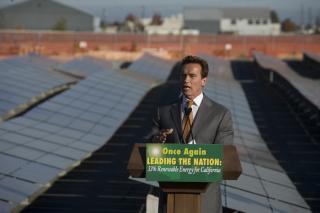
SAN DIEGO – California Governor Arnold Schwarzenegger made a surprise appearance at the solar industry’s annual confab Monday night, warning not to use the financial crisis as an excuse to abandon the fight against global warming.

“We should not give in to those who say environmental goals should take a back seat until the economy improves,” said Schwarzenegger, kicking off the Solar Power International conference. “That’s short-sighted thinking. Tough economic times mean we need more solar, more green jobs.”

The governator’s championing of solar energy through California’s million solar roofs initiative and its landmark global warming law has made Schwarzenegger something of a patron saint of the solar industry, and the audience was on its feet cheering the perma-tanned politician.

The solar power conference is a barometer of the industry’s growth. When Schwarzenegger last appeared at the conference in 2006, 6,000 attendees crammed the San Jose Convention center. This week an estimated 20,000 people have descended upon San Diego for the event. (For techies, think of it as the Consumer Electronics Show and Macworld rolled into one.)

The crowd was in a festive mood. Solar stocks were up dramatically Monday with the bounce back on Wall Street – First Solar (FSLR) spiked nearly 23% and Suntech (STP) rose 21% as was SunPower (SPWRA). And ten days ago Congress slipped into the financial bailout package an eight-year extension of a crucial 30% solar investment tax credit, lifted a $2,000 tax credit limit for homeowners who install solar arrays and allowed utilities to claim the investment tax credit for solar installations. “Imagine it took a financial rescue plan to get a tax credit for solar,” Schwarzenegger remarked.

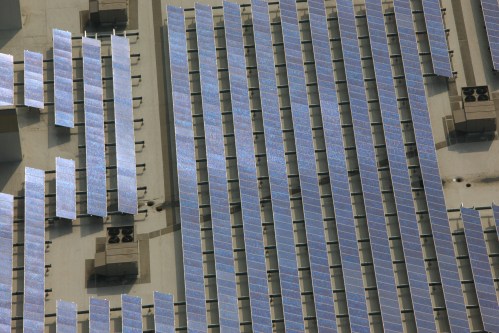
The Republican governor used the occasion to champion California, as he is his wont, giving kudos to Southern California Edison (EIX) for the utility’s plans to install 250-megawatts’ worth of solar panels on warehouse roofs. “I can envision going up in a helicopter and up and down California and see no more warehouses without solar panels.”

“Solar is the future, it cannot be stopped,” he added.

Read Full Post »

« Newer Posts - Older Posts »

Design a site like this with WordPress.com
Get started