Feeds:
Posts
Comments

Archive for the ‘environment’ Category

thinkox_004.jpg

General Electric has officially confirmed its $4 million investment in Norwegian electric carmaker Think Global, a development Green Wombat reported back in December. GE Energy Financial Services (GE) also has invested $20 million in Massachusetts lithium-ion battery maker A123Systems, which will supply batteries to Think. General Electric said its scientists will work with both Think and A123 to improve battery technology for electric cars to “enable global electrification of transportation.”

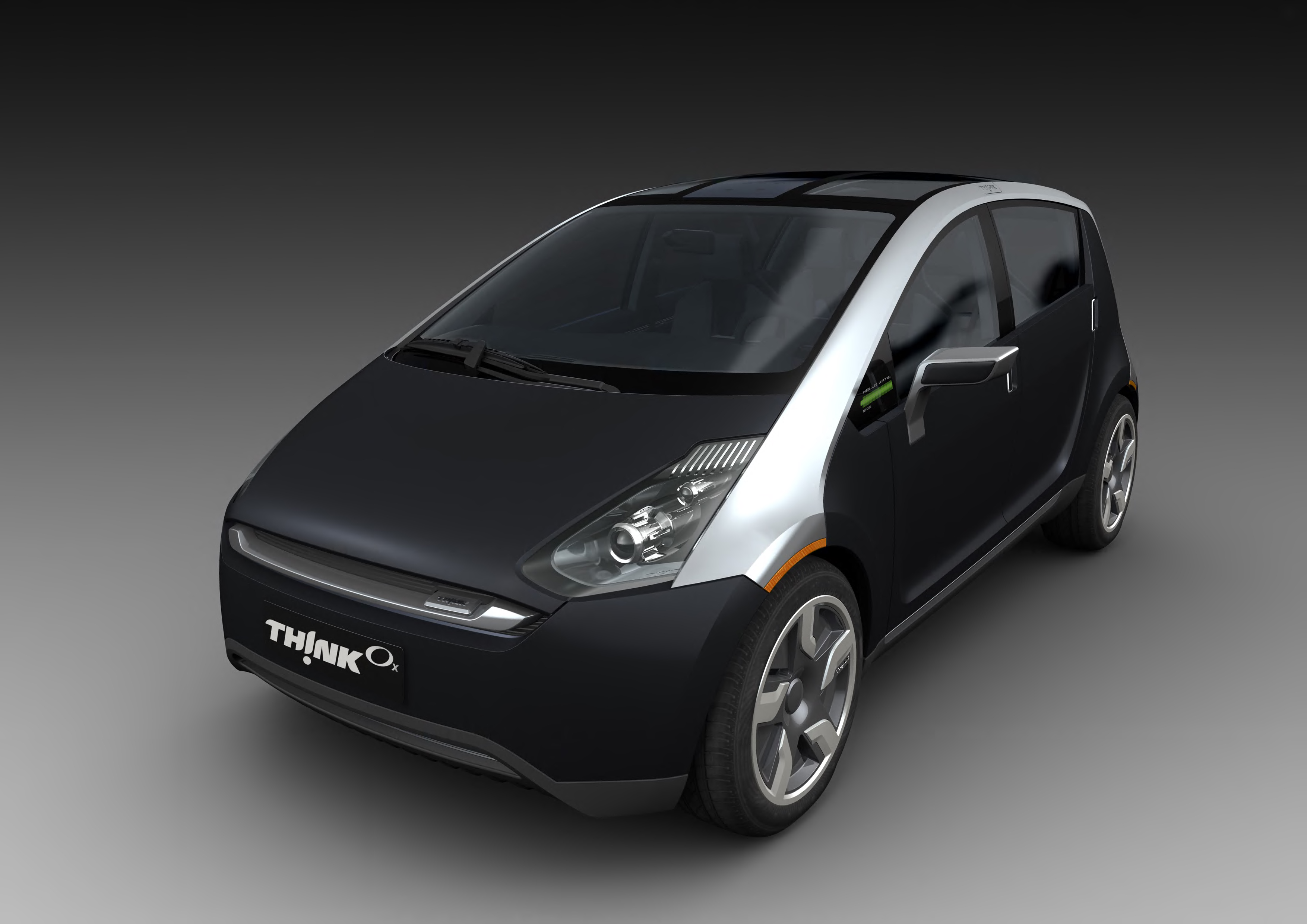
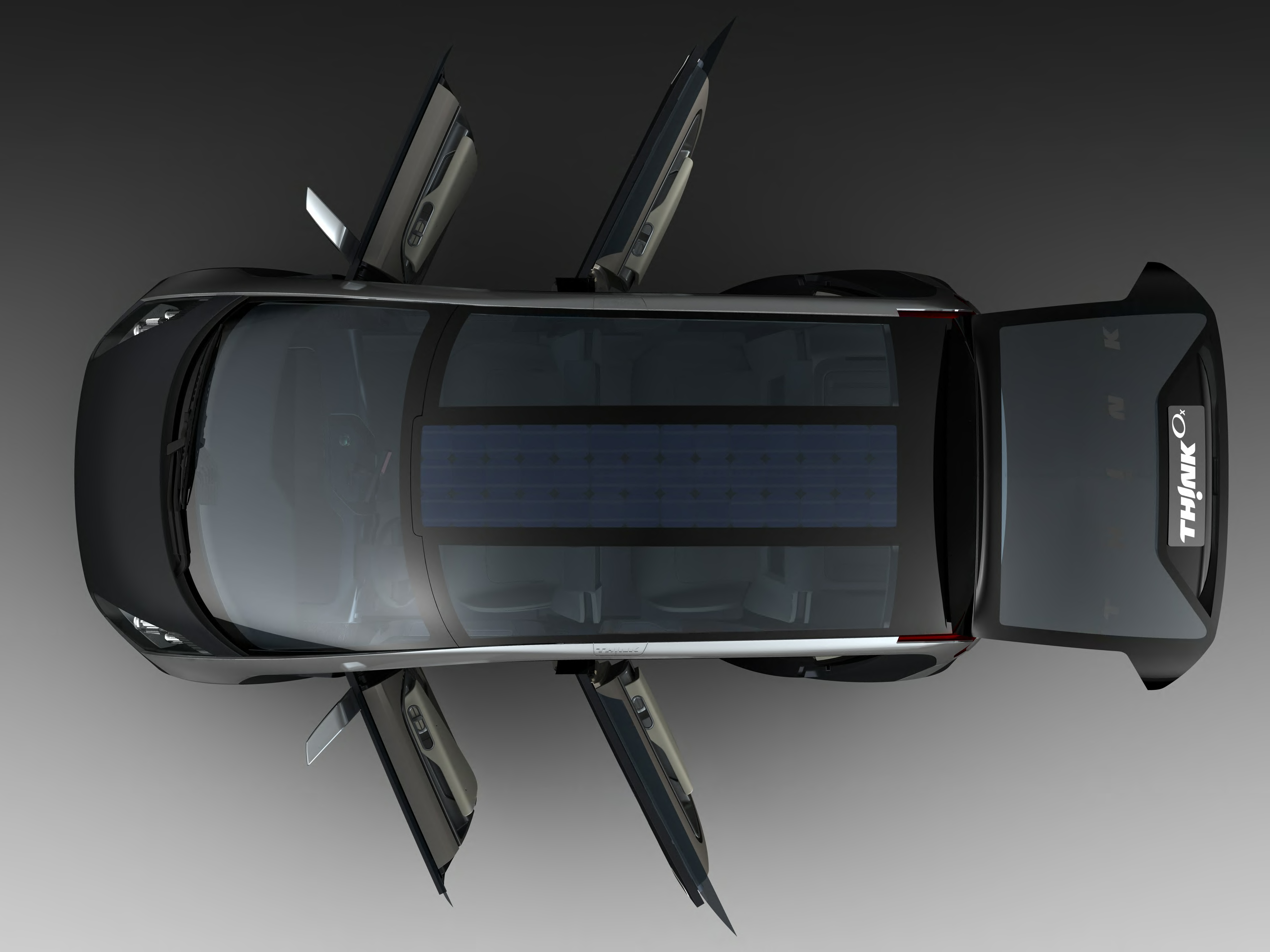
thinkox_006.jpgAnd as Green Wombat reported last week, Think, formerly owned by Ford (F), unveiled its next model Wednesday at the Geneva Auto Show, a futuristic five-seater called the Think Ox that will eventually be available as a two-door coupe and possibly a taxi. The sleek five-door vehicle resembles a low-slung crossover SUV but maintains the signature touches of the Think City — an urban runabout now rolling off Think’s production line in Norway — including the roof-to-bump glass rear hatch. The concept car also sports a translucent roof with a solar panel, presumably to power radios and other gadgets.

According to Think, the Ox will have a range of about 125 miles (200 kilometers) on a charge and a top speed of about 85 miles an hour. Future models may include a range extender — a small flex-fuel engine that will charge the battery and let the Ox go 280 miles. (The General Motors (GM) Volt electric hybrid is based on the same concept.) Think also unveiled its “connect car” technology to make the Think City and Ox a rolling Internet-connected, GPS-enabled computer that will calculate the cheapest and most environmentally beneficial times to recharge as well as give drivers access to the cars’ systems through their mobile phones.

When Green Wombat caught up with Think CEO Jan-Olaf Willums in San Francisco last week he emphasized that although the Ox is being presented as a concept car, the technology is almost ready for prime time and the model that is expected to hit the market in 2011 will resemble the show version.

Correction: An earlier version of this story said Think was collaborating with an unnamed Fortune 100 automaker. In fact, Think was collaborating with a Fortune 100 company, General Electric.

thinkox_001.jpg

Read Full Post »

think-production3.jpgIt was a year ago that venture capitalist and solar energy entrepreneur Jan-Olaf Willums appeared at the Cleantech Forum in San Francisco shortly after taking over Think Global, a Norwegian electric car maker once owned by Ford (F). Willums and his partners had just secured their first round of funding and unveiled plans to revive Think and a zippy urban runabout called the Think City. This week Willums made a return appearance at the 2008 Cleantech Forum and showed just how fast an automotive startup can move amid the lumbering dinosaurs of Detroit.

Green Wombat caught up with the ever-cheerful Willums over coffee Wednesday (unlike his American counterparts he meets the press without the PR minders that seem to accompany every exec everywhere). A day earlier on a panel about alternative transportation he dropped something of a bombshell: At the Geneva Auto Show on Tuesday Think will unveil its next-generation car, a sleek five-seat sedan and a collaboration with an unnamed Fortune 100 company. (See correction at the end of the story.)

Willums, who has raised $93 million from U.S. and European investors, was keeping mum on the identity of its big-league partner until Tuesday but he did say that new model was not just a concept car. “We have designed a five-seater show car but it really is much more than that,” says Willums (photo above). “It is very much a car that can be produced and it looks like the car that will produced.” The plan is to offer the next-gen Think in 2011 as an all-electric as well as well as a so-called series hybrid that uses a small engine to charge the battery and extend its range. (The current Think City has a range of 180 kilometers –112 miles.)

The drawing Willums briefly displayed on the panel showed an stylish aerodynamic four-door sedan. He says Think is planning to later produce a crossover SUV and coupe version of the car. Silicon Valley electric car startup Tesla’s next car also is a five-seater sedan, code-named White Star. “We won’t compete with Tesla,” says Willums. “The Tesla will be more a BMW; we’ll be more the Volkswagen.”

In the meantime, the two-seater Think City is rolling off the production line at the company’s factory outside Oslo and the first 500 cars are set for delivery to customers in March. (For the Think back-story and my 2007 Business 2.0 magazine feature on the company and its innovative business model click here.) Production will be fully ramped up by the end of 2008 and Think aims to produce 10,000 cars a year.

Willums, who will appear on a panel I’m moderating at Fortune’s Brainstorm: Green conference in April, also tells Green Wombat that Think later this week will introduce the City to London and Paris. Think’s strategy is to pursue urban markets that offer incentives for electric vehicles. For instance, for electric cars London waives the $15 congestion “congestion fee” charged for driving into the city and offers free parking. France gives EV buyers a $7,500 rebate. Think plans to begin selling the City in those markets in early 2009. Think has also established a subsidiary in Denmark

The company’s North American plans are still in flux. “We hope to have a plant in the U.S. in 2009,” he says. As with Europe, Think will target urban markets in the U.S., such as San Francisco and New York.

Think has markedly picked up the pace since I last met Willums in Oslo. That’s due in part, he says, because of the big automakers’ more aggressive moves to get into the electric car market, such as General Motors (GM) with its Chevy Volt electric hybrid.

It also seems increasingly clear that innovative startups like Think will survive by making strategic partnerships with bigger players and moving nimbly into select and potentially profitable markets. Whether Think will be a drive-away success remains to be seen but its clear Willums is hitting the accelerator.

Correction: An earlier version of this story said Think was collaborating with an unnamed Fortune 100 automaker. In fact, Think was collaborating with a Fortune 100 company, General Electric.

Read Full Post »

masdar-city.jpg

While the United States Congress hems and haws over extending relatively modest tax incentives to encourage renewable energy development, Abu Dhabi is spending $15 billion in a drive to make the oil-rich emirate an epicenter of green technology. Called the Masdar Initiative, it’s best known for plans to build Masdar City, a “zero-carbon, zero-waste” urban center.

But Abu Dhabi’s ambitions extend far beyond making Masdar City a showcase for sustainable development, as Masdar Initiative CEO Sultan Ahmed Al Jaber made clear when Green Wombat sat down with him on Tuesday when he was in San Francisco to accept the “Cleantech Leader of the Year” award at the annual Cleantech Forum. “We have decided to establish the Silicon Valley of renewables in Abu Dhabi,” says Al Jaber. “We want to cover the whole value chain – from research to labs to manufacturing to the deployment of technologies.”

To that end, Masdar is collaborating with European and U.S. universities – including MIT and Columbia – to develop a research institute. The Masdar Clean Tech Fund has invested $250 million in renewable energy ventures and Al Jaber, who will be speaking at Fortune’s Brainstorm: Green conference in April, says a second fund is in the works. “We’ll invest wherever the opportunity goes,” he says. “We’re keen on developing renewable energy infrastructure in California; we’re just looking for the right opportunity.”

Masdar City will be a tax-free zone in a bid to lure makers of photovoltaic equipment and other green energy manufacturers. When Al Jaber says Abu Dhabi wants to own the whole supply chain, he means that literally, beginning with polysilicon, the basic building block of solar cells. “We’re looking at manufacturing polysilicon, thin-film for photovoltaics, wind energy components,” he says. “We’re no longer interested in only being a consumer of technology or an off-taker of specific equipment. We want to transform ourselves into a more knowledge-based economy. ”

He expects the renewable energy and waste-reduction technologies developed to build Masdar City – its expected population is 50,000 – to be exported to help retrofit existing cities. “A city of this size would require 820 megawatts of power, but we will reduce energy requirements to 220 megawatts from integrating new designs from day one.”

“This city is going to literally re-engineer urban planning,” he claims.

Abu Dhabi’s ambitions will create opportunities for U.S., European and Asian green tech firms and Al Jaber acknowledges that forming the right partnerships will be the biggest challenge in fulfilling the emirate’s green dreams.

But he says he sees no irony in one of the world’s biggest oil-exporting nations going green. The bottom line: it’s all about power and markets.

“Abu Dhabi recognizes that the global energy markets are evolving and are evolving with substantial growth in alternative energy,” Al Jaber says. “It’s only going to go up. Does that make it a threat or an opportunity? It’s a great opportunity if we invest in it now.”

Read Full Post »

solana1.jpgArizona Public Service, Arizona’s largest utility, announced plans Thursday for a 280-megawatt solar power plant to be built 70 miles southwest of Phoenix by Spanish company Abengoa Solar. What’s striking about the deal is that it offers a rare glimpse inside the economics of Big Solar. And as the renewable energy industry pushes Congress to extend crucial green tax credits, the jobs that will be spawned by the Solana Generating Station and the economic ripple effect of the huge construction project is Exhibit A in why fighting global warming can be a win-win when it comes to the economy and the environment.

All the previous contracts for 100+ megawatt solar power plants have been in California, where utilities PG&E (PCG), Southern California Edison (EIX) and San Diego Gas & Electric (SRE) have shrouded power purchase agreements in secrecy.

APS (PNW), on the other hand, has lifted the green veil a bit, giving some indication of the current cost of producing utility-scale solar electricity and the larger economic impact. According to APS, the utility will pay around $4 billion over 30 years for the greenhouse gas-free electricity generated by Solana that will light 70,000 homes. That comes to about $133 million a year for the life of the power purchase agreement.

Abengoa spokesman Peter Kelley told Green Wombat that the exact kilowatt per hour rate the company is paying APS is confidential. No doubt though that the utility will pay a premium per kilowatt/hour for its first large-scale solar energy deal compared to electricity produced by a coal or natural-gas fired power plant. That cost disparity is likely to evaporate when the United States moves to price carbon — either through a carbon tax (unlikely) or a cap-and-trade system that requires fossil-fuel power plants to pay if they exceed limits on CO2 emissions. And the cost of financing carbon-spewing power plants will grow in coming years as Wall Street shies way from projects that carry climate change risks. And as solar power plant components and systems go from being one-off prototypes to mass-produced commodities, the cost of solar electricity is expected to drop even further.

Abengoa and APS are not revealing the construction cost of Solana but solar power plants of that size can run half a billion dollars or more. Of course, once built their operating costs are significantly lower than conventional power plants; the fuel — the sun — after all is free.

In the meantime, the Solana Generation Station is expected to inject about $1 billion into the Arizona economy as Abengoa hired 1,500 workers to build the power station and 85 others to operate it, according to APS. The utility estimates that the ripple affect will create another 11,000 to 15,000 jobs.

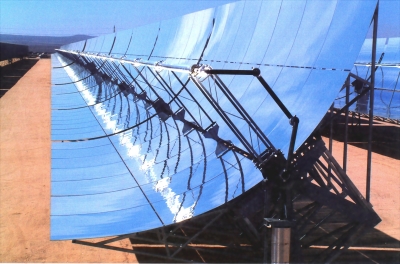
Abengoa is using a solar trough design for the plant. A tried and true technology, solar trough plants deploy long rows of parabolic mirrors to heat liquid-filled tubes to produce steam that drives electricity-generating turbines. The Solana plant will also store heat in silos of molten salt. The heat can be released when the sun is not shining to run the turbines. “The molten storage will extend the operating hours of the plant both during cloud cover and when sun goes down,” Kelley says. That means Solana can continue to generate electricty as long as six hours after sunset.

The big “if” for Solana is the 30 percent investment tax credit that expires at the end of 2008. If Congress fails to extend the credit, the cost of such solar power plants will jump, jeopardizing their economic viability

Solana is likely to be just the first big solar power plant in Arizona. Utilities there must obtain 15 percent of their electricity from renewable sources by 2025 and with little wind or geothermal available in Arizona, the state is likely to place a big bet on Big Solar.

Read Full Post »

For a state steeped in the mythology of Big Oil, Big Coal (plants) and well, big everything, Texas does not necessarily come to mind when you think of Big Green.

It’s a reputation somewhat undeserved, given the Texas-sized wind farms sprawling across the hundreds of thousands of acres of the state’s ranch lands. Now there are signs that California’s solar boom is spreading eastward. One leading indicator: Silicon Valley solar power plant startup Ausra is opening an outpost in the Lone Star State and hiring an executive to “lead the development of stand-alone solar thermal power projects in Texas using Ausra’s proprietary Compact Linear Fresnel reflector technology and the sale of solar field to utility scale customers,” according to a job description posted last week at the Berkeley Institute of the Environment at the University of California, Berkeley.

Like a growing number of states, Texas has a so-called renewable energy portfolio standard that mandates a certain portion of its electricity supply come from green sources. (Unlike most other states that require utilities to obtain a set percentage of electricity from renewable sources, Texas sets a total green energy target and ups the ante every two years. For instance, the 2009 target of 3,272 megawatts rises to 5,880 megawatts in 2011. Texas utilities are allocated a share of those megawatts based on their sales.)

But if you want to sell solar to Texans you have to be in Texas. That’s because when it comes to electricity, Texas is literally a country onto itself: the Texas power grid is not connected to the rest of the country (except for some outbound transmission lines) and all renewable energy must be generated within the state. (Unlike, say, California, which can buy electricity produced by solar power plants in neighboring Nevada or Arizona.)

“Texas is another California-sized market that’s growing rapidly and seeking clean options in the portfolio,” Ausra executive vice president John O’Donnell tells Green Wombat. “While solar resources are somewhat lower than the Mojave, west Texas is a very good solar region and we see major opportunities going forward.”

O’Donnell wouldn’t reveal details about Ausra’s Texas plans (though the job posting says Ausra aims to build 1-to-2 gigawatts worth of solar power plants a year). But Texas clearly is in the market for green energy. Utility TXU’s (TXU) cancellation of several massive megawatt coal-fired plants (and Wall Street’s growing aversion to such projects) along with the ratcheting up of renewable energy mandates means the state will increasingly be looking to solar and wind to fill the void.

Utility El Paso (EE) is accepting bids to supply for 300-megawatts of green energy while Austin Energy is committed to obtaining at least 100 megawatts of solar energy under the city’s goal of going carbon neutral by 2020.

With wide open spaces and plenty of sunshine and flat land, look for other solar power plant players to beat a path to Texas in the coming months.

Read Full Post »

infinia-stirling-dish.jpgA passel of high-profile high-tech investors  — including Khosla Ventures, Paul Allen’s Vulcan Capital and Bill Gross’ Idealab — are backing yet another new player in the increasingly hot market for large-scale solar power, pumping $50 million into Infinia, a Kennewick, Wash., company manufacturing a Stirling solar dish.

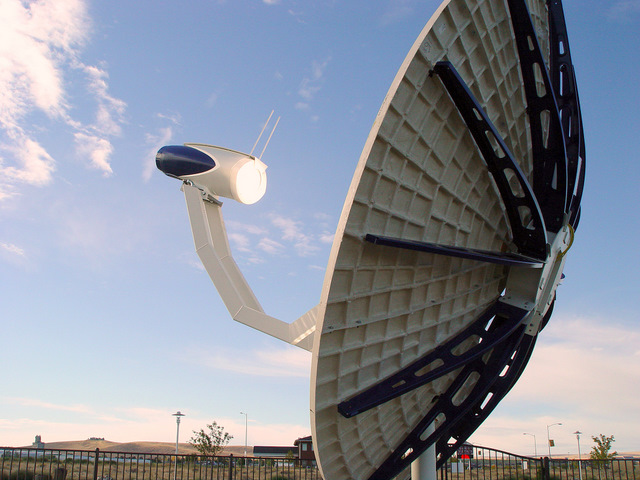
The Stirling dish has a storied — if unfulfilled – history in the annals of solar energy. It marries a Stirling heat engine, 17th-century invention, with a mirrored dish that looks like a super-sized version of a home satellite receiver. The solar dish focuses the sun’s rays on the Stirling engine, heating a gas inside that drives pistons to generate electricity. Stirling dishes are much more efficient at converting sunlight into electricity than solar thermal technologies that use mirrors to heat liquid-filled tubes to create steam to drive electricity-generating turbines. But while solar thermal plants exist today, the Stirling solar dish has never been deployed on a large scale since work on the technology began in earnest following the oil shocks of the 1970s.

Stirling Energy Systems of Phoenix in 2005 signed contracts with utilities Southern California Edison (EIX) and San Diego Gas & Electric (SRE) to build up to build tens of thousands of Stirling dishes to produce up to 1.75 gigawatts of greenhouse gas-free electricity. Though the company operates a six dishes in a prototype power plant at Sandia National Laboratories New Mexico, it is still working to get production costs down and rivals have questioned whether Stirling Energy Systems will be able to fulfill its deals. (See Green Wombat’s 2007 Business 2.0 magazine article on Stirling Energy Systems here. )

infinia-stirling-engine.jpgBut Infinia CEO J.D. Sitton tells Green Wombat that his company has perfected the Stirling dish to make it competitive with large-scale solar thermal as well as new photovoltaic technologies like thin-film solar. Infinia aims to deploy its Stirling dishes in smaller configurations so that solar power plants can be located near cities and at other sites that don’t require vast stretches of desert land where solar thermal plants are typically built. Each 21-foot-high, 15-foot-wide solar dish can generate 3-kilowatts (compared to 25 kilowatts for Stirling Energy Systems’ dish).

Infinia won’t itself become a solar developer but will provide its dishes to for power plants that range in size from 1 megawatt to 150 megawatts or more. In contrast, most solar thermal power plants now being planned are in the 400-500 megawatt range.

“We fly in the face of what has been the conventional wisdom in the solar thermal field that to be competitive you have to have a very large system,” says Sitton. “We can be deployed within city limits and be connected to existing transmission systems. No additional transmission capacity is required.”

“Our approach is that the winning solutions will be those that generate for most kilowatts for the least cost,” he adds. “This is a game about capital efficiency.”

That, of course, has been the mantra of leading green tech investor Vinod Khosla, who has disparaged photovolatic solar systems as too expensive to displace fossil-fuel generated power. Khosla also is backing Palo Alto solar thermal startup Ausra, which last year signed a deal to supply solar electricity to California’s largest utility, PG&E (PCG). Serial entrepreneur Bill Gross’ Idealab is funding solar thermal startup eSolar, which also is being backed by Google (GOOG).

Infinia contends the design of its Stirling dish system makes it competitive with solar thermal technologies. First, the Stirling engine uses helium rather than hydrogen, which typically must be periodically replenished. “We have no lubrication inside the machine and it needs no maintenance,” Sitton says. “We use helium in a hermetically sealed system.”

Second, he says the Infinia dish is made of six panels of glass rather than the 76 panels on the Stirling Energy Systems dish. “That gives us lower production costs and lower capital costs,” says Sitton. “We brought in large-scale manufacturer from the beginning. It’s not like we built a prototype and now have to reduce the cost to produce it.”

The first prototype went online last October and Sitton says Infinia is building a second at Sandia. Field tests will be conducted later this year in California and Nevada. He says Infinia is currently negotiating with solar developers and full-scale production is set to begin in November. Infinia has been in business since the 1980s, building Stirling engines for other applications. But the green tech boom and demands from utilities for renewable energy led the company to focus on solar.

Whether Infinia beats Stirling Energy Systems to market remains to be seen but look for the deals it signs with solar developers for a good indication of just how viable its technology is likely to be.

Read Full Post »

brightsource-ivanpah.png

When President Bush signed the energy bill into law last month, much was made of the legislation’s mandate that automakers dramatically boost the fuel efficiency of their fleets. Less noticed was that the bill dropped a provision that would have extended the solar investment tax credit — a measure viewed as essential to transforming solar energy from a niche business into a multi billion-dollar industry that can generate gigawatts of greenhouse gas-free electricity.

The timing couldn’t be worse. With the current solar credit set to sunset, as it were, at the end of 2008, Big Solar is at at a tipping point: Utilities and renewable energy companies are in the midst of negotiating massive megawatt power purchase deals whose financing depends on the 30 percent investment tax credit, or ITC.

“I think there is a major concern that this will stall all the beneficiaries of the ITC,” said Joshua Bar-Lev, vice president for regulatory affairs for solar power plant developer BrightSource Energy. The Oakland, Calif.-based startup is negotiating a 500-megawatt agreement with California utility PG&E and is proceeding with plans to build a 400-megawatt solar thermal power station on the Nevada border (artist rendering above).

Solar energy companies, utilities like PG&E (PCG) and Edison International (EIX) as well as financiers such as Morgan Stanley (MS) and GE Energy Financial Services (GE), had pushed for an eight-year extension of the investment tax credit to give Big Solar projects enough time to get off the ground and start to achieve economies of scale. The provision also would have allowed utilities to claim the credit for solar projects they build. The measure drew support from both sides of the aisle in Congress but died — by one vote in the Senate — when Bush threatened to veto the energy bill because the solar tax credit would be financed by repealing previous tax breaks given to Big Oil.

“The Congressional leadership is very strong in their support of the ITC; they will put this on the table In 2008,” said Chris O’Brien, a Sharp Solar executive and chairman of the Solar Energy Industries Association, in an e-mail. “The solar industry will continue to contact legislators in key states.”

House Speaker Nancy Pelosi and the Democratic leadership in the Senate have pledged to re-introduce renewable energy tax credit legislation this session. “Speaker Pelosi has said repeatedly that she hopes to address that this year,” Drew Hammill, a spokesman for Pelosi, told Green Wombat. “We’re just getting started but there’s bipartisan support for the tax credit.”

Publicly, at least, no one in the solar industry will say that the uncertainty over the tax credit is affecting planned projects. “Our expectation is that there will be another tax bill that will address this issue,” said Kevin Walsh, managing director of the renewable energy group at GE Energy Financial Services. “We’re working on a number of [solar thermal] deals but it’s too early to disclose them.”

In recent months, PG&E has signed deals for more than a gigawatt of electricity — enough to light more than 750,000 homes — with solar power plant developers. Such power purchase agreements can take more than a year to hammer out and the permitting and construction of a solar power station can take another three to five years.

“We’re continuing to move forward with negotiations and with contracts that have already been signed, but certainly the absence of the ITC could potentially impact future projects,” said PG&E spokesman Keely Wachs. “Without the credit, it does increase the cost of that energy and of course it also sends a very clear market signal as to our country’s energy priorities.”

Silicon Valley solar startup Ausra is building a 177-megawatt solar power plant on the Central California coast to supply electricity to PG&E and is pursuing deals with Florida’s FPL (FPL) and other utilities.

“Just like any business, the solar industry prefers a predictable system for the future,” wrote Holly Gordon, Ausra’s director of regulatory and legislative affairs, in an e-mail. “It will be more difficult to plan for our projects while the situation remains uncertain. While we are currently seeing excellent demand for solar energy at market prices, we need a long term extension of the renewable energy tax credits to ensure market stability and investor confidence as the market continues to grow.”

Read Full Post »

Web 2.0 to the rescue

instedd-2.png

A non-profit bankrolled by Google.org launches Thursday with a mission to deploy technology to detect disease and coordinate responses to global health and environmental disasters. And a prime weapon in its arsenal?

Twitter.

InSTEDD (Innovative Support to Emergencies, Diseases and Disasters) has big plans for the instant messaging service that techies, teenagers and twentysomethings use to instantly – and constantly — update their network of friends by broadcasting instant messages over their cell phones.

“It’s an example that seems almost laughable,” InSTEDD chief executive Eric Rasmussen tells Green Wombat. “But from our perspective, Twitter has remarkable capacity.”

InSTEDD will use free social networking services like Twitter and Facebook and Web 2.0 programs like Google (GOOG) Maps to coordinate health programs and disaster relief.

Rasmussen — a physician, former U.S. Navy commander and veteran relief worker — says one of InSTEDD’s first projects will be working with the Mekong Basin Disease Surveillance Network Project, a joint effort of six Southeast Asian nations. Field workers, for instance, can send out Twitter updates on their work to colleagues, hospitals and relief organizations.

“I was very impressed that Twitter worked in Laos,” Rasmussen says. “We were in the highlands of the Mekong Delta and had one bar [of cell phone signal strength] but we could get messages out. I have had trouble finding my team members from time to time when people go to remote villages to deliver supplies. But if there is a cell signal I can get an SMS message out. It is the ubiquitous form factor.”

InSTEDD’s Palo Alto-based team — which includes former Microsoft (MSFT) executives — will tap $5 million from Google.org (Google’s philanthropic arm) plus money from the Rockefeller Foundation to develop technology tools for humanitarian organizations, the United Nations and other groups.

“The eventual hope is that there will be a robust, resilient platform that goes end to end, from field reporting to deep analysis,” says Rasmussen. “We only build what we can’t find off the shelf.”

One humanitarian mashup might combine Twitter, Facebook and Google Maps. Managers and members of a relief organization, for example, could check their Facebook group to see the location of far-flung field workers on a map and receive updates on their work via Twitter.

“It’s the broadcast aspect of Twitter that’s so powerful,” says Rasmussen. “I can go to the people in a tent next to me, I can go to four different emergency centers and headquarters all at one time.”

For the field worker, all that is needed is a mobile phone.

Says Rasmussen: “We recognize the hot, tired, scared aspect of working in these environments so we’re looking at keeping things simple.”

Read Full Post »

ecomotors-engine-diagram-012008_examples.jpg

Silicon Valley green tech investor Vinod Khosla caused a stir recently when he dissed plug-in electric hybrid cars as “toys” that would not contribute much in the way of fighting global warming. The blogs were buzzing from red-faced EV enthusiasts taking umbrage at Khosla, who has made big bets on biofuels and is never shy at expressing his opinions on all matters green.

But an investment Khosla Ventures announced this week in EcoMotors, a Detroit startup developing a high-efficiency diesel engines, shows that the legendary venture capitalist is more eclectic when it comes to electrics than his public pronouncements might make him seem.

EcoMotors founders Peter Hofbrauer and John Coletti, veterans of Volkswagen and Ford (F) respectively, are engineering engines that they hope will achieve 100 miles per gallon, run on gasoline, diesel or biofuels and be used to power — wait for it — plug-in hybrid electric cars.

What drove Khosla to change his mind on hybrids? He didn’t, really. To understand why, we need to look under the hybrid hood. There are two types of hybrids. A parallel” hybrid contains two drive trains — an electric motor to power the car at low speeds for short periods of time, and a conventional gasoline engine for higher speeds. The Toyota (TM) Prius and Honda (HMC) Civic hybrid and most other hybrids on the road today are parallel hybrids. (A plug-in version would allow for a more powerful battery pack that could be recharged from a standard electrical outlet.)

In contrast, a series hybrid takes some of the complexity — and presumably the cost — out of the design by using only an electric drive train to propel the car while relying on a small internal combustion engine to power a generator that charges the battery and provides power to the electric motor when needed. The Chevrolet Volt, General Motor’s (GM) plug-in electric hybrid under development, is a series plug-in hybrid. And the EcoMotors’ engine will be designed for use in a series hybrid.

“He was referring to parallel hybrids,” says Khosla Partner’s Ford Tamer of his boss’s anti-hybrid comments made in a speech at an investor conference. “We do believe a series hybrid is the way to go. He was also referring to the fact that the hybrid platform is inherently an expensive platform.”

So is a series platform at this point, but Khosla’s vision is to drive that cost down by creating high-efficiency engines and batteries. Hence the investment in EcoMotors. And hence the hiring last September of Tamer, a former top executive at chipmaker Broadcom and a co-founder of another chip company, Agere (later acquired by Lucent). “I’ve been focused on the efficiency side of Khosla — engines, motors, turbines, even solar and batteries,” says Tamer, Khosla Ventures’ operating partner.

Khosla is the sole funder of EcoMotors – and no, Tamer won’t reveal the size of the investment – which officially launched this month and remains so stealthy it doesn’t even have a website yet.

Tamer says EcoMotors CEO Hofbrauer developed a high-efficiency engine under contract with the Defense Advanced Research Projects Agency, of DARPA, for use in military vehicles. EcoMotors has now licensed the technology for commercial use.

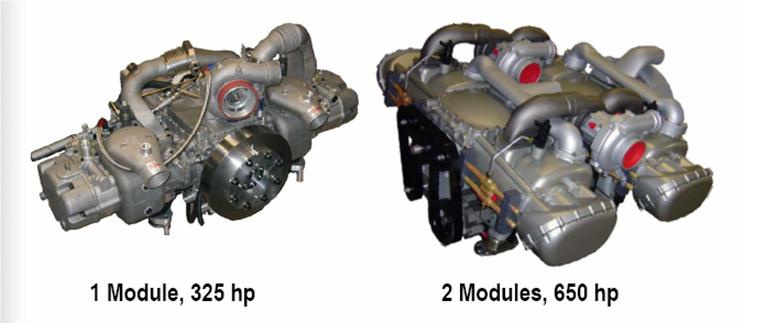
Here’s how it works, as explained by Tamer: the EcoMotors engine is built of 2-cylindar “modules” that can be stacked depending on the need for power – one or two modules for a car, three or four for a big truck. “If you have two modules, you can shut down one module for city driving,” says Tamer. “But when you need to need to go uphill or need power for highway driving, you engage the second module. That gives you better fuel efficiency and reduces emissions.” (EcoMotors’ renderings of the engine’s design are above.)

With the recently enacted energy bill mandating automakers raise the average fuel efficiency of their fleets to 35 miles per gallon by 2020, EcoMotors aims to demo its first engine to potential customers by early 2009.

A plug-in electric hybrid drive train will be further down the road but Khosla Ventures already has made investments in companies developing components for such a system. One such startup is Seeo, a Berkeley, Calif.-based company whose website cryptically says it is “developing advanced materials to revolutionize electricity storage and delivery.” And Thursday morning, Khosla Ventures announced it had upped its investment in Transonic Combustion, a California startup developing  fuel injection systems designed to increase fuel efficiency.

“Our belief is that we have to get a fuel-efficient, emissions-conscious diesel engine on its own,” Tamer says. “Then going to a hybrid becomes a bonus.”

One of Vinod Khosla’s mantras is that green technology must become cheap and scalable enough to be adopted in China and India, countries whose impact on climate change is monumental. In other words, a $25,000 plug-in hybrid doesn’t stand a chance against a Tata Nano, the Indian people’s car unveiled last week.

Remarks Tamer: “$2,500 will buy a Tata – that’s a DVD upgrade on a Lexus.”

Read Full Post »

schott.jpegBig Solar has been about Big Dreams – fields of mirrors carpeting the desert to produce clean, greenhouse-gas free electricity. But in another step toward making that vision a concrete-and-glass reality, Schott Solar announced Monday that it is building a factory in Albuquerque, N.M., to manufacture components for large-scale solar thermal power plants as well as photovoltaic modules for commercial rooftop arrays.

The German company’s news follows Silicon Valley solar startup Ausra’s announcement last month that it’s building a solar thermal factory in Nevada — the first in North America.

That solar companies are now investing capital to break ground on manufacturing plants represents the creation of a Big Solar infrastructure and, of course, a move to get on the ground floor of what is expected to be a solar building boom in the sun-drenched Southwest of the United States. Utilities throughout the region are facing mandates to dramatically increase their use of renewable energy. In California, for instance, PG&E (PCG), Southern California Edison (EIX) and San Diego Gas & Electric (SRE) are all negotiating big megawatt contracts for utility-scale solar power thermal power plants. A consortium of Southwest utilities meanwhile has put out to bid a 250-megawatt solar station.

“We certainly see the opportunity for growth in the solar thermal market,” Mark Finocchario, CEO of Shott’s North American operations, told Green Wombat. “The concentration of solar thermal plants will be in the Southwest and we see that’s where the rest of the supply market will develop as well. But we would have the ability to ship product to anywhere in the world.”

The $100 million Albuquerque factory will manufacture solar thermal receivers — long tubes that hang over curved mirrors called solar troughs. The mirrors focus the sun’s rays on the receivers and liquid inside becomes superheated to produce steam that drives electricity-generating turbines.

Finocchario says the the plant, which will employ 350 people, is set to go online by the end of the first quarter of 2009. Future plans call for another $400 million investment to expand the factory’s workforce to 1,500.

Read Full Post »

« Newer Posts - Older Posts »

Design a site like this with WordPress.com
Get started